

|
시장보고서
상품코드
2119366
세제 효소 : 시장 점유율 분석, 업계 동향 및 통계, 성장 예측(2026-2031년)Detergent Enzymes - Market Share Analysis, Industry Trends & Statistics, Growth Forecasts (2026 - 2031) |
||||||
 Mordor Intelligence
Mordor Intelligence에 의하면, 세제 효소 시장 규모는 2025년에 42억 4,000만 달러로 평가되었습니다. 2026년 44억 6,000만 달러에서 2031년까지 59억 5,000만 달러로 확대되어 예측 기간(2026-2031년) CAGR은 5.93%가 된다고 전망되고 있습니다.
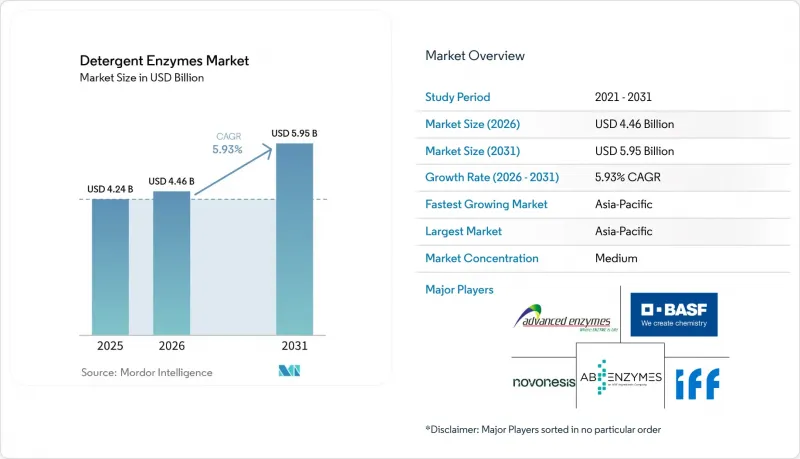
본 보고서는 효소의 유형(프로테아제 등), 형태(액상 효소 등), 세제의 유형(세탁용 세제 등), 용도(가정용 세척 등), 지역(아시아태평양, 북미, 유럽, 남미, 중동 및 아프리카)별로 분류되어 있습니다. 시장 예측은 금액(달러) 기준으로 제시되어 있습니다.
세계의 세제 효소 시장 동향 및 인사이트
냉수 및 단시간 세탁의 보급
냉수 세탁은 가정용 세탁 제품에서 일반적인 사용 조건입니다. 저온 및 단시간 세탁 사이클에서는 기존의 화학 세정 시스템이 얼룩을 제거하는 데 필요한 시간과 열 에너지가 부족합니다. 2025년 Novonesis가 12개 시장과 8,537명의 응답자를 대상으로 실시한 소비자 조사에 따르면, 응답자의 54%가 짧은 세탁 시간 후에도 잘 지워지지 않는 얼룩이 남았다고 보고했습니다. 이러한 성능 격차로 인해, 저온 및 단시간 세탁 조건에서도 활성을 유지할 수 있는 효소를 활용한 제품 개발이 진행되고 있습니다. BASF는 2025년 7월, 20°C라는 저온에서도 기름때를 제거할 수 있는 ‘Lavergy L Pace’를 출시했습니다. 브랜드가 소비자들이 고온·장시간 세탁 프로그램으로 되돌아가지 않고도 세탁 성능을 회복할 수 있도록 해야 할 경우, 세제 효소 시장은 그 혜택을 누리게 될 것입니다.
농축형 및 1회용 세제
농축형 및 1회용 세제는 1회 세탁당 물 사용량을 줄이고 포장재 절감으로도 이어지지만, 효소의 안정성 측면에서는 까다로운 조건을 만들어냅니다. 계면활성제, 염분, 기타 성분이 고농도로 포함되어 있으면 제품이 세탁 공정에 도달하기 전에 활성을 잃게 되는 원인이 됩니다. 2025년 오르후스 대학교가 발표한 조사에 따르면, 음이온성 계면활성제는 세탁용 효소에 다양한 영향을 미치는 것으로 밝혀졌으며, 그 중에는 보관 중에 프로테아제의 자가 절단을 촉진하는 조건도 포함되어 있습니다. 캡슐화 기술을 활용하면 활성화가 필요할 때까지 효소를 제형에서 분리시켜 둘 수 있습니다. 또한, 세제 효소 시장은 안정화된 액상 블렌드로 전환되고 있습니다. 이러한 형태는 액체 세제 제조를 지원할 뿐만 아니라, 취급 시 분진에 대한 노출을 줄여주기 때문입니다.
높은 이온 강도의 액상 제제에서 효소의 비활성화
액체 제품의 경우, 보관 중에 효소가 음이온성 계면활성제, 킬레이트제 및 염과 접촉하게 됩니다. 2025년 오르후스 대학교의 연구에 따르면, 계면활성제와의 상호작용으로 인해 효소의 구조가 변화하여 특정 조건에서 프로테아제의 자가 절단을 유발할 가능성이 있는 것으로 밝혀졌습니다. 효소 배합량을 늘리면 냉수 세척 효과가 향상되지만, 보관 기간 중 성능 저하의 위험도 높아집니다. 이 문제는 보관 조건에 민감한 제제에 추가적인 부담을 주는 따뜻한 기후 지역에서는 더욱 심각해집니다. 안정화 및 캡슐화 기술을 보유한 공급업체는 세제 효소 시장에서 액상 제품이나 1회용 제품에 이를 적용하는 데 있어 더 유리한 입장에 있습니다.
부문별 분석
프로테아제는 혈액, 땀, 달걀, 풀, 우유 등 단백질 유래 얼룩을 처리할 수 있는 능력 덕분에 2025년 세제 효소 총 수요의 41.45%를 차지했습니다. 다양한 세탁 조건에서 범용적으로 사용할 수 있어, 배합 개발자들에게 세제 시스템 구축의 실용적인 기반이 되고 있습니다. 아밀라제는 전분 얼룩 제거에 도움이 되며, 원단의 밝기를 유지하는 데 기여합니다. 셀룰라제, 만나나제, 펙티나제는 백색도 유지나 보풀 발생 감소 등 보다 전문적인 원단 관리 효과를 지원합니다. 2025년『Scientific Reports』지에 게재된 연구에 따르면, Bacillus paramycoides 유래의 내열성 알칼리성 프로테아제는 80°C에서 10분간 유지한 후에도 활성의 75%를 유지하며, pH 12 조건에서 1시간 동안 유지한 후에도 89%를 유지하는 것으로 밝혀졌습니다. 이는 세제 효소 시장에서 저온 세탁이 일반화되고 있는 반면, 고온의 산업용 분야에서는 여전히 강력한 효소 성능이 요구되고 있음을 보여줍니다.
리파아제는 가장 빠르게 성장하는 효소 분류이며, 이 부문의 세제 효소 시장 규모는 2026년부터 2031년까지 연평균 성장률(CAGR) 6.75%로 확대될 것으로 예측됩니다. 단시간의 저온 세탁 사이클에서는 계면활성제의 성능이 저하되기 때문에 피지, 식용유, 화장품 잔여물을 제거하기 어렵습니다. 2025년 AMB Express의 조사에 따르면, 세탁 용도로 평가된 아스페르길루스 테레우스(Aspergillus terreus) 유래 효소는 pH 8, 40°C 조건에서 3,867 U/mg의 리파아제 활성을 보였으며, 동일한 조건에서 옥수수유 및 올리브유 얼룩에 대한 성능도 확인되었습니다. 다중 효소 시스템은 프로테아제, 리파제, 아밀라제, 셀룰라제, 펙티나제, 만나나제를 조합함으로써 첨가 공정을 줄여줍니다. AB Enzymes사는 2026년 6월, 여러 세제 효소 제품에 대해 ECOCERT 인증을 획득했습니다. 이는 지속가능성 인증을 받은 효소 제품군에 대한 관심이 계속해서 높아지고 있음을 반영합니다.
2025년, 액상 효소는 세제 효소 총 수요의 44.67%를 차지했습니다. 이는 액상 세제 시스템에 배합하기 쉬울 뿐만 아니라, 근로자 보호와 관련된 저분진 제조 환경을 실현할 수 있기 때문입니다. 과립 및 분말 형태는 남아시아 및 동남아시아 일부, 사하라 이남 아프리카, 라틴아메리카 등 분말 세제의 소매 수요가 강한 지역에서 여전히 중요한 위치를 차지하고 있습니다. 형태의 선택은 세제의 형태, 제조 공정, 기후 노출, 그리고 필요한 보관 기간에 따라 달라집니다.
캡슐화 효소는 2026년부터 2031년까지 연평균 성장률(CAGR) 6.32%를 나타낼 것으로 예측됩니다. 1회용 또는 고농도 세제의 경우, 사용 시점까지 효소가 배합물로부터 격리된 상태를 유지해야 합니다. IFF사는 2025년 9월, 세탁용 세제 배합에 자사의 ‘Designed Enzymatic Biomaterials’ 플랫폼을 처음으로 대규모로 도입했다고 발표했습니다. 이를 통해 생분해되지 않는 폴리쿼터늄계 성분을 생분해 가능한 바이오 폴리머 대체재로 대체했습니다. 미국산업위생협회(AIHA)는 산업 현장에서 효소 분진에 대한 노출을 줄이기 위한 효과적인 관리 기법으로 캡슐화를 꼽고 있습니다. 세제 효소 업계는 캡슐화 형태로 전환되고 있으며, 제형 개발자들은 보존 기간 확보와 노출 관리 모두를 필요로 하고 있습니다.
지역별 분석
아시아태평양은 2025년 세제 효소 총 수요의 37.15%를 차지했으며, 2026년부터 2031년까지 연평균 성장률(CAGR) 6.78%를 나타낼 것으로 예측됩니다. 이 지역은 세탁기 보급률 상승, 도시화 진전, 그리고 고성능 세제 형태에 대한 수요 증가의 혜택을 받고 있습니다. 중국은 여전히 이 지역 최대 시장이며, 가정용 세제 생산량이 많아 효소 사용의 폭넓은 기반이 되고 있습니다. 인도는 세탁기 보급 확대와 인산염에 관한 규제 조치로 시장에 기여하고 있습니다. 일본과 한국은 중요한 프리미엄 시장으로, 각 브랜드가 제품의 성능과 배합 기술에서 경쟁하고 있습니다. 카오(Kao)는 2026년 3월, 일반 세탁 주기 중 세탁기 드럼 내부에서 발생하는 세균을 제거하기 위해 설계된, 바이오필름을 표적으로 하는 기술을 채택한 ‘어택 ZERO(Attack ZERO)’ 시리즈를 리뉴얼 출시했습니다.
북미 및 유럽은 규제, 배합 조사, 그리고 프리미엄 세제에 대한 수요 측면에서 여전히 중요한 시장입니다. 세탁기의 효율 기준과 소비자들이 저온 세탁 주기를 이용하는 경향은 저온 활성 효소 시스템에 대한 수요를 뒷받침하고 있습니다. 유럽공급업체는 REACH 규정(EC) No 1907/2006에 따라 문서 관리 및 노출 관리를 유지해야 합니다. 독일, 프랑스 및 북유럽 국가에서는 저온 제품에 대한 표시 및 친환경 라벨과 관련된 배합 개발을 위한 여건이 갖춰져 있습니다. 국제 비누 및 세제·유지보수 제품 협회(A.I.S.E.)가 제시한 효소 함유 소비자 제품에 관한 지침은 공급업체에게 위험 평가를 위한 최신 지침을 제공합니다. 이러한 요건들은 세제 효소 시장에서 용도에 대한 전문 지식, 규제 준수 및 안정적인 공급 관계를 갖춘 제조업체에게 유리하게 작용할 가능성이 있습니다.
남미, 중동 및 아프리카에서는 소매망 구축, 현지 생산 및 기관용 수요 측면에서 각각 고유한 비즈니스 기회가 존재합니다. 브라질과 아르헨티나는 남미의 주요 시장이며, 액체 세제의 유통이 확대되고 있지만, 가격에 대한 민감성으로 인해 효소 함량이 높은 제품에 대한 수요가 제한될 가능성이 있습니다. 사우디아라비아의 산업 다각화 정책은 현지 세제 제조 및 관련 원료 수요를 촉진할 가능성이 있습니다. 또한 중동에서는 호텔·관광 및 헬스케어 분야의 성장에 따라 기관용 세탁 수요가 증가할 가능성이 있습니다. 남아프리카에서는 효소 도입이 초기 단계에 있으며, 상업용 및 기관용 세탁 분야에 집중되어 있습니다. 이 지역 전반에 걸쳐 공급업체들은 현지 가격 기대치, 기후 조건, 수질 및 세제 형태에 대한 선호도를 충족시키는 제품을 제공해야 합니다.
기타 혜택 :
- 엑셀 형식 시장 예측(ME) 시트
- 3개월간의 애널리스트 지원
자주 묻는 질문
목차
제1장 서론
제2장 조사 방법
제3장 개요
제4장 시장 구도
제5장 시장 규모 및 성장 예측
제6장 경쟁 구도
제7장 시장 기회 및 향후 전망
KTH 26.09.02According to Mordor Intelligence, the detergent enzymes market size is estimated at USD 4.24 billion in 2025 and is estimated to grow from USD 4.46 billion in 2026 to USD 5.95 billion by 2031, at a CAGR of 5.93% during the forecast period (2026-2031).
This report is Segmented by Enzyme Type (Proteases and More), Form (Liquid Enzymes and More), Detergent Type (Laundry Detergents and More), Application (Household Cleaning and More), and Geography (Asia-Pacific, North America, Europe, South America, and Middle-East and Africa). The Market Forecasts are Provided in Terms of Value (USD).
Global Detergent Enzymes Market Trends and Insights
Cold-Water and Short-Cycle Washing Adoption
Cold-water washing is a common operating condition for household laundry products. Lower temperatures and rapid cycles provide less time and thermal energy for conventional chemical cleaning systems to remove stains. A 2025 Novonesis consumer study covering 12 markets and 8,537 respondents found that 54% reported stubborn stains after rapid washes. This performance gap is directing product development toward enzymes that remain active at lower temperatures and during shorter wash periods. BASF introduced Lavergy L Pace in July 2025 for fat and oil stain removal at temperatures as low as 20°C. The detergent enzymes market benefits when brands need to restore cleaning performance without returning consumers to hotter, longer wash programs.
Concentrated and Unit-Dose Detergent Formats
Concentrated and unit-dose detergents reduce water use per wash and can lower packaging requirements, but they create demanding conditions for enzyme stability. High concentrations of surfactants, salts, and other ingredients can cause activity to be lost before the product reaches the wash. Research published by Aarhus University in 2025 found divergent effects of anionic surfactants on laundry enzymes, including conditions that promote protease self-cleavage during storage. Encapsulation separates the enzyme from the formulation until activation is needed. The detergent enzymes market is also shifting toward stabilized liquid blends, as these formats reduce dust exposure during handling while supporting liquid detergent production.
Enzyme Inactivation in High-Ionic-Strength Liquid Formulations
Liquid products keep enzymes in contact with anionic surfactants, chelating agents, and salts during storage. Research from Aarhus University in 2025 found that surfactant interactions can alter enzyme structure and lead to protease self-cleavage under relevant conditions. Higher enzyme loading can improve cold-water cleaning but also increases the risk of performance loss over shelf life. This challenge becomes more severe in warmer climates, where storage conditions can place added pressure on sensitive formulations. Suppliers with stabilization and encapsulation capabilities are better positioned to serve liquid and unit-dose applications in the detergent enzymes market.
Other drivers and restraints analyzed in the detailed report include:
- Institutional and Industrial Laundry Sustainability Procurement
- Precision Fermentation and Protein Engineering
- Fermentation and Downstream Processing Cost Volatility
For complete list of drivers and restraints, kindly check the Table Of Contents.
Segment Analysis
Proteases accounted for 41.45% of total detergent enzyme demand in 2025, owing to their ability to address protein-based stains such as blood, sweat, egg, grass, and milk. Their broad use across a range of wash conditions provides formulators with a practical foundation for detergent systems. Amylases provide starch-stain removal and help maintain fabric brightness. Cellulases, mannanases, and pectinases support more specialized fabric-care claims, including whiteness retention and pilling reduction. A 2025 Scientific Reports study found that a thermostable alkaline protease from Bacillus paramycoides retained 75% of its activity after 10 minutes at 80°C and 89% after 1 hour at pH 12. This indicates that high-temperature institutional applications require strong enzyme performance, even as lower-temperature laundry becomes more common in the detergent enzymes market.
Lipases represent the fastest-growing enzyme class, with the detergent enzymes market size for this segment projected to grow at a CAGR of 6.75% from 2026 to 2031. Sebum, cooking oil, and cosmetic residues are difficult to remove during short, cold wash cycles when surfactant performance is reduced. A 2025 AMB Express study reported lipase activity of 3,867 U/mg at pH 8 and 40°C for an Aspergillus terreus enzyme evaluated for use in laundry, including performance against corn and olive oil stains under those conditions. Multi-enzyme systems combine protease, lipase, amylase, cellulase, pectinase, and mannanase into fewer dosing steps. AB Enzymes received ECOCERT certification for several detergent enzyme products in June 2026, reflecting continued interest in sustainability-certified enzyme portfolios.
Liquid enzymes accounted for 44.67% of total detergent enzyme demand in 2025, as they are straightforward to incorporate into liquid detergent systems and support low-dust manufacturing environments relevant to worker protection. Granular and powder forms remain important in regions with strong retail demand for powder detergents, including parts of South and Southeast Asia, Sub-Saharan Africa, and Latin America. Form selection depends on the detergent format, manufacturing process, climate exposure, and required shelf life.
Encapsulated enzymes are forecast to grow at a CAGR of 6.32% from 2026 to 2031. Unit-dose and highly concentrated detergents require enzymes to remain isolated from the formulation until use. IFF announced the first large-scale deployment of its Designed Enzymatic Biomaterials platform in a laundry detergent formulation in September 2025, replacing non-biodegradable polyquaternium ingredients with a biodegradable, bio-based polymer alternative. The American Industrial Hygiene Association (AIHA) identifies encapsulation as a relevant control method for reducing exposure to enzyme dust in industrial settings. The detergent enzymes industry is moving toward encapsulated formats, in which formulators require both shelf-life protection and exposure control.
Complete Report Scope:
- By Enzyme Type
- Proteases
- Amylases
- Lipases
- Others (Cellulases, Mannanases, Pectinases, Specialty Enzymes)
- By Form
- Liquid Enzymes
- Granular Enzymes
- Powder Enzymes
- Encapsulated Enzymes
- By Detergent Type
- Laundry Detergents
- Dishwashing Detergents
- Industrial and Institutional Detergents
- Others (Specialty Cleaning Products)
- By Application
- Household Cleaning
- Industrial Cleaning
- Institutional Cleaning
- Others (Textile Processing and Other Applications)
- By Geography
- Asia-Pacific
- China
- India
- Japan
- South Korea
- ASEAN Countries
- Rest of Asia-Pacific
- North America
- United States
- Canada
- Mexico
- Europe
- Germany
- United Kingdom
- France
- Italy
- NORDIC Countries
- Rest of Europe
- South America
- Brazil
- Argentina
- Rest of South America
- Middle-East and Africa
- Saudi Arabia
- South Africa
- Rest of Middle-East and Africa
- Asia-Pacific
Geography Analysis
Asia-Pacific accounted for 37.15% of total detergent enzyme demand in 2025 and is forecast to grow at a CAGR of 6.78% from 2026 to 2031. The region benefits from rising washing machine ownership, urban growth, and increasing demand for higher-performing detergent formats. China remains the largest regional market, with high household detergent output providing a broad base for enzyme use. India is contributing by expanding washing machine adoption and regulatory action on phosphates. Japan and South Korea are important premium markets where brands compete on product performance and formulation technology. Kao relaunched its Attack ZERO series in March 2026 with biofilm-targeting technology designed to address bacteria in washing machine drums during regular cycles.
North America and Europe remain important markets for regulation, formulation research, and premium detergent demand. Washing machine efficiency standards and consumer use of colder wash cycles support demand for enzyme systems with low-temperature activity. European suppliers must maintain documentation and exposure controls under the REACH Regulation (EC) No 1907/2006. Germany, France, and Nordic countries present conditions for low-temperature product claims and Ecolabel-related formulation work. The International Association for Soaps, Detergents and Maintenance Products (A.I.S.E.) guidance on enzyme-containing consumer products provides suppliers with a current reference for risk assessment. These requirements can favor producers with expertise in applications, regulatory compliance, and stable supply relationships in the detergent enzymes market.
South America, the Middle-East, and Africa present distinct opportunities in retail development, local manufacturing, and institutional demand. Brazil and Argentina are the primary South American markets where liquid detergent distribution is expanding, although price sensitivity can limit premium enzyme loading. Saudi Arabia's industrial diversification agenda may support local detergent manufacturing and related demand for ingredients. Growth in hospitality and healthcare sectors may also increase institutional laundry demand in the Middle-East. South Africa represents an earlier stage of enzyme adoption, concentrated in commercial and institutional laundry settings. Across these regions, suppliers need products that meet local price expectations, climate conditions, water quality, and detergent format preferences.
- AB Enzymes
- Advanced Enzyme Technologies
- Amano Enzyme Inc.
- Antozyme Biotech
- Aum Enzymes
- Aumgene Biosciences
- BASF
- Bestzyme
- Biocatalysts
- Creative Enzymes
- International Flavors & Fragrances Inc.
- Kao Corporation
- Maps Enzymes Ltd.
- Novozymes A/S
- Sunson Industry Group Co., Ltd
Additional Benefits:
- The market estimate (ME) sheet in Excel format
- 3 months of analyst support
TABLE OF CONTENTS
1 Introduction
- 1.1 Study Assumptions and Market Definition
- 1.2 Scope of the Study
2 Research Methodology
3 Executive Summary
4 Market Landscape
- 4.1 Market Overview
- 4.2 Market Drivers
- 4.2.1 Cold-Water and Short-Cycle Washing Adoption
- 4.2.2 Concentrated and Unit-Dose Detergent Formats
- 4.2.3 Regulatory Substitution of High-Chemical Cleaning Systems
- 4.2.4 Institutional and Industrial Laundry Sustainability Procurement
- 4.2.5 Precision Fermentation and Protein Engineering
- 4.2.6 Regional Stain and Water-Condition Customization
- 4.3 Market Restraints
- 4.3.1 Enzyme Inactivation in High-Ionic-Strength Liquid Formulations
- 4.3.2 Fermentation and Downstream Processing Cost Volatility
- 4.3.3 Occupational Exposure and Dust-Control Requirements
- 4.3.4 Formulation Qualification and Switching Costs
- 4.4 Value Chain Analysis
- 4.5 Porter's Five Forces Analysis
- 4.5.1 Threat of New Entrants
- 4.5.2 Bargaining Power of Suppliers
- 4.5.3 Bargaining Power of Buyers
- 4.5.4 Threat of Substitutes
- 4.5.5 Competitive Rivalry
5 Market Size and Growth Forecasts (Value)
- 5.1 By Enzyme Type
- 5.1.1 Proteases
- 5.1.2 Amylases
- 5.1.3 Lipases
- 5.1.4 Others (Cellulases, Mannanases, Pectinases, Specialty Enzymes)
- 5.2 By Form
- 5.2.1 Liquid Enzymes
- 5.2.2 Granular Enzymes
- 5.2.3 Powder Enzymes
- 5.2.4 Encapsulated Enzymes
- 5.3 By Detergent Type
- 5.3.1 Laundry Detergents
- 5.3.2 Dishwashing Detergents
- 5.3.3 Industrial and Institutional Detergents
- 5.3.4 Others (Specialty Cleaning Products)
- 5.4 By Application
- 5.4.1 Household Cleaning
- 5.4.2 Industrial Cleaning
- 5.4.3 Institutional Cleaning
- 5.4.4 Others (Textile Processing and Other Applications)
- 5.5 By Geography
- 5.5.1 Asia-Pacific
- 5.5.1.1 China
- 5.5.1.2 India
- 5.5.1.3 Japan
- 5.5.1.4 South Korea
- 5.5.1.5 ASEAN Countries
- 5.5.1.6 Rest of Asia-Pacific
- 5.5.2 North America
- 5.5.2.1 United States
- 5.5.2.2 Canada
- 5.5.2.3 Mexico
- 5.5.3 Europe
- 5.5.3.1 Germany
- 5.5.3.2 United Kingdom
- 5.5.3.3 France
- 5.5.3.4 Italy
- 5.5.3.5 NORDIC Countries
- 5.5.3.6 Rest of Europe
- 5.5.4 South America
- 5.5.4.1 Brazil
- 5.5.4.2 Argentina
- 5.5.4.3 Rest of South America
- 5.5.5 Middle-East and Africa
- 5.5.5.1 Saudi Arabia
- 5.5.5.2 South Africa
- 5.5.5.3 Rest of Middle-East and Africa
- 5.5.1 Asia-Pacific
6 Competitive Landscape
- 6.1 Market Concentration
- 6.2 Strategic Moves
- 6.3 Market Share (%)/Ranking Analysis
- 6.4 Company Profiles (includes Global Overview, Market Overview, Core Segments, Financials as available, Strategic Information, Products and Services, and Recent Developments)
- 6.4.1 AB Enzymes
- 6.4.2 Advanced Enzyme Technologies
- 6.4.3 Amano Enzyme Inc.
- 6.4.4 Antozyme Biotech
- 6.4.5 Aum Enzymes
- 6.4.6 Aumgene Biosciences
- 6.4.7 BASF
- 6.4.8 Bestzyme
- 6.4.9 Biocatalysts
- 6.4.10 Creative Enzymes
- 6.4.11 International Flavors & Fragrances Inc.
- 6.4.12 Kao Corporation
- 6.4.13 Maps Enzymes Ltd.
- 6.4.14 Novozymes A/S
- 6.4.15 Sunson Industry Group Co., Ltd
7 Market Opportunities and Future Outlook
- 7.1 White-Space and Unmet-Need Assessment


