

|
시장보고서
상품코드
2119373
스마트 제조용 사설 네트워크 : 시장 점유율 분석, 업계 동향 및 통계, 성장 예측(2026-2031년)Private Networks For Smart Manufacturing - Market Share Analysis, Industry Trends & Statistics, Growth Forecasts (2026 - 2031) |
||||||
 Mordor Intelligence
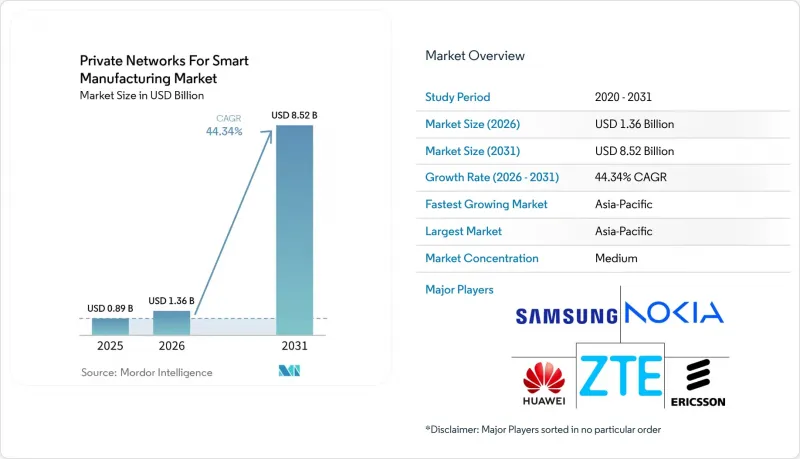
Mordor Intelligence에 의하면, 스마트 제조용 사설 네트워크 시장 규모는 2025년 8억 9,000만 달러로 평가되었습니다. 2026년에는 13억 6,000만 달러로 확대되어 2031년까지 85억 2,000만 달러에 이를 것으로 예측되며, 2026년부터 2031년까지 연평균 복합 성장률(CAGR)은 44.34%를 나타낼 전망입니다.
본 보고서는 제공 방식(하드웨어, 소프트웨어, 서비스), 주파수 대역(저대역, 중대역, mm파), 도입 아키텍처(클라우드 기반, On-Premise형, 하이브리드형), 제조업(자동차·모빌리티 등), 기업 규모(대기업 등) 및 지역별로 분류되어 있습니다. 시장 예측은 금액(달러) 기준으로 제시되어 있습니다.
세계의 스마트 제조용 사설 네트워크 시장 동향 및 인사이트
산업 자동화 및 스마트 팩토리 투자
공장 자동화에 대한 투자로 인해 전용 무선 연결이 필요한 용도의 범위가 확대되고 있습니다. 무인 운반 차량(AGV), 실시간 감시 제어 및 데이터 수집 시스템(SCADA), AI 기반 검사, 그리고 커넥티드 워커를 위한 도구에는 생산 구역 전체에 걸쳐 신뢰할 수 있는 통신이 필요합니다. 이러한 시스템이 고립된 도입 환경에서 연동된 운영 환경으로 전환됨에 따라, 스마트 제조용 사설 네트워크 시장은 그 혜택을 누리고 있습니다. 전용 네트워크는 생산 공정의 자동화가 진행됨에 따라, 공장이 범용 엔터프라이즈 네트워크의 한계를 극복하는 데 도움이 됩니다. 또한 전용 네트워크는 그렇지 않으면 개별적인 연결 수단이 필요한 용도에 공통의 통신 기반을 제공합니다. 게다가 제조업체들은 자동화, 분석 및 운영 기술을 통합적으로 지원할 수 있는 인프라를 원하고 있습니다.
모바일 로보틱스 및 머신 비전을 위한 결정론적 연결성
모바일 로보틱스 및 머신 비전에는 공유 무선 네트워크로는 제공하기 어려운 안정적인 서비스 수준이 요구됩니다. 산업 분야 가이드라인에서는 협업 이송 용도에 대해 가용성 99.9999% 이상, 지연 시간 1-2.5밀리초를 목표로 하고 있습니다. Samsung Electronics와 현대자동차는 2025년 2월 현대자동차 울산 공장에서 엔드투엔드 프라이빗 5G RedCap 시험을 완료하고, 하루 6,000대의 차량을 생산하는 시설에서 차량 검사 데이터를 전송했습니다. RedCap 지원 디바이스는 5G의 주요 기능을 유지하면서 디바이스의 크기와 전력 소비를 줄일 수 있습니다. 이를 통해 센서, 카메라, 검사 단말기의 고밀도 배치가 더욱 현실화됩니다. 스마트 제조용 사설 네트워크 시장은 생산 용도에서 예측 가능한 연결성과 고속 데이터 전송이 요구되는 상황에서 장점을 발휘합니다.
높은 초기 도입 비용 및 엔드포인트 비용
프라이빗 5G 도입에는 무선 액세스 하드웨어, 전용 코어, 엣지 서버, 시스템 통합, 그리고 필요에 따라 주파수 대역 접근에 대한 투자가 필요할 수 있습니다. 이러한 초기 투자는 더 빠른 투자 회수가 기대되는 프로세스 프로젝트와 비교할 수밖에 없는 중소규모 제조업체에게는 부담이 될 수 있습니다. 또한, 산업용 엔드포인트의 선택지 역시 더 광범위한 5G 기기 생태계에 비해 제한적입니다. 세계 모바일 공급자 협회(GMSA)는 2025년 4월 기준으로 3,378종의 5G 기기 카탈로그 중 326종의 5G 모듈과 330종의 산업용 라우터 및 모뎀을 제공했습니다. 선택의 폭이 제한적이기 때문에 엔드포인트 가격이 높은 수준을 유지하고 조달의 유연성이 떨어질 가능성이 있습니다. 스마트 제조용 사설 네트워크 시장은 제조업체가 비용을 여러 고부가가치 용도에 분산할 수 없는 지역에서는 발전 속도가 둔화될 가능성이 있습니다.
부문 분석
2025년 기준, 스마트 제조용 사설 네트워크 시장 중 하드웨어가 48.21%를 차지했습니다. 이는 무선 액세스 네트워크 장비, 프라이빗 5G 코어 하드웨어, 엣지 서버 및 게이트웨이의 초기 비용을 반영한 것입니다. 제조업체가 공장 전체에 처음으로 로컬 커버리지를 구축할 때는 여전히 하드웨어가 필수적입니다. 개방형 무선 액세스 네트워크 설계로 인해 제조업체가 멀티 벤더 구성을 고려할 수 있게 되면서 무선 장비의 차별화가 진행되고 있습니다. 많은 제조업체가 셀룰러 네트워크에 대한 내부 전문 지식이 부족하기 때문에 서비스는 여전히 중요합니다.
소프트웨어 시장은 2031년까지 연평균 성장률(CAGR) 44.61%를 나타낼 것으로 예측됩니다. 하드웨어 도입 기반이 확대됨에 따라 네트워크 관리, 오케스트레이션, 보안 및 분석 소프트웨어의 중요성이 높아지고 있습니다. NTT 도코모는 2026년 3월, 법인 고객을 대상으로 한 5G 슬라이싱 서비스를 개시했습니다. 스마트 제조용 사설 네트워크는 공장이 초기 장비 구매를 넘어 네트워크 기능을 활용하게 됨에 따라 지속적인 소프트웨어 및 서비스 수익으로 전환되고 있습니다. 이러한 전환으로 인해 지속적인 플랫폼 지원이 공급업체와의 관계에서 더욱 중요해지고 있습니다.
2025년, 스마트 제조용 사설 네트워크 시장에서 미드밴드가 54.12%의 점유율을 차지했습니다. 미드밴드는 대규모 공장 현장에서 커버리지, 용량 및 구축 밀도의 균형을 제공합니다. 미드밴드 네트워크는 고주파 대역에서 흔히 요구되는 고밀도 액세스 포인트 배치를 필요로 하지 않으면서도 무인 운반차(AGV), 머신 비전, 센서 시스템을 지원할 수 있습니다. 미국에서는 CBRS가 이러한 입지를 더욱 공고히 하고 있습니다. 2025년 ‘American Made 5G’ 조사에 따르면, 해당 연도에 구축된 미국 내 사설 5G 네트워크의 75%가 CBRS 주파수 대역을 사용한 것으로 보고되었습니다.
mm파는 2031년까지 연평균 성장률(CAGR) 44.83%를 나타낼 것으로 예측됩니다. 『MDPI Electronics』 저널에 게재된 산업 평가에 따르면, 시야 거리가 제한된 환경에서의 적층 가공 및 정밀 로봇 공학 분야에서 신뢰성이 높은 고처리량 성능이 확인되었습니다. 저대역은 높은 데이터 전송 속도보다 장애물 주변의 신호 전파가 중요한 실외 산업용 캠퍼스에서 여전히 중요한 역할을 하고 있습니다. 고밀도 스몰 셀 설계와 설정 가능한 멀티밴드 무전기는 금속 구조물이 많은 시설에서 밀리파의 제약을 해결하는 데 도움이 됩니다. 스마트 제조용 사설 네트워크의 경우, 공장 레이아웃과 용도 요구 사항이 매우 다양하기 때문에 여러 대역이 사용됩니다.
지역별 분석
아시아태평양은 2025년에 41.21%의 점유율로 스마트 제조용 사설 네트워크 시장을 주도했으며, 2031년까지 연평균 성장률(CAGR) 46.14%를 나타낼 것으로 예측됩니다. 이 지역은 제조업의 집적도, 지역 주파수 정책, 그리고 로봇 기술 채택 확대가 맞물려 성장하고 있습니다. 소프트뱅크와 무라타 제작소는 2026년 2월, 프라이빗 5G 독립형 네트워크를 통해 시간 민감형 네트워킹 실증 실험을 실시하여 122나노초의 시간 동기화 정확도를 달성했습니다. 이러한 노력은 사설 무선을 유선 시스템의 단순한 부가 기능으로 사용하는 것이 아니라, 5G 네이티브 생산 제어 방식으로 전환하고 있음을 보여줍니다. 일본, 한국, 중국, 인도, 동남아시아, 오세아니아는 자동차, 전자, 수출 지향형 제조업 분야에서 각각 서로 다른 수요 견인 요인으로 작용하고 있습니다.
북미는 CBRS 접근성과 자동차, 항공우주, 식음료 분야의 제조 투자에 힘입어 지역별 2위를 차지했습니다. 세라니즈(Ceranies)는 2025년 9월, 텍사스주에 위치한 두 곳의 제조 시설에 NTT 데이터의 매니지드 프라이빗 5G를 도입했습니다. TERAGO와 에릭슨은 2026년 5월, 센서, 로봇 공학, AI 검증을 목적으로 맥마스터 제조 연구소에 프라이빗 5G 네트워크를 구축했습니다. 유럽에서는 독일의 캠퍼스 네트워크 프레임워크와 생산 현장의 도입 활동을 통해 진전이 나타나고 있습니다. 중동 및 아프리카, 남미는 여전히 초기 단계에 있는 지역으로, 주파수 대역 규제와 가용한 제조 자본이 전개 속도를 좌우하게 될 것입니다.
스마트 제조용 사설 네트워크 시장은 신규 시설이 초기 설계 단계에서 전용 무선 시스템을 통합할 수 있기 때문에 광범위한 지역 기반을 갖추고 있습니다. 성숙한 산업 지역에서는 기존의 복잡한 공장을 현대화하기 위해 사설 네트워크가 활용되고 있습니다. 신흥 지역에서는 산업 단지나 그린필드 프로젝트를 활용하여 처음부터 전용 무선 시스템을 도입할 수 있습니다. 현지 주파수 대역의 이용 가능 여부는 제조업체가 신속하게 구축할 수 있을지, 아니면 통신 사업자와의 제휴에 의존할 수밖에 없을지를 좌우합니다. 또한, 국경을 넘어 사업을 전개하는 제조업체의 경우, 지역별 규제나 장비 선택지를 조정하기 쉬운 환경이라면 이점이 있습니다. 이러한 조건으로 인해 지역적 요인은 사설 네트워크 프로젝트의 시기나 설계에 있어 중요한 요소가 됩니다.
기타 혜택 :
- 엑셀 형식 시장 예측(ME) 시트
- 3개월간의 애널리스트 지원
자주 묻는 질문
목차
제1장 서론
제2장 조사 방법
제3장 주요 요약
제4장 시장 구도
제5장 시장 규모 및 성장 예측
제6장 경쟁 구도
제7장 시장 기회 및 향후 전망
KTH 26.09.10According to Mordor Intelligence, the private networks for Smart Manufacturing Market size is projected to expand from USD 0.89 billion in 2025 to USD 1.36 billion in 2026, and to USD 8.52 billion by 2031, registering a CAGR of 44.34% between 2026 and 2031.
This report is Segmented by Offering (Hardware, Software, and Services), Frequency Band (Low Band, Mid Band, and Millimeter Wave), Deployment Architecture (Cloud-Based, On-Premise, and Hybrid), Manufacturing Industry (Automotive and Mobility, and More), Enterprise Size (Large Enterprises, and More), and Geography. The Market Forecasts are Provided in Terms of Value (USD).
Global Private Networks For Smart Manufacturing Market Trends and Insights
Industrial Automation and Smart Factory Investment
Factory automation investment is expanding the set of applications requiring dedicated wireless connectivity. Automated guided vehicles, real-time supervisory control and data acquisition systems, AI inspection, and connected-worker tools need dependable communications across production areas. The Private Networks for Smart Manufacturing Market benefits when these systems move from isolated deployments to linked operating environments. Dedicated networks help factories avoid the limitations of general-purpose enterprise networks when production processes become more automated. They provide a common communications base for applications that would otherwise require separate connectivity arrangements. Manufacturers are also seeking infrastructure that can support automation, analytics, and operational technology together.
Deterministic Connectivity for Mobile Robotics and Machine Vision
Mobile robotics and machine vision require stable service levels that shared wireless networks can struggle to provide. Industrial guidance targets availability above 99.9999% and latency of 1 to 2.5 milliseconds for cooperative carrying applications. Samsung and Hyundai Motor completed an end-to-end private 5G RedCap trial at Hyundai Motor's Ulsan plant in February 2025, transmitting vehicle inspection data at a facility producing 6,000 vehicles per day. RedCap devices can reduce device size and power requirements while retaining key 5G capabilities. This can make dense arrays of sensors, cameras, and inspection terminals more practical. The Private Networks for Smart Manufacturing Market benefits where production applications require predictable connectivity and fast data transmission.
High Initial Deployment and Endpoint Costs
A private 5G deployment may require investment in radio access hardware, a dedicated core, edge servers, system integration, and spectrum access where needed. This initial requirement can be difficult for small and medium manufacturers that must compare it with process projects that offer faster returns. Industrial endpoint selection is also more limited than the broader 5G device ecosystem. The Global Mobile Suppliers Association listed 326 5G modules and 330 industrial routers and modems within a catalog of 3,378 5G devices as of April 2025. The limited range can keep endpoint prices high and reduce procurement flexibility. The Private Networks for Smart Manufacturing Market may develop more slowly in regions where manufacturers cannot spread costs across multiple high-value applications.
Other drivers and restraints analyzed in the detailed report include:
- Private Edge Intelligence for Real-Time Quality and Process Decisions
- Localized Spectrum Access and Industrial 5G Policy Support
- OT-IT Integration and Multi-Vendor Skills Gaps
For complete list of drivers and restraints, kindly check the Table Of Contents.
Segment Analysis
Hardware represented 48.21% of the Private Networks for Smart Manufacturing Market in 2025. This reflects the initial cost of radio access network equipment, private 5G core hardware, edge servers, and gateways. Hardware remains necessary when a manufacturer first builds local coverage across a factory. Radio equipment is becoming more differentiated as open radio access network designs allow manufacturers to consider multi-vendor configurations. Services remain important because many manufacturers lack in-house expertise in cellular networks.
Software is forecast to grow at a 44.61% CAGR through 2031. Network management, orchestration, security, and analytics software become more important as the installed base of hardware expands. NTT Docomo launched 5G slicing services for enterprise customers in March 2026. Private networks in the smart manufacturing industry are shifting toward recurring software and service revenue as factories use network functions beyond the initial equipment purchase. This transition makes ongoing platform support more relevant to the supplier relationship.
Mid band held 54.12% of the Private Networks for Smart Manufacturing Market in 2025. It provides a balance between coverage, capacity, and deployment density for large factory floors. Mid-band networks can support automated guided vehicles, machine vision, and sensor systems without the dense access-point layout often required by higher frequencies. CBRS has reinforced this position in the United States. The 2025 American Made 5G study reported that 75% of U.S. private 5G networks deployed that year used CBRS spectrum.
Millimeter wave is forecast to grow at a 44.83% CAGR through 2031. An industrial evaluation published in MDPI Electronics found reliable high-throughput performance for additive manufacturing and precision robotics in line-of-sight environments. Low band remains relevant for outdoor industrial campuses where signal propagation around obstructions matters more than high data rates. Dense small-cell designs and configurable multi-band radios can help address millimeter-wave constraints in metal-heavy facilities. The private networks for the smart manufacturing industry will use several bands because factory layouts and application needs vary widely.
Complete Report Scope:
- By Offering
- Hardware
- Radio Access Network Hardware
- Private 5G Core Network Hardware
- Edge Servers and Gateways
- Software
- Network Management and Orchestration
- Industrial Security and Analytics Software
- Services
- Professional Services
- Managed Services
- Hardware
- By Frequency Band
- Low Band
- Mid Band
- Millimeter Wave
- By Deployment Architecture
- Cloud-Based
- ON Premise
- Hybrid
- By Manufacturing Industry
- Automotive and Mobility
- Electrical and Electronics
- Machinery and Industrial Equipment
- Food and Beverage
- Pharmaceuticals and Medical Devices
- Aerospace and Defense Manufacturing
- Chemicals, Metals, and Materials
- By Enterprise Size
- Large Enterprises
- Small and Medium Enterprises
- By Geography
- North America
- United States
- Canada
- Mexico
- South America
- Brazil
- Rest of South America
- Europe
- Germany
- United Kingdom
- France
- Italy
- Russia
- Rest of Europe
- Asia-Pacific
- China
- Japan
- South Korea
- India
- Southeast Asia
- Rest of Asia-Pacific
- Middle East
- Turkey
- Saudi Arabia
- United Arab Emirates
- Rest of Middle East
- Africa
- South Africa
- Kenya
- Rest of Africa
- North America
Geography Analysis
Asia-Pacific led the Private Networks for Smart Manufacturing Market with a 41.21% share in 2025 and is forecast to grow at a 46.14% CAGR through 2031. The region combines manufacturing density, local spectrum policy, and rising adoption of robotics. SoftBank and Murata Manufacturing demonstrated time-sensitive networking over a private 5G standalone network in February 2026, achieving a time synchronization accuracy of 122 nanoseconds. This work shows a shift toward 5G-native production control rather than using private wireless only as an add-on to wired systems. Japan, South Korea, China, India, Southeast Asia, and Oceania contribute different demand drivers across automotive, electronics, and export-oriented manufacturing.
North America held the second-largest regional position, supported by CBRS access and manufacturing investment in the automotive, aerospace, and food and beverage sectors. Celanese deployed NTT DATA's managed private 5G at 2 Texas manufacturing facilities in September 2025. TERAGO and Ericsson launched a private 5G network at the McMaster Manufacturing Research Institute in May 2026 for sensor, robotics, and AI validation. Europe is advancing through Germany's campus-network framework and production-grade deployment activity. The Middle East, Africa, and South America remain earlier-stage regions where spectrum rules and available manufacturing capital will shape rollout speed.
The Private Networks for Smart Manufacturing Market has a broad regional base because new facilities can incorporate dedicated wireless systems in their initial designs. Mature industrial regions are using private networks to update complex existing plants. Emerging regions can use industrial parks and greenfield projects to introduce dedicated wireless systems from the start. Local spectrum availability influences whether manufacturers can deploy quickly or must rely on operator partnerships. Cross-border manufacturers also benefit when regional rules and equipment options are easier to align. These conditions make geography an important factor in the timing and design of private-network projects.
- Huawei Technologies Co., Ltd.
- Nokia Corporation
- Telefonaktiebolaget LM Ericsson
- Samsung Electronics Co., Ltd.
- ZTE Corporation
- Siemens Aktiengesellschaft
- Cisco Systems, Inc.
- NEC Corporation
- Qualcomm Incorporated
- Hewlett Packard Enterprise Company
- Amazon Web Services, Inc.
- Deutsche Telekom AG
- Verizon Communications Inc.
- AT&T Inc.
- Vodafone Group Plc
- Orange S.A.
- Telefonica, S.A.
- NTT DATA Group Corporation
- Celona, Inc.
- Druid Software Limited
- Future Technologies, Inc.
- Cumucore Oy
Additional Benefits:
- The market estimate (ME) sheet in Excel format
- 3 months of analyst support
TABLE OF CONTENTS
1 INTRODUCTION
- 1.1 Study Assumptions and Market Definition
- 1.2 Scope of the Study
2 RESEARCH METHODOLOGY
3 EXECUTIVE SUMMARY
4 MARKET LANDSCAPE
- 4.1 Market Overview
- 4.2 Impact of Macroeconomic Factors on the Market
- 4.3 Market Drivers
- 4.3.1 Industrial Automation and Smart Factory Investment
- 4.3.2 Deterministic Connectivity for Mobile Robotics and Machine Vision
- 4.3.3 Localized Spectrum Access and Industrial 5G Policy Support
- 4.3.4 Private Edge Intelligence for Real-Time Quality and Process Decisions
- 4.3.5 Wireless Reconfiguration of Production Lines and Digital Twins
- 4.3.6 Physical AI Fleet Expansion Across Factories
- 4.4 Market Restraints
- 4.4.1 High Initial Deployment and Endpoint Costs
- 4.4.2 OT-IT Integration and Multi-Vendor Skills Gaps
- 4.4.3 Fragmented Spectrum Rules and Cross-Border Rollout Friction
- 4.4.4 Limited Industrial 5G Endpoint Variety and Lifecycle Risk
- 4.5 Industry Value Chain Analysis
- 4.6 Regulatory Landscape
- 4.7 Technological Outlook
- 4.8 Porter's Five Forces Analysis
- 4.8.1 Bargaining Power of Suppliers
- 4.8.2 Bargaining Power of Buyers
- 4.8.3 Threat of New Entrants
- 4.8.4 Threat of Substitutes
- 4.8.5 Competitive Rivalry
5 MARKET SIZE AND GROWTH FORECASTS (VALUE)
- 5.1 By Offering
- 5.1.1 Hardware
- 5.1.1.1 Radio Access Network Hardware
- 5.1.1.2 Private 5G Core Network Hardware
- 5.1.1.3 Edge Servers and Gateways
- 5.1.2 Software
- 5.1.2.1 Network Management and Orchestration
- 5.1.2.2 Industrial Security and Analytics Software
- 5.1.3 Services
- 5.1.3.1 Professional Services
- 5.1.3.2 Managed Services
- 5.1.1 Hardware
- 5.2 By Frequency Band
- 5.2.1 Low Band
- 5.2.2 Mid Band
- 5.2.3 Millimeter Wave
- 5.3 By Deployment Architecture
- 5.3.1 Cloud-Based
- 5.3.2 ON Premise
- 5.3.3 Hybrid
- 5.4 By Manufacturing Industry
- 5.4.1 Automotive and Mobility
- 5.4.2 Electrical and Electronics
- 5.4.3 Machinery and Industrial Equipment
- 5.4.4 Food and Beverage
- 5.4.5 Pharmaceuticals and Medical Devices
- 5.4.6 Aerospace and Defense Manufacturing
- 5.4.7 Chemicals, Metals, and Materials
- 5.5 By Enterprise Size
- 5.5.1 Large Enterprises
- 5.5.2 Small and Medium Enterprises
- 5.6 By Geography
- 5.6.1 North America
- 5.6.1.1 United States
- 5.6.1.2 Canada
- 5.6.1.3 Mexico
- 5.6.2 South America
- 5.6.2.1 Brazil
- 5.6.2.2 Rest of South America
- 5.6.3 Europe
- 5.6.3.1 Germany
- 5.6.3.2 United Kingdom
- 5.6.3.3 France
- 5.6.3.4 Italy
- 5.6.3.5 Russia
- 5.6.3.6 Rest of Europe
- 5.6.4 Asia-Pacific
- 5.6.4.1 China
- 5.6.4.2 Japan
- 5.6.4.3 South Korea
- 5.6.4.4 India
- 5.6.4.5 Southeast Asia
- 5.6.4.6 Rest of Asia-Pacific
- 5.6.5 Middle East
- 5.6.5.1 Turkey
- 5.6.5.2 Saudi Arabia
- 5.6.5.3 United Arab Emirates
- 5.6.5.4 Rest of Middle East
- 5.6.6 Africa
- 5.6.6.1 South Africa
- 5.6.6.2 Kenya
- 5.6.6.3 Rest of Africa
- 5.6.1 North America
6 COMPETITIVE LANDSCAPE
- 6.1 Market Concentration
- 6.2 Strategic Moves
- 6.3 Market Share Analysis
- 6.4 Company Profiles (includes Global Level Overview, Market Level Overview, Core Segments, Financials as available, Strategic Information, Market Rank/Share, Products and Services, Recent Developments)
- 6.4.1 Huawei Technologies Co., Ltd.
- 6.4.2 Nokia Corporation
- 6.4.3 Telefonaktiebolaget LM Ericsson
- 6.4.4 Samsung Electronics Co., Ltd.
- 6.4.5 ZTE Corporation
- 6.4.6 Siemens Aktiengesellschaft
- 6.4.7 Cisco Systems, Inc.
- 6.4.8 NEC Corporation
- 6.4.9 Qualcomm Incorporated
- 6.4.10 Hewlett Packard Enterprise Company
- 6.4.11 Amazon Web Services, Inc.
- 6.4.12 Deutsche Telekom AG
- 6.4.13 Verizon Communications Inc.
- 6.4.14 AT&T Inc.
- 6.4.15 Vodafone Group Plc
- 6.4.16 Orange S.A.
- 6.4.17 Telefonica, S.A.
- 6.4.18 NTT DATA Group Corporation
- 6.4.19 Celona, Inc.
- 6.4.20 Druid Software Limited
- 6.4.21 Future Technologies, Inc.
- 6.4.22 Cumucore Oy
7 MARKET OPPORTUNITIES AND FUTURE OUTLOOK
- 7.1 White-Space and Unmet-Need Assessment


