
|
시장보고서
상품코드
2119374
중립 호스트 사설 네트워크 : 시장 점유율 분석, 업계 동향 및 통계, 성장 예측(2026-2031년)Neutral Host Private Networks - Market Share Analysis, Industry Trends & Statistics, Growth Forecasts (2026 - 2031) |
||||||
 Mordor Intelligence
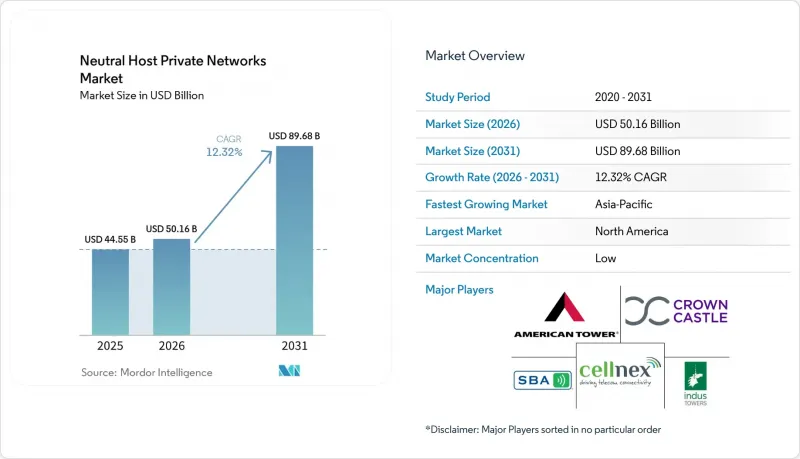
Mordor Intelligence에 의하면, 중립 호스트 사설 네트워크 시장 규모는 2025년 445억 5,000만 달러로 평가되었습니다. 2026년에는 501억 6,000만 달러로 확대되어 2031년까지 896억 8,000만 달러에 이를 것으로 예측되며, 2026년부터 2031년까지 연평균 복합 성장률(CAGR)은 12.32%를 나타낼 전망입니다.
본 보고서는 구성 요소(인프라, 서비스, 소프트웨어), 기술(분산 안테나 시스템 등), 주파수 대역(면허 주파수 대역 등), 소유 모델(단일 사업자 모델 등), 구축 방식(실내 네트워크 등), 최종 이용 산업(통신 등) 및 지역별로 분류되어 있습니다. 시장 전망은 금액(달러) 기준으로 제시되어 있습니다.
세계의 중립 호스트 사설 네트워크 시장 동향 및 인사이트
프라이빗 5G 및 기업용 무선 네트워크 도입
프라이빗 5G 도입은 시범 운영 단계에서 더 광범위한 기업에서의 실제 운영 단계로 전환되고 있습니다. GSA의 기록에 따르면, 2026년 1분기 말 기준으로 88개국에서 2,003개 조직이 인증 기준을 충족하는 프라이빗 모바일 네트워크를 도입했습니다. 2022년 이후 발표된 도입 사례의 절반 이상에서 5G가 채택되었으며, 신규 프로젝트에서는 프라이빗 LTE보다 5G 기능이 점점 더 중요시되고 있음을 보여줍니다. 이러한 변화로 인해 중립 호스트 제공업체는 커버리지, 용량 및 공유 액세스가 동시에 요구되는 사이트에 대한 선택지를 확대할 수 있습니다. 또한, 개방형 인터페이스를 통해 시설 운영자는 무선, 코어, 관리 분야의 각 공급업체를 개별적으로 선택할 수 있게 됩니다. 따라서 기업이 무선 연결을 제한적인 시범 프로젝트가 아닌 운영 자산으로 취급하게 되면, 중립 호스트 사설 네트워크 시장은 그 혜택을 누리게 될 것입니다.
고성능 실내 커버리지에 대한 수요
실내 커버리지는 공유형 셀룰러 시스템을 도입하는 데 있어 여전히 중요한 이유로 작용하고 있습니다. 철골, 콘크리트, 단열 유리는 실외 셀룰러 신호를 약화시키지만, 한편 모바일 통신 사업자들은 보다 광범위한 5G 커버리지 확대에 투자의 대부분을 집중하고 있습니다. 그 결과, 건물 소유주와 운영자는 실내 연결에 대해 더 큰 책임을 지게 되었습니다. 에릭슨은 자사의 ‘Radio Dot’ 시스템을 실내 5G 커버리지를 위한 기존의 분산 안테나 시스템(DAS) 설계를 대체할 수 있는 소형 대안으로 포지셔닝하고 있습니다. 스몰셀 포럼은 2023년 14%에 비해 2030년까지 기업용 스몰셀의 28%가 중립 호스트에 의해 운영될 것으로 예측했습니다. 이러한 상황은 사무실, 병원, 호텔, 교통 기관의 역 등 신뢰할 수 있는 실내 서비스가 필요한 장소에서의 프로젝트를 촉진하고 있습니다.
높은 도입 및 통합 비용
대규모 중립 호스트 프로젝트의 경우, 무선 주파수 계획, 건설 공사, 통신 사업자와의 조정, 그리고 여러 공급업체에 걸친 통합이 필요합니다. 건물 소유주, 통신 사업자, 시스템 통합사업자가 설계의 각 부분을 승인해야 하는 경우, 설치 기간이 길어질 수 있습니다. 오래된 건물의 경우, 기존의 동축 케이블, 전원 시스템, 장비실이 능동형 디지털 아키텍처를 지원하지 않을 가능성이 있어 추가 비용이 발생할 수 있습니다. 광섬유나 카테고리 6A로 업그레이드하려면 업무에 지장을 주고 비용도 많이 드는 토목 공사가 필요할 수 있습니다. 건축기준법, 화재 안전 요건, 통신 사업자 간 상호 운용성 테스트로 인해 서비스 개시까지 추가 절차가 필요합니다. 이러한 요건은 확고한 자금 조달 능력, 설치 능력, 통신 사업자와의 관계를 갖춘 사업자에게 유리하게 작용하여, 중립 호스트·사설 네트워크 시장 진입을 제한할 가능성이 있습니다.
부문 분석
2025년 기준, 인프라는 뉴트럴 호스트 프라이빗 네트워크 시장 규모의 46.12%를 차지했습니다. 이 비율은 분산형 안테나 시스템(DAS)의 헤드엔드, 스몰셀 무선 기기, 클라우드 기반 네트워크 하드웨어 및 실내 연결 장비에 대한 초기 투자 요건을 반영한 것입니다. 장기적인 운영권 계약을 통해 이러한 비용을 15년에서 20년에 걸쳐 분산시킬 수 있습니다. 고객은 네트워크의 설계, 통합, 모니터링, 유지보수 및 일상적인 운영을 외부에 위탁하는 경우가 많기 때문에 서비스 부문의 중요성은 여전히 높습니다. 시설 소유주는 일반적으로 무선 주파수(RF) 엔지니어링을 위한 사내 팀을 운영하지 않습니다. 사업자가 건물, 역, 캠퍼스, 교통 시설로 커버리지를 확대해 나감에 따라 인프라는 앞으로도 필수적인 요소로 남을 것입니다.
소프트웨어는 2031년까지 연평균 성장률(CAGR)이 12.43%에 달하고, 가장 빠르게 성장하는 구성 요소가 될 것으로 예측됩니다. 관리, 모니터링, 보안 오케스트레이션, 자동화 및 분석 도구는 이미 구축된 무선 네트워크에서 얻을 수 있는 가치를 높여줍니다. 오픈 RAN은 하드웨어 계층과 소프트웨어 계층을 분리하여 통신 사업자가 여러 공급업체의 관리 용도를 활용할 수 있도록 합니다. 이를 통해 기존 DAS 프로젝트에서는 흔하지 않았던 지속적인 라이선스 수익이 창출됩니다. 에릭슨의 ‘지능형 자동화 플랫폼’은 콤스코프의 ‘OneCell’ 플랫폼과 통합되어 2025년 AT&T의 O-RAN DAS 프로젝트에서 검증되었습니다. 이를 통해 멀티 벤더 배포에서 소프트웨어 연동의 역할이 입증되었습니다. 따라서 뉴트럴 호스트 프라이빗 네트워크 시장은 물리적 커버리지 자산과 이를 관리하는 소프트웨어 간의 균형으로 전환되고 있습니다.
2025년 기준으로 스몰 셀은 기술 부문의 34.16%를 차지했습니다. 이 디지털 아키텍처는 콤팩트한 설치 환경에서 4G 및 5G 서비스, 캐리어 애그리게이션, 네트워크 슬라이싱, 프라이빗 5G 운영을 지원합니다. 이러한 기술은 기존의 수동형 DAS 설계가 적합하지 않은 사무실이나 중규모 행사장에서 자주 활용되고 있습니다. 분산 안테나 시스템(DAS)은 대규모 병원, 교통 기관의 역, 경기장 및 기타 대용량 사이트에서 계속해서 중요한 역할을 수행하고 있습니다. Wi-Fi는 많은 장소에서 추가 용량 계층으로서의 역할을 계속하고 있지만, 이동통신 사업자의 접속이 필요한 상황에서 캐리어급 셀룰러 서비스를 대체하지는 않습니다.
오픈 RAN은 2031년까지 연평균 성장률(CAGR) 12.41%를 나타낼 것으로 예측됩니다. NTT 동일본은 2026년 3월, 일본 국내의 프라이빗 5G용 멀티 벤더 O-RAN RAN 지능형 컨트롤러 시험에 관한 공동 실증 보고서를 발표했습니다. 이 실증에는 26개사가 참여했습니다. 이 노력은 각 공급업체가 단일 통합 벤더 스택을 넘어서는 상호 운용성을 검증하고 있음을 보여줍니다. 개방형 인터페이스는 단일 장비 벤더에 대한 의존도를 낮추고, 통신 사업자의 조달 측면에서의 유연성을 높입니다. 또한, 시스템 전체를 재설계하지 않고도 구성 요소의 교체나 업그레이드를 용이하게 할 수 있습니다. 이러한 유연성으로 인해 공유 네트워크의 기술적 및 조달상의 장벽이 낮아져, 뉴트럴 호스트 전용 네트워크 시장이 혜택을 받게 됩니다.
지역별 분석
2025년, 북미는 지역별 부문의 36.14%를 차지했습니다. 미국에는 고부가가치 시설이 다수 존재하며, CBRS를 통한 공유 스펙트럼 옵션도 있습니다. Boldyn Networks와 AT&T는 2025년 뉴욕시 지하철 4호선, 5호선, G선의 터널 내 추가 구간에서 셀룰러 서비스 제공 범위를 확대했습니다. 이러한 대중교통 프로그램은 중립 호스트가 전파 수신이 어려운 지역에서 통신 사업자에게 공유 인프라를 제공할 수 있음을 보여줍니다. 또한 FirstNet의 상호운용성 요건도 공공 부문 및 교통 기관 시설에서의 선택에 영향을 미치고 있습니다. 따라서 북미의 통신 사업자들은 동일한 프로젝트 내에서 공유 액세스, 라이선스 주파수 대역 및 공공 안전 관련 의무를 관리해야 합니다.
아시아태평양은 2031년까지 연평균 성장률(CAGR)이 12.96%로 가장 빠르게 성장하는 지역이 될 것으로 예측됩니다. 중국에서는 산업용 프라이빗 5G 추진이 활발해지는 한편, 일본에서는 체계적인 지역 5G 프레임워크가 구축되고 있습니다. 2026년 6월, 중국 공업정보화부 및 기타 4개 부처는 원자재, 장비 제조, 전자, 에너지, 운송, 국방 각 분야의 산업용 5G 독립형 사설 네트워크 시범 사업을 지원한다는 공지를 발표했습니다. NTT 도코모 비즈니스는 2026년 3월에 5G 슬라이싱 서비스를 개시했으며, 서비스 개시 시점에 프라이빗 5G와 네트워크 슬라이싱을 합쳐 총 260건의 실적을 보고했습니다. 한국, 호주, 인도에서는 전용 주파수 대역, 광업·산업 프로젝트, 그리고 전용 사설 네트워크 체계를 통해 수요가 확대되고 있습니다. 이러한 다양성으로 인해 뉴트럴 호스트 사설 네트워크 시장에는 지역별로 여러 성장 경로가 형성되고 있습니다.
유럽에서는 영국의 성숙한 뉴트럴 호스트 활동과 독일의 산업용 5G 프라이빗 네트워크 활동이 결합되고 있습니다. 볼딘(Bordin)사의 런던 지하철 운영권은 여러 사업자가 참여하는 교통망 커버리지와 관련하여 장기적인 참고 모델이 되고 있습니다. 유럽연합 집행위원회는 ‘NextGen 5G Airports’ 이니셔티브를 통해 차세대 공항 연결을 지원하고 있으며, 여기에는 크로아티아 공항의 전용 5G 독립형 사설 네트워크도 포함됩니다. 남미, 중동 및 아프리카는 주파수 대역 규제와 통신 사업자의 전개 상황이 진화 중인 단계이므로, 여전히 초기 단계의 기회에 머물러 있습니다. 브라질의 사설 네트워크용 주파수 할당, 카타르 및 아랍에미리트의 스마트 교통에 대한 투자, 그리고 남아프리카공화국의 초기 도입이 그 기반을 다지고 있습니다. 이 지역들은 규제 모델과 현지 제공 역량이 성숙해짐에 따라 2026년 이후 더 중요한 시장이 될 가능성이 있습니다.
기타 혜택 :
- 엑셀 형식 시장 예측(ME) 시트
- 3개월간의 애널리스트 지원
자주 묻는 질문
목차
제1장 서론
제2장 조사 방법
제3장 주요 요약
제4장 시장 구도
제5장 시장 규모 및 성장 예측
제6장 경쟁 구도
제7장 시장 기회 및 향후 전망
KTH 26.09.10According to Mordor Intelligence, the neutral host private networks market size is projected to expand from USD 44.55 billion in 2025 to USD 50.16 billion in 2026, and to USD 89.68 billion by 2031, registering a CAGR of 12.32% between 2026 and 2031.
This report is Segmented by Component (Infrastructure, Services, and Software), Technology (Distributed Antenna System, and More), Spectrum (Licensed Spectrum, and More), Ownership Model (Single-Operator Model, and More), Deployment Mode (Indoor Networks, and More), End-Use Industry (Telecommunications, and More), and Geography. The Market Forecasts are Provided in Terms of Value (USD).
Global Neutral Host Private Networks Market Trends and Insights
Adoption of Private 5G and Enterprise Wireless Networks
Private 5G deployment is moving from trials to operational use across a wider set of enterprises. The GSA recorded 2,003 organizations deploying qualifying private mobile networks in 88 countries by the end of Q1 2026. More than half of the deployments announced since 2022 have used 5G, indicating that newer projects increasingly favor 5G capabilities over private LTE. This change gives neutral host providers a larger pool of sites where coverage, capacity, and shared access are needed together. Open interfaces also allow a venue operator to choose radio, core, and management suppliers separately. The Neutral Host Private Networks Market therefore benefits when enterprises treat wireless connectivity as an operational asset rather than a limited pilot project.
Demand for High-Performance Indoor Coverage
Indoor coverage remains an important reason for deploying shared cellular systems. Steel, concrete, and insulated glass reduce outdoor cellular signals, while mobile operators have focused much of their spending on broader 5G coverage. Building owners and operators are consequently taking greater responsibility for indoor connectivity. Ericsson has positioned its Radio Dot system as a compact alternative to traditional distributed antenna system designs for indoor 5G coverage. The Small Cell Forum expects neutral hosts to operate 28% of enterprise small cells by 2030, compared with 14% in 2023. These conditions support projects in offices, hospitals, hotels, transit stations, and other sites where reliable indoor service is necessary.
High Deployment and Integration Costs
Large neutral host projects require radio-frequency planning, construction work, carrier coordination, and integration across multiple suppliers. The installation period can be extended when building owners, carriers, and system integrators must approve different parts of the design. Older buildings can add further cost because existing coaxial cable, power systems, and equipment rooms may not support active digital architectures. Fiber and Category 6A upgrades can require civil work that is disruptive and expensive. Building codes, fire safety requirements, and carrier interoperability testing add further steps before service begins. These requirements favor operators with established financing, installation capability, and carrier relationships, which can limit entry into the Neutral Host Private Networks Market.
Other drivers and restraints analyzed in the detailed report include:
- Shared Infrastructure Cost Efficiency
- Smart Transportation and High-Density Venue Connectivity
- Spectrum, Licensing, and Public-Safety Regulatory Fragmentation
For complete list of drivers and restraints, kindly check the Table Of Contents.
Segment Analysis
Infrastructure accounted for 46.12% of the Neutral Host Private Networks Market size in 2025. This position reflects the upfront requirements for distributed antenna system headends, small-cell radios, cloud-based network hardware, and indoor connectivity equipment. Long concessions can spread these costs across 15 to 20 years. Services remain important because customers often outsource network design, integration, monitoring, maintenance, and day-to-day operations. Venue owners typically do not maintain internal teams for radio-frequency engineering. Infrastructure will remain necessary as operators add coverage to buildings, stations, campus sites, and transport facilities.
Software is projected to be the fastest-growing component, at a 12.43% CAGR through 2031. Management, monitoring, security orchestration, automation, and analytics tools increase the value derived from the installed radio network. Open RAN separates the hardware and software layers, allowing operators to use management applications from multiple suppliers. This supports recurring license revenue that was less common in traditional DAS projects. Ericsson's Intelligent Automation Platform was integrated with CommScope's OneCell platform and validated with AT&T's O-RAN DAS work in 2025, showing the role of software coordination in multi-vendor deployments. The Neutral Host Private Networks Market industry is therefore moving toward a balance between physical coverage assets and software that manages them.
Small cells held 34.16% of the technology segment in 2025. Their digital architecture supports 4G and 5G service, carrier aggregation, network slicing, and private 5G activation in compact installations. They are often used in offices and medium-sized venues where a traditional passive DAS design is less suitable. Distributed antenna systems continue to play a role in large hospitals, transit stations, stadiums, and other high-capacity sites. Wi-Fi remains an additional capacity layer in many locations, but it does not replace carrier-grade cellular service where mobile operator access is needed.
Open RAN is forecast to grow at a 12.41% CAGR through 2031. NTT EAST released a joint demonstration report in March 2026 covering a multi-vendor O-RAN RAN Intelligent Controller test for private 5G in Japan, with 26 participating companies. This work shows that suppliers are testing interoperability beyond a single integrated vendor stack. Open interfaces can reduce dependence on a single equipment provider and offer operators greater sourcing flexibility. They can also make it easier to replace or upgrade elements without redesigning an entire system. The Neutral Host Private Networks Market benefits when this flexibility lowers technology and procurement barriers for shared networks.
Complete Report Scope:
- By Component
- Infrastructure
- Distributed Antenna System Infrastructure
- Small Cell Infrastructure
- Wireless Network Hardware
- Cloud-Based Network Infrastructure
- In-Building Connectivity Infrastructure
- Services
- Network Deployment Services
- Managed Connectivity Services
- Network Design and Planning Services
- Integration and Installation Services
- Maintenance and Support Services
- Software
- Network Management Software
- Network Monitoring Software
- Security Management Software
- Cloud Network Orchestration Software
- Data Analytics and Optimization Software
- Infrastructure
- By Technology
- Distributed Antenna System
- Small Cells
- Wireless Fidelity
- Open Radio Access Network
- Other Technologies
- By Spectrum
- Licensed Spectrum
- Shared Spectrum
- Unlicensed Spectrum
- By Ownership Model
- Single-Operator Model
- Multi-Operator Model
- By Deployment Mode
- Indoor Networks
- Outdoor Networks
- Hybrid Indoor-Outdoor Networks
- By End-Use Industry
- Telecommunications
- Transportation and Logistics
- Healthcare Facilities
- Hospitality and Retail
- Industrial and Manufacturing
- Education and Higher Education
- Government and Public Safety
- Commercial Real Estate and Offices
- By Geography
- North America
- United States
- Canada
- Mexico
- South America
- Brazil
- Argentina
- Rest of South America
- Europe
- United Kingdom
- Germany
- France
- Italy
- Russia
- Rest of Europe
- Asia-Pacific
- China
- Japan
- India
- South Korea
- Australia
- Rest of Asia-Pacific
- Middle East
- Saudi Arabia
- United Arab Emirates
- Qatar
- Israel
- Rest of Middle East
- Africa
- South Africa
- Egypt
- Morocco
- Rest of Africa
- North America
Geography Analysis
North America accounted for 36.14% of the regional segment in 2025. The United States has a large base of high-value venues and a shared-spectrum option through CBRS. Boldyn Networks and AT&T extended cellular service in 2025 across additional sections of New York City subway tunnels on the 4, 5, and G lines. This kind of transit program demonstrates how a neutral host can provide shared infrastructure for carriers in challenging coverage areas. FirstNet interoperability requirements also influence choices for public-sector and transit venues. North American operators, therefore, need to manage shared access, licensed spectrum, and public-safety obligations within the same project.
Asia-Pacific is forecast to be the fastest-growing geography at a 12.96% CAGR through 2031. China is increasing industrial private 5G activity, while Japan has developed a structured local 5G framework. In June 2026, China's Ministry of Industry and Information Technology and 4 other ministries issued a notice supporting industrial 5G standalone private network pilots across raw materials, equipment manufacturing, electronics, energy, transportation, and defense. NTT DOCOMO Business launched its 5G Slicing service in March 2026 and reported 260 combined private 5G and network slicing project references at launch. South Korea, Australia, and India add demand through dedicated spectrum, mining and industrial projects, and captive private network frameworks. This diversity gives the Neutral Host Private Networks Market several regional routes to growth.
Europe combines mature neutral host activity in the United Kingdom with industrial private 5G activity in Germany. Boldyn's London Underground concession offers a long-term reference model for multi-operator transit coverage. The European Commission has supported next-generation airport connectivity through its NextGen 5G Airports initiative, including dedicated 5G standalone private networks at Croatian airports. South America, the Middle East, and Africa remain earlier-stage opportunities as spectrum rules and operator footprints evolve. Brazil's private network spectrum allocation, smart transportation investments in Qatar and the United Arab Emirates, and South Africa's early deployments provide an initial foundation. These regions can become more material after 2026 as regulatory models and local delivery capabilities mature.
- Boldyn Networks
- American Tower Corporation
- Crown Castle Inc.
- Cellnex Telecom, S.A.
- Verizon Communications Inc.
- Boingo Wireless, Inc.
- ExteNet Systems, Inc.
- CommScope Holding Company, Inc.
- Nokia Corporation
- Ericsson AB
- Huawei Investment & Holding Co., Ltd.
- Cisco Systems, Inc.
- Celona, Inc.
- Betacom Incorporated
- BAI Communications Pty Ltd
- Freshwave Group Limited
- JMA Wireless
- Airspan Networks Holdings Inc.
- Wireless Infrastructure Group Limited
- Shared Access Limited
- Mobilitie LLC
Additional Benefits:
- The market estimate (ME) sheet in Excel format
- 3 months of analyst support
TABLE OF CONTENTS
1 INTRODUCTION
- 1.1 Study Assumptions and Market Definition
- 1.2 Scope of the Study
2 RESEARCH METHODOLOGY
3 EXECUTIVE SUMMARY
4 MARKET LANDSCAPE
- 4.1 Market Overview
- 4.2 Impact of Macroeconomic Factors on the Market
- 4.3 Market Drivers
- 4.3.1 Adoption of Private 5G and Enterprise Wireless Networks
- 4.3.2 Demand for High-Performance Indoor Coverage
- 4.3.3 Shared Infrastructure Cost Efficiency
- 4.3.4 Smart Transportation and High-Density Venue Connectivity
- 4.3.5 Healthcare Dual-Network Architecture for Public and Mission-Critical Users
- 4.3.6 CBRS, Local-Spectrum, and Multi-Operator Access Expansion
- 4.4 Market Restraints
- 4.4.1 High Deployment and Integration Costs
- 4.4.2 Spectrum, Licensing, and Public-Safety Regulatory Fragmentation
- 4.4.3 Multi-MNO Commercial Alignment Complexity
- 4.4.4 Fiber, Power, and Backhaul Constraints in Existing Buildings
- 4.5 Industry Value Chain Analysis
- 4.6 Regulatory Landscape
- 4.7 Technological Outlook
- 4.8 Porter's Five Forces Analysis
- 4.8.1 Bargaining Power of Suppliers
- 4.8.2 Bargaining Power of Buyers
- 4.8.3 Threat of New Entrants
- 4.8.4 Threat of Substitutes
- 4.8.5 Intensity of Competitive Rivalry
5 MARKET SIZE AND GROWTH FORECASTS (VALUE)
- 5.1 By Component
- 5.1.1 Infrastructure
- 5.1.1.1 Distributed Antenna System Infrastructure
- 5.1.1.2 Small Cell Infrastructure
- 5.1.1.3 Wireless Network Hardware
- 5.1.1.4 Cloud-Based Network Infrastructure
- 5.1.1.5 In-Building Connectivity Infrastructure
- 5.1.2 Services
- 5.1.2.1 Network Deployment Services
- 5.1.2.2 Managed Connectivity Services
- 5.1.2.3 Network Design and Planning Services
- 5.1.2.4 Integration and Installation Services
- 5.1.2.5 Maintenance and Support Services
- 5.1.3 Software
- 5.1.3.1 Network Management Software
- 5.1.3.2 Network Monitoring Software
- 5.1.3.3 Security Management Software
- 5.1.3.4 Cloud Network Orchestration Software
- 5.1.3.5 Data Analytics and Optimization Software
- 5.1.1 Infrastructure
- 5.2 By Technology
- 5.2.1 Distributed Antenna System
- 5.2.2 Small Cells
- 5.2.3 Wireless Fidelity
- 5.2.4 Open Radio Access Network
- 5.2.5 Other Technologies
- 5.3 By Spectrum
- 5.3.1 Licensed Spectrum
- 5.3.2 Shared Spectrum
- 5.3.3 Unlicensed Spectrum
- 5.4 By Ownership Model
- 5.4.1 Single-Operator Model
- 5.4.2 Multi-Operator Model
- 5.5 By Deployment Mode
- 5.5.1 Indoor Networks
- 5.5.2 Outdoor Networks
- 5.5.3 Hybrid Indoor-Outdoor Networks
- 5.6 By End-Use Industry
- 5.6.1 Telecommunications
- 5.6.2 Transportation and Logistics
- 5.6.3 Healthcare Facilities
- 5.6.4 Hospitality and Retail
- 5.6.5 Industrial and Manufacturing
- 5.6.6 Education and Higher Education
- 5.6.7 Government and Public Safety
- 5.6.8 Commercial Real Estate and Offices
- 5.7 By Geography
- 5.7.1 North America
- 5.7.1.1 United States
- 5.7.1.2 Canada
- 5.7.1.3 Mexico
- 5.7.2 South America
- 5.7.2.1 Brazil
- 5.7.2.2 Argentina
- 5.7.2.3 Rest of South America
- 5.7.3 Europe
- 5.7.3.1 United Kingdom
- 5.7.3.2 Germany
- 5.7.3.3 France
- 5.7.3.4 Italy
- 5.7.3.5 Russia
- 5.7.3.6 Rest of Europe
- 5.7.4 Asia-Pacific
- 5.7.4.1 China
- 5.7.4.2 Japan
- 5.7.4.3 India
- 5.7.4.4 South Korea
- 5.7.4.5 Australia
- 5.7.4.6 Rest of Asia-Pacific
- 5.7.5 Middle East
- 5.7.5.1 Saudi Arabia
- 5.7.5.2 United Arab Emirates
- 5.7.5.3 Qatar
- 5.7.5.4 Israel
- 5.7.5.5 Rest of Middle East
- 5.7.6 Africa
- 5.7.6.1 South Africa
- 5.7.6.2 Egypt
- 5.7.6.3 Morocco
- 5.7.6.4 Rest of Africa
- 5.7.1 North America
6 COMPETITIVE LANDSCAPE
- 6.1 Market Concentration
- 6.2 Strategic Moves
- 6.3 Market Share Analysis
- 6.4 Company Profiles (includes Global Level Overview, Market Level Overview, Core Segments, Financials as available, Strategic Information, Market Rank/Share, Products and Services, Recent Developments)
- 6.4.1 Boldyn Networks
- 6.4.2 American Tower Corporation
- 6.4.3 Crown Castle Inc.
- 6.4.4 Cellnex Telecom, S.A.
- 6.4.5 Verizon Communications Inc.
- 6.4.6 Boingo Wireless, Inc.
- 6.4.7 ExteNet Systems, Inc.
- 6.4.8 CommScope Holding Company, Inc.
- 6.4.9 Nokia Corporation
- 6.4.10 Ericsson AB
- 6.4.11 Huawei Investment & Holding Co., Ltd.
- 6.4.12 Cisco Systems, Inc.
- 6.4.13 Celona, Inc.
- 6.4.14 Betacom Incorporated
- 6.4.15 BAI Communications Pty Ltd
- 6.4.16 Freshwave Group Limited
- 6.4.17 JMA Wireless
- 6.4.18 Airspan Networks Holdings Inc.
- 6.4.19 Wireless Infrastructure Group Limited
- 6.4.20 Shared Access Limited
- 6.4.21 Mobilitie LLC
7 MARKET OPPORTUNITIES AND FUTURE OUTLOOK
- 7.1 White-Space and Unmet-Need Assessment