|
시장보고서
상품코드
2119375
뇌파 전극 : 시장 점유율 분석, 업계 동향 및 통계, 성장 예측(2026-2031년)EEG Electrodes - Market Share Analysis, Industry Trends & Statistics, Growth Forecasts (2026 - 2031) |
||||||
 Mordor Intelligence
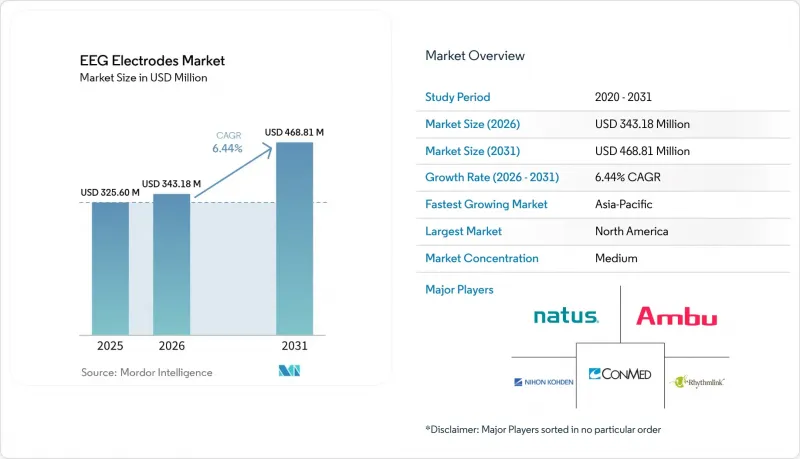
Mordor Intelligence에 의하면, 뇌파 전극 시장 규모는 2025년에 3억 2,560만 달러로 평가되었습니다. 2026년 3억 4,318만 달러에서 2031년까지 4억 6,881만 달러에 이를 것으로 예상되며, 예측 기간(2026-2031년) CAGR은 6.44%를 나타낼 전망입니다.
본 보고서는 제품별(일회용, 재사용 가능, EEG 캡·헤드셋, 전극 어레이, 기타), 기술별(습식, 건식, 반건식, 능동형 등), 용도별(간질, 수면장애, 중환자실(ICU), 외상성 뇌손상 및 뇌졸중, 소아, 기타),최종 사용자(병원, 진단센터, 학술 기관, 제약 기업/CRO, 기타), 지역(북미, 기타)별로 분류되어 있습니다. 예측치는 금액(달러)으로 표시되어 있습니다.
세계의 뇌파 전극 시장 동향 및 인사이트
신경 질환의 부담 증가가 장기적인 뇌파 전극 수요를 뒷받침하고 있습니다.
30억 명 이상이 신경 질환을 앓고 있으며, 관련 건강 부담은 1990년부터 2024년까지의 보고 기간 동안 18% 증가했습니다. 간질은 전 세계적으로 5,000만 명에게 영향을 미치고 있으며, 매년 240만 명의 신규 환자가 진단받고 있습니다. 이러한 질환에서 진단, 발작 평가 또는 반복적인 모니터링이 필요한 경우, 뇌파(EEG) 전극 시장은 그 혜택을 누리게 됩니다. 저소득 국가에서는 인구 10만 명당 신경과 전문의 수가 고소득 국가에 비해 최대 82배나 적은 상황입니다. 이러한 격차로 인해 보다 신속한 임상 판단을 지원할 수 있는 현장 진료(Point-of-Care) 솔루션의 가치가 높아지고 있습니다. 또한, 유럽과 동아시아의 고령화 진행도 치매, 수면장애, 파킨슨병과 관련된 수요를 증가시키고 있습니다.
이러한 수요는 기존의 병원 검사에만 국한되지 않습니다. 환자가 급성기 의료, 외래 진료, 재택 모니터링을 오가면서 반복적인 평가의 중요성이 커지고 있습니다. 이러한 상황에서는 착용이 용이하고, 별다른 준비가 필요 없는 전극이 요구됩니다. 또한, 원격지에서의 확인을 위해 신뢰성 높은 기록을 생성할 수 있는 시스템도 선호됩니다.
일회용 뇌파 전극의 도입은 체계적인 감염 관리 요건을 반영하고 있습니다.
일회용 제품은 감염 관리 노력을 지원하고, 재사용 가능한 전극에 수반되는 재처리 작업을 줄여줍니다. 발표된 비용 대비 효과 연구에 따르면, 일회용 EEG 컵 전극을 사용함으로써 환자 1인당 평균 1.45달러의 비용 절감이 확인되었습니다. 또한, 재사용 가능한 전극의 경우 10만 건의 시술당 33건의 패혈증 위험이 모델링된 반면, 일회용 전극에서는 이러한 위험이 배제된 것으로 보고되었습니다. 이 연구에서는 세척된 재사용형 전극의 25%에서 양성 세균 배양 결과가 확인되었습니다. 이러한 연구 결과는 급성기 의료 환경에서 일회용 뇌파 전극의 도입을 뒷받침합니다. 또한 감염 예방을 최우선 과제로 삼는 일관된 조달 방침을 지지하는 것이기도 합니다.
일회용 제품을 도입하면 직원의 시간과 기록 작성이 필요한 세척 주기가 불필요해집니다. 병원의 공동 조달 조직은 여러 시설에 걸쳐 조달을 표준화함으로써 이러한 이점을 더욱 확대할 수 있습니다. 이러한 계약은 신뢰할 수 있는 생산 능력과 규제 관련 문서를 갖춘 공급업체를 우대하는 것입니다.
전극과 피부의 임피던스 및 운동 아티팩트가 휴대용 뇌파(EEG)의 신뢰성을 제한합니다.
전극-피부 임피던스의 변동은 휴대용 기기 및 실제 임상 환경에서 기록 품질을 저하시킵니다. 2024년 연구에 따르면, 전극의 수직 방향 움직임이 상당한 역위상 아티팩트를 유발하는 것으로 밝혀졌습니다. 또한 케이블 배선 설계의 차이에 따라 캡 시스템마다 아티팩트의 영향을 받는 정도에 차이가 있는 것으로 나타났습니다. 임상 현장에서 임피던스를 관리하기 위해서는 두피 준비나 전도성 젤의 사용이 종종 필요합니다. 이러한 절차는 가정에서의 개인 사용 시 재현하기 어렵습니다. 이로 인해 임상 수준의 정확도가 요구되는 상황에서 도입이 제한되고 있습니다.
습식 Ag/AgCl 전극은 젤이 탈수되기 때문에 5시간 후에 기능을 상실할 가능성이 있습니다. 이러한 제한은 장시간 기록이나 반복적으로 사용되는 용도에 영향을 미칩니다. 세미드라이 및 드라이 설계는 이러한 부담을 줄이는 것을 목표로 하고 있지만, 신호 품질과의 상충 관계는 여전히 남아 있습니다. 재료 연구의 진전에 따라 세미드라이 설계의 전망은 밝아지고 있습니다. 2025년 연구에서는 12시간 동안 접촉 임피던스가 400Ω 미만을 유지하는 세미드라이 하이드로겔 전극이 보고되었습니다. 뇌파 전극 시장은 준비 과정을 간소화하면서도 착용감과 안정성을 유지할 수 있는 설계에 의존하게 될 것입니다.
부문 분석
2025년, 일회용 뇌파 전극은 매출의 38.36%를 차지했습니다. 의료 기관의 구매, 감염 예방, 신속한 도입이 이러한 위치를 뒷받침했습니다. 포인트 오브 케어용 헤드밴드 시스템 덕분에 전극 준비 시간이 30분 이상에서 5분 미만으로 단축되었습니다. Ceribell사의 ‘Instant EEG Headcap’과 일본광전공업사의 ‘CerebBand’는 이러한 접근 방식을 구현하고 있습니다. 착용 시간 단축을 통해 응급 상황 평가 시 전문 인력에 대한 의존도를 낮출 수 있습니다. 이러한 제품들은 중환자실이나 응급 의료 현장에서 특히 유용합니다.
EEG 캡 및 헤드셋 시장은 2026년부터 2031년까지 연평균 성장률(CAGR) 10.86%를 나타낼 것으로 예측됩니다. 그 역할은 BCI(뇌-컴퓨터 인터페이스), 재택 모니터링, 뉴로피드백 용도로 확대되고 있습니다. 에모티브(Emotive)사는 즉각적인 BCI 상호작용을 목적으로 설계된 세미드라이형 폴리머 센서 캡을 제공합니다. 이를 통해 이 캡은 단순한 소모품으로 취급되는 것이 아니라, 보다 광범위한 디지털 플랫폼의 일부로 자리매김하고 있습니다.
습식 전극은 2025년 매출의 48.12%를 차지했습니다. 이러한 위상은 광범위한 임상 검증과 익숙한 워크플로우를 반영합니다. 젤의 탈수로 인해 5시간을 초과하는 모니터링에서는 신뢰성이 저하될 가능성이 있습니다. 이로 인해 연속적이고 반복적인 기록에는 한계가 따릅니다. 그럼에도 불구하고, 확립된 장비와 프로토콜이 갖춰진 현장에서는 습식 방식이 여전히 널리 사용되고 있습니다. 저렴한 비용과 호환성은 일상적인 임상 사용을 지속적으로 뒷받침하고 있습니다.
세미드라이 전극은 2026년부터 2031년에 걸쳐 연평균 성장률(CAGR) 11.81%를 나타낼 것으로 예측됩니다. 이 기술의 뇌파(EEG) 전극 시장 규모는 임피던스, 내구성, 위생성 향상을 목표로 하는 소재 설계에 의해 뒷받침되고 있습니다. 2025년 하이드로겔에 관한 연구에서는 1회 세션당 2시간, 21일간 연속으로 안정적인 데이터 수집이 가능함이 확인되었습니다.
지역별 분석
2025년, 북미는 매출의 41.78%를 차지했습니다. 미국은 의료비 지출, 간질 모니터링 장치, 그리고 확립된 급성기 의료용 EEG 인프라를 통해 지역 수요를 주도하고 있습니다. 또한, FDA의 승인 활동도 신경기술 제품의 활용 범위를 확대되고 있습니다. Ceribell사는 2026년 1월, 대혈관 폐쇄성 뇌졸중의 감지 및 모니터링 솔루션에 대해 FDA의 ‘획기적 의료기기(Breakthrough Device) 지정’을 획득했습니다. 유럽은 뇌파(EEG) 전극 시장에서 두 번째로 큰 규모를 자랑하는 지역입니다. 독일, 프랑스, 영국, 이탈리아, 스페인이 수요의 핵심을 형성하고 있습니다. 2026년 시점에서 독일 인구의 23.00% 이상이 65세 이상이며, 이것이 신경학적 모니터링 수요를 뒷받침하고 있습니다.
아시아태평양은 2026년부터 2031년까지 연평균 성장률(CAGR) 11.32%를 나타낼 것으로 예측됩니다. 중국, 인도, 일본, 한국이 이 지역의 성장 기반을 형성하고 있습니다. 중국에서는 병원 확충 및 신경학적 진단 역량에 대한 투자를 통해 뇌파(EEG) 전극 시장이 뒷받침되고 있습니다. 인도에서는 뭄바이, 델리, 방갈로르와 같은 대도시권을 중심으로 성장하고 있지만, 농촌 지역의 이용 기회는 여전히 제한적입니다. 일본과 호주에서는 웨어러블 뇌 모니터링 제품에 대한 전자기 호환성(EMC) 요건이 강화되고 있습니다. 한국에서는 Ybrain사가 2025년에 Korea Pharma사와 정신과용 뇌파(EEG) 진단 시스템 판매 계약을 체결한 것이 주목을 받았습니다.
기타 혜택 :
- 엑셀 형식 시장 예측(ME) 시트
- 3개월간의 애널리스트 지원
자주 묻는 질문
목차
제1장 서론
제2장 조사 방법
제3장 주요 요약
제4장 시장 구도
제5장 시장 규모 및 성장 예측
제6장 경쟁 구도
제7장 시장 기회 및 향후 전망
KTH 26.09.10According to Mordor Intelligence, the EEG electrodes market size was valued at USD 325.60 million in 2025 and is estimated to grow from USD 343.18 million in 2026 to reach USD 468.81 million by 2031, at a CAGR of 6.44% during the forecast period (2026-2031).
This report is Segmented by Product Offering (Disposable, Reusable, EEG Caps & Headsets, Electrode Arrays, Others), Technology Offering (Wet, Dry, Semi-Dry, Active, and More), Application (Epilepsy, Sleep Disorder, ICU, TBI & Stroke, Pediatric, and More), End User (Hospitals, Diagnostic Centers, Academic, Pharma/CROs, Others), and Geography (North America and More). Forecasts are Provided in Value (USD).
Global EEG Electrodes Market Trends and Insights
Rising Neurological Disorder Burden Sustains Long-Cycle EEG Electrode Demand
More than 3 billion people live with neurological conditions, and the related health burden rose 18% between 1990 and the 2024 report period. Epilepsy affects 50 million people globally, with 2.4 million new diagnoses each year. The EEG electrodes market benefits when these conditions require diagnosis, seizure assessment, or repeated monitoring. Low-income countries have up to 82 times fewer neurologists per 100,000 people than high-income countries. This gap increases the value of point-of-care solutions that can support faster clinical decisions. Aging populations in Europe and East Asia also increase demand related to dementia, sleep disorders, and Parkinson's disease.
The need is not limited to conventional hospital testing. Repeated assessment is becoming more relevant as patients move between acute care, outpatient care, and home monitoring. This pattern supports electrodes that are easier to apply and less dependent on extensive preparation. It also favors systems that can produce reliable recordings for remote review.
Disposable EEG Electrodes Adoption Reflects Systemic Infection-Control Requirements
Disposable products support infection-control practices and reduce the reprocessing work associated with reusable electrodes. A published cost-effectiveness study found an average saving of USD 1.45 per patient for single-use EEG cup electrodes. It also reported that single-use electrodes eliminated the modeled sepsis risk, compared with 33 cases per 100,000 procedures for reusable electrodes. The study noted positive bacterial cultures on 25% of cleaned reusable electrodes. These findings strengthen the case for disposable EEG Electrodes in acute-care environments. They also support consistent procurement policies where infection prevention is a priority.
Single-use products remove cleaning cycles that require staff time and documentation. Hospital group purchasing organizations can extend this advantage by standardizing purchasing across multiple sites. Such contracts favor suppliers with dependable production capacity and regulatory documentation.
Electrode-Skin Impedance and Motion Artifacts Constrain Ambulatory EEG Reliability
Electrode-skin impedance variation reduces recording quality in ambulatory and real-world settings. A 2024 study found that vertical electrode movement introduced substantial out-of-phase artifacts. It also showed that cap systems differed in artifact susceptibility because of cable-routing design. Clinical impedance practices often require scalp preparation and conductive gel. These steps are difficult to reproduce in independent home use. This limits adoption where clinical-grade accuracy is necessary.
Wet Ag/AgCl electrodes can lose function after 5 hours as the gel dehydrates. This limitation affects long recordings and repeated-use applications. Semi-dry and dry designs seek to reduce this burden, but signal quality tradeoffs remain. Material research is improving the outlook for semi-dry designs. A 2025 study reported a semi-dry hydrogel electrode with contact impedance below 400 Ω over 12 hours. The EEG electrodes market will depend on designs that preserve comfort and stability while reducing preparation requirements.
Other drivers and restraints analyzed in the detailed report include:
- Expansion of Portable and Home-Based EEG Monitoring Opens New Care Settings
- BCI and Neurofeedback Commercialization Creates Additional Electrode Demand
- High Total Cost of Ownership Limits Advanced EEG Uptake
For complete list of drivers and restraints, kindly check the Table Of Contents.
Segment Analysis
Disposable EEG Electrodes held 38.36% of revenue in 2025. Institutional purchasing, infection prevention, and rapid deployment supported this position. Point-of-care headband systems have reduced electrode preparation from more than 30 minutes to less than 5 minutes. Ceribell's Instant EEG Headcap and Nihon Kohden's CerebBand illustrate this approach. Faster placement can reduce the need for specialized staff during urgent assessment. These products are particularly relevant in intensive care and emergency settings.
EEG Caps & Headsets are forecast to grow at a 10.86% CAGR from 2026 to 2031. Their role is expanding across BCI, home monitoring, and neurofeedback use. Emotiv offers semi-dry polymer sensor caps designed for immediate BCI interaction. This places the cap within a broader digital platform rather than treating it as only a consumable.
Wet Electrodes held 48.12% of revenue in 2025. Their position reflects extensive clinical validation and familiar workflows. Gel dehydration can reduce their reliability in monitoring that extends beyond 5 hours. This creates limitations for continuous and repeated recordings. Wet formats nevertheless remain widely used where established equipment and protocols are in place. Their low cost and compatibility continue to support routine clinical use.
Semi-Dry Electrodes are projected to grow at an 11.81% CAGR from 2026 to 2031. The EEG electrodes market size for this technology is supported by material designs that aim to improve impedance, durability, and hygiene. The 2025 hydrogel study found stable acquisition over 21 consecutive days at 2 hours per session.
Complete Report Scope:
- By Product Offering
- Disposable EEG Electrodes
- Reusable EEG Electrodes
- EEG Caps & Headsets
- Electrode Arrays & High-Density Sets
- Others (Ear-EEG & In-Ear Electrodes, Textile & Wearable EEG Systems)
- By Technology Offering
- Wet Electrodes
- Dry Electrodes
- Semi-Dry Electrodes
- Active Electrodes
- Passive Electrodes
- Other (High-Density EEG Electrodes, Hybrid Electrodes)
- By Application
- Epilepsy and Seizure Monitoring
- Sleep Disorder Diagnosis
- ICU Monitoring
- TBI & Stroke Assessment
- Pediatric Neurology
- Pre-Surgical Mapping
- Neurofeedback
- Neuromodulation therapies
- Brain stimulation monitoring
- Others
- By End User
- Hospitals & Neurology Clinics
- Diagnostic & Sleep Centers
- Academic & Research Institutes
- Pharmaceutical and Contract Research Organizations
- Others (Home Healthcare Providers, Consumer and Wellness Providers)
- By Geography
- North America
- United States
- Canada
- Mexico
- Europe
- Germany
- United Kingdom
- France
- Italy
- Spain
- Rest of Europe
- Asia-Pacific
- China
- India
- Japan
- Australia
- South Korea
- Rest of Asia-Pacific
- Middle East and Africa
- GCC
- South Africa
- Rest of Middle East and Africa
- South America
- Brazil
- Argentina
- Rest of South America
- North America
Geography Analysis
North America held 41.78% of revenue in 2025. The United States leads regional demand through healthcare spending, epilepsy monitoring units, and established acute-care EEG infrastructure. FDA clearance activity is also broadening the use of neurotechnology products. Ceribell received FDA Breakthrough Device Designation for its large-vessel-occlusion stroke detection and monitoring solution in January 2026. Europe is the second-largest regional area for the EEG electrodes market. Germany, France, the United Kingdom, Italy, and Spain form the core of demand. More than 23.00% of Germany's population is aged 65 and above in 2026, supporting neurological monitoring needs.
Asia-Pacific is forecast to grow at an 11.32% CAGR from 2026 to 2031. China, India, Japan, and South Korea form the regional growth base. China supports the EEG electrodes market through hospital expansion and investment in neurological diagnostic capacity. India is growing through metropolitan centers in Mumbai, Delhi, and Bangalore, although rural access remains limited. Japan and Australia have tightened electromagnetic compatibility expectations for wearable brain-monitoring products. South Korea gained attention after Ybrain's 2025 distribution agreement with Korea Pharma for its psychiatric EEG diagnostic system.
- Ambu
- ANT Neuro B.V.
- BIOPAC Systems, Inc.
- Brain Products GmbH
- Cadwell
- Ceribell, Inc.
- Compumedics
- Conmed
- DIXI Medical
- EB Neuro
- Electrical Geodesics, Inc. (EGI)
- g.tec medical engineering
- Micromed S.p.A.
- Mitsar Co., Ltd.
- Natus Medical
- Neuroelectrics Corp.
- Nihon Kohden
- Rhythmlink International, LLC
- Wearable Sensing, Inc.
Additional Benefits:
- The market estimate (ME) sheet in Excel format
- 3 months of analyst support
TABLE OF CONTENTS
1 Introduction
- 1.1 Study Assumptions & Market Definition
- 1.2 Scope of the Study
2 Research Methodology
3 Executive Summary
4 Market Landscape
- 4.1 Market Overview
- 4.2 Market Drivers
- 4.2.1 Rising Neurological Disorder Burden
- 4.2.2 Disposable Electrode Adoption for Infection-Control Workflows
- 4.2.3 Expansion of Portable and Home-Based EEG Monitoring
- 4.2.4 Commercialization of Brain-Computer Interface and Neurofeedback Applications
- 4.2.5 In-Ear, Hair-Strand, and Conductive-Textile Electrode Development
- 4.2.6 Electrode Integration With AI-Enabled EEG Interpretation
- 4.3 Market Restraints
- 4.3.1 Electrode-Skin Impedance and Motion-Artifact Variability
- 4.3.2 High Total Cost of Ownership for Advanced EEG Workflows
- 4.3.3 Limited Interoperability Across Electrode, Cap, and Amplifier Ecosystems
- 4.3.4 Disposal Burden and Sustainability Concerns From Single-Use Electrodes
- 4.4 Supply-Chain Analysis
- 4.5 Regulatory Landscape
- 4.6 Technological Outlook
- 4.7 Porter's Five Forces Analysis
- 4.7.1 Threat of New Entrants
- 4.7.2 Bargaining Power of Suppliers
- 4.7.3 Bargaining Power of Buyers
- 4.7.4 Threat of Substitutes
- 4.7.5 Industry Rivalry
5 Market Size & Growth Forecasts (Value, USD)
- 5.1 By Product Offering
- 5.1.1 Disposable EEG Electrodes
- 5.1.2 Reusable EEG Electrodes
- 5.1.3 EEG Caps & Headsets
- 5.1.4 Electrode Arrays & High-Density Sets
- 5.1.5 Others (Ear-EEG & In-Ear Electrodes, Textile & Wearable EEG Systems)
- 5.2 By Technology Offering
- 5.2.1 Wet Electrodes
- 5.2.2 Dry Electrodes
- 5.2.3 Semi-Dry Electrodes
- 5.2.4 Active Electrodes
- 5.2.5 Passive Electrodes
- 5.2.6 Other (High-Density EEG Electrodes, Hybrid Electrodes)
- 5.3 By Application
- 5.3.1 Epilepsy and Seizure Monitoring
- 5.3.2 Sleep Disorder Diagnosis
- 5.3.3 ICU Monitoring
- 5.3.4 TBI & Stroke Assessment
- 5.3.5 Pediatric Neurology
- 5.3.6 Pre-Surgical Mapping
- 5.3.7 Neurofeedback
- 5.3.8 Neuromodulation therapies
- 5.3.9 Brain stimulation monitoring
- 5.3.10 Others
- 5.4 By End User
- 5.4.1 Hospitals & Neurology Clinics
- 5.4.2 Diagnostic & Sleep Centers
- 5.4.3 Academic & Research Institutes
- 5.4.4 Pharmaceutical and Contract Research Organizations
- 5.4.5 Others (Home Healthcare Providers, Consumer and Wellness Providers)
- 5.5 By Geography
- 5.5.1 North America
- 5.5.1.1 United States
- 5.5.1.2 Canada
- 5.5.1.3 Mexico
- 5.5.2 Europe
- 5.5.2.1 Germany
- 5.5.2.2 United Kingdom
- 5.5.2.3 France
- 5.5.2.4 Italy
- 5.5.2.5 Spain
- 5.5.2.6 Rest of Europe
- 5.5.3 Asia-Pacific
- 5.5.3.1 China
- 5.5.3.2 India
- 5.5.3.3 Japan
- 5.5.3.4 Australia
- 5.5.3.5 South Korea
- 5.5.3.6 Rest of Asia-Pacific
- 5.5.4 Middle East and Africa
- 5.5.4.1 GCC
- 5.5.4.2 South Africa
- 5.5.4.3 Rest of Middle East and Africa
- 5.5.5 South America
- 5.5.5.1 Brazil
- 5.5.5.2 Argentina
- 5.5.5.3 Rest of South America
- 5.5.1 North America
6 Competitive Landscape
- 6.1 Market Concentration
- 6.2 Market Share Analysis
- 6.3 Company Profiles {(includes Global level Overview, Market level overview, Core Segments, Financials as available, Strategic Information, Market Rank/Share for key companies, Products & Services, and Recent Developments)}
- 6.3.1 Ambu A/S
- 6.3.2 ANT Neuro B.V.
- 6.3.3 BIOPAC Systems, Inc.
- 6.3.4 Brain Products GmbH
- 6.3.5 Cadwell Industries, Inc.
- 6.3.6 Ceribell, Inc.
- 6.3.7 Compumedics Limited
- 6.3.8 CONMED Corporation
- 6.3.9 DIXI Medical
- 6.3.10 EB Neuro S.p.A.
- 6.3.11 Electrical Geodesics, Inc. (EGI)
- 6.3.12 g.tec medical engineering GmbH
- 6.3.13 Micromed S.p.A.
- 6.3.14 Mitsar Co., Ltd.
- 6.3.15 Natus Medical Incorporated
- 6.3.16 Neuroelectrics Corp.
- 6.3.17 Nihon Kohden Corporation
- 6.3.18 Rhythmlink International, LLC
- 6.3.19 Wearable Sensing, Inc.
7 Market Opportunities & Future Outlook
- 7.1 White-space & unmet-need assessment