

|
시장보고서
상품코드
2119376
소생용 마스크 : 시장 점유율 분석, 업계 동향 및 통계, 성장 예측(2026-2031년)Resuscitation Masks - Market Share Analysis, Industry Trends & Statistics, Growth Forecasts (2026 - 2031) |
||||||
 Mordor Intelligence
Mordor Intelligence에 의하면, 소생용 마스크 시장 규모는 2025년 14억 4,000만 달러로 평가되었습니다. 2026년에는 15억 1,000만 달러로 확대되어 2031년까지 20억 9,000만 달러에 이를 것으로 예상되고 2026년부터 2031년에 걸쳐 CAGR 6.66%로 성장할 전망입니다.
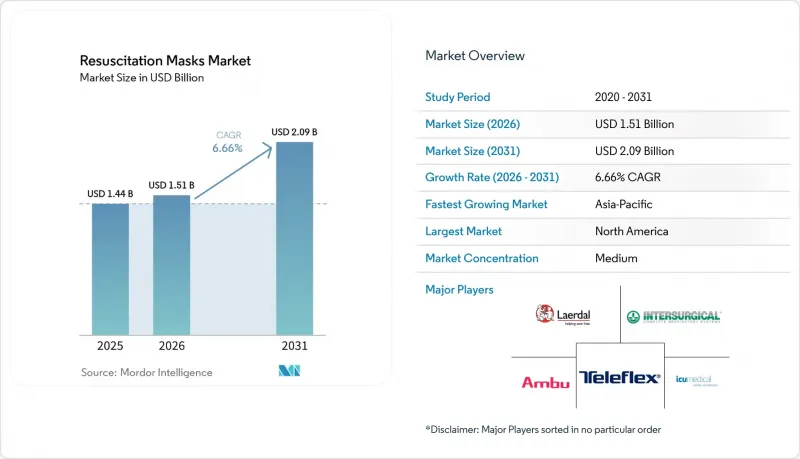
본 보고서는 제품 유형(일회용, 재사용 가능, 고급 밸브 장착 마스크, 기타), 용도(단일 사용, 다회 사용), 환자 유형(성인, 소아, 신생아),적응증(심정지, 호흡부전, 신생아 소생, 외상, COPD), 최종 사용자(병원, 구급차/EMS, 진료소, ASC, 기타), 지역(북미, 유럽, 아시아태평양, 기타)별로 분류되어 있습니다. 시장 예측은 금액(달러) 기준입니다.
세계의 소생용 마스크 시장 동향 및 인사이트
1인용 기기에 대한 감염 관리 선호도
소생용 마스크 시장은 1인용 기도 확보 기기를 일상적인 감염 관리 요건으로 취급하는 조달 관행의 혜택을 지속적으로 받고 있습니다. 미국 식품의약국(FDA)은 심폐소생용 마스크를 21 CFR Part 880에 근거한 클래스 II 의료기기로 분류하고 있으며, 이에 따라 제품의 설계와 문서화가 구매 결정의 핵심이 됩니다. 일회용 형태는 멸균 검증의 필요성을 줄이고, 재처리와 관련된 기록 관리를 간소화합니다. 또한, 사용 후 마스크를 교체함으로써 병원 및 응급 의료 기관은 재고 수준을 보다 안정적으로 유지할 수 있습니다. 앰브(Amb)사는 2025년에 ‘킹마스크(King Mask)’ 시리즈를 프탈레이트 및 DEHP가 포함되지 않은 소재로 변경하여, 소재의 규정 준수 및 크기 식별을 더욱 명확히 할 수 있음을 보여주었습니다. 따라서 소생용 마스크 시장은 일회용 기도 장비를 표준화하고 있는 시설로부터 안정적인 재주문 기반을 확보하고 있습니다.
CPR 교육의 확대와 일반인을 위한 소생술 프로그램
CPR 교육 프로그램을 통해 마스크 수요는 학교, 직장, 지역 사회 단체, 그리고 응급 키트 프로그램까지 확대되고 있습니다. 미국 적십자사는 2025년에 하루 평균 약 8,000명에게 CPR 및 AED 사용법을 교육했으며, 82만 4,000명 이상의 의료 종사자와 구급대원이 해당 단체의 ‘Resuscitation Suite’ 프로그램을 수료했습니다. 미국심장협회(AHA) 보고서에 따르면, 2025년에는 미국 내 병원 외 심정지 환자의 41%가 구급대가 도착하기 전에 심폐소생술을 받았습니다. 동 협회의 2025년 지침에서는 미디어 캠페인, 강사 주도 교육, 그리고 12세 이상 어린이를 대상으로 한 심폐소생술 교육이 권장되고 있습니다. 이러한 노력으로 인해 초보자용 포켓 마스크나 소생 키트를 사용할 가능성이 있는 사람들의 기반이 확대될 것입니다. 일반인을 대상으로 한 제세동 프로그램에서 마스크가 AED나 응급 대응 장비와 세트로 제공되게 되면, 소생용 마스크 시장에 새로운 판매 경로가 생겨날 것입니다.
시행자에 따른 환기 품질의 편차
기존의 마스크 환기는 사용자의 기술에 크게 의존하고 있으며, 이는 표준 제품에 대한 신뢰를 저해하는 요인이 될 수 있습니다. Archeon Medical사가 2025년 프랑스에서 실시한 현장 조사에 따르면, 훈련을 받은 응급의료 전문가의 60% 이상이 지침에 부합하는 1회 환기량을 달성하지 못했습니다. 이 조사에서는 불충분한 환기가 생존 확률을 13.5%에서 4.1%로 낮추는 요인임이 밝혀졌습니다. 2025년 『Transactions on Additive Manufacturing Meets Medicine』지에 게재된 연구에 따르면, 기초 소생술(BLS) 중 발생한 과환기 사건의 79%가 기존의 BVM(수동 호흡백) 사용에서 기인한 것으로 밝혀졌습니다. 이러한 성능상의 격차는 기본적인 마스크 시스템에 대한 조달 시 신뢰를 저해할 가능성이 있습니다. 반면, 이 사실은 사용자가 보다 정밀하게 환기를 제어할 수 있도록 지원하는 고급 밸브 기능 및 피드백 기능을 갖춘 제품에 대한 수요를 뒷받침하고 있습니다.
부문별 분석
2025년 기준, 일회용 소생 마스크는 시장 가치의 58.41%를 차지하며 소생 마스크 시장에서 1위를 유지했습니다. 응급 의료 부문, 구급차용 키트 및 일반 시민 대상 프로그램에서의 사용 현황은 환자 1명당 처치 후 장치를 교체하는 것의 실용적 가치를 반영하고 있습니다. 일회용 제품의 도입으로 재처리 절차 기록이 불필요해졌으며, 재고 관리도 간소화되었습니다. FDA의 클래스 II 프레임워크에 따라 안전성, 설계 및 감염 관리 기능은 구매 결정에 있어 여전히 중요한 요소로 남아 있습니다.
재사용 가능한 마스크는 교육 현장이나 신뢰할 수 있는 멸균 절차가 확립된 시설에서 여전히 중요한 역할을 하고 있습니다. 앰브(Amb)사의 ‘Oval Plus 실리콘 소생 마스크’는 재사용을 통한 경제성이 제품 선정의 근거가 될 수 있는 좋은 예입니다. 포켓형 CPR 마스크나 산소 포트 일체형 디자인은 컴팩트한 보관이 중요한 지역 응급 대응 및 재택 간호 수요를 충족시키고 있습니다. 첨단 밸브가 장착된 마스크는 가장 빠르게 성장하는 제품 카테고리이며, 2031년까지의 예측 연평균 성장률(CAGR)은 7.83%를 나타낼 전망입니다. 이러한 성장은 소생 중 수동 환기 시 발생하는 편차를 줄일 필요성을 반영하고 있습니다. 인터서지컬(InterSurgical)사의 ‘VT Select BVM’은 제어된 환기량 공급을 지원하도록 설계되어 제품 개발의 방향성을 보여주고 있습니다.
2025년, 일회용 소생 마스크는 소생 마스크 시장 규모의 58.44%를 차지했으며, 2031년까지 연평균 성장률(CAGR) 6.78%를 나타낼 것으로 예측됩니다. 이러한 형태는 병원의 감염 관리 절차 및 응급 대응 후 응급의료서비스(EMS)에 의한 비품 보충과 밀접하게 연계되어 있습니다. 재사용 가능한 기기의 세척 및 멸균에 수반되는 시간적 부담과 검증 부담을 피할 수 있습니다. 또한, 여러 응급 거점을 담당하는 구매 담당자의 경우, 수량별 재고 관리가 용이해집니다. 이러한 운영상의 이점은 병원, 구급차 및 일반용 응급 키트에서 나타나는 정기적인 재주문 패턴을 뒷받침하고 있습니다. 따라서 소생용 마스크 시장은 일관되고 지속적인 수요를 유지하기 위해 계속해서 일회용 제품에 의존하고 있습니다.
지역별 분석
2025년, 북미는 세계 시장의 41.23%를 차지하며 소생용 마스크 시장에서 가장 규모가 큰 지역이 되었습니다. 2025년, CARES는 36개 주 전역에 걸친 등록 제도를 통해 1억 8,900만 명 이상을 포괄하며, 상세한 응급 대응 인프라를 뒷받침했습니다. AHA의 2025년 지침은 보다 광범위한 CPR(심폐소생술) 교육과 개정된 신생아 소생 프로토콜을 권장하고 있습니다.
유럽은 성숙한 병원 전 의료 체계와 규제 준수에 대한 강력한 집중 덕분에 계속해서 주요 지역 수요의 중심지로 자리 잡고 있습니다. ERC의 2025년판 성인 및 신생아 지침에 따라 각국의 응급의료서비스(EMS) 시스템과 병원 네트워크 전반에 걸쳐 조달 재검토가 진행되었습니다.
아시아태평양은 2031년까지 연평균 성장률(CAGR) 7.65%를 나타낼 것으로 예측되며, 이는 소생용 마스크 시장에서 각 지역 중 가장 높은 성장률입니다. 정부의 응급의료(EMS) 체계 구축, 심혈관 질환의 부담, 그리고 공인된 소생 프로토콜의 보급이 이러한 성장을 뒷받침하고 있습니다. 중국과 일본은 확고한 병원 수요를 제공하는 반면, 한국에서는 지역사회 및 응급의료(EMS) 대응 활동이 활발합니다. 호주의 전국 신생아 데이터에 따르면, 최근 몇 년간 출생아의 10.3%가 양압 환기를 받았습니다.
기타 혜택 :
- 엑셀 형식 시장 예측(ME) 시트
- 3개월간의 애널리스트 지원
자주 묻는 질문
목차
제1장 서론
제2장 조사 방법
제3장 개요
제4장 시장 구도
제5장 시장 규모 및 성장 예측
제6장 경쟁 구도
제7장 시장 기회 및 향후 전망
KTH 26.09.02According to Mordor Intelligence, the resuscitation masks market size is expected to increase from USD 1.44 billion in 2025 to USD 1.51 billion in 2026 and reach USD 2.09 billion by 2031, growing at a CAGR of 6.66% over 2026-2031.
This report is Segmented by Product Type (Disposable, Reusable, Advanced Valve Masks, Others), Usage (Single-Use, Multi-Use), Patient Type (Adult, Pediatric, Neonatal), Application (Cardiac Arrest, Resp. Failure, Neonatal Resuscitation, Trauma, COPD), End User (Hospitals, Ambulance/EMS, Clinics, Ascs, Others), Geography (North America, Europe, Asia-Pacific, and More). Market Forecasts in Value (USD).
Global Resuscitation Masks Market Trends and Insights
Infection-Control Preference for Single-Patient-Use Devices
The resuscitation masks market continues to benefit from procurement practices that treat single-patient-use airways as a routine infection-control requirement. The U.S. Food and Drug Administration classifies cardiopulmonary resuscitation masks as Class II devices under 21 CFR Part 880, which places product design and documentation at the center of purchasing decisions. Single-use formats reduce the need for sterilization validation and simplify records associated with reprocessing. Hospitals and EMS agencies can also maintain more consistent stock levels when a mask is replaced after use. Ambu changed its King Mask line to phthalate-free and DEHP-free materials in 2025, showing how material compliance can be paired with clearer size identification. The resuscitation masks market, therefore, receives a dependable reorder base from facilities that standardize on disposable airway supplies.
Wider CPR Training and Public-Access Resuscitation Programs
CPR training programs extend mask demand into schools, workplaces, community groups, and first-aid kit programs. The American Red Cross trained nearly 8,000 people each day in CPR and AED use during 2025, while more than 824,000 health professionals and first responders completed its Resuscitation Suite programs. The American Heart Association reported that 41% of U.S. out-of-hospital cardiac arrest victims received CPR before EMS arrived in 2025. Its 2025 guidance supports media campaigns, instructor-led training, and CPR education for children aged 12 and above. These measures enlarge the base of people who may use entry-level pocket masks and resuscitation kits. The resuscitation masks market gains an additional purchasing channel when public-access defibrillation programs bundle masks with AED and first-response equipment.
Operator-Dependent Ventilation Quality
Conventional mask ventilation depends heavily on the user's technique, which can constrain confidence in standard products. Archeon Medical's 2025 French field study found that more than 60% of trained EMS professionals did not achieve guideline-compliant tidal volumes. The study associated inadequate ventilation with a reduction in survival odds from 13.5% to 4.1%. A 2025 study in Transactions on Additive Manufacturing Meets Medicine found that conventional BVM use accounted for 79% of hyperventilation events during basic life support. This performance gap can limit procurement confidence in basic mask systems. At the same time, it supports demand for advanced valve and feedback-enabled products that help users deliver more controlled ventilation.
Other drivers and restraints analyzed in the detailed report include:
- Growth in Cardiac Arrest and Respiratory Emergency Interventions
- Protocol-Led Demand for Neonatal and Pediatric Fit
- Low-Resource-Market Price Sensitivity
For complete list of drivers and restraints, kindly check the Table Of Contents.
Segment Analysis
Disposable resuscitation masks held 58.41% of value in 2025, giving them the leading position in the resuscitation masks market. Their use across emergency departments, ambulance kits, and public-access programs reflects the practical value of replacing a device after a single patient encounter. Single-use procurement reduces the need to document reprocessing steps and can simplify inventory control. The FDA's Class II framework keeps safety, design, and infection-control features important in purchasing decisions.
Reusable masks remain relevant in training settings and in facilities that have reliable sterilization procedures. Ambu's Oval Plus Silicone Resuscitator illustrates where reuse economics can continue to support product selection. Pocket CPR masks and oxygen-port integrated designs serve community response and home-care needs where compact storage is important. Advanced valve masks are the fastest-growing product category, with a forecast CAGR of 7.83% through 2031. Their growth reflects the need to reduce variation in manual ventilation during resuscitation. Intersurgical's VT Select BVM is designed to support controlled volume delivery and shows the direction of product development.
Single-use resuscitation masks accounted for 58.44% of the resuscitation masks market size in 2025 and are forecast to grow at a 6.78% CAGR through 2031. The format aligns closely with hospital infection-control procedures and with EMS restocking after a response. It avoids the time and validation burden of cleaning and sterilizing reusable devices. It also makes par-level inventory management easier for purchasers responsible for several emergency locations. These operational benefits support routine reorder patterns across hospitals, ambulances, and public-access kits. The resuscitation masks market therefore continues to rely on single-use devices for consistent recurring demand.
Complete Report Scope:
- By Product Type
- Disposable Resuscitation Masks
- Reusable Resuscitation Masks
- Advanced Valve Masks
- Others (Pocket CPR Masks, Masks with Oxygen Port, etc.)
- By Usage
- Single-Use
- Multi-Use and Reprocessable
- By Patient Type
- Adult
- Pediatric
- Neonatal
- By Application
- Cardiopulmonary Arrest
- Respiratory Failure and Apnea
- Neonatal Resuscitation
- Trauma and Prehospital Care
- Chronic Obstructive Pulmonary Disease Emergencies
- By End User
- Hospitals and Critical-Care Units
- Ambulance Services and Emergency Medical Services
- Clinics and Urgent-Care Centers
- Ambulatory Surgical Centers
- Others (Home Care and Community Responders, Training Institutes and CPR Education Centers, etc.)
- By Geography
- North America
- United States
- Canada
- Mexico
- Europe
- Germany
- United Kingdom
- France
- Italy
- Spain
- Rest of Europe
- Asia-Pacific
- China
- India
- Japan
- Australia
- South Korea
- Rest of Asia-Pacific
- Middle East and Africa
- GCC
- South Africa
- Rest of Middle East and Africa
- South America
- Brazil
- Argentina
- Rest of South America
- North America
Geography Analysis
North America held 41.23% of the global value in 2025, making it the largest regional part of the resuscitation masks market. CARES covered more than 189 million people through 36 statewide registries in 2025, supporting a detailed emergency response infrastructure. The AHA's 2025 guidelines support broader CPR training and revised neonatal resuscitation protocols.
Europe remains a major regional demand center because of mature prehospital care systems and a strong focus on regulatory compliance. The ERC's 2025 adult and neonatal guidance prompted purchasing reviews across national EMS systems and hospital networks.
Asia-Pacific is forecast to grow at a 7.65% CAGR through 2031, the highest rate among the regions in the resuscitation masks market. Government EMS development, cardiovascular disease burden, and wider use of recognized resuscitation protocols support this growth. China and Japan provide established hospital demand, while South Korea has a strong community and EMS response activity. Australia's national neonatal data showed that 10.3% of live births received positive-pressure ventilation in recent years.
- Allied Healthcare Products
- Ambu
- Beckton Dickinson
- Besmed Health Business
- BLS Systems Limited
- Cardinal Health
- Dragerwerk
- Dynarex
- HUM
- ICU Medical
- Intersurgical Ltd.
- Laerdal Medical
- Medline Industries
- Mercury Medical
- O-Two Medical Technologies Inc.
- Teleflex
- Vyaire Medical
- WEINMANN Emergency Medical Technology GmbH
Additional Benefits:
- The market estimate (ME) sheet in Excel format
- 3 months of analyst support
TABLE OF CONTENTS
1 Introduction
- 1.1 Study Assumptions & Market Definition
- 1.2 Scope of the Study
2 Research Methodology
3 Executive Summary
4 Market Landscape
- 4.1 Market Overview
- 4.2 Market Drivers
- 4.2.1 Infection-Control Preference for Single-Patient-Use Devices
- 4.2.2 Expansion of Emergency Medical Services and Ambulance Fleets
- 4.2.3 Wider CPR Training and Public-Access Resuscitation Programs
- 4.2.4 Growth in Cardiac Arrest and Respiratory Emergency Interventions
- 4.2.5 Protocol-Led Demand for Neonatal and Pediatric Fit
- 4.2.6 Procurement Shift Toward Integrated, Error-Reducing Kits
- 4.3 Market Restraints
- 4.3.1 Operator-Dependent Ventilation Quality
- 4.3.2 Low-Resource-Market Price Sensitivity
- 4.3.3 Disposable-Plastic Sustainability and Waste Requirements
- 4.3.4 Substitution by Advanced Airway and Automated Ventilation Solutions
- 4.4 Supply-Chain Analysis
- 4.5 Regulatory Landscape
- 4.6 Technological Outlook
- 4.7 Porter's Five Forces Analysis
- 4.7.1 Threat of New Entrants
- 4.7.2 Bargaining Power of Suppliers
- 4.7.3 Bargaining Power of Buyers
- 4.7.4 Threat of Substitutes
- 4.7.5 Industry Rivalry
5 Market Size & Growth Forecasts (Value, USD)
- 5.1 By Product Type
- 5.1.1 Disposable Resuscitation Masks
- 5.1.2 Reusable Resuscitation Masks
- 5.1.3 Advanced Valve Masks
- 5.1.4 Others (Pocket CPR Masks, Masks with Oxygen Port, etc.)
- 5.2 By Usage
- 5.2.1 Single-Use
- 5.2.2 Multi-Use and Reprocessable
- 5.3 By Patient Type
- 5.3.1 Adult
- 5.3.2 Pediatric
- 5.3.3 Neonatal
- 5.4 By Application
- 5.4.1 Cardiopulmonary Arrest
- 5.4.2 Respiratory Failure and Apnea
- 5.4.3 Neonatal Resuscitation
- 5.4.4 Trauma and Prehospital Care
- 5.4.5 Chronic Obstructive Pulmonary Disease Emergencies
- 5.5 By End User
- 5.5.1 Hospitals and Critical-Care Units
- 5.5.2 Ambulance Services and Emergency Medical Services
- 5.5.3 Clinics and Urgent-Care Centers
- 5.5.4 Ambulatory Surgical Centers
- 5.5.5 Others (Home Care and Community Responders, Training Institutes and CPR Education Centers, etc.)
- 5.6 By Geography
- 5.6.1 North America
- 5.6.1.1 United States
- 5.6.1.2 Canada
- 5.6.1.3 Mexico
- 5.6.2 Europe
- 5.6.2.1 Germany
- 5.6.2.2 United Kingdom
- 5.6.2.3 France
- 5.6.2.4 Italy
- 5.6.2.5 Spain
- 5.6.2.6 Rest of Europe
- 5.6.3 Asia-Pacific
- 5.6.3.1 China
- 5.6.3.2 India
- 5.6.3.3 Japan
- 5.6.3.4 Australia
- 5.6.3.5 South Korea
- 5.6.3.6 Rest of Asia-Pacific
- 5.6.4 Middle East and Africa
- 5.6.4.1 GCC
- 5.6.4.2 South Africa
- 5.6.4.3 Rest of Middle East and Africa
- 5.6.5 South America
- 5.6.5.1 Brazil
- 5.6.5.2 Argentina
- 5.6.5.3 Rest of South America
- 5.6.1 North America
6 Competitive Landscape
- 6.1 Market Concentration
- 6.2 Market Share Analysis
- 6.3 Company Profiles {(includes Global level Overview, Market level overview, Core Segments, Financials as available, Strategic Information, Market Rank/Share for key companies, Products & Services, and Recent Developments)}
- 6.3.1 Allied Healthcare Products, Inc.
- 6.3.2 Ambu A/S
- 6.3.3 Becton, Dickinson and Company (BD)
- 6.3.4 Besmed Health Business Corp.
- 6.3.5 BLS Systems Limited
- 6.3.6 Cardinal Health, Inc.
- 6.3.7 Dragerwerk AG & Co. KGaA
- 6.3.8 Dynarex Corporation
- 6.3.9 HUM GmbH
- 6.3.10 ICU Medical, Inc.
- 6.3.11 Intersurgical Ltd.
- 6.3.12 Laerdal Medical
- 6.3.13 Medline Industries, LP
- 6.3.14 Mercury Medical
- 6.3.15 O-Two Medical Technologies Inc.
- 6.3.16 Teleflex Incorporated
- 6.3.17 Vyaire Medical, Inc.
- 6.3.18 WEINMANN Emergency Medical Technology GmbH
7 Market Opportunities & Future Outlook
- 7.1 White-space & unmet-need assessment


