|
시장보고서
상품코드
2119386
비료 가공 및 생산 설비 : 시장 점유율 분석, 업계 동향 및 통계, 성장 예측(2026-2031년)Fertilizer Processing and Production Equipment - Market Share Analysis, Industry Trends & Statistics, Growth Forecasts (2026 - 2031) |
||||||
 Mordor Intelligence
Mordor Intelligence에 의하면, 비료 가공 및 생산 설비 시장은 2025년에 98억 4,000만 달러 규모로 평가되었습니다. 2026년 103억 8,000만 달러에서 2031년까지 135억 8,000만 달러에 이를 것으로 예상되며, 예측 기간(2026-2031년) CAGR은 5.52%를 나타낼 전망입니다.
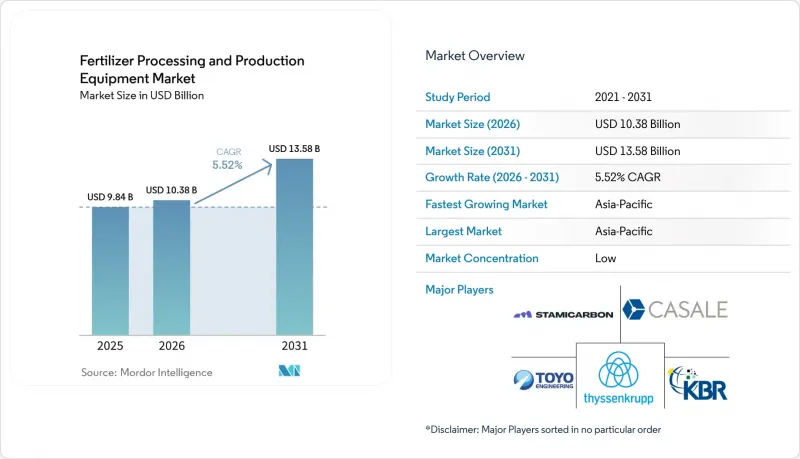
본 보고서는 설비 유형(반응·합성·변환 설비, 원료 조제·계량·혼합 설비 등), 비료 생산 유형(질소 비료, 인산 비료, 칼륨 비료) 및 지역(아시아태평양, 북미 등)별로 분류되어 있습니다. 시장 예측은 금액(달러)으로 표시되어 있습니다.
세계의 비료 가공 및 생산 설비 시장 동향 및 인사이트
고효율 질소 생산 능력 확대
인도의 ‘요소 관련 국가 투자 정책 2026’은 8-9곳의 가스 기반 플랜트를 통해 요소 생산 능력을 1,000만 메트릭 톤 증강하는 것을 목표로 하고 있습니다. 이 정책은 2026년 7월 경제 문제 각료위원회에 의해 승인되었으며, 국내 비료 생산에 대한 신규 투자를 지원하기 위한 것입니다. 신규 플랜트 1기당 암모니아 합성, 요소 전환, 과립화 및 제품 조정 시스템이 필요합니다. 이에 따라 비료 가공 및 생산 설비 시장 전반에 걸쳐 반응기, 컨버터 카트리지, 과립기 및 관련 제어 시스템에 대한 수요가 발생합니다. 또한, 이러한 신규 시설은 가동 기간 동안 교체 부품, 개보수 공사 및 촉매 공급에 대한 미래 수요도 창출할 것입니다. 가격 지원 및 가스 공급 대책은 프로젝트의 위험을 완화하고 설비 조달 기간 단축에 기여할 가능성이 있습니다.
그린 암모니아 및 저탄소 비료 프로젝트
그린 암모니아 프로젝트는 신규 질소 생산 복합 시설의 자본 요건을 변화시키고 있습니다. 생산 경로의 핵심 설비로 증기 메탄 개질 장치를 대신해 전해 장치가 채택되는 한편, 모듈식 합성 시스템은 재생 가능 전력 공급 상황에 따라 유연하게 적응할 수 있게 되었습니다. AM Green사는 2025년 1월, 인도 카키나다에서 연간 150만 메트릭톤 그린 수소 기반 암모니아 플랜트 건설을 시작했으며, 2027년 중반 첫 생산을 목표로 하고 있습니다. EIB Global은 2026년, 파라과이에서 그린 수소를 원료로 하는 비료 프로젝트에 대해 최대 9,500만 달러의 자금 지원을 제공했습니다. 소규모의 모듈식 합성 루프는 유연한 설비 구성을 제공할 수 있는 공급업체에게 유리하게 작용합니다. 이 경로를 통해 비료 가공 및 생산 설비 시장은 기존의 대규모 가스 기반 프로젝트의 범위를 넘어 확대될 것입니다.
열처리의 높은 에너지 집약도
암모니아 합성과 열건조는 비료 생산 과정에서 에너지 집약도가 높은 공정입니다. 유엔 식량농업기구(FAO)에 따르면, 암모니아 플랜트에서는 제품 1메트릭톤당 3,200만-3,600만 영국열량단위(BTU)의 천연가스를 소비합니다. 가스 가격의 급등은 프로젝트의 경제성을 저해하고 설비 선정 과정을 지연시킬 가능성이 있습니다. 회전식 건조기나 유동층 건조기는 요소 과립화 라인의 보조 에너지 수요를 더욱 증가시킵니다. 에너지 소비량 감축을 입증할 수 있는 공급업체는 프로젝트의 수명 주기 운영 비용을 기준으로 평가될 때 우위를 점할 수 있습니다. MAIRE사는 자사의 ‘NX STAMI 초저에너지 요소’ 설계를 통해 기존 공정에 비해 증기 소비량을 35%, 냉각수 사용량을 16% 절감했다고 밝혔습니다.
부문 분석
2025년, 반응·합성·전환 설비는 비료 가공 및 생산 설비 시장 점유율의 28.14%를 차지했습니다. 이는 암모니아 컨버터, 개질 장치, 요소 반응 장치가 고부가가치 플랜트 설비이기 때문입니다. 이러한 시스템은 질소 생산의 핵심을 이루며, 전문적인 공정 기술이 필요합니다. 제품 성형 및 고형화 시스템은 생산자들이 서방형 및 방진성이 뛰어난 제품을 요구함에 따라 2031년까지 연평균 성장률(CAGR) 6.34%로 확대될 것으로 예측됩니다. 이 설비는 펠릿화, 유동층 과립화 및 보다 균일한 과립을 생성하는 기타 방법을 지원합니다. IPCO AB는 2026년, 시간당 최대 처리 용량이 10메트릭톤에 달하는 대용량 페스탈레이션 시스템 ‘Rotoform XG’를 출시했습니다. 이 시스템은 유황 벤토나이트나 요소 혼합물을 포함한 고체 입자가 포함된 저점도 용융물을 처리할 수 있도록 설계되었습니다.
Stamicarbon사의 요소 과립화 기술은 하루 2,000-3,000미터톤 이상의 생산 능력을 갖춘 공장에서 채택되고 있습니다. MAIRE사는 2026년, 서아프리카의 3곳 비료 복합 시설에 대한 기술 라이선싱, 공정 설계 패키지 및 독자적으로 개발한 설비에 대해 4억 8,500만 유로 규모의 계약을 수주했습니다. 원료 전처리, 투입·혼합 장치, 그리고 건조, 냉각, 제품 조정 장치는 많은 시설의 유연한 가공 요구를 충족시킵니다. 통합형 복합 시설이 재활용 루프의 처리 능력을 확대함에 따라 선별, 분쇄 및 재활용 시스템의 중요성이 높아지고 있습니다. 벌크 자재의 자재관리 및 저장 시스템은 대규모 플랜트의 이송 및 저장 요구 사항을 충족시킵니다. 자루 포장, 포장 및 적재 시스템은 농가가 벌크가 아닌 소매용 소포장으로 비료를 구매할 때 유용합니다.
지역별 분석
아시아태평양은 2026년에 비료 가공 및 생산 설비 시장 점유율의 35.06%를 차지했으며, 2031년까지 연평균 성장률(CAGR) 6.18%로 확대될 것으로 전망됩니다. 인도의 요소 투자 정책은 천연가스를 연료로 하는 생산 능력 확충 및 관련 비료 가공 및 생산 설비 시장 수요를 뒷받침하고 있습니다. 중국의 현대화 프로그램은 고효율 설비에 대한 수요를 지속적으로 뒷받침하고 있습니다. MAIRE사는 2025년, 중국 동부에 위치한 일일 2,700메트릭톤 요소 공장에 대한 기술 및 자체 개발 설비 공급 계약을 수주했습니다. 인도네시아도 플랜트 개보수에 투자하고 있으며, 필리핀은 국내 요소 생산을 검토하고 있습니다. 이러한 동향은 아시아태평양에서 브라운필드 및 그린필드 활동 모두 폭넓은 기반을 가지고 있음을 뒷받침합니다.
북미와 유럽은 개조, 기술 라이선싱, 저탄소화 통합 등 비료 가공 및 생산 설비 시장 수요에서 중요한 점유율을 차지하고 있습니다. 멕시코의 페르마카(Fermaca)사는 KBR사의 암모니아 기술과 스태미카본(Stamicarbon)사의 요소 과립화 기술을 채택하여, 2026년에 15억 달러 규모의 질소 비료 복합 시설 건설을 시작했습니다. 이 프로젝트에서는 기존 가공 기술에 탄소 포집 및 처리수 시스템을 결합하고 있습니다. 튀르키예에서는 티센크루프 우데(ThyssenKrupp Ude)사와 존슨 매티(Johnson Mattes)사가 2026년에 IGSAS사의 암모니아 컨버터 현대화를 완료했습니다. 이 공사는 가동 기간 중반에 접어든 플랜트에서 설비 전체를 전면 교체하는 것보다 컨버터 교체가 우선시되는 이유를 보여주었습니다. 유럽의 그린 암모니아 사업 기회 또한 초기 계획 단계에서 설계 작업으로 전환되고 있습니다.
남미, 중동 및 아프리카는 그린필드 비료 가공 및 생산 설비 시장의 수주처로 확대되고 있습니다. 팜파 에너지아(Pampa Energia)는 2026년, 아르헨티나 바이아 블랑카에 27억 달러 규모의 요소 복합 시설 건설을 승인했습니다. 이 프로젝트에서는 테크니몬트(Technimont)가 엔지니어링을, 스태미카본(StamiCarbon)이 요소 기술을, KBR이 암모니아 기술을 제공합니다. 이 지역들의 비료 가공 및 생산 설비 시장은 파라과이, 나이지리아, 사우디아라비아의 프로젝트를 통해서도 혜택을 받고 있습니다. 신규 시설 건설로 인해 반응 장치, 과립화 라인,저장 시스템, 그리고 적재 인프라 전반에 걸쳐 수요가 발생하고 있습니다. 관련 기술 및 서비스를 제공하는 공급업체는 프로젝트 범위의 더 넓은 부분을 담당할 수 있습니다. SABIC Agri-Nutrients는 2026년, 주바이르 산업단지에 위치한 7번째 플랜트에 대한 승인을 받았습니다. 이 공장의 암모니아 생산 능력은 연간 120만 메트릭톤, 요소 생산 능력은 연간 260만 메트릭톤입니다. MAIRE의 서아프리카 계약에는 3개의 복합 시설에 걸쳐 있는 6기의 요소 과립화 유닛이 포함되어 있습니다.
기타 혜택 :
- 엑셀 형식 시장 예측(ME) 시트
- 3개월간의 애널리스트 지원
자주 묻는 질문
목차
제1장 서론
제2장 조사 방법
제3장 주요 요약
제4장 시장 구도
제5장 시장 규모 및 성장 예측
제6장 경쟁 구도
제7장 시장 기회 및 향후 전망
KTH 26.09.10According to Mordor Intelligence, the fertilizer processing and Production Equipment Market was valued at USD 9.84 billion in 2025 and is estimated to grow from USD 10.38 billion in 2026 to reach USD 13.58 billion by 2031, at a CAGR of 5.52% during the forecast period (2026-2031).
This report is Segmented by Equipment Type (Reaction, Synthesis and Conversion Equipment, Feedstock Preparation, Dosing and Mixing Equipment, and More), Fertilizer Production Type (Nitrogen Fertilizers, Phosphate Fertilizers, and Potash Fertilizers), and Geography (Asia-Pacific, North America, and More). The Market Forecasts are Provided in Terms of Value (USD).
Global Fertilizer Processing and Production Equipment Market Trends and Insights
Expansion of High-Efficiency Nitrogen Capacity
India's National Investment Policy for Urea-2026 targets 10 million metric tons of additional urea capacity through 8-9 gas-based plants. The policy was approved by the Cabinet Committee on Economic Affairs in July 2026 and supports new investment in domestic fertilizer production. Each greenfield unit requires ammonia synthesis, urea conversion, granulation, and product-conditioning systems. This creates demand for reactors, converter cartridges, granulators, and associated controls across the fertilizer processing and production equipment market. The new facilities also create future demand for replacement parts, revamp work, and catalyst supply over their operating lives. Price support and gas-supply measures can reduce project risk and help shorten equipment procurement timelines.
Green Ammonia and Low-Carbon Fertilizer Projects
Green ammonia projects are changing capital requirements in new nitrogen production complexes. Electrolyzers replace steam methane reformers as a central item in the production route, while modular synthesis systems can better suit renewable-power availability. AM Green began construction of a 1.5 million metric ton per year green hydrogen-based ammonia plant in Kakinada, India, in January 2025, with initial production targeted for mid-2027. EIB Global supported a green hydrogen-based fertilizer project in Paraguay with financing of up to USD 95 million in 2026. Smaller, modular synthesis loops can favor suppliers that can provide flexible equipment configurations. This route broadens the fertilizer processing and production equipment market beyond conventional large-scale gas-based projects.
High Energy Intensity of Thermal Processing
Ammonia synthesis and thermal drying are energy-intensive parts of fertilizer production. Ammonia plants consumed 32-36 million British thermal units of natural gas per metric ton of product, according to the Food and Agriculture Organization of the United Nations. Higher gas prices can weaken project economics and delay equipment decisions. Rotary dryers and fluidized-bed dryers add to auxiliary energy requirements in urea granulation trains. Suppliers that can document lower energy use can have an advantage when projects are evaluated on lifetime operating costs. MAIRE stated that its NX STAMI Ultra-Low Energy urea design reduced steam consumption by 35% and cooling-water use by 16% compared with conventional processes.
Other drivers and restraints analyzed in the detailed report include:
- Brownfield Revamps for Energy and Emissions Performance
- Rising Demand for Precision Nutrient Formulations
- Feedstock and Project-Finance Volatility
For complete list of drivers and restraints, kindly check the Table Of Contents.
Segment Analysis
The reaction, synthesis and conversion equipment held 28.14% of the fertilizer processing and production equipment market share in 2025 because ammonia converters, reformers, and urea reactors are high-value plant items. These systems form the core of nitrogen production and require specialized process technology. Product forming and solidification systems are projected to advance at a 6.34% CAGR through 2031 as producers seek controlled-release and dust-resistant products. This equipment supports pastillation, fluid-bed granulation, and other methods that produce more consistent granules. IPCO AB introduced the Rotoform XG high-capacity pastillation system in 2026, with a throughput of up to 10 metric tons per hour. The system was designed to handle low-viscosity melts with solid particles, including sulfur bentonite and urea mixes.
Stamicarbon's urea granulation technology has been used in plants with capacities from 2,000 metric tons per day to more than 3,000 metric tons per day. MAIRE received a EUR 485 million contract in 2026 for technology licensing, process design packages, and proprietary equipment at three fertilizer complexes in West Africa. Feedstock preparation, dosing and mixing equipment and drying, cooling and product-conditioning equipment support flexible processing needs at many facilities. Screening, crushing and recycle systems become more important as integrated complexes increase recycle-loop capacity. Bulk material handling and storage systems serve the movement and storage needs of large plants. Bagging, packaging and loading systems benefit where farmers buy fertilizer in smaller retail bags rather than bulk volumes.
Complete Report Scope:
- By Equipment Type
- Reaction, Synthesis and Conversion Equipment
- Feedstock Preparation, Dosing and Mixing Equipment
- Product Forming and Solidification Systems
- Drying, Cooling and Product-Conditioning Equipment
- Screening, Crushing and Recycle Systems
- Bulk Material Handling and Storage Systems
- Bagging, Packaging and Loading Systems
- By Fertilizer Production Type
- Nitrogen Fertilizers
- Phosphate Fertilizers
- Potash Fertilizers
- By Geography
- Asia-Pacific
- China
- India
- Japan
- South Korea
- ASEAN Countries
- Rest of Asia-Pacific
- North America
- United States
- Canada
- Mexico
- Europe
- Germany
- United Kingdom
- France
- Italy
- NORDIC Countries
- Rest of Europe
- South America
- Brazil
- Argentina
- Rest of South America
- Middle-East and Africa
- Saudi Arabia
- South Africa
- Rest of Middle-East and Africa
- Asia-Pacific
Geography Analysis
Asia-Pacific held 35.06% of the fertilizer processing and production equipment market share in 2026 and is projected to advance at a 6.18% CAGR through 2031. India's urea investment policy supports gas-based capacity additions and related fertilizer processing and production equipment market demand. China's modernization program continues to support demand for higher-efficiency equipment. MAIRE received a contract in 2025 for technology and proprietary equipment for a 2,700 metric ton per day urea plant in Eastern China. Indonesia is also investing in plant upgrades, while the Philippines has examined domestic urea production. These developments reinforce Asia-Pacific's broad base of both brownfield and greenfield activity.
North America and Europe have a meaningful share of fertilizer processing and production equipment market demand for revamps, technology licensing, and low-carbon integration. Mexico's Fermaca began construction of a USD 1.5 billion nitrogen fertilizer complex in 2026 using KBR ammonia technology and Stamicarbon urea granulation technology. The project combines conventional processing technology with carbon capture and treated-water systems. In Turkey, thyssenkrupp Uhde and Johnson Matthey completed modernization of the IGSAS ammonia converter in 2026. The work showed why mid-life plants can favor converter replacement over full replacement. European green ammonia opportunities are also moving from early planning into engineering work.
South America, and Middle-East and Africa are expanding as destinations for greenfield fertilizer processing and production equipment market orders. Pampa Energia approved a USD 2.7 billion urea complex at Bahia Blanca, Argentina, in 2026, with Tecnimont providing engineering, Stamicarbon supplying urea technology, and KBR supplying ammonia technology. The fertilizer processing and production equipment market in these regions also benefits from projects in Paraguay, Nigeria, and Saudi Arabia. New facilities create demand across reaction equipment, granulation lines, storage systems, and loading infrastructure. Suppliers that provide linked technology and services can address more of the project scope. SABIC Agri-Nutrients received approval in 2026 for a seventh plant at Jubail Industrial City with 1.2 million metric tons per year of ammonia capacity and 2.6 million metric tons per year of urea capacity. MAIRE's West Africa contract covers six urea granulation units across three complexes.
- ANDRITZ
- Casale SA
- Ceylan Makina Sanayi ve Ticaret A.S.
- FEECO International, Inc.
- Henan Tongda Heavy Industry Science And Technology Co., Ltd.
- IPCO AB
- Kawasaki Heavy Industries, Ltd.
- KBR Inc.
- MAIRE S.p.A.
- Stamicarbon
- thyssenkrupp Uhde GmbH
- Toyo Engineering Corporation
- Zhengzhou Azeus Machinery Co., Ltd.
- Zhengzhou Shunxin Engineering Equipment Co., Ltd.
Additional Benefits:
- The market estimate (ME) sheet in Excel format
- 3 months of analyst support
TABLE OF CONTENTS
1 Introduction
- 1.1 Study Assumptions and Market Definition
- 1.2 Scope of the Study
2 Research Methodology
3 Executive Summary
4 Market Landscape
- 4.1 Market Overview
- 4.2 Market Drivers
- 4.2.1 Expansion of High-Efficiency Nitrogen Capacity
- 4.2.2 Rising Demand for Precision Nutrient Formulations
- 4.2.3 Automation of Granulation and Quality Control
- 4.2.4 Green Ammonia and Low-Carbon Fertilizer Projects
- 4.2.5 Brownfield Revamps for Energy and Emissions Performance
- 4.2.6 Modular Plants for Regional Fertilizer Security
- 4.3 Market Restraints
- 4.3.1 High Energy Intensity of Thermal Processing
- 4.3.2 Long Qualification Cycles for Proprietary Process Equipment
- 4.3.3 Feedstock and Project-Finance Volatility
- 4.3.4 Dust, Ammonia, and Nitrogen-Oxide Compliance Burden
- 4.4 Value Chain Analysis
- 4.5 Porter's Five Forces Analysis
- 4.5.1 Threat of New Entrants
- 4.5.2 Bargaining Power of Suppliers
- 4.5.3 Bargaining Power of Buyers
- 4.5.4 Threat of Substitutes
- 4.5.5 Competitive Rivalry
5 Market Size and Growth Forecasts (Value)
- 5.1 By Equipment Type
- 5.1.1 Reaction, Synthesis and Conversion Equipment
- 5.1.2 Feedstock Preparation, Dosing and Mixing Equipment
- 5.1.3 Product Forming and Solidification Systems
- 5.1.4 Drying, Cooling and Product-Conditioning Equipment
- 5.1.5 Screening, Crushing and Recycle Systems
- 5.1.6 Bulk Material Handling and Storage Systems
- 5.1.7 Bagging, Packaging and Loading Systems
- 5.2 By Fertilizer Production Type
- 5.2.1 Nitrogen Fertilizers
- 5.2.2 Phosphate Fertilizers
- 5.2.3 Potash Fertilizers
- 5.3 By Geography
- 5.3.1 Asia-Pacific
- 5.3.1.1 China
- 5.3.1.2 India
- 5.3.1.3 Japan
- 5.3.1.4 South Korea
- 5.3.1.5 ASEAN Countries
- 5.3.1.6 Rest of Asia-Pacific
- 5.3.2 North America
- 5.3.2.1 United States
- 5.3.2.2 Canada
- 5.3.2.3 Mexico
- 5.3.3 Europe
- 5.3.3.1 Germany
- 5.3.3.2 United Kingdom
- 5.3.3.3 France
- 5.3.3.4 Italy
- 5.3.3.5 NORDIC Countries
- 5.3.3.6 Rest of Europe
- 5.3.4 South America
- 5.3.4.1 Brazil
- 5.3.4.2 Argentina
- 5.3.4.3 Rest of South America
- 5.3.5 Middle-East and Africa
- 5.3.5.1 Saudi Arabia
- 5.3.5.2 South Africa
- 5.3.5.3 Rest of Middle-East and Africa
- 5.3.1 Asia-Pacific
6 Competitive Landscape
- 6.1 Market Concentration
- 6.2 Strategic Moves
- 6.3 Market Share (%)/Ranking Analysis
- 6.4 Company Profiles (includes Global Overview, Market Overview, Core Segments, Financials as available, Strategic Information, Products and Services, and Recent Developments)
- 6.4.1 ANDRITZ
- 6.4.2 Casale SA
- 6.4.3 Ceylan Makina Sanayi ve Ticaret A.S.
- 6.4.4 FEECO International, Inc.
- 6.4.5 Henan Tongda Heavy Industry Science And Technology Co., Ltd.
- 6.4.6 IPCO AB
- 6.4.7 Kawasaki Heavy Industries, Ltd.
- 6.4.8 KBR Inc.
- 6.4.9 MAIRE S.p.A.
- 6.4.10 Stamicarbon
- 6.4.11 thyssenkrupp Uhde GmbH
- 6.4.12 Toyo Engineering Corporation
- 6.4.13 Zhengzhou Azeus Machinery Co., Ltd.
- 6.4.14 Zhengzhou Shunxin Engineering Equipment Co., Ltd.
7 Market Opportunities and Future Outlook
- 7.1 White-Space and Unmet-Need Assessment