

|
시장보고서
상품코드
2119390
대장내시경 검사용 장 정결제 : 시장 점유율 분석, 업계 동향 및 통계, 성장 예측(2026-2031년)Colonoscopy Bowel Preparation Drugs - Market Share Analysis, Industry Trends & Statistics, Growth Forecasts (2026 - 2031) |
||||||
 Mordor Intelligence
Mordor Intelligence에 의하면, 대장내시경 검사용 장 정결제 시장 규모는 2025년 22억 달러로 평가되었습니다. 2026년에는 23억 3,000만 달러로 확대되어 2026년부터 2031년에 걸쳐 CAGR 5.83%로 성장을 지속하여, 2031년까지 30억 9,000만 달러에 이를 것으로 예측됩니다.
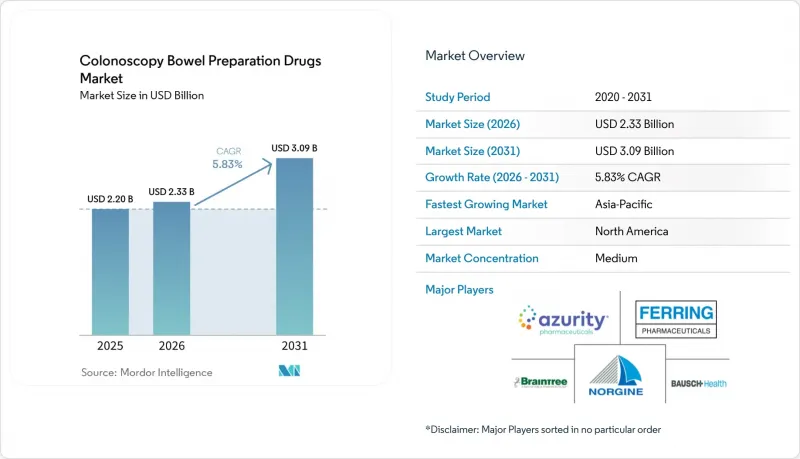
본 보고서는 제품 유형(폴리에틸렌글리콜 제제 등), 제제 용량(대용량 제제, 4리터 이상 등), 작용기전(등장성 약제 등), 유통 채널(병원 약국, 소매 약국 등) 및 지역(북미, 유럽 등)별로 분류되어 있습니다. 시장 예측은 금액(미 달러) 기준으로 제시되어 있습니다.
세계의 대장내시경 검사용 장 정결제 시장 동향 및 인사이트
대장암 검진 건수 증가
의무화 및 자발적인 대장암 검진 프로그램으로 인해 일부 의료 제도에서 장 세정제에 대한 수요가 증가하고 있습니다. 미국 암 학회(American Cancer Society)는 2024년에 미국에서 10만 6,000건의 신규 대장암 사례와 4만 4,000건의 신규 직장암 사례가 발생할 것으로 예측했습니다. 대변 검사나 혈액 검사에서 양성 결과가 나온 경우 일반적으로 후속 대장내시경 검사가 필요하기 때문에 비침습적 검사의 이용이 확대되더라도 여전히 장 세정제의 처방 수요는 발생할 것입니다. 일본의 체계적인 검진 접근 방식과 중국의 대장내시경 검사를 중시하는 지침 덕분에, 의료 제공업체는 보다 예측 가능한 검사 건수를 확보할 수 있게 되었습니다. 또한, 일본, 중국, 한국의 전국적인 검진 규정에 따라 제조업체들은 향후 수요를 보다 명확하게 파악할 수 있게 되었습니다. 따라서 대장내시경 검사용 하제 시장은 직접적인 대장내시경 검진과 다른 검사를 통한 후속 조치 경로 모두와 계속해서 밀접한 관련을 맺고 있습니다.
소량형, 정제 및 즉시 음용형 제품
갱신된 미국 합의 권고안에서는 대부분의 환자에게 2L의 세정제 사용을 지지함으로써, 소량 접근법의 임상적 역할이 더욱 명확해졌습니다. 이러한 변화는 이미 복용 부담이 적은 제품을 선호하는 처방 경향을 뒷받침합니다. 『Endoscopy』 저널의 2025년 비교 연구에 따르면, 1L의 PEG-아스코르브산은 피코황산나트륨·마그네슘 시트레이트보다 우수한 고품질 장 세척 및 선종 검출 효과를 보였으나, 후자는 내약성 측면에서 우위를 유지했습니다. 즉시 복용형 액제나 정제는 특히 환자가 투여를 2회로 나누어 해야 하는 경우, 투여 과정을 간소화할 수 있습니다. 이러한 제품들은 기존의 4L PEG 제제보다 처방 가격이 비쌀 가능성이 있어, 이에 따라 검사 건수 증가가 수익에 어떻게 반영될지가 달라집니다. 대장내시경 검사용 장 세척제 시장에서도 한국에서는 새로운 정제 옵션이 등장하고 있으며, 2026년 임상시험에서는 정제 수가 적고 황산염 함량도 낮은 피코황산나트륨 정제가 평가되었습니다.
안전성의 한계와 대량 투여 시 내약성
체액 손실이나 전해질 불균형은 모든 장 세정제에서 여전히 중요한 안전상의 과제로 남아 있습니다. SUPREP에 관한 FDA의 첨부 문서에서는 신장 기능에 영향을 미치는 약물을 복용 중인 환자나 체액·전해질 이상을 일으키기 쉬운 환자에 대해 주의를 환기하고 있습니다. 2025년 합의 권고안에서도 체액 과다나 전해질 이상 위험이 있는 환자에 대한 고삼투압 요법은 권장되지 않습니다. 이러한 제한으로 인해 고령자에서 일부 피코황산나트륨 제제나 황산염계 제제의 사용이 제한될 가능성이 있습니다. 고용량 제품은 특정 환자에서 일부 위험을 피할 수 있지만, 필요한 수분 섭취량으로 인해 시술 완료율이나 환자의 수용성이 저하될 가능성이 있습니다. 따라서 대장내시경 검사용 장세정제 시장에서는 저용량화와 편의성, 그리고 임상적 적합성을 양립시켜야 합니다. 중증 동반 질환이 있는 환자에 대한 안전성 관련 근거는 앞으로도 신제품 보급에 있어 매우 중요한 요소로 남아 있을 것입니다.
부문별 분석
대장내시경 검사용 하제 시장에서 폴리에틸렌글리콜(PEG) 제제는 제품 유형별 매출액에서 1위를 차지하고 있으며, 2025년에는 42.18%를 차지했습니다. 이러한 위상은 고령자나 신장 기능 장애가 있는 환자에 대한 PEG-전해질 제제의 광범위한 사용을 반영합니다. 임상의들은 체액 이동이나 전해질 변화가 우려되는 경우 종종 PEG 제제를 선택합니다. 이로 인해 이 카테고리는 일상적인 시술부터 고위험 시술에 이르기까지 안정적인 기반을 확보하고 있습니다. 또한, 투여량이 적은 PEG-아스코르브산 제제의 등장으로 이 부문은 기존의 4L 제제라는 범위를 넘어 확장되고 있습니다. 2025년 리뷰에 따르면, 1L 및 2L PEG-아스코르브산 제제를 이용한 투여법이 고용량 PEG-전해질 용액과 동등한 효능을 보였으며, 복약 순응도도 향상된 것으로 밝혀졌습니다. 그 결과, 이 제품군은 해당 안전성 프로파일이 필요한 환자와 체액 부하 감소를 원하는 환자 모두에게 도움이 되고 있습니다. 황산나트륨, 구연산마그네슘 및 인산나트륨 제제는 여전히 보다 제한적인 임상 상황에서 역할을 수행하고 있습니다. 인산나트륨의 사용은 신장 기능과 관련된 안전성 경고가 처방에 영향을 미치는 경우 여전히 제한적입니다. 비사코딜 및 만니톨 제제는 병용 요법의 구성 요소로서 더 빈번하게 사용되고 있습니다.
피코황산나트륨 제제 시장은 2031년까지 연평균 성장률(CAGR) 7.36%로 확대될 것으로 예측됩니다. 이 제품의 매력은 환자가 복용하기 쉬운 소량의 액제나 정제에 있다고 할 수 있습니다. ‘Clenpiq’ 및 관련 복합제는 수분 섭취 부담을 줄여주는 제품에 대한 수요를 충족시키는 제품입니다. 2026년 무작위 임상시험에서 DWJ1609 피코황산나트륨 정제는 기존의 경구용 황산염 정제와 비교하여 장 세척 효과 면에서 비열등성을 보였으며, 내약성도 향상된 것으로 확인되었습니다. 보고된 비교 결과, 이 정제는 28정이 아닌 20정으로 충분했으며, 황산염 함유량은 25% 감소한 것으로 나타났습니다. 이러한 특징은 준비의 편의성이 큰 우려 사항이 되는 상황에서 이 제품의 채택을 촉진할 가능성이 있습니다. 다만, 피코황산나트륨 제제는 신장 기능, 심장 또는 전해질 관련 위험이 있는 환자에게는 신중한 선택이 필요합니다. 이러한 제품의 성장은 새로운 제제가 내약성을 유지하면서 안전성 근거를 강화할 수 있는지에 달려 있습니다. ‘대장내시경 검사용 장 세척제 시장’은 이러한 혁신의 혜택을 받고 있지만, PEG에 대한 임상적 필요성이 사라지는 것은 아닙니다.
2L에서 4L 미만으로 정의되는 저용량 제제는 대장내시경 검사용 장 정결제 시장에서 2025년 매출의 53.46%를 차지하며, 제제 용량별 매출 1위를 기록했습니다. 이러한 위상은 기존의 4L 프로토콜에서 지속적으로 전환되는 추세를 반영한 것입니다. 개정된 미국 지침에 따르면, 대부분의 환자에게는 2L 분할 투여 요법으로 충분하다고 명시되어 있습니다. 이 권고 사항은 많은 외래 시술에서 저용량 제품이 실용적인 표준이 되도록 뒷받침하고 있습니다. 이 카테고리는 익숙한 PEG 및 병용 옵션을 유지하면서 액체 용량을 줄이고 있습니다. 또한, 현재 일상적인 권장 사항이 된 분할 투여 일정에도 부합합니다. 그러나 지급 정책에 따라 환자들이 이러한 제품을 이용하기 어려워질 가능성이 있습니다. 2025년 청구 데이터 조사에 따르면, 저용량 제품 청구의 61%에서 본인부담금이 발생한 반면, 고용량 제품의 경우 35%에 그쳤습니다. 이러한 격차는 임상적으로 입증된 처방 경향의 전환을 지연시킬 우려가 있습니다. 준비가 불충분할 경우 검사가 중단되거나 재실시될 가능성이 있으므로, 제약사와 보험사 입장에서는 이 격차를 해소해야 할 이유가 있습니다.
2리터 미만으로 정의되는 초저용량 제제는 2031년까지 연평균 성장률(CAGR) 7.88%를 나타낼 것으로 예측됩니다. 이 범주에는 1리터 용량의 PEG-아스코르브산 제제와 직접적인 수분 섭취량을 줄일 수 있는 정제형 제제가 포함됩니다. 이러한 제품들은 대량의 액체를 섭취하는 데 따르는 일반적인 장벽을 해결하기 위한 것입니다. 2025년 내시경 검사에 관한 연구에서는 피코황산나트륨·구연산마그네슘보다 우수한 장 세척 효과가 확인되었다고 보고하여, 1L PEG-아스코르베이트 제제의 유효성을 뒷받침했습니다. 또한, 정제 제품은 혼합하는 수고를 덜어주므로 준비 과정의 복잡성을 줄일 수 있습니다. 중증 동반 질환이 있는 일부 환자의 경우, 여전히 대량의 하제 제제가 필요할 것입니다. 따라서 소량 제제가 외래 진료에서 더 일상적으로 사용되게 되더라도, 대량 제제의 역할이 사라지지는 않을 것입니다. 또한 검사 부서 입장에서도, 하제 준비의 품질 목표를 달성하는 데 도움이 되는 제품을 우선적으로 선택하려는 유인이 있습니다. 제품 선택은 앞으로도 환자의 상태, 경제적 부담, 검사 시기에 따라 결정될 것입니다. ‘대장내시경 검사용 하제 시장’은 단일 용량 시장으로 굳어지지 않고, 소량 옵션으로 점차 전환되고 있습니다.
지역별 분석
대장내시경 검사용 하제 시장에서 2025년에는 북미가 37.23%를 차지하며 지역별 매출액 1위를 기록했습니다. 이 지역에서는 대장내시경 검사 실시 건수가 많고, 외래 내시경 검사 체계가 확립되어 있으며, 브랜드 의약품 부문도 큰 비중을 차지하고 있습니다. 미국 예방의료서비스작업반(USPSTF)이 선별검사의 대상 시작 연령을 낮춤에 따라, 선별검사 대상이 되는 잠재 인구가 증가했습니다. 또한, 저용량의 고부가가치 제제나 정제 제제의 접근성 또한 북미 시장의 성장을 뒷받침하고 있습니다. 비용 분담은 이러한 제품의 사용을 제한할 가능성이 있으므로 여전히 큰 우려 사항으로 남아 있습니다. 2025년 보험 청구 분석에 따르면, 메디케어 파트 D 청구의 83%, 민간 보험 청구의 53%에서 비용 분담이 이루어졌습니다. 2026년 2월, CMS(미국 의료보험 및 의료보조 서비스 센터)에 FDA 승인 장 세정제에 대한 보다 명확한 보험 적용 지침을 요청하는 청원이 제기되었습니다. 캐나다와 멕시코가 지역별 판매량을 끌어올리고 있으며, 2024년 멕시코에서 체결된 NTC015 라이선싱 계약은 라틴아메리카 전역으로의 유통 확대를 시사하고 있습니다. 보험 적용 정책의 향방은 환자가 실제로 어떤 제형을 이용할 수 있는지에 영향을 미칠 것입니다.
2025년, 유럽은 지역별 시장 중 2위 규모를 차지했습니다. 각국의 보험 급여 제도와 유럽 내시경 검사 지침은 일반적으로 저비용의 제네릭 PEG 제품 조달을 권장하고 있습니다. 독일, 프랑스, 영국이 이 지역의 검사 건수 대부분을 차지하고 있습니다. 영국의 대장암 검진 프로그램에서는 50세부터 74세까지의 성인을 대상으로 2년마다 FIT 검사를 실시하고, 그 결과에 따라 대장내시경 검사를 후속 조치로 시행하고 있습니다. 이 과정을 통해 검사에서 이상이 발견된 후 하제를 필요로 하는 환자가 정기적으로 발생합니다. 노르지네(Norgene)사는 소화기내과와의 협력 및 완하제 사용 지원 자료를 통해 해당 지역에서 확고한 입지를 다져왔습니다. 유럽의 첨부문서 및 시판 후 안전성 요건은 많은 신흥 지역에 비해 시장 간 일관성이 더 높습니다. 노르지네(Norgene)사는 2026년 2월, 유럽 5개국에서 소아를 대상으로 한 플렌부(Plenvu)의 3상 임상시험 ‘CLARITY’를 시작했습니다. 이 지역은 현재 수요와 임상적 근거 창출 양면 모두에서 여전히 중요한 위치를 차지하고 있습니다.
아시아태평양은 2031년까지 연평균 성장률(CAGR) 7.87%를 나타낼 것으로 예측되며, 지역별 부문 중 가장 높은 성장률을 보이고 있습니다. 중국의 2024년 대장암 검진 지침에서는 대장내시경 검사가 1차 선별 검사법으로 공식적으로 권장되고 있습니다. 이는 공립 병원 시스템 전반에 걸친 PEG 제품 조달을 촉진하는 요인입니다. 일본의 검진 체계는 대변 검사에서 후속 대장내시경 검사로 이어지는 연속적인 경로를 구축하고 있습니다. 한국은 피코황산나트륨 복합제를 포함한 정제 형태의 혁신 중심지로 자리 잡고 있습니다. 지역 제조업체들은 편의성이 높은 제품에 대한 현지 내 관심 증가를 반영하고 있습니다. 인도에서는 의료 보험 적용 범위와 진단 능력의 발전에 따라 시장이 확대될 것으로 예측됩니다. 중동 및 아프리카, 남미는 여전히 시장 규모가 작지만, 라이선싱 제휴를 통해 제품 접근성이 확대될 가능성이 있습니다. 이 지역들의 대장내시경 검사용 장정비제 시장은 현지 스크리닝 보급 현황, 의료 제공업체의 대응 능력, 그리고 제품의 가격 경쟁력에 따라 좌우될 것입니다.
기타 혜택 :
- 엑셀 형식 시장 예측(ME) 시트
- 3개월간의 애널리스트 지원
자주 묻는 질문
목차
제1장 서론
제2장 조사 방법
제3장 개요
제4장 시장 구도
제5장 시장 규모 및 성장 예측
제6장 경쟁 구도
제7장 시장 기회 및 향후 전망
KTH 26.09.02According to Mordor Intelligence, the colonoscopy bowel preparation drugs market size is expected to grow from USD 2.20 billion in 2025 to USD 2.33 billion in 2026 and is forecast to reach USD 3.09 billion by 2031 at 5.83% CAGR over 2026-2031.
This report is Segmented by Product Type (Polyethylene Glycol Preparations and More), by Formulation Volume (High-Volume Preparations, 4 L or More, and More), by Mechanism of Action (Isosmotic Agents and More), by Distribution Channel (Hospital Pharmacies, Retail Pharmacies, and More), and by Geography (North America, Europe, and More). The Market Forecasts are Provided in Terms of Value (USD).
Global Colonoscopy Bowel Preparation Drugs Market Trends and Insights
Rising Colorectal Cancer Screening Volumes
Mandatory and voluntary colorectal cancer screening programs are increasing the demand for bowel preparation drugs in several health systems. The American Cancer Society projected 106,000 new colon cancer cases and 44,000 new rectal cancer cases in the United States during 2024. A positive stool-based or blood-based screening result usually requires a follow-up colonoscopy, so broader use of noninvasive testing can still create preparation prescriptions. Japan's structured screening approach and China's colonoscopy-focused guidance give providers more predictable procedure volumes. National screening rules in Japan, China, and South Korea also give manufacturers clearer visibility on future demand. The Colonoscopy Bowel Preparation Drugs Market, therefore, remains connected to both direct colonoscopy screening and the follow-up pathway from other tests.
Lower-Volume, Tablet, and Ready-to-Drink Products
Updated U.S. consensus recommendations supported the use of a 2 L preparation for most patients and gave lower-volume approaches a clearer clinical role. This change supports prescribing patterns that already favored products with a smaller drinking burden. A 2025 Endoscopy comparison found that 1 L PEG-ascorbate produced better high-quality cleansing and adenoma detection than sodium picosulfate-magnesium citrate, while the latter retained a tolerability advantage. Ready-to-drink liquids and tablets can make the dosing process simpler, especially when patients must divide treatment into 2 administrations. These products can carry higher prescription prices than legacy 4 L PEG products, which changes how procedure growth translates into revenue. The Colonoscopy Bowel Preparation Drugs Market is also gaining new tablet options in South Korea, where a 2026 trial evaluated a sodium picosulfate tablet with fewer tablets and lower sulfate content.
Safety Limits and High-Volume Tolerability
Fluid loss and electrolyte disruption remain important safety issues across bowel preparation products. FDA labeling for SUPREP advises caution for patients using medicines that affect kidney function and for patients vulnerable to fluid or electrolyte abnormalities. The 2025 consensus recommendations also discourage hyperosmotic regimens for people at risk of volume overload or electrolyte disturbances. These limits can narrow the use of some sodium picosulfate and sulfate-based options among older people. High-volume products avoid some risks for selected patients, but the required fluid intake can reduce completion and patient acceptance. The Colonoscopy Bowel Preparation Drugs Market must therefore balance lower volume and convenience against clinical suitability. Safety evidence for people with serious comorbidities remains central to the future uptake of newer products.
Other drivers and restraints analyzed in the detailed report include:
- Split-Dose Regimens and Digital Adherence Support
- Preparation Selection for Patients With Comorbidities
- Coverage Gaps and Patient Cost Sharing
For complete list of drivers and restraints, kindly check the Table Of Contents.
Segment Analysis
Polyethylene glycol preparations led product-type sales, with 42.18% in 2025, within the Colonoscopy Bowel Preparation Drugs Market. Their position reflects the broad use of PEG-electrolyte products for elderly patients and people with renal impairment. Clinicians often select PEG when fluid shifts or electrolyte changes create a concern. This gives the category a stable base across routine and higher-risk procedures. Lower-volume PEG-ascorbate products have also extended the class beyond traditional 4 L formulations. A 2025 review found that 1 L and 2 L PEG-ascorbate regimens had noninferior efficacy to high-volume PEG-electrolyte solutions and improved compliance. The product class consequently serves both patients who require its safety profile and patients seeking a smaller fluid burden. Sodium sulfate, magnesium citrate, and sodium phosphate products retain roles in narrower clinical situations. Sodium phosphate use remains limited where renal safety warnings affect prescribing. Bisacodyl and mannitol products are more often used as components of combination approaches.
Sodium picosulfate preparations are expected to advance at a 7.36% CAGR through 2031. Their appeal comes from low-volume liquids and tablets that can be easier for patients to take. Clenpiq and related combinations align with the preference for products that reduce the drinking burden. A 2026 randomized trial found that the DWJ1609 sodium picosulfate tablet was noninferior for cleansing and improved tolerability relative to a conventional oral sulfate tablet. The tablet required 20 tablets rather than 28 and contained 25% less sulfate in the reported comparison. These features can support adoption where preparation convenience is a major concern. However, sodium picosulfate products need careful selection for patients with renal, cardiac, or electrolyte risks. Their growth will depend on whether new formulations can preserve tolerability while strengthening safety evidence. The Colonoscopy Bowel Preparation Drugs Market benefits from this innovation, but it does not remove the clinical need for PEG.
Low-volume preparations, defined as 2 L to less than 4 L, led formulation-volume sales, with 53.46% in 2025, within the Colonoscopy Bowel Preparation Drugs Market. This position followed a continuing move away from traditional 4 L protocols. The updated U.S. guidance stated that a 2 L split-dose regimen is sufficient for most patients. That recommendation supports low-volume products as a practical standard for many outpatient procedures. The category reduces the liquid amount while retaining familiar PEG and combination options. It also fits split-dose scheduling, which is now a routine recommendation. Yet payment policies can restrict patient access to these products. In the 2025 claims study, 61% of low-volume claims involved out-of-pocket costs, compared with 35% for high-volume products. This gap can slow a clinically supported shift in prescribing. Manufacturers and payers have a reason to address this gap because incomplete preparation can lead to canceled or repeated procedures.
Ultra-low-volume preparations, defined as less than 2 L, are forecast to record a 7.88% CAGR through 2031. This category includes 1 L PEG-ascorbate options and tablet-based preparations that require less direct fluid intake. These products address a common barrier, which is the difficulty of consuming a large volume of liquid. The 2025 Endoscopy study added support for 1 L PEG-ascorbate by reporting stronger high-quality cleansing than sodium picosulfate-magnesium citrate. Tablet products also avoid mixing requirements, which can reduce preparation complexity. High-volume preparations will remain necessary for some people with substantial comorbidities. Their role will therefore not disappear even as lower-volume options take more routine outpatient use. Procedure units also have an incentive to favor products that help them meet preparation-quality targets. Product choice will continue to depend on patient condition, affordability, and procedure timing. The Colonoscopy Bowel Preparation Drugs Market is moving toward lower-volume options without becoming a single-volume market.
Complete Report Scope:
- By Product Type
- Polyethylene Glycol Preparations
- Sodium Sulfate Preparations
- Sodium Picosulfate Preparations
- Magnesium Citrate Preparations
- Sodium Phosphate Preparations
- Other Bowel Preparation Drugs
- By Formulation Volume
- High-Volume Preparations, 4 L or More
- Low-Volume Preparations, 2 L to Less Than 4 L
- Ultra-Low-Volume Preparations, Less Than 2 L
- By Mechanism of Action
- Isosmotic Agents
- Hypoosmotic Agents
- Hyperosmotic Agents
- Combination Osmotic and Stimulant Agents
- By Distribution Channel
- Hospital Pharmacies
- Retail Pharmacies
- Online Pharmacies
- Others (Specialty Pharmacies, Wholesale Distributors, etc.)
- By Geography
- North America
- United States
- Canada
- Mexico
- Europe
- Germany
- United Kingdom
- France
- Italy
- Spain
- Rest of Europe
- Asia-Pacific
- China
- Japan
- India
- Australia
- South Korea
- Rest of Asia-Pacific
- Middle East and Africa
- GCC
- South Africa
- Rest of Middle East and Africa
- South America
- Brazil
- Argentina
- Rest of South America
- North America
Geography Analysis
North America led regional sales, with 37.23% in 2025, within the Colonoscopy Bowel Preparation Drugs Market. The region has high colonoscopy procedure use, established ambulatory endoscopy capacity, and a substantial branded-drug segment. The expansion of screening eligibility after the U.S. Preventive Services Task Force lowered the starting age, adding people to the potential screening population. The availability of premium low-volume and tablet formulations also shapes North American growth. Cost sharing remains a major concern because it can limit the use of those products. The 2025 claims analysis showed cost sharing in 83% of Medicare Part D claims and 53% of commercial claims. A February 2026 request to CMS sought clearer coverage guidance for FDA-approved bowel preparations. Canada and Mexico add regional volume, while the 2024 NTC015 licensing arrangement in Mexico points to broader Latin American distribution. The direction of coverage policy will influence which formulations patients can practically access.
Europe was the second-largest regional market in 2025. National reimbursement systems and European endoscopy guidance commonly support procurement of lower-cost generic PEG products. Germany, France, and the United Kingdom account for much of the region's procedure volume. The United Kingdom's bowel cancer screening program invites adults aged 50 to 74 for FIT testing every 2 years, with colonoscopy as the follow-up route. This process creates a regular stream of patients who may require preparation products after an abnormal test. Norgine has built a strong regional presence through gastroenterology relationships and preparation support materials. European labeling and post-market safety requirements are more consistent across markets than in many emerging regions. Norgine began the CLARITY Phase 3 pediatric Plenvu study across 5 European countries in February 2026. The region remains important both for current demand and for clinical evidence generation.
Asia-Pacific is expected to grow at a 7.87% CAGR through 2031, the fastest rate among regional segments. China's 2024 colorectal cancer screening guidance formally recommends colonoscopy as a primary screening method. This supports the procurement of PEG products across public hospital systems. Japan's screening structure creates a continuing pathway from fecal testing to follow-up colonoscopy. South Korea has become a center for tablet-form innovation, including sodium picosulfate combinations. Regional manufacturers represent the growing local focus on more convenient products. India is expected to expand as health coverage and diagnostic capacity develop. The Middle East, Africa, and South America remain smaller, but licensing partnerships can extend product access. The Colonoscopy Bowel Preparation Drugs Market in these areas will depend on local screening adoption, provider capacity, and product affordability.
- Azurity Pharmaceuticals
- Bausch Health
- Bayer
- Beijing Podconley Pharmaceutical Technology and Development Co., Ltd.
- Braintree Laboratories, Inc.
- Eton Pharmaceuticals, Inc.
- Ferring Pharmaceuticals
- Fresenius
- Ipsen Pharma SAS
- Jiangxi Hengkang Pharmaceutical Co., Ltd.
- Norgine B.V.
- Pfizer
- Pharmbio Korea Co., Ltd.
- Salix Pharmaceuticals, Ltd.
- Sandoz Group AG
- Sebela Pharmaceuticals, Inc.
- Shenzhen Wanhe Pharmaceutical Co., Ltd.
- Sichuan Jianneng Pharmaceutical Co., Ltd.
- Takeda Pharmaceuticals
- Viatris
Additional Benefits:
- The market estimate (ME) sheet in Excel format
- 3 months of analyst support
TABLE OF CONTENTS
1 INTRODUCTION
- 1.1 Study Assumptions and Market Definition
- 1.2 Scope of the Study
2 RESEARCH METHODOLOGY
3 EXECUTIVE SUMMARY
4 MARKET LANDSCAPE
- 4.1 Market Overview
- 4.2 Market Drivers
- 4.2.1 Rising Colorectal Cancer Screening Volumes
- 4.2.2 Shift Toward Low-Volume and Ultra-Low-Volume Preparations
- 4.2.3 Split-Dose Regimens Improving Cleansing Adequacy
- 4.2.4 Patient Navigation and Digital Adherence Support
- 4.2.5 Tablet-Based and Ready-to-Drink Formulation Adoption
- 4.2.6 Personalized Preparation Selection for Comorbid Patients
- 4.3 Market Restraints
- 4.3.1 Dehydration and Electrolyte Disturbances
- 4.3.2 Renal, Cardiac, and Metabolic Contraindications
- 4.3.3 Poor Tolerability of High-Volume Preparations
- 4.3.4 Reimbursement and Out-of-Pocket Cost Differences
- 4.4 Value and Supply-Chain Analysis
- 4.5 Regulatory Landscape
- 4.6 Technological Outlook
- 4.7 Porter's Five Forces Analysis
- 4.7.1 Threat of New Entrants
- 4.7.2 Bargaining Power of Suppliers
- 4.7.3 Bargaining Power of Buyers
- 4.7.4 Threat of Substitutes
- 4.7.5 Competitive Rivalry
5 MARKET SIZE AND GROWTH FORECASTS (VALUE, USD)
- 5.1 By Product Type
- 5.1.1 Polyethylene Glycol Preparations
- 5.1.2 Sodium Sulfate Preparations
- 5.1.3 Sodium Picosulfate Preparations
- 5.1.4 Magnesium Citrate Preparations
- 5.1.5 Sodium Phosphate Preparations
- 5.1.6 Other Bowel Preparation Drugs
- 5.2 By Formulation Volume
- 5.2.1 High-Volume Preparations, 4 L or More
- 5.2.2 Low-Volume Preparations, 2 L to Less Than 4 L
- 5.2.3 Ultra-Low-Volume Preparations, Less Than 2 L
- 5.3 By Mechanism of Action
- 5.3.1 Isosmotic Agents
- 5.3.2 Hypoosmotic Agents
- 5.3.3 Hyperosmotic Agents
- 5.3.4 Combination Osmotic and Stimulant Agents
- 5.4 By Distribution Channel
- 5.4.1 Hospital Pharmacies
- 5.4.2 Retail Pharmacies
- 5.4.3 Online Pharmacies
- 5.4.4 Others (Specialty Pharmacies, Wholesale Distributors, etc.)
- 5.5 By Geography
- 5.5.1 North America
- 5.5.1.1 United States
- 5.5.1.2 Canada
- 5.5.1.3 Mexico
- 5.5.2 Europe
- 5.5.2.1 Germany
- 5.5.2.2 United Kingdom
- 5.5.2.3 France
- 5.5.2.4 Italy
- 5.5.2.5 Spain
- 5.5.2.6 Rest of Europe
- 5.5.3 Asia-Pacific
- 5.5.3.1 China
- 5.5.3.2 Japan
- 5.5.3.3 India
- 5.5.3.4 Australia
- 5.5.3.5 South Korea
- 5.5.3.6 Rest of Asia-Pacific
- 5.5.4 Middle East and Africa
- 5.5.4.1 GCC
- 5.5.4.2 South Africa
- 5.5.4.3 Rest of Middle East and Africa
- 5.5.5 South America
- 5.5.5.1 Brazil
- 5.5.5.2 Argentina
- 5.5.5.3 Rest of South America
- 5.5.1 North America
6 COMPETITIVE LANDSCAPE
- 6.1 Market Concentration
- 6.2 Market Share Analysis
- 6.3 Company Profiles (includes Global Level Overview, Market Level Overview, Core Segments, Financials as available, Strategic Information, Market Rank/Share, Products and Services, Recent Developments)
- 6.3.1 Azurity Pharmaceuticals, Inc.
- 6.3.2 Bausch Health Companies Inc.
- 6.3.3 Bayer AG
- 6.3.4 Beijing Podconley Pharmaceutical Technology and Development Co., Ltd.
- 6.3.5 Braintree Laboratories, Inc.
- 6.3.6 Eton Pharmaceuticals, Inc.
- 6.3.7 Ferring B.V.
- 6.3.8 Fresenius Kabi AG
- 6.3.9 Ipsen Pharma SAS
- 6.3.10 Jiangxi Hengkang Pharmaceutical Co., Ltd.
- 6.3.11 Norgine B.V.
- 6.3.12 Pfizer Inc.
- 6.3.13 Pharmbio Korea Co., Ltd.
- 6.3.14 Salix Pharmaceuticals, Ltd.
- 6.3.15 Sandoz Group AG
- 6.3.16 Sebela Pharmaceuticals, Inc.
- 6.3.17 Shenzhen Wanhe Pharmaceutical Co., Ltd.
- 6.3.18 Sichuan Jianneng Pharmaceutical Co., Ltd.
- 6.3.19 Takeda Pharmaceutical Company Limited
- 6.3.20 Viatris Inc.
7 MARKET OPPORTUNITIES AND FUTURE OUTLOOK
- 7.1 White-Space and Unmet-Need Assessment


