|
시장보고서
상품코드
2119395
케이블 상륙 기지 : 시장 점유율 분석, 업계 동향 및 통계, 성장 예측(2026-2031년)Cable Landing Station - Market Share Analysis, Industry Trends & Statistics, Growth Forecasts (2026 - 2031) |
||||||
 Mordor Intelligence
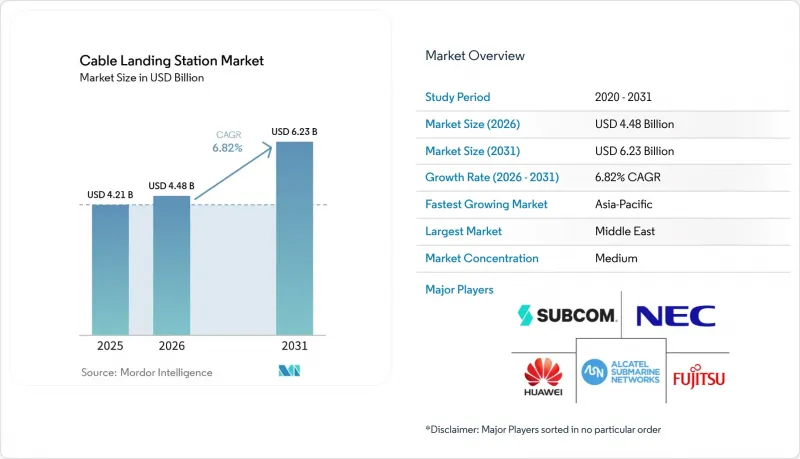
Mordor Intelligence에 의하면, 케이블 상륙 기지 시장 규모는 2025년에 42억 1,000만 달러로 평가되었습니다. 2026년에 44억 8,000만 달러에 달하고, 2031년까지 62억 3,000만 달러에 이를 것으로 예측되며, 2026년부터 2031년에 걸쳐 CAGR 6.82%로 성장할 전망입니다.
본 보고서는 구성 요소(전원 공급 설비, 해저 케이블 종단 설비, 감시·제어 설비, 보호 설비 등), 서비스(업그레이드 및 개보수 등), 용도(국가 간 및 섬 간 연결 등), 소유 형태 및 비즈니스 모델(단일 소유자 시스템 등), 지역별로 분류되어 있습니다. 시장 전망은 금액(달러) 기준으로 제시되어 있습니다.
세계의 케이블 상륙 기지 시장 동향 및 인사이트
클라우드 및 AI 트래픽이 새로운 국제 통신 용량을 견인
인공지능(AI) 추론에는 낮은 지연 시간과 거점 간 대규모 모델 파일의 정기적인 전송이 필요합니다. 국제 대역폭 사용량은 2025년부터 2035년까지 연평균 24% 성장할 것으로 예측되며, 이를 위해서는 개별적인 네트워크 업그레이드가 아닌 장거리 용량에 대한 지속적인 투자가 필요합니다. 트래픽 밀도가 높아짐에 따라 연안 시설에서의 광통신 모니터링 필요성이 커지고 있습니다. 또한, 사업자는 포트 용량을 확장할 때 신뢰할 수 있는 전력 공급, 냉각 시스템 및 백홀 회선이 필요합니다. 새로운 경로는 각각 육상 네트워크에 대한 접근이 확보된 보호 구역에 연결되어야 하기 때문에 케이블 상륙 기지 시장은 혜택을 보고 있습니다. 특히, 클라우드 리전이 대서양, 태평양, 인도양의 각 해역을 횡단하는 직접 연결을 필요로 하는 지역에서 수요가 두드러집니다.
하이퍼스케일러의 단일 소유자형 해저 케이블 시스템 투자
대형 기술 기업들은 용량, 라우팅, 네트워크 설계를 자체적으로 제어할 수 있는 경로를 점점 더 선호하고 있습니다. 메타(Meta)가 2025년에 발표한 ‘프로젝트 워터워스(Project Waterworth)’는 이 회사가 소유한 총 길이 5만km에 달하며 5개 대륙을 연결하는 케이블 시스템으로, 이러한 추세를 여실히 보여줍니다. 아마존은 2025년, 메릴랜드주와 코크 카운티를 연결하며 초당 320테라비트 이상의 용량을 가진 케이블 ‘패스트넷(Fastnet)’을 발표했습니다. 이러한 프로젝트에는 전용 광 시스템 및 전용 육상 연결을 지원할 수 있는 스테이션이 필요합니다. 호스트 사업자는 전용 시스템의 전력 공급, 물리적 레이아웃, 광 분배 프레임을 조정함으로써 서비스 수익을 창출할 수 있습니다. 이러한 소유 모델은 단일 소유자에 의한 구축 확대와 기존 시설의 개보수 공사 촉진을 뒷받침하고 있습니다.
해안 지역의 인허가 및 환경 심사에 따른 지연
환경 심사 및 지방 자치 단체의 승인으로 인해 케이블 상륙 프로젝트가 수년 지연될 가능성이 있습니다. 각 경로에는 여러 당국의 승인이 필요하며, 상업적 운영은 계획된 모든 상륙 지점의 준비가 완료되는지에 따라 좌우될 수 있습니다. 미국 하원은 2025년 ‘해저 케이블 보호법’을 통과시켜 ‘국립 해양 보호 구역법’에 근거한 중복된 특별 이용 허가 요건을 철폐했습니다. 이 조치는 특정 승인 절차를 다루는 것이지만, 더 광범위한 연안, 환경 및 지역 사회의 심사 요건을 철폐하는 것은 아닙니다. 지연이 발생하면, 시스템의 해저 구간이 완성되었음에도 불구하고 준비가 완료되지 않은 단일 지점 때문에 대기해야 할 가능성이 있습니다. 이러한 불확실성은 특히 심사 절차가 엄격한 연안 지역에서 케이블 상륙 기지 시장의 개발 위험을 높입니다.
부문 분석
2025년, 해저 회선 종단 장치는 케이블 상륙 기지 시장 점유율의 32.51%를 차지했습니다. 이 장치는 해저 시스템과 육상 시스템 간의 트래픽을 변환하는 역할을 담당하며, 모든 대용량 케이블 종단에서 핵심을 이루고 있습니다. 이러한 역할로 인해 사업자가 새로운 상륙 지점을 개발할 때는 항상 대량의 장비가 필요합니다. 노키아는 총 투자액 1억 5,000만 달러 규모의 프로젝트인 ‘방글라데시 민간 케이블 시스템’을 위해 해저 회선 종단 장비를 공급했습니다. 구매자는 이러한 시스템을 선정할 때 용량, 에너지 소비량, 장비 간 상호 운용성 및 보안을 평가합니다. 또한 광통신 규격의 발전에 따라 이미 도입된 장비에 대해서도 정기적인 업데이트가 필요합니다.
감시·제어 장비 시장은 2026년부터 2031년에 걸쳐 연평균 성장률(CAGR) 7.46%로 확대될 것으로 예측됩니다. 광섬유 쌍 수와 파장 용량이 증가함에 따라 통신 사업자는 광 성능을 지속적으로 파악해야 합니다. 감시를 통해 더 큰 서비스 문제를 일으키기 전에 성능 저하를 파악할 수 있습니다. 전원 공급 장비 및 보호 장비는 육상 시설의 전기적 및 물리적 무결성을 뒷받침합니다. 많은 시설이 이전 광섬유 구축 시 건설된 것이기 때문에 기존 시스템은 현재의 코히런트 광 기술을 지원하도록 설계되지 않았을 가능성이 있습니다. 국제전기통신연합(ITU)은 2026년, 환경적 압박의 변화가 케이블 및 연안 인프라의 내결함성에 영향을 미치고 있다고 지적했습니다. 이러한 업데이트 필요성은 확장기 및 신규 건설이 둔화되는 시기 모두에서 부품 수요를 뒷받침합니다. 또한 장비 공급업체에게는 자동화, 장애 가시화, 에너지 관리 및 새로운 광 시스템과의 호환성을 향상시킬 수 있는 지속적인 기회가 될 것입니다. 스테이션 소유자는 이러한 업그레이드를 활용함으로써 전체 사이트를 재구축하지 않고도 보호된 연안 시설의 수명을 연장할 수 있습니다.
2025년, 케이블 상륙 기지 시장에서 ‘설치 및 시운전’의 점유율은 43.26%를 차지했습니다. 이 서비스에는 해안 연결 작업, 케이블 매설, 광 정렬, 시험 및 국내 장비의 최종 통합이 포함됩니다. 이러한 작업에는 전문적인 엔지니어링과 해저 케이블 시공업체와의 조정이 필요합니다. 2026년부터 2029년에 걸쳐 가동될 예정인 케이블의 총액은 160억 달러를 초과하며, 이는 현재의 부설 파이프라인을 뒷받침하고 있습니다. NEC는 ‘Candle’ 시스템의 시스템 통합사업자로서 제조, 경로 설계, 설치 및 시험을 담당했습니다. 턴키 계약은 단일 책임 있는 납품 파트너를 필요로 하는 케이블 소유주에게 조정상의 위험을 완화해 줄 수 있습니다.
업그레이드 및 개보수 시장은 2026년부터 2031년에 걸쳐 연평균 성장률(CAGR) 8.15%로 확대될 것으로 예측됩니다. 기존 사이트에서는 광 용량 증강, 전력 관리 기능 확충, 그리고 주요 기술 기업이 소유한 전용 시스템을 위한 공간 확보가 요구되고 있습니다. 또한, 사업자가 지속적인 성능 모니터링을 필요로 하는 경우, 유지보수 및 지원 계약의 가치도 높아집니다. 캐리어 중립 사이트에서는 개발업자가 향후 케이블을 위해 도관, 전력 용량, 랙 공간을 확보해야 하므로 설계 및 엔지니어링이 점점 더 복잡해지고 있습니다. 모듈식 건설 방식을 채택함으로써 신규 시설에 필요한 현장 작업 시간을 단축할 수 있습니다. 이러한 서비스 수요로 인해 케이블 상륙 기지 업계는 신규 상륙뿐만 아니라 가동 중인사이트에서도 비즈니스 기회를 창출할 수 있습니다. 지역별 건설 규정과 광통신 시스템 통합을 잘 이해하고 있는 서비스 제공업체는 설계, 시운전, 유지보수, 확장 및 사고 대응의 전 과정을 통해 고객을 지원할 수 있습니다. 이러한 폭넓은 서비스 제공은 전문 인력이 제한적인 지역에서 중요할 수 있습니다.
지역별 분석
2025년, 아시아태평양은 케이블 상륙 기지 시장 점유율의 38.63%를 차지했습니다. 이 지역은 방대한 인터넷 사용자 수, 아시아 지역 내의 고밀도 트래픽, 그리고 주요 태평양 횡단 경로를 모두 갖추고 있습니다. 2026년부터 2029년에 걸쳐 아시아의 신규 케이블 투자액은 37억 달러를 넘어설 것으로 예측됩니다. 일본의 입지 분산화 프로그램에서는 2025년에 홋카이도와 규슈에 새로운 해저 케이블 상륙 기지를 건설할 사업자로 소프트뱅크가 선정되었습니다. 인도, 중국, 말레이시아, 인도네시아, 필리핀도 경로 개발의 또 다른 원동력이 되고 있습니다. 아시아태평양의 케이블 상륙 기지 시장은 상용 클라우드 수요와 공공 부문의 복원력 향상 프로그램에 의해 뒷받침되고 있습니다.
중동은 2026년부터 2031년까지 연평균 성장률(CAGR) 8.37%로 확대될 것으로 예측됩니다. 아시아, 유럽, 아프리카의 케이블 경로 중간에 위치하고 있어 중계 지역으로서의 역할이 뒷받침되고 있습니다. 모빌리(Mobily)사는 2025년 사우디아라비아의 두바이에 ‘아프리카-1’ 케이블을 상륙시켰습니다. 총 길이 1만km인 이 시스템은 8쌍의 광섬유와 11곳의 상륙 지점을 갖추고 있습니다. 이집트는 포트사이드와 라스 갈레브에 SEA-ME-WE-6의 상륙 인프라를 추가했습니다. 홍해와 지중해 연안에 분산된 설치 위치는 동서 간 트래픽을 처리하는 사업자에게 경로 선택의 폭을 넓혀줍니다. 북미에서는 하이퍼스케일러가 이용하는 전용 시설에 대한 수요가 나타나고 있습니다. 아마존은 Fastnet의 상륙 지점으로 메릴랜드주를 선정했으며, 이 회사의 케이블은 미국과 아일랜드를 연결하게 됩니다.
유럽에서는 2027년까지 케이블 보안 및 우선 프로젝트에 3억 4,700만 유로(3억 8,100만 달러)를 투자할 예정입니다. 아프리카에서는 대서양 노선 진입 비용을 절감해 주는 캐리어 중립 시설의 혜택을 누릴 수 있습니다. 남미에서는 모듈식 설치 및 아시아태평양으로의 새로운 연결 가능성이 있습니다. 이 지역들의 케이블 상륙 기지 시장은 현지 인허가, 송전망 접근성, 연안 보안, 그리고 장애 내성이 높은 육상 백홀에 좌우됩니다. 해저 케이블은 육상 기지국 및 육상 회선이 구축되어야만 용량을 제공할 수 있으므로, 현지 개발 조건은 물리적 경로만큼이나 중요합니다. 이러한 요건을 조기에 확보한 개발사는 해저 공사 개시 후 발생할 수 있는 지연 위험을 줄일 수 있습니다.
기타 혜택 :
- 엑셀 형식 시장 예측(ME) 시트
- 3개월간의 애널리스트 지원
자주 묻는 질문
목차
제1장 서론
제2장 조사 방법
제3장 주요 요약
제4장 시장 구도
제5장 시장 규모 및 성장 예측
제6장 경쟁 구도
제7장 시장 기회 및 향후 전망
KTH 26.09.10According to Mordor Intelligence, the cable landing station market size is projected to be USD 4.21 billion in 2025, USD 4.48 billion in 2026, and reach USD 6.23 billion by 2031, growing at a CAGR of 6.82% from 2026 to 2031.
This report is Segmented by Component (Power Feeding Equipment, Submarine Line Terminal Equipment, Monitoring and Control Equipment, Protection Equipment, and More), Service (Upgrades and Retrofits, and More), Application (Inter-Country and Island Connection, and More), Ownership and Business Model (Single-Owner Systems, and More), and Geography. The Market Forecasts are Provided in Terms of Value (USD).
Global Cable Landing Station Market Trends and Insights
Cloud and AI Traffic Driving New International Capacity
Artificial intelligence inference requires low latency and recurring transfers of large model files between locations. Used international bandwidth is projected to grow at a 24% annual rate from 2025 through 2035, which requires continued investment in long-haul capacity rather than isolated network upgrades. Higher traffic density raises the need for optical monitoring at coastal facilities. Operators also need dependable power, cooling, and backhaul links when they increase port capacity. The cable landing station market benefits because each new route must connect to a protected site with terrestrial network access. Demand is especially relevant where cloud regions need direct links across the Atlantic, Pacific, and Indian Ocean basins.
Hyperscaler Investment in Single-Owner Submarine Systems
Large technology companies increasingly favor routes that give them control over capacity, routing, and network design. Meta announced Project Waterworth in 2025 as a 50,000-km, five-continent cable system that it would own, which illustrates this direction. Amazon announced Fastnet in 2025, a cable linking Maryland and County Cork with more than 320 terabits per second of capacity. These projects require stations capable of accommodating private optical systems and dedicated terrestrial connections. Host operators can capture service revenue by modifying power, physical layout, and optical distribution frames in private systems. This ownership model supports growth in single-owner deployments and in retrofit work at existing facilities.
Coastal Permitting and Environmental Review Delays
Environmental review and local approvals can delay a cable landing project for years. Each route requires approvals from multiple authorities, and its commercial operation may depend on all planned landing points being ready. The United States House of Representatives passed the Undersea Cable Protection Act in 2025 to remove a duplicative special-use permit requirement under the National Marine Sanctuary Act. The measure addresses a specific approval step but does not remove broader coastal, environmental, and community review requirements. Delays can leave completed marine portions of a system waiting for a single unready site. This uncertainty increases development risk for the cable landing station market, particularly in coastal areas with strict review processes.
Other drivers and restraints analyzed in the detailed report include:
- National Digital Sovereignty and Critical Infrastructure Spending
- Carrier-Neutral Landing Station Expansion in Emerging Corridors
- Cybersecurity and Physical-Security Compliance Costs
For complete list of drivers and restraints, kindly check the Table Of Contents.
Segment Analysis
Submarine Line Terminal Equipment held 32.51% of the cable landing station market share in 2025. It converts traffic between submarine and terrestrial systems, making it central to every high-capacity cable termination. Its role results in a significant equipment requirement whenever operators develop a new landing point. Nokia supplied Submarine Line Terminal Equipment for the Bangladesh Private Cable System, a project with a total investment of USD 150 million. Buyers assess capacity, energy use, equipment interoperability, and security when they select these systems. The installed base also requires periodic replacement as optical standards advance.
Monitoring and Control Equipment is projected to expand at a 7.46% CAGR from 2026 to 2031. Operators need continuous visibility into optical performance as fiber-pair counts and wavelength capacity rise. Monitoring can identify degraded performance before it creates a larger service issue. Power Feeding Equipment and Protection Equipment support the electrical and physical integrity of the landing installation. Many facilities date from earlier fiber deployments, so existing systems may not have been designed for current coherent optical technologies. The International Telecommunication Union noted in 2026 that changing environmental pressures affect the resilience of cables and coastal infrastructure. This replacement need supports component demand during both expansion and slower new-build periods. It also gives equipment suppliers recurring opportunities to improve automation, fault visibility, energy management, and compatibility with new optical systems. Station owners can use these upgrades to extend the useful life of protected coastal facilities without rebuilding the entire site.
Installation and Commissioning held 43.26% of the cable landing station market share in 2025. The service includes beach-joint work, cable burial, optical alignment, testing, and the final integration of station equipment. These activities require specialized engineering and coordination with the marine cable contractor. Cables due to enter service from 2026 to 2029 exceed USD 16 billion in value, supporting the current installation pipeline. NEC served as system integrator for the Candle system, covering manufacturing, route design, installation, and testing. Turnkey contracts can reduce coordination risk for cable owners who need a single accountable delivery partner.
Upgrades and Retrofits are projected to expand at a 8.15% CAGR from 2026 to 2031. Existing sites need more optical capacity, additional power management, and room for private systems owned by large technology companies. Maintenance and Support contracts also become more valuable when operators require continuous performance oversight. Design and engineering are becoming more complex at carrier-neutral sites because developers must reserve conduits, power capacity, and frame space for future cables. Modular construction can shorten the on-site work required for a new facility. These service needs allow the cable landing station industry to generate activity from operating sites as well as from new landings. Service providers that understand local construction rules and optical integration can support customers throughout design, commissioning, maintenance, expansion, and incident response. That broader service role can be important in regions with limited specialist capacity.
Complete Report Scope:
- By Component
- Power Feeding Equipment
- Submarine Line Terminal Equipment
- Monitoring and Control Equipment
- Protection Equipment
- Other Components
- By Service
- Design and Engineering
- Installation and Commissioning
- Maintenance and Support
- Upgrades and Retrofits
- By Application
- Telecommunications and Internet Backbone
- Hyperscale and Data Center Interconnection
- Government and Defense Connectivity
- Offshore Energy and Industrial Connectivity
- Inter-Country and Island Connection
- By Ownership and Business Model
- Consortium-Owned Systems
- Single-Owner Systems
- Carrier-Neutral Landing-Party Model
- Government and Development-Bank-Backed Systems
- By Geography
- North America
- United States
- Canada
- Mexico
- South America
- Brazil
- Argentina
- Chile
- Rest of South America
- Europe
- Germany
- United Kingdom
- France
- Italy
- Spain
- Rest of Europe
- Asia-Pacific
- China
- Japan
- India
- South Korea
- Australia
- Rest of Asia-Pacific
- Middle East
- United Arab Emirates
- Saudi Arabia
- Qatar
- Rest of Middle East
- Africa
- South Africa
- Egypt
- Nigeria
- Rest of Africa
- North America
Geography Analysis
Asia-Pacific held 38.63% of the cable landing station market share in 2025. The region combines large internet populations, dense intra-Asian traffic, and major transpacific routes. New Asian cable investment is expected to exceed USD 3.7 billion during 2026-2029. Japan's location-diversification program selected SoftBank to establish new cable landing stations in Hokkaido and Kyushu in 2025. India, China, Malaysia, Indonesia, and the Philippines provide additional sources of route development. The cable landing station market in Asia-Pacific is supported by commercial cloud demand and public resilience programs.
The Middle East is projected to expand at a 8.37% CAGR from 2026 to 2031. Its location between Asian, European, and African cable routes supports its role as a transit region. Mobily landed the Africa-1 cable in Dubai, Saudi Arabia, in 2025. The 10,000-km system has 8 fiber pairs and 11 landing points. Egypt added SEA-ME-WE-6 landing infrastructure at Port Said and Ras Ghareb. Diversified sites along the Red Sea and Mediterranean improve route options for operators serving east-west traffic. North America reflects demand for private facilities used by hyperscalers. Amazon selected a Maryland landing location for Fastnet, while its cable will connect the United States and Ireland.
Europe is directing EUR 347 million (USD 381 million) toward cable security and priority projects through 2027. Africa can gain from carrier-neutral facilities that lower the cost of entering Atlantic routes. South America has scope for modular installations and new links to Asia-Pacific. The cable landing station market across these regions depends on local permitting, grid access, coastal security, and resilient terrestrial backhaul. Local development conditions can be as important as the physical route because a cable cannot deliver capacity until its station and terrestrial links are ready. Developers that secure these requirements early can reduce the risk of delays after marine construction begins.
- Alcatel Submarine Networks SAS
- SubCom, LLC
- Huawei Marine Networks Co., Ltd.
- NEC Corporation
- Fujitsu Limited
- Nokia Corporation
- Ciena Corporation
- Xtera Limited
- Global Marine Systems Limited
- Prysmian S.p.A.
- Nexans S.A.
- Sumitomo Electric Industries, Ltd.
- Hengtong Optic-Electric Co., Ltd.
- ZTT International Limited
- LS Cable & System Ltd.
- TE Connectivity Ltd.
- Corning Incorporated
- Infinera Corporation
- ZTE Corporation
- Elettra Tlc S.p.A.
Additional Benefits:
- The market estimate (ME) sheet in Excel format
- 3 months of analyst support
TABLE OF CONTENTS
1 INTRODUCTION
- 1.1 Study Assumptions and Market Definition
- 1.2 Scope of the Study
2 RESEARCH METHODOLOGY
3 EXECUTIVE SUMMARY
4 MARKET LANDSCAPE
- 4.1 Market Overview
- 4.2 Market Drivers
- 4.2.1 Cloud and AI Traffic Driving New International Capacity
- 4.2.2 Hyperscaler Investment in Single-Owner Submarine Systems
- 4.2.3 Carrier-Neutral Landing Station Expansion in Emerging Corridors
- 4.2.4 Offshore Energy and Island Connectivity Requirements
- 4.2.5 National Digital Sovereignty and Critical-Infrastructure Spending
- 4.2.6 Modular and Prefabricated Landing Station Deployment
- 4.3 Market Restraints
- 4.3.1 Coastal Permitting and Environmental Review Delays
- 4.3.2 Cable Repair Vessel and Specialized Workforce Constraints
- 4.3.3 Concentrated Landing-Point and Backhaul Failure Exposure
- 4.3.4 Cybersecurity and Physical-Security Compliance Costs
- 4.4 Impact of Macroeconomic Factors on the Market
- 4.5 Industry Ecosystem Analysis
- 4.6 Regulatory Landscape
- 4.7 Technological Outlook
- 4.8 Porter's Five Forces Analysis
- 4.8.1 Bargaining Power of Suppliers
- 4.8.2 Bargaining Power of Buyers
- 4.8.3 Threat of New Entrants
- 4.8.4 Threat of Substitutes
- 4.8.5 Competitive Rivalry
5 MARKET SIZE AND GROWTH FORECASTS (VALUE)
- 5.1 By Component
- 5.1.1 Power Feeding Equipment
- 5.1.2 Submarine Line Terminal Equipment
- 5.1.3 Monitoring and Control Equipment
- 5.1.4 Protection Equipment
- 5.1.5 Other Components
- 5.2 By Service
- 5.2.1 Design and Engineering
- 5.2.2 Installation and Commissioning
- 5.2.3 Maintenance and Support
- 5.2.4 Upgrades and Retrofits
- 5.3 By Application
- 5.3.1 Telecommunications and Internet Backbone
- 5.3.2 Hyperscale and Data Center Interconnection
- 5.3.3 Government and Defense Connectivity
- 5.3.4 Offshore Energy and Industrial Connectivity
- 5.3.5 Inter-Country and Island Connection
- 5.4 By Ownership and Business Model
- 5.4.1 Consortium-Owned Systems
- 5.4.2 Single-Owner Systems
- 5.4.3 Carrier-Neutral Landing-Party Model
- 5.4.4 Government and Development-Bank-Backed Systems
- 5.5 By Geography
- 5.5.1 North America
- 5.5.1.1 United States
- 5.5.1.2 Canada
- 5.5.1.3 Mexico
- 5.5.2 South America
- 5.5.2.1 Brazil
- 5.5.2.2 Argentina
- 5.5.2.3 Chile
- 5.5.2.4 Rest of South America
- 5.5.3 Europe
- 5.5.3.1 Germany
- 5.5.3.2 United Kingdom
- 5.5.3.3 France
- 5.5.3.4 Italy
- 5.5.3.5 Spain
- 5.5.3.6 Rest of Europe
- 5.5.4 Asia-Pacific
- 5.5.4.1 China
- 5.5.4.2 Japan
- 5.5.4.3 India
- 5.5.4.4 South Korea
- 5.5.4.5 Australia
- 5.5.4.6 Rest of Asia-Pacific
- 5.5.5 Middle East
- 5.5.5.1 United Arab Emirates
- 5.5.5.2 Saudi Arabia
- 5.5.5.3 Qatar
- 5.5.5.4 Rest of Middle East
- 5.5.6 Africa
- 5.5.6.1 South Africa
- 5.5.6.2 Egypt
- 5.5.6.3 Nigeria
- 5.5.6.4 Rest of Africa
- 5.5.1 North America
6 COMPETITIVE LANDSCAPE
- 6.1 Market Concentration
- 6.2 Strategic Moves
- 6.3 Market Share Analysis
- 6.4 Company Profiles (includes Global Level Overview, Market Level Overview, Core Segments, Financials as available, Strategic Information, Market Rank/Share, Products and Services, Recent Developments)
- 6.4.1 Alcatel Submarine Networks SAS
- 6.4.2 SubCom, LLC
- 6.4.3 Huawei Marine Networks Co., Ltd.
- 6.4.4 NEC Corporation
- 6.4.5 Fujitsu Limited
- 6.4.6 Nokia Corporation
- 6.4.7 Ciena Corporation
- 6.4.8 Xtera Limited
- 6.4.9 Global Marine Systems Limited
- 6.4.10 Prysmian S.p.A.
- 6.4.11 Nexans S.A.
- 6.4.12 Sumitomo Electric Industries, Ltd.
- 6.4.13 Hengtong Optic-Electric Co., Ltd.
- 6.4.14 ZTT International Limited
- 6.4.15 LS Cable & System Ltd.
- 6.4.16 TE Connectivity Ltd.
- 6.4.17 Corning Incorporated
- 6.4.18 Infinera Corporation
- 6.4.19 ZTE Corporation
- 6.4.20 Elettra Tlc S.p.A.
7 MARKET OPPORTUNITIES AND FUTURE OUTLOOK
- 7.1 White-Space and Unmet-Need Assessment