
|
시장보고서
상품코드
2119396
봉합바늘 : 시장 점유율 분석, 업계 동향 및 통계, 성장 예측(2026-2031년)Suture Needles - Market Share Analysis, Industry Trends & Statistics, Growth Forecasts (2026 - 2031) |
||||||
 Mordor Intelligence
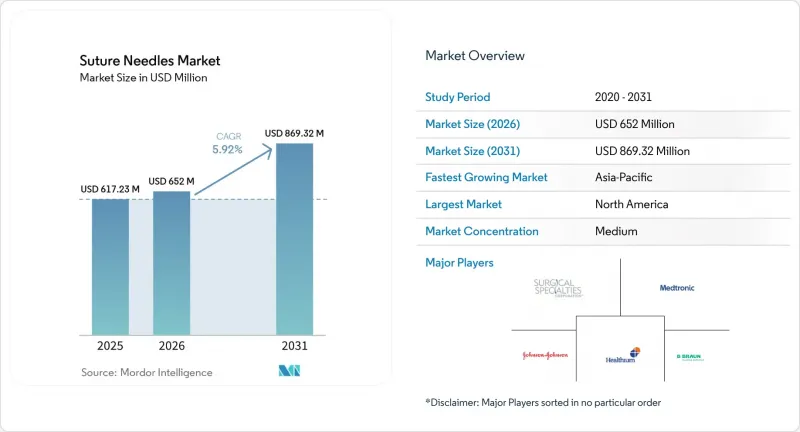
Mordor Intelligence에 의하면, 봉합바늘 시장 규모는 2025년 6억 1,723만 달러로 평가되었습니다. 2026년에는 6억 5,200만 달러로 확대되어 2031년까지 8억 6,932만 달러에 이를 것으로 예상되고 2026년부터 2031년에 걸쳐 CAGR 5.92%로 성장할 전망입니다.
본 보고서는 형태(스트레이트 바늘 등), 바늘 끝 유형(테이퍼 포인트 바늘 등), 형태(아이리스, 스웨지드 바늘 등), 재질(300계 스테인리스 스틸 등), 바늘의 곡률, 용도, 최종 사용자, 유통 채널 및 지역(북미, 유럽, 아시아태평양 등)별로 분류되어 있습니다. 시장 전망은 금액(미 달러) 기준으로 제시되어 있습니다.
세계의 봉합바늘 시장 동향 및 인사이트
외과 수술 건수 증가
봉합바늘 시장은 충족되지 않은 외과적 치료 수요에 지속적으로 대응해야 할 필요성으로부터 혜택을 받고 있습니다. 『랜싯 커미션』의 2025년 리뷰에 따르면, 충족되지 않은 외과적 수요는 연간 최소 1억 6,000만 건의 수술에 달할 것으로 추정됩니다. 이러한 수요는 병원 및 외래 진료 현장에서의 상처 봉합 제품에 대한 지속적인 수요를 뒷받침하고 있으며, 조달 담당 팀은 범용 제품과 다양한 조직 유형 및 외과적 접근 조건에 필요한 특수한 형태의 제품 간 균형을 맞추어야 합니다. 외래 수술의 경우, 입원 환자를 위한 상처 관리 제품의 사용량이 적기 때문에 직접적인 상처 봉합이 매우 요구되는 경우가 있습니다. 이러한 추세로 인해 진료 현장에서 적절한 유형의 봉합바늘를 상비해 두는 것이 더욱 중요해지고 있습니다. 폭넓고 즉시 사용 가능한 제품 라인업을 유지하고 있는 공급업체는 수술 회전율이 높은 의료 기관에 대응하는 데 유리한 입장에 있습니다.
최소 침습 수술 및 현미경 수술의 확대
저침습 수술 및 현미경 수술에서는 보다 정밀한 바늘 조작이 요구되므로 봉합바늘 시장은 변화하고 있습니다. 천자 부위의 소형화 및 작업 공간의 제약으로 인해 유연성, 연성 및 형상의 중요성이 더욱 높아지고 있습니다. 따라서 표준 스테인리스 스틸 제품으로는 수술 요건을 충족할 수 없는 경우, 특히 제어된 유연성, 예리함, 가시성 및 변형 저항성을 모두 갖추어야 하는 수술에서는 특수한 소재와 설계의 중요성이 점점 더 커지고 있습니다. 로봇 수술에서도 손목 가동식 기구나 소정의 접근 경로에 대응할 수 있는 바늘이 요구되고 있습니다. 이러한 요건으로 인해 북미, 독일, 한국 및 기타 로봇 수술이 정착된 지역에서 정밀 제품에 대한 수요가 증가하고 있습니다. 그 결과, OEM 파트너와 협력하여 전용 설계 제품을 개발할 수 있는 공급업체가 유리한 입장에 있습니다.
바늘 찔림 사고 및 직업적 노출 위험
직업적 노출은 봉합바늘 시장, 특히 표준적인 날카로운 제품의 경우 여전히 제약 요인으로 작용하고 있습니다. 미국 질병통제예방센터(CDC)에 따르면, 미국 병원에서 근무하는 의료 종사자들은 매년 약 38만 5,000건의 바늘 찔림 사고 및 기타 날카로운 물체와 관련된 부상을 경험하고 있습니다. 2026년 종단 연구에 따르면, 전 세계 의료 종사자들 사이에서 연간 200만 건 이상의 직업적 바늘 찔림 사고가 발생하고 있는 것으로 보고되었습니다. 안전상의 우려로 인해 수동 안전 장치 및 바늘 수납 시스템에 대한 수요가 증가할 가능성이 있습니다. 이로 인해 단가가 상승할 우려가 있으므로, 병원 측은 제품의 입수 가능성, 직원 교육 요구 사항, 확립된 임상 관행에 더해 안전상의 이점도 평가해야 합니다. 또한, 일부 병원에서는 얕은 상처의 경우 접착성 봉합재, 스테이플 또는 바늘 없는 대안을 고려하기도 합니다. 이러한 대체 수단은 복잡성이 낮은 상처 봉합에서의 사용량 증가를 억제하는 한편, 봉합이 여전히 필요한 시술에 대한 수요는 유지하게 될 것입니다.
부문별 분석
2025년, 피부 봉합 및 표층 건수복를 배경으로, 직선 바늘은 봉합바늘 시장 점유율의 39.49%를 차지했습니다. 외과의가 조직을 직접 확인할 수 있고, 일상적인 수술실 워크플로우에서 단순한 표층 봉합 작업에 익숙한 제품을 필요로 하는 경우, 그 사용은 여전히 실용적입니다. 시장 기반이 크다고 해서 접근이 제한된 상황을 위해 설계된 형태로의 다각화가 저해되는 것은 아닙니다. 반곡선 바늘은 2031년까지 연평균 성장률(CAGR) 7.33%를 나타낼 것으로 예측됩니다. 이 바늘의 형태는 기존의 곡선형 제품으로는 트로카 접근을 통해 삽입하기 어려운 경우가 있는 복강경 수술이나 싱글 포트 수술에 적합합니다. J자형 바늘 또한 안과 수술이나 재건 수술에서의 정밀한 작업에 도움이 됩니다.
반곡선형 및 J자형 제품은 복강경 수술 후 복강 폐쇄에서 점점 더 중요해지고 있습니다. 콤팩트한 삽입 형태 덕분에 외과의사는 직선 바늘로는 적합하지 않은 트로카 포트 부위의 폐쇄를 수행할 수 있습니다. 복합 곡선 바늘은 해부학적 구조상 하나 이상의 평면을 가로질러 이동해야 하는 심혈관 수술이나 흉강경 수술에서 여전히 유용합니다. 제한된 공간에서는 표준화된 형태보다 기구의 조작성이 중요하기 때문에 이러한 제품들이 주목을 받고 있습니다. 각 제조업체는 OEM 계약을 바탕으로 형상에 특화된 제품 라인업을 확충하고 있습니다. 이를 통해 병원 시스템은 더 적은 수공급업체와의 거래를 통해 더 폭넓은 형상의 제품을 조달할 수 있게 됩니다.
테이퍼 포인트 바늘은 2025년 매출의 35.30%를 차지하며, 봉합바늘 시장에서 가장 주요한 바늘 끝 유형으로 자리 잡았습니다. 이 바늘들은 소화기, 비뇨기 및 연조직 복원에서 여전히 널리 사용되고 있습니다. 테이퍼 컷 바늘은 2031년까지 연평균 성장률(CAGR) 9.96%로 확대될 것으로 예측됩니다. 이 바늘의 절삭 모서리와 테이퍼형 바늘 몸체는 석회화 조직이나 섬유화 조직에서의 수술을 지원하는 동시에, 섬세한 심혈관 및 흉부 외과 환경에서 외과의사가 까다로운 천자 요건을 충족할 수 있도록 돕습니다. 이 설계는 기존 테이퍼 포인트 바늘이 휘어질 가능성이 있는 성인 심장 수술에 유용합니다. 리버스 커팅 제품은 피부과 및 성형외과 분야의 피부 봉합을 지속적으로 지원하고 있습니다.
심혈관 및 흉부 수술은 테이퍼 컷 제품의 프리미엄 위상을 뒷받침하고 있습니다. 미국 흉부외과학회(Society of Thoracic Surgeons)의 ‘성인 심장 수술 데이터베이스’는 2026년 업데이트판에서 860만 건 이상의 수술을 포괄하고 있습니다. 이러한 대규모 임상 기반이 차별화된 바늘 끝 형태에 대한 지속적인 수요를 뒷받침하고 있습니다. 원통형 제품은 조직 절개가 선호되는 안과 및 신경외과 수술에서 전문적인 역할을 유지하고 있습니다. 무딘 바늘 제품도 특정 근막 및 복막 봉합 수술에 사용되고 있습니다. 그 결과, 모든 용도에 단일 바늘 끝 디자인을 사용하는 대신 바늘 끝 유형에 대한 임상적 요구가 더욱 광범위해지고 있습니다. 따라서 병원에는 조직의 특성, 수술 접근법, 임상 전문 분야의 요구 사항, 그리고 수술팀의 취급 선호도를 구분한 제품 포트폴리오가 필요합니다.
아이리스 스웨지드 바늘은 2025년 매출의 80.7%를 차지하며 봉합바늘 시장의 주류 형태로 자리 잡았으며, 2031년까지 연평균 성장률(CAGR) 6.44%를 나타낼 것으로 예측됩니다. 이 형태는 일관된 바늘과 봉합바늘의 조립을 제공하여 예측 가능한 취급을 가능하게 하고, 많은 수술실의 표준화된 제품 준비와 부합하기 때문에 의료 기관에서 널리 사용되고 있습니다. 또한, 수술실에서 실을 꿰는 데 소요되는 시간과 불일치를 해소합니다. 일회용 멸균 워크플로우 또한 이러한 추세를 뒷받침하고 있습니다. 자동 검사를 통해 스웨이지 가공의 품질과 장착 강도를 확인할 수 있습니다. 이러한 장점은 빡빡한 수술 일정 속에서 의료진이 예측 가능한 조작을 필요로 하는 병원 및 외래수술센터(ASC)의 운영 관행과 부합합니다.
고리가 달린 제품은 일회용 인프라가 충분히 갖춰지지 않은 분야에서 여전히 특수한 역할을 담당하고 있습니다. 또한, 수의학 및 법의학 분야에서도 사용되어 안정적이지만 소규모인 수요 기반을 뒷받침하고 있습니다. Healthium사는 채널 유형, 드릴 엔드, 고리가 달린 제품 및 특수 형식에 이르는 46,000개 이상의 SKU를 제공합니다. 이 기업의 제품 포트폴리오는 최종 용도의 복잡화가 제품 사양을 얼마나 확대해 왔는지를 보여줍니다. 소량 생산되는 특수 스웨지 가공 제품에는 여전히 수작업 공정이 포함될 수 있으며, 고객이 이러한 제품에 기대하는 정확한 사양, 무균 상태에서의 제공, 신뢰성 높은 봉합바늘 부착과 같은 특징을 높이 평가하더라도 업무상의 복잡성을 가중시키는 요인이 됩니다. 이러한 운영상의 복잡성은 특수 제품이 더 높은 단가를 가지고 있더라도 이익률 확대를 저해할 가능성이 있습니다.
지역별 분석
북미는 2025년 매출의 39.06%를 차지하며, 봉합바늘 시장에서 가장 규모가 큰 지역 점유율을 기록했습니다. 이 지역은 높은 수술 건수와 선진적인 병원, 그리고 프리미엄 제품 구성을 겸비하고 있어 특수 소재나 정교하게 설계된 형태가 수용되기 쉬운 환경이 조성되어 있습니다. 심혈관 외과 및 로봇 수술이 특수 디자인에 대한 수요를 뒷받침하고 있습니다. 클리블랜드 클리닉은 2025년 6월, 3억 4,000만 달러를 투자한 에이본 병원 확장 계획을 발표했습니다. 또한, 피에몬테 아테네 리저널도 2025년 9월, 5,600만 달러를 투자한 외과 서비스 확장 계획을 시작했습니다. 이러한 프로젝트는 수술 역량을 강화하는 것이며, 각 시설에서 시행되는 수술에 적합한 제품을 임상의가 사용할 수 있도록 다양한 바늘 끝 모양, 곡률, 포장 옵션을 포함한 새로운 소모품 재고가 필요합니다.
유럽은 독일, 영국, 프랑스, 이탈리아, 스페인이 성숙한 외과 프로그램을 보유하고 있어 중요한 위치를 차지하고 있습니다. 이 지역의 봉합바늘 시장 규모는 일회용 및 멸균 포장 제품에 대한 강력한 수요에 의해 형성되고 있습니다. EU의 MDR 요건은 조달에 영향을 미치고 있으며, 공급업체는 지속적인 문서화 및 시판 후 임상 후속 조치가 필요하기 때문에 규제 대응 준비는 공급업체의 적격성 평가 및 지속적인 계약 지원에 있어 중요한 요소가 되고 있습니다. EASSI는 이러한 의무가 지속되는 가운데, 봉합바늘가 확립된 기술의 지위를 유지하고 있음을 확인하고 있습니다(EASSI.EU). 이러한 환경에서는 구매자가 기록 유지, 시판 후 책임 이행, 그리고 일상적인 요건과 전문적인 요건 모두에서 일관된 제품을 제공하는 공급업체의 역량을 고려해야 하므로, 확립된 기술적·규제적 역량을 갖춘 공급업체가 유리합니다. 이로 인해 소량 생산되는 전문 제품을 취급하는 소규모 지역 기업 시장 진입이 제한될 가능성이 있습니다.
아시아태평양은 2031년까지 연평균 성장률(CAGR) 8.16%를 나타낼 것으로 예측되며, 이는 봉합바늘 시장에서 지역별 가장 높은 성장률입니다. 인도의 생산 능력 확대, 중국의 외래 진료로의 전환, 그리고 일본의 고령화가 이 지역 수요 기반에 기여하고 있는 한편, 각 제조업체들도 국가별 다양한 조달 요구에 부응하기 위해 현지 사업 체제 구축을 모색하고 있습니다. 또한, 일본은 MANI 등의 기업을 통해 정밀 바늘 제조 분야에서 확고한 입지를 유지하고 있습니다. MANI는 2025년에 말레이시아 사업체를 ‘MANI Asia’로 재편하고, 쿠알라룸푸르를 지역 본부로 삼았습니다. GCC 국가들의 민간 병원 투자로 인해 중동 및 아프리카의 외과 수술 역량이 확대되고 있습니다. 브라질과 아르헨티나가 남미 수요를 지탱하고 있지만, 수입 물류 및 환율 상황에 따라 고급 제품의 보급이 둔화될 가능성이 있습니다.
기타 혜택 :
- 엑셀 형식 시장 예측(ME) 시트
- 3개월간의 애널리스트 지원
자주 묻는 질문
목차
제1장 서론
제2장 조사 방법
제3장 개요
제4장 시장 구도
제5장 시장 규모 및 성장 예측
제6장 경쟁 구도
제7장 시장 기회 및 향후 전망
KTH 26.09.02According to Mordor Intelligence, the suture needles market size is expected to increase from USD 617.23 million in 2025 to USD 652 million in 2026 and reach USD 869.32 million by 2031, growing at a CAGR of 5.92% over 2026-2031.
This report is Segmented by Shape (Straight Shaped Needles, and More), Needle Point Type (Taper Point Needles, and More), Form (Eyeless, Swaged Needles, and More), Material (300-Series Stainless Steel, and More), Needle Curvature, Application, End User, Distribution Channel, and Geography (North America, Europe, Asia-Pacific, and More). The Market Forecasts are Provided in Terms of Value (USD).
Global Suture Needles Market Trends and Insights
Rising Surgical Procedure Volumes
The suture needles market benefits from the continuing need to address unmet surgical care. The Lancet Commission's 2025 review placed unmet surgical need at no fewer than 160 million operations each year. This need supports recurring demand for closure products across hospitals and outpatient settings, where procurement teams must balance common-use products with the specialized formats needed for different tissue types and surgical access conditions. Ambulatory procedures can require a high level of direct wound closure because they often use fewer inpatient wound-management products. That pattern increases the importance of having the right needle type available at the point of care. Suppliers that maintain broad, ready-to-use portfolios are better placed to serve facilities with fast procedure turnover.
Expansion of Minimally Invasive and Microsurgical Procedures
The suture needles market is changing as minimally invasive and microsurgical procedures require more controlled needle handling. Smaller access points and restricted working spaces place greater importance on flexibility, ductility, and geometry. Specialty materials and designs are therefore becoming more relevant where standard stainless steel products do not meet procedural requirements, particularly when a procedure requires a combination of controlled flexibility, sharpness, visibility, and resistance to deformation. Robotic procedures also require needles that work with wristed instruments and defined access paths. These requirements support demand for precision products in North America, Germany, South Korea, and other established robotic surgery settings. The resulting specifications favor suppliers that can develop purpose-designed products with OEM partners.
Needlestick Injury and Occupational Exposure Risk
Occupational exposure remains a constraint for the Suture needles market, particularly for standard sharp products. The CDC states that hospital-based health care personnel in the United States experience an estimated 385,000 needlestick and other sharps-related injuries each year. A 2026 longitudinal study reported more than 2 million occupational needlestick injuries annually among health care workers worldwide. Safety concerns can increase demand for passive safeguards and needle-retraction systems, which can raise unit costs and require hospitals to evaluate safety benefits alongside product availability, staff training needs, and established clinical practice. Hospitals may also consider adhesive closure, staples, or needle-free options for some superficial wounds. These alternatives limit volume growth in lower-complexity closure use while preserving demand for procedures where suturing remains necessary.
Other drivers and restraints analyzed in the detailed report include:
- Hospital Modernization and Surgical Infrastructure Expansion
- OEM and Private-Label Needle Outsourcing
- Regulatory and Quality-Validation Burden
For complete list of drivers and restraints, kindly check the Table Of Contents.
Segment Analysis
Straight needles held 39.49% of the suture needles market share in 2025, supported by skin closure and surface-level tendon repair. Their use remains practical when surgeons have direct line-of-sight access to the tissue and require a familiar product for straightforward surface closure tasks in routine operating room workflows. The large base does not prevent diversification into shapes designed for restricted access. Half curved needles are forecast to grow at a 7.33% CAGR through 2031. Their geometry supports laparoscopic and single-port procedures where conventional curved products can be difficult to place through trocar access. J-shaped needles also serve for precise work in ophthalmic and reconstructive procedures.
Half curved and J-shaped products are increasingly relevant in abdominal cavity closure after laparoscopic procedures. Compact entry geometry can help surgeons close trocar port sites that are poorly suited to straight needles. Compound curve needles remain useful in cardiovascular and thoracoscopic work where anatomy requires movement through more than 1 plane. These products command attention because instrument control matters more than a standardized shape in confined spaces. Manufacturers are expanding shape-specific product libraries under OEM agreements. This lets hospital systems procure a broader set of shapes through a smaller number of supplier relationships.
Taper point needles accounted for 35.30% of 2025 revenue, making them the leading point type in the suture needles market. They remain widely used in gastrointestinal, urological, and soft-tissue repair. Tapercut needles are projected to expand at a 9.96% CAGR through 2031. Their cutting entry edge and tapered body can support work in calcified or fibrotic tissue while helping surgeons manage demanding penetration requirements in sensitive cardiovascular and thoracic settings. This design is relevant in adult cardiac surgery when conventional taper points can deflect. Reverse cutting products continue to support skin closure in dermatology and plastic surgery.
Cardiovascular and thoracic procedures support the premium position of tapercut products. The Society of Thoracic Surgeons' Adult Cardiac Surgery Database covered more than 8.6 million procedures in its 2026 update. This large clinical base supports continued demand for differentiated needle points. Round-bodied products retain a specialist role in ophthalmic and neurological procedures where tissue splitting is preferred. Blunt-tipped products are also used for selected fascial and peritoneal closure procedures. The result is a broader clinical need for point types rather than a single point design across all uses. Hospitals, therefore, need portfolios that distinguish between tissue characteristics, surgical access, clinical specialty requirements, and the handling preferences of their surgical teams.
Eyeless swaged needles captured 80.7% of 2025 revenue, establishing the dominant form within the suture needles market and is expected to grow at a CAGR of 6.44% through 2031. The format is widely used in institutional settings because it provides a consistent needle-suture assembly, supports predictable handling, and aligns with standardized product preparation across many procedure rooms. It also removes the time and variability associated with threading in the operating room. Single-use sterile workflows reinforce this preference. Automated inspection can verify swaging quality and attachment strength. These benefits align with the operating practices of hospitals and ambulatory surgical centers, where staff need predictable handling during a demanding schedule of procedures.
Eyed products retain a specialized role where single-use infrastructure is less developed. They are also used in veterinary work and forensic pathology, which supports a stable but smaller demand base. Healthium offers more than 46,000 SKUs across channel-type, drilled-end, eyed, and specialty formats. Its portfolio illustrates how end-use complexity has widened product specifications. Low-volume specialty swaged products can still involve manual production steps, which adds operational complexity even when customers value the precise specification, sterile presentation, and reliable suture attachment that these products are intended to provide. That operating complexity can limit margin expansion even where specialty products carry higher unit values.
Complete Report Scope:
- By Shape
- Straight Shaped Needles
- Half Curved Needles
- J-Shaped Needles
- Compound Curve Shaped Needles
- By Needle Point Type
- Taper Point Needles
- Tapercut Needles
- Round Bodied Needles
- Reverse Cutting Needles
- Other Needle Point Types
- By Form
- Eyeless, Swaged Needles
- Eyed Needles
- By Material
- 300-Series Stainless Steel
- 400-Series Stainless Steel
- Titanium and Specialty Alloys
- Polymer-Coated Needles
- By Needle Curvature
- Straight
- 1/4 Circle
- 3/8 Circle
- 1/2 Circle
- 5/8 Circle
- Other Needle Curvatures
- By Application
- General Surgery
- Cardiovascular Surgery
- Orthopedic Procedures
- Gynecological and Obstetric Procedures
- Ophthalmic Surgery
- Plastic and Reconstructive Surgery
- Other Applications
- By End User
- Hospitals
- Ambulatory Surgical Centers
- Specialty Clinics
- Academic and Research Institutions
- By Distribution Channel
- Direct Hospital and Health-System Procurement
- Medical Device Distributors
- Original Equipment Manufacturer and Private Label
- By Geography
- North America
- United States
- Canada
- Mexico
- Europe
- Germany
- United Kingdom
- France
- Italy
- Spain
- Rest of Europe
- Asia-Pacific
- China
- Japan
- India
- Australia
- South Korea
- Rest of Asia-Pacific
- Middle East and Africa
- GCC
- South Africa
- Rest of Middle East and Africa
- South America
- Brazil
- Argentina
- Rest of South America
- North America
Geography Analysis
North America held 39.06% of 2025 revenue, the largest regional position in the Suture needles market. The region combines high procedure volumes with advanced hospitals and a premium product mix, creating a setting in which specialty materials and carefully designed geometries can gain acceptance. Cardiovascular and robotic surgery support demand for specialty designs. Cleveland Clinic announced a USD 340 million Avon Hospital expansion in June 2025. Piedmont Athens Regional also began a USD 56 million surgical services expansion in September 2025. These projects add surgical capacity and require new consumable inventories, including a range of point configurations, curvatures, and packaging options that allow clinicians to use products suited to the procedures performed at each site.
Europe has a substantial position because Germany, the United Kingdom, France, Italy, and Spain have mature surgical programs. The Suture needles market size in the region is shaped by strong demand for single-use, sterile-packaged products. EU MDR requirements influence procurement because suppliers need continuing documentation and post-market clinical follow-up, making regulatory readiness an important part of supplier qualification and ongoing contract support. EASSI confirms that sutures retain well-established technology status while those obligations continue EASSI.EU. This environment favors suppliers with established technical and regulatory capabilities, since buyers must consider the supplier's ability to maintain records, support post-market responsibilities, and provide consistent products across both routine and specialty requirements. It can limit access for small regional companies that serve low-volume specialty products.
Asia-Pacific is forecast to grow at an 8.16% CAGR through 2031, the highest regional rate in the Suture needles market. India's capacity additions, China's outpatient migration, and Japan's aging population contribute to the region's demand base, while manufacturers also seek local operating structures to serve varied national purchasing needs. Japan also retains a strong position in precision needle manufacturing through companies such as MANI. MANI repositioned its Malaysian entity as MANI Asia in 2025, making Kuala Lumpur its regional headquarters. GCC investment in private hospitals expands surgical capacity in the Middle East and Africa. Brazil and Argentina support South American demand, although import logistics and currency conditions can slow adoption of premium products.
- Advin Health Care
- Alfresa Pharma Corporation
- Aurolab
- B. Braun
- Bear Medic Corporation
- DemeTECH
- FSSB Chirurgische Nadeln GmbH
- Futura Surgicare Pvt. Ltd.
- Healthium Medtech Limited
- Johnson & Johnson
- Kono Seisakusho Co., Ltd.
- MANI, INC.
- Medtronic
- Natsume Seisakusho Co., Ltd.
- Peters Surgical
- Smiths Group
- Surgical Specialties
- SUTUREX & RENODEX
- Teleflex
- UNIK SURGICAL SUTURES MFG. CO.
- WEGO Medical
Additional Benefits:
- The market estimate (ME) sheet in Excel format
- 3 months of analyst support
TABLE OF CONTENTS
1 Introduction
- 1.1 Study Assumptions & Market Definition
- 1.2 Scope of the Study
2 Research Methodology
3 Executive Summary
4 Market Landscape
- 4.1 Market Overview
- 4.2 Market Drivers
- 4.2.1 Rising Surgical Procedure Volumes
- 4.2.2 Expansion of Minimally Invasive and Microsurgical Procedures
- 4.2.3 Hospital Modernization and Surgical Infrastructure Expansion
- 4.2.4 Demand for Precision Needles That Reduce Tissue Trauma
- 4.2.5 OEM and Private-Label Needle Outsourcing
- 4.2.6 Digitally Controlled Needle Geometry and Inspection
- 4.3 Market Restraints
- 4.3.1 Needlestick Injury and Occupational Exposure Risk
- 4.3.2 Regulatory and Quality-Validation Burden
- 4.3.3 Substitution by Adhesive Closure, Staples, and Automated Suturing
- 4.3.4 Sterile Supply and Traceability Complexity for Low-Volume Specialty SKUs
- 4.4 Supply-Chain Analysis
- 4.5 Regulatory Landscape
- 4.6 Technological Outlook
- 4.7 Porter's Five Forces
- 4.7.1 Threat of New Entrants
- 4.7.2 Bargaining Power of Suppliers
- 4.7.3 Bargaining Power of Buyers
- 4.7.4 Threat of Substitutes
- 4.7.5 Competitive Rivalry
5 Market Size & Growth Forecasts (Value in USD)
- 5.1 By Shape
- 5.1.1 Straight Shaped Needles
- 5.1.2 Half Curved Needles
- 5.1.3 J-Shaped Needles
- 5.1.4 Compound Curve Shaped Needles
- 5.2 By Needle Point Type
- 5.2.1 Taper Point Needles
- 5.2.2 Tapercut Needles
- 5.2.3 Round Bodied Needles
- 5.2.4 Reverse Cutting Needles
- 5.2.5 Other Needle Point Types
- 5.3 By Form
- 5.3.1 Eyeless, Swaged Needles
- 5.3.2 Eyed Needles
- 5.4 By Material
- 5.4.1 300-Series Stainless Steel
- 5.4.2 400-Series Stainless Steel
- 5.4.3 Titanium and Specialty Alloys
- 5.4.4 Polymer-Coated Needles
- 5.5 By Needle Curvature
- 5.5.1 Straight
- 5.5.2 1/4 Circle
- 5.5.3 3/8 Circle
- 5.5.4 1/2 Circle
- 5.5.5 5/8 Circle
- 5.5.6 Other Needle Curvatures
- 5.6 By Application
- 5.6.1 General Surgery
- 5.6.2 Cardiovascular Surgery
- 5.6.3 Orthopedic Procedures
- 5.6.4 Gynecological and Obstetric Procedures
- 5.6.5 Ophthalmic Surgery
- 5.6.6 Plastic and Reconstructive Surgery
- 5.6.7 Other Applications
- 5.7 By End User
- 5.7.1 Hospitals
- 5.7.2 Ambulatory Surgical Centers
- 5.7.3 Specialty Clinics
- 5.7.4 Academic and Research Institutions
- 5.8 By Distribution Channel
- 5.8.1 Direct Hospital and Health-System Procurement
- 5.8.2 Medical Device Distributors
- 5.8.3 Original Equipment Manufacturer and Private Label
- 5.9 By Geography
- 5.9.1 North America
- 5.9.1.1 United States
- 5.9.1.2 Canada
- 5.9.1.3 Mexico
- 5.9.2 Europe
- 5.9.2.1 Germany
- 5.9.2.2 United Kingdom
- 5.9.2.3 France
- 5.9.2.4 Italy
- 5.9.2.5 Spain
- 5.9.2.6 Rest of Europe
- 5.9.3 Asia-Pacific
- 5.9.3.1 China
- 5.9.3.2 Japan
- 5.9.3.3 India
- 5.9.3.4 Australia
- 5.9.3.5 South Korea
- 5.9.3.6 Rest of Asia-Pacific
- 5.9.4 Middle East and Africa
- 5.9.4.1 GCC
- 5.9.4.2 South Africa
- 5.9.4.3 Rest of Middle East and Africa
- 5.9.5 South America
- 5.9.5.1 Brazil
- 5.9.5.2 Argentina
- 5.9.5.3 Rest of South America
- 5.9.1 North America
6 Competitive Landscape
- 6.1 Market Concentration
- 6.2 Market Share Analysis
- 6.3 Company Profiles {(includes Global level Overview, Market level overview, Core Segments, Financials as available, Strategic Information, Market Rank/Share for key companies, Products & Services, and Recent Developments)}
- 6.3.1 Advin Health Care
- 6.3.2 Alfresa Pharma Corporation
- 6.3.3 Aurolab
- 6.3.4 B. Braun Melsungen AG
- 6.3.5 Bear Medic Corporation
- 6.3.6 DemeTECH Corporation
- 6.3.7 FSSB Chirurgische Nadeln GmbH
- 6.3.8 Futura Surgicare Pvt. Ltd.
- 6.3.9 Healthium Medtech Limited
- 6.3.10 Johnson & Johnson Services, Inc.
- 6.3.11 Kono Seisakusho Co., Ltd.
- 6.3.12 MANI, INC.
- 6.3.13 Medtronic plc
- 6.3.14 Natsume Seisakusho Co., Ltd.
- 6.3.15 Peters Surgical
- 6.3.16 Smith & Nephew plc
- 6.3.17 Surgical Specialties Corporation
- 6.3.18 SUTUREX & RENODEX
- 6.3.19 Teleflex Incorporated
- 6.3.20 UNIK SURGICAL SUTURES MFG. CO.
- 6.3.21 WEGO Medical
7 Market Opportunities & Future Outlook
- 7.1 White-space & unmet-need assessment