

|
시장보고서
상품코드
2119553
에드테크 마케팅 서비스 : 시장 점유율 분석, 업계 동향 및 통계, 성장 예측(2026-2031년)EdTech Marketing Services - Market Share Analysis, Industry Trends & Statistics, Growth Forecasts (2026 - 2031) |
||||||
 Mordor Intelligence
Mordor Intelligence에 의하면, 에드테크 마케팅 서비스 시장 규모는 2025년 45억 6,000만 달러로 평가되었습니다. 2026년 48억 9,000만 달러에서 2031년까지 73억 6,000만 달러로 확대되어 2026년부터 2031년에 걸쳐 CAGR 8.52%를 나타낼 것으로 예측됩니다.
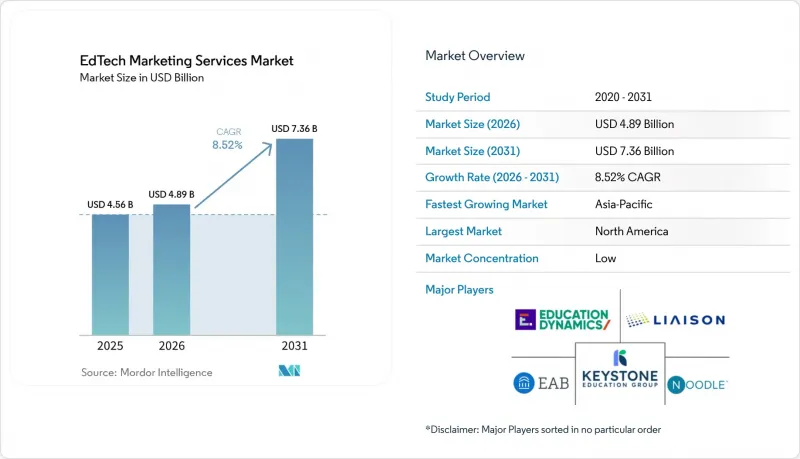
본 보고서는 서비스 유형별(학생 유치 및 성과 마케팅, 콘텐츠 및 SEO 서비스, 인플루언서 및 소셜 미디어 마케팅, 라이프사이클 및 고객 유지 마케팅, 전략·분석·마케팅 기술(MarTech) 통합) 및 지역별(북미, 남미, 유럽, 아시아태평양, 중동 및 아프리카)로 분류되어 있습니다. 시장 전망은 금액(달러) 기준으로 제시됩니다.
세계의 에드테크 마케팅 서비스 시장 동향 및 인사이트
AI를 활용한 개인화 및 마케팅 자동화의 확산
AI를 활용한 개인화는 2025년부터 2026년에 걸쳐 고등교육 마케팅에서 핵심적인 운영 우선순위가 되었습니다. 고등교육 마케팅에 관한 조사에서는 데이터 기반 세분화, 예측적 신입생 관리, 개인화된 커뮤니케이션, 디지털 학생 여정 및 거버넌스가 상호 관련된 실천 분야로 파악되었습니다. 이 조사에 따르면, AI 활용은 단순한 캠페인 효율화 도구로서뿐만 아니라 교육 기관의 책임성 및 등록금 수입 계획에도 영향을 미치고 있는 것으로 나타났습니다. 에드테크 마케팅 서비스 시장에서 이로 인해 전략, 분석 및 마케팅 기술 통합 팀의 역할이 확대되고 있습니다. 교육 기관에는 데이터 관리 현황을 감사하고, 승인된 데이터 흐름을 입학 워크플로우와 연동하며, 새로운 프로세스에 대해 직원을 교육하고, 연동되지 않는 도구의 추가를 방지할 수 있는 서비스 파트너가 필요합니다. 2026년 4월, NMIMS 대학은 실시간 데이터 통합과 개인화된 디지털 참여를 활용하여 입학 전형 과정 전반에 Salesforce Agentforce Marketing 및 Education 솔루션을 도입했습니다. 예측적 입학자 수 분석과 고객 관계 관리(CRM) 워크플로를 연계하는 제공업체는 미디어 운영만을 전문으로 하는 대행사보다 더 종합적인 서비스를 제공할 수 있습니다.
측정 가능한 학생 유치 효율에 대한 수요 증가
미디어 비용의 급등과 교육 기관의 예산 제약으로 인해, 관심은 ‘문의 건수’에서 ‘입학 1건당 비용’으로 이동하고 있습니다. EducationDynamics의 보고서에 따르면, 2025년 비브랜드 유료 검색의 클릭당 비용은 전년 대비 30.9% 상승했습니다. 동 보고서에 따르면, 2026년 지원자 수 중 ‘스텔스 지원자’의 비율이 9.7%에 달한 것으로 나타났습니다(2020년은 1%). 이로 인해 기존의 리드 기반 보고서만으로는 분석이 불완전해질 수 있습니다. 이러한 학생들은 문의 퍼널에 진입하기 전에 독자적으로 조사를 진행하고 있으므로, 교육 기관은 검색, 콘텐츠, 브랜드 노출 및 직접 접근이 각각 어느 정도 기여하고 있는지 파악해야 합니다. 에드테크 마케팅 서비스 시장에서는 여러 채널에 걸친 초기 조사 신호를 식별하고, 이를 지원 및 입학이라는 성과로 연결하는 어트리뷰션 프로그램에 대한 수요가 증가하고 있습니다. 학습자의 조사 경로를 추적하고 전환 과정을 개선할 수 있는 대행사는 단순한 유료 미디어 관리와는 차별화된 서비스를 제공할 수 있습니다.
학생 데이터 활용에 관한 개인정보 보호 및 동의 요건의 강화
학생 데이터 규제로 인해 많은 교육 마케팅 프로그램을 뒷받침하는 타겟팅 및 프로파일링 관행이 제한되고 있습니다. 2025년 1월, 연방거래위원회(FTC)는 ‘아동 온라인 개인정보 보호 규정(COPPA)’ 개정을 최종 확정했습니다. 이에 따라 타겟팅 광고를 포함하여 아동의 데이터를 제3자에게 공개할 때는 별도로 보호자의 동의가 필요합니다. 또한, 이 규정에서는 아동 데이터의 특정 이용에 대해서도 보호자의 별도 동의가 요구되므로, K-12(유치원부터 고등학교까지) 대상자 구축 활동에 활용할 수 있는 데이터가 제한됩니다. 미국 및 유럽의 학습자에게 서비스를 제공하는 교육 기관은 데이터 처리와 관련하여 FERPA(가족 교육 권리 및 개인정보 보호법) 및 일반 데이터 보호 규정(GDPR(EU 개인정보보호규정))의 요건도 준수해야 합니다. 에드테크 마케팅 서비스 시장은 동의 관리, 승인된 데이터 흐름, 접근 제한 및 학생 정보 이용에 대한 명확한 설명 책임을 지원해야 합니다. 이러한 요건으로 인해 배포 비용이 증가하고 캠페인 준비 기간이 길어지며, 법적 및 기술적 자원이 제한적인 소규모 대행사에게는 규정 준수상의 장벽이 됩니다.
부문별 분석
2025년, 학생 유치 및 성과 기반 마케팅은 에드테크 마케팅 서비스 시장에서 34.08%의 점유율을 차지했습니다. 이러한 위상은 마케팅 활동과 입학 성과(문의당 비용, 입학당 비용 등)를 연결해 주는 서비스에 대한 교육 기관의 오랜 수요를 반영합니다. 많은 교육 기관이 여전히 신입생 유치 마케팅을 직접 측정 가능한 운영 비용으로 취급하고 있기 때문에 이 부문은 계속해서 중요한 위치를 차지하고 있습니다. 그러나 광고 단가 상승과 학생들의 자발적인 정보 탐색 행동 증가로 인해 기존 리드 생성 보고서의 포괄성은 떨어지고 있습니다. 이로 인해 유료 학생 유치와 보다 광범위한 어트리뷰션 및 전환 분석을 결합한 서비스의 가치가 높아지고 있습니다.
‘전략, 분석 및 마케팅 기술 통합’ 부문은 2031년까지 9.16%라는 가장 높은 연평균 성장률(CAGR)을 나타낼 전망입니다. 이 부문의 에드테크 마케팅 서비스 시장 규모는 파편화된 마케팅 도구를 대체하는 연계된 데이터 시스템에 대한 수요에 힘입어 성장하고 있습니다. 인도네시아 대학을 대상으로 한 조사에 따르면, AI 기반 추천 및 상호작용의 질은 지원 의향에 영향을 미칠 가능성이 있으며, 이러한 영향에는 교육 기관에 대한 신뢰가 매개체 역할을 한다는 사실이 밝혀졌습니다. 카네기 하이어 에드(Carnegie Higher Ed)는 2026년 교육 기관 감사에서 AI 가시성 점수의 평균치가 35%였다고 보고했습니다. 이러한 격차는 앤서 엔진(Answer Engine)의 가시화 작업과 콘텐츠, 분석, 입학 관리 시스템을 연계하는 자문 서비스에 대한 수요를 촉진하고 있습니다. 또한 콘텐츠 및 검색 서비스에서도 기존의 키워드 순위뿐만 아니라 생성형 AI에 의한 검색 결과도 고려해야 합니다.
지역별 분석
2025년, 북미는 에드테크 마케팅 서비스 시장의 40.13%를 차지했습니다. 이 지역은 미국의 공립 및 사립 대학의 대규모 기반, 확립된 입학 중개 기관, 성과 기반 서비스 계약, 그리고 성숙한 기술 공급업체 그룹에 의해 뒷받침되고 있습니다. 교육 기관은 마케팅 프로그램과 입학 관리 시스템을 연계하고, 입학 과정을 통해 성과를 측정하기 위해 외부 지원을 필요로 하는 경우가 많습니다. 국제교육협회(IIE)는 2026년 봄 ‘Snapshot IIE.ORG’ 설문조사에 응답한 585개 미국 교육 기관을 대상으로 조사한 결과, 유학생 모집이 여전히 최우선 과제임을 확인했습니다. 반면, 캐나다의 상황은 다르며, 캐나다 통계청의 추산에 따르면 2025년부터 2026년에 걸쳐 유학생 수가 26% 감소할 것으로 예측됩니다. 이에 따라 교육 기관의 예산은 전문 서비스에 대한 필요성은 유지하면서도 국내 학생 모집, 프로그램 홍보, 브랜드 관리로 전환될 가능성이 있습니다.
아시아태평양은 2031년까지 연평균 성장률(CAGR) 9.23%를 나타낼 것으로 예측되며, 이는 각 지역 중 가장 높은 성장률입니다. 이 지역이 에드테크 마케팅 서비스 시장에서 차지하는 위상은 대규모 디지털 학습자층, 국경을 초월한 입학에 대한 관심 증가, 그리고 고등교육 및 전문 교육 분야에서 디지털 채널의 활용 확대와 밀접한 관련이 있습니다. 각 교육 기관은 지역 전반에 걸쳐 다양한 언어 요구 사항, 미디어 플랫폼, 입학에 대한 기대치, 학습자의 선호도를 충족해야 합니다. 2026년 4월, NMIMS 대학은 잠재 고객부터 입학에 이르는 전체 과정에서 개인화된 참여를 실현하기 위해 Salesforce 도구를 도입했습니다. 이러한 도입은 데이터 통합, 시스템 구축, 캠페인 관리 및 성과 측정 서비스에 대한 관련 수요를 창출하고 있습니다. 아시아태평양의 한 국가에서 작동하는 프로그램이 다른 국가에서 사용되는 플랫폼이나 커뮤니케이션 관행과 일치하지 않을 수 있으므로, 현지 전문 지식이 중요합니다.
유럽에서는 교육 기관들이 국제적인 학습자를 유치하기 위해 경쟁을 벌이는 가운데, 다국어 교육 마케팅에 대한 수요가 증가하고 있습니다. 유럽의 에드테크 마케팅 서비스 시장 규모는 각국의 상황에 맞춘 현지화된 콘텐츠, 미디어 기획, 커뮤니케이션을 필요로 하는 프로그램들에 의해 뒷받침되고 있습니다. 대상 학습자가 여러 국가나 언어 그룹에 걸쳐 있는 경우, 교육 기관은 더 폭넓은 모집 채널을 활용하게 됩니다. 서비스 기업은 현지 규제, 콘텐츠 요건 및 학생의 의사결정 과정을 이해해야 합니다. 남미, 중동 및 아프리카의 각 시장은 규모는 작지만, 민간 교육 활동의 활성화와 디지털 광고 이용 확대에 힘입어 성장하고 있습니다. 이러한 시장에서는 현지 접속 환경, 언어, 플랫폼 상황에 적합한 프로그램이 요구됩니다.
기타 혜택 :
- 엑셀 형식 시장 예측(ME) 시트
- 3개월간의 애널리스트 지원
자주 묻는 질문
목차
제1장 서론
제2장 조사 방법
제3장 개요
제4장 시장 구도
제5장 시장 규모 및 성장 예측
제6장 경쟁 구도
제7장 시장 기회 및 향후 전망
KTH 26.09.02According to Mordor Intelligence, the edTech marketing services market size is projected to expand from USD 4.56 billion in 2025 and USD 4.89 billion in 2026 to USD 7.36 billion by 2031, registering a CAGR of 8.52% between 2026 and 2031.
This report is Segmented by Service Type (Student Acquisition and Performance Marketing, Content and SEO Services, Influencer and Social Media Marketing, Lifecycle and Retention Marketing, and Strategy, Analytics and Martech Integration) and Geography (North America, South America, Europe, Asia-Pacific, Middle East, and Africa). The Market Forecasts are Provided in Terms of Value (USD).
Global EdTech Marketing Services Market Trends and Insights
Greater Adoption of AI-Powered Personalization and Marketing Automation
AI-powered personalization became a core operating priority in higher education marketing during 2025 and 2026. Research on higher education marketing identified data-based segmentation, predictive enrollment management, personalized communication, digital student journeys, and governance as linked areas of practice. The research shows that AI use affects institutional accountability and tuition-revenue planning, rather than serving only as a campaign efficiency tool. Within the EdTech marketing services market, this expands the role of strategy, analytics, and marketing technology integration teams. Institutions need service partners that can audit data practices, connect approved data flows with enrollment workflows, train staff on new processes, and avoid adding disconnected tools. In April 2026, NMIMS University deployed Salesforce Agentforce Marketing and Education solutions across its admissions process, using real-time data integration and personalized digital engagement. Providers that connect predictive enrollment intelligence with customer relationship management workflows can offer a more complete service than agencies focused only on media execution.
Rising Need for Measurable Student Acquisition Efficiency
Rising media costs and constrained institutional budgets are shifting attention from inquiry volume toward cost per enrollment. EducationDynamics reported that non-brand paid-search cost per click rose 30.9% year over year in 2025. The same report found that stealth applicants accounted for 9.7% of applications in 2026, compared with 1% in 2020, making conventional lead-based reporting less complete. These students conduct independent research before entering an inquiry funnel, so institutions need to understand the contribution of search, content, brand exposure, and direct visits. The EdTech marketing services market has a greater need for attribution programs that identify early research signals across multiple channels and link them to application and enrollment outcomes. Agencies that trace a learner's research path and improve conversion processes can distinguish their work from basic paid media management.
Tightening Privacy and Consent Requirements for Student Data Use
Student-data rules limit the targeting and profiling practices that support many education marketing programs. In January 2025, the Federal Trade Commission finalized changes to the Children's Online Privacy Protection Rule that require separate parental consent for the disclosure of children's data to third parties, including for targeted advertising. The rule also requires parents to separately consent to certain uses of children's data, which narrows the data available for K-12 audience-building activities. Institutions serving U.S. and European learners also need to address requirements under FERPA and the General Data Protection Regulation in their data practices. The EdTech marketing services market must support consent management, approved data flows, limited access controls, and clear accountability for the use of student information. These requirements raise delivery costs, lengthen campaign preparation, and create a compliance barrier for smaller agencies with limited legal and technical resources.
Other drivers and restraints analyzed in the detailed report include:
- Growth in Online and Hybrid Learning Offerings
- Expansion of International Student Recruitment and Cross-Border Enrollment
- Rising Media Costs and Keyword Competition in Education Advertising
For complete list of drivers and restraints, kindly check the Table Of Contents.
Segment Analysis
Student Acquisition and Performance Marketing commanded a 34.08% share of the EdTech marketing services market in 2025. Its position reflects long-standing institutional demand for services that connect marketing activity with admissions outcomes, including cost per inquiry and cost per enrollment. The segment remains important because many institutions still treat enrollment marketing as a directly measured operating cost. Higher advertising prices and independent student research behavior, however, make conventional lead-generation reporting less complete. This has increased the value of services that combine paid acquisition with broader attribution and conversion work.
Strategy, Analytics, and Martech Integration is projected to record the highest CAGR of 9.16% through 2031. The EdTech marketing services market size for this segment is supported by demand for connected data systems that replace fragmented marketing tools. Research on Indonesian universities found that the quality of AI-based recommendations and interactions can affect application intention, with institutional trust mediating the effect. Carnegie Higher Ed reported an average AI visibility score of 35% in its 2026 institutional audits. This gap supports demand for answer-engine visibility work and for advisory services that align content, analytics, and enrollment systems. Content and search services also need to account for generative AI retrieval rather than only traditional keyword rankings.
Complete Report Scope:
- By Service Type
- Student Acquisition and Performance Marketing
- Content and SEO Services
- Influencer and Social Media Marketing
- Lifecycle and Retention Marketing
- Strategy, Analytics and Martech Integration
- By Geography
- North America
- United States
- Canada
- Mexico
- South America
- Brazil
- Argentina
- Chile
- Rest of South America
- Europe
- Germany
- United Kingdom
- France
- Italy
- Spain
- Rest of Europe
- Asia-Pacific
- China
- Japan
- India
- South Korea
- Australia
- Rest of Asia-Pacific
- Middle East
- United Arab Emirates
- Saudi Arabia
- Qatar
- Rest of Middle East
- Africa
- South Africa
- Egypt
- Nigeria
- Rest of Africa
- North America
Geography Analysis
North America held 40.13% of the EdTech marketing services market share in 2025. The region is supported by a large base of U.S. public and private universities, established enrollment agencies, performance-based service contracts, and a mature group of technology suppliers. Institutions often need external support to connect marketing programs with admissions systems and to measure results through the enrollment process. The Institute of International Education confirmed that international recruitment remained a priority for the 585 U.S. institutions represented in its Spring 2026 Snapshot IIE.ORG. Canada faced a different situation, with Statistics Canada estimating a 26% decline in international students in 2025-2026. This can redirect institutional budgets toward domestic recruitment, program messaging, and brand management while retaining a need for specialized services.
Asia-Pacific is projected to grow at a 9.23% CAGR through 2031, the fastest rate among the regions. The region's position in the EdTech marketing services market is linked to large digital learner populations, growing interest in cross-border enrollment, and the increasing use of digital channels across higher education and professional learning. Institutions must manage different language requirements, media platforms, admission expectations, and learner preferences across the region. In April 2026, NMIMS University deployed Salesforce tools for personalized engagement across its lead-to-admission process. Such adoption creates related demand for data integration, implementation, campaign management, and performance measurement services. Local expertise is important because a program that works in one Asia-Pacific country may not align with the platforms or communication practices used in another.
Europe is developing greater demand for multilingual education marketing as institutions compete for international learners. The EdTech marketing services market size in Europe is supported by programs that need localized content, media planning, and communications that reflect different national settings. Institutions may use a wider range of recruitment channels when their target learners are spread across countries and language groups. Service firms need to understand local regulation, content requirements, and student decision processes. South America, the Middle East, and Africa have smaller positions, supported by private education activity and the increasing use of digital advertising. These markets need programs that fit local access, language, and platform conditions.
- EAB Global, Inc.
- Keystone Education Group
- EducationDynamics, LLC
- Liaison International, Inc.
- Noodle Partners, LLC
- Carnegie Dartlet LLC
- Archer Education, Inc.
- OHO Interactive, LLC
- SimpsonScarborough, LLC
- Search Influence, LLC
- Everspring, Inc.
- Keypath Education
- ApplyBoard Inc.
- Element451, Inc.
- Encoura, LLC
- Intead LLC
Additional Benefits:
- The market estimate (ME) sheet in Excel format
- 3 months of analyst support
TABLE OF CONTENTS
1 INTRODUCTION
- 1.1 Study Assumptions and Market Definition
- 1.2 Scope of the Study
2 RESEARCH METHODOLOGY
3 EXECUTIVE SUMMARY
4 MARKET LANDSCAPE
- 4.1 Market Overview
- 4.2 Market Drivers
- 4.2.1 Growth In Online and Hybrid Learning Offerings
- 4.2.2 Rising Need for Measurable Student Acquisition Efficiency
- 4.2.3 Expansion of International Student Recruitment and Cross-Border Enrollment
- 4.2.4 Greater Adoption of AI-Powered Personalization and Marketing Automation
- 4.2.5 AI Answer-Engine Visibility Becoming a New Demand-Capture Layer
- 4.2.6 Creator-Led Trust Signals Improving Conversion in High-Consideration Education Purchases
- 4.3 Market Restraints
- 4.3.1 Tightening Privacy and Consent Requirements for Student Data Use
- 4.3.2 Rising Media Costs and Keyword Competition In Education Advertising
- 4.3.3 Zero-Click Search and AI Summaries Reducing Attributable Web Traffic
- 4.3.4 Fragmented CRM and Student Data Stacks Limiting Lifecycle Activation
- 4.4 Industry Value Chain Analysis
- 4.5 Regulatory Landscape
- 4.6 Technological Outlook
- 4.7 Impact of Macroeconomic Factors on the Market
- 4.8 Porter's Five Forces Analysis
- 4.8.1 Threat of New Entrants
- 4.8.2 Bargaining Power of Buyers
- 4.8.3 Bargaining Power of Suppliers
- 4.8.4 Threat of Substitutes
- 4.8.5 Industry Rivalry
5 MARKET SIZE AND GROWTH FORECASTS (VALUE)
- 5.1 By Service Type
- 5.1.1 Student Acquisition and Performance Marketing
- 5.1.2 Content and SEO Services
- 5.1.3 Influencer and Social Media Marketing
- 5.1.4 Lifecycle and Retention Marketing
- 5.1.5 Strategy, Analytics and Martech Integration
- 5.2 By Geography
- 5.2.1 North America
- 5.2.1.1 United States
- 5.2.1.2 Canada
- 5.2.1.3 Mexico
- 5.2.2 South America
- 5.2.2.1 Brazil
- 5.2.2.2 Argentina
- 5.2.2.3 Chile
- 5.2.2.4 Rest of South America
- 5.2.3 Europe
- 5.2.3.1 Germany
- 5.2.3.2 United Kingdom
- 5.2.3.3 France
- 5.2.3.4 Italy
- 5.2.3.5 Spain
- 5.2.3.6 Rest of Europe
- 5.2.4 Asia-Pacific
- 5.2.4.1 China
- 5.2.4.2 Japan
- 5.2.4.3 India
- 5.2.4.4 South Korea
- 5.2.4.5 Australia
- 5.2.4.6 Rest of Asia-Pacific
- 5.2.5 Middle East
- 5.2.5.1 United Arab Emirates
- 5.2.5.2 Saudi Arabia
- 5.2.5.3 Qatar
- 5.2.5.4 Rest of Middle East
- 5.2.6 Africa
- 5.2.6.1 South Africa
- 5.2.6.2 Egypt
- 5.2.6.3 Nigeria
- 5.2.6.4 Rest of Africa
- 5.2.1 North America
6 COMPETITIVE LANDSCAPE
- 6.1 Market Concentration
- 6.2 Strategic Moves
- 6.3 Market Share Analysis
- 6.4 Company Profiles (includes Global Level Overview, Market Level Overview, Core Segments, Financials as available, Strategic Information, Market Rank/Share, Products and Services, Recent Developments)
- 6.4.1 EAB Global, Inc.
- 6.4.2 Keystone Education Group
- 6.4.3 EducationDynamics, LLC
- 6.4.4 Liaison International, Inc.
- 6.4.5 Noodle Partners, LLC
- 6.4.6 Carnegie Dartlet LLC
- 6.4.7 Archer Education, Inc.
- 6.4.8 OHO Interactive, LLC
- 6.4.9 SimpsonScarborough, LLC
- 6.4.10 Search Influence, LLC
- 6.4.11 Everspring, Inc.
- 6.4.12 Keypath Education
- 6.4.13 ApplyBoard Inc.
- 6.4.14 Element451, Inc.
- 6.4.15 Encoura, LLC
- 6.4.16 Intead LLC
7 MARKET OPPORTUNITIES AND FUTURE OUTLOOK
- 7.1 White-Space and Unmet-Need Assessment


