

|
시장보고서
상품코드
2119571
중국의 옵토일렉트로닉스 : 시장 점유율 분석, 업계 동향 및 통계, 성장 예측(2026-2031년)China Optoelectronics - Market Share Analysis, Industry Trends & Statistics, Growth Forecasts (2026 - 2031) |
||||||
 Mordor Intelligence
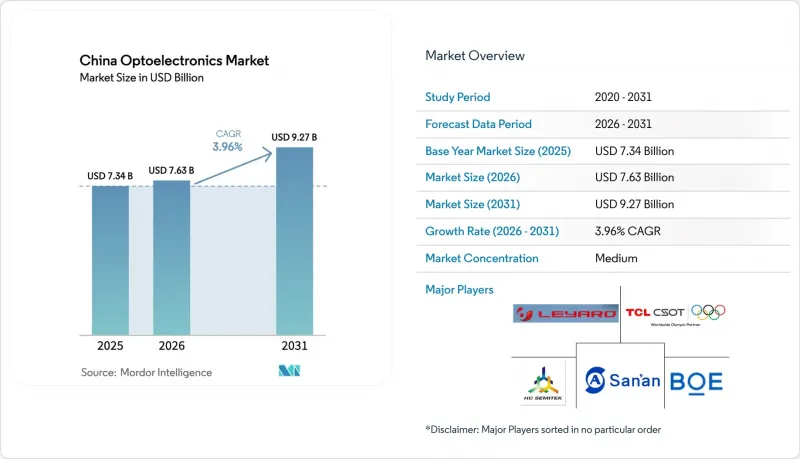
Mordor Intelligence에 의하면, 중국의 옵토일렉트로닉스 시장 규모는 2025년 73억 4,000만 달러로 평가되었습니다. 2026년에는 76억 3,000만 달러로 확대되어 2026년부터 2031년에 걸쳐 CAGR 3.96%로 성장을 지속하여, 2031년에는 92억 7,000만 달러에 이를 것으로 예측됩니다.
본 보고서는 디바이스 유형(LED, 레이저 다이오드, 이미지 센서 등), 디바이스 소재(갈륨 질화물, 갈륨 비소 등), 용도(조명·디스플레이, 광통신·Li-Fi 등), 최종 사용자 산업(가전제품, 자동차 등)별로 분류되어 있습니다. 시장 예측은 금액(달러) 기준으로 제시되어 있습니다.
중국의 옵토일렉트로닉스 시장 동향 및 인사이트
국내 반도체 공급망 구축을 위한 정부의 추진
'국가 집적회로 산업 투자 기금'의 3단계에서는 2024년에 400억 달러 이상이 투입되어, 광전자 소자에 필수적인 화합물 반도체의 생산 능력을 확대하겠다는 명확한 사명이 제시되었습니다. 보조금을 받은 팹(제조 공장) 프로젝트는 실질적인 자본 비용을 절감하고 은행 융자를 확보하는 동시에, 현지 조달 규정을 통해 조달 경로를 보장합니다. 이러한 조치들이 맞물리면서 LED, 레이저 다이오드, 센서의 조달처가 국내 공급업체로 쏠리게 되었고, 경기 순환에 따른 침체기에도 중국의 옵토일렉트로닉스 시장에 일정한 바닥이 형성되고 있습니다. 또한, 이 정책은 대학 파트너와의 공동 파일럿 라인에 자금을 지원함으로써 기술 습득의 학습 곡선을 단축시키고 있습니다. 중기적으로는 현지화 노력을 통해 금속 유기 화학 기상 증착(MOCVD) 및 이온 주입 분야의 공정 기술 격차가 해소될 전망입니다.
LED, 미니 LED, 마이크로 LED의 급속한 상용화
BOE 테크놀로지는 2024년, 고급 스마트폰 및 태블릿용 미니 LED 백라이트를 시범 단계에서 양산 단계로 전환하며, 다이 본딩 사이클 타임을 35% 단축하는 대량 전사 공정의 유효성을 입증했습니다. 단위 비용의 감소로 인해 대상인 2차 휴대폰 및 TV 시장이 확대되면서, 국내 기판, 드라이버 IC, 패키징 기업의 수익 창출이 가속화되고 있습니다. OLED에 비해 색역과 수명이 뛰어난 점이 OEM의 설계 채택으로 이어지는 한편, 무역 정책 동향으로 인해 해외 공급은 운송 비용 측면에서 경쟁력을 잃고 있습니다. 선전을 거점으로 하는 수탁 조립 제조업체의 신속한 인증 프로그램을 통해 설계 채택까지의 주기는 6개월 만에 완료되지만, 해외 경쟁사들은 9개월 이상 소요됩니다. 그 결과, 중국의 광전자 시장은 상품화된 LED 조명과 비교하여 평균 판매 가격 상승과 고객 이탈 위험 감소라는 혜택을 누리고 있습니다.
미국과 중국의 기술 수출 규제
2024년 10월 미국의 규제 개정에 따라 첨단 갈륨 나이탈리아드 및 실리콘 카바이드 제조 장비의 출하가 제한되어, 장비 조달 리드타임이 18개월 이상으로 늘어났습니다. 국내 팹은 구형 리액터를 가동하거나 자체 장비 설계를 가속화하는 것 중 하나를 선택할 수밖에 없으며, 두 시나리오 모두 초기 수율을 저하시켜 웨이퍼당 비용을 상승시키고 있습니다. 다국적 공급업체들은 현지 서비스 센터 확장을 연기하고 있어 생산 확대 일정이 더욱 지연되고 있습니다. 그 결과, 단기적인 웨이퍼 생산량은 EV 및 5G 부문 수요를 따라가지 못하고 있으며, 이는 예측 기간 중 첫 2년 동안 중국의 옵토일렉트로닉스 시장의 연평균 성장률(CAGR)을 끌어내리고 있습니다.
부문별 분석
레이저 다이오드는 2031년까지 연평균 성장률(CAGR) 4.86%를 나타낼 것으로 예측되며, 2025년 시점에서 LED가 매출액 기준 33.68%의 선두를 유지했음에도 불구하고 중국의 옵토일렉트로닉스 시장 전체를 상회하는 성장이 전망됩니다. LiDAR 탑재율의 상승과 데이터센터용 광학 부품은 휴대폰용 VCSEL 출하량에 대한 경기 변동을 완화하는 견고한 수요 완충제 역할을 하고 있습니다. LED의 가격 탄력성으로 인해 이익률이 하락하고 있으므로, 각 벤더들은 평균 판매 가격(ASP)이 단위당 20달러를 초과하는 코히런트 광학 제품으로 생산 능력을 전환하고 있습니다. 금속 절단 및 적층 가공(AM)용 산업용 레이저 어레이는 대상 수익원을 더욱 확대하고 있는 반면, 옵토커플러는 성장이 둔화되고 있지만 전력 변환의 절연 용도에서 여전히 유용성을 유지하고 있습니다.
반면, 태양전지는 공급 과잉으로 인한 가격 압박에 시달리고 있지만, 탄소 중립 정책에 기반한 그리드 패리티 프로젝트의 혜택은 여전히 누리고 있습니다. 이미지 센서의 출하 대수는 듀얼 카메라 및 트리플 카메라를 탑재한 스마트폰 설계로 인해 증가하고 있지만, 부가가치 창출은 포토다이오드 아래에 로직을 내장한 적층형 픽셀 아키텍처로 전환되고 있습니다. 이러한 변화들이 맞물려 전체 디바이스 카테고리의 평균 판매 가격이 상승하고 있으며, 이는 중국의 옵토일렉트로닉스 시장의 출하량 성장 둔화를 상쇄하는 데 일조하고 있습니다.
실리콘 카바이드(SiC)는 4.45%라는 가장 높은 연평균 성장률(CAGR)을 기록하며, 2025년에는 매출의 41.75%를 차지한 질화갈륨(GaN)의 우위를 서서히 잠식했습니다. 전기차(EV)의 트랙션 인버터나 5G 기지국의 PA 모듈에서는 SiC의 뛰어난 열전도성이 높이 평가받고 있으며, 이를 통해 고전력 밀도화와 냉각 비용 절감이 가능해졌습니다. 톈진 중환(天津中環)의 200mm SiC 기판 기술적 돌파구로 인해 결함 밀도가 40% 감소하고, GaN과의 비용 격차가 좁혀지면서 더 광범위한 채택이 촉진되고 있습니다. GaN은 고속 스위칭 충전기 및 RF 프런트엔드 분야에서 우위를 유지하고 있는 반면, 인듐 인화물은 1550nm 자동차용 LiDAR 레이저 분야에서 수요가 증가하고 있습니다. 화합물 반도체로의 전환은 기기 인증에 대한 장벽을 높이지만, 동시에 높은 가격 책정이 가능하게 하여 중국의 옵토일렉트로닉스 시장 전체의 매출 총이익률 변동을 완화합니다.
기존의 실리콘 및 갈륨 비소는 중출력 LED 램프와 휴대전화용 P-As에서 여전히 중요한 위치를 차지하고 있지만, 고성능 대체재로 인해 장기적으로 시장 점유율이 감소하고 있습니다. 중국의 옵토일렉트로닉스 산업이 발전함에 따라 경쟁력 있는 비용 구조를 유지하기 위해서는 공정 수율 향상과 현지 기판 공급이 전략적으로 중요합니다.
기타 혜택 :
- 엑셀 형식 시장 예측(ME) 시트
- 3개월간의 애널리스트 지원
자주 묻는 질문
목차
제1장 서론
제2장 조사 방법
제3장 주요 요약
제4장 시장 구도
제5장 시장 규모 및 성장 예측
제6장 경쟁 구도
제7장 시장 기회 및 향후 전망
KTH 26.09.10According to Mordor Intelligence, the China optoelectronics market size is expected to grow from USD 7.34 billion in 2025 to USD 7.63 billion in 2026 and is forecast to reach USD 9.27 billion by 2031 at 3.96% CAGR over 2026-2031.
This report is Segmented by Device Type (LED, Laser Diode, Image Sensors, and More), Device Material (Gallium Nitride, Gallium Arsenide, and More), Application (Lighting and Display, Optical Communication and Li-Fi, and More), End-User Industry (Consumer Electronics, Automotive, and More). The Market Forecasts are Provided in Terms of Value (USD).
China Optoelectronics Market Trends and Insights
Government Push for Domestic Semiconductor Supply Chains
The third phase of the National Integrated Circuit Industry Investment Fund injected more than USD 40 billion in 2024, with a clear mandate to scale compound-semiconductor capacity critical for optoelectronic devices. Subsidized fab projects lower effective capital costs, lock in bank financing, and guarantee procurement channels through local-content rules. Collectively, these measures tilt purchasing toward domestic LED, laser diode, and sensor vendors, creating a baseline floor for the China optoelectronics market even during cyclical slowdowns. The policy also shortens technology-learning curves by financing joint pilot lines with university partners. Over the medium term, the localization agenda should close process-technology gaps in metal-organic chemical vapor deposition and ion implantation.
Rapid LED Mini and Micro-LED Commercialization
BOE Technology transitioned from pilot to volume mini-LED backlighting for premium smartphones and tablets in 2024, validating mass-transfer processes that reduce die-bonding cycle times by 35%. Unit-cost compression widens the addressable tier-two handset and TV segments, accelerating revenue capture for domestic substrate, driver-IC, and packaging firms. Color gamut and lifetime advantages over OLED win OEM design slots, while trade policy dynamics render overseas supply less competitive on landed cost. Rapid-qualifier programs at Shenzhen-based contract assemblers enable six-month design-win cycles, compared with nine months or more for foreign rivals. As a result, the China optoelectronics market benefits from higher average selling prices and lower churn risk versus commoditized LED lighting.
US-China Tech Export Controls
The October 2024 revision of U.S. regulations curtailed shipments of advanced gallium-nitride and silicon-carbide equipment, lengthening tool-procurement lead times to more than 18 months. Domestic fabs either run older-node reactors or accelerate in-house tool designs, both scenarios depressing initial yields and raising cost per wafer. Multinational suppliers postpone local service-center expansion, further delaying ramp schedules. Consequently, near-term wafer output lags demand from EV and 5G segments, trimming the China optoelectronics market CAGR during the first two forecast years.
Other drivers and restraints analyzed in the detailed report include:
- 5G- and Data-Center-Driven Optical Transceiver Demand
- Electric Vehicle LiDAR Integration
- High CAPEX for 8-inch GaN and SiC Fabrication
For complete list of drivers and restraints, kindly check the Table Of Contents.
Segment Analysis
Laser diodes are expected to contribute a 4.86% CAGR through 2031, outperforming the broader China optoelectronics market despite LEDs retaining a 33.68% revenue lead in 2025. Rising LiDAR attach rates and data-center optics create resilient demand buffers that cushion cyclical swings in handset VCSEL volumes. The price elasticity of LEDs erodes margins, prompting vendors to migrate capacity to coherent-light products where ASPs exceed USD 20 per unit. Industrial laser arrays for metal cutting and additive manufacturing further widen addressable revenue pools, while optocouplers maintain utility in power-conversion isolation despite slower growth.
In parallel, photovoltaic cells wrestle with overcapacity-led price compression yet still benefit from grid-parity projects under carbon-neutral mandates. Image-sensor volumes climb on dual- and triple-camera smartphone designs, but value capture shifts toward stacked-pixel architectures that embed logic under photodiodes. Collectively, these shifts raise the blended ASP across device categories, helping the China optoelectronics market offset slower unit expansion.
Silicon carbide posted the fastest 4.45% CAGR, nibbling at gallium nitride's 41.75% revenue dominance in 2025. EV traction inverters and 5G base-station PA modules value SiC's superior thermal conductivity, enabling higher power density and reduced cooling overhead. Tianjin Zhonghuan's 200 mm SiC substrate breakthrough cut defect density by 40%, narrowing the cost delta with GaN and supporting wider adoption. GaN retains an edge in fast-switching chargers and RF front-ends, while indium phosphide rises for 1550 nm automotive LiDAR lasers. The shift toward compound semiconductors magnifies equipment-qualification hurdles but unlocks premium pricing that smooths gross-margin volatility across the China optoelectronics market.
Traditional silicon and gallium arsenide remain relevant in mid-power LED lamps and handset P-As but face secular share drift to higher-performance alternatives. Process-yield improvements and localized substrate supply are strategic for sustaining competitive cost structures as the China optoelectronics industry advances.
Complete Report Scope:
- By Device Type
- LED
- Laser Diode
- Image Sensors
- Optocouplers
- Photovoltaic Cells
- Other Device Types
- By Device Material
- Gallium Nitride (GaN)
- Gallium Arsenide (GaAs)
- Silicon Carbide (SiC)
- Indium Phosphide (InP)
- Silicon and Other Device Materials
- By Application
- Lighting and Display
- Optical Communication and Li-Fi
- Sensing and Imaging
- Power Conversion and Photovoltaics
- Other Applications
- By End-user Industry
- Consumer Electronics
- Automotive
- Information Technology and Telecom
- Healthcare and Life-Sciences
- Aerospace and Defense
- Industrial Automation
- Other End-user Industries
List of Companies Covered in this Report:
- BOE Technology Group Co., Ltd.
- Shenzhen China Star Optoelectronics Technology Co., Ltd.
- Sanan Optoelectronics Co., Ltd.
- HC Semitek Corporation
- Leyard Optoelectronic Co., Ltd.
- Nationstar Optoelectronics Co., Ltd.
- Yangzhou AUO Optoelectronics Technology Co., Ltd.
- Focuslight Technologies Inc.
- Wuhan Raycus Fiber Laser Technologies Co., Ltd.
- Suzhou Everbright Photonics Co., Ltd.
- Truelight Corporation
- Zhuhai Orbita Aerospace Science and Technology Co., Ltd.
- GigaDevice Semiconductor (Beijing) Inc.
- OFILM Group Co., Ltd.
- Will Semiconductor Co., Ltd. Shanghai
- Shandong Inspur Huaguang Optoelectronics Co., Ltd.
- Goertek Inc.
- Tianjin Zhonghuan Semiconductor Co., Ltd.
- Advanced Micro-Fabrication Equipment Inc. China
- Ennostar Inc.
Additional Benefits:
- The market estimate (ME) sheet in Excel format
- 3 months of analyst support
TABLE OF CONTENTS
1 INTRODUCTION
- 1.1 Study Assumptions and Market Definition
- 1.2 Scope of the Study
2 RESEARCH METHODOLOGY
3 EXECUTIVE SUMMARY
4 MARKET LANDSCAPE
- 4.1 Market Overview
- 4.2 Market Drivers
- 4.2.1 Government Push for Domestic Semiconductor Supply Chains
- 4.2.2 Rapid LED Mini and MicroLED Commercialization
- 4.2.3 5G-and-Data-Center Driven Optical Transceiver Demand
- 4.2.4 Electric Vehicle LiDAR Integration
- 4.2.5 Carbon-Neutral Policies Accelerating Photovoltaic Adoption
- 4.2.6 Emerging Quantum Dot Image Sensor Start-Ups
- 4.3 Market Restraints
- 4.3.1 US-China Tech Export Controls
- 4.3.2 Talent Shortage in Compound Semiconductor Processing
- 4.3.3 High CAPEX for 8-inch GaN and SiC Fabrication
- 4.3.4 Price Erosion in LED Backlighting
- 4.4 Industry Ecosystem Analysis
- 4.5 Regulatory Landscape
- 4.6 Technological Outlook
- 4.7 Impact of Macroeconomic Factors
- 4.8 Porter's Five Forces Analysis
- 4.8.1 Threat of New Entrants
- 4.8.2 Bargaining Power of Suppliers
- 4.8.3 Bargaining Power of Buyers
- 4.8.4 Threat of Substitutes
- 4.8.5 Intensity Competitive Rivalry
5 MARKET SIZE AND GROWTH FORECASTS (VALUE)
- 5.1 By Device Type
- 5.1.1 LED
- 5.1.2 Laser Diode
- 5.1.3 Image Sensors
- 5.1.4 Optocouplers
- 5.1.5 Photovoltaic Cells
- 5.1.6 Other Device Types
- 5.2 By Device Material
- 5.2.1 Gallium Nitride (GaN)
- 5.2.2 Gallium Arsenide (GaAs)
- 5.2.3 Silicon Carbide (SiC)
- 5.2.4 Indium Phosphide (InP)
- 5.2.5 Silicon and Other Device Materials
- 5.3 By Application
- 5.3.1 Lighting and Display
- 5.3.2 Optical Communication and Li-Fi
- 5.3.3 Sensing and Imaging
- 5.3.4 Power Conversion and Photovoltaics
- 5.3.5 Other Applications
- 5.4 By End-user Industry
- 5.4.1 Consumer Electronics
- 5.4.2 Automotive
- 5.4.3 Information Technology and Telecom
- 5.4.4 Healthcare and Life-Sciences
- 5.4.5 Aerospace and Defense
- 5.4.6 Industrial Automation
- 5.4.7 Other End-user Industries
6 COMPETITIVE LANDSCAPE
- 6.1 Market Concentration
- 6.2 Strategic Moves
- 6.3 Market Share Analysis
- 6.4 Company Profiles (includes Global level Overview, Market level overview, Core Segments, Financials as available, Strategic Information, Market Rank/Share for key companies, Products and Services, and Recent Developments)
- 6.4.1 BOE Technology Group Co., Ltd.
- 6.4.2 Shenzhen China Star Optoelectronics Technology Co., Ltd.
- 6.4.3 Sanan Optoelectronics Co., Ltd.
- 6.4.4 HC Semitek Corporation
- 6.4.5 Leyard Optoelectronic Co., Ltd.
- 6.4.6 Nationstar Optoelectronics Co., Ltd.
- 6.4.7 Yangzhou AUO Optoelectronics Technology Co., Ltd.
- 6.4.8 Focuslight Technologies Inc.
- 6.4.9 Wuhan Raycus Fiber Laser Technologies Co., Ltd.
- 6.4.10 Suzhou Everbright Photonics Co., Ltd.
- 6.4.11 Truelight Corporation
- 6.4.12 Zhuhai Orbita Aerospace Science and Technology Co., Ltd.
- 6.4.13 GigaDevice Semiconductor (Beijing) Inc.
- 6.4.14 OFILM Group Co., Ltd.
- 6.4.15 Will Semiconductor Co., Ltd. Shanghai
- 6.4.16 Shandong Inspur Huaguang Optoelectronics Co., Ltd.
- 6.4.17 Goertek Inc.
- 6.4.18 Tianjin Zhonghuan Semiconductor Co., Ltd.
- 6.4.19 Advanced Micro-Fabrication Equipment Inc. China
- 6.4.20 Ennostar Inc.
7 MARKET OPPORTUNITIES AND FUTURE OUTLOOK
- 7.1 White-space and Unmet-need Assessment


