|
시장보고서
상품코드
2119573
플라스틱 필름 커패시터 : 시장 점유율 분석, 업계 동향 및 통계, 성장 예측(2026-2031년)Plastic Film Capacitors - Market Share Analysis, Industry Trends & Statistics, Growth Forecasts (2026 - 2031) |
||||||
 Mordor Intelligence
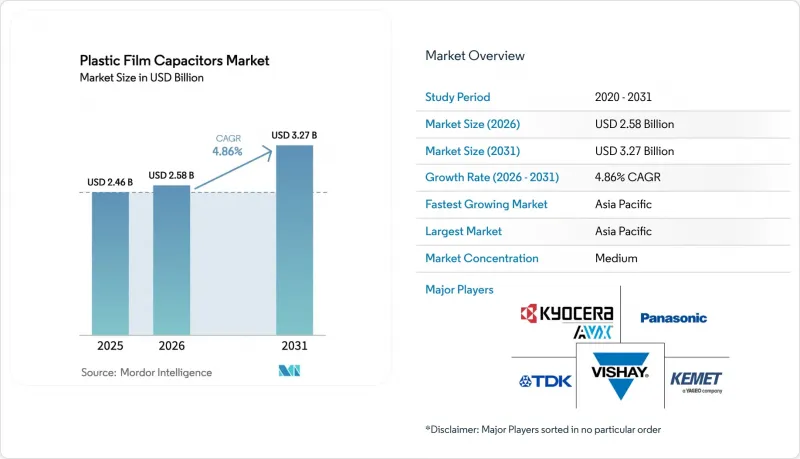
Mordor Intelligence에 의하면, 플라스틱 필름 커패시터 시장 규모는 2025년 24억 6,000만 달러로 평가되었습니다. 2026년에는 25억 8,000만 달러로 확대되어 2026년부터 2031년에 걸쳐 CAGR 4.86%로 성장을 지속하여, 2031년까지 32억 7,000만 달러에 이를 것으로 예측됩니다.
본 보고서는 유전체 유형(폴리프로필렌, 폴리에틸렌, 폴리에스터 등), 정격 전압(1000V),형상(레이디얼 리드형, 표면 실장형, 축형, 스택형 및 박스형), 용도(자동차, 통신, 산업용 드라이브, 항공우주 등), 지역(북미, 유럽 등)별로 분류되어 있습니다. 시장 예측은 금액(미 달러) 기준으로 제시되어 있습니다.
세계의 플라스틱 필름 커패시터 시장 동향 및 인사이트
EV 트랙션 인버터용 DC 링크 수요의 급증
전기차(EV)의 경우, 모든 트랙션 인버터, 차량용 충전기 및 보조 컨버터에 대용량 DC 링크 뱅크가 필요하기 때문에 차량 1대당 커패시터 탑재량이 최대 5배까지 증가하고 있습니다. TDK의 ‘xEVCap’ 시리즈는 리플 전류 내성과 105°C에서의 동작을 갖추고 있어 이러한 요구를 충족하며, 그라바타이 공장에서 대량으로 출하되고 있습니다. 2030년까지 판매 대수의 50%를 전기차로 만들겠다고 공약한 자동차 제조업체들은 배터리 팩의 전압이 400V에서 800V 아키텍처로 상승하는 가운데, 커패시터 조달에 대해 수년에 걸친 전망을 확정하고 있습니다. 필름 소자는 15년에 달하는 차량 수명 동안 인버터의 신뢰성에 매우 중요한 자가 복구 특성을 갖추고 있어, 플라스틱 필름 커패시터 시장은 직접적인 혜택을 보고 있습니다. 인도와 브라질이 세제 혜택 조치를 통해 전기차 부품 투자자를 유치하고 있어 공급망의 폭이 넓어지고, OEM 제조업체의 지리적 리스크가 완화되고 있습니다. 충전 인프라가 확대되는 가운데, 급속 충전기에 탑재되는 보조 DC 필터가 생산량 증가를 더욱 견인하고 있습니다.
SiC/GaN 파워 디바이스로의 급속한 전환
광대역 갭 반도체는 20 kHz 이상에서 작동하기 때문에 설계자는 저 ESR 유전체를 우선적으로 선택할 수밖에 없습니다. 폴리프로필렌은 저손실이라는 특징 덕분에 여전히 주도적인 위치를 유지하고 있지만, 질화붕소 필러를 배합한 나노 복합 PPS 필름은 200°C에서도 절연 파괴가 발생하지 않으면서 3배의 에너지 밀도를 실현하여,항공우주 분야 및 산업용 구동 장치에서의 설계 자유도를 넓히고 있습니다. SiC 소자의 가격 하락으로 인해 산업 분야에서의 대규모 설비 교체가 가능해졌으며, 2-3%의 효율 향상은 전기 요금 절감과 탄소 발자국 감소로 이어집니다. 파워 모듈 제조업체들은 인증 재료 목록에 필름 커패시터를 점점 더 많이 등재하고 있으며, 고주파 용도에서 알루미늄 전해 커패시터 시장 점유율을 빼앗고 있습니다. 이러한 추세에 따라 OEM 각사는 EMI, 열, 수명 목표를 동시에 충족하기 위해 커패시터와 파워 모듈을 공동 설계하게 되어 개발 주기가 단축되고 있습니다. 부분 방전 마진을 유지하면서 초박막 메탈라이제이션이 가능한 공급업체는 비용 대비 성능 측면에서 우위를 점하고 있습니다.
폴리프로필렌 및 알루미늄 가격 변동
커패시터의 부품표(BOM)의 거의 절반을 폴리프로필렌 수지가 차지하고 있으며, 그 수익성은 석유화학 사이클의 영향을 받기 쉬운 상황입니다. 2024년 초, 가격은 급등했으나 추가 정제 설비가 가동을 시작하면서 안정세를 되찾았고, 중견 제조업체의 분기 이익률은 압박을 받았습니다. 알루미늄 포일 비용은 에너지 가격 변동에 연동되어 있어 예측을 더욱 어렵게 만들고 있습니다. 대형 공급업체들은 여러 분기에 걸친 계약이나 자사 소유의 필름 압출 라인을 통해 헤지하고 있지만, 중소 제조업체들은 협상력이 부족하여 업계 재편 압력이 높아지고 있습니다. 원자재 가격의 급등으로 인해 공급업체가 수익성이 높은 주문에 우선적으로 배정함에 따라, 고객의 리드타임이 길어질 위험이 있습니다. 2025년 말까지 수지 가격은 안정되었으나, 원자재 슈퍼사이클은 여전히 상존하는 위협으로 남아 있습니다.
부문 분석
2025년, 폴리프로필렌은 플라스틱 필름 커패시터 시장에서 65.55%의 점유율을 차지했습니다. 이는 뛰어난 가성비와 성숙한 압출 성형 노하우 덕분입니다. 이 부문은 플라스틱 필름 커패시터 생산량의 대부분을 차지하고 있으며, 주류인 자동차용 인버터의 보급에 따라 꾸준히 확대될 전망입니다. 한편, PPS 필름은 150°C의 내열성이 필요한 항공우주 분야와 전기차(EV) 엔진룸 내 전자기기 수요에 힘입어 연평균 5.63%의 성장률이 예상됩니다. 나노 복합재에 대한 조사 결과, PPS가 500 MV/m의 절연 파괴 전압을 견디면서 200°C까지의 유전 안정성을 유지할 수 있음이 입증되었습니다. 각 OEM 업체들은 105°C를 초과하면 폴리프로필렌의 정격이 대폭 저하되는 터보차저가 장착된 SiC 모듈에 PPS를 채택하는 경향을 보이고 있습니다. 재료 비용은 높지만, 보조 냉각을 불필요하게 하거나 전력 밀도를 높임으로써 시스템 전체의 비용 절감을 도모하고 있습니다.
폴리에틸렌과 폴리에스터는 비용 효율을 중시하는 조명용 안정기나 모터 구동용 커패시터에서 계속 사용되고 있지만, 더 얇은 폴리프로필렌 등급으로의 대체가 진행되고 있습니다. PTFE는 초저손실 계수 덕분에 항공우주용 마이크로파 및 RF 필터에 여전히 사용되고 있습니다. 개발 중인 첨단 아라미드 섬유 복합재료는 200°C를 초과하는 환경에서 작동하는 미사일 및 우주용 전원 버스를 대상으로 하고 있으나, 상업적 보급은 여전히 틈새 분야에 그치고 있습니다. ESG 우선순위에 따라 폴리프로필렌의 주류는 성능을 저하시키지 않으면서 Scope 3 배출량을 줄이는 바이오·순환형 원료로 전환되고 있으며, 이를 통해 예측 기간 동안 생산량 우위를 유지할 가능성이 있습니다.
2025년에는 100-1,000V의 전압 대역이 플라스틱 필름 커패시터 시장 규모의 53.35%를 차지하며, EV 구동 시스템, 산업용 드라이브, 통신용 전원 셸프에 대응했습니다. 제조 적합 설계(DFM)에 관한 파트너십을 통해 단위 비용의 경쟁력이 유지되고 생산량이 확보되고 있습니다. 1,000V를 초과하는 영역에서는 태양광 발전용 인버터 및 풍력 발전 클러스터를 전력망에 연결하는 고전압 직류(HVDC) 컨버터를 배경으로 시장 침투율이 연평균 성장률(CAGR) 4.72%로 상승하고 있습니다. 고전압 소자의 경우, 부분 방전을 방지하기 위해 두꺼운 필름과 에지 폴드 메탈라이제이션이 채택되어, 이를 통해 높은 평균 판매 가격(ASP)과 두 자릿수의 이익률이 뒷받침되고 있습니다. 100V 미만 분야에서는 세라믹 커패시터의 진출이 격화되고 있지만, 오디오, 조명 및 프리미엄 SMPS 설계자들은 그 온화한 고장 모드와 낮은 마이크로포닉 특성 때문에 여전히 필름 커패시터를 지정하고 있습니다.
앞으로 등장할 800V EV 플랫폼에 따라 사용되는 부품은 점차 600-1,200V 범위로 전환되어, 대상 시장 기회가 확대될 전망입니다. 2026년에 예정된 IEC 61071 개정으로 인해 열 사이클 시험 및 습도 시험 기준이 더욱 엄격해질 전망이며, 이는 검증된 유전체 배합을 보유한 기존 공급업체에 유리하게 작용할 가능성이 있습니다.
지역별 분석
아시아태평양은 2025년 매출의 43.80%를 차지했으며, 2031년까지 연평균 성장률(CAGR) 6.42%로 플라스틱 필름 커패시터 시장을 주도하고 있습니다. 중국의 BOPP 압출 성형 제조업체들은 국내 부품 권선 제조업체에 공급하는 동시에 전 세계로 필름을 수출하고 있어 비용 면에서의 우위를 뒷받침하고 있습니다. 인도의 240억 달러 규모의 PLI(생산 연계 인센티브) 지출은 국내 커패시터 권선 및 최종 기기 조립을 가속화하여 지역 내 공급 과잉을 초래하고 있습니다. 일본은 수십 년에 걸친 유전체 공정 노하우를 활용하여 고급 자동차용 및 산업용 등급 제품 분야에서 명성을 유지하고 있습니다. 한국의 반도체 팹은 전원 관리 장치용 고주파 커패시터 수요를 주도하고 있는 반면, 동남아시아 국가들은 ‘차이나 플러스 원(China Plus One)’ 전략과 관련된 생산 능력 이전을 유치하고 있습니다.
북미는 여전히 대량 생산자라기보다는 기술 도입자의 입장에 있지만, 전기차(EV), 항공우주, 데이터센터용 재생에너지 분야에서 견조한 수요를 보이고 있습니다. ‘인플레이션 억제법(Inflation Reduction Act)’에 따른 연방 정부의 인센티브는 새로운 배터리 및 인버터 생산 라인의 가동을 뒷받침하고 있으며, 간접적으로 국내 커패시터 수요를 끌어올리고 있습니다. 유럽에서는 품질과 지속가능성이 중시되고 있으며, 독일의 자동차 부품 공급업체들은 800V 구동 유닛 최적화를 위해 TDK 및 WIMA와 공동으로 스택형 커패시터 어레이를 개발하고 있습니다. RoHS 및 REACH 준수는 저비용 신규 진입 업체에 대한 자연스러운 장벽이 되어 가격 안정화에 기여하고 있습니다.
남미는 브라질의 1,866억 레알(350억 9,000만 달러) 규모의 디지털화 계획과 PADIS 인센티브에 힘입어 반도체 및 수동 부품 생산이 촉진되며 입지를 강화하고 있습니다. TDK의 그라바타이 공장은 생산량 6억 개 중 80% 이상을 이미 수출하고 있어 이 지역의 경쟁력을 입증하고 있습니다. 중동 및 아프리카는 아직 발전 단계에 있지만, 무시할 수 없는 존재입니다. 사우디아라비아의 NEOM이나 남아프리카공화국의 REIPPP 프로그램과 같은 태양광 발전 메가 프로젝트에서는 대규모 DC 필터 뱅크가 필요하며, 이는 수익원 다각화를 모색하는 전 세계 공급업체들을 끌어들이고 있습니다. 환율 변동과 인프라 부족은 여전히 장벽으로 남아 있지만, 태양광 발전의 균등화 비용 하락은 단계적 도입에 긍정적인 요인으로 작용하고 있습니다.
기타 혜택 :
- 엑셀 형식 시장 예측(ME) 시트
- 3개월간의 애널리스트 지원
자주 묻는 질문
목차
제1장 서론
제2장 조사 방법
제3장 주요 요약
제4장 시장 구도
제5장 시장 규모 및 성장 예측
제6장 경쟁 구도
제7장 시장 기회 및 향후 전망
KTH 26.09.10According to Mordor Intelligence, the plastic film capacitors market size is expected to grow from USD 2.46 billion in 2025 to USD 2.58 billion in 2026 and is forecast to reach USD 3.27 billion by 2031 at 4.86% CAGR over 2026-2031.
This report is Segmented by Dielectric Type (Polypropylene, Polyethylene, Polyester, and More), Voltage Rating (1000V), Form Factor (Radial-Leaded, Surface-Mount, Axial, and, Stack and Box), Application (Automotive, Telecommunications, Industrial Drives, Aerospace, and More), and Geography (North America, Europe, and More). The Market Forecasts are Provided in Terms of Value (USD).
Global Plastic Film Capacitors Market Trends and Insights
Surge in DC-link Demand for EV Traction Inverters
Electric vehicles multiply capacitor content per car by up to five times, as every traction inverter, onboard charger, and auxiliary converter requires high-capacitance DC-link banks. TDK's xEVCap line targets this need with ripple-current endurance and 105 °C operation, shipping in volume from its Gravatai plant. Automakers pledging 50% electric sales by 2030 lock in multi-year visibility for capacitor procurement as battery pack voltages climb from 400 V to 800 V architectures. The plastic film capacitors market benefits directly, since film devices exhibit self-healing behavior critical to inverter reliability over 15-year vehicle lifetimes. Supply-chain depth is widening as India and Brazil court EV-component investors with fiscal incentives, reducing geographic risk for OEMs. As charging infrastructure scales, auxiliary DC filters in fast-chargers further reinforce volume momentum.
Rapid Shift Toward SiC/GaN Power Devices
Wide-bandgap semiconductors operate above 20 kHz, forcing designers to favor low-ESR dielectrics. Polypropylene retains leadership because of low losses, but nanocomposite PPS films with boron-nitride fillers now deliver triple energy density at 200 °C without dielectric breakdown, broadening design latitude for aerospace and industrial drives. Declining SiC device prices unlock mainstream industrial retrofits, where 2-3% efficiency gains translate into lower electricity bills and carbon footprints. Power-module makers increasingly list film capacitors on qualified material sheets, diverting share from aluminum electrolytics in high-frequency roles. The trend compresses development cycles as OEMs co-design capacitors and power modules to meet EMI, thermal, and life targets simultaneously. Suppliers able to metallize ultra-thin films while maintaining partial-discharge margins gain a cost-performance edge.
Volatility in Polypropylene and Aluminum Prices
Polypropylene resin accounts for nearly half of capacitor Bill-of-Materials, leaving profitability exposed to petrochemical cycles. In early 2024, prices spiked before easing as additional refinery streams came online, squeezing quarterly margins for second-tier producers. Aluminum foil costs followed energy-price swings, further complicating forecasting. Large vendors hedge through multi-quarter contracts and own film extrusion lines, but smaller firms lack leverage, raising consolidation pressure. Sudden commodity jumps risk lengthening customer lead times as vendors reprioritize allocations toward higher-margin orders. Although resin prices stabilized by late 2025, commodity super-cycles remain an ever-present threat.
Other drivers and restraints analyzed in the detailed report include:
- Grid-scale Renewable Integration Requiring High-voltage DC Filters
- Miniaturization Pressure from 5G Base Stations
- Supply-Chain Concentration in BOPP Film Extrusion
For complete list of drivers and restraints, kindly check the Table Of Contents.
Segment Analysis
Polypropylene held 65.55% of the plastic film capacitors market share in 2025, a result of favorable cost-to-performance ratios and mature extrusion know-how. The segment generated the bulk of the plastic film capacitors and is set to expand steadily alongside mainstream automotive inverters. PPS films, meanwhile, are charted to grow 5.63% annually, boosted by aerospace and under-hood EV electronics that demand 150 °C endurance. Nanocomposite research validates PPS's ability to withstand 500 MV/m breakdown stress while maintaining dielectric stability to 200 °C. OEMs gravitate toward PPS for turbo-charged SiC modules where polypropylene derates aggressively above 105 °C. Despite higher material cost, total system savings accrue by eliminating auxiliary cooling or increasing power density.
Polyethylene and polyester continue to service cost-sensitive lighting ballasts and motor-run capacitors, but face substitution from slimmer polypropylene grades. PTFE persists in microwave and RF filters for aerospace thanks to ultralow dissipation factors. Advanced aramid-fiber composites under development target missiles and space power buses operating beyond 200 °C, yet commercial uptake remains niche. ESG priorities are nudging the polypropylene mainstream toward bio-circular feedstocks that cut scope-3 emissions without altering performance, potentially defending its volume advantage well into the forecast horizon.
The 100-1,000 V band captured 53.35% of the plastic film capacitors market size in 2025, catering to EV traction, industrial drives, and telecom power shelves. Design-for-manufacture partnerships keep unit costs competitive, safeguarding volume. Above 1,000 V, penetration is rising at a 4.72% CAGR on the back of solar inverters and HVDC converters connecting wind clusters to grids. High-voltage devices leverage thicker films and edge-folded metallization to deter partial discharge, supporting premium ASPs and double-digit margins. Below 100 V, ceramic encroachment intensifies, yet audio, lighting, and premium SMPS designers still specify film for its benign failure mode and low microphonics.
Forthcoming 800 V EV platforms will gradually shift content into the 600-1,200 V bracket, expanding addressable opportunities. IEC 61071 updates expected in 2026 will codify thermal-cycling and humidity tests more stringently, likely favoring established suppliers with proven dielectric formulations.
Complete Report Scope:
- By Dielectric Type
- Polypropylene
- Polyethylene
- Polyester
- Polytetrafluoroethylene (PTFE)
- Polyphenylene Sulfide (PPS)
- Other Dielectric Types
- By Voltage Rating
- <100 V
- 100V - 1,000 V
- >1,000 V
- By Form Factor
- Radial-leaded
- Surface-mount
- Axial
- Stack and Box
- By Application
- Automotive (xEV, Charging)
- Telecommunications (5G, Datacentre)
- Industrial Drives and Inverters
- Aerospace and Defense
- Consumer Electronics
- Medical Devices
- Renewable Energy (PV, Wind)
- Other Applications
- By Geography
- North America
- United States
- Canada
- Mexico
- South America
- Brazil
- Argentina
- Rest of South America
- Europe
- Germany
- United Kingdom
- France
- Italy
- Spain
- Russia
- Rest of Europe
- Asia-Pacific
- China
- Japan
- India
- South Korea
- South-East Asia
- Rest of Asia-Pacific
- Middle East and Africa
- Middle East
- Saudi Arabia
- United Arab Emirates
- Rest of Middle East
- Africa
- South Africa
- Egypt
- Rest of Africa
- Middle East
- North America
Geography Analysis
Asia-Pacific controls 43.80% of 2025 revenue and leads the plastic film capacitors market at a 6.42% CAGR through 2031. China's cluster of BOPP extruders supplies domestic component winders and exports film worldwide, underpinning cost leadership. India's USD 24 billion PLI outlay accelerates local capacitor winding and end-device assembly, creating intra-regional supply redundancy. Japan sustains its reputation for premium automotive and industrial grades, leveraging decades of dielectric process know-how. South Korea's semiconductor fabs spur demand for high-frequency capacitors in power-management units, while Southeast Asian nations attract capacity relocation tied to China-plus-one strategies.
North America remains a technology adopter rather than a volume producer but boasts strong demand in EVs, aerospace, and data-center renewables. Federal incentives under the Inflation Reduction Act are stimulating new battery and inverter lines, indirectly boosting domestic capacitor needs. Europe emphasizes quality and sustainability; German automotive suppliers co-develop stack capacitor arrays with TDK and WIMA to optimize 800 V drive units. RoHS and REACH compliance acts as a natural barrier to low-cost entrants, stabilizing pricing.
South America's profile is rising as Brazil's BRL 186.6 billion (USD 35.09 billion) digitalization plan and PADIS incentives cultivate semiconductor and passive production. TDK's Gravatai site already exports more than 80% of its 600 million units, proving regional competitiveness. The Middle East and Africa are nascent but not negligible. Solar mega-projects such as Saudi Arabia's NEOM and South Africa's REIPPP program require large DC-filter banks, drawing global suppliers keen to diversify revenue streams. Currency volatility and infrastructure gaps remain obstacles, but declining PV-levelized costs bode well for gradual adoption.
- Vishay Intertechnology Inc.
- Panasonic Holdings Corporation
- KEMET Corporation (Yageo Group)
- TDK Corporation
- KYOCERA AVX Components Corporation
- Murata Manufacturing Co., Ltd.
- Cornell Dubilier Electronics, Inc.
- Nichicon Corporation
- Rubycon Corporation
- WIMA GmbH & Co. KG
- Nantong Jianghai Capacitor Co., Ltd.
- Suntan Technology Co., Ltd.
- Hefei Jianghai Film Capacitor Co., Ltd.
- Vishay Polytech Co., Ltd.
- Aerovox Corp.
- Illinois Capacitor (Cornell Dubilier Brand)
- Elna Co., Ltd.
- SRT Microceramique
- IcEL s.r.l.
- PolyCharge America, Inc.
- Polytronics Technology Corp.
- Dean Technology, Inc.
- Samwha Electric Co., Ltd.
- Shenzhen Yunxing Electronics Co., Ltd.
- EACO Electric Co., Ltd.
- Xiamen Faratronic Co., Ltd.
- Exxelia Group
Additional Benefits:
- The market estimate (ME) sheet in Excel format
- 3 months of analyst support
TABLE OF CONTENTS
1 INTRODUCTION
- 1.1 Study Assumptions and Market Definition
- 1.2 Scope of the Study
2 RESEARCH METHODOLOGY
3 EXECUTIVE SUMMARY
4 MARKET LANDSCAPE
- 4.1 Market Drivers
- 4.1.1 Surge in DC-link demand for EV traction inverters
- 4.1.2 Rapid shift toward SiC/GaN power devices
- 4.1.3 Grid-scale renewable integration requiring high-voltage DC filters
- 4.1.4 Miniaturisation pressure from 5G base-stations
- 4.1.5 Government localization mandates (e.g., India, Brazil)
- 4.1.6 Circular-economy push for polypropylene film recycling
- 4.2 Market Restraints
- 4.2.1 Volatility in polypropylene and aluminium prices
- 4.2.2 Supply-chain concentration in BOPP film extrusion
- 4.2.3 Fire-safety compliance costs for e-mobility packs
- 4.2.4 Competition from multilayer ceramic capacitors in <100 V domain
- 4.3 Industry Supply Chain Analysis
- 4.4 Regulatory Landscape
- 4.5 Technological Outlook
- 4.6 Porter's Five Forces Analysis
- 4.6.1 Bargaining Power of Buyers
- 4.6.2 Bargaining Power of Suppliers
- 4.6.3 Threat of Substitute Products
- 4.6.4 Threat of New Entrants
- 4.6.5 Intensity of Competitive Rivalry
- 4.7 Impact of Macroeconomic Factors
5 MARKET SIZE AND GROWTH FORECASTS (VALUE)
- 5.1 By Dielectric Type
- 5.1.1 Polypropylene
- 5.1.2 Polyethylene
- 5.1.3 Polyester
- 5.1.4 Polytetrafluoroethylene (PTFE)
- 5.1.5 Polyphenylene Sulfide (PPS)
- 5.1.6 Other Dielectric Types
- 5.2 By Voltage Rating
- 5.2.1 <100 V
- 5.2.2 100V - 1,000 V
- 5.2.3 >1,000 V
- 5.3 By Form Factor
- 5.3.1 Radial-leaded
- 5.3.2 Surface-mount
- 5.3.3 Axial
- 5.3.4 Stack and Box
- 5.4 By Application
- 5.4.1 Automotive (xEV, Charging)
- 5.4.2 Telecommunications (5G, Datacentre)
- 5.4.3 Industrial Drives and Inverters
- 5.4.4 Aerospace and Defense
- 5.4.5 Consumer Electronics
- 5.4.6 Medical Devices
- 5.4.7 Renewable Energy (PV, Wind)
- 5.4.8 Other Applications
- 5.5 By Geography
- 5.5.1 North America
- 5.5.1.1 United States
- 5.5.1.2 Canada
- 5.5.1.3 Mexico
- 5.5.2 South America
- 5.5.2.1 Brazil
- 5.5.2.2 Argentina
- 5.5.2.3 Rest of South America
- 5.5.3 Europe
- 5.5.3.1 Germany
- 5.5.3.2 United Kingdom
- 5.5.3.3 France
- 5.5.3.4 Italy
- 5.5.3.5 Spain
- 5.5.3.6 Russia
- 5.5.3.7 Rest of Europe
- 5.5.4 Asia-Pacific
- 5.5.4.1 China
- 5.5.4.2 Japan
- 5.5.4.3 India
- 5.5.4.4 South Korea
- 5.5.4.5 South-East Asia
- 5.5.4.6 Rest of Asia-Pacific
- 5.5.5 Middle East and Africa
- 5.5.5.1 Middle East
- 5.5.5.1.1 Saudi Arabia
- 5.5.5.1.2 United Arab Emirates
- 5.5.5.1.3 Rest of Middle East
- 5.5.5.2 Africa
- 5.5.5.2.1 South Africa
- 5.5.5.2.2 Egypt
- 5.5.5.2.3 Rest of Africa
- 5.5.5.1 Middle East
- 5.5.1 North America
6 COMPETITIVE LANDSCAPE
- 6.1 Market Concentration
- 6.2 Strategic Moves
- 6.3 Market Share Analysis
- 6.4 Company Profiles (includes Global level Overview, Market level overview, Core Segments, Financials as available, Strategic Information, Market Rank/Share for key companies, Products and Services, and Recent Developments)
- 6.4.1 Vishay Intertechnology Inc.
- 6.4.2 Panasonic Holdings Corporation
- 6.4.3 KEMET Corporation (Yageo Group)
- 6.4.4 TDK Corporation
- 6.4.5 KYOCERA AVX Components Corporation
- 6.4.6 Murata Manufacturing Co., Ltd.
- 6.4.7 Cornell Dubilier Electronics, Inc.
- 6.4.8 Nichicon Corporation
- 6.4.9 Rubycon Corporation
- 6.4.10 WIMA GmbH & Co. KG
- 6.4.11 Nantong Jianghai Capacitor Co., Ltd.
- 6.4.12 Suntan Technology Co., Ltd.
- 6.4.13 Hefei Jianghai Film Capacitor Co., Ltd.
- 6.4.14 Vishay Polytech Co., Ltd.
- 6.4.15 Aerovox Corp.
- 6.4.16 Illinois Capacitor (Cornell Dubilier Brand)
- 6.4.17 Elna Co., Ltd.
- 6.4.18 SRT Microceramique
- 6.4.19 IcEL s.r.l.
- 6.4.20 PolyCharge America, Inc.
- 6.4.21 Polytronics Technology Corp.
- 6.4.22 Dean Technology, Inc.
- 6.4.23 Samwha Electric Co., Ltd.
- 6.4.24 Shenzhen Yunxing Electronics Co., Ltd.
- 6.4.25 EACO Electric Co., Ltd.
- 6.4.26 Xiamen Faratronic Co., Ltd.
- 6.4.27 Exxelia Group
7 MARKET OPPORTUNITIES AND FUTURE OUTLOOK
- 7.1 White-space and Unmet-Need Assessment