|
시장보고서
상품코드
2119607
전임상 CRO 시장 : 점유율 분석, 업계 동향과 통계, 성장 예측(2026-2031년)Preclinical CRO - Market Share Analysis, Industry Trends & Statistics, Growth Forecasts (2026 - 2031) |
||||||
 Mordor Intelligence
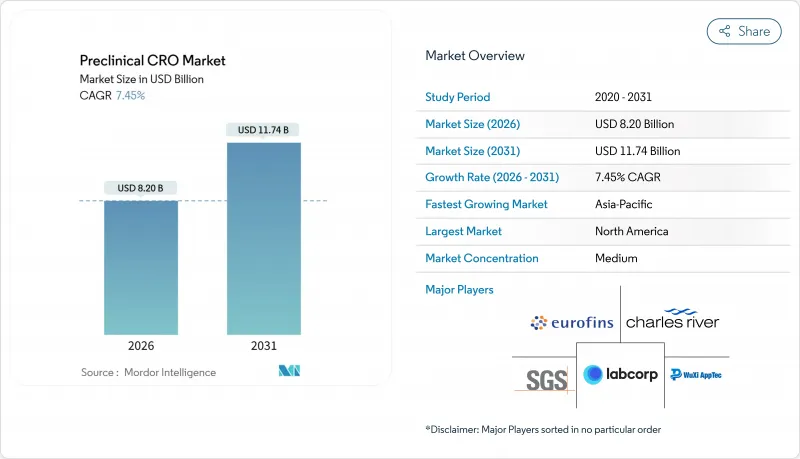
Mordor Intelligence에 의하면, 전임상 CRO 시장 규모는 2026년에 82억 달러로 추정되고 있어 예측 기간(2026-2031년)에서 CAGR 7.45%로 확대되어 2031년에는 117억 4,000만 달러에 이를 전망입니다.
본 보고서는 서비스별(독성 시험, 바이오분석 및 DMPK 시험, 안전성 약리학, 기타 서비스), 모델 유형별(환자 유래 오가노이드(PDO) 모델, 환자 유래 이종 이식편(PDX) 모델,인실리코/AI 기반 모델), 최종 사용자(바이오의약품·제약 기업 등), 지역(북미 등)별로 분류되어 있습니다. 시장 예측은 금액(미 달러) 기준으로 제시되어 있습니다.
세계 전임상 CRO 시장 동향 및 인사이트
신약 개발 분야의 연구개발비 증가
2025년에는 제약 업계의 연구개발 예산이 급증하여, 화이자(Pfizer)는 107억-117억 달러를 투자하는 한편, 사내 독성학 연구소를 폐쇄하고 해당 지출을 디지털 병리학 분야로 전환할 방침을 밝혔습니다. 종양학 및 희귀질환 분야의 후원 기업들이 사내의 고정된 체제를 유지하기보다는 필요에 따라 전임상 패키지를 요구하게 된 결과, CRO는 독성학 워크플로우의 35-40%를 흡수했습니다. NIH의 외부 보조금은 223억 달러에 달했으며, 그중 18%는 외부 파트너가 GLP를 준수하는 평가 지표를 요구하는 IND 신청을 위한 연구에 할당되었습니다. 2024년에는 중소 바이오테크 기업이 미국 내 IND 신청의 62%를 차지하게 되었으며, 이로 인해 전임상 CRO 시장은 대형 제약사의 파이프라인 침체로부터 더욱 격리되게 되었습니다. 그 결과 발생한 수요의 변화로 인해 가격 책정 및 일정 우선순위에 대한 CRO의 협상력이 강화되었습니다.
전임상 파이프라인의 확대
2025년에는 8,200건 이상의 진행 중인 전임상 프로그램이 있으며, 그중 1,450건은 세포 및 유전자 치료 후보로, 2023년 대비 22% 증가했습니다. EMA(유럽의약품청)가 개정된 ATMP 지침에서는 2유형의 동물을 이용한 벡터 배출 시험을 의무화하고 있으며, 이로 인해 유전자 치료 CRO 그룹의 업무량은 실질적으로 2배로 늘어났습니다. GLP-1 수용체 작용제 및 APOE4를 표적으로 하는 약제로 인해 340건의 신규 파이프라인이 추가되었으며, 각각에 대해 다양한 동물을 이용한 독성 시험 및 중추신경계(CNS) 투과성 시험이 필요합니다. 중국 스폰서만 해도 1,100건의 프로그램을 시작했으며, 동서 양 시장의 데이터 패키지를 확보하기 위해 유럽 및 미국의 CRO와 제휴하고 있어, 동일한 화합물 시리즈에 대한 연속적인 시험 의뢰가 발생하고 있습니다. 파이프라인의 확대로 인해 GLP 수용 능력이 한계에 달하고,, 각 CRO는 시설 확장을 급속도로 추진하고 있습니다.
표준화 및 데이터 상호 운용성의 부재
SEND 검증 오류는 2024년 IND 신청의 38%에 영향을 미쳐 재제출을 불가피하게 만들었고, FDA 심사 기간을 30-60일 연장시켰습니다. 독자적인 사양의 LIMS 플랫폼은 CRO 파트너 간의 데이터 통합을 방해하고 있으며, 조직병리학 및 임상병리학 데이터 세트를 수작업으로 대조해야 하는 스폰서에게 15-20%의 예산 초과를 초래하고 있습니다. 2026년 중반 시점에서 상위 20개 CRO 중 Pistoia Alliance의 ‘FAIR Preclinical Data’ 이니셔티브에 참여한 곳은 불과 12개사에 그쳐, 메타데이터의 분절화가 장기화되고 있습니다. 그 결과, 스폰서들이 통합에 따른 부대 비용을 억제하기 위해 노력하는 가운데, 우선 공급업체 패널로의 통합이 가속화되고 있습니다.
부문 분석
2025년, 독성 시험은 전임상 CRO 시장 점유율의 40.55%를 차지하며, ICH M3(R2)에 기반한 IND 신청 자료에서 그 필수적인 역할을 반영하고 있습니다. 오가노이드 기술이 일부 탐색적 연구를 대체하고 있음에도 불구하고, 두 유형의 동물을 이용한 반복 투여 시험은 여전히 표준으로 남아 있습니다. 한편, 안전성 약리학은 심혈관계 위험에 대한 우려 증가와 hERG 채널 및 QT 간격 연구의 급증에 힘입어 연평균 성장률(CAGR) 12.25%로 빠르게 확대되고 있습니다. 키나아제 억제제의 경우, 더 많은 스폰서가 수면 중 원격 측정법을 이용한 개 실험을 실시함에 따라, 안전성 약리학의 전임상 CRO 시장 규모는 2031년까지 2배로 증가할 것으로 예측됩니다. 바이오분석 및 DMPK는 항체-약물 복합체(ADC)와 같은 복잡한 치료 기법에서 여전히 매우 중요합니다. 이러한 분야에서는 손상되지 않은 항체 및 페이로드의 정량화를 위해 전문적인 LC-MS/MS 지식이 요구됩니다. 제형 및 DMPK 서비스를 고정 가격의 독성학 패키지에 통합한 통합형 ‘IND-Ready’ 번들은 바이오의약품 스폰서의 조달 프로세스를 간소화하여 계속해서 지지를 얻고 있습니다.
오르간 온 칩(Organ-on-Chip) 플랫폼의 부상으로 하이브리드 워크플로가 도입되고 있습니다. 스폰서는 미세생리학적 시스템에서 여러 리드 화합물을 스크리닝하고, 가장 유망한 화합물을 GLP 시험으로 진행함으로써 후기 단계에서의 탈락률을 줄이고 있습니다. FDA 인증 ‘Liver-Chip’은 일부 탐색적 간독성 시험을 대체하고 있지만, 전 세계적인 신청에는 여전히 완전한 동물 시험 패키지가 필수적이기 때문에 즉각적인 대체 가능성은 제한적입니다. 유전독성 시험은 부분적으로 인실리코 QSAR로 전환되고 있지만, 규제 당국은 여전히 확인을 위한 에임스 시험 및 소핵 시험을 요구하고 있어, 이를 통해 습식 실험실 기반 분석법의 안정적인 수익 기반이 유지되고 있습니다.
지역별 분석
북미는 2025년 매출의 45.13%를 차지하고 있으며, FDA와의 근접성, AAALAC 인증 인프라, 그리고 계약 체결 후 4-6주 이내에 시험을 시작할 수 있는 역량에 힘입고 있습니다. 이 지역의 우위는 동물 사용에 관한 감사가 엄격하여 시험 시작이 지연되는 유럽과 비교할 때, 윤리 심사 절차가 신속하다는 점에 의해 더욱 강화되고 있습니다. 그러나 아시아태평양의 전임상 CRO 시장 규모는 중국의 면세 수입 정책과 인도의 ICH 지침 준수를 반영하여 2031년까지 연평균 성장률(CAGR) 10.81%로 확대될 것으로 예측됩니다. WuXi AppTec은 2025년에 쑤저우 캠퍼스를 1만 2,000제곱미터 확장하여, 이를 통해 전 세계 고객을 대상으로 연간 600건 이상의 IND 신청 준비가 완료된 시험을 수행할 수 있게 되었습니다.
대형 동물을 이용한 심혈관 약리학 분야에서 유럽은 여전히 필수적인 존재입니다. Labcorp의 영국 시설 인수로 인해, 의식 하 텔레메트리 기술을 활용한 개를 대상으로 한 시험 수용 능력이 확대되었습니다. 이러한 시험은 키나아제 억제제 프로그램에서 종종 병목 현상을 일으킵니다. 남미 및 중동 및 아프리카는 도입 초기 단계에 있지만, 2025년에 개설된 브라질 상파울루 거점(AAALAC 인증)은 이 지역에서 새로운 활력의 조짐을 보이고 있습니다.
국경을 초월한 수요가 임상시험 시설 전략을 변화시키고 있습니다. 많은 유럽 및 미국 후원사들은 비용 측면에서 아시아태평양에서 탐색적 연구를 수행하는 한편, 감사 대응을 원활히 하기 위해 북미나 유럽에서 GLP 준수 주요 시험을 실시했습니다. 이러한 듀얼 소싱 모델로 인해 CRO는 지역에 관계없이 일관된 데이터 기준을 유지해야 합니다.
기타 혜택:
- 엑셀 형식 시장 예측(ME) 시트
- 3개월간의 애널리스트 지원
목차
제1장 서론
제2장 조사 방법
제3장 개요
제4장 시장 구도
제5장 시장 규모와 성장 예측
제6장 경쟁 구도
제7장 시장 기회와 향후 전망
JHSAccording to Mordor Intelligence, the preclinical CRO market size is estimated at USD 8.20 billion in 2026, and is expected to reach USD 11.74 billion by 2031, at a CAGR of 7.45% during the forecast period (2026-2031).
This report is Segmented by Service (Toxicology Testing, Bioanalysis & DMPK Studies, Safety Pharmacology, and Other Services), Mode Type (Patient Derived Organoid (PDOs) Models, Patient-Derived Xenograft (PDX) Models, and In-Silico / AI-Driven Models), End Users (Biopharma & Pharma Companies, and More), and Geography (North America, and More). The Market Forecasts are Provided in Terms of Value (USD).
Global Preclinical CRO Market Trends and Insights
Increasing R&D Expenditure in Drug Discovery
Pharmaceutical R&D budgets soared in 2025, with Pfizer committing USD 10.7-11.7 billion yet shuttering internal toxicology labs to redirect spending toward digital pathology capabilities. CROs absorbed 35-40% of toxicology workflows as oncology and rare-disease sponsors pursued episodic preclinical packages rather than maintaining fixed in-house capacity. NIH extramural funding reached USD 22.3 billion, with 18% earmarked for IND-enabling research that necessitates GLP-compliant endpoints from external partners. Small biotechs filed 62% of U.S. INDs in 2024, further insulating the preclinical CRO market from downturns in large-pharma pipelines. The resulting demand shift has strengthened CRO bargaining power on pricing and schedule priority.
Expansion of Preclinical Pipelines
More than 8,200 active preclinical programs were in play during 2025, including 1,450 cell and gene therapy candidates, up 22% from 2023. EMA's revised ATMP guideline now mandates two-species vector shedding studies, effectively doubling workloads for gene-therapy CRO groups. GLP-1 receptor agonists and APOE4-targeted drugs added 340 new pipeline entries, each requiring multi-species toxicology and CNS penetration assays. Chinese sponsors alone initiated 1,100 programs and are partnering with Western CROs to secure dual-market data packages, creating back-to-back study requests for the same compound series. The broadened pipeline has compressed GLP capacity, prompting CROs to fast-track facility expansions.
Lack of Standardization and Data Interoperability
SEND validation errors affected 38% of 2024 IND submissions, forcing resubmissions and adding 30-60 days to FDA review times. Proprietary LIMS platforms hinder data merging across CRO partners, imposing 15-20% budget overruns on sponsors who must reconcile histopathology and clinical pathology datasets manually. Only 12 of the top 20 CROs joined Pistoia Alliance's FAIR Preclinical Data initiative by mid-2026, prolonging metadata fragmentation. Consolidation to preferred-provider panels has therefore intensified as sponsors aim to contain integration overhead.
Other drivers and restraints analyzed in the detailed report include:
- Cost and Time Efficiency from Outsourcing
- Adoption of AI-Enabled In-Silico Models
- Stringent Regulatory and Animal-Welfare Compliance
For complete list of drivers and restraints, kindly check the Table Of Contents.
Segment Analysis
Toxicology testing delivered a 40.55% preclinical CRO market share in 2025, reflecting its obligatory role in IND-enabling packages under ICH M3(R2). Repeat-dose studies in two species remain standard, even as organ-on-chip tools displace some exploratory work. Safety pharmacology, however, is racing ahead at a 12.25% CAGR, buoyed by rising cardiovascular liability concerns and a surge in hERG channel and QT interval investigations. The preclinical CRO market size for safety pharmacology is forecast to double by 2031 as more sponsors run conscious telemetered dog studies for kinase inhibitors. Bioanalysis and DMPK remain pivotal for complex modalities such as antibody-drug conjugates, where intact antibody and payload quantification demand specialized LC-MS/MS expertise. Integrated "IND-Ready" bundles continue to gain traction, embedding formulation and DMPK services into fixed-price toxicology packages that simplify procurement for biopharma sponsors.
The rise of organ-on-chip platforms introduces hybrid workflows: sponsors screen multiple leads on microphysiological systems, advance the most promising into GLP studies, and reduce late attrition. The FDA-qualified Liver-Chip now replaces some exploratory hepatotoxicity studies, yet full animal packages remain mandatory for global filings, limiting immediate substitution potential. Genotoxicity work is partially shifting to in-silico QSAR, but regulators still insist on confirmatory Ames and micronucleus tests, preserving a stable revenue floor for wet-lab assays.
Complete Report Scope:
- By Service
- Toxicology Testing
- Bioanalysis & DMPK Studies
- Safety Pharmacology
- Other Services
- By Model Type
- Patient-Derived Organoid (PDO) Models
- Patient-Derived Xenograft (PDX) Models
- In-silico / AI-Driven Models
- By End User
- Biopharma & Pharma Companies
- Academic & Research Institutes
- Other End Users
- By Geography
- North America
- United States
- Canada
- Mexico
- Europe
- Germany
- United Kingdom
- France
- Italy
- Spain
- Rest of Europe
- Asia-Pacific
- China
- Japan
- India
- South Korea
- Australia
- Rest of Asia-Pacific
- Middle East & Africa
- GCC
- South Africa
- Rest of Middle East & Africa
- South America
- Brazil
- Argentina
- Rest of South America
- North America
Geography Analysis
North America accounted for 45.13% of 2025 revenue, buoyed by FDA proximity, AAALAC-certified infrastructure, and the ability to initiate studies within four to six weeks of contract signature. The region's dominance is reinforced by rapid ethical review processes compared with Europe, where stricter animal-use audits delay starts. Nonetheless, preclinical CRO market size in Asia-Pacific is forecast to climb at a 10.81% CAGR through 2031, reflecting China's duty-free import policies and India's alignment with ICH guidelines. WuXi AppTec expanded its Suzhou campus by 12,000 square meters in 2025, a move that allows more than 600 IND-ready studies annually for a global clientele.
Europe remains indispensable for large-animal cardiovascular pharmacology. Labcorp's acquisition of a U.K. facility added capacity for conscious telemetered dog studies, which often become rate-limiting for kinase inhibitor programs. South America and the Middle East & Africa sit at earlier adoption stages; however, Brazil's AAALAC-accredited Sao Paulo site, opened in 2025, signals nascent regional momentum.
Cross-border demand is reshaping site strategy. Many Western sponsors run exploratory work in Asia-Pacific for cost reasons but conduct pivotal GLP studies in North America or Europe to ease audits. This dual-sourcing model puts pressure on CROs to maintain consistent data standards across regions.
- Altasciences Company Inc.
- BioDuro-Sundia
- Charles River
- Crown Bioscience
- Envigo (part of Inotiv)
- Eurofins
- ICON
- Inotiv Inc.
- ITR Laboratories Canada Inc.
- LabCorp
- MedPace
- NorthEast BioAnalytical Laboratories LLC
- Parexel International
- PharmaLegacy Laboratories
- Pharmaron
- SGS
- Syngene International
- Thermo Fisher Scientific Inc. (PPD)
- WuXi App Tec
Additional Benefits:
- The market estimate (ME) sheet in Excel format
- 3 months of analyst support
TABLE OF CONTENTS
1 Introduction
- 1.1 Study Assumptions & Market Definition
- 1.2 Scope of the Study
2 Research Methodology
3 Executive Summary
4 Market Landscape
- 4.1 Market Overview
- 4.2 Market Drivers
- 4.2.1 Increasing R&D expenditure in drug discovery
- 4.2.2 Expansion of preclinical pipelines
- 4.2.3 Cost & time efficiency from outsourcing
- 4.2.4 Adoption of AI-enabled in-silico models
- 4.2.5 Demand for CRO capabilities in advanced therapies
- 4.3 Market Restraints
- 4.3.1 Lack of standardization & data interoperability
- 4.3.2 Stringent regulatory & animal-welfare compliance
- 4.3.3 Shortage of skilled in-vivo pharmacology talent
- 4.4 Regulatory Landscape
- 4.5 Technological Outlook
- 4.6 Porter's Five Forces
- 4.6.1 Threat of New Entrants
- 4.6.2 Bargaining Power of Buyers
- 4.6.3 Bargaining Power of Suppliers
- 4.6.4 Threat of Substitutes
- 4.6.5 Industry Rivalry
5 Market Size & Growth Forecasts (Value, USD)
- 5.1 By Service
- 5.1.1 Toxicology Testing
- 5.1.2 Bioanalysis & DMPK Studies
- 5.1.3 Safety Pharmacology
- 5.1.4 Other Services
- 5.2 By Model Type
- 5.2.1 Patient-Derived Organoid (PDO) Models
- 5.2.2 Patient-Derived Xenograft (PDX) Models
- 5.2.3 In-silico / AI-Driven Models
- 5.3 By End User
- 5.3.1 Biopharma & Pharma Companies
- 5.3.2 Academic & Research Institutes
- 5.3.3 Other End Users
- 5.4 By Geography
- 5.4.1 North America
- 5.4.1.1 United States
- 5.4.1.2 Canada
- 5.4.1.3 Mexico
- 5.4.2 Europe
- 5.4.2.1 Germany
- 5.4.2.2 United Kingdom
- 5.4.2.3 France
- 5.4.2.4 Italy
- 5.4.2.5 Spain
- 5.4.2.6 Rest of Europe
- 5.4.3 Asia-Pacific
- 5.4.3.1 China
- 5.4.3.2 Japan
- 5.4.3.3 India
- 5.4.3.4 South Korea
- 5.4.3.5 Australia
- 5.4.3.6 Rest of Asia-Pacific
- 5.4.4 Middle East & Africa
- 5.4.4.1 GCC
- 5.4.4.2 South Africa
- 5.4.4.3 Rest of Middle East & Africa
- 5.4.5 South America
- 5.4.5.1 Brazil
- 5.4.5.2 Argentina
- 5.4.5.3 Rest of South America
- 5.4.1 North America
6 Competitive Landscape
- 6.1 Market Concentration
- 6.2 Market Share Analysis
- 6.3 Company Profiles (includes Global level Overview, Market level overview, Core Segments, Financials as available, Strategic Information, Market Rank/Share for key companies, Products & Services, and Recent Developments)
- 6.3.1 Altasciences Company Inc.
- 6.3.2 BioDuro-Sundia
- 6.3.3 Charles River Laboratories
- 6.3.4 Crown Bioscience Inc.
- 6.3.5 Envigo (part of Inotiv)
- 6.3.6 Eurofins Scientific
- 6.3.7 ICON plc
- 6.3.8 Inotiv Inc.
- 6.3.9 ITR Laboratories Canada Inc.
- 6.3.10 Labcorp Drug Development (Covance)
- 6.3.11 Medpace Holdings Inc.
- 6.3.12 NorthEast BioAnalytical Laboratories LLC
- 6.3.13 Parexel International Corporation
- 6.3.14 PharmaLegacy Laboratories
- 6.3.15 Pharmaron
- 6.3.16 SGS SA
- 6.3.17 Syngene International
- 6.3.18 Thermo Fisher Scientific Inc. (PPD)
- 6.3.19 WuXi AppTec
7 Market Opportunities & Future Outlook
- 7.1 White-space & Unmet-need Assessment