|
시장보고서
상품코드
2119612
오스틴 데이터센터 : 시장 점유율 분석, 업계 동향과 통계, 성장 예측(2026-2031년)Austin Data Center - Market Share Analysis, Industry Trends & Statistics, Growth Forecasts (2026 - 2031) |
||||||
 Mordor Intelligence
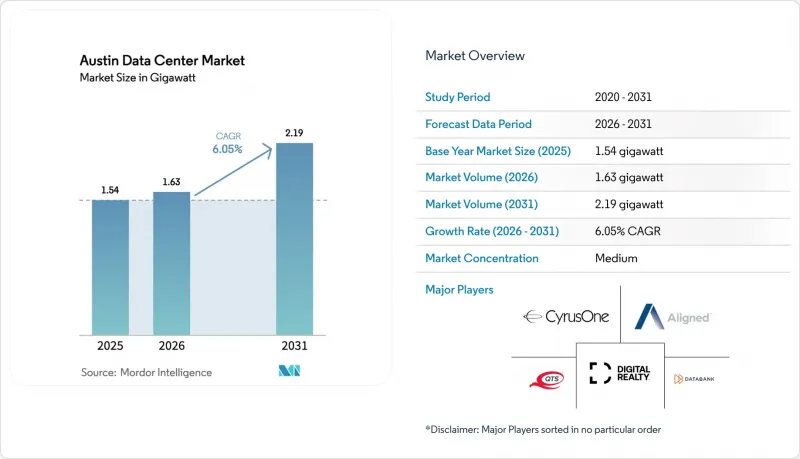
Mordor Intelligence에 따르면 오스틴 데이터센터 시장 규모는 2025년에 1.54기가와트라고 평가되며, 2026년 1.63기가와트로부터 2031년까지 2.19기가와트에 달할 것으로 추정되고 있으며, 예측 기간(2026-2031년)에 CAGR은 6.05%에 달할 전망입니다.
이 보고서는 데이터센터 규모(소규모, 중규모, 대규모, 초대규모, 메가 규모), 티어 유형(Tier 1·2, Tier 3, Tier 4), 데이터센터 유형(코로케이션, 클라우드 서비스 제공업체(CSP), 기업, 모듈형, 엣지)별로 분류되어 있습니다. 시장 전망은 금액(달러) 기준으로 제시되어 있습니다.
오스틴 데이터센터 시장의 동향 및 인사이트
댈러스 및 휴스턴 회랑에서 하이퍼스케일러의 이전
텍사스 중부의 토지 가격은 댈러스-포트워스 지역의 평균보다 낮은 반면, ERCOT의 큐 데이터에 따르면 오스틴 근교에는 더 큰 상호 연결 용량을 이용할 수 있는 것으로 나타났습니다. Alphabet과 Microsoft는 이미 100메가와트 단위의 증설에 대응할 수 있는 연속된 부지를 우선으로 하는 여러 거점에서의 확장 프로그램을 결정했습니다. 이러한 입지적 이점으로 인해 주내 최대 기업 클러스터로의 지연 시간이 단축되며, 사업자들은 서부 텍사스의 풍력발전과 부하 근처에서 생산되는 태양광발전을 결합하여 활용할 수 있게 됩니다. 웨코 북쪽에서 송전망 혼잡이 심화되는 가운데, 개발업체들은 프로젝트를 남쪽으로 이동시키고 있으며, 그 결과 핫,테일러, 조지타운 주변의 캠퍼스 건설 발표가 급증하고 있습니다. 멕시코만 연안을 경유하는 새로운 해저 케이블 상륙 파트너십을 통해 라틴아메리카로의 왕복 지연 시간이 더욱 단축되면서, 다중 지역 재해 복구를 필요로 하는 하이퍼스케일러들에게 오스틴의 매력이 높아지고 있습니다.
실리콘 힐스의 반도체 확장으로 인한 기업 클라우드 오프로드
삼성이 테일러의 제조 거점에 지속적으로 450억 달러를 투자함에 따라 전례 없는 엣지 분석 요구 사항이 발생하고 있습니다. 2나노미터 공정 노드에서는 시간당 테라바이트 규모의 텔레메트리 데이터가 발생하며, 수율 분석을 위한 실시간 연산이 요구되고 있습니다. AMD가 지역 AI 가속기에 대한 연구개발 투자를 통해 이러한 수요를 더욱 부추기고 있는 한편, 포토레지스트 공급업체부터 백엔드 테스트 벤더에 이르는 광범위한 반도체 공급망에서도 근접성을 중시한 데이터 수집이 요구되고 있습니다. 그 결과, 오스틴의 데이터센터 시장은 해당 지역의 반도체 생태계를 지원하는 병렬 인프라의 중추로 자리 잡고 있으며, 설계 센터, 팹, 클라우드 AI 클러스터 간의 저지연 연결을 제공하고 있습니다. 예측 기간 중 제조 공정이 하나 늘어날 때마다 30-50메가와트의 추가 컴퓨팅 수요가 발생할 것으로 예상되며, 제조 규모 확대와 데이터센터 성장 간의 선순환이 강화될 것입니다.
전력망의 변동성과 발전 제한의 위험
ERCOT의 예측에 따르면 2031년까지 피크 부하는 218기가와트에 달할 가능성이 있으며, 그 증가분의 수요 중 40% 가까이를 데이터센터가 차지할 것으로 예상됩니다. 플래거빌 및 매너 주변의 138kV 계층에서 국지적인 혼잡으로 인해 웨스트 존의 풍력발전 출력이 급격히 떨어질 경우, 때때로 부하 감축 지시가 내려지기도 합니다. 일부 사업자는 현재 N+1 공급을 확보하기 위해 30-50메가와트 규모의 계량기 후방 가스 터빈 설비를 추가하고 있지만, 규제 당국은 배출량 증가와의 상충 관계에 대해 여전히 경계하고 있습니다. 2025년 5월, 텍사스 주의회는 공공사업위원회에 신규 대규모 부하 연결 신청을 면밀히 검토할 수 있는 권한을 확대했습니다. 이로 인해 승인까지 걸리는 기간이 길어질 가능성이 있습니다. ERCOT가 예비율 안정화를 목표로 한 시장 설계 개혁을 최종 확정할 때까지는 출력 억제 위험이 단기적인 건설 일정에 큰 부담으로 작용하여 오스틴 데이터센터 시장의 성장 궤도를 둔화시킬 것입니다.
부문 분석
메가 시설은 2026-2031년까지 누적 86억 5,000만 달러의 자본 투자를 유치할 것으로 예상되며, 오스틴 데이터센터 시장에서 가장 빠르게 성장하는 분야입니다. 2025년에도 대규모 시설은 설치 메가와트 수의 43.12%를 차지하고 있지만, 10년 전에 건설된 셸 구조 설계로는 80킬로와트를 초과하는 AI 랙을 수용하기 어렵습니다. Aligned Data Centers의 DeltaFlow 액체 냉각 시스템을 갖춘 지상 2층 슬래브 온 등급 구조의 건물은 140킬로와트를 초과하는 랙 밀도를 실현하고 있으며, 이러한 구성은 생성형 AI 클러스터에 선호되고 있습니다. 메가 캠퍼스는 일반적으로 250-500에이커의 면적을 가지고 있으며, 멀티 기가와트급 확장성을 확보하기 위한 400kV 변전소를 부지 내에 설치할 공간을 제공합니다. 또한 ERCOT가 단일 소유자에 의한 마스터플랜 개발을 위해 간소화한 상호 연결 조사도 성장을 지원하고 있으며, 단편적인 확장에 비해 리드 타임을 8개월 단축하고 있습니다. 그 결과, 메가 스케일 구축이 개발 파이프라인에서 가장 큰 비중을 차지하며, 오스틴 데이터센터 시장 전체를 능가하는 연평균 성장률(CAGR) 9.05%를 지원하고 있습니다. 소규모 시설은 계속해서 엣지 및 지연 시간이 중요한 워크로드를 처리하고 있지만, 고밀도 메가 캠퍼스와의 경쟁력을 유지하기 위해 현재는 모듈식 액체 냉각 포드를 채택하고 있습니다.
장기적으로, 현재 건설 중인 1.1기가와트 규모의 프로젝트가 2028년까지 전면 가동되면 메가 캠퍼스는 오스틴 데이터센터 시장 규모의 최소 55%를 차지할 것으로 전망됩니다. 캠퍼스 운영 사업자는 대량 구매 할인이 적용된 15년간 갱신 가능한 전력 구매 계약(PPA)을 체결하여, 1kWh당 총 에너지 비용을 중규모 시설이 지불하는 평균 비용보다 12% 낮게 유지할 수 있게 되었습니다. 이러한 비용 차이로 인해 AI 입주사들은 30년짜리 토지 임대차 계약을 체결하려는 의지가 높아지며, 개발자의 고객 이탈 위험이 감소합니다. 한편, CHIPS법에 따른 연방 정부의 우대 조치로 인해 반도체 공장 확장과 해당 지역에 입지한 컴퓨팅 시설 간의 연계가 강화되고 있습니다. 그 결과 형성된 생태계를 통해 메가 캠퍼스는 미국 중남부 지역내 AI 보급의 핵심 인프라로서의 입지를 확고히 하고 있습니다.
기타 혜택:
- 엑셀 형식의 시장 예측(ME) 시트
- 3개월간의 애널리스트 지원
자주 묻는 질문
목차
제1장 서론
제2장 조사 방법
제3장 개요
제4장 시장 구도
제5장 시장 규모와 성장 예측(MW)
제6장 경쟁 구도
제7장 시장 기회와 향후 전망
KSA 26.09.02According to Mordor Intelligence, the austin data center market size was valued at 1.54 gigawatts in 2025 and estimated to grow from 1.63 gigawatts in 2026 to reach 2.19 gigawatts by 2031, at a CAGR of 6.05% during the forecast period (2026-2031).
This report is Segmented by Data Center Size (Small, Medium, Large, Massive, Mega), Tier Type (Tier 1&2, Tier 3, Tier 4), Data Center Type(Colocation, Cloud Service Providers (CSPs), Enterprise, Modular, and Edge). The Market Forecasts are Provided in Terms of Value (USD).
Austin Data Center Market Trends and Insights
Hyperscaler migration from Dallas and Houston corridors
Central Texas land prices remain below Dallas-Fort Worth averages, while ERCOT queue data shows greater available interconnection capacity near Austin. Alphabet and Microsoft already committed to multi-site expansion programs that prioritize contiguous parcels capable of supporting 100 megawatt increment builds. The proximity advantage reduces latency to the state's largest enterprise clusters and allows operators to blend West Texas wind with solar power generated closer to load. As grid congestion worsens north of Waco, developers are shifting pipelines southward, leading to a surge in campus announcements around Hutto, Taylor, and Georgetown. New subsea cable landing partnerships through the Gulf Coast further shorten round-trip latency to Latin America, adding to Austin's appeal for hyperscalers seeking multi-region disaster recovery.
Enterprise cloud off-load from "Silicon Hills" semiconductor expansion
Samsung's ongoing USD 45 billion commitment to the Taylor fabrication complex has introduced unprecedented edge-analytics requirements. Process nodes at 2 nanometers generate telemetry in terabytes per hour, demanding real-time compute for yield analysis. AMD's investment in local AI accelerator RandD intensifies that need, while the broader semiconductor supply chain-from photoresist suppliers to backend test vendors-requires proximity-based data ingestion. The Austin data center market is therefore becoming a parallel infrastructure backbone for the region's chip ecosystem, providing low-latency links between design centers, fabs, and cloud AI clusters. Over the forecast period, each additional fabrication phase could translate into 30-50 megawatts of incremental compute demand, reinforcing a virtuous cycle between manufacturing scale-up and data center growth.
Power-grid volatility and curtailment risk
ERCOT forecasts indicate peak load could hit 218 gigawatts by 2031, with data centers accounting for nearly 40% of incremental demand. Local congestion at the 138 kV layer around Pflugerville and Manor forces occasional load-shed directives when wind output in the West Zone collapses. Some operators now add behind-the-meter gas turbines sized at 30-50 megawatts to assure N+1 supply, but regulators remain wary of the emissions trade-off. In May 2025, the Texas Legislature granted the Public Utility Commission expanded authority to scrutinize new large-load interconnection requests, potentially lengthening approval cycles. Until ERCOT finalizes its market-design reform aimed at firming reserve margins, curtailment risk will weigh on near-term build schedules, tempering the Austin data center market growth trajectory.
Other drivers and restraints analyzed in the detailed report include:
- Texas sales- and property-tax abatements for mission-critical facilities
- Cheap renewable PPAs via ERCOT congestion-zone reforms
- Shrinking water table and cooling-water moratoriums
For complete list of drivers and restraints, kindly check the Table Of Contents.
Segment Analysis
Mega facilities are on track to capture USD 8.65 billion cumulative capital deployment between 2026 and 2031, representing the fastest-growing slice of the Austin data center market. Massive sites still retained a 43.12% share of installed megawatts in 2025, yet their decade-old shell designs struggle to host AI racks exceeding 80 kilowatts. Aligned Data Centers' 2-story slab-on-grade buildings with DeltaFlow liquid cooling achieve rack densities above 140 kilowatts, a configuration favored for generative-AI clusters. Mega campuses typically span 250-500 acres, providing space for on-site 400 kV substations that ensure multi-gigawatt scalability. Growth also benefits from ERCOT's simplified interconnection studies for single-owner master-planned developments, trimming lead time by eight months compared with piecemeal expansion. As a result, mega-scale deployments command the highest development pipeline share, underpinning an expected 9.05% CAGR that outpaces the overall Austin data center market. Smaller facilities continue to serve edge and latency-critical workloads, but they now adopt modular liquids cooling pods to stay competitive against high-density mega campuses.
Long-term, mega campuses should anchor at least 55% of the Austin data center market size once the current tranche of 1.1 gigawatts under construction fully energizes by 2028. Campus operators secure 15-year renewable PPAs at volume discounts, enabling total energy cost per kWh that is 12% below averages paid by medium facilities. This cost spread encourages AI tenants to commit to 30-year ground leases, reducing churn risk for developers. Meanwhile, federal incentives under the CHIPS Act strengthen the link between semiconductor plant expansions and co-located compute estates. The resulting ecosystem positions mega campuses as the backbone infrastructure for South-Central United States AI proliferation.
Complete Report Scope:
- By Data Center Size
- Small
- Medium
- Large
- Massive
- Mega
- By Tier Type
- Tier 1 and 2
- Tier 3
- Tier 4
- By Data Center Type
- Cloud Service Providers (CSPs)
- Enterprise, Modular and Edge
- Colocation
- Utilized
- Colocation Type
- Retail
- Wholesale
- Hyperscale
- End User
- Cloud and IT
- Telecom
- Media and Entertainment
- Government
- BFSI
- Manufacturing
- E-Commerce
- Other End User
- Colocation Type
- Utilized
List of Companies Covered in this Report:
- Digital Realty Trust Inc.
- CyrusOne LLC
- DataBank Ltd.
- Switch Inc.
- Sabey Data Center Properties LLC
- QTS Realty Trust Inc.
- Equinix Inc.
- Aligned Data Centers
- EdgeConneX Inc.
- NTT Global Data Centers Americas Inc.
- Compass Datacenters LLC
- Stream Data Centers LP
- Flexential Corp.
- TierPoint LLC
- CoreSite Realty Corp.
- Iron Mountain Data Centers
- Google LLC (Self-build)
- Amazon Web Services Inc. (Self-build)
- Microsoft Corp. (Self-build)
- Meta Platforms Inc. (Self-build)
Additional Benefits:
- The market estimate (ME) sheet in Excel format
- 3 months of analyst support
TABLE OF CONTENTS
1 INTRODUCTION
- 1.1 Study Assumptions and Market Definition
- 1.2 Scope of the Study
2 RESEARCH METHODOLOGY
3 EXECUTIVE SUMMARY
4 MARKET LANDSCAPE
- 4.1 Market Overview
- 4.2 Market Drivers
- 4.2.1 Hyperscaler migration from Dallas and Houston corridors
- 4.2.2 Enterprise cloud off-load from "Silicon Hills" semiconductor expansion
- 4.2.3 Texas sales- and property-tax abatements for mission-critical facilities
- 4.2.4 Cheap renewable PPAs via ERCOT's congestion-zone reforms
- 4.2.5 Increasing edge-compute demand from autonomous-vehicle testing cluster
- 4.2.6 Rapid 5G densification raising micro-edge colocation needs
- 4.3 Market Restraints
- 4.3.1 Power-grid volatility and curtailment risk
- 4.3.2 Shrinking water table and cooling-water moratoriums
- 4.3.3 Escalating Williamson- and Travis-County land valuations
- 4.3.4 Specialized workforce shortage in critical-facility OandM
- 4.4 Value / Supply-Chain Analysis
- 4.5 Regulatory Landscape
- 4.6 Technological Outlook
- 4.7 Investment and Capacity Pipeline Analysis
- 4.8 Porter's Five Forces Analysis
- 4.8.1 Threat of New Entrants
- 4.8.2 Bargaining Power of Suppliers
- 4.8.3 Bargaining Power of Buyers
- 4.8.4 Threat of Substitutes
- 4.8.5 Competitive Rivalry
- 4.9 Assessment of Macro Economic Trends on the Market
5 MARKET SIZE AND GROWTH FORECASTS (MW)
- 5.1 By Data Center Size
- 5.1.1 Small
- 5.1.2 Medium
- 5.1.3 Large
- 5.1.4 Massive
- 5.1.5 Mega
- 5.2 By Tier Type
- 5.2.1 Tier 1 and 2
- 5.2.2 Tier 3
- 5.2.3 Tier 4
- 5.3 By Data Center Type
- 5.3.1 Cloud Service Providers (CSPs)
- 5.3.2 Enterprise, Modular and Edge
- 5.3.3 Colocation
- 5.3.3.1 Utilized
- 5.3.3.1.1 Colocation Type
- 5.3.3.1.1.1 Retail
- 5.3.3.1.1.2 Wholesale
- 5.3.3.1.1.3 Hyperscale
- 5.3.3.1.2 End User
- 5.3.3.1.2.1 Cloud and IT
- 5.3.3.1.2.2 Telecom
- 5.3.3.1.2.3 Media and Entertainment
- 5.3.3.1.2.4 Government
- 5.3.3.1.2.5 BFSI
- 5.3.3.1.2.6 Manufacturing
- 5.3.3.1.2.7 E-Commerce
- 5.3.3.1.2.8 Other End User
- 5.3.3.1.1 Colocation Type
- 5.3.3.1 Utilized
6 COMPETITIVE LANDSCAPE
- 6.1 Market Concentration
- 6.2 Strategic Moves
- 6.3 Market Share Analysis
- 6.4 Company Profiles (includes Global level Overview, Market level Overview, Core Segments, Financials as available, Strategic Information, Market Rank/Share, Products and Services, Recent Developments)
- 6.4.1 Digital Realty Trust Inc.
- 6.4.2 CyrusOne LLC
- 6.4.3 DataBank Ltd.
- 6.4.4 Switch Inc.
- 6.4.5 Sabey Data Center Properties LLC
- 6.4.6 QTS Realty Trust Inc.
- 6.4.7 Equinix Inc.
- 6.4.8 Aligned Data Centers
- 6.4.9 EdgeConneX Inc.
- 6.4.10 NTT Global Data Centers Americas Inc.
- 6.4.11 Compass Datacenters LLC
- 6.4.12 Stream Data Centers LP
- 6.4.13 Flexential Corp.
- 6.4.14 TierPoint LLC
- 6.4.15 CoreSite Realty Corp.
- 6.4.16 Iron Mountain Data Centers
- 6.4.17 Google LLC (Self-build)
- 6.4.18 Amazon Web Services Inc. (Self-build)
- 6.4.19 Microsoft Corp. (Self-build)
- 6.4.20 Meta Platforms Inc. (Self-build)
7 MARKET OPPORTUNITIES AND FUTURE OUTLOOK
- 7.1 White-space and Unmet-need Assessment