|
시장보고서
상품코드
2119613
모발 이식 : 시장 점유율 분석, 업계 동향과 통계, 성장 예측(2026-2031년)Hair Transplant - Market Share Analysis, Industry Trends & Statistics, Growth Forecasts (2026 - 2031) |
||||||
 Mordor Intelligence
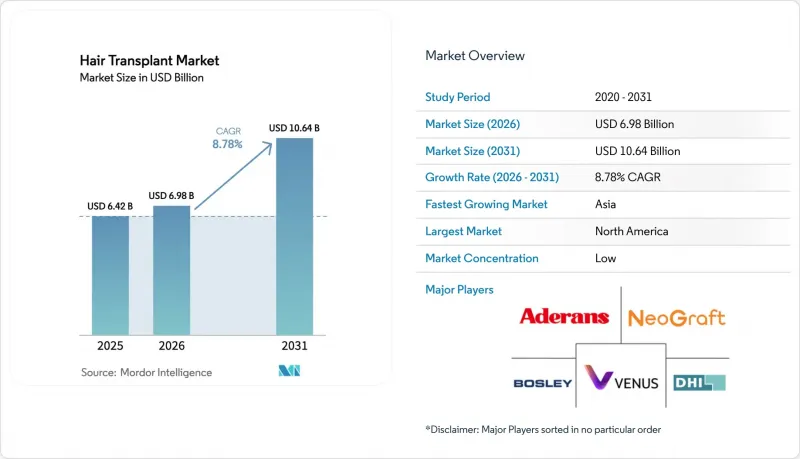
Mordor Intelligence에 따르면 모발 이식 시장 규모는 2025년에 64억 2,000만 달러로 평가되며, 2026년 69억 8,000만 달러에서 2031년까지 106억 4,000만 달러에 달할 것으로 예측되고 있으며, 예측 기간(2026-2031년)에 CAGR은 8.78%에 달할 전망입니다.
이 보고서는 시술 방법(모낭 단위 이식(FUT), 모낭 단위 채취(FUE) [수동 FUE, 로봇 FUE], FUT·FUE 병용 등), 성별(여성, 남성),서비스 제공자(병원, 피부과 클리닉), 지역(북미, 유럽, 아시아태평양, 중동 및 아프리카, 남미)별로 분류되어 있습니다. 시장 예측은 금액(달러) 기준으로 제시되어 있습니다.
전 세계 모발 이식 시장의 동향 및 인사이트
외모와 자존감을 높이기 위한 모발 이식의 인기 상승
소셜미디어 플랫폼을 통해 미용 시술이 보편화됨에 따라 20대 후반 성인들은 모발 이식을 교정이 아닌 예방적 관리로 인식하고 있습니다. 임상 연구에 따르면 FUE에 대한 만족도는 98%에 달하며, 이는 환자가 얻는 심리사회적 효과가 크다는 점을 지원합니다. 젊은 세대, 특히 엔터테인먼트 업계나 영업직 전문가들은 자신의 브랜드 이미지를 유지하기 위해 더 이른 시기에 수술 예약을 잡는 추세입니다. 이러한 인식의 변화로 인해 수입원은 기존의 중년 남성뿐만 아니라 여성 및 Z세대 소비자로 확대되고 있습니다. 클리닉은 인플루언서나 운동선수와 제휴하여 실제 시술 결과를 소개함으로써 시술에 대한 편견을 줄이고, 초진 환자의 평균 연령을 낮추고 있습니다. 예방적 수요는 외용 요법을 위한 재진도 지원하며, 재방문을 촉진하고 있습니다.
탈모를 유발하는 피부 질환의 유병률 증가
중국에는 안드로겐성 탈모증 환자가 2억 5,000만 명에 달하며, 이는 의료 부담의 증가를 여실히 보여줍니다. 생활 습관에 기인한 스트레스나 호르몬 균형의 변화로 인해 발병 시기가 앞당겨지면서, 치료 대상이 되는 환자 수가 급증하고 있습니다. 자가면역 질환 분야에서는 2024년 FDA가 데우록솔리티닙을 승인함에 따라 혜택을 보고 있으며, 치료 경로가 확대되고 있습니다. 여성형 탈모증은 개별적인 이식 배치나 호르몬 균형 조정이 필요한 독립적인 질환으로 분류되는 사례가 늘고 있습니다. 체계적 문헌 인사이트에 따르면 혈소판 농축 피브린(PRF) 주사가 여성의 모발 밀도를 개선하는 것으로 나타났습니다. 조기 발견 플랫폼은 피부경검사와 AI 진단을 통합하여, 클리닉에서 모낭의 현저한 미세화가 발생하기 전에 환자에게 적절한 상담을 제공할 수 있게 되었습니다.
비용적 제약과 수술 후 세심한 관리의 필요성
가격 장벽으로 인해 많은 중산층 환자들이 치료를 받지 못하고 있습니다. 특히 보험사가 미용 목적의 치료비 환급을 거부하는 지역에서는 이러한 경향이 두드러집니다. 진통제나 약용 샴푸 등의 부수적 비용은 12개월 이내 총 비용의 30%를 추가로 차지할 가능성이 있습니다. 경기 둔화는 클리닉 예약 건수에 직접적인 타격을 주고 있으며, 그 증거로 Venus Concept사의 2024년 3분기 매출이 15% 감소한 반면, 유동성을 유지하기 위한 설비 투자 부채는 절반으로 줄었습니다. 영국의 의료 서비스 기관들은 해외에서 할인 수술로 인한 합병증을 처리하기 위해 추가 자원을 투입하고 있다고 보고하고 있으며, 이는 숨겨진 장기적 비용이 부각되고 있음을 보여줍니다.
부문별 분석
모발 이식 시장에서 환자들이 흉터 최소화와 빠른 회복을 중시한 결과, 2025년 매출의 58.62%를 모낭 단위 채취(FUE)가 차지했습니다. ARTAS iXi를 도입한 클리닉에서는 시간당 500-700 그라프트의 채취율과 44마이크론의 정밀도를 기록하며, 이 장비가 생산성에 크게 기여하고 있음이 부각되었습니다. 그러나 엘리트 외과의사들은 곱슬머리나 밝은 색의 모발에 대해서는 여전히 수동 펀치 세트를 선호하고 있으며, 동일한 수술 날에도 첨단 기술과 장인의 솜씨가 공존하고 있음을 보여줍니다.
FUT·FUE 병용법은 연평균 성장률(CAGR) 14.88%로 성장할 것으로 예측되며, 이는 이식 모낭 수를 극대화하면서도 기증 부위의 흉터를 눈에 띄지 않게 하는 하이브리드 시술법에 대한 수요를 반영하고 있습니다. 이 모델에서 외과의사는 후두부 중앙부를 스트립법으로 채취(수확량 확보)하고, 주변부를 펀치법으로 채취(흉터 최소화)함으로써 3,500개 이상의 이식편이 필요한 환자에게 자연스러운 밀도를 실현합니다. 복합 기술을 활용한 모발 이식 시장 규모는 2031년까지 35억 2,000만 달러에 달할 것으로 예측되며, 현미경이나 듀얼 모드 펀치 시스템과 같은 장비의 애프터마켓도 확대될 전망입니다.
FUEsion X 5.0과 같은 2세대 로봇은 모낭의 각도를 실시간으로 매핑하는 증강현실(AR) 오버레이 기능을 탑재하여 모낭 절단률을 4% 미만으로 낮추고 있습니다. 조기 도입자들은 15-20%의 가격 프리미엄을 부과하고 있지만, 많은 도시 지역의 밀레니얼 세대는 이를 수용하고 있습니다. 다이렉트 헤어 이식, 노쉐이브 FUE, 그리고 무바늘 마취 플랫폼은 눈에 띄지 않는 회복을 원하는 환자들의 마이크로 틈새 시장을 충족시키고 있습니다.
지역별 분석
북미는 높은 가처분 소득과 로봇 기술의 조기 도입에 힘입어 2025년에도 33.29%라는 최대 지역 점유율을 유지했습니다. 국내 수술 건수는 여전히 견고하지만, 가격에 민감한 소비자들은 여전히 인증을 받은 터키의 의료 시설을 찾고 있으며, 가격 탄력성이 나타나고 있습니다. 데우룩소리티닙의 규제 당국 승인 및 임박한 세포 치료 임상 시험으로 인해 치료의 폭이 넓어지면서, 이 지역의 수술 건수는 유지될 전망입니다.
유럽에서는 양극화된 경향이 나타나고 있습니다. 독일과 스페인의 유서 깊은 의료 제공업체들은 안정적인 국내 수요를 유지하고 있는 반면, 저비용의 동유럽 및 터키 의료 시설들은 가격을 중시하는 영국과 스칸디나비아 국가들의 환자들을 끌어모으고 있습니다. 2,000달러 패키지를 제공하는 유럽의 병원들은 과거 해외 의료 관광을 촉진했던 가격 격차를 좁히고 있으며, 이에 따라 이스탄불의 클리닉들은 컨시어지 서비스가 제공되는 회복 스위트 등 부가가치 서비스에 주력하고 있습니다.
아시아태평양은 2031년까지 12.41%라는 가장 높은 연평균 성장률(CAGR)을 기록할 것으로 전망됩니다. 중국에서는 2억 5,000만 명의 탈모 환자가 있음에도 불구하고 시술 보급률은 0.2% 미만에 그치고 있으며, 큰 성장 여지가 있음을 보여주고 있습니다. 일본에서는 고령화가 진행되고 있음에도 외모를 중요시하는 인구층이 저침습 로봇 수술에 대한 수요를 지원하고 있으며, 한국에서는 K-뷰티 문화가 예방적인 모낭 관리를 촉진하고 있습니다. 인도의 의료 비자 개혁 등 지방 정부의 우대 조치로 인해 지역내 국경을 초월한 의료 서비스가 더욱 정착되고 있습니다.
기타 혜택:
- 엑셀 형식의 시장 예측(ME) 시트
- 3개월간의 애널리스트 지원
자주 묻는 질문
목차
제1장 서론
제2장 조사 방법
제3장 개요
제4장 시장 구도
제5장 시장 규모와 성장 예측
제6장 경쟁 구도
제7장 시장 기회와 향후 전망
KSA 26.09.02According to Mordor Intelligence, the hair transplant market size was valued at USD 6.42 billion in 2025 and estimated to grow from USD 6.98 billion in 2026 to reach USD 10.64 billion by 2031, at a CAGR of 8.78% during the forecast period (2026-2031).
This report is Segmented by Procedure (Follicular Unit Transplantation (FUT), Follicular Unit Extraction (FUE) [Manual FUE, and Robotic FUE], Combination of FUT & FUE, and More), Gender (Female and Male), Service Provider (Hospital and Dermatology Clinics), and Geography (North America, Europe, Asia-Pacific, Middle East and Africa, and South America). The Market Forecasts are Provided in Terms of Value (USD).
Global Hair Transplant Market Trends and Insights
Rising Popularity of Hair Transplants to Enhance Looks & Self-Esteem
Social platforms have normalized cosmetic procedures, prompting adults in their late 20s to view transplantation as preventive rather than corrective care. Clinical studies report 98% satisfaction with FUE, underscoring the psychosocial uplift patients gain. Younger cohorts, especially professionals in entertainment and sales, are scheduling surgeries earlier to preserve personal branding. This attitudinal shift broadens revenue beyond traditional middle-aged males to women and Gen Z consumers. Clinics partner with influencers and athletes to showcase authentic results, which reduces stigma and lowers the average age of first-time patients. Preventive demand also sustains follow-up visits for topical therapies, stimulating recurring spend.
Increasing Prevalence of Dermatological Disorders Causing Hair Loss
China counts 250 million residents with androgenetic alopecia-an illustration of mounting medical burden. Lifestyle stressors and hormonal shifts bring onset forward, multiplying candidate numbers. Autoimmune segments benefit from the 2024 FDA nod to deuruxolitinib, expanding treatment pathways. Female pattern loss is increasingly classified as a standalone disorder requiring tailored graft placement and hormone balance strategies. Systematic reviews show platelet-rich fibrin injections improving density in women. Early detection platforms integrate dermoscopy and AI diagnosis, enabling clinics to counsel patients before extensive follicle miniaturization occurs.
Cost Constraints and High Post-Surgery Care Needs
Price hurdles exclude many middle-income patients, especially where insurance refuses cosmetic reimbursement. Ancillary expenditures on analgesics and medicated shampoos can add 30% to total costs within 12 months. Economic slowdowns directly dent clinic bookings, evidenced by Venus Concept's 15% revenue dip in Q3 2024 while equipment debt was halved to preserve liquidity. UK health services report investing extra resources to manage complications from discounted overseas surgeries, highlighting hidden long-term costs.
Other drivers and restraints analyzed in the detailed report include:
- Rising Disposable Income & Medical Tourism in Emerging Economies
- Emergence of Regenerative PRP & Stem-Cell Adjuncts Boosting Outcomes
- Surgical Risks and Side-Effects Impacting Patient Willingness
For complete list of drivers and restraints, kindly check the Table Of Contents.
Segment Analysis
Follicular Unit Extraction generated 58.62% of 2025 revenue as patients prioritized minimal scarring and faster recovery within the hair transplant market. Clinics adopting ARTAS iXi recorded harvest rates of 500-700 grafts per hour with 44-micron precision, underscoring equipment contributions to productivity. Yet elite surgeons continue to favor manual punch sets for curly or light-colored hair, demonstrating the coexistence of high-tech and artisanal craft within the same surgical day.
Combination FUT + FUE is projected to grow at 14.88% CAGR, reflecting demand for hybrid protocols that maximize graft counts while disguising donor scars. Under this model, surgeons strip-harvest central occipital zones (yield) and punch peripheral regions (concealment), delivering natural density for patients requiring 3,500+ grafts. The hair transplant market size for combination techniques is forecast to grow to USD 3.52 billion by 2031, expanding the equipment aftermarket for microscopes and dual-modality punch systems.
Second-generation robots like FUEsion X 5.0 introduce augmented-reality overlays that map follicle angle in real time, reducing transection below 4%. Early adopters charge 15-20% price premiums that many urban millennials accept. Direct Hair Implantation, no-shave FUE, and needle-free anaesthesia platforms address micro-niches of patients seeking discreet recovery.
Complete Report Scope:
- By Procedure
- Follicular Unit Transplantation (FUT)
- Follicular Unit Extraction (FUE)
- Manual FUE
- Robotic FUE
- Combination of FUT & FUE
- Other Procedures
- By Gender
- Female
- Male
- By Service Provider
- Hospitals
- Dermatology Clinics
- Geography
- North America
- United States
- Canada
- Mexico
- Europe
- Germany
- United Kingdom
- France
- Italy
- Spain
- Rest of Europe
- Asia-Pacific
- China
- Japan
- India
- South Korea
- Australia
- Rest of Asia-Pacific
- Middle East and Africa
- GCC
- South Africa
- Rest of Middle East and Africa
- South America
- Brazil
- Argentina
- Rest of South America
- North America
Geography Analysis
North America retained the largest regional stake at 33.29% in 2025, buoyed by high disposable income and early adoption of robotics. Domestic surgery volumes remain strong, yet cost-sensitive consumers still travel to accredited Turkish facilities, evidencing price elasticity. Regulatory clearance for deuruxolitinib and impending cell-therapy trials expand therapeutic breadth, likely sustaining regional procedure counts.
Europe presents a two-speed profile: established providers in Germany and Spain observe steady local demand, while low-cost Eastern European and Turkish centers lure price-driven patients from the United Kingdom and Scandinavia. European hospitals offering USD 2,000 packages shrink the arbitrage that previously fueled outbound tourism, driving Istanbul clinics toward value-added services such as concierge recovery suites.
Asia-Pacific posts the fastest 12.41% CAGR through 2031. China's sub-0.2% procedure penetration against 250 million hair-loss sufferers depicts vast headroom. Japan's aging yet image-conscious population fuels demand for minimally invasive robotics, and South Korea's K-beauty culture promotes preventive follicular care. Local government incentives-for example, India's medical-visa reforms-further institutionalize cross-border care within the region.
- Bernstein Medical
- Cole Hair Transplant Group
- Elite Hair Restoration
- Aderans
- Hairline International Hair & Skin Clinic
- Apira Sciences
- Hair Restoration Blackrock
- Hair Sure
- Hair Transplants of Florida
- Bosley Hair Restoration & Transplant
- Venus Concept
- NeoGraft
- Restoration Robotics (ARTAS)
- SmartGraft
- Dr. Batra's Positive Health Clinic
- DHI Medical Group
- Eugenix Hair Sciences
- FUE Clinics
Additional Benefits:
- The market estimate (ME) sheet in Excel format
- 3 months of analyst support
TABLE OF CONTENTS
1 Introduction
- 1.1 Study Assumptions & Market Definition
- 1.2 Scope of the Study
2 Research Methodology
3 Executive Summary
4 Market Landscape
- 4.1 Market Overview
- 4.2 Market Drivers
- 4.2.1 Rising Popularity of Hair Transplants To Enhance Looks & Self-Esteem
- 4.2.2 Increasing Prevalence of Dermatological Disorders Causing Hair Loss
- 4.2.3 Rising Disposable Income & Medical Tourism In Emerging Economies
- 4.2.4 Emergence of Regenerative PRP & Stem-Cell Adjuncts Boosting Outcomes
- 4.2.5 Social-Media-Driven Male Grooming Trend Accelerating Early Adoption
- 4.3 Market Restraints
- 4.3.1 Cost Constraints And High Post-Surgery Care Needs
- 4.3.2 Surgical Risks & Side-Effects Impacting Patient Willingness
- 4.3.3 Regulatory Scrutiny Of Unlicensed Clinics Dampening Demand
- 4.4 Porter's Five Forces
- 4.4.1 Threat of New Entrants
- 4.4.2 Bargaining Power of Buyers/Consumers
- 4.4.3 Bargaining Power of Suppliers
- 4.4.4 Threat of Substitute Products
- 4.4.5 Intensity of Competitive Rivalry
5 Market Size & Growth Forecasts (Value, USD)
- 5.1 By Procedure
- 5.1.1 Follicular Unit Transplantation (FUT)
- 5.1.2 Follicular Unit Extraction (FUE)
- 5.1.2.1 Manual FUE
- 5.1.2.2 Robotic FUE
- 5.1.3 Combination of FUT & FUE
- 5.1.4 Other Procedures
- 5.2 By Gender
- 5.2.1 Female
- 5.2.2 Male
- 5.3 By Service Provider
- 5.3.1 Hospitals
- 5.3.2 Dermatology Clinics
- 5.4 Geography
- 5.4.1 North America
- 5.4.1.1 United States
- 5.4.1.2 Canada
- 5.4.1.3 Mexico
- 5.4.2 Europe
- 5.4.2.1 Germany
- 5.4.2.2 United Kingdom
- 5.4.2.3 France
- 5.4.2.4 Italy
- 5.4.2.5 Spain
- 5.4.2.6 Rest of Europe
- 5.4.3 Asia-Pacific
- 5.4.3.1 China
- 5.4.3.2 Japan
- 5.4.3.3 India
- 5.4.3.4 South Korea
- 5.4.3.5 Australia
- 5.4.3.6 Rest of Asia-Pacific
- 5.4.4 Middle East and Africa
- 5.4.4.1 GCC
- 5.4.4.2 South Africa
- 5.4.4.3 Rest of Middle East and Africa
- 5.4.5 South America
- 5.4.5.1 Brazil
- 5.4.5.2 Argentina
- 5.4.5.3 Rest of South America
- 5.4.1 North America
6 Competitive Landscape
- 6.1 Market Concentration
- 6.2 Market Share Analysis
- 6.3 Company Profiles (includes Global level Overview, Market level overview, Core Segments, Financials as available, Strategic Information, Market Rank/Share for key companies, Products & Services, and Recent Developments)
- 6.3.1 Bernstein Medical
- 6.3.2 Cole Hair Transplant Group
- 6.3.3 Elite Hair Restoration
- 6.3.4 Aderans (Hair Club)
- 6.3.5 Hairline International Hair & Skin Clinic
- 6.3.6 Apira Sciences Inc (iGrow Laser)
- 6.3.7 Hair Restoration Blackrock
- 6.3.8 Hair Sure
- 6.3.9 Hair Transplants of Florida
- 6.3.10 Bosley Hair Restoration & Transplant
- 6.3.11 Venus Concept
- 6.3.12 NeoGraft
- 6.3.13 Restoration Robotics (ARTAS)
- 6.3.14 SmartGraft
- 6.3.15 Dr. Batra's Positive Health Clinic
- 6.3.16 DHI Medical Group
- 6.3.17 Eugenix Hair Sciences
- 6.3.18 FUE Clinics
7 Market Opportunities & Future Outlook
- 7.1 White-space & Unmet-need Assessment