|
시장보고서
상품코드
2119620
위성 페이로드 : 시장 점유율 분석, 업계 동향과 통계, 성장 예측(2026-2031년)Satellite Payload - Market Share Analysis, Industry Trends & Statistics, Growth Forecasts (2026 - 2031) |
||||||
 Mordor Intelligence
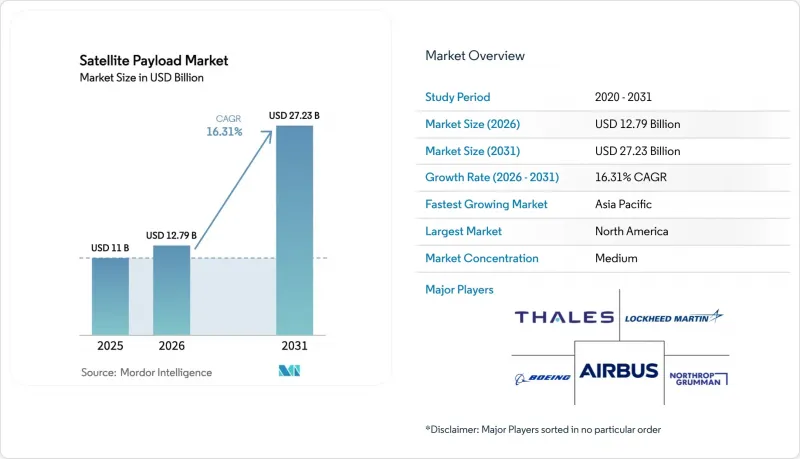
Mordor Intelligence에 따르면 2026년 위성 페이로드 시장의 규모는 127억 9,000만 달러로 추정되고 있으며, 2025년 110억 달러에서 확대하며, 2031년에는 272억 3,000만 달러에 달할 것으로 예측됩니다.
2026-2031년까지 연평균 성장률(CAGR) 16.31%로 성장할 것으로 전망됩니다.
이 보고서는 페이로드 유형(통신, 항법, 영상 촬영 등), 궤도(저궤도 등), 최종 용도(상업, 정부·국방, 이중 용도), 용도(통신, 지구 관측·기상 감시, 측량·항법 등) 및 지역(북미, 남미 등)별로 분류되어 있습니다. 시장 전망은 금액(달러) 기준으로 제시되어 있습니다.
글로벌 위성 페이로드 시장의 동향 및 인사이트
정부 및 다자간 우주 프로그램 예산 증가
국방 예산 배분은 계속 확대되고 있으며, 각국 정부가 회복력 있는 분산형 아키텍처를 우선시함에 따라 위성 페이로드에 대한 전반적인 수요를 끌어올리고 있습니다. NASA는 2025 회계연도에 상용 LEO 개발에 13억 달러를 배정하여 차세대 페이로드 연구개발에 직접 자금을 투입하고 있습니다. 인도의 2024년도 우주 예산은 통신 및 레이더 임무를 위한 국산 페이로드 제조를 추진하고 있습니다. 한편, 미국 국방부(DoD)는 군사 통신 능력을 강화하기 위해 스타쉴드(Starshield)와 같은 상용 위성 네트워크를 활용하고 있으며, 이중용도(군민 양용) 기술의 도입이 가속화되고 있습니다. 공공 기관이 위험을 여러 궤도로 분산시키는 가운데, 신속한 재구성 및 양산이 가능한 공급업체는 뚜렷한 우위를 점하고 있습니다. 그 결과, 2020년대 중반까지 계약 기반의 페이로드 수량은 지속적으로 증가할 전망입니다.
고처리량 광대역 위성 군에 대한 수요 급증
스타링크의 3세대 위성은 1기당 처리량을 약 1테라비트/초까지 끌어올려, 기존 기종에 비해 용량을 10배로 확대합니다. 이에 반해, 중국의 GuoWang 계획은 연간 300기 발사 규모로 전개되는 13,000기의 위성을 상정한 로드맵을 제시하고 있습니다. 하류 시장에서는 NanoAvionics와 같은 중견 제조사들이 수백 대의 플랫폼을 공급하는 9자리 규모의 계약을 수주하며, 대량 생산 및 저단가 모델을 강화하고 있습니다. 광대역 위성 군집은 적어도 2028년까지 통신 페이로드 어셈블리의 최대 수요 견인 요인으로 남아 있을 것입니다.
주파수 대역의 혼잡과 규제상의 병목 현상
LEO 및 GEO 사업자들이 전력 밀도 제한을 놓고 다투고 있으므로 미국에서는 라이선스 취득까지의 리드타임이 9개월까지 길어졌으며, 일부 위성 군집의 전개가 정체되고 있습니다. 국제전기통신연합(ITU)의 사이클은 혁신적인 파형을 따라가지 못하고 있으며, 기존 사업자에게 유리한 비공식적인 조정이 불가피한 상황입니다. 곧 시행될 EU 우주법은 유럽 이외의 기업에 추가적인 규정 준수 요건을 부과하게 되어, 병행되는 규제 체계가 생겨나 전 세계적인 배치를 복잡하게 만들 것입니다. 주파수 수요가 급증하는 가운데, 페이로드 공급업체는 기동성이 높은 무선 장비를 설계하고 더 조기에 신청을 해야 하므로, 이로 인해 프로그램의 위험과 비용이 증가하고 있습니다.
부문 분석
2025년에는 광대역 및 트렁킹 서비스가 통신 사업자의 조달을 주도함에 따라 통신 하드웨어가 업계 매출의 49.20%를 차지했습니다. 소프트웨어 정의 페이로드는 여전히 점유율이 낮지만, 궤도 상에서의 재구성을 통해 전체 수명 주기의 업그레이드 비용을 절감하고, 통신 사업자가 트래픽 피크에 맞춰 빔과 주파수를 전환할 수 있으므로 연평균 성장률(CAGR) 21.92%로 확대되고 있습니다. 또한 보험사, 에너지 기업, 정부 기관에 변화 감지 데이터를 판매하는 상용 SAR 위성군에 힘입어, 영상 및 레이더 페이로드도 꾸준한 상승세를 보이고 있습니다. 양자 키 배포 단말기나 우주 기상 관측 장치와 같은 틈새 과학 장비는 고수익률의 조사 임무에 기여함으로써 수요를 더욱 확대하고 있습니다.
적응형 아키텍처에 대한 투자자들의 관심이 높아짐에 따라더 많은 저궤도(LEO) 및 정지궤도(GEO) 프로그램이 아날로그 중계기에서 완전 디지털 프로세서로 전환됨에 따라 소프트웨어 정의 플랫폼 위성 페이로드 시장 규모는 2026-2031년 사이에 3배로 확대될 가능성이 있습니다. 소형화된 통신 모듈은 현재 200kg 미만의 버스에 수 기가비트의 처리량을 탑재할 수 있게 되었으며, 이를 통해 멀티 매니페스트 발사 및 보다 신속한 교체 주기가 촉진되고 있습니다. 이에 따라 각 부품 공급업체들도 방사선 내성이 있는 FPGA와 현장 업그레이드를 지원하는 칩셋을 잇달아 출시하고 있으며, 이러한 동향으로 인해 유연성이 주요 구매 기준으로 더욱 자리 잡고 있습니다. 이러한 변화로 인해 재구성 가능한 하드웨어와 안전한 클라우드 기반 임무 계획 소프트웨어를 결합한 페이로드 공급업체가 조달 평가에서 우위를 점하고 있습니다.
저궤도(LEO) 플랫폼은 출하 대수의 62.10%를 차지하고 있으며, 스마트폰이나 기업 단말기와의 왕복 통신에 30-70밀리초의 지연 시간이 필요한 지연에 민감한 서비스에 힘입어 2031년까지 연평균 성장률(CAGR) 18.70%로 성장할 것으로 예측됩니다. 위성 페이로드 시장은 표준화된 LEO 버스를 통해 자동차 공장과 유사한 양산 방식이 가능해져, 제조 기간과 단가를 대폭 단축할 수 있다는 점에서 혜택을 보고 있습니다. 중궤도(MEO) 위성군은 여전히 항법 네트워크에 필수적입니다. 갈릴레오의 2세대 위성 계층은 완전 디지털화된 페이로드와 전기 추진 버스에 대한 레이저 크로스링크를 특징으로 하며, 전 세계에서 센티미터 수준의 정확도를 실현하고 있습니다.
정지 궤도(GEO) 시스템은 비용 면에서 압박을 받고 있지만, 해양, 항공 및 정부 방송 고객에게 대륙 규모의 커버리지라는 귀중한 서비스를 제공하고 있습니다. HummingSat과 같은 새로운 소형 GEO 제품 덕분에 사업자들은 기존 발사 예산의 불과 몇 분의 일로 2-3kW의 페이로드를 운영할 수 있게 되어 GEO의 잠재 시장이 확대되고 있습니다. GEO 페이로드의 연간 매출 성장률은 3-4%에 그칠 것으로 예상되지만, LEO가 고속 백홀을 담당하고 GEO가 상시 연결 커버리지를 제공하는 하이브리드 네트워크 설계 덕분에 수요는 안정적인 수준을 유지할 전망입니다. 10년 말 무렵에는 조달 요건에서 다중 궤도 간 상호 운용성이 기본 요건으로 명시될 가능성이 높으며, 이에 따라 페이로드 설계자는 네트워크 간 핸드셰이크 프로토콜 및 애자일 안테나의 우선순위를 높일 수밖에 없을 것입니다.
지역별 분석
북미의 사업자들은 2024-2025년에 LEO 아키텍처 확충에 막대한 투자를 단행했으며, 방위 예산 사상 최대 규모를 통신, ISR(정보·감시·정찰), 조기 경보 임무에 배정했습니다. 견고한 민간 자본이 공공 지출을 보완하고 있으며, 이로 인해 위성 군의 갱신 주기가 단축되고, 첨단 디지털 프로세서를 탑재한 소프트웨어 정의 페이로드에 대한 지역적 수요가 촉진되고 있습니다. 북미 위성 페이로드 시장 규모는 2031년까지 112억 4,000만 달러에 달할 것으로 예측되며, 지속적인 기술 도입과 견고한 공급망의 두께 덕분에 주도적인 위치를 유지할 것으로 전망됩니다.
아시아태평양의 성장 가속화는 광대역, 영상 촬영, 달 탐사 프로젝트에 대한 자금 지원에 적극적인 국내 대기업과 지속적으로 확대되는 벤처 생태계에 기인합니다. 중국의 GuoWang 및 GalaxySpace 프로그램은 기기로의 직접 전송 서비스를 목표로 하고 있는 반면, 인도의 민간 기업 친화적인 개혁을 통해 발사 시설 및 클린룸 용량이 민간 기업에 개방되고 있습니다. 정부가 지원하는 보험 풀이 우주 쓰레기와 관련된 위험을 부분적으로 상쇄하고 있으며, 신규 기업의 시장 진입을 가속화하고 있습니다. 발사 속도가 유지된다면, 이 지역의 위성 페이로드 시장 점유율은 2025년 21.18%에서 2031년까지 27.34% 가까이 상승할 가능성이 있습니다.
유럽은 소형 GEO 구상나 완전 디지털 페이로드 체인을 통합한 차세대 갈릴레오 위성 등 ESA가 자금을 지원하는 프로그램의 혜택을 받고 있습니다. 지속가능성 및 궤도 상의 우주 쓰레기 감축에 관한 규제 측면의 리더십이 사업자의 행동을 형성하고 있으며, 자율적인 충돌 회피 기능과 신속한 궤도 이탈 장치를 갖춘 설계를 촉진하고 있습니다. 제조 비용은 구조적으로 여전히 높은 편이지만, 유럽 대륙은 기술적 고도성과 각국 국방부가 요구하는 주권 보장형 솔루션이라는 점에서 차별화를 꾀하고 있습니다.
기타 혜택:
- 엑셀 형식의 시장 예측(ME) 시트
- 3개월간의 애널리스트 지원
자주 묻는 질문
목차
제1장 서론
제2장 조사 방법
제3장 개요
제4장 시장 구도
제5장 시장 규모와 성장 예측
제6장 경쟁 구도
제7장 시장 기회와 향후 전망
KSA 26.09.02According to Mordor Intelligence, satellite payload market size in 2026 is estimated at USD 12.79 billion, growing from 2025 value of USD 11.00 billion with 2031 projections showing USD 27.23 billion, growing at 16.31% CAGR over 2026-2031.
This report is Segmented by Payload Type (Communication, Navigation, Imaging, and More), Orbit (Low Earth Orbit, and More), End-Use (Commercial, Government and Defense, and Dual Use), Application (Communication, Earth Observation/Weather Monitoring, Mapping and Navigation, and More), and Geography (North America, South America, and More). The Market Forecasts are Provided in Terms of Value (USD).
Global Satellite Payload Market Trends and Insights
Rising Government and Multilateral Space-Program Budgets
Defense allocations continue to swell, lifting overall satellite payload demand as governments prioritize resilient, distributed architectures. NASA has earmarked USD 1.3 billion in FY 2025 for commercial LEO development, injecting direct capital into next-generation payload R&D. India's 2024 space budget pushes indigenous payload manufacturing for communications and radar missions. Meanwhile, the US Department of Defense (DoD) taps commercial satellite networks such as Starshield to augment military connectivity, accelerating dual-use uptake. As public agencies spread risk across multiple orbits, suppliers capable of rapid reconfiguration and mass production gain a measurable advantage. The net result is a sustained uplift in contracted payload volumes through mid-decade.
Surging Demand for High-Throughput Broadband Constellations
Starlink's third-generation satellites lift per-spacecraft throughput to roughly one terabit per second, multiplying capacity tenfold versus earlier units. China's GuoWang program counters with a 13,000-satellite roadmap that scales launches at 300 units annually. Downstream, mid-tier manufacturers such as NanoAvionics have secured nine-digit contracts to supply hundreds of platforms, reinforcing a high-volume, low-unit-cost model. Broadband constellations remain the largest demand driver for communication payload assemblies through at least 2028.
Spectrum Congestion and Regulatory Bottlenecks
With LEO and GEO operators fighting over power-flux-density limits, licensing lead times now stretch to nine months in the United States, stalling some constellation deployments. International Telecommunication Union cycles cannot keep pace with innovative waveforms, forcing informal coordination that favors incumbents. The forthcoming EU Space Act is set to impose additional compliance layers on non-European firms, creating parallel regulatory tracks that complicate global rollouts. As spectrum demand surges, payload suppliers must design agile radios and file applications earlier, increasing program risk and cost.
Other drivers and restraints analyzed in the detailed report include:
- Earth-Observation Data Monetization Across Industries
- LEO Constellation Proliferation Lowering Unit Economics
- Stricter Space-Debris Mitigation Standards
For complete list of drivers and restraints, kindly check the Table Of Contents.
Segment Analysis
Communication hardware generated 49.20% of industry revenue in 2025 as broadband and trunking services dominated operator procurement. Software-defined payloads, though still a smaller slice, are advancing at a 21.92% CAGR because their on-orbit reconfiguration cuts lifetime upgrade costs and lets operators shift beams or frequencies to match traffic peaks. Imaging and radar payloads are also on a solid upswing, helped by commercial SAR constellations that sell change-detection data to insurers, energy firms, and governments. Niche scientific instruments-such as quantum-key-distribution terminals and space-weather monitors-round out demand by serving high-margin research missions.
Investor appetite for adaptive architectures means the total satellite payload market value of software-defined platforms could triple between 2026 and 2031 as more LEO and GEO programs switch from analog repeaters to fully digital processors. Miniaturized communication modules now cram multi-gigabit throughput into sub-200 kg buses, encouraging multi-manifest launches and faster replacement cycles. Component vendors follow suit by rolling out radiation-tolerant FPGAs and chipsets that support in-field upgrades, a trend that further cements flexibility as the prime buying criterion. These shifts are tilting procurement scorecards toward payload suppliers that pair reconfigurable hardware with secure, cloud-based mission-planning software.
Low-Earth-orbit (LEO) platforms account for 62.10% of shipped units and are projected to grow at an 18.70% CAGR through 2031, driven by latency-sensitive services that need 30-70 ms round-trip links to smartphones and enterprise terminals. The satellite payload market benefits because standardized LEO buses allow line-production methods similar to automotive plants, significantly compressing build times and unit pricing. Medium-Earth-orbit fleets remain indispensable for navigation networks; Galileo's second-generation craft layer features fully digital payloads and laser cross-links onto electric-propulsion buses to deliver global centimeter-level accuracy.
Geostationary systems face cost pressure yet provide irreplaceable, continent-wide footprints for maritime, aero, and governmental broadcast customers. New small-GEO products such as HummingSat let operators field 2-3 kW payloads at a fraction of legacy launch budgets, widening GEO's addressable market. Forecasts point to just 3-4% annual revenue growth for GEO payloads, but hybrid network designs-where LEO handles high-speed backhaul and GEO provides always-on coverage-should keep demand steady. Procurement templates will likely specify multi-orbit interoperability as a baseline by decade-end, forcing payload designers to prioritize cross-network handshake protocols and agile antennas.
Complete Report Scope:
- By Payload Type
- Communication
- Navigation
- Imaging
- Scientific and Research
- Software-defined Payload
- Radar
- By Orbit
- Low Earth Orbit (LEO)
- Medium Earth Orbit (MEO)
- Geostationary Orbit (GEO)
- By End-Use
- Commercial
- Government and Defense
- Dual Use
- By Application
- Communication
- Earth Observation/Weather Monitoring
- Mapping and Navigation
- Intelligence, Surveillance, and Reconnaissance (ISR)
- Scientific Research and Exploration
- Others (IoT, Asset Tracking, etc.)
- By Geography
- North America
- United States
- Canada
- Mexico
- Europe
- Germany
- United Kingdom
- France
- Russia
- Rest of Europe
- Asia-Pacific
- China
- Japan
- India
- Australia
- Rest of Asia-Pacific
- South America
- Brazil
- Rest of South America
- Middle East and Africa
- Middle East
- United Arab Emirates
- Saudi Arabia
- Rest of Middle East
- Africa
- South Africa
- Rest of Africa
- Middle East
- North America
Geography Analysis
North American operators invested heavily in proliferated LEO architectures during 2024 and 2025, channeling record defense allocations toward communication, ISR, and early-warning missions. Robust private capital supplements public outlays, allowing rapid constellation refresh cycles and stimulating regional demand for software-defined payloads with advanced digital processors. The satellite payload market size attributable to North America is anticipated to reach USD 11.24 billion by 2031, retaining leadership through continuous technology insertion and strong supply-chain depth.
Asia-Pacific's acceleration stems from national champions and a growing venture ecosystem willing to fund broadband, imaging, and lunar-pathfinder projects. China's GuoWang and GalaxySpace programs target direct-to-device services, while India's commercial-friendly reforms open launch pads and clean-room capacity to private firms. Government-backed insurance pools partly offset debris-related risk, hastening new-entrant participation. The region's share of the satellite payload market could climb from 21.18% in 2025 to nearly 27.34% by 2031 if launch cadence holds.
Europe benefits from ESA-funded programs such as the small-GEO initiative and next-generation Galileo satellites incorporating all-digital payload chains. Regulatory leadership on sustainability and orbital-debris mitigation shapes operator behavior, encouraging designs with autonomous collision-avoidance and rapid de-orbit devices. Although manufacturing costs remain structurally higher, the continent differentiates in terms of technical sophistication and sovereign-secure solutions demanded by defense ministries.
- Airbus SE
- Lockheed Martin Corporation
- Thales Group
- RTX Corporation
- Northrop Grumman Corporation
- The Boeing Company
- L3Harris Technologies, Inc.
- Honeywell International Inc.
- Sierra Nevada Company, LLC
- Space Exploration Technologies Corp.
- Maxar Technologies Holdings Inc.
- OHB SE
- Surrey Satellite Technology Limited
- Capella Space Corp.
- MDA Ltd.
- Satixfy UK Limited
- BAE Systems plc
- Rocket Lab USA, Inc.
- Blue Canyon Technologies LLC
- Israel Aerospace Industries Ltd.
Additional Benefits:
- The market estimate (ME) sheet in Excel format
- 3 months of analyst support
TABLE OF CONTENTS
1 INTRODUCTION
- 1.1 Study Assumptions and Market Definition
- 1.2 Scope of the Study
2 RESEARCH METHODOLOGY
3 EXECUTIVE SUMMARY
4 MARKET LANDSCAPE
- 4.1 Market Overview
- 4.2 Market Drivers
- 4.2.1 Rising government and multilateral space-program budgets
- 4.2.2 Surging demand for high-throughput broadband constellations
- 4.2.3 Earth-observation data monetization across industries
- 4.2.4 LEO constellation proliferation lowering unit economics
- 4.2.5 Adoption of software-defined reconfigurable payloads
- 4.2.6 Low-cost rideshare and micro-launchers expanding access
- 4.3 Market Restraints
- 4.3.1 Spectrum congestion and regulatory bottlenecks
- 4.3.2 Escalating R&D cost of next-gen payload technologies
- 4.3.3 Stricter space-debris mitigation standards
- 4.3.4 Uncertainty in on-orbit servicing revenue models
- 4.4 Value Chain Analysis
- 4.5 Regulatory Landscape
- 4.6 Technological Outlook
- 4.7 Porter's Five Forces Analysis
- 4.7.1 Threat of New Entrants
- 4.7.2 Bargaining Power of Buyers
- 4.7.3 Bargaining Power of Suppliers
- 4.7.4 Threat of Substitute Products
- 4.7.5 Intensity of Competitive Rivalry
5 MARKET SIZE AND GROWTH FORECASTS (VALUE)
- 5.1 By Payload Type
- 5.1.1 Communication
- 5.1.2 Navigation
- 5.1.3 Imaging
- 5.1.4 Scientific and Research
- 5.1.5 Software-defined Payload
- 5.1.6 Radar
- 5.2 By Orbit
- 5.2.1 Low Earth Orbit (LEO)
- 5.2.2 Medium Earth Orbit (MEO)
- 5.2.3 Geostationary Orbit (GEO)
- 5.3 By End-Use
- 5.3.1 Commercial
- 5.3.2 Government and Defense
- 5.3.3 Dual Use
- 5.4 By Application
- 5.4.1 Communication
- 5.4.2 Earth Observation/Weather Monitoring
- 5.4.3 Mapping and Navigation
- 5.4.4 Intelligence, Surveillance, and Reconnaissance (ISR)
- 5.4.5 Scientific Research and Exploration
- 5.4.6 Others (IoT, Asset Tracking, etc.)
- 5.5 By Geography
- 5.5.1 North America
- 5.5.1.1 United States
- 5.5.1.2 Canada
- 5.5.1.3 Mexico
- 5.5.2 Europe
- 5.5.2.1 Germany
- 5.5.2.2 United Kingdom
- 5.5.2.3 France
- 5.5.2.4 Russia
- 5.5.2.5 Rest of Europe
- 5.5.3 Asia-Pacific
- 5.5.3.1 China
- 5.5.3.2 Japan
- 5.5.3.3 India
- 5.5.3.4 Australia
- 5.5.3.5 Rest of Asia-Pacific
- 5.5.4 South America
- 5.5.4.1 Brazil
- 5.5.4.2 Rest of South America
- 5.5.5 Middle East and Africa
- 5.5.5.1 Middle East
- 5.5.5.1.1 United Arab Emirates
- 5.5.5.1.2 Saudi Arabia
- 5.5.5.1.3 Rest of Middle East
- 5.5.5.2 Africa
- 5.5.5.2.1 South Africa
- 5.5.5.2.2 Rest of Africa
- 5.5.5.1 Middle East
- 5.5.1 North America
6 COMPETITIVE LANDSCAPE
- 6.1 Market Concentration
- 6.2 Strategic Moves
- 6.3 Market Share Analysis
- 6.4 Company Profiles (includes Global level Overview, Market level overview, Core Segments, Financials as available, Strategic Information, Market Rank/Share for key companies, Products and Services, and Recent Developments)
- 6.4.1 Airbus SE
- 6.4.2 Lockheed Martin Corporation
- 6.4.3 Thales Group
- 6.4.4 RTX Corporation
- 6.4.5 Northrop Grumman Corporation
- 6.4.6 The Boeing Company
- 6.4.7 L3Harris Technologies, Inc.
- 6.4.8 Honeywell International Inc.
- 6.4.9 Sierra Nevada Company, LLC
- 6.4.10 Space Exploration Technologies Corp.
- 6.4.11 Maxar Technologies Holdings Inc.
- 6.4.12 OHB SE
- 6.4.13 Surrey Satellite Technology Limited
- 6.4.14 Capella Space Corp.
- 6.4.15 MDA Ltd.
- 6.4.16 Satixfy UK Limited
- 6.4.17 BAE Systems plc
- 6.4.18 Rocket Lab USA, Inc.
- 6.4.19 Blue Canyon Technologies LLC
- 6.4.20 Israel Aerospace Industries Ltd.
7 MARKET OPPORTUNITIES AND FUTURE OUTLOOK
- 7.1 White-space and Unmet-Need Assessment