
|
시장보고서
상품코드
2119628
주거용 HVAC : 시장 점유율 분석, 업계 동향과 통계, 성장 예측(2026-2031년)Residential HVAC - Market Share Analysis, Industry Trends & Statistics, Growth Forecasts (2026 - 2031) |
||||||
 Mordor Intelligence
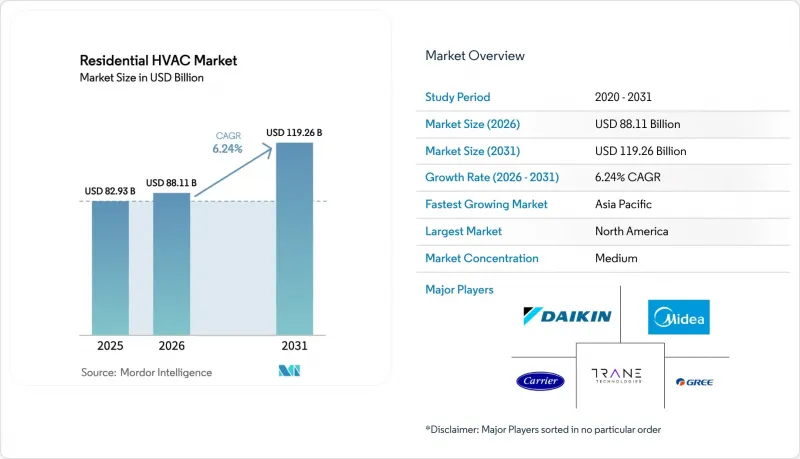
Mordor Intelligence에 따르면 주거용 HVAC 시장 규모는 2025년 829억 3,000만 달러에서 2026년에는 881억 1,000만 달러로 확대되고, 2026년부터 2031년까지 CAGR 6.24%를 기록하며 2031년에는 1,192억 6,000만 달러에 달할 것으로 예측됩니다.
본 보고서는 장비(냉방·환기 장비, 난방 장비), 기술(기존형, 저GWP 냉매 등), 설치 형태(신축, 개보수·교체), 주택 유형(단독주택, 공동주택·분양 아파트), 지역별로 분류되어 있습니다. 시장 예측은 금액(달러) 기준으로 제시되어 있습니다.
세계 주거용 HVAC 시장의 동향 및 인사이트
탈탄소화 의무화가 전기 히트 펌프 보급을 가속화
연방 정부의 세제 혜택 및 주 차원의 건축 기준에 따라 히트 펌프는 주거용 시장에서 주류로 자리 잡고 있습니다. 캘리포니아주의 2024 Title 24 요건과 워싱턴주의 1만 4,000달러 리베이트로 인해 소비자의 투자 회수 기간이 대폭 단축되었을 뿐만 아니라, 인플레이션 억제법에 따른 30% 세액 공제로 초기 비용의 최대 60%가 상쇄되고 있습니다. 기술의 발전으로 현재는 화씨 -20°F까지의 저온 환경에서도 작동이 가능해져, 기존에는 난방용 보일러가 주류를 이루던 북부 시장에서도 도입이 가능해졌습니다. 여러 주가 참여하는 공동 조달 컨소시엄이 수요를 집약함으로써, 1대당 제조 비용이 절감되고 있습니다. 연방 정부, 주 정부 및 전력 회사의 각 프로그램이 결합되어 다층적인 인센티브 체계가 형성되어 있으며, 천연가스 요금이 여전히 낮은 지역에서도 히트 펌프는 수명주기 비용 측면에서 가스식 난방로와 경쟁할 수 있는 입장에 있습니다. 각 제조사는 이처럼 확대되는 주거용 HVAC 시장의 기회를 포착하기 위해 한랭지용 압축기의 생산 규모를 확대하고 있습니다.
인버터 구동 가변 속도 압축기로의 전환
가변속 압축기는 고급 제품에서 주류 제품으로 전환되며, 주거용 HVAC 시장에서 다가올 효율 향상 붐의 기반이 되고 있습니다. Daikin과 Copeland의 합작 사업은 북미의 히트 펌프 용도를 목표로 하고 있는 반면, Lennox의 SL22KLV는 광범위한 용량 조절을 통해 21.1 SEER2 등급을 달성했습니다. 25-100% 범위의 출력 조절을 통해 사이클 손실이 감소하고 습도 제어가 향상되며, 단일 단계 유닛에 비해 에너지 소비량을 20-30% 절감할 수 있습니다. 전 세계 압축기 생산량의 95% 이상을 중국이 공급하고 있으며, OEM 제조업체에게는 조기 도입을 통한 비용상의 이점이 있습니다. 전력 회사는 수요를 실시간으로 조정할 수 있는 장비를 높이 평가하고 있으며, 신흥 수요 반응 시장을 통해 주택 소유자의 수익 향상에 기여하고 있습니다.
냉매 규제 및 단계적 감축 일정의 변동
EPA의 기술 전환 일정에 따라 OEM 및 시공업체는 A2L 안전 프로토콜을 준수하면서 두 종류의 냉매 재고를 동시에 관리해야 합니다. EU의 F-가스 규제의 차이로 인해 복잡성이 가중되어, AHRI 인증 절차 하에서는 제품 출시가 최대 12개월 지연될 가능성이 있습니다. R-32 또는 R-454B로의 전환에 따라 누출 감지 장비 및 기술자 교육 등, 유닛당 규정 준수 비용이 500-1,000달러가 소요됩니다. 전환기의 불확실성이 소비자 가격을 상승시키고, 공급망에 부담을 주며, 초기 단계의 수요를 둔화시키고 있습니다.
부문 분석
2025년 매출 중 냉방 및 환기 기기 분야가 60.12%를 차지했습니다. 신흥 경제국의 급속한 도시화, 기후 온난화 추세, 그리고 중산층의 소득 증가로 인해 에어컨 보급은 계속해서 확대되고 있습니다. 주거용 HVAC 시장에서 냉방 기기의 시장 규모는 가변 냉매 유량(VRF) 및 덕트리스 미니 스플릿 플랫폼이 단독주택 리모델링 공사 및 공동주택 프로젝트에 점차 보급됨에 따라 2031년까지 연평균 성장률(CAGR) 6.98%로 확대될 것으로 예측됩니다. 옥상 설치형 및 패키지형 시스템은 여전히 틈새 시장에 머물러 있지만, 중앙 집중식 관리가 비용 면에서 이점을 제공하는 조립식 주택이나 저층 공동 주택에서 이용되고 있습니다. 난방 기기에 대한 수요는 탈탄소화 의무화에 힘입어 전기 히트 펌프로 구조적인 전환을 이루고 있습니다. 한랭지용 모델은 현재 영하의 기온에도 대응할 수 있게 되어, 기존 가스식 난방기의 대상 시장은 축소되고 있습니다. 천연가스 인프라가 정착된 지역에서는 여전히 가스식 난방기가 교체 판매의 주류를 차지하고 있지만, 효율 기준을 충족하면서도 내구성을 유지하기 위한 과도기적 해결책으로서 히트 펌프와 가스식 난방기를 결합한 하이브리드 시스템의 도입이 대두되고 있습니다.
난방 기기 분야의 급속한 변화는 시너지 효과를 가져오는 전기화 정책과 직접적으로 연결되어 있습니다. 연방 정부의 보조금 덕분에 중가대 히트 펌프와 가스식 난방기의 초기 투자 비용이 동등해지면서, 주거용 HVAC 시장 내 점유율 전환이 가속화되고 있습니다. 각 OEM 업체들은 5년 이내에 비용이 동등해질 것으로 전망하며, 응축식 가스 기술에서 인버터 구동 히트 펌프 플랫폼으로 연구개발 자원을 재분배하고 있습니다. 차세대 수순환식 및 강제 송풍식 히트 펌프에 통합된 계통연계 기능은 이러한 제품의 차별화를 한층 더 촉진하고, 수요 조정 프로그램을 통해 지속적인 수익원을 개척하며, 초기 설비 이익을 넘어서는 부가가치를 창출하고 있습니다.
기존의 R 410A 및 구형 R 22 유닛은 여전히 설치 기반의 69.85%를 차지하고 있지만, 생산 및 수입에 대한 규제 상한선으로 인해 공급이 부족해지고 서비스 비용이 상승하고 있습니다. 그 결과 발생한 공급 부족으로 노후화된 시스템의 조기 교체가 가속화되고 있으며, 교체 수요는 낮은 GWP를 가진 대체 제품으로 이동하고 있습니다. R 32의 지구 온난화 지수(GWP)는 68% 더 낮기 때문에 제조업체는 하드웨어 변경을 최소화하면서 기존 생산 라인을 활용할 수 있어 보다 원활한 전환과 BOM(부품표) 비용 절감이 가능합니다. R 454B는 취급 요건이 추가되지만, 더 낮은 GWP를 실현하여 주거용 HVAC 시장에서 장기적인 규정 준수를 위한 길을 마련하고 있습니다.
저GWP 냉매 시스템은 2031년까지 연평균 성장률(CAGR) 7.32%를 기록할 것으로 예측됩니다. 각 OEM 업체들은 이러한 냉매를 인버터 구동 장치, 스마트 진단 기능, 클라우드 연동 제어 시스템과 결합하여 대당 매출을 향상시키고 있습니다. 밀봉 기술의 향상과 충전량 감소로 인해 가연성에 대한 우려가 완화되고 있습니다. 정속 압축기의 비중이 감소하는 가운데, 가변속 압축기의 도입으로 평균 판매 가격은 상승하는 반면, 전체 수명주기 동안의 운영 비용은 절감되어 규제 요건과 주택 소유자의 경제적 우선순위 모두를 충족시키고 있습니다.
지역별 분석
2025년 전 세계 매출액 중 북미가 37.55%를 차지했습니다. 인플레이션 억제법에 따른 연방 정부의 인센티브와 각 주의 리베이트가 맞물려, 2024년 11월까지 미국의 히트 펌프 판매 대수는 15% 급증했습니다. 캐나다의 연방 프로그램에서는 설치 건당 최대 5,000캐나다 달러(3,700달러)가 지급되며, 주 정부의 추가 보조금을 합치면 리베이트 총액이 2배가 될 가능성이 있습니다. 멕시코의 HVAC 수출액은 2024년에 76억 달러에 달하며, 이 지역의 공급망 통합이 강조되고 있습니다. 단독주택의 교체 수요는 여전히 활발하지만, 건축 성능 기준이 엄격해짐에 따라 공동주택의 전기화가 가속화되고 있습니다.
아시아태평양은 2031년까지 연평균 성장률(CAGR)이 6.82%로 가장 빠르게 성장하고 있는 지역입니다. 중국은 전 세계 히트 펌프 설치 대수의 약 30%를 차지하며, 압축기 생산능력의 95% 이상을 장악하고 있어, 이를 통해 적극적인 가격 책정과 신속한 제품 개량이 가능해졌습니다. 인도에서는 중산층의 부상과 심화되는 도시 지역의 열섬 현상이 에어컨 출하를 뒷받침하고 있으며, 정부 산하 에너지 효율국(Bureau of Energy Efficiency)의 규제가 신형 인버터 도입을 촉진하고 있습니다. 일본에서는 팬데믹으로 인한 수주 지체가 해소됨에 따라, 2024년 교체 시장은 연말까지 5%의 성장률로 회복되었습니다.
유럽은 단기적으로 혼란을 겪고 있습니다. 천연가스 가격의 침체와 건설 공사의 둔화로 인해 독일에서는 2024년 상반기 히트 펌프 판매 대수가 50% 감소했습니다. 그러나 3,000-1만 5,000유로의 보조금으로 뒷받침되는 REPowerEU의 목표인 2027년까지 주거용 히트 펌프를 1,000만 대 증설한다는 계획에 힘입어, 2025년 이후에는 두 자릿수 성장이 회복될 전망입니다. 이 지역의 개보수 잠재력은 여전히 막대하며, 건축 물량의 4분의 3 가까이가 현대적인 에너지 절약 기준이 제정되기 이전에 지어진 것입니다.
중동 및 아프리카에서는 냉방 수요가 주를 이루지만, 전기 요금 보조금 제도로 인해 고효율 모델의 보급은 더딘 편입니다. 그러나 걸프협력회의(GCC) 회원국의 전력 회사들은 성수기 전력망 부하를 완화하기 위해 고SEER(에너지 효율 비율) 제품에 대한 리베이트 제도를 시범적으로 도입하고 있으며, 이는 주거용 HVAC 시장에서 고급 냉방 제품의 향후 성장 여지를 시사합니다.
기타 혜택:
- 엑셀 형식의 시장 예측(ME) 시트
- 3개월간의 애널리스트 지원
자주 묻는 질문
목차
제1장 소개
제2장 조사 방법
제3장 주요 요약
제4장 시장 구도
제5장 시장 규모와 성장 예측
제6장 경쟁 구도
제7장 시장 기회와 향후 전망
KSM 26.09.03According to Mordor Intelligence, the residential HVAC market size is expected to grow from USD 82.93 billion in 2025 to USD 88.11 billion in 2026 and is forecast to reach USD 119.26 billion by 2031 at 6.24% CAGR over 2026-2031.
This report is Segmented by Equipment (Cooling and Ventilation Equipment and Heating Equipment), Technology (Conventional, Low-GWP Refrigerants, and More), Installation Type (New Construction and Retrofit and Replacement), Housing Type (Single-Family Homes and Multi-Family Apartments and Condominiums), and Geography. The Market Forecasts are Provided in Terms of Value (USD).
Global Residential HVAC Market Trends and Insights
Decarbonization Mandates Accelerating Electric-Heat-Pump Adoption
Federal tax incentives and state-level building codes are pushing heat pumps into mainstream residential applications. California's 2024 Title 24 requirements and Washington's USD 14,000 rebates have slashed consumer payback periods, while the Inflation Reduction Act's 30% credit offsets up-front costs by as much as 60%. Technology enhancements now enable operation down to -20 °F, allowing deployment in historically furnace-dominant northern markets. Multi-state procurement coalitions aggregate demand, reducing per-unit manufacturing costs. Combined federal, state, and utility programs create a layered incentive stack that positions heat pumps as lifecycle-cost-competitive with gas furnaces even where natural-gas tariffs remain low. Manufacturers are scaling cold-climate compressors to capture this expanding residential HVAC market opportunity.
Shift Toward Inverter-Driven Variable-Speed Compressors
Variable-speed compressors have migrated from premium to mainstream status, underpinning the next wave of efficiency gains in the residential HVAC market. Daikin's joint venture with Copeland targets North American heat-pump applications, while Lennox's SL22KLV achieves a 21.1 SEER2 rating through wide-range capacity modulation. Modulation between 25-100% reduces cycling losses, improves humidity control, and cuts energy use by 20-30% compared with single-stage units. China supplies more than 95% of global compressor output, granting OEMs early-access cost advantages. Utilities value equipment that can throttle demand in real time, enhancing homeowner earnings via emerging demand-response markets.
Volatility in Refrigerant Regulations and Phasedown Schedules
EPA Technology Transition timelines require OEMs and contractors to juggle dual refrigerant inventories while navigating A2L safety protocols. Divergent EU F-Gas rules amplify complexity, delaying product launches by up to 12 months under AHRI certification processes. The switch to R 32 or R 454B drives unit-level compliance costs of USD 500-1,000 for leak-detection hardware and technician training. Transitional uncertainty inflates consumer prices and strains supply chains, slowing early-cycle demand.
Other drivers and restraints analyzed in the detailed report include:
- Surge in Home-Improvement and Retrofit Cycles Post-Pandemic
- Growing Penetration of Smart Thermostats and IoT-Enabled HVAC Controls
- Up-Front Cost Premium of High-Efficiency Equipment
For complete list of drivers and restraints, kindly check the Table Of Contents.
Segment Analysis
Cooling and ventilation captured 60.12% of 2025 revenue. Strong urbanization, warmer climate trends, and rising middle-class incomes in emerging economies continue to lift air-conditioning adoption. The residential HVAC market size for cooling equipment is projected to expand at a 6.98% CAGR through 2031 as variable-refrigerant flow and ductless mini-split platforms penetrate single-family retrofits and multi-family projects. Rooftop and packaged systems remain niche but serve manufactured housing and low-rise multi-family complexes where centralized maintenance offers cost advantages. Heating-equipment demand is undergoing a structural shift toward electric heat pumps, reinforced by decarbonization mandates. Cold-climate models now handle sub-zero temperatures, shrinking the addressable market for legacy gas furnaces. Furnaces still dominate replacement sales in regions with entrenched natural-gas infrastructure, but hybrid heat-pump/furnace installations are emerging as transitional solutions to meet efficiency codes while maintaining resilience.
The heating segment's rapid transformation is directly tied to electrification policy stacking. Federal rebates equalize capital outlays between mid-tier heat pumps and gas furnaces, accelerating the share shift within the residential HVAC market. OEMs are reallocating R&D resources from condensing gas technology toward inverter-driven heat-pump platforms, anticipating cost parity within five years. Grid-interactive capabilities embedded in next-generation hydronic and forced-air heat pumps further differentiate these products, opening recurring revenue streams via demand-flexibility programs and extending value beyond upfront equipment margins.
Conventional R 410A and legacy R 22 units still represent 69.85% of the installed base, yet regulatory caps on production and imports are tightening supply and inflating service costs. The resulting scarcity is propelling accelerated retirement of aging systems, shifting replacement demand toward low-GWP alternatives. R 32's 68% lower global-warming potential allows manufacturers to leverage existing production lines with minimal hardware changes, supporting smoother transitions and lighter bill-of-materials. R 454B introduces additional handling requirements but offers even lower GWP, aligning long-term compliance paths in the residential HVAC market.
Low-GWP refrigerant systems are forecast to post a 7.32% CAGR through 2031. OEMs are bundling these refrigerants with inverter drives, smart diagnostics, and cloud-integrated controls, elevating per-unit revenue. Enhanced sealing technology and lower charge volumes mitigate flammability concerns. As fixed-speed compressors decline, variable-speed adoption lifts average selling prices yet reduces lifecycle operational costs, dovetailing with both regulatory and homeowner economic priorities.
Complete Report Scope:
- By Equipment
- Cooling and Ventilation Equipment
- Ducted Split Systems
- Ductless Split Systems
- VRF Systems
- Air-Handling Units
- Rooftops and Fan-Coils
- Heating Equipment
- Furnaces and Boilers
- Heat Pumps
- Cooling and Ventilation Equipment
- By Technology
- Conventional (R410A/R22)
- Low-GWP Refrigerants (R32, R454B, CO2, Propane)
- Fixed-speed
- Inverter / Variable-speed
- Smart / Connected
- By Installation Type
- New Construction
- Retrofit / Replacement
- By Housing Type
- Single-family Homes
- Multi-family Apartments and Condominiums
- By Geography
- North America
- United States
- Canada
- Mexico
- South America
- Brazil
- Argentina
- Rest of South America
- Europe
- United Kingdom
- Germany
- France
- Italy
- Spain
- Nordics
- Benelux
- Eastern Europe
- Russia
- Rest of Europe
- Asia Pacific
- China
- Japan
- India
- South Korea
- Australia and New Zealand
- ASEAN
- Rest of Asia Pacific
- Middle East and Africa
- Middle East
- Saudi Arabia
- United Arab Emirates
- Turkey
- Rest of Middle East
- Africa
- South Africa
- Nigeria
- Rest of Africa
- Middle East
- North America
Geography Analysis
North America represented 37.55% of 2025 global revenue. Federal incentives under the Inflation Reduction Act, combined with state rebates, drove a 15% surge in U.S. heat-pump sales by November 2024. Canadian federal programs provide up to CAD 5,000 (USD 3,700) per installation, while provincial add-ons can double total rebate values. Mexico's HVAC export output reached USD 7.6 billion in 2024, underscoring the region's supply-chain integration. Single-family replacement demand remains vigorous, but multi-family electrification is accelerating as building performance standards tighten.
Asia Pacific is the fastest-growing region with a 6.82% CAGR through 2031. China accounts for roughly 30% of global heat-pump installations and controls more than 95% of compressor production capacity, enabling aggressive pricing and rapid product iterations. India's rising middle-class and blistering urban heat islands propel air-conditioning shipments, while governmental Bureau of Energy Efficiency regulations drive new inverter adoption. Japan's 2024 replacement market returned to 5% growth by year-end as pandemic backlogs cleared.
Europe faces near-term turbulence. Low natural-gas prices and construction slowdowns slashed first-half 2024 heat-pump sales by 50% in Germany. Yet REPowerEU's target of 10 million additional residential heat pumps by 2027, supported by grants of EUR 3,000-15,000, is poised to restore double-digit growth from 2025 onward. The region's retrofit potential remains vast as nearly three-quarters of building stock predates modern efficiency codes.
The Middle East and Africa exhibit cooling-dominant demand yet slower penetration of high-efficiency models due to subsidized electricity tariffs. Nevertheless, Gulf Cooperation Council utilities are piloting high-SEER rebate schemes to curb peak-season grid stress, signaling future upside for premium cooling products in the residential HVAC market.
- Daikin Industries, Ltd.
- Carrier Global Corporation
- Trane Technologies plc
- Lennox International Inc.
- Johnson Controls International plc
- Robert Bosch GmbH
- Mitsubishi Electric Corporation
- Systemair AB
- TROX GmbH
- Hitachi, Ltd.
- Blue Star Limited
- Swegon AB
- Ariston Holding NV
- Danfoss A/S
- Alfa Laval AB
- Vaillant GmbH
- Rheem Manufacturing Company
- Samsung Electronics Co., Ltd.
- LG Electronics Inc.
- Panasonic Holdings Corporation
- Fujitsu General Limited
- Gree Electric Appliances, Inc.
- Midea Group Co., Ltd.
- Nortek Global HVAC, LLC
- Viessmann Climate Solutions SE
- Glen Dimplex Group
Additional Benefits:
- The market estimate (ME) sheet in Excel format
- 3 months of analyst support
TABLE OF CONTENTS
1 INTRODUCTION
- 1.1 Study Assumptions and Market Definition
- 1.2 Scope of the Study
2 RESEARCH METHODOLOGY
3 EXECUTIVE SUMMARY
4 MARKET LANDSCAPE
- 4.1 Market Overview
- 4.2 Market Drivers
- 4.2.1 Decarbonisation mandates accelerating electric-heat-pump adoption
- 4.2.2 Shift toward inverter-driven variable-speed compressors
- 4.2.3 Surge in home-improvement and retrofit cycles post-pandemic
- 4.2.4 Growing penetration of smart thermostats and IoT-enabled HVAC controls
- 4.2.5 Grid-interactive efficient buildings (GEB) incentives from utilities
- 4.2.6 Home electrification financing models (PACE, on-bill) gaining traction
- 4.3 Market Restraints
- 4.3.1 Volatility in refrigerant regulations and phasedown schedules
- 4.3.2 Up-front cost premium of high-efficiency equipment
- 4.3.3 Skilled-labour shortage for proper installation and commissioning
- 4.3.4 Electrical-service upgrade constraints in legacy housing stock
- 4.4 Industry Value Chain Analysis
- 4.5 Regulatory Landscape
- 4.6 Technological Outlook
- 4.7 Porter's Five Forces Analysis
- 4.7.1 Bargaining Power of Suppliers
- 4.7.2 Bargaining Power of Buyers
- 4.7.3 Threat of New Entrants
- 4.7.4 Threat of Substitute Products
- 4.7.5 Intensity of Competitive Rivalry
- 4.8 Impact of Macroeconomic Factors
- 4.9 Investment Analysis
5 MARKET SIZE AND GROWTH FORECASTS (VALUE)
- 5.1 By Equipment
- 5.1.1 Cooling and Ventilation Equipment
- 5.1.1.1 Ducted Split Systems
- 5.1.1.2 Ductless Split Systems
- 5.1.1.3 VRF Systems
- 5.1.1.4 Air-Handling Units
- 5.1.1.5 Rooftops and Fan-Coils
- 5.1.2 Heating Equipment
- 5.1.2.1 Furnaces and Boilers
- 5.1.2.2 Heat Pumps
- 5.1.1 Cooling and Ventilation Equipment
- 5.2 By Technology
- 5.2.1 Conventional (R410A/R22)
- 5.2.2 Low-GWP Refrigerants (R32, R454B, CO2, Propane)
- 5.2.3 Fixed-speed
- 5.2.4 Inverter / Variable-speed
- 5.2.5 Smart / Connected
- 5.3 By Installation Type
- 5.3.1 New Construction
- 5.3.2 Retrofit / Replacement
- 5.4 By Housing Type
- 5.4.1 Single-family Homes
- 5.4.2 Multi-family Apartments and Condominiums
- 5.5 By Geography
- 5.5.1 North America
- 5.5.1.1 United States
- 5.5.1.2 Canada
- 5.5.1.3 Mexico
- 5.5.2 South America
- 5.5.2.1 Brazil
- 5.5.2.2 Argentina
- 5.5.2.3 Rest of South America
- 5.5.3 Europe
- 5.5.3.1 United Kingdom
- 5.5.3.2 Germany
- 5.5.3.3 France
- 5.5.3.4 Italy
- 5.5.3.5 Spain
- 5.5.3.6 Nordics
- 5.5.3.7 Benelux
- 5.5.3.8 Eastern Europe
- 5.5.3.9 Russia
- 5.5.3.10 Rest of Europe
- 5.5.4 Asia Pacific
- 5.5.4.1 China
- 5.5.4.2 Japan
- 5.5.4.3 India
- 5.5.4.4 South Korea
- 5.5.4.5 Australia and New Zealand
- 5.5.4.6 ASEAN
- 5.5.4.7 Rest of Asia Pacific
- 5.5.5 Middle East and Africa
- 5.5.5.1 Middle East
- 5.5.5.1.1 Saudi Arabia
- 5.5.5.1.2 United Arab Emirates
- 5.5.5.1.3 Turkey
- 5.5.5.1.4 Rest of Middle East
- 5.5.5.2 Africa
- 5.5.5.2.1 South Africa
- 5.5.5.2.2 Nigeria
- 5.5.5.2.3 Rest of Africa
- 5.5.5.1 Middle East
- 5.5.1 North America
6 COMPETITIVE LANDSCAPE
- 6.1 Market Concentration
- 6.2 Strategic Moves
- 6.3 Market Share Analysis
- 6.4 Company Profiles (includes Global level Overview, Market level overview, Core Segments, Financials as available, Strategic Information, Market Rank/Share for key companies, Products and Services, and Recent Developments)
- 6.4.1 Daikin Industries, Ltd.
- 6.4.2 Carrier Global Corporation
- 6.4.3 Trane Technologies plc
- 6.4.4 Lennox International Inc.
- 6.4.5 Johnson Controls International plc
- 6.4.6 Robert Bosch GmbH
- 6.4.7 Mitsubishi Electric Corporation
- 6.4.8 Systemair AB
- 6.4.9 TROX GmbH
- 6.4.10 Hitachi, Ltd.
- 6.4.11 Blue Star Limited
- 6.4.12 Swegon AB
- 6.4.13 Ariston Holding NV
- 6.4.14 Danfoss A/S
- 6.4.15 Alfa Laval AB
- 6.4.16 Vaillant GmbH
- 6.4.17 Rheem Manufacturing Company
- 6.4.18 Samsung Electronics Co., Ltd.
- 6.4.19 LG Electronics Inc.
- 6.4.20 Panasonic Holdings Corporation
- 6.4.21 Fujitsu General Limited
- 6.4.22 Gree Electric Appliances, Inc.
- 6.4.23 Midea Group Co., Ltd.
- 6.4.24 Nortek Global HVAC, LLC
- 6.4.25 Viessmann Climate Solutions SE
- 6.4.26 Glen Dimplex Group
7 MARKET OPPORTUNITIES AND FUTURE OUTLOOK
- 7.1 White-space and Unmet-Need Assessment