

|
시장보고서
상품코드
2119653
mPOS 단말기 : 시장 점유율 분석, 업계 동향과 통계, 성장 예측(2026-2031년)MPOS Terminals - Market Share Analysis, Industry Trends & Statistics, Growth Forecasts (2026 - 2031) |
||||||
 Mordor Intelligence
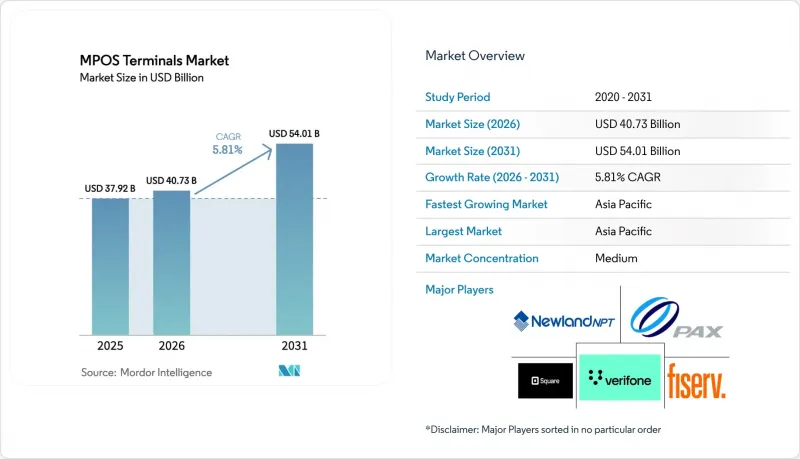
Mordor Intelligence에 따르면 mPOS 단말기 시장 규모는 2025년 379억 2,000만 달러, 2026년 407억 3,000만 달러에서 2031년까지 540억 1,000만 달러로 확대되고, 2026년부터 2031년까지 CAGR 5.81%를 기록할 것으로 예측됩니다.
본 보고서는 기기 유형(IC 칩 및 PIN, IC 칩 및 서명, 비접촉식/NFC, 마그네틱 스트라이프 전용, 생체 인증 지원), 결제 방식(접촉식, 비접촉식), 최종사용자 산업(소매, 호스피탈리티, 의료, 운송·물류, 기타), 도입 형태(온프레미스, 클라우드형·SaaS), 및 지역별로 분류되어 있습니다. 시장 예측은 금액(달러) 기준으로 제시되어 있습니다.
세계 mPOS 단말기 시장의 동향 및 인사이트
저비용 카드 결제 단말기의 보급
50달러 미만의 엔트리 레벨 리더 단말기의 등장으로, 이전에는 현금 결제만 가능했던 노점상, 팝업 소매업체, 긱 경제 근로자들도 결제 시스템을 도입할 수 있게 되었습니다. Square, SumUp, PayPal Zettle은 모두 50달러 미만의 동글 단말기를 라인업하고 있으며, 아시아태평양의 수탁 제조업체들은 현재 공장 인도 가격(FOB) 기준으로 30달러 미만의 화이트 라벨 단말기를 공급하고 있어, 인도의 2선 도시 및 동남아시아의 비공식 소매 부문으로의 침투를 가속화하고 있습니다. 단말기의 상품화(commoditization)로 인해 각 업체들은 분석 대시보드, 로열티 프로그램 통합, 내장형 금융 서비스와 같은 수익성이 높은 구독 서비스로 사업을 전환해야 하는 상황에 직면해 있으며, 하드웨어 매출 총이익에 대한 의존도는 낮아지고 있습니다. ISO 20022 메시징 표준 및 EMVCo 사양에 따라 상호 운용성이 보장되고 벤더 종속성이 해소됨에 따라 가격 경쟁이 격화되고 있습니다.
비접촉 결제 및 전자 지갑으로의 소비자 전환 가속화
아일랜드에서는 2025년 상반기, 판매 시점 정보 관리(POS) 거래액의 58.2%를 모바일 지갑이 차지했으며, 영국에서는 2024년 카드 결제 중 92%가 탭 결제였습니다. 가맹점 입장에서는 15초의 탭 조작이 30-45초의 PIN 입력 대신 이루어짐에 따라, 패스트푸드점에서는 대기 줄이 줄어들고 인건비도 절감됩니다. 호스피탈리티 업계에서는 테이블 옆 NFC 단말기를 도입함으로써 계산대로 이동할 필요가 없어져, 테이블 회전율이 10-15% 향상되었다고 보고되고 있습니다. mPOS 공급업체에게 있어 이점은 비접촉식 하드웨어 교체 수요가 가속화된다는 점입니다. 다만, 이와 유사한 소비자 선호에 따라 SoftPOS도 실용화되고 있어, 보급형 단말기 판매에 하방 압력이 가해지고 있습니다.
부상하는 Tap-on-Phone(스마트폰 터치 결제)형 SoftPOS가 전용 mPOS 하드웨어의 수요를 잠식하고 있다
Stripe의 소프트웨어 전용 SDK, Apple의 Tap to Pay, 그리고 Adyen 및 Worldline이 제공하는 Android용 SoftPOS는 소규모 사업자에게 50-150달러의 하드웨어 구매 비용을 없애주고, 기존 스마트폰을 전용 단말기 대신 활용할 수 있게 해줍니다. 월간 거래 건수가 100건 미만인 초소규모 사업자나 계절성 영업 업체의 경우, 설비 투자(CAPEX)가 필요 없는 도입 방식이 특히 매력적입니다. 유럽 내 SoftPOS 보급률은 2027년까지 신규 가맹점 계정의 15-20%에 달할 가능성이 있어, 엔트리 레벨 단말기 수요를 잠식하게 될 것입니다. 기존 벤더들은 스마트폰으로는 재현할 수 없는 프린터, 고객용 디스플레이, 생체 인증 리더기를 갖춘 고정형 단말기를 강조하며 대응하고 있지만, 낮은 마진과 높은 판매량을 보이는 부문에서는 이미 소프트웨어로의 전환이 진행되고 있습니다.
부문 분석
2025년 현재, IC 칩 및 PIN은 mPOS 단말기 시장 점유율의 36.89%를 차지하고 있으며, 규제 환경 하에서 확고하게 자리 잡은 모습을 보여주고 있습니다. 한편, PSD2에 따라 인증 기준이 강화됨에 따라 생체 인증 리더는 2031년까지 연평균 성장률(CAGR) 9.13%를 기록하며, 유럽 전역에서 지문 인증 및 얼굴 인증 단말기에 대한 수요를 뒷받침하고 있습니다. 따라서 가맹점이 차지백을 줄이고 데이터 보호 규정을 준수하기 위해 30-40% 더 높은 단가를 감수함에 따라, 생체 인증 기기에 할당되는 mPOS 단말기 시장 규모는 다른 분야에 비해 현저히 확대되고 있습니다. 기능이 제한된 마그네틱 스트라이프형이나 IC 칩 전용 모델은 현재 주로 EMV 전환이 지연되고 있는 국가에서 극히 일부의 틈새 시장을 차지하는 데 그치고 있습니다. 시간이 지남에 따라 단말기 간의 경쟁은 인터페이스 기술에서 인증의 고도화로 이동하고 있으며, FIDO 인증을 받은 센서와 개인정보 보호 알고리즘이 제품의 차별화 요인으로 부상하고 있습니다.
이러한 프리미엄 지향의 고조로 인해, 베트남 단말기에 지문 센서를 도입한 Next Biometrics나 아랍에미리트에서 얼굴 인증 결제 시스템의 시범 운영을 실시한 PopID와 같은 전문 공급업체들이 주목을 받고 있습니다. 기존 벤더들은 시장 점유율을 지키기 위해 유사한 모듈을 통합하고 있는 반면, 소프트웨어 플랫폼 분야에서는 생체 인증 기능을 연령 확인이나 셀프 체크아웃과 같은 부가가치 기능과 연계하고 있습니다. 부정 발생률이 낮은 환경에서 비용을 중시하는 가맹점은 여전히 IC 칩 및 PIN 방식을 채택하고 있지만, 고액 거래가 이루어지는 업계에서는 보안과 사용자 경험의 균형을 맞추기 위해 생체 인증 기능을 탑재한 모델로의 전환이 진행되고 있습니다.
2025년에도 접촉식 거래의 점유율은 76.67%를 유지했으나, 비접촉식 거래의 취급액은 연평균 성장률(CAGR) 8.34%로 확대되고 있으며, 이는 mPOS 단말기 시장 전체 성장률의 약 1.5배에 해당합니다. 탭 결제 지원 카드나 모바일 지갑에 대한 소비자의 친숙도는 전환점에 도달했으며, 그 대표적인 예로 2024년 캐나다에서 발생한 34억 건의 모바일 비접촉 거래와 영국의 92%에 달하는 탭 이용률을 들 수 있습니다. 경쟁을 피하기 위해 가맹점들은 단말기 교체 주기를 앞당겨 NFC 지원 모델로의 전환을 가속화하거나, 스마트폰의 내장 안테나를 활용하는 SoftPOS를 도입하고 있습니다.
이러한 전환을 뒷받침하는 것은 속도와 편의성입니다. 비접촉 결제의 처리 시간은 평균 15초인 반면, PIN 입력은 최대 45초가 소요되므로 소매업 및 호스피탈리티 업계에서는 대기 시간 단축과 처리 능력 향상으로 이어집니다. 주유소나 고액 티켓 판매 등 규정 준수상의 이유로 접촉식 결제를 유지하는 업계도 있지만, 모바일 지갑 생태계가 사용자 참여도를 높이는 로열티, 쿠폰, 디지털 ID 기능을 확충해 감에 따라 비접촉 결제의 성장 우위는 더욱 확대될 것으로 예상됩니다.
지역별 분석
아시아태평양은 2025년에 전 세계 매출의 29.41%를 차지하고, 2031년까지 연평균 성장률(CAGR) 6.02%를 기록할 것으로 예측되며, 이는 다른 어떤 지역보다 빠른 성장률입니다. 이러한 성장의 원동력은 2024년 12월 167억 3,000만 건의 거래를 기록한 인도의 UPI와, 태국, 말레이시아, 인도네시아의 가맹점이 새로운 하드웨어를 도입하지 않고도 QR코드를 통해 중국인 관광객의 결제를 받을 수 있도록 하는 중국의 Alipay Plus입니다. 일본과 한국에서는 규제 철폐에 앞서 마그네틱 스트라이프에서 NFC로의 전환이 진행되고 있는 반면, 호주에서는 탭앤고(Tap & Go) 결제 보급률이 95%를 초과하고 있습니다. 인도와 인도네시아의 지방 지역에서는 광대역 보급률이 40% 미만에 그치고 있으며, 방글라데시와 베트남에서는 전력 공급이 불안정하여 상시 접속형 도입이 제한되고 있습니다.
북미는 시장 규모 면에서 2위를 차지하고 있습니다. 이 지역에서는 EMV에 따른 책임 전가가 조기에 시행되었기 때문에 하드웨어 업그레이드가 선행되어 왔으며, 현재 수요는 기존 단말기를 비접촉식이나 생체 인증 지원 모델로 교체하는 데 집중되고 있습니다. 2024년 캐나다에서 발생한 34억 건의 모바일 비접촉 결제는 소비자 보급률이 높음을 보여주고 있으며, 멕시코에서는 핀테크 주도의 가맹점 확보가 진행되어 추가적인 성장 여지가 생기고 있습니다. 성장은 꾸준하지만, 시장의 성숙도와 기존의 높은 보급률을 반영하여 아시아태평양에는 미치지 못하는 상황입니다.
유럽의 동향은 PSD2의 강력한 고객 인증에 좌우되고 있습니다. 이로 인해 SoftPOS가 엔트리 레벨 시장을 잠식하고 있음에도 불구하고, 고급 하드웨어의 교체가 촉진되고 있습니다. 프랑스나 독일 등의 시장에서는 면제 기준을 충족하기 위해 단말기에 지문 센서를 사후 장착하고 있는 반면, 소규모 가맹점은 설비 투자를 피하기 위해 스마트폰 기반 결제 도입을 추진하고 있습니다. 남미는 2024년에 400억 건 이상의 송금 실적을 기록한 브라질의 즉시결제 시스템 ‘Pix’에 힘입어 QR코드 결제가 POS 소프트웨어에 직접 통합되고 있습니다. 중동은 아랍에미리트(UAE)의 스마트 시티 투자와 사우디아라비아의 ‘비전 2030’의 혜택을 받고 있는 반면, 아프리카는 전력 공급 제약으로 인해 강력한 모바일 머니 생태계가 존재함에도 불구하고 오프라인을 우선시하는 하이브리드 방식의 도입을 선택할 수밖에 없습니다.
기타 혜택:
- 엑셀 형식의 시장 예측(ME) 시트
- 3개월간의 애널리스트 지원
자주 묻는 질문
목차
제1장 소개
제2장 조사 방법
제3장 주요 요약
제4장 시장 구도
제5장 시장 규모와 성장 예측
제6장 경쟁 구도
제7장 시장 기회와 향후 전망
KSM 26.09.03According to Mordor Intelligence, the mPOS terminals market size is projected to expand from USD 37.92 billion in 2025 and USD 40.73 billion in 2026 to USD 54.01 billion by 2031, registering a 5.81% CAGR between 2026 to 2031.
This report is Segmented by Device Type (Chip and PIN, Chip and Signature, Contactless/NFC, Magnetic-Stripe-Only, and More), Mode of Payment (Contact-Based, and Contactless), End-User Industry (Retail, Hospitality, Healthcare, Transportation and Logistics, and More), Deployment Mode (On-Premise, and Cloud-Based and SaaS), and Geography. The Market Forecasts are Provided in Terms of Value (USD).
Global MPOS Terminals Market Trends and Insights
Ubiquity of Low-Cost Card Acceptance Hardware
Entry-level readers priced below USD 50 have unlocked acceptance for street vendors, pop-up retailers, and gig-economy workers that previously operated on cash alone. Square, SumUp, and PayPal Zettle all list sub-USD 50 dongles, and Asia-Pacific contract manufacturers now supply white-label units at under USD 30 ex-works, accelerating penetration into India's tier-2 cities and Southeast Asia's informal retail sector. Device commoditization is forcing vendors to pivot toward higher-margin subscriptions for analytics dashboards, loyalty integration, and embedded financing, reducing reliance on hardware gross profit. ISO 20022 messaging and EMVCo specifications guarantee interoperability, stripping away vendor lock-in and sharpening price competition.
Accelerating Consumer Shift to Contactless and E-Wallet Payments
Ireland logged mobile wallets at 58.2% of point-of-sale value during H1 2025, and 92% of U.K. card payments were tap-to-pay in 2024. For merchants, a 15-second tap replaces a 30-45-second PIN entry, shrinking queues and labor costs in quick-service restaurants. Hospitality venues report 10-15% faster table turns when tableside NFC terminals remove trips to a cashier station. The upside for MPOS vendors is an accelerated replacement wave for contactless-capable hardware, although the same consumer preference also makes SoftPOS viable, applying downward pressure on entry-level device sales.
Emerging Tap-on-Phone SoftPOS Cannibalizing Dedicated MPOS Hardware
Stripe's software-only SDK, Apple Tap to Pay, and Android SoftPOS from Adyen and Worldline eliminate the USD 50-150 hardware purchase for small merchants, substituting existing smartphones for separate terminals. Micro-merchants and seasonal vendors processing fewer than 100 transactions a month are particularly drawn to zero-capex onboarding. European SoftPOS adoption could reach 15-20% of new merchant accounts by 2027, eroding entry-level device demand. Incumbent vendors are countering by emphasizing countertop units with printers, customer displays, and biometric readers that smartphones cannot replicate, but the low-margin high-volume segment is already migrating toward software.
Other drivers and restraints analyzed in the detailed report include:
- On-Device Tap to Phone Certification Unlocking Smartphone-as-POS Solutions
- Rapid Rollout of Value-Add Analytics for Micro-Merchants
- Costly Migration to PCI MPoC and PCI v6 Compliance
For complete list of drivers and restraints, kindly check the Table Of Contents.
Segment Analysis
Chip-and-PIN held 36.89% of the MPOS terminals market share in 2025, underscoring its entrenchment in regulated environments. Biometric readers, however, are recording a 9.13% CAGR to 2031 after PSD2 raised authentication thresholds, fueling demand for fingerprint or facial recognition terminals across Europe. The MPOS terminals market size allocated to biometric devices therefore rises disproportionately as merchants absorb 30-40% higher unit prices to reduce chargebacks and align with data-protection rules. Low-feature magnetic-stripe and chip-only models now occupy a residual niche, mainly in countries with delayed EMV migration. Over time, device competition is shifting from interface technology toward authentication sophistication, with FIDO-certified sensors and privacy-preserving algorithms emerging as product differentiators.
The premium emphasis is attracting specialized suppliers such as Next Biometrics, which deployed fingerprint sensors in Vietnamese terminals, and PopID, which piloted facial-auth payment systems in the United Arab Emirates. Established vendors are integrating similar modules to defend share, while software platforms tie biometric readiness to value-add features like age verification and self-checkout. Cost-sensitive merchants in low-fraud environments stick with chip-and-PIN, while higher-ticket verticals migrate toward biometric-embedded models to balance security and user experience.
Contact-based transactions retained 76.67% share in 2025, yet contactless volume is expanding at an 8.34% CAGR, nearly 1.5 times the overall MPOS terminals market growth. Consumer familiarity with tap-to-pay cards and mobile wallets has reached a tipping point, exemplified by Canada's 3.4 billion mobile contactless transactions in 2024 and the United Kingdom's 92% tap rate. To remain competitive, merchants are accelerating terminal refresh cycles toward NFC-enabled models or adopting SoftPOS that leverages the built-in antenna on smartphones.
Speed and convenience drive this migration. Contactless swipes average 15 seconds versus up to 45 seconds for PIN entry, translating into shorter queues and higher throughput in retail and hospitality. While compliance-driven verticals such as fuel or high-value ticketing will sustain contact-based methods, the growth premium for contactless is expected to keep widening as mobile wallet ecosystems expand loyalty, coupon, and digital-identity features that deepen user engagement.
Complete Report Scope:
- By Device Type
- Chip and PIN
- Chip and Signature
- Contactless and NFC
- Magnetic-Stripe-Only
- Biometric-Enabled
- By Mode of Payment
- Contact-based
- Contactless
- By End-User Industry
- Retail
- Hospitality
- Healthcare
- Transportation and Logistics
- Other End-User Industries
- By Deployment Mode
- On-Premise
- Cloud-Based and SaaS
- By Geography
- North America
- United States
- Canada
- Mexico
- South America
- Brazil
- Argentina
- Rest of South America
- Europe
- Germany
- United Kingdom
- France
- Italy
- Spain
- Rest of Europe
- Asia-Pacific
- China
- Japan
- India
- South Korea
- Southeast Asia
- Rest of Asia-Pacific
- Middle East
- Saudi Arabia
- United Arab Emirates
- Rest of Middle East
- Africa
- South Africa
- Egypt
- Rest of Africa
- North America
Geography Analysis
Asia-Pacific contributed 29.41% of global revenue in 2025 and is forecast to post a 6.02% CAGR through 2031, the fastest of any region. Momentum stems from India's UPI, which recorded 16.73 billion transactions in December 2024, and China's Alipay Plus, which lets Thai, Malaysian, and Indonesian merchants accept payments from Chinese visitors via QR code without new hardware. Japan and South Korea are migrating from magnetic stripe to NFC ahead of regulatory sunsets, while Australia's tap-and-go penetration tops 95%. Rural broadband in India and Indonesia hovers below 40%, and inconsistent electricity in Bangladesh and Vietnam limits always-on deployment.
North America ranks second in size. The region's early EMV liability shift front-loaded hardware upgrades, so current demand revolves around replacing legacy units with contactless and biometric models. Canada's 3.4 billion mobile contactless payments in 2024 showcase the consumer uptake, and Mexico's fintech-driven merchant onboarding adds incremental headroom. Growth is steady but trails Asia-Pacific, reflecting market maturity and high existing penetration.
Europe's trajectory hinges on PSD2 Strong Customer Authentication, which is driving premium hardware refresh even as SoftPOS cannibalizes entry tiers. Markets such as France and Germany are retrofitting terminals with fingerprint sensors to meet exemption thresholds, while micro-merchants adopt smartphone-based acceptance to avoid capital outlays. South America is propelled by Brazil's Pix instant-payment system that exceeded 40 billion transfers in 2024, integrating QR acceptance directly into point-of-sale software. The Middle East benefits from smart-city investments in the United Arab Emirates and Saudi Arabia's Vision 2030, whereas Africa remains constrained by power availability, forcing hybrid offline-first deployments despite strong mobile-money ecosystems.
- Block Inc. (Square)
- Fiserv Inc. (Clover)
- VeriFone Inc.
- PAX Technology Ltd.
- Newland Payment Technology
- BBPOS Ltd.
- SumUp Payments Ltd.
- PayPal Zettle
- Adyen N.V.
- Lightspeed Commerce Inc.
- Shopify Inc. (Shop POS)
- Toast Inc.
- NCR Voyix Corp.
- HP Development Company L.P.
- NEC Corporation
- Panasonic Holdings Corp.
- Spectra Technologies India Pvt Ltd.
- Posiflex Technology Inc.
- Oracle Micros Systems
- North American Bancard (PayAnywhere)
- Yoco Technologies Pty Ltd.
- myPOS World Ltd.
Additional Benefits:
- The market estimate (ME) sheet in Excel format
- 3 months of analyst support
TABLE OF CONTENTS
1 INTRODUCTION
- 1.1 Study Assumptions and Market Definition
- 1.2 Scope of the Study
2 RESEARCH METHODOLOGY
3 EXECUTIVE SUMMARY
4 MARKET LANDSCAPE
- 4.1 Market Overview
- 4.2 Market Drivers
- 4.2.1 Ubiquity of Low-Cost Card Acceptance Hardware
- 4.2.2 Accelerating Consumer Shift to Contactless and E-Wallet Payments
- 4.2.3 On-Device Tap to Phone Certification Unlocking Smartphone-as-POS Solutions
- 4.2.4 Rapid Rollout of Value-Add Analytics for Micro-Merchants
- 4.2.5 Biometric SCA Mandates Under PSD2 Boosting Hardware Refresh
- 4.2.6 In-Store BNPL Enablement Requiring MPOS Firmware Upgrades
- 4.3 Market Restraints
- 4.3.1 Patchy Broadband and Power in Rural Markets
- 4.3.2 Persistent Security and Fraud Concerns
- 4.3.3 Emerging Tap-on-Phone SoftPOS Cannibalizing Dedicated MPOS Hardware
- 4.3.4 Costly Migration to PCI MPoC and PCI v6 Compliance
- 4.4 Industry Value Chain Analysis
- 4.5 Regulatory Landscape
- 4.6 Technological Outlook
- 4.7 Impact of Macroeconomic Factors on the Market
- 4.8 Porter's Five Forces Analysis
- 4.8.1 Bargaining Power of Buyers
- 4.8.2 Bargaining Power of Suppliers
- 4.8.3 Threat of New Entrants
- 4.8.4 Threat of Substitutes
- 4.8.5 Intensity of Competitive Rivalry
5 MARKET SIZE AND GROWTH FORECASTS (VALUE)
- 5.1 By Device Type
- 5.1.1 Chip and PIN
- 5.1.2 Chip and Signature
- 5.1.3 Contactless and NFC
- 5.1.4 Magnetic-Stripe-Only
- 5.1.5 Biometric-Enabled
- 5.2 By Mode of Payment
- 5.2.1 Contact-based
- 5.2.2 Contactless
- 5.3 By End-User Industry
- 5.3.1 Retail
- 5.3.2 Hospitality
- 5.3.3 Healthcare
- 5.3.4 Transportation and Logistics
- 5.3.5 Other End-User Industries
- 5.4 By Deployment Mode
- 5.4.1 On-Premise
- 5.4.2 Cloud-Based and SaaS
- 5.5 By Geography
- 5.5.1 North America
- 5.5.1.1 United States
- 5.5.1.2 Canada
- 5.5.1.3 Mexico
- 5.5.2 South America
- 5.5.2.1 Brazil
- 5.5.2.2 Argentina
- 5.5.2.3 Rest of South America
- 5.5.3 Europe
- 5.5.3.1 Germany
- 5.5.3.2 United Kingdom
- 5.5.3.3 France
- 5.5.3.4 Italy
- 5.5.3.5 Spain
- 5.5.3.6 Rest of Europe
- 5.5.4 Asia-Pacific
- 5.5.4.1 China
- 5.5.4.2 Japan
- 5.5.4.3 India
- 5.5.4.4 South Korea
- 5.5.4.5 Southeast Asia
- 5.5.4.6 Rest of Asia-Pacific
- 5.5.5 Middle East
- 5.5.5.1 Saudi Arabia
- 5.5.5.2 United Arab Emirates
- 5.5.5.3 Rest of Middle East
- 5.5.6 Africa
- 5.5.6.1 South Africa
- 5.5.6.2 Egypt
- 5.5.6.3 Rest of Africa
- 5.5.1 North America
6 COMPETITIVE LANDSCAPE
- 6.1 Market Concentration
- 6.2 Strategic Moves
- 6.3 Market Share Analysis
- 6.4 Company Profiles (includes Global Level Overview, Market Level Overview, Core Segments, Financials as available, Strategic Information, Market Rank/Share, Products and Services, Recent Developments)
- 6.4.1 Block Inc. (Square)
- 6.4.2 Fiserv Inc. (Clover)
- 6.4.3 VeriFone Inc.
- 6.4.4 PAX Technology Ltd.
- 6.4.5 Newland Payment Technology
- 6.4.6 BBPOS Ltd.
- 6.4.7 SumUp Payments Ltd.
- 6.4.8 PayPal Zettle
- 6.4.9 Adyen N.V.
- 6.4.10 Lightspeed Commerce Inc.
- 6.4.11 Shopify Inc. (Shop POS)
- 6.4.12 Toast Inc.
- 6.4.13 NCR Voyix Corp.
- 6.4.14 HP Development Company L.P.
- 6.4.15 NEC Corporation
- 6.4.16 Panasonic Holdings Corp.
- 6.4.17 Spectra Technologies India Pvt Ltd.
- 6.4.18 Posiflex Technology Inc.
- 6.4.19 Oracle Micros Systems
- 6.4.20 North American Bancard (PayAnywhere)
- 6.4.21 Yoco Technologies Pty Ltd.
- 6.4.22 myPOS World Ltd.
7 MARKET OPPORTUNITIES AND FUTURE OUTLOOK
- 7.1 White-Space and Unmet-Need Assessment


