

|
시장보고서
상품코드
2119670
이식형 제세동기 : 시장 점유율 분석, 업계 동향과 통계, 성장 예측(2026-2031년)Implantable Defibrillators - Market Share Analysis, Industry Trends & Statistics, Growth Forecasts (2026 - 2031) |
||||||
 Mordor Intelligence
Mordor Intelligence에 따르면 2026년 이식형 제세동기(ICD) 시장 규모는 47억 6,000만 달러로 추정되며, 2025년 45억 2,000만 달러에서 확대되어 2031년에는 61억 9,000만 달러에 달할 것으로 예측됩니다.
2026년부터 2031년까지 연평균 성장률(CAGR) 5.38%로 성장할 것으로 전망됩니다.
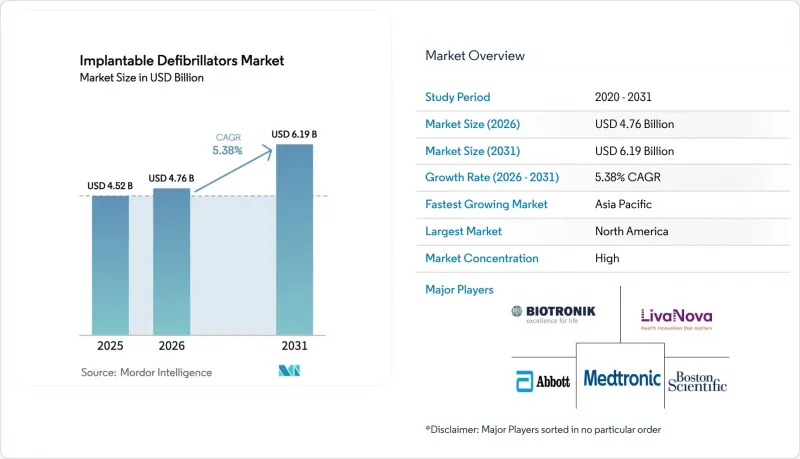
본 보고서는 제품 유형(경정맥형 ICD, 피하 이식형 ICD, 혈관외/리드리스형 ICD), 최종사용자(병원·심장 센터, 외래 수술 센터 등), 환자 유형(성인, 소아), 및 지역(북미, 유럽, 아시아태평양, 중동 및 아프리카, 남미)별로 분류되어 있습니다. 시장 예측은 금액(달러) 기준으로 제시되어 있습니다.
세계 이식형 제세동기 시장의 동향 및 인사이트
부정맥 유병률 증가와 SCD 위험
전 세계적인 고령화와 심근경색 후 생존율 향상으로 인해, 갑작스러운 심장사 위험에 노출된 인구가 증가하고 있습니다. 미국에서는 매년 약 40만 명이 심정지에 빠지고 있으며, 생존율은 여전히 10% 전후에 머물러 있습니다. 지침에 뒷받침된 근거에 따라, 박출률이 저하된 심부전 환자군에서 예방적 ICD 사용이 권장되고 있으며, 임상의들은 가족력이나 유전적 마커를 활용하여 조기 선별 검사를 실시하도록 권장받고 있습니다. 그 결과, 1차 예방을 목적으로 한 이식이 가장 빠르게 성장하는 적응증이 되었으며, 이식형 제세동기 시장 전체에 걸쳐 지속적인 수요가 확보되고 있습니다.
지속적인 소형화 및 배터리 수명 향상
Boston Scientific사의 EnduraLife 배터리는 1.9 Ah의 용량을 자랑하며, 예상 수명을 17.5년으로 연장하는 동시에 교체 수술 횟수를 40% 줄여줍니다. 수명 연장은 수혜자 1인당 1만 5,120달러의 메디케어 비용 절감으로 이어져, 의료 시스템 내에서 프리미엄 플랫폼에 대한 선호도를 높이고 있습니다. 또한 소형화를 통해 피하 이식이 가능해져, 이전에는 환자의 15%에게 영향을 미치던 리드 관련 합병증을 피할 수 있습니다.
엄격한 규제 장벽과 제품 리콜
2024년에 발생한 메드트로닉(Medtronic)의 코발트(Cobalt) 및 보스턴 사이언티픽(Boston Scientific)의 EMBLEM 리콜은 10만 대 이상의 기기에 영향을 미쳤으며, FDA의 사이버 보안 강화 요구를 초래했을 뿐만 아니라 승인 주기를 최대 18개월까지 연장시켰습니다. 많은 중소기업들은 규정 준수 비용이 25% 급증한 것을 감당하는 데 어려움을 겪고 있으며, 이로 인해 단기적인 제품 공급이 위축되고 도입 의욕이 꺾이고 있습니다.
부문 분석
2025년에는 경정맥형 시스템이 70.92%의 점유율을 유지했으나, 의료진이 리드리스(전극선 없음) 이식을 적극적으로 채택함에 따라 피하 이식형 기기는 2031년까지 연평균 성장률(CAGR) 6.44%를 기록하고 있습니다. PRAETORIAN 임상시험에서는 리드와 관련된 합병증이 적고, 충격 효과도 동등한 것으로 확인되었습니다. 그 결과, 피하 이식형 플랫폼의 이식형 제세동기(ICD) 시장 규모는 성숙한 경정맥형 부문보다 빠르게 확대되고 있습니다.
혈관 외/리드리스형 설계는 새로운 가능성을 열어주고 있습니다. Medtronic사의 Aurora EV-ICD는 2024년에 FDA 승인을 획득했으며, 리드리스의 안전성과 페이싱 기능을 겸비하고 있습니다. 적절한 쇼크 성공률이 95%에 달하고 시술 시간도 단축됨에 따라, 혈관외형 시스템은 기존 두 카테고리에서 시장 점유율을 빼앗을 뿐만 아니라 이식형 제세동기 시장 전체의 회복력을 높일 것으로 전망됩니다.
지역별 분석
북미의 42.11% 시장 점유율은 보편적인 보험 환급 제도와 전기생리학 전문가가 밀집해 있는 데 기인합니다. 그러나 보험사가 비용 대비 효과에 대한 증거를 요구하고, 조달 방침을 장수명 배터리 및 견고한 사이버 보안 감사로 전환하고 있어 시장 확대는 완만해지고 있습니다.
유럽은 2위를 차지하고 있으며, 지속가능성을 중시하고 있습니다. 심장학회가 생분해성 소재와 재활용 워크플로우를 권장하고 있어, 이것이 구매 기준에 영향을 미치고 환경 친화적인 설계 요건을 조성하고 있습니다. 다양한 보험 환급 모델로 인해 보급 현황은 편차를 보이고 있지만, CE 마킹의 통일로 인해 여러 국가에서의 출시가 가속화되고 있습니다.
아시아태평양은 연평균 성장률(CAGR) 7.02%의 속도로 성장하고 있으며, 가장 큰 성장 잠재력을 지니고 있습니다. 일본은 프리미엄 제품 도입을 주도하고 있지만, 인도 등 인구가 많은 국가에서는 주로 경제적 격차와 전기생리학 분야의 인력 부족으로 인해 임상적 필요성에 비해 이식률이 10-20분의 1 수준에 그치고 있습니다. 정부 주도의 연수 및 현지 생산 장려 정책을 통해 이러한 격차 해소가 도모되고 있으며, 궁극적으로는 이식형 제세동기(ICD) 시장의 확대로 이어질 것으로 전망됩니다.
기타 혜택:
- 엑셀 형식의 시장 예측(ME) 시트
- 3개월간의 애널리스트 지원
자주 묻는 질문
목차
제1장 소개
제2장 조사 방법
제3장 주요 요약
제4장 시장 구도
제5장 시장 규모와 성장 예측
제6장 경쟁 구도
제7장 시장 기회와 향후 전망
KSM 26.09.03According to Mordor Intelligence, implantable cardioverter defibrillator market size in 2026 is estimated at USD 4.76 billion, growing from 2025 value of USD 4.52 billion with 2031 projections showing USD 6.19 billion, growing at 5.38% CAGR over 2026-2031.
This report is Segmented by Product Type (Transvenous ICDs, Subcutaneous ICDs, Extravascular/Leadless ICDs), End User (Hospitals & Cardiac Centers, Ambulatory Surgical Centers, and More), Patient Type (Adults, Pediatrics), and Geography (North America, Europe, Asia-Pacific, Middle East & Africa, South America). The Market Forecasts are Provided in Terms of Value (USD).
Global Implantable Defibrillators Market Trends and Insights
Rising Prevalence of Cardiac Arrhythmias & SCD Risk
Global aging and higher post-infarction survival have enlarged the population vulnerable to sudden cardiac death. Roughly 400,000 U.S. residents suffer cardiac arrest each year, and survival remains close to 10% . Guideline-backed evidence supports prophylactic ICD use in heart-failure cohorts with reduced ejection fraction, pushing clinicians to screen earlier using family history and genetic markers. As a result, primary-prevention implants constitute the fastest-growing indication, ensuring sustained demand across the implantable cardioverter defibrillator market.
Continuous Miniaturization & Battery-Longevity Improvements
Boston Scientific's EnduraLife cell delivers 1.9 Ah, extending projected service lives to 17.5 years and cutting replacement procedures by 40% . Longer life translates to Medicare savings of USD 15,120 per recipient, reinforcing health-system preference for premium platforms. Miniaturization also supports subcutaneous placement, avoiding lead complications that previously affected 15% of patients.
Stringent Regulatory Hurdles & Product Recalls
Medtronic's Cobalt and Boston Scientific's EMBLEM recalls in 2024 affected more than 100,000 devices, triggering FDA demands for tighter cybersecurity and lengthening approval cycles by up to 18 months . Smaller firms struggle to absorb the 25% compliance-cost spike, which restrains near-term product flow and tempers adoptive enthusiasm.
Other drivers and restraints analyzed in the detailed report include:
- Wider Adoption of MRI-Conditional & Connected ICDs
- "Shock-Less" ICD Algorithms Easing Patient Anxiety
- High Device & Follow-Up Costs in Low-Income Settings
For complete list of drivers and restraints, kindly check the Table Of Contents.
Segment Analysis
Transvenous systems maintained 70.92% dominance in 2025, yet subcutaneous devices are clocking a 6.44% CAGR through 2031 as practitioners embrace lead-free implantation. The PRAETORIAN trial confirmed equal shock efficacy with fewer lead-related complications. The implantable cardioverter defibrillator market size for subcutaneous platforms is therefore expanding faster than the mature transvenous segment.
Extravascular and leadless designs add another frontier. Medtronic's Aurora EV-ICD received FDA clearance in 2024, combining lead-free safety with pacing capability. Appropriate shock success reached 95% and reduced procedural time, positioning extravascular systems to siphon share from both incumbent categories while elevating overall implantable cardioverter defibrillator market resilience.
Complete Report Scope:
- By Product Type
- Transvenous ICDs
- Single-Chamber ICD
- Dual-Chamber ICD
- Cardiac Resynchronization Therapy-Defibrillator (CRT-D)
- Subcutaneous ICDs (S-ICD)
- Extravascular / Leadless ICDs
- Transvenous ICDs
- By End User
- Hospitals & Cardiac Centers
- Ambulatory Surgical Centers
- Specialty Clinics
- Home-care / Remote Monitoring Programs
- By Patient Type
- Adults
- Pediatrics
- By Geography
- North America
- United States
- Canada
- Mexico
- Europe
- Germany
- United Kingdom
- France
- Italy
- Spain
- Rest of Europe
- Asia-Pacific
- China
- Japan
- India
- Australia
- South Korea
- Rest of Asia-Pacific
- Middle East & Africa
- GCC
- South Africa
- Rest of Middle East & Africa
- South America
- Brazil
- Argentina
- Rest of South America
- North America
Geography Analysis
North America's 42.11% share stems from universal reimbursement and a dense electrophysiology workforce. Yet market expansion moderates as insurers demand evidence of cost efficacy, pivoting procurement toward extended-life batteries and robust cybersecurity audits.
Europe ranks second and emphasizes sustainability: cardiac societies endorse biodegradable materials and recycling workflows, influencing purchasing criteria and cultivating eco-centric design mandates. Diverse reimbursement models create fragmented uptake, but harmonized CE-marking accelerates multi-country launches.
Asia-Pacific, paced by 7.02% CAGR, offers the deepest runway. Japan leads premium adoption, while populous nations such as India exhibit implant rates 10-20-fold below clinical need, mainly due to affordability gaps and limited electrophysiology talent. Government-sponsored training and local manufacturing incentives aim to narrow the disparity, ultimately broadening the implantable cardioverter defibrillator market footprint.
- Medtronic
- Boston Scientific
- Abbott Laboratories (St. Jude)
- BIOTRONIK
- MicroPort CRM (MicroPort Scientific)
- LivaNova
- Integer Holdings Corp.
- Lepu Medical Technology Co.
- Shree Pacetronix
- Medico S.p.A.
- OSYPKA
- Sorin Group (legacy)
- Greatbatch Medical
- Jingjing Medical Equipment
- EBR Systems
- EBR Extravascular Solutions
- CathRx Ltd.
Additional Benefits:
- The market estimate (ME) sheet in Excel format
- 3 months of analyst support
TABLE OF CONTENTS
1 Introduction
- 1.1 Study Assumptions & Market Definition
- 1.2 Scope of the Study
2 Research Methodology
3 Executive Summary
4 Market Landscape
- 4.1 Market Overview
- 4.2 Market Drivers
- 4.2.1 Rising Prevalence Of Cardiac Arrhythmias & SCD Risk
- 4.2.2 Continuous Miniaturization & Battery-Longevity Improvements
- 4.2.3 Wider Adoption Of Mri-Conditional & Connected LCDS
- 4.2.4 "Shock-Less Icd" Algorithms Easing Patient Anxiety
- 4.2.5 Extravascular/Leadless ICD Trial Success Expanding Eligibility
- 4.2.6 AI-Driven Predictive Analytics Boosting Prophylactic Implants
- 4.3 Market Restraints
- 4.3.1 Stringent Regulatory Hurdles & Product Recalls
- 4.3.2 High Device & Follow-Up Costs In Low-Income Settings
- 4.3.3 Cyber-Security Concerns With Wireless ICD Telemetry
- 4.3.4 Rise Of Catheter-Ablation Curbing Implant Growth
- 4.4 Value / Supply-Chain Analysis
- 4.5 Regulatory Landscape
- 4.6 Technological Outlook
- 4.7 Porter's Five Forces Analysis
- 4.7.1 Bargaining Power of Suppliers
- 4.7.2 Bargaining Power of Buyers
- 4.7.3 Threat of New Entrants
- 4.7.4 Threat of Substitutes
- 4.7.5 Competitive Rivalry
5 Market Size & Growth Forecasts (Value, USD)
- 5.1 By Product Type
- 5.1.1 Transvenous ICDs
- 5.1.1.1 Single-Chamber ICD
- 5.1.1.2 Dual-Chamber ICD
- 5.1.1.3 Cardiac Resynchronization Therapy-Defibrillator (CRT-D)
- 5.1.2 Subcutaneous ICDs (S-ICD)
- 5.1.3 Extravascular / Leadless ICDs
- 5.1.1 Transvenous ICDs
- 5.2 By End User
- 5.2.1 Hospitals & Cardiac Centers
- 5.2.2 Ambulatory Surgical Centers
- 5.2.3 Specialty Clinics
- 5.2.4 Home-care / Remote Monitoring Programs
- 5.3 By Patient Type
- 5.3.1 Adults
- 5.3.2 Pediatrics
- 5.4 By Geography
- 5.4.1 North America
- 5.4.1.1 United States
- 5.4.1.2 Canada
- 5.4.1.3 Mexico
- 5.4.2 Europe
- 5.4.2.1 Germany
- 5.4.2.2 United Kingdom
- 5.4.2.3 France
- 5.4.2.4 Italy
- 5.4.2.5 Spain
- 5.4.2.6 Rest of Europe
- 5.4.3 Asia-Pacific
- 5.4.3.1 China
- 5.4.3.2 Japan
- 5.4.3.3 India
- 5.4.3.4 Australia
- 5.4.3.5 South Korea
- 5.4.3.6 Rest of Asia-Pacific
- 5.4.4 Middle East & Africa
- 5.4.4.1 GCC
- 5.4.4.2 South Africa
- 5.4.4.3 Rest of Middle East & Africa
- 5.4.5 South America
- 5.4.5.1 Brazil
- 5.4.5.2 Argentina
- 5.4.5.3 Rest of South America
- 5.4.1 North America
6 Competitive Landscape
- 6.1 Market Concentration
- 6.2 Market Share Analysis
- 6.3 Company Profiles (includes Global level Overview, Market level overview, Core Segments, Financials as available, Strategic Information, Market Rank/Share for key companies, Products & Services, and Recent Developments)
- 6.3.1 Medtronic plc
- 6.3.2 Boston Scientific Corp.
- 6.3.3 Abbott Laboratories (St. Jude)
- 6.3.4 Biotronik SE & Co. KG
- 6.3.5 MicroPort CRM (MicroPort Scientific)
- 6.3.6 LivaNova PLC
- 6.3.7 Integer Holdings Corp.
- 6.3.8 Lepu Medical Technology Co.
- 6.3.9 Shree Pacetronix Ltd.
- 6.3.10 Medico S.p.A.
- 6.3.11 Osypka AG
- 6.3.12 Sorin Group (legacy)
- 6.3.13 Greatbatch Medical
- 6.3.14 Jingjing Medical Equipment
- 6.3.15 EBR Systems
- 6.3.16 EBR Extravascular Solutions
- 6.3.17 CathRx Ltd.
7 Market Opportunities & Future Outlook
- 7.1 White-space & Unmet-Need Assessment


