|
시장보고서
상품코드
2119707
퍼블릭 클라우드 시장 : 점유율 분석, 업계 동향과 통계, 성장 예측(2026-2031년)Public Cloud - Market Share Analysis, Industry Trends & Statistics, Growth Forecasts (2026 - 2031) |
||||||
 Mordor Intelligence
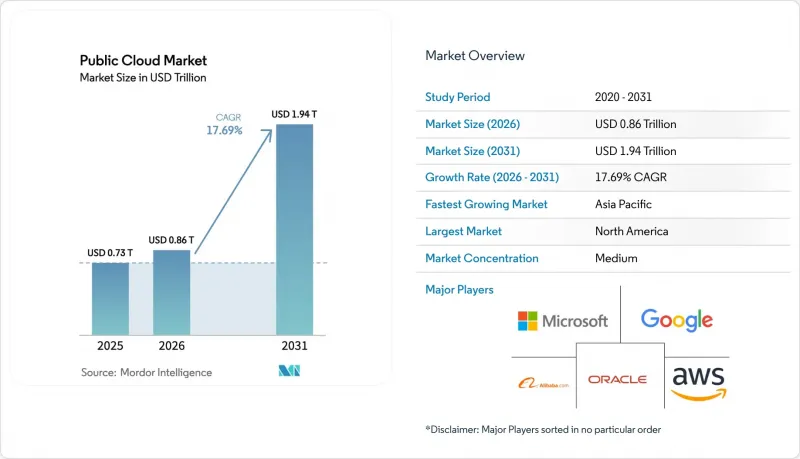
Mordor Intelligence에 의하면, 2026년 퍼블릭 클라우드 시장 규모는 8,600억 달러로 추정되고 있어 2025년 7,300억 달러에서 확대해, 2031년에는 1조 9,400억 달러에 이를 것으로 예측됩니다.
2026년부터 2031년까지의 연평균 성장률(CAGR)은 17.69%가 될 것으로 전망됩니다.
본 보고서는 도입 형태(Software-As-A-Service(SaaS), Platform-As-A-Service(PaaS), Infrastructure-As-A-Service(IaaS)), 조직 규모(중소기업 및 대기업), 최종 사용자 산업(은행, 금융서비스 및 보험(BFSI), 헬스케어 및 생명과학,정부·공공 부문, 제조업, IT 및 통신, 기타) 및 지역별로 분류되어 있습니다. 시장 전망은 금액(달러) 기준으로 제시되어 있습니다.
세계 퍼블릭 클라우드 시장 동향 및 인사이트
AI 주도 워크로드 전환 붐
제조업, 은행업, 의료 업계의 조직들은 파일럿 단계를 넘어 생산 환경 규모의 AI로 전환하고 있으며, 이는 퍼블릭 클라우드 시장으로의 대규모 이전을 가속화하고 있습니다. BMW는 6,000개의 용도를 클라우드 인프라상의 SAP S/4HANA로 이전했으며, JPMorgan Chase는 연간 170억 달러의 기술 예산 하에 1엑사바이트의 데이터를 AWS로 이전했습니다. 2024년에는 제조업체의 93%가 새로운 AI 프로젝트를 시작했으며, 이는 클라우드 호스팅형 AI가 더 이상 실험이 아니라 전략적 필수 요건이 되었음을 입증합니다.
GenAI에 최적화된 칩 공급 확대
NVIDIA, 소프트뱅크, 그리고 일본 정부는 전 세계적인 부품 부족 문제에 대응하기 위해 국내 AI 데이터센터에 공동 투자하고 있습니다. 한편, 미국의 하이퍼스케일 기업들은 마더보드와 프로세서 공급을 확보하기 위해 수십억 규모의 자본을 투입하고 있습니다. AWS는 칩 부족이 2024년 4분기 매출의 발목을 잡고 있음을 인정하면서도, 2026년까지 새로운 팹 및 패키징 시설이 가동됨에 따라 공급 제약이 완화될 것으로 전망하고 있습니다.
데이터 주권을 둘러싼 조각보 같은 상황
EU의 GDPR(EU 개인정보보호규정)이나 미국의 CLOUD법과 같은 상충되는 법령으로 인해 다국적 기업들은 지역별로 스토리지를 중복해서 마련할 수밖에 없어, 운영 비용 증가와 국경을 넘는 분석 파이프라인의 지연을 초래하고 있습니다. 마찬가지로 중국의 사이버 보안법도 ‘중요 데이터’를 현지에서 격리해야 하는 외국 기업들에게 규정 준수상의 마찰을 가중시키고 있습니다.
부문 분석
2025년에는 SaaS가 퍼블릭 클라우드 시장 점유율의 55.60%를 차지한 반면, PaaS는 2031년까지 연평균 성장률(CAGR) 19.08%로 성장할 전망입니다. 기업들은 ‘SaaS 우선’ 단계에서 PaaS로 전환하여, 기반 인프라를 관리하지 않고도 독자적인 AI 서비스를 구축하고 있습니다. 유럽에서는 통합 환경에 대한 개발자들 수요로 인해 PaaS가 IaaS(Infrastructure-as-a-Service)를 앞지르고 있습니다. 지멘스가 Teamcenter PLM과 Microsoft Azure를 결합한 사례는 제조 워크플로우에 AI를 통합하는 데 있어 PaaS가 수행하는 역할을 여실히 보여줍니다. 로우코드 플랫폼이 개발 주기를 단축함에 따라 PaaS의 퍼블릭 클라우드 시장 규모는 급속히 확대될 것으로 예상되는 반면, SaaS는 도메인 특화형 용도를 통해 성장 속도는 둔화되고 있지만 계속해서 확대될 전망입니다.
IaaS(Infrastructure-as-a-Service)는 리프트 앤 시프트(lift-and-shift) 방식의 마이그레이션에서 여전히 중요한 위치를 차지하고 있으며, 아직 컨테이너화할 수 없는 레거시 워크로드를 처리하고 있습니다. 예측 기간 동안 기업들이 패키지 소프트웨어보다 맞춤형 ML 모델을 선호할 경우, PaaS가 SaaS 시장 점유율을 잠식할 가능성이 있습니다. 그러나 CRM, HCM, 협업 분야에서의 높은 SaaS 보급률로 인해 SaaS는 퍼블릭 클라우드 시장의 주요 수익원으로 자리매김할 것입니다.
지역별 분석
북미는 하이퍼스케일 기업의 본사, 벤처 생태계, 그리고 성숙한 기업의 지출 패턴에 힘입어 2025년에도 43.75%의 점유율을 차지하는 최대 지역으로 남을 것입니다. 그러나 전자제품에 최대 34%의 관세가 도입될 예정이어서 제조 비용이 증가할 위험이 있으며, 마이크로소프트 등 사업자들은 확장 계획 협의를 연기할 수밖에 없는 상황입니다. 연방 정부의 클라우드 예산은 증가하고 있으며, 2025 회계연도에는 83억 달러가 편성되어 인플레이션으로 인한 부정적 영향을 일부 상쇄하고 있습니다. 재무부만 해도 클라우드에 대한 예산 배정을 전년 대비 4배로 늘려 공공 부문의 확고한 수요를 뒷받침하고 있습니다.
아시아태평양은 성장 속도가 두드러지며, 2031년까지 연평균 성장률(CAGR) 18.12%를 나타낼 것으로 예측됩니다. AWS는 일본의 인프라 구축에 2조 2,600억 엔(151억 달러)을 투자하겠다고 약속했으며, 마이크로소프트는 AI 데이터센터에 29억 달러를 지출하고 있습니다. 도쿄도의 ‘경제안보촉진법’은 1억 달러 규모의 GenAI 슈퍼컴퓨터 비용의 절반을 보조하고 있으며, 이는 계산 자원을 확보하려는 정부의 의지를 반영하고 있습니다. 아시아개발은행(ADB)의 조사에 따르면, 클라우드는 GDP의 최대 2.23%를 차지하고 있으며, 정책 개혁을 통해 2028년까지 0.7%의 성장이 예상됩니다.
유럽에서는 DORA 등 더 엄격한 데이터 거주지 관련 법규가 도입되어 다국적 기업의 사업 전개가 복잡해지고 있지만, 규정 준수에 능숙한 지역 업체들에게는 명확한 지침이 되고 있습니다. 규제가 있음에도 불구하고, 유럽의 클라우드 서비스 시장은 연평균 성장률(CAGR) 23.1%로 확대되어 2028년까지 1,104억 유로에 달할 전망이지만, 미국 벤더들은 여전히 72%의 점유율을 차지하고 있습니다. 남미, 중동 및 아프리카는 아직 발전 단계에 있지만 전략적으로 중요한 시장이며, 충족되지 않은 디지털 전환 수요를 흡수하기 위해 선구적인 인프라 구축이 진행되고 있습니다.
기타 혜택:
- 엑셀 형식 시장 예측(ME) 시트
- 3개월간의 애널리스트 지원
자주 묻는 질문
목차
제1장 서론
제2장 조사 방법
제3장 개요
제4장 시장 구도
제5장 시장 규모와 성장 예측
제6장 경쟁 구도
제7장 시장 기회와 향후 전망
JHS 26.09.03According to Mordor Intelligence, public cloud market size in 2026 is estimated at USD 0.86 trillion, growing from 2025 value of USD 0.73 trillion with 2031 projections showing USD 1.94 trillion, growing at 17.69% CAGR over 2026-2031.
This report is Segmented by Deployment (Software-As-A-Service (SaaS), Platform-As-A-Service (PaaS), and Infrastructure-As-A-Service (IaaS)), Organization Size (Small and Medium Enterprises, and Large Enterprises), End-User Industry (BFSI, Healthcare and Life Sciences, Government and Public Sector, Manufacturing, IT and Telecom, and More), and Geography. The Market Forecasts are Provided in Terms of Value (USD).
Global Public Cloud Market Trends and Insights
AI-led workload migration boom
Manufacturing, banking, and healthcare organizations have moved beyond pilots to production-scale AI, propelling wholesale shifts into the public cloud market. BMW migrated 6,000 applications to SAP S/4HANA on cloud infrastructure, and JPMorgan Chase transferred 1 exabyte of data to AWS under a USD 17 billion annual technology budget. Ninety-three percent of manufacturers launched fresh AI projects in 2024, confirming that cloud-hosted AI is now a strategic imperative rather than an experiment.
GenAI-optimized chip supply ramp-up
NVIDIA, SoftBank, and the Japanese government are co-funding domestic AI datacenters to counter global component shortages, while U.S. hyperscale's commit double-digit-billion capital to secure motherboard and processor supply. AWS acknowledged chip scarcity as a drag on Q4 2024 revenue yet expects new fabs and packaging facilities to ease constraints by 2026.
Data-sovereignty patchwork
Conflicting statutes such as the EU GDPR and U.S. CLOUD Act force multinationals to duplicate storage across regions, hiking operational costs and slowing cross-border analytics pipelines. China's Cybersecurity Law similarly raises compliance friction for foreign firms that must isolate "important data" locally.
Other drivers and restraints analyzed in the detailed report include:
- Hyperscale price-performance wars
- Sovereign-cloud mandates
- GPU/optics supply bottlenecks
For complete list of drivers and restraints, kindly check the Table Of Contents.
Segment Analysis
PaaS will grow at 19.08% CAGR through 2031, even as SaaS held 55.60% public cloud market share in 2025. Enterprises graduate from a SaaS-first phase into PaaS to build proprietary AI services without managing underlying infrastructure. In Europe, developer demand for integrated environments has pushed PaaS ahead of Infrastructure-as-a-Service. Siemens' pairing of Teamcenter PLM with Microsoft Azure underscores PaaS's role in embedding AI into manufacturing workflows. The public cloud market size for PaaS is expected to surge as low-code platforms shrink development cycles, while SaaS continues to experience expansive albeit slower growth through domain-specific applications.
Infrastructure-as-a-Service retains steady relevance for lift-and-shift migrations, serving legacy workloads that cannot yet be containerized. Over the forecast, PaaS may erode SaaS' share where firms favor custom ML models over packaged software. Yet SaaS' ubiquity in CRM, HCM, and collaboration ensures it remains the revenue anchor of the public cloud market.
Complete Report Scope:
- By Deployment
- Software-as-a-Service (SaaS)
- Platform-as-a-Service (PaaS)
- Infrastructure-as-a-Service (IaaS)
- By Organisation Size
- Small and Medium Enterprises (SMEs)
- Large Enterprises
- By End-user Industry
- BFSI
- Healthcare and Life Sciences
- Government and Public Sector
- Manufacturing
- IT and Telecom
- Other End-user Industries
- By Geography
- North America
- South America
- Europe
- Asia-Pacific
- Middle East
- Africa
Geography Analysis
North America remains the largest region with 43.75% share in 2025, anchored by hyperscale headquarters, venture ecosystems, and mature enterprise spending patterns. However, pending tariffs of up to 34% on electronics risk inflating build costs, pushing operators like Microsoft to delay expansion talks. Federal cloud budgets are climbing, USD 8.3 billion earmarked for FY 2025, offsetting some inflationary drag. Treasury alone lifted its cloud allocation fourfold year-over-year, underscoring unwavering public-sector appetite.
Asia-Pacific is the velocity story, projected to grow 18.12% CAGR through 2031. AWS pledged JPY 2.26 trillion (USD 15.1 billion) for Japanese buildouts, while Microsoft is spending USD 2.9 billion on AI datacenters. Tokyo's Economic Security Promotion Act subsidizes half of a USD 100 million GenAI supercomputer, reflecting sovereign determination to secure compute. The Asian Development Bank finds cloud contributes up to 2.23% of GDP, with policy reform able to add 0.7 percentage-point growth by 2028.
Europe navigates stricter data-residency statutes such as DORA, complicating multinational rollouts but offering clarity for regional players adept at compliance. Despite regulation, continental cloud services are set for 23.1% CAGR to reach EUR 110.4 billion by 2028, although U.S. vendors still hold 72% share. South America, the Middle East, and Africa remain nascent yet strategic, attracting first-mover builds to capture unmet digital transformation demand.
- Amazon Web Services Inc.
- Microsoft Corporation (Azure)
- Google LLC (Google Cloud)
- Alibaba Cloud
- Oracle Corporation
- IBM Corporation
- Tencent Cloud
- Salesforce Inc.
- SAP SE
- Adobe Inc.
- VMware Inc.
- Huawei Cloud
- OVHcloud
- DigitalOcean Holdings Inc.
- Rackspace Technology Inc.
- Linode (Akamai)
- Hetzner Online GmbH
- Snowflake Inc.
- Workday Inc.
- ServiceNow Inc.
Additional Benefits:
- The market estimate (ME) sheet in Excel format
- 3 months of analyst support
TABLE OF CONTENTS
1 INTRODUCTION
- 1.1 Study Assumptions and Market Definition
- 1.2 Scope of the Study
2 RESEARCH METHODOLOGY
3 EXECUTIVE SUMMARY
4 MARKET LANDSCAPE
- 4.1 Market Overview
- 4.2 Market Drivers
- 4.2.1 AI-led workload migration boom
- 4.2.2 GenAI - optimised chip supply ramp-up
- 4.2.3 Hyperscaler price-performance wars
- 4.2.4 Sovereign-cloud mandates (under-reported)
- 4.2.5 Green datacentre tax credits
- 4.2.6 "Cloud-adjacent" AI accelerators demand
- 4.3 Market Restraints
- 4.3.1 Data-sovereignty patch-work
- 4.3.2 Escalating cloud egress fees
- 4.3.3 GPU/optics supply bottlenecks
- 4.3.4 Rising datacentre water-use scrutiny
- 4.4 Regulatory Landscape
- 4.5 Technological Outlook
- 4.6 Porter's Five Forces Analysis
- 4.6.1 Bargaining Power of Suppliers
- 4.6.2 Bargaining Power of Buyers
- 4.6.3 Threat of New Entrants
- 4.6.4 Threat of Substitutes
- 4.6.5 Intensity of Competitive Rivalry
- 4.7 Impact of Macroeconomic Factors on the Market
5 MARKET SIZE AND GROWTH FORECASTS (VALUE)
- 5.1 By Deployment
- 5.1.1 Software-as-a-Service (SaaS)
- 5.1.2 Platform-as-a-Service (PaaS)
- 5.1.3 Infrastructure-as-a-Service (IaaS)
- 5.2 By Organisation Size
- 5.2.1 Small and Medium Enterprises (SMEs)
- 5.2.2 Large Enterprises
- 5.3 By End-user Industry
- 5.3.1 BFSI
- 5.3.2 Healthcare and Life Sciences
- 5.3.3 Government and Public Sector
- 5.3.4 Manufacturing
- 5.3.5 IT and Telecom
- 5.3.6 Other End-user Industries
- 5.4 By Geography
- 5.4.1 North America
- 5.4.2 South America
- 5.4.3 Europe
- 5.4.4 Asia-Pacific
- 5.4.5 Middle East
- 5.4.6 Africa
6 COMPETITIVE LANDSCAPE
- 6.1 Market Concentration
- 6.2 Strategic Moves
- 6.3 Market Share Analysis
- 6.4 Company Profiles (includes Global level Overview, Market level overview, Core Segments, Financials as available, Strategic Information, Market Rank/Share for key companies, Products and Services, and Recent Developments)
- 6.4.1 Amazon Web Services Inc.
- 6.4.2 Microsoft Corporation (Azure)
- 6.4.3 Google LLC (Google Cloud)
- 6.4.4 Alibaba Cloud
- 6.4.5 Oracle Corporation
- 6.4.6 IBM Corporation
- 6.4.7 Tencent Cloud
- 6.4.8 Salesforce Inc.
- 6.4.9 SAP SE
- 6.4.10 Adobe Inc.
- 6.4.11 VMware Inc.
- 6.4.12 Huawei Cloud
- 6.4.13 OVHcloud
- 6.4.14 DigitalOcean Holdings Inc.
- 6.4.15 Rackspace Technology Inc.
- 6.4.16 Linode (Akamai)
- 6.4.17 Hetzner Online GmbH
- 6.4.18 Snowflake Inc.
- 6.4.19 Workday Inc.
- 6.4.20 ServiceNow Inc.
7 MARKET OPPORTUNITIES AND FUTURE OUTLOOK
- 7.1 White-space and Unmet-need Assessment