

|
시장보고서
상품코드
2119712
차세대 컴퓨팅 시장 : 점유율 분석, 업계 동향과 통계, 성장 예측(2026-2031년)Next-generation Computing - Market Share Analysis, Industry Trends & Statistics, Growth Forecasts (2026 - 2031) |
||||||
 Mordor Intelligence
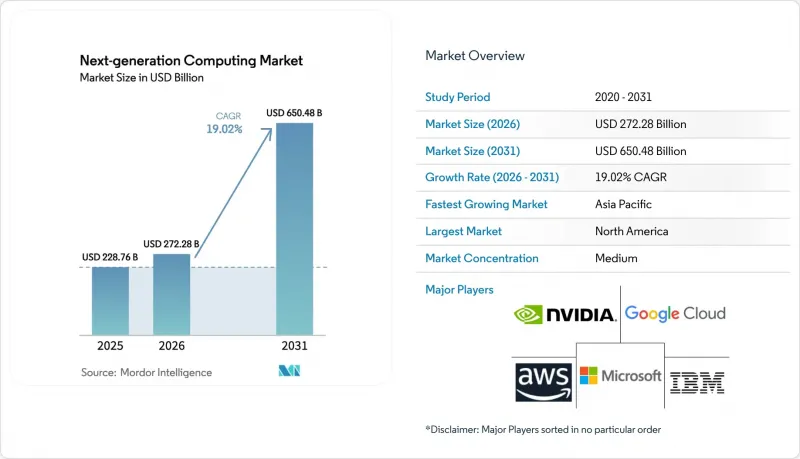
Mordor Intelligence에 의하면, 차세대 컴퓨팅 시장 규모는 2025년 2,287억 6,000만 달러에서 2026년에는 2,722억 8,000만 달러로 확대되어 2026년부터 2031년까지 CAGR 19.02%로 성장을 지속하여, 2031년에는 6,504억 8,000만 달러에 이를 것으로 예측됩니다.
본 보고서는 구성 요소(하드웨어, 소프트웨어, 서비스), 컴퓨팅 패러다임(고성능 컴퓨팅(HPC), 양자 컴퓨팅, 광/포토닉 컴퓨팅, 뉴로모픽 컴퓨팅,엣지/니어엣지 컴퓨팅 등), 도입 형태(클라우드, On-Premise, 하이브리드), 최종 사용자 산업(은행, 금융서비스 및 보험(BFSI), 헬스케어 및 생명과학, 자동차 및 운송, 에너지·유틸리티, 기타) 및 지역별로 분류되어 있습니다.
전 세계 차세대 컴퓨팅 시장 동향 및 인사이트
생성형 AI를 위한 컴퓨팅 및 확장성 수요 급증
주요 GPU 공급업체의 2025 회계연도 데이터센터 매출액은 전년 대비 2배 이상 증가했으며, 대규모 언어 모델(LLM)과 이미지 생성 도구가 현재 반도체 수요를 견인하고 있음이 입증되었습니다. 블랙웰급 프로세서에는 2,080억 개의 트랜지스터가 집적되어 있어, 이전 세대에 비해 극히 적은 전력 소비로 1조 파라미터 규모의 추론을 가능하게 합니다. 이에 대응해 클라우드 제공업체들은 저지연 네트워크와 풀링된 고대역폭 메모리를 묶은 전용 AI 인스턴스를 출시하여, 중견 기업도 온디맨드로 엑사스케일 용량을 활용할 수 있게 했습니다. 시스템 통합사업자들은 보드 수준의 전원 공급을 재설계하는 동시에 수천 대의 GPU에 걸친 스케줄링을 최적화하는 소프트웨어 스택을 도입하여 진입 장벽을 낮췄습니다. 이러한 노력들이 결합되어 차세대 컴퓨팅 시장으로의 자본 유입이 가속화되었고, 하드웨어 업데이트 주기가 강화되었습니다.
양자 기술 허브를 향한 정부의 자금 지원 물결
미국 에너지부는 2025년 1월, 양자 연구를 위해 6억 2,500만 달러의 신규 보조금을 지급했습니다. 마찬가지로 영국도 1억 2,100만 파운드(1억 6,434만 달러)를 배정하여 국내 테스트베드와 비즈니스 액셀러레이터를 지원했습니다. 이러한 자금 지원 클러스터는 대학, 국립 연구소, 민간 공급업체를 장기적인 파트너십으로 묶어 프로토타입 개발의 위험을 분담하는 동시에, 펠로우십 프로그램을 통해 인재 양성을 촉진하고 있습니다. 이와 병행하여 일본과 인도는 희석 냉동기, 포토닉스, 제어 전자 기기를 둘러싼 공급망의 회복탄력성을 구축하기 위해 양자 기술 관련 국가 예산을 확대했습니다. 이러한 노력은 큐비트 연결 기술, 극저온 패키징, 오류 감소 알고리즘 분야의 특허 출원을 촉진하여 차세대 컴퓨팅 시장에 지속적인 활력을 불어넣었습니다.
양자 기술에 정통한 인재 부족
2025년에 양자 기술 이해관계자를 대상으로 실시한 설문조사에서 응답자의 45%가 도입의 주요 장벽으로 인재 부족을 꼽았습니다. 양자 알고리즘 설계에는 물리학, 수학, 컴퓨터 과학이 융합되어 있지만, 일반적인 교육 과정에서 이 세 가지를 모두 아우르는 경우는 드뭅니다. 기업들은 사내 부트캠프나 대학과의 공동 강좌를 통해 이러한 격차를 메우려 시도했으나, 인재 양성에 소요되는 시간이 프로젝트 기한을 종종 초과해 버렸습니다. 정부의 장학금 제도로 박사 과정 학생 수는 증가했으나, 단기적인 인재 공급은 여전히 부족하여 암호학, 최적화, 재료 과학 분야의 작업량에 대한 계획된 도입이 지연되고, 차세대 컴퓨팅 시장 전체의 성장이 둔화되었습니다.
부문 분석
하드웨어 관련 차세대 컴퓨팅 시장 규모는 GPU, 텐서 처리 장치(TPU), 포토닉 상호 연결의 채택에 힘입어 2025년에는 1,065억 9,000만 달러에 달했습니다. 엑사스케일급 보드에는 6개의 HBM 스택이 통합되어 대역폭이 2배로 증가하고, 모델 훈련의 배치 크기가 10배로 확대되었습니다. 각 메모리 제조업체들은 2035년까지 HPC 및 AI용 HBM 수요가 15배 증가할 것이라는 예측에 대응하기 위해 생산 능력 확대를 약속하고 부품 공급을 확보했습니다. 또한, 전력 효율이 뛰어난 광 링크도 주류 서버 보드에 채택되어 가속기 포드 간의 지연 시간을 마이크로초 수준으로 단축했습니다.
서비스 부문은 규모는 작지만 아키텍처 설계, 안전한 도입, 라이프사이클 관리를 담당함으로써 더욱 급속한 성장을 이루었습니다. 관리형 양자 워크로드, AI 파이프라인 최적화, 예방적 냉각 분석이 새로운 수익원이 되었습니다. 클라우드 제공업체는 전문 서비스 시간을 플랫폼 구독에 묶어 연금형 수익을 창출했습니다. 이러한 하이브리드 수익 구조를 통해 하드웨어 공급이 변동할 때에도 차세대 컴퓨팅 시장의 회복력이 향상되었으며, 전문적인 툴체인을 둘러싼 고객의 락인 현상이 촉진되었습니다.
기상 모델링, 유체 역학, 금융 리스크 그리드 분야의 확립된 조달 주기 덕분에 HPC는 2024년 수익의 상당 부분을 계속 차지했습니다. 각 벤더들은 x86 또는 Arm CPU와 차세대 GPU를 NVLink-over-Ethernet 패브릭 상에서 결합한 엑사스케일 시스템을 출시하여 7 엑사플롭스를 넘는 단정밀도 처리량을 달성했습니다. 이러한 비약적인 발전 덕분에, 대체 패러다임이 성숙해 가는 와중에도 차세대 컴퓨팅 시장은 견조한 흐름을 보였습니다.
양자 컴퓨팅은 가장 가파른 성장 곡선을 보였습니다. D-Wave사는 조합 최적화를 목적으로 5,000큐비트 이상의 애니일러를 출시한 반면, 트랩 이온형 및 중성 원자형 벤더들은 오류 정정 기능을 갖춘 프로토타입 개발을 위해 벤처 자금을 조달했습니다. 초기 하이브리드 파일럿 프로젝트에서는 양자 커널이 금융 리스크 모델의 몬테카를로 시뮬레이션 수렴을 가속화한다는 사실이 확인되었습니다. 연평균 성장률(CAGR)이 34.05%로 예상에 따라, 양자 컴퓨팅은 기존 고전 컴퓨팅 전용 예산을 서서히 잠식하며 차세대 컴퓨팅 시장 전체에서 그 입지를 공고히할 것입니다.
지역별 분석
2025년 차세대 컴퓨팅 시장의 매출 중 40.80%를 북미가 차지했습니다. 미국만으로도 이 지역 지출의 약 4분의 3을 차지하고 있으며, 이는 공공 자금, 풍부한 벤처 캐피털, 그리고 클라우드 분야의 유력한 기존 기업들의 존재에 힘입은 결과입니다. 국립 연구소는 중성 원자 어레이와 엑사스케일 슈퍼컴퓨터를 통합한 선구적인 양자 테스트베드를 운영하며 그 리더십을 확고히 했습니다. 산업 전반에 걸친 컨소시엄을 통해 지속가능성에 중점을 둔 정책을 반영한, 에너지 효율이 뛰어난 데이터센터의 혁신 기술이 탄생했습니다.
아시아태평양은 22.45%라는 가장 높은 연평균 성장률(CAGR)을 나타낼 전망입니다. 중국, 일본, 인도는 반도체 단지에 대한 우대 조치를 확대하고 양자 연구 펠로우십에 대한 지원을 실시했습니다. 하이퍼스케일 사업자들은 AI 수요에 대응하기 위해 싱가포르,시드니, 뭄바이의 코로케이션용 화이트스페이스를 두 배로 늘리겠다고 약속했습니다. 병행하여 진행된 5G-Advanced의 구축으로 새로운 엣지 컴퓨팅 노드가 창출되고, 워크로드의 현지화가 심화됨에 따라 차세대 컴퓨팅 시장에서 해당 지역의 중요성이 강화되었습니다. 호주와 한국은 양자 표준에 관한 다자간 동맹에 참여하여 이 지역에 기술적 다양성을 가져왔습니다.
유럽은 디지털 주권과 환경 관리를 결합한 통일된 산업 전략을 유지했습니다. 독일의 프라운호퍼 연구소는 1와트 미만의 추론을 목표로 하는 뉴로모픽 프로토타입 개발을 추진한 반면, 프랑스의 한 연구소에서는 포토닉스 기반 양자 라우터의 실증 실험이 진행되었습니다. EU의 ‘Fit for 55’ 기후 패키지는 데이터센터 사업자들에게 장기 재생 에너지 구매 계약 체결을 촉진함으로써, 규제 준수와 투자자들의 압력을 양립시켰습니다. 이러한 노력으로 차세대 컴퓨팅 시장에서 지속가능성의 선구자로서 유럽의 역할이 더욱 강화되었습니다.
기타 혜택:
- 엑셀 형식 시장 예측(ME) 시트
- 3개월간의 애널리스트 지원
자주 묻는 질문
목차
제1장 서론
제2장 조사 방법
제3장 개요
제4장 시장 구도
제5장 시장 규모와 성장 예측
제6장 경쟁 구도
제7장 시장 기회와 향후 전망
JHS 26.09.03According to Mordor Intelligence, the next-generation computing market size is expected to grow from USD 228.76 billion in 2025 to USD 272.28 billion in 2026 and is forecast to reach USD 650.48 billion by 2031 at 19.02% CAGR over 2026-2031.
This report is Segmented by Component (Hardware, Software, Services), Computing Paradigm (High-Performance Computing (HPC), Quantum Computing, Optical/Photonic Computing, Neuromorphic Computing, Edge/Near-Edge Computing, and More), Deployment Mode (Cloud, On-Premise, Hybrid), End-User Industry (BFSI, Healthcare and Life Sciences, Automotive and Transportation, Energy and Utilities, and More), and Geography.
Global Next-generation Computing Market Trends and Insights
Demand surge for generative-AI compute scaling
Fiscal-2025 datacenter revenue at a leading GPU vendor more than doubled year-over-year, confirming that large language models (LLMs) and image generators now dominate silicon demand. Blackwell-class processors integrated 208 billion transistors, enabling trillion-parameter inference with a fraction of prior-generation energy draw. Cloud providers responded by releasing dedicated AI instances that bundle low-latency networking and pooled high-bandwidth memory, allowing medium-sized firms to access exa-scale capacity on demand. System integrators simultaneously re-engineered board-level power delivery and introduced software stacks that finesse scheduling across thousands of GPUs, flattening barriers to entry. These steps combined to accelerate capital flows into the next-generation computing market and to reinforce hardware refresh cycles.
Government funding waves for quantum-tech hubs
The United States Department of Energy opened USD 625 million in fresh awards for quantum research in January 2025. Similar UK allocations of GBP 121 million (USD 164.34 million) supported national testbeds and business accelerators. Funding clusters anchor universities, national labs, and private suppliers into long-term partnerships, share prototyping risk, and catalyse workforce development through fellowship programmes. In parallel, Japan and India enlarged their sovereign quantum budgets to build supply-chain resilience around dilution refrigerators, photonics, and control electronics. These initiatives triggered patent filings in qubit connectivity, cryogenic packaging, and error-mitigation algorithms, adding durable momentum to the next-generation computing market.
Quantum-skilled talent shortage
A 2025 survey of quantum-technology stakeholders showed 45% citing workforce scarcity as their primary adoption barrier. Quantum algorithm design blends physics, mathematics, and computer science, yet mainstream curricula rarely cover all three. Enterprises attempted to close gaps via internal boot camps and joint university chairs, but ramp-up time often exceeded project deadlines. While government scholarships expanded PhD enrolment, near-term supply remained tight, delaying planned roll-outs in cryptography, optimisation, and material-science workloads and moderating overall expansion of the next-generation computing market.
Other drivers and restraints analyzed in the detailed report include:
- Edge-to-cloud convergence for ultra-low-latency IoT
- Falling GPU TCO via cloud credits and open-IP chiplets
- Grid-power and permitting bottlenecks for hyperscale DCs
For complete list of drivers and restraints, kindly check the Table Of Contents.
Segment Analysis
The next-generation computing market size tied to hardware reached USD 106.59 billion in 2025, powered by the adoption of GPUs, tensor processing units, and photonic interconnects. Exascale-class boards integrated six HBM stacks, doubling bandwidth and allowing 10X larger model training batches. Memory producers committed capacity expansions to meet a projected fifteen-fold increase in HBM demand for HPC and AI by 2035, safeguarding component supply. Power-efficient optical links also entered mainstream server boards, cutting latency between accelerator pods to microsecond levels.
Services, although smaller, grew faster by handling architecture design, secure deployment, and life-cycle management. Managed quantum workloads, AI-pipeline optimisation, and proactive cooling analytics formed new fee lines. Cloud providers bundled professional services hours into platform subscriptions, creating annuity-style revenue. This hybrid revenue mix improved resilience in the next-generation computing market during hardware supply oscillations and cultivated customer lock-in around specialised toolchains.
HPC still delivered the bulk of 2024 revenue, thanks to well-established procurement cycles in weather modelling, fluid dynamics, and financial risk grids. Vendors launched exascale systems that combined x86 or Arm CPUs with next-generation GPUs on NVLink-over-Ethernet fabrics, offering single-precision throughput beyond seven exaflops. Such leaps sustained the next-generation computing market even as alternative paradigms matured.
Quantum computing exhibited the steepest growth curve. D-Wave released a 5,000-plus-qubit annealer geared for combinatorial optimisation, while trapped-ion and neutral-atom providers attracted venture funding for error-corrected prototypes. Early hybrid pilots saw quantum kernels accelerate Monte Carlo simulation convergence in high-finance risk models. Given its 34.05% CAGR outlook, quantum will progressively erode classical-only budgets, solidifying its role in the overall next-generation computing market.
Complete Report Scope:
- By Component
- Hardware
- Processors and Accelerators
- Memory and Storage
- Interconnect and Networking
- Thermal and Power Solutions
- Software
- Services
- Hardware
- By Computing Paradigm
- High-Performance Computing (HPC)
- Quantum Computing
- Optical/Photonic Computing
- Neuromorphic Computing
- Edge / Near-Edge Computing
- Cloud-Native Accelerated Computing
- Hybrid and Other Emerging
- By Deployment Mode
- Cloud
- On-Premise
- Hybrid
- By End-user Industry
- BFSI
- Healthcare and Life Sciences
- Automotive and Transportation
- Energy and Utilities
- Aerospace and Defense
- Media and Entertainment
- IT and Telecom
- Retail and e-Commerce
- Manufacturing and Industrial
- Government and Public Sector
- Other End-user Industries
- By Geography
- North America
- United States
- Canada
- Mexico
- South America
- Brazil
- Argentina
- Rest of South America
- Europe
- Germany
- United Kingdom
- France
- Italy
- Russia
- Rest of Europe
- Asia Pacific
- China
- Japan
- South Korea
- India
- ASEAN
- Rest of Asia Pacific
- Middle East and Africa
- Middle East
- Saudi Arabia
- UAE
- Turkey
- Rest of Middle East
- Africa
- South Africa
- Nigeria
- Rest of Africa
- Middle East
- North America
Geography Analysis
North America generated 40.80% of 2025 revenue in the next-generation computing market. The United States alone accounted for roughly three-quarters of regional spend, buoyed by public financing, deep venture capital, and dominant cloud incumbents. National laboratories operated pathfinder quantum testbeds that integrate neutral-atom arrays with exascale supercomputers, cementing leadership. Energy-efficient data-centre innovations emerged from cross-industry consortia, reflecting policy focus on sustainability.
Asia-Pacific will post the fastest 22.45% CAGR. China, Japan, and India expanded semiconductor park incentives and subsidised quantum-research fellowships. Hyperscale operators pledged to double colocation white-space in Singapore, Sydney, and Mumbai to meet AI demand. Parallel 5G-Advanced roll-outs created new edge-computing nodes, deepening workload localisation and strengthening regional relevance of the next-generation computing market. Australia and South Korea joined multilateral alliances on quantum standards, adding technical pluralism to the region.
Europe preserved a unified industrial strategy combining digital sovereignty and environmental stewardship. Germany's Fraunhofer institutes advanced neuromorphic prototypes targeting sub-watt inference, while French labs piloted photonic-based quantum routers. The EU's fit-for-55 climate package spurred data-centre operators to sign long-term renewable-energy purchase agreements, aligning regulatory compliance with investor pressure. These initiatives elevated Europe's role as a sustainability vanguard within the next-generation computing market.
- Alibaba Group Holding Ltd.
- Amazon Web Services Inc.
- Alphabet Inc. (Google Cloud)
- Microsoft Corp.
- IBM Corp.
- NVIDIA Corp.
- Intel Corp.
- Advanced Micro Devices Inc.
- Cisco Systems Inc.
- Oracle Corp.
- NEC Corp.
- Hewlett Packard Enterprise
- Dell Technologies
- Fujitsu Ltd.
- Graphcore Ltd.
- D-Wave Quantum Inc.
- IonQ Inc.
- Rigetti Computing Inc.
- ARM Ltd.
- PsiQuantum Corp.
- Cerebras Systems Inc.
- Tencent Holdings (Tencent Cloud)
- Baidu Inc.
- Huawei Technologies Co. Ltd.
- Samsung Electronics Co. Ltd.
- Graphcore Ltd.
- Cerebras Systems Inc.
Additional Benefits:
- The market estimate (ME) sheet in Excel format
- 3 months of analyst support
TABLE OF CONTENTS
1 INTRODUCTION
- 1.1 Study Assumptions and Market Definition
- 1.2 Scope of the Study
2 RESEARCH METHODOLOGY
3 EXECUTIVE SUMMARY
4 MARKET LANDSCAPE
- 4.1 Market Overview
- 4.2 Market Drivers
- 4.2.1 Demand surge for generative-AI compute scaling
- 4.2.2 Government funding waves for quantum-tech hubs
- 4.2.3 Edge-to-cloud convergence for ultra-low-latency IoT
- 4.2.4 Falling GPU TCO via cloud credits and open-IP chiplets
- 4.2.5 Liquid-cooling breakthroughs enabling dense HPC racks
- 4.2.6 Secondary market for de-commissioned AI accelerators
- 4.3 Market Restraints
- 4.3.1 Quantum-skilled talent shortage
- 4.3.2 High CAPEX and integration risk for heterogeneous clusters
- 4.3.3 Grid-power and permitting bottlenecks for hyperscale DCs
- 4.3.4 Export-control limits on advanced HBM and GPU shipments
- 4.4 Value Chain Analysis
- 4.5 Regulatory Landscape
- 4.6 Technological Outlook
- 4.7 Porter's Five Forces
- 4.7.1 Bargaining Power of Suppliers
- 4.7.2 Bargaining Power of Buyers
- 4.7.3 Threat of New Entrants
- 4.7.4 Threat of Substitutes
- 4.7.5 Intensity of Competitive Rivalry
- 4.8 Impact of Macroeconomic Factors
- 4.9 Investment Analysis
5 MARKET SIZE AND GROWTH FORECASTS (VALUE)
- 5.1 By Component
- 5.1.1 Hardware
- 5.1.1.1 Processors and Accelerators
- 5.1.1.2 Memory and Storage
- 5.1.1.3 Interconnect and Networking
- 5.1.1.4 Thermal and Power Solutions
- 5.1.2 Software
- 5.1.3 Services
- 5.1.1 Hardware
- 5.2 By Computing Paradigm
- 5.2.1 High-Performance Computing (HPC)
- 5.2.2 Quantum Computing
- 5.2.3 Optical/Photonic Computing
- 5.2.4 Neuromorphic Computing
- 5.2.5 Edge / Near-Edge Computing
- 5.2.6 Cloud-Native Accelerated Computing
- 5.2.7 Hybrid and Other Emerging
- 5.3 By Deployment Mode
- 5.3.1 Cloud
- 5.3.2 On-Premise
- 5.3.3 Hybrid
- 5.4 By End-user Industry
- 5.4.1 BFSI
- 5.4.2 Healthcare and Life Sciences
- 5.4.3 Automotive and Transportation
- 5.4.4 Energy and Utilities
- 5.4.5 Aerospace and Defense
- 5.4.6 Media and Entertainment
- 5.4.7 IT and Telecom
- 5.4.8 Retail and e-Commerce
- 5.4.9 Manufacturing and Industrial
- 5.4.10 Government and Public Sector
- 5.4.11 Other End-user Industries
- 5.5 By Geography
- 5.5.1 North America
- 5.5.1.1 United States
- 5.5.1.2 Canada
- 5.5.1.3 Mexico
- 5.5.2 South America
- 5.5.2.1 Brazil
- 5.5.2.2 Argentina
- 5.5.2.3 Rest of South America
- 5.5.3 Europe
- 5.5.3.1 Germany
- 5.5.3.2 United Kingdom
- 5.5.3.3 France
- 5.5.3.4 Italy
- 5.5.3.5 Russia
- 5.5.3.6 Rest of Europe
- 5.5.4 Asia Pacific
- 5.5.4.1 China
- 5.5.4.2 Japan
- 5.5.4.3 South Korea
- 5.5.4.4 India
- 5.5.4.5 ASEAN
- 5.5.4.6 Rest of Asia Pacific
- 5.5.5 Middle East and Africa
- 5.5.5.1 Middle East
- 5.5.5.1.1 Saudi Arabia
- 5.5.5.1.2 UAE
- 5.5.5.1.3 Turkey
- 5.5.5.1.4 Rest of Middle East
- 5.5.5.2 Africa
- 5.5.5.2.1 South Africa
- 5.5.5.2.2 Nigeria
- 5.5.5.2.3 Rest of Africa
- 5.5.5.1 Middle East
- 5.5.1 North America
6 COMPETITIVE LANDSCAPE
- 6.1 Market Concentration
- 6.2 Strategic Moves
- 6.3 Market Share Analysis
- 6.4 Company Profiles (includes Global-level Overview, Market-level Overview, Core Segments, Financials, Strategic Information, Market Rank/Share, Products and Services, Recent Developments)
- 6.4.1 Alibaba Group Holding Ltd.
- 6.4.2 Amazon Web Services Inc.
- 6.4.3 Alphabet Inc. (Google Cloud)
- 6.4.4 Microsoft Corp.
- 6.4.5 IBM Corp.
- 6.4.6 NVIDIA Corp.
- 6.4.7 Intel Corp.
- 6.4.8 Advanced Micro Devices Inc.
- 6.4.9 Cisco Systems Inc.
- 6.4.10 Oracle Corp.
- 6.4.11 NEC Corp.
- 6.4.12 Hewlett Packard Enterprise
- 6.4.13 Dell Technologies
- 6.4.14 Fujitsu Ltd.
- 6.4.15 Graphcore Ltd.
- 6.4.16 D-Wave Quantum Inc.
- 6.4.17 IonQ Inc.
- 6.4.18 Rigetti Computing Inc.
- 6.4.19 ARM Ltd.
- 6.4.20 PsiQuantum Corp.
- 6.4.21 Cerebras Systems Inc.
- 6.4.22 Tencent Holdings (Tencent Cloud)
- 6.4.23 Baidu Inc.
- 6.4.24 Huawei Technologies Co. Ltd.
- 6.4.25 Samsung Electronics Co. Ltd.
- 6.4.26 Graphcore Ltd.
- 6.4.27 Cerebras Systems Inc.
7 MARKET OPPORTUNITIES AND FUTURE OUTLOOK
- 7.1 White-space and Unmet-need Assessment


