

|
시장보고서
상품코드
2119746
사용자 생성 컨텐츠 플랫폼 시장 : 점유율 분석, 업계 동향과 통계, 성장 예측(2026-2031년)User-Generated Content Platform - Market Share Analysis, Industry Trends & Statistics, Growth Forecasts (2026 - 2031) |
||||||
 Mordor Intelligence
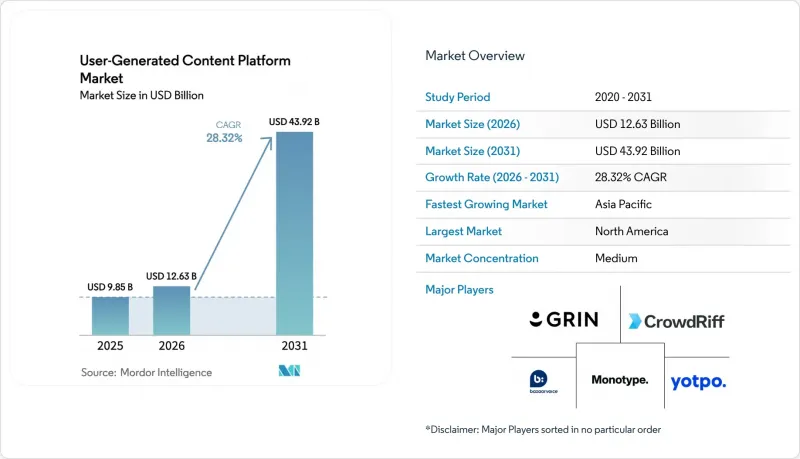
Mordor Intelligence에 의하면, 사용자 생성 컨텐츠(UGC) 플랫폼 시장 규모는 2025년 98억 5,000만 달러에서 2026년에는 126억 3,000만 달러로 확대되어 2026년부터 2031년까지 CAGR 28.32%로 성장을 지속하여, 2031년에는 439억 2,000만 달러에 이를 것으로 예측됩니다.
본 보고서는 제품 유형(블로그, 소셜 미디어 게시물, 오디오·동영상 등), 최종 사용자(개인, 중소기업, 대기업), 도입 형태(클라우드 기반, On-Premise/프라이빗 클라우드), 수익 모델(광고 수익형, 구독/SaaS 등) 및 지역별로 분류되어 있습니다. 시장 예측은 금액(달러) 기준으로 제시되어 있습니다.
전 세계 사용자 생성 컨텐츠(UGC) 플랫폼 시장 동향 및 인사이트
인플루언서 주도형 커머스의 가속화
크리에이터 네트워크와 통합된 결제 기능을 결합한 브랜드는 구매 퍼널을 단축하고 측정 가능한 ROI 향상을 실현하고 있습니다. 인플루언서 마케팅 플랫폼의 2024년 매출은 210억 달러에 달하며, 마이크로 인플루언서는 매크로 크리에이터에 비해 60% 더 높은 참여도를 창출하고 있습니다. 틈새 크리에이터를 확장 가능하게 식별하고자 하는 기업 수요가 AI 기반 발견 엔진에 대한 투자를 촉진하고 있습니다. 구매 가능한 컨텐츠의 통합으로 고객과의 접점이 평균 2.3곳 감소했으며, 이는 실시간 UGC 활용이 전략적으로 필수적임을 더욱 강조하고 있습니다. FTC(연방거래위원회)의 권장 지침 개정으로 인해, 공개 규정 준수를 자동화하는 플랫폼이 권장되고 있으며, 이를 통해 신뢰도가 높아지고 사용자 생성 컨텐츠 플랫폼 시장 전체의 성장이 촉진되고 있습니다.
UGC 양을 주도하는 숏폼 동영상 플랫폼
2024년 하반기, 각 플랫폼에서는 하루 평균 72만 시간 이상의 동영상이 처리되었습니다. 이러한 급증으로 인해 컨텐츠의 홍수 속에 묻히기 쉬운 브랜드를 위해, 관련성 높은 클립을 추출하는 지능형 큐레이션 시스템의 필요성이 높아지고 있습니다. 모바일 이용에 최적화된 세로형 동영상 형식은 현재 40% 더 높은 참여도를 창출하고 있으며, 각 플랫폼은 추천 알고리즘을 재구축하고 있습니다. 2024년 9월 Meta가 출시한 AI 스튜디오는 크리에이터의 생산성을 향상시키고, 특유의 ‘진정성’을 유지하며, 성과를 검증하는 동시에 기만적인 컨텐츠를 걸러내는 분석 도구에 대한 수요를 더욱 촉진했습니다. 이러한 요인들이 결합되어 사용자 생성 컨텐츠(UGC) 플랫폼 시장에서 플랫폼의 정착률과 수익화 기회를 확대되고 있습니다.
브랜드 안전성 및 컨텐츠 검토 비용
2024년, 업계 전체의 컨텐츠 관리 비용은 250억 달러를 넘어섰으며, 100만 명 이상의 인간 검토자가 AI 필터를 보완하고 있습니다. EU의 디지털 서비스법(DSA)에 따라 의무가 강화되고, 정교한 분류 및 24시간 이내 삭제 조치가 의무화된 결과, 대기업들은 연간 28억 달러의 추가 규정 준수 비용을 부담하고 있습니다. AI 도구를 통해 건당 비용은 35% 절감되지만, 특히 단 한 번의 부적절한 게시물로 인해 계약이 무효화될 가능성이 있는 기업 대상 캠페인의 경우, 미묘한 맥락을 평가하는 데에는 여전히 인간의 감독이 필요합니다. 이러한 운영상의 부담이 수익성을 저하시켜, 사용자 생성 컨텐츠(UGC) 플랫폼 시장의 단기적 성장을 둔화시키고 있습니다.
부문 분석
소셜 미디어 게시물은 2025년 매출의 41.18%를 차지하며, 브랜드 스토리텔링에서 그 확고한 역할을 부각시키고 있습니다. 라이브 스트리밍은 2031년까지 연평균 성장률(CAGR)이 30.12%로 가장 높으며, 이는 실시간 교류 및 팁 기반 수익화에 대한 소비자 수요를 반영합니다. 게임을 중심으로 한 스트리밍은 2024년에 크리에이터 수익으로 42억 달러를 창출했습니다. 제작 키트의 가격이 저렴해짐에 따라 오디오·동영상 하이브리드 컨텐츠는 꾸준한 성장을 이어가고 있습니다. 평가와 리뷰는 특히 전자상거래 사이트의 결제 페이지에 통합된 경우, 여전히 신뢰를 나타내는 기본적인 지표로 작용하고 있습니다. 블로그는 성숙한 시장이지만, AI를 활용한 멀티미디어 삽입 기능을 통해 다시 활기를 되찾고 있습니다.
클라우드 네이티브 AI 태깅 시스템은 EU의 ‘디지털 서비스법’에 따라 규정된, 끊임없이 진화하는 분류 기준을 준수하도록 보장하며 수작업 부담을 줄여줍니다. 스마트폰에 최적화된 세로형 동영상 알고리즘은 시청 시간과 클릭률을 향상시키고 있습니다. 이러한 모바일 우선 경험이 보편화됨에 따라, 다양한 형식을 아우르는 통합이 가능한 제공업체들이 시장 점유율을 확대하며 사용자 생성 컨텐츠(UGC) 플랫폼 시장의 성장을 뒷받침하고 있습니다.
대기업은 2025년 매출의 43.21%를 차지하며, CRM 및 마케팅 기술 스택과의 연동을 활용하여 전체 퍼널의 ROI를 측정하고 있습니다. 한편, 중소기업은 구독 요금제를 통해 초기 투자 장벽이 해소됨에 따라 2031년까지 연평균 성장률(CAGR) 30.25%로 성장을 지속하고, 있습니다. 고객이 직접 촬영한 사진과 동영상은 브랜드가 제작한 자산에 비해 중소기업의 참여도를 45% 향상시켜, 대형 경쟁사와의 성과 격차를 좁히고 있습니다.
대기업의 구매자들은 어트리뷰션 모델링을 위해 견고한 브랜드 안전성 대시보드와 API 수준의 데이터 전송을 요구하고 있습니다. 반면, 중소기업은 신속한 도입, 안내형 워크플로우, 번들형 권리 관리를 우선시합니다. 단계별 구성을 제공하는 플랫폼은 양측의 요구를 모두 충족시키며, 사용자 생성 컨텐츠(UGC) 플랫폼 시장의 잠재 고객 기반을 확대되고 있습니다.
지역별 분석
북미의 사용자 생성 컨텐츠(UGC) 플랫폼 시장 규모는 달러 기준 브랜드 예산과 엔터프라이즈용 SaaS의 광범위한 보급의 혜택을 받아 사용자 1인당 평균 수익(ARPU)을 높은 수준으로 유지하고 있습니다. 이 지역의 엄격한 브랜드 안전성 요구 사항은 고도화된 컨텐츠 검토 도구 개발을 촉진하고 있으며, 소규모 경쟁사들 시장 진입 장벽을 높이고 있습니다. 각 주에서 진행 중인 개인정보 보호 관련 법안으로 인해 병행해야 할 규정 준수 요건이 발생하고 있어, 플랫폼 사업자들은 민첩성을 저해하지 않으면서 이를 조화롭게 관리해야 합니다.
아시아태평양에서는 폭발적으로 증가하는 컨텐츠 양과 크리에이터 인구가 활기찬 경쟁 환경을 뒷받침하고 있습니다. 지역에 최적화된 결제 인프라와 슈퍼앱 생태계가 라이브 스트리밍 내 소액 결제를 촉진하며, 수익화 혁신을 주도하고 있습니다. 한국과 인도네시아의 정부 지원 프로그램은 디지털 기술 교육에 대한 보조금을 통해 크리에이터 기반과 플랫폼 서비스에 대한 수요를 확대되고 있습니다. 그러나 컨텐츠 검열 지침에 대응하기 위해 컨텐츠 삭제를 피할 수 있는 유연한 분류 엔진이 요구되고 있습니다.
중동 및 아프리카는 스마트폰 가격이 저렴해진 점과, 도달 범위를 확대하는 소셜 플랫폼에 대한 통신 사업자의 제로레이팅 지원에 힘입어 가장 높은 예상 연평균 성장률(CAGR)을 기록하고 있습니다. 걸프협력회의(GCC) 회원국에서의 전자상거래 전개에서는 구매 가능한 UGC 피드가 통합되어, 소셜 디스커버리에서 구매로의 전환이 전례 없는 속도로 진행되고 있습니다. 현지 언어나 방언은 전 세계 AI 필터에 있어 과제가 되고 있으며, 맥락에 맞는 훈련 데이터를 제공하는 지역 파트너십 형성을 촉진하고 있습니다. 이러한 지역별 다양한 동향이 결합되어 전 세계 사용자 생성 컨텐츠(UGC) 플랫폼 시장의 다양성을 더욱 강화하고 있습니다.
기타 혜택:
- 엑셀 형식 시장 예측(ME) 시트
- 3개월간의 애널리스트 지원
자주 묻는 질문
목차
제1장 서론
제2장 조사 방법
제3장 개요
제4장 시장 구도
제5장 시장 규모와 성장 예측
제6장 경쟁 구도
제7장 시장 기회와 향후 전망
JHS 26.09.03According to Mordor Intelligence, the user-generated content platform market size is expected to grow from USD 9.85 billion in 2025 to USD 12.63 billion in 2026 and is forecast to reach USD 43.92 billion by 2031 at 28.32% CAGR over 2026-2031.
This report is Segmented by Product Type (Blogs, Social Media Posts, Audio and Video, and More), End-User (Individuals, Small and Medium Enterprises, and Large Enterprises), Deployment Mode (Cloud-Based, and On-premises/Private Cloud), Revenue Model (Advertising-Supported, Subscription/SaaS, and More), and Geography. The Market Forecasts are Provided in Terms of Value (USD).
Global User-Generated Content Platform Market Trends and Insights
Influencer-Driven Commerce Acceleration
Brands fusing creator networks with integrated checkout features are shortening purchase funnels and driving measurable ROI improvements. Influencer marketing platforms generated USD 21 billion in 2024 revenue, with micro-influencers producing 60% higher engagement than macro creators. Enterprise demand for scalable identification of niche creators is propelling investment in AI-based discovery engines. Shoppable content integrations are eliminating an average of 2.3 customer touchpoints, reinforcing the strategic imperative for real-time UGC activation. Updated FTC endorsement guidelines are encouraging platforms that automate disclosure compliance, boosting trust and reinforcing growth across the user-generated content platform market.
Short-Form Video Platforms Fueling UGC Volumes
Platforms processed more than 720,000 video hours daily in late 2024. This surge increases the need for intelligent curation systems that surface relevant clips for brands drowning in content abundance. Vertical-video formats optimized for mobile use now deliver 40% higher engagement, prompting platforms to redeploy recommendation algorithms. Meta's September 2024 AI studio rollout accelerated creator productivity and preserved hallmark authenticity, fueling additional demand for analytics that validate performance while filtering deceptive content. These forces collectively expand platform stickiness and monetization opportunities inside the user-generated content platform market.
Brand-Safety and Content-Moderation Costs
Industry-wide moderation spend surpassed USD 25 billion in 2024, with more than 1 million human moderators supplementing AI filters. The EU Digital Services Act heightened obligations, forcing sophisticated classification and 24-hour takedown windows that add USD 2.8 billion in annual compliance expenses for dominant firms. AI tools trim per-item costs by 35%, yet nuanced contextual evaluation still demands human oversight, especially for enterprise campaigns where a single unsafe placement can void contracts. These operating burdens temper profitability and slow near-term expansion in the user-generated content platform market.
Other drivers and restraints analyzed in the detailed report include:
- Social-Commerce Integrations by Major Retailers
- Generative-AI-Assisted Content Creatio
- Rising Regulatory Scrutiny on Data Use
For complete list of drivers and restraints, kindly check the Table Of Contents.
Segment Analysis
Social media posts contributed 41.18% of 2025 revenue, underscoring their entrenched role in brand storytelling. Live-streaming boasts the highest 30.12% CAGR through 2031, reflecting consumer appetite for real-time interaction and tipping-based monetization. Gaming-centric broadcasts produced USD 4.2 billion in creator revenue during 2024. Audio-video hybrids continue steady growth as production kits become affordable. Ratings and reviews remain foundational trust signals, especially when embedded in e-commerce checkouts. Blogs, while mature, are regaining momentum through AI-enhanced multimedia inserts.
Cloud-native AI tagging systems ensure compliance with evolving classification standards set by the EU's Digital Services Act, reducing manual workload. Vertical video algorithms optimized for smartphones are lifting dwell times and click-throughs. As these mobile-first experiences proliferate, providers capable of cross-format orchestration gain share, sustaining the user-generated content platform market expansion.
Large enterprises held 43.21% of 2025 revenue, leveraging integrations with CRM and martech stacks to measure full-funnel ROI. SMEs, however, post a 30.25% CAGR to 2031 as subscription tiers remove upfront investment hurdles. Authentic customer photos and videos drive 45% higher SME engagement than brand-authored assets, closing performance gaps with larger competitors.
Enterprise buyers demand robust brand-safety dashboards and API-level data transfers for attribution modeling. SMEs prioritize quick onboarding, guided workflows, and bundled rights management. Platforms offering tiered configurations appease both cohorts, broadening the user-generated content platform market addressable base.
Complete Report Scope:
- By Product Type
- Blogs
- Social Media Posts
- Audio and Video
- Ratings and Reviews
- Live-Streaming
- By End-user
- Individuals
- Small and Medium Enterprises
- Large Enterprises
- By Deployment Mode
- Cloud-based
- On-premise / Private Cloud
- By Revenue Model
- Advertising-supported
- Subscription / SaaS
- Freemium and Transaction-based
- By Geography
- North America
- South America
- Europe
- Asia-Pacific
- Middle East and Africa
Geography Analysis
North America's user-generated content platform market size benefited from USD-denominated brand budgets and broad enterprise SaaS penetration, sustaining higher average revenue per user. The region's stringent brand-safety demands foster advanced moderation tooling, elevating barrier-to-entry for smaller competitors. Ongoing state privacy bills create parallel compliance tracks that platforms must harmonize without sacrificing agility.
Asia-Pacific's explosive content volume and creator population underpin a vibrant competitive field. Localized payment rails and super-app ecosystems catalyze micro-transactions within live-streams, driving monetization innovation. Government support programs in South Korea and Indonesia subsidize digital-skills training, expanding the creator base and demand for platform services. However, content censorship guidelines require adaptable classification engines to avert takedowns.
The Middle East and Africa records the highest forecast CAGR, propelled by smartphone affordability and carrier-backed zero-rating of social platforms that amplify reach. E-commerce rollouts across Gulf Cooperation Council states integrate shoppable UGC feeds, translating social discovery into purchase at unprecedented speed. Local languages and dialects challenge global AI filters, incentivizing regional partnerships that supply contextual training data. Collectively, divergent regional dynamics reinforce the heterogeneity of the global user-generated content platform market.
- Bazaarvoice Inc.
- Yotpo Ltd.
- Pixlee TurnTo Corp.
- CrowdRiff Inc.
- Grin Technologies Inc.
- Upfluence SAS
- Taggbox Private Limited
- Stackla Pty Ltd (a Nosto company)
- Olapic Inc.
- TINT (Filestack Inc.)
- Social Native Inc.
- Khoros LLC
- Sprinklr Inc.
- Nosto Solutions Oy
- Adobe Inc. (UGC Framework)
- Hootsuite Inc.
- Later Media Inc.
- Dash Hudson Inc.
- Curalate, LLC
- Monotype Imaging Holdings Inc.
- Pancake Laboratories Inc.
Additional Benefits:
- The market estimate (ME) sheet in Excel format
- 3 months of analyst support
TABLE OF CONTENTS
1 INTRODUCTION
- 1.1 Study Assumptions and Market Definition
- 1.2 Scope of the Study
2 RESEARCH METHODOLOGY
3 EXECUTIVE SUMMARY
4 MARKET LANDSCAPE
- 4.1 Market Overview
- 4.2 Market Drivers
- 4.2.1 Influencer-driven commerce acceleration
- 4.2.2 Short-form video platforms fueling UGC volumes
- 4.2.3 Social-commerce integrations by major retailers
- 4.2.4 Generative-AI-assisted content creation
- 4.2.5 Web3 token-based creator monetisation models
- 4.2.6 Privacy-centric first-party data advantages
- 4.3 Market Restraints
- 4.3.1 Brand-safety and content-moderation costs
- 4.3.2 Rising regulatory scrutiny on data use
- 4.3.3 Decline of third-party cookies reducing ad yields
- 4.3.4 Generative-AI misinformation risks
- 4.4 Industry Value Chain Analysis
- 4.5 Regulatory Landscape
- 4.6 Technological Outlook
- 4.7 Porter's Five Forces Analysis
- 4.7.1 Bargaining Power of Buyers
- 4.7.2 Bargaining Power of Suppliers
- 4.7.3 Threat of New Entrants
- 4.7.4 Threat of Substitutes
- 4.7.5 Intensity of Competitive Rivalry
- 4.8 Impact of Macroeconomic Factors
5 MARKET SIZE AND GROWTH FORECASTS (VALUE)
- 5.1 By Product Type
- 5.1.1 Blogs
- 5.1.2 Social Media Posts
- 5.1.3 Audio and Video
- 5.1.4 Ratings and Reviews
- 5.1.5 Live-Streaming
- 5.2 By End-user
- 5.2.1 Individuals
- 5.2.2 Small and Medium Enterprises
- 5.2.3 Large Enterprises
- 5.3 By Deployment Mode
- 5.3.1 Cloud-based
- 5.3.2 On-premise / Private Cloud
- 5.4 By Revenue Model
- 5.4.1 Advertising-supported
- 5.4.2 Subscription / SaaS
- 5.4.3 Freemium and Transaction-based
- 5.5 By Geography
- 5.5.1 North America
- 5.5.2 South America
- 5.5.3 Europe
- 5.5.4 Asia-Pacific
- 5.5.5 Middle East and Africa
6 COMPETITIVE LANDSCAPE
- 6.1 Market Concentration
- 6.2 Strategic Moves
- 6.3 Market Share Analysis
- 6.4 Company Profiles (includes Global Overview, Market Overview, Core Segments, Financials, Strategic Information, Market Rank/Share, Products and Services, Recent Developments)
- 6.4.1 Bazaarvoice Inc.
- 6.4.2 Yotpo Ltd.
- 6.4.3 Pixlee TurnTo Corp.
- 6.4.4 CrowdRiff Inc.
- 6.4.5 Grin Technologies Inc.
- 6.4.6 Upfluence SAS
- 6.4.7 Taggbox Private Limited
- 6.4.8 Stackla Pty Ltd (a Nosto company)
- 6.4.9 Olapic Inc.
- 6.4.10 TINT (Filestack Inc.)
- 6.4.11 Social Native Inc.
- 6.4.12 Khoros LLC
- 6.4.13 Sprinklr Inc.
- 6.4.14 Nosto Solutions Oy
- 6.4.15 Adobe Inc. (UGC Framework)
- 6.4.16 Hootsuite Inc.
- 6.4.17 Later Media Inc.
- 6.4.18 Dash Hudson Inc.
- 6.4.19 Curalate, LLC
- 6.4.20 Monotype Imaging Holdings Inc.
- 6.4.21 Pancake Laboratories Inc.
7 MARKET OPPORTUNITIES AND FUTURE OUTLOOK
- 7.1 White-space and Unmet-Need Assessment


