|
시장보고서
상품코드
2119755
5K 디스플레이 해상도 시장 : 점유율 분석, 업계 동향과 통계, 성장 예측(2026-2031년)5k Display Resolution - Market Share Analysis, Industry Trends & Statistics, Growth Forecasts (2026 - 2031) |
||||||
 Mordor Intelligence
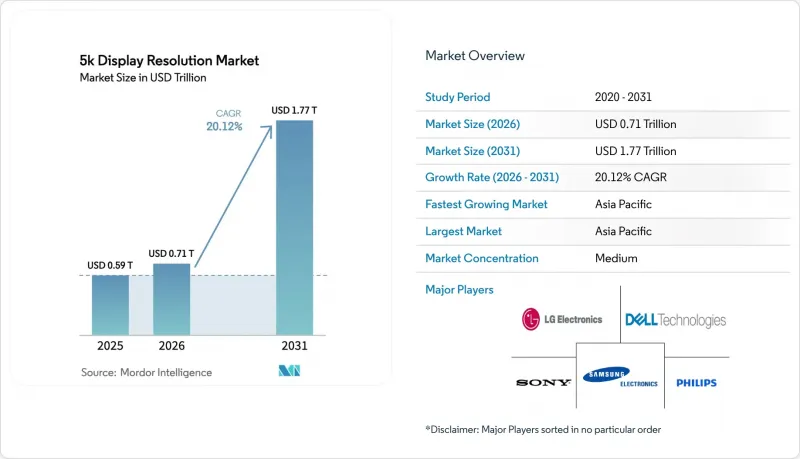
Mordor Intelligence에 의하면, 2026년 5K 디스플레이 해상도 시장 규모는 7,100억 달러로 추정되고 있어 2025년 5,900억 달러에서 확대해, 2031년에는 1조 7,700억 달러에 이를 것으로 예측됩니다.
2026년부터 2031년까지 연평균 성장률(CAGR) 20.12%로 성장할 것으로 전망됩니다.
본 보고서는 제품 유형(모니터, TV 등), 패널 기술(LCD, OLED, Mini-LED/Micro-LED), 기본 해상도(5120×2880(16:9) 등),최종 사용자용도(전문 컨텐츠 제작, 상업용 디지털 사이니지 및 제어실 등), 유통 채널(온라인, 오프라인), 지역별로 분류되어 있습니다. 시장 예측은 금액(미 달러) 기준으로 제시되어 있습니다.
전 세계 5K 디스플레이 해상도 시장 동향 및 인사이트
할리우드 및 한국의 스튜디오에서 AI를 활용한 포스트 프로덕션용 5K 지원 워크스테이션 채택이 급증
최첨단 생성형 필, 리그 제거, HDR 톤 매핑 도구는 패널이 1,470만 픽셀의 연속적인 캔버스를 제공할 때만 실시간으로 작동합니다. 로스앤젤레스의 두 편집실에서 수집한 초기 현장 데이터에 따르면, 4K 모니터 2대를 5K 모니터 1대로 교체한 결과, 컨폼 시간이 17% 단축되었습니다. 한국의 드라마 편집자들도 유사한 성과를 거두고 있으며, 2026년까지 31인치 IPS 5K 디스플레이 4만 3,000대를 추가로 주문했습니다. 워크스테이션 OEM 업체들은 DisplayPort 2.1 지원 카드를 표준 사양으로 채택하고 있어, 대역폭 병목 현상이 완전히 해소되었음을 시사합니다. 또한, 클라우드 방송국의 피니싱 하우스도 5K로의 전환에 동참하고 있는데, 이는 해당 해상도의 메자닌 ProRes 데이터가 10 GbE 링크에서 800 Mbps 미만으로 전송되기 때문입니다.
GCC 전역의 공항 지휘통제 시스템 업그레이드에 따른 울트라와이드 5K 사이니지 확대
아부다비의 미드필드 터미널에서는 2024년 11월에 전체 길이 88미터의 5,120×1,440 픽셀 LED 캐비닛을 가동하여, 기존 A-SMGCS 오버레이 표시를 방해하던 베젤로 인한 아티팩트를 해소했습니다. 사우디아라비아의 ‘비전 2030’ 항공 전자 장비 로드맵에 따르면, 2026년까지 리야드와 제다에 230장의 유사한 패널을 추가로 도입할 예정입니다. 초광폭 화면은 레이더 섹터의 종횡비와 일치하여, 운영자가 시선을 세로 방향으로 이동시키지 않고도 색상 정확도가 중요한 경고 정보를 정확하게 파악할 수 있게 됩니다. 또한, 각 통합 업체에 따르면, 하나의 DisplayPort 2.1 신호로 2개의 5K 화면을 구동할 수 있게 되어 GPU 랙 수가 15% 감소했고, 이는 전력 소비 절감으로도 이어지고 있습니다.
5K 패널의 Mini-LED 백라이트로 인한 높은 BOM 비용이 일반용 모니터의 평균 판매 가격(ASP)을 억제하고 있습니다.
32인치 5K 스크린에는 2,048개의 조광 구역이 필요하지만, 4K의 경우 1,152개 구역으로 충분하기 때문에 2차 렌즈의 효율이 92%에 도달할 때까지는 백라이트 비용이 동급 4K 모델보다 120달러 높은 수준을 유지하고 있습니다. ODM의 견적에 따르면, 이 차액은 2026년까지 65달러 이하로 떨어지지 않을 가능성이 있어, 프로슈머용 가격대가 799달러 아래로 내려가는 시기가 늦어질 전망입니다. 그 결과, 가성비를 중시하는 구매자들은 광색역 4K 제품을 계속 선택하게 되어, 단기적인 판매량 증가세가 둔화될 것입니다.
부문 분석
모니터 부문은 2025년 매출의 41.27%를 차지하며, 5K 디스플레이 해상도 시장에서 2,435억 미 달러에 해당합니다. 출하량은 HDR-600 인증을 획득한 31.5인치 5,120×2,880 IPS 패널에 집중되어 있습니다. 패널 제조업체들은 성숙한 산화물 패널의 수율을 활용하여 모니터용 유리의 매출 총이익률을 19%까지 끌어올렸습니다. 2024년에는 소매 평균 판매 가격(ASP)이 11% 하락하면서 프리랜서 편집자 및 컬러리스트들 사이에서 인기가 높아졌습니다. 대조적으로, 노트북 분야에서는 네이티브 5K의 보급률이 더딘 편이지만, 2025년 3분기 출하가 발표된 14인치 5,120×3,200 OLED 패널 덕분에 무게 2kg 미만의 5K 디스플레이가 모바일 크리에이터의 워크플로우에 도입될 전망입니다.
노트북 및 태블릿 수요는 2031년까지 연평균 성장률(CAGR) 26.4%를 기록하며, 제품 유형 중 가장 높은 성장률을 보일 것으로 전망됩니다. OLED가 본래 지닌 발광형 명암비 덕분에 얇고 가벼운 본체에서 로컬 디밍 기능의 부재를 보완하며, 부피가 큰 백라이트 어레이 없이도 HDR 사양을 충족합니다. DisplayPort 2.1 얼터네이트 모드를 지원하는 USB-C 포트가 기본으로 탑재되어 있어, 외부 5K 레퍼런스 모니터에 단일 케이블로 연결할 수 있습니다. 이러한 시너지 효과로 인해 노트북은 소스 디스플레이이자 컴패니언 디스플레이로 기능하며, 대당 5K 픽셀 활용 면적이 2배로 늘어납니다.
2025년에는 LCD의 인플레인 스위칭(IPS) 및 수직 배향(VA)이 매출 점유율의 62.88%를 차지했습니다. 성숙한 기판 크기, 충분히 이해된 편광판 스택, 그리고 규모의 경제 덕분에 LCD는 5K 디스플레이 해상도 시장의 핵심 부문으로 남아 있습니다. 높은 비용 효율성 덕분에 OLED 및 미니 LED로 인해 평균 판매 가격(ASP)이 상승하는 상황에서도 LCD는 2028년까지 출하 대수 점유율의 과반수를 유지할 것으로 전망됩니다.
미니 LED/마이크로 LED는 2025년 출하량에서 차지하는 비중이 9.48%에 불과하지만, 평균 판매 가격(ASP)이 LCD의 2.1배를 웃도는 프리미엄 가격이기 때문에 매출에서 차지하는 비중은 매우 높습니다. 대면적 미니 LED 백라이트의 원가 하락에 힘입어, 이 부문의 예상 성장률은 연평균 성장률(CAGR) 28.9%를 나타낼 것으로 전망됩니다. 애플, BOE, LG는 2024년에 총 3만 5,000대의 미니 LED 본딩 헤드를 증설하여 2026년까지 생산량을 두 배로 늘리기 위한 처리 능력을 확보했습니다. 따라서 5k 해상도 디스플레이 업계에서는 진정한 자체 발광형 마이크로 LED가 양산화 단계에 도달할 때까지 즉각적인 성능 향상을 도모하기 위해 LCD와 미니 LED를 결합한 하이브리드 설계에 의존하고 있습니다.
지역별 분석
아시아태평양은 2025년 지출의 35.98%를 차지하며, 이는 2,123억 달러, 640만 대에 해당합니다. 중국 내 크리에이터용 노트북 출시와 베이징 및 허페이에서의 패널 자급자족을 위한 노력으로 인해 해당 지역에 공급망이 집중되고 있습니다. 한국의 컨텐츠 수출 급증은 워크스테이션 업그레이드를 촉진하고 있으며, 아시아태평양은 공급 거점인 동시에 수요의 견인차로서의 역할을 더욱 공고히 하고 있습니다.
북미는 할리우드 스튜디오, AAA급 게임 개발사, 의료기기 OEM 제조업체에 힘입어 2025년 매출의 28.05%를 차지하며 2위를 기록했습니다. 북미의 모니터만을 대상으로 한 5K 해상도 디스플레이 시장 규모는 2025년 1,184억 달러에서 2031년까지 3,559억 달러로 연평균 성장률(CAGR) 20.1%를 기록하며 확대될 것으로 예측됩니다. 의료용 자본 설비의 가속 상각을 상쇄하는 연방 정부의 투자 세액 공제로 인해, 병원 내 5K 수술용 모니터 도입이 가속화되고 있습니다.
유럽은 독일의 정밀 제조 문화와 영국의 방송 기술 부문에 힘입어 2025년 지출의 21.72%를 차지했습니다. BMW와 메르세데스-벤츠의 자동차 콕핏 채택으로 인해 현지 1차 공급업체와의 장기 계약이 체결되고 있습니다. EU의 에너지 규제로 인해 대기 전력을 절감하는 산화물 TFT 백플레인의 도입이 촉진되고 있으며, 2028년까지 기존의 4K 제어실용 디스플레이 어레이에서 5K급 제품으로의 대규모 교체가 진행될 전망입니다.
기타 혜택:
- 엑셀 형식 시장 예측(ME) 시트
- 3개월간의 애널리스트 지원
목차
제1장 서론
제2장 조사 방법
제3장 개요
제4장 시장 구도
제5장 시장 규모와 성장 예측
제6장 경쟁 구도
제7장 시장 기회와 향후 전망
JHSAccording to Mordor Intelligence, the 5k display resolution market size in 2026 is estimated at USD 0.71 trillion, growing from 2025 value of USD 0.590 trillion with 2031 projections showing USD 1.77 trillion, growing at 20.12% CAGR over 2026-2031.
This report is Segmented by Product Type (Monitors, Televisions, and More), Panel Technology (LCD, OLED, Mini-LED/Micro-LED), Native Resolution (5120 X 2880 (16:9), and More), End-User Application (Professional Content Creation, Commercial Digital Signage and Control Rooms, and More), Distribution Channel (Online, Offline), and Geography. The Market Forecasts are Provided in Terms of Value (USD).
Global 5k Display Resolution Market Trends and Insights
Surging Adoption of 5K-Ready Workstations for AI-Assisted Post-Production in Hollywood and Korean Studios
Cutting-edge generative fill, rig removal and HDR tone-mapping tools now operate in real time only when panels present a contiguous 14.7 million-pixel canvas. Early field data from two Los Angeles suites shows a 17% reduction in conform time after replacing dual 4K monitors with single 5K units. Korean drama editors record similar wins and are ordering 43,000 incremental 31-inch IPS 5K screens through 2026. Workstation OEMs quote DisplayPort 2.1 cards as standard, signaling the final removal of bandwidth bottlenecks, and cloud bureau finishing houses echo the shift to 5K because mezzanine ProRes at that resolution stays below 800 Mbps over 10 GbE links.
Expansion of Ultra-Wide 5K Signage in Airport Command-and-Control Upgrades across GCC
Abu Dhabi's Midfield terminal switched on 88 linear meters of 5,120 X 1,440 LED cabinets in November 2024, eliminating bezel artefacts that previously obstructed A-SMGCS overlays. Saudi Arabia's Vision 2030 avionics roadmap earmarks a further 230 such panels for Riyadh and Jeddah by 2026. Ultra-wide canvases match radar sector aspect ratios, decrypting color-critical warnings without forcing operators to scan vertically. Integrators also report a 15% reduction in GPU rack count as single DisplayPort 2.1 feeds can now drive two 5K canvases, lowering power budgets.
High BOM Cost of Mini-LED Backlights in 5K Panels Limiting Mainstream Monitor ASPs
A 32-inch 5K screen needs 2,048 dimming zones versus 1,152 zones on 4K, holding backlight costs at USD 120 above comparable 4K until secondary lens efficiency hits 92%. ODM quotes suggest the delta may not fall below USD 65 until 2026, delaying prosumer price points below USD 799. Value-oriented buyers consequently stick with wide-gamut 4K, tempering near-term unit growth.
Other drivers and restraints analyzed in the detailed report include:
- Proliferation of 5K Surgical Monitors for Robotic-Assisted Procedures in Japan and Germany
- In-Vehicle 5K Instrument Clusters in Premium EVs (Lucid, NIO) Accelerating Automotive Vertical
- Low Penetration of 5K Content Delivery Networks Outside Tier-1 Cities
For complete list of drivers and restraints, kindly check the Table Of Contents.
Segment Analysis
The monitor segment generated 41.27% of 2025 revenue, translating to USD 243.5 billion of the 5k display resolution market. Shipments concentrate in 31.5-inch 5,120 X 2,880 IPS panels bundled with HDR-600 certification. Panel makers leverage matured oxide yields, pushing gross margins to 19% on monitor-class glass. Retail ASPs declined 11% in 2024, broadening appeal among freelance editors and colorists. By contrast, the laptop cohort lags in native 5K penetration, but 14-inch 5,120 X 3,200 OLED panels announced for Q3 2025 shipping insert 5K into mobile creator workflows at under 2 kilograms carry weight.
Laptop and tablet demand will pace at 26.4% CAGR through 2031, the highest across product types. OLED's inherent emissive contrast masks the absence of local dimming on thin-and-light form factors, satisfying HDR specifications without bulkier backlight arrays. Bundled DisplayPort 2.1 alternate-mode USB-C ports guarantee single-cable connections to external 5K reference monitors. This synergy ensures laptops act as both source and companion display, doubling the counted 5K pixel footprint per purchase.
LCD in-plane switching (IPS) and vertical alignment (VA) commanded 62.88% revenue share in 2025. Mature substrate sizes, well-understood polarizer stacks and volume economies keep LCD the anchor segment of the 5k display resolution market. Cost efficiencies will help LCD retain a majority unit share through 2028 even as OLED and mini-LED raise blended ASPs.
Mini-LED / micro-LED, while only 9.48% of 2025 units, accounts for an outsized revenue mix due to ASP premiums that exceed LCD by 2.1X. Segment forecasts point to a 28.9% CAGR, aided by converging costs on large-area mini-LED backlights. Apple, BOE and LG collectively added 35,000 mini-LED bonding heads in 2024, providing the throughput to double output by 2026. The 5k display resolution industry thus leans on hybrid LCD-mini-LED designs for immediate performance gains while true emissive micro-LED matures for volume.
Complete Report Scope:
- By Product Type
- Monitors
- Televisions
- Cameras and Digital Cinema
- Laptops and Tablets
- Smartphones
- Projectors and Others
- By Panel Technology
- LCD (IPS, VA)
- OLED
- Mini-LED / Micro-LED
- By Native Resolution
- 5120 X 2880 (16:9)
- 5120 X 3200 (16:10)
- 5120 X 1440 (21:9)
- By End-user Application
- Professional Content Creation
- Commercial Digital Signage and Control Rooms
- Consumer Gaming and Entertainment
- Education and Training
- Healthcare Imaging
- Automotive Cockpit Displays
- By Distribution Channel
- Online (Direct, Marketplaces)
- Offline (Retail, Pro-AV System Integrators)
- By Geography
- North America
- United States
- Canada
- Mexico
- South America
- Brazil
- Argentina
- Rest of South America
- Europe
- Germany
- United Kingdom
- France
- Italy
- Spain
- Rest of Europe
- Asia-Pacific
- China
- Japan
- South Korea
- India
- Australia
- New Zealand
- Rest of Asia-Pacific
- Middle East and Africa
- United Arab Emirates
- Saudi Arabia
- South Africa
- Rest of Middle East and Africa
- North America
Geography Analysis
Asia-Pacific generated 35.98% of 2025 spending, equal to USD 212.3 billion and 6.4 million units. Creator laptop launches in China and panel self-sufficiency initiatives in Beijing and Hefei concentrate supply chains in the region. Korea's content export boom amplifies workstation upgrades, further cementing Asia-Pacific's role as both supply hub and demand driver.
North America ranked second at 28.05% of 2025 revenue, led by Hollywood studios, AAA game developers and medical device OEMs. The 5k display resolution market size for North America monitors alone is projected to climb from USD 118.4 billion in 2025 to USD 355.9 billion by 2031 at a 20.1% CAGR. Federal investment allowances covering accelerated depreciation on medical capital equipment speed hospital adoption of 5K surgical monitors.
Europe contributed 21.72% of 2025 outlays, underpinned by Germany's precision manufacturing culture and the United Kingdom's broadcast technology sector. Automotive cockpit wins at BMW and Mercedes-Benz place long-dated contracts on local Tier-1 suppliers. EU energy regulations incentivize oxide TFT backplanes that reduce standby power, prompting widescale replacement of legacy 4K control-room arrays with 5K equivalents by 2028.
- Apple Inc.
- Dell Technologies
- HP Inc.
- LG Electronics Inc.
- Samsung Electronics Co. Ltd.
- Sony Group Corp.
- Koninklijke Philips N.V.
- ASUSTeK Computer Inc.
- Micro-Star International Co. Ltd.
- Red Digital Cinema LLC
- Canon Inc.
- Sharp Corp.
- ViewSonic Corp.
- BOE Technology Group Co. Ltd.
- AU Optronics Corp.
- TCL CSOT
- BenQ Corp.
- EIZO Corp.
- Panasonic Holdings Corp.
- Vizio Holding Corp.
Additional Benefits:
- The market estimate (ME) sheet in Excel format
- 3 months of analyst support
TABLE OF CONTENTS
1 INTRODUCTION
- 1.1 Study Assumptions and Market Definition
- 1.2 Scope of the Study
2 RESEARCH METHODOLOGY
3 EXECUTIVE SUMMARY
4 MARKET LANDSCAPE
- 4.1 Market Overview
- 4.2 Market Drivers
- 4.2.1 Surging Adoption of 5K-ready Workstations for AI-assisted Post-Production in Hollywood and Korean Studios
- 4.2.2 Expansion of Ultra-Wide 5K Signage in Airport Command-and-Control Upgrades across GCC
- 4.2.3 Proliferation of 5K Surgical Monitors for Robotic-Assisted Procedures in Japan and Germany
- 4.2.4 Roll-out of DisplayPort 2.1 and Thunderbolt 5 Boosting 5K Docks in Enterprise Desktops
- 4.2.5 Brand-led "Creator Class" Laptop Launches in China Driving Native-5K OLED Panel Demand
- 4.2.6 In-vehicle 5K Instrument Clusters in Premium EVs (Lucid, NIO) Accelerating Automotive Vertical
- 4.3 Market Restraints
- 4.3.1 High BOM Cost of Mini-LED Backlights in 5K Panels Limiting Mainstream Monitor ASPs
- 4.3.2 Low Penetration of 5K Content Delivery Networks Outside Tier-1 Cities
- 4.3.3 Color-Calibration Complexity vs 4K Raising Service Costs for Pro-AV Integrators
- 4.3.4 Substitution Threat from 6K/8K in High-End Cinematography Equipment Procurement Cycles
- 4.4 Technological Outlook
- 4.5 Porter's Five Forces Analysis
- 4.5.1 Bargaining Power of Buyers
- 4.5.2 Bargaining Power of Suppliers
- 4.5.3 Threat of New Entrants
- 4.5.4 Threat of Substitutes
- 4.5.5 Intensity of Competitive Rivalry
- 4.6 Investment Analysis (Capex Trends and VC Funding in 5K Display Fabs)
5 MARKET SIZE AND GROWTH FORECASTS (VALUE)
- 5.1 By Product Type
- 5.1.1 Monitors
- 5.1.2 Televisions
- 5.1.3 Cameras and Digital Cinema
- 5.1.4 Laptops and Tablets
- 5.1.5 Smartphones
- 5.1.6 Projectors and Others
- 5.2 By Panel Technology
- 5.2.1 LCD (IPS, VA)
- 5.2.2 OLED
- 5.2.3 Mini-LED / Micro-LED
- 5.3 By Native Resolution
- 5.3.1 5120 X 2880 (16:9)
- 5.3.2 5120 X 3200 (16:10)
- 5.3.3 5120 X 1440 (21:9)
- 5.4 By End-user Application
- 5.4.1 Professional Content Creation
- 5.4.2 Commercial Digital Signage and Control Rooms
- 5.4.3 Consumer Gaming and Entertainment
- 5.4.4 Education and Training
- 5.4.5 Healthcare Imaging
- 5.4.6 Automotive Cockpit Displays
- 5.5 By Distribution Channel
- 5.5.1 Online (Direct, Marketplaces)
- 5.5.2 Offline (Retail, Pro-AV System Integrators)
- 5.6 By Geography
- 5.6.1 North America
- 5.6.1.1 United States
- 5.6.1.2 Canada
- 5.6.1.3 Mexico
- 5.6.2 South America
- 5.6.2.1 Brazil
- 5.6.2.2 Argentina
- 5.6.2.3 Rest of South America
- 5.6.3 Europe
- 5.6.3.1 Germany
- 5.6.3.2 United Kingdom
- 5.6.3.3 France
- 5.6.3.4 Italy
- 5.6.3.5 Spain
- 5.6.3.6 Rest of Europe
- 5.6.4 Asia-Pacific
- 5.6.4.1 China
- 5.6.4.2 Japan
- 5.6.4.3 South Korea
- 5.6.4.4 India
- 5.6.4.5 Australia
- 5.6.4.6 New Zealand
- 5.6.4.7 Rest of Asia-Pacific
- 5.6.5 Middle East and Africa
- 5.6.5.1 United Arab Emirates
- 5.6.5.2 Saudi Arabia
- 5.6.5.3 South Africa
- 5.6.5.4 Rest of Middle East and Africa
- 5.6.1 North America
6 COMPETITIVE LANDSCAPE
- 6.1 Strategic Developments
- 6.2 Vendor Positioning Analysis
- 6.3 Company Profiles (includes Global level Overview, Market level overview, Core Segments, Financials as available, Strategic Information, Products and Services, and Recent Developments)
- 6.3.1 Apple Inc.
- 6.3.2 Dell Technologies
- 6.3.3 HP Inc.
- 6.3.4 LG Electronics Inc.
- 6.3.5 Samsung Electronics Co. Ltd.
- 6.3.6 Sony Group Corp.
- 6.3.7 Koninklijke Philips N.V.
- 6.3.8 ASUSTeK Computer Inc.
- 6.3.9 Micro-Star International Co. Ltd.
- 6.3.10 Red Digital Cinema LLC
- 6.3.11 Canon Inc.
- 6.3.12 Sharp Corp.
- 6.3.13 ViewSonic Corp.
- 6.3.14 BOE Technology Group Co. Ltd.
- 6.3.15 AU Optronics Corp.
- 6.3.16 TCL CSOT
- 6.3.17 BenQ Corp.
- 6.3.18 EIZO Corp.
- 6.3.19 Panasonic Holdings Corp.
- 6.3.20 Vizio Holding Corp.
7 MARKET OPPORTUNITIES AND FUTURE OUTLOOK
- 7.1 White-space and Unmet-Need Assessment