|
시장보고서
상품코드
2119759
자동차용 운영체제(OS) 시장 : 점유율 분석, 업계 동향과 통계, 성장 예측(2026-2031년)Automotive Operating Systems - Market Share Analysis, Industry Trends & Statistics, Growth Forecasts (2026 - 2031) |
||||||
 Mordor Intelligence
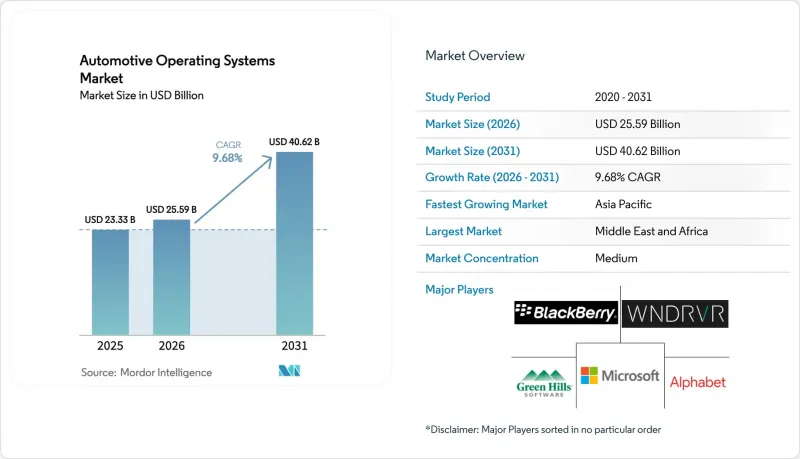
Mordor Intelligence에 의하면, 자동차용 운영체제 시장 규모는 2025년 233억 3,000만 달러에서 2026년에는 255억 9,000만 달러로 확대되어 2026년부터 2031년까지 CAGR 9.68%로 성장을 지속하여, 2031년에는 406억 2,000만 달러에 이를 것으로 예측됩니다.
(1) 반도체 산업 협회(Semiconductor Industry Association), 「State of the Industry 2024」, semiconductors.org 전동화의 진전, 유비쿼터스 연결성, 그리고 AI의 급속한 보급에 따라 운영체제는 센서,도메인 컨트롤러, 클라우드 백엔드를 연결하는 핵심 통합 계층이 되었습니다. 본 보고서는 OS의 유형(실시간 OS, 범용 OS 등), 차량의 유형(승용차, 소형 상용차 등), 용도(인포테인먼트 및 디지털 콕핏 등),구동 방식(내연기관 차량, 하이브리드 차량 등), 판매 채널(OEM 내장, 애프터마켓용 사후 장착), 자율주행 수준(레벨 0-1, 레벨 2 등), 그리고 지역별로 분류되어 있습니다.
전 세계 자동차용 운영체제 시장 동향 및 인사이트
커넥티드카 및 자율주행차에 대한 수요 급증
레벨 2 이상의 자율주행 기능은 중형 부문 차종에서도 표준 사양으로 자리 잡아가고 있으며, 각 OEM 업체들은 다중 모드 센서 입력을 실시간으로 융합할 수 있는 결정론적이고 높은 처리량을 갖춘 운영체제를 탑재해야 하는 상황에 직면해 있습니다. NVIDIA의 DriveOS는 주행용 AI 가속기를 탑재하고 있으며, OEM 각사에 안전 인증을 받은 턴키 스택을 제공하여 파일럿 프로그램에서 소프트웨어 검증 주기를 30% 단축했습니다. 메르세데스-벤츠는 2024년형 모델 시리즈에 ‘DriveOS’ 기반의 연산 유닛 탑재를 시작했으며, 이는 프리미엄 브랜드들이 OS 선택을 차별화의 수단으로 활용하고 있음을 보여줍니다. 현대는 자사의 커넥티드카 OS를 NVIDIA의 칩과 통합하여, 2025년까지 2,000만 대의 커넥티드카에서 OTA(Over-the-Air)를 통한 기능 릴리스 준비를 마쳤습니다. 이러한 도입 사례는 자동차용 운영체제 시장이 인포테인먼트 영역을 넘어 자율주행의 연산 영역으로 확대되고 있음을 보여줍니다.
차량 도메인 전반에 걸친 AI/ML 통합
현재 각 OEM 업체들은 에너지 관리, 차량 내 환경의 개인화, 예측 진단을 위해 디바이스 내에 머신러닝 엔진을 탑재하고 있습니다. BMW는 2024년, 센서 데이터를 학습 모델로 스트리밍하는 OS 수준의 추상화 레이어를 활용하여 클라우드 분석과 엣지 AI를 연계함으로써 예정에 없던 서비스 방문을 30% 줄였습니다. 토요타는 NTT와 제휴하여 실시간 교통 정보를 도시 규모의 경로 계산 엔진에 반영함으로써, 도시 지역의 평균 이동 시간을 20% 단축했습니다. 이를 위해서는 100밀리초 미만의 지연 시간으로 차량에서 클라우드로의 데이터 흐름을 조정할 수 있는 운영체제가 필요했습니다. HarmonyOS 5.0은 신경망 기반 장면 렌더링을 통합하여, 시간이 지남에 따라 운전자의 선호도를 학습하는 몰입형 3D 대시보드를 구현했습니다. 이러한 전개로 인해 자동차용 운영체제 시장은 AI 도입의 가파른 성장 곡선을 유지하고 있습니다.
데이터 개인정보 보호 및 사이버 보안 취약점
BlackBerry는 2023년 9월부터 12월 사이에 520만 건의 자동차 관련 악성코드 공격을 차단했다고 보고했으며, 그 중 절반은 지금까지 확인된 적이 없는 익스플로잇을 이용한 것이었습니다. 제너럴 모터스(GM)는 2024년, 인증되지 않은 소프트웨어가 구동계 제어 모듈에 간섭할 위험이 있다는 이유로 Apple CarPlay 사후 장착 프로젝트를 중단했습니다. 유럽의 ‘사이버 복원력 법(Cyber Resilience Act)’은 차량의 전체 수명 주기에 걸친 보안 업데이트를 의무화하게 되어, 중소 벤더들의 규정 준수 비용을 증가시킬 전망입니다. 이러한 위협으로 인해 자동차용 OS 시장의 단기적인 성장 기대는 억제되고 있습니다.
부문 분석
QNX는 브레이크, 스티어링, 섀시 분야에서의 ASIL D 인증 실적을 강점으로 삼아 2025년 자동차용 OS 시장 점유율 38.20%를 차지했습니다. Android Automotive는 OEM 각사가 익숙한 사용자 인터페이스 패러다임과 번거롭지 않은 클라우드 연동을 추구함에 따라 연평균 성장률(CAGR) 17.47%라는 가장 높은 성장 전망을 기록했습니다.
BlackBerry는 자사의 코드베이스가 전 세계 2억 3,500만 대의 차량에 탑재되어 있음을 밝히며, 안전 분야에서의 확고한 입지를 더욱 공고히 했습니다. 그러나 포드가 2024년 콕핏 개편에 안드로이드를 채택하기로 한 결정은 틈새 시장용 실시간 커널보다 소비자 지향적인 생태계가 우선시되는 경우가 많음을 보여줍니다. QNX Hypervisor 8.0과 같은 하이퍼바이저 설계를 통해 안드로이드와 리눅스는 QNX와 실리콘을 공유할 수 있게 되어, 구글 플레이 서비스를 호스팅하면서도 레거시 안전 코드를 그대로 유지하는 중요도 혼합형 브리지가 제공됩니다. 이러한 추세는 자동차용 운영체제 시장이 안전성과 인포테인먼트라는 양극화된 수요에 적응해 가고 있음을 보여줍니다.
2025년, 승용차는 판매 대수가 많아 자동차용 OS 시장 규모의 65.70%를 차지했으나, 배송 사업자들이 경로 관리, 텔레매틱스, 예측 유지보수의 디지털화를 추진함에 따라 소형 상용차 시장은 연평균 10.12%의 복합 성장률로 확대될 것으로 예측됩니다.
플릿 관리자들은 현재 OTA를 통한 가동률 향상을 요구하고 있습니다. 현대모비스는 단일 SoC 상에서 진단과 내비게이션을 분리하여 실행하는 물류 등급 콕핏에 QNX 하이퍼바이저를 채택하여 BOM 비용을 12% 절감했습니다. 대형 트럭도 유사한 스택을 채택하여 플래토닝 및 운전자 피로 분석을 통합 관리하고 있습니다. 상용차의 연간 주행 거리는 승용차의 2-3배에 달하므로 차량당 소프트웨어 가치가 높으며, 자동차용 운영체제 시장은 차량 함대의 현대화와 밀접하게 연결되어 있습니다.
지역별 분석
2025년 자동차용 운영체제 시장 규모에서 아시아태평양이 44.30%를 차지하며 1위를 기록했습니다. 이는 HarmonyOS와 자체 개발한 AI 칩을 결합한 중국의 수직 통합형 접근 방식이 주도한 결과입니다. 화웨이는 2025년 이전에 자사의 스마트 드라이빙 제품군 최종 사용자 수가 41만 2,100명에 달했다고 보고했으며, 이는 현지 공급망에 기반을 둔 국내 스택이 얼마나 신속하게 규모를 확대할 수 있는지를 보여줍니다. 일본 경제산업성은 도요타, 혼다, 닛산 3사의 소프트웨어 제휴를 촉진하고, 미들웨어 계층의 표준화를 통해 전 세계 소프트웨어 정의 차량(SDV) 매출의 30%를 확보하는 것을 목표로 하고 있습니다. 이러한 노력을 통해 해당 지역 시장 점유율은 더욱 확대될 가능성이 있습니다.
유럽에서는 UNECE(유엔 유럽 경제 위원회)의 사이버 보안 규제로 인해 규정 준수 비용이 증가했음에도 불구하고, 자국 내 인재 양성에 대한 투자를 지속했습니다. 폭스바겐의 CARIAD 부문은 그룹 전체 브랜드를 위한 공통 차량 OS와 클라우드를 구축하여, 모델별 소프트웨어 개발 공수를 40% 절감하는 것을 목표로 하고 있습니다. 발레오는 2025년에 AWS와 제휴하여 검증 워크플로우를 클라우드 네이티브 인프라로 전환함으로써, 기능의 OTA(Over-The-Air) 출시 기간을 몇 주에서 며칠로 단축했습니다. 레드햇은 차량용 리눅스로 ASIL-B 인증을 획득하여, 유럽 안전 기준을 준수하는 오픈소스 대안을 제공했습니다.
북미는 기술 기업과 자동차 제조업체의 협력에 있어 시험장으로서의 위상을 유지했습니다. 퀄컴과 구글은 차량용 코드의 컴파일, 플래시, 테스트를 모두 클라우드상에서 수행하는 브라우저 기반의 ‘Workbench’를 제공하여 프로토타이핑 주기를 50% 단축했습니다. 현대는 미국에 210억 달러를 투자하겠다고 약속했으며, 그중 60억 달러를 보스턴 다이내믹스 및 엔비디아와의 자율주행 AI 연구에 투입할 것이라고 밝혔습니다. 한편, 중동 및 아프리카에서는 레거시 제약에서 자유로운 전기차 중심의 OS 스택이 그린필드 모빌리티 프로젝트에 채택됨에 따라 연평균 성장률(CAGR) 11.12%의 전망이 제시되었으며, 자동차용 OS 시장의 신규 진출기업들에게 새로운 시장 기회가 창출되었습니다.
기타 혜택:
- 엑셀 형식 시장 예측(ME) 시트
- 3개월간의 애널리스트 지원
자주 묻는 질문
목차
제1장 서론
제2장 조사 방법
제3장 개요
제4장 시장 구도
제5장 시장 규모와 성장 예측
제6장 경쟁 구도
제7장 시장 기회와 향후 전망
JHS 26.09.03According to Mordor Intelligence, the automotive operating systems market size is expected to grow from USD 23.33 billion in 2025 to USD 25.59 billion in 2026 and is forecast to reach USD 40.62 billion by 2031 at 9.68% CAGR over 2026-2031.
[1] Semiconductor Industry Association, "State of the Industry 2024," semiconductors.org Growing electrification, ubiquitous connectivity, and rapid AI adoption have made the operating system the core integration layer that links sensors, domain controllers, and cloud back-ends. This report is Segmented by Operating System Type (Real-Time OS, General-Purpose OS, and More), Vehicle Type (Passenger Cars, Light Commercial Vehicles, and More), Application (Infotainment and Digital Cockpit, and More), Propulsion Type (ICE Vehicles, Hybrid Vehicles, and More), Sales Channel (OEM-Embedded, Aftermarket Retro-Fit), Level of Autonomy (Level 0-1, Level 2, and More), and Geography.
Global Automotive Operating Systems Market Trends and Insights
Demand surge for connected and autonomous vehicles
Level-2 and above automation features have become standard even in mid-segment cars, pushing OEMs to embed deterministic, high-throughput operating systems that can fuse multi-modal sensor inputs in real time. NVIDIA's DriveOS, shipped with drive-ready AI accelerators, provided OEMs a turnkey safety-certified stack that reduced software validation cycles by 30% in pilot programs. Mercedes-Benz started fitting DriveOS-based compute units in 2024 series models, signalling how premium brands leverage OS choice as a differentiation lever. Hyundai integrated its Connected-Car OS with NVIDIA silicon to prepare 20 million connected vehicles for over-the-air (OTA) feature releases by 2025. These deployments illustrate how the automotive operating systems market is expanding beyond infotainment into autonomous driving compute domains.
AI/ML integration across in-vehicle domains
OEMs now embed on-device machine-learning engines for energy management, cabin personalization, and predictive diagnostics. BMW linked its cloud analytics with edge AI in 2024 to cut unplanned service visits by 30%, using an OS-level abstraction layer that streams sensor data to learning models. Toyota partnered with NTT to feed real-time traffic inputs into a city-scale routing engine that lowered average urban travel times by 20%, requiring operating systems able to orchestrate vehicle-to-cloud data flows under 100 ms latency. HarmonyOS 5.0 integrated neural scene-rendering to deliver immersive 3-D dashboards that learn driver preferences over time. Such roll-outs keep the automotive operating systems market on a steep AI adoption curve.
Data-privacy and cyber-security vulnerabilities
BlackBerry reported blocking 5.2 million automotive-related malware attacks between September and December 2023, half of which relied on never-seen exploits. General Motors halted an Apple CarPlay retrofit project in 2024, citing risks that uncertified software could interfere with drive-train control modules. Europe's Cyber Resilience Act will impose mandatory security updates for the full vehicle lifecycle, raising compliance costs for smaller vendors. These threats temper near-term growth expectations for the automotive operating systems market.
Other drivers and restraints analyzed in the detailed report include:
- Regulatory push on cybersecurity and functional safety
- Transition to software-defined vehicle and OTA monetization
- System complexity and legacy integration hurdles
For complete list of drivers and restraints, kindly check the Table Of Contents.
Segment Analysis
QNX captured 38.20% of the automotive operating systems market share in 2025 on the strength of its ASIL D pedigree in braking, steering, and chassis domains. Android Automotive logged the fastest 17.47% CAGR outlook as OEMs sought familiar user-interface paradigms and effortless cloud tie-ins.
BlackBerry disclosed that its code base shipped inside 235 million vehicles worldwide, reinforcing its entrenched safety position. Yet Ford's decision to adopt Android for its 2024 cockpit refresh illustrated how consumer-oriented ecosystems are often prioritized over niche real-time kernels. Hypervisor designs such as QNX Hypervisor 8.0 let Android and Linux share silicon with QNX, providing a mixed-criticality bridge that keeps legacy safety code intact while hosting Google Play services. These patterns show the automotive operating systems market adjusting to polarized safety and infotainment demands.
Passenger cars provided 65.70% of the automotive operating systems market size in 2025, thanks to unit scale, yet light commercial vehicles are forecast to compound at 10.12% annually as delivery operators digitize routing, telematics, and predictive maintenance.
Fleet managers now demand OTA-driven uptime gains. Hyundai Mobis selected QNX Hypervisor for a logistics-grade cockpit that runs diagnostics and navigation isolation on a single SoC, cutting BOM cost by 12%. Heavy trucks adopt similar stacks to orchestrate platooning and driver fatigue analytics. Because commercial vehicles log 2-3X the annual mileage of passenger cars, software value per unit is higher, keeping the automotive operating systems market firmly tied to fleet modernization.
Complete Report Scope:
- By Operating System Type
- Real-Time OS (QNX, AUTOSAR Classic, VxWorks, INTEGRITY)
- General-Purpose OS (Android Automotive, AGL Linux, Windows, HarmonyOS)
- Hypervisor-based Mixed-Criticality Stacks
- By Vehicle Type
- Passenger Cars
- Light Commercial Vehicles
- Heavy Commercial Vehicles
- By Application
- Infotainment and Digital Cockpit
- ADAS and Autonomous Driving
- Connected Services and Telematics
- Body Control and Comfort
- Powertrain and Battery Management
- By Propulsion Type
- ICE Vehicles
- Hybrid Vehicles
- Battery Electric Vehicles
- Fuel-Cell Electric Vehicles
- By Sales Channel
- OEM-Embedded
- Aftermarket Retro-fit
- By Level of Autonomy
- Level 0-1
- Level 2
- Level 3
- Level 4-5
- By Geography
- North America
- United States
- Canada
- Mexico
- South America
- Brazil
- Argentina
- Rest of South America
- Europe
- Germany
- France
- United Kingdom
- Italy
- Spain
- Russia
- Rest of Europe
- Asia-Pacific
- China
- Japan
- South Korea
- India
- Southeast Asia
- Rest of Asia-Pacific
- Middle East and Africa
- Middle East
- Saudi Arabia
- United Arab Emirates
- Turkey
- Rest of Middle East
- Africa
- South Africa
- Rest of Africa
- Middle East
- North America
Geography Analysis
Asia-Pacific led with 44.30% of the automotive operating systems market size in 2025, anchored by China's vertically integrated approach that couples HarmonyOS with in-house AI chips. Huawei reported 412,100 end users on its smart-driving suite before 2025, demonstrating how domestic stacks can scale quickly when backed by local supply chains. Japan's industry ministry facilitated a software alliance between Toyota, Honda, and Nissan to capture 30% of global software-defined vehicle revenue by standardizing middleware layers, an initiative that may raise the region's stake further.
Europe continued to invest in sovereign software talent even as UNECE cyber-security rules raised compliance costs. Volkswagen's CARIAD unit built a common vehicle OS and cloud for all group brands, aiming to reduce per-model software effort by 40%. Valeo teamed with AWS in 2025 to migrate validation workflows to cloud-native infrastructure, enabling over-the-air feature releases within days rather than weeks. Red Hat received ASIL-B certification for its in-vehicle Linux, providing an open-source option that aligns with European safety doctrines.
North America remained the testbed for tech-automotive collaboration. Qualcomm and Google offered the browser-based Workbench that compiles, flashes, and tests vehicle code entirely in the cloud, trimming prototyping cycles by 50%. Hyundai pledged USD 21 billion of United States investment, reserving USD 6 billion for autonomous-driving AI research with Boston Dynamics and NVIDIA. Meanwhile, the Middle East and Africa posted an 11.12% CAGR outlook as green-field mobility projects adopted EV-centric OS stacks without legacy constraints, opening whitespace for new entrants in the automotive operating systems market.
- BlackBerry Limited
- Alphabet Inc. (Google)
- Wind River Systems
- Green Hills Software
- Microsoft Corporation
- Apple Inc.
- Automotive Grade Linux (Linux Foundation)
- Vector Informatik
- Elektrobit (Continental AG)
- Bosch Software and Digital Solutions
- Continental Automotive (EB corbos)
- NVIDIA Corporation
- Huawei Technologies (HarmonyOS Auto)
- Baidu Inc. (Apollo OS)
- Tencent AutoLink
- Renesas Electronics Corporation
- Qualcomm Technologies
- Samsung Electronics (Tizen IVI)
- NXP Semiconductors
- Lynx Software Technologies
- OpenSynergy GmbH
- Aptiv PLC
- Tata Elxsi
- Panasonic Automotive Systems
- PATEO Connectivity
Additional Benefits:
- The market estimate (ME) sheet in Excel format
- 3 months of analyst support
TABLE OF CONTENTS
1 INTRODUCTION
- 1.1 Study Assumptions and Market Definition
- 1.2 Scope of the Study
2 RESEARCH METHODOLOGY
3 EXECUTIVE SUMMARY
4 MARKET LANDSCAPE
- 4.1 Market Overview
- 4.2 Market Drivers
- 4.2.1 Demand surge for connected and autonomous vehicles
- 4.2.2 AI/ML integration across in-vehicle domains
- 4.2.3 Regulatory push on cybersecurity and functional safety
- 4.2.4 Transition to software-defined vehicle and OTA update monetization
- 4.2.5 Cloud-native virtual validation accelerating OS release cycles
- 4.2.6 Freemium licensing models expanding developer ecosystem
- 4.3 Market Restraints
- 4.3.1 Data-privacy and cyber-security vulnerabilities
- 4.3.2 System complexity and legacy integration hurdles
- 4.3.3 Scarcity of certified automotive-grade software talent
- 4.3.4 OEM concerns over platform lock-in and IP leakage
- 4.4 Value Chain Analysis
- 4.5 Regulatory Landscape
- 4.6 Technological Outlook
- 4.7 Porter's Five Forces Analysis
- 4.7.1 Threat of New Entrants
- 4.7.2 Bargaining Power of Buyers
- 4.7.3 Bargaining Power of Suppliers
- 4.7.4 Threat of Substitutes
- 4.7.5 Intensity of Competitive Rivalry
5 MARKET SIZE AND GROWTH FORECASTS (VALUES)
- 5.1 By Operating System Type
- 5.1.1 Real-Time OS (QNX, AUTOSAR Classic, VxWorks, INTEGRITY)
- 5.1.2 General-Purpose OS (Android Automotive, AGL Linux, Windows, HarmonyOS)
- 5.1.3 Hypervisor-based Mixed-Criticality Stacks
- 5.2 By Vehicle Type
- 5.2.1 Passenger Cars
- 5.2.2 Light Commercial Vehicles
- 5.2.3 Heavy Commercial Vehicles
- 5.3 By Application
- 5.3.1 Infotainment and Digital Cockpit
- 5.3.2 ADAS and Autonomous Driving
- 5.3.3 Connected Services and Telematics
- 5.3.4 Body Control and Comfort
- 5.3.5 Powertrain and Battery Management
- 5.4 By Propulsion Type
- 5.4.1 ICE Vehicles
- 5.4.2 Hybrid Vehicles
- 5.4.3 Battery Electric Vehicles
- 5.4.4 Fuel-Cell Electric Vehicles
- 5.5 By Sales Channel
- 5.5.1 OEM-Embedded
- 5.5.2 Aftermarket Retro-fit
- 5.6 By Level of Autonomy
- 5.6.1 Level 0-1
- 5.6.2 Level 2
- 5.6.3 Level 3
- 5.6.4 Level 4-5
- 5.7 By Geography
- 5.7.1 North America
- 5.7.1.1 United States
- 5.7.1.2 Canada
- 5.7.1.3 Mexico
- 5.7.2 South America
- 5.7.2.1 Brazil
- 5.7.2.2 Argentina
- 5.7.2.3 Rest of South America
- 5.7.3 Europe
- 5.7.3.1 Germany
- 5.7.3.2 France
- 5.7.3.3 United Kingdom
- 5.7.3.4 Italy
- 5.7.3.5 Spain
- 5.7.3.6 Russia
- 5.7.3.7 Rest of Europe
- 5.7.4 Asia-Pacific
- 5.7.4.1 China
- 5.7.4.2 Japan
- 5.7.4.3 South Korea
- 5.7.4.4 India
- 5.7.4.5 Southeast Asia
- 5.7.4.6 Rest of Asia-Pacific
- 5.7.5 Middle East and Africa
- 5.7.5.1 Middle East
- 5.7.5.1.1 Saudi Arabia
- 5.7.5.1.2 United Arab Emirates
- 5.7.5.1.3 Turkey
- 5.7.5.1.4 Rest of Middle East
- 5.7.5.2 Africa
- 5.7.5.2.1 South Africa
- 5.7.5.2.2 Rest of Africa
- 5.7.5.1 Middle East
- 5.7.1 North America
6 COMPETITIVE LANDSCAPE
- 6.1 Market Concentration
- 6.2 Strategic Moves
- 6.3 Market Share Analysis
- 6.4 Company Profiles (includes Global level Overview, Market level overview, Core Segments, Financials as available, Strategic Information, Market Rank/Share for key companies, Products and Services, and Recent Developments)
- 6.4.1 BlackBerry Limited
- 6.4.2 Alphabet Inc. (Google)
- 6.4.3 Wind River Systems
- 6.4.4 Green Hills Software
- 6.4.5 Microsoft Corporation
- 6.4.6 Apple Inc.
- 6.4.7 Automotive Grade Linux (Linux Foundation)
- 6.4.8 Vector Informatik
- 6.4.9 Elektrobit (Continental AG)
- 6.4.10 Bosch Software and Digital Solutions
- 6.4.11 Continental Automotive (EB corbos)
- 6.4.12 NVIDIA Corporation
- 6.4.13 Huawei Technologies (HarmonyOS Auto)
- 6.4.14 Baidu Inc. (Apollo OS)
- 6.4.15 Tencent AutoLink
- 6.4.16 Renesas Electronics Corporation
- 6.4.17 Qualcomm Technologies
- 6.4.18 Samsung Electronics (Tizen IVI)
- 6.4.19 NXP Semiconductors
- 6.4.20 Lynx Software Technologies
- 6.4.21 OpenSynergy GmbH
- 6.4.22 Aptiv PLC
- 6.4.23 Tata Elxsi
- 6.4.24 Panasonic Automotive Systems
- 6.4.25 PATEO Connectivity
7 MARKET OPPORTUNITIES AND FUTURE OUTLOOK
- 7.1 White-space and Unmet-Need Assessment