
|
시장보고서
상품코드
2119800
자동차 대출 : 시장 점유율 분석, 업계 동향 및 통계, 성장 예측(2026-2031년)Auto Loan - Market Share Analysis, Industry Trends & Statistics, Growth Forecasts (2026 - 2031) |
||||||
 Mordor Intelligence
Mordor Intelligence에 의하면, 자동차 대출 시장 규모는 2025년에 1조 8,400억 달러로 평가되었습니다. 2026년 1조 9,800억 달러에서 2031년까지 2조 8,800억 달러에 이를 것으로 추정되고 예측 기간(2026-2031년) CAGR은 7.78%를 나타낼 전망입니다.
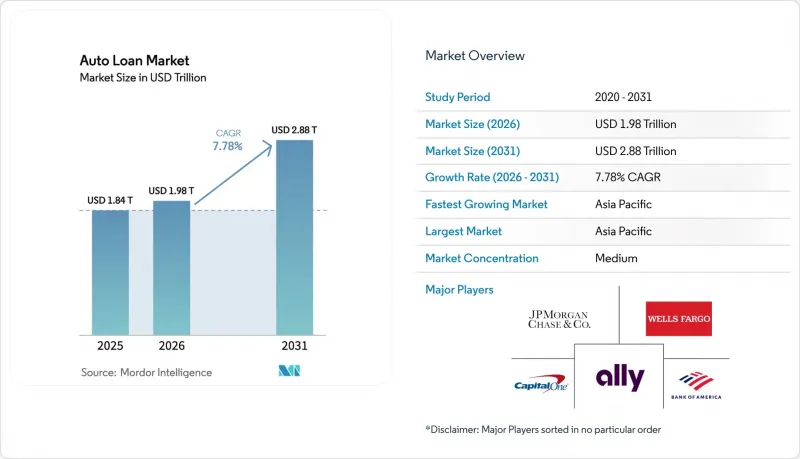
본 보고서는 차량 유형(승용차, 상용차), 차종(이륜차·스쿠터, 오토릭샤·화물용 삼륜차, 기타), 소유 형태(신차, 중고차), 제공업체 유형(은행, 비은행 금융기관, 기타), 계약 기간(3년 미만, 기타),지역(북미, 기타)별로 분류되어 있습니다. 시장 예측은 금액(달러) 기준으로 제시되어 있습니다.
세계의 자동차 대출 시장 동향 및 인사이트
승용차 수요 증가
승용차 대출 실행액은 2024년 시장 점유율의 81.23%를 차지했으며, 중국, 인도, 동남아시아의 급속한 도시화에 힘입어 연평균 성장률(CAGR) 8.95%로 성장하고 있습니다. 중국의 OEM은 2024년 21%에서 2030년까지 세계 점유율 33%를 달성할 전망이며, 이에 따라 수출 시장에서 캡티브 파이낸스의 확산이 촉진되고 있습니다. 전기차(EV)가 이러한 추세를 더욱 뒷받침하고 있습니다. 중국이 2025년까지 신차 판매에서 전기차 보급률을 45%로 끌어올리겠다는 목표를 내건 가운데, 아시아는 전 세계 전기차 판매 대수의 60%를 차지하고 있습니다. 금융 기관들은 전기차 전용 잔존가치 프로그램을 맞춤형으로 설계하고, 배터리 보증과 연계된 금리 우대 조치를 제공함으로써 이러한 추세를 활용하고 있습니다.
신속한 디지털 대출 심사
디지털 대출 신청 건수는 2020년 대비 165% 증가했으며, 1페이지로 완료되는 신청서와 소프트 크레딧 조회를 통해 승인까지 걸리는 시간이 2분 이하로 단축되었습니다. 캐피탈 원의 ‘Auto Navigator’는 차량 검색 중에 사전 승인된 금리를 제공하며, 업스타트의 AI 워크플로우를 통해 딜러는 1분 이내에 계약을 체결할 수 있고, FICO 오토 스코어 및 사기 점검이 자동으로 수행됩니다. 구매자의 70% 이상이 집에서 대출 절차를 완료하기를 희망하고 있으며, 딜러 측에서는 사전 심사를 마친 잠재 고객에 대한 계약 성사율이 41% 상승했다고 보고하고 있습니다. 플랫폼형 대출 업체는 자동화된 워크플로우를 통해 수동 심사 과정을 줄이고, 계약 1건당 고객 확보 비용을 절감함으로써 비용 효율성을 높이고 있습니다.
금리 상승
2024년 11월 연방준비제도이사회(FRB)가 정책 금리를 25베이시스포인트 인하했으나, 자동차 대출 연이율(APR)은 여전히 높은 수준을 유지하고 있어 소비자 지출의 부담이 되고 있습니다. Bankrate의 데이터에 따르면, 기준금리 인상은 특히 서브프라임 계층에서 자동차 대출 금리 상승으로 직접 이어지고 있는 것으로 확인되었습니다. 연체율은 현재 팬데믹 이전의 최고치를 상회하고 있으며, 연방준비제도이사회(FRB)는 2022년 계약 대출의 상환 상황 악화를 지적하고 있습니다. 각 대출 기관은 성장과 위험의 균형을 맞추기 위해 신용 점수 기준을 강화하고, 얼터너티브 데이터의 활용을 확대되고 있습니다.
부문 분석
2025년, 승용차 대출은 전 세계 자동차 대출 시장의 80.75%를 차지했으며, 이 부문은 연평균 성장률(CAGR) 7.46%로 확대될 것으로 예상되어 전 세계 자동차 대출 시장은 가계의 이동성 예산에 자리 잡고 있습니다. 콤팩트 SUV와 배터리 전기자동차(BEV)의 부상으로 차주층이 확대되면서, 대출 기관은 보험 및 서비스 계약의 교차 판매가 가능해졌습니다. 대조적으로, 상용차 금융은 화물 수송량이나 전자상거래 수요에 좌우되기 때문에 여전히 경기 순환의 영향을 받기 쉬운 상황에 있습니다. 더 친환경적인 트럭을 원하는 중국의 차량 운영 업체들로 인해, OEM의 보증이 뒷받침되는 그린 파이낸스 상품에 대한 관심이 높아지고 있습니다.
이 부문은 표준화된 신용 심사 기준과 견고한 담보 유동성을 뒷받침하고 있어 전 세계 자동차 대출 시장 규모에 크게 기여하고 있습니다. 도시 지역의 교통 체증 대책이 발전함에 따라 대출 기관은 여러 사용자 간에 잔존 가치를 증권화하는 공동 소유자 시범 프로그램을 개발하고 있습니다. 한편, 상용차 대출 기관들은 상환액을 주행 거리나 적재율에 연동시키는 텔레메트리 기반의 ‘주행 거리 기반 결제(Pay-as-you-drive)’ 시스템을 도입하고 있습니다.
2025년, 해치백, 세단, SUV와 같은 승용차는 세계 자동차 대출 시장에서 82.30%의 점유율을 차지했습니다. 이는 소비자의 뿌리 깊은 선호도와 탄탄한 딜러 금융 체계를 반영한 결과입니다. 그러나 도시 지역의 라이더들이 저렴하고 기동성이 높은 이동 수단을 찾는 가운데, 이륜차와 스쿠터는 연평균 성장률(CAGR) 9.98%를 기록하며 그 성장세를 앞지르고 있습니다. 이 하위 부문의 대출 금액은 소액이지만 대출 건수가 많아, 인도와 동남아시아에서 세계 자동차 대출 시장 규모 확대에 크게 기여하고 있습니다.
금융기관은 이륜차에 대해 위험 기반 가격 책정을 실시하여, 급속한 감가상각과 높은 회수율 간의 균형을 맞추고 있습니다. 화물용 삼륜차와 픽업트럭도 원격 신원 확인(KYC) 및 즉시 담보권 등록을 제공하는 핀테크 플랫폼에 진입하고 있습니다. 승용차는 여전히 증권화 풀을 주도하고 있으며, 이를 통해 유통 시장의 유동성이 확보되어 마이크로모빌리티 대출에 비해 위험 프리미엄이 억제되고 있습니다.
지역별 분석
아시아태평양은 2025년 점유율 33.62%, 연평균 성장률(CAGR) 9.48%의 전망을 보이며, 세계 자동차 대출 시장의 중심이 되었습니다. 2024년 4월 중국이 최저 계약금 요건을 폐지한 조치는 대출 수요를 자극하고 쇼룸 방문객 수를 증가시켰습니다. 전 세계 판매 대수의 60%를 차지하는 이 지역의 전기차(EV) 부문에서의 주도적 입지는 대출 기관들이 배터리 잔존가치 모델 및 충전 구독과 같은 부가 서비스에 진출하도록 촉진하고 있습니다. 인도와 아세안(ASEAN) 회원국들은 e-KYC 체계를 자유화하여, 스마트폰 앱을 통한 이륜차 대출 확대가 가능해졌습니다.
북미 시장은 성숙 단계에 있지만 여전히 유동적입니다. CFPB(소비자금융보호국)의 2024년 감독 보고서는 GAP 면책 및 추가 옵션 판매와 관련된 기만적인 행위를 지적했으며, 이로 인해 금융 기관들은 공개 내용을 근본적으로 재검토해야만 했습니다. 평균 거래 가격이 4만 8,000달러인 만큼, 소비자들은 더 긴 상환 기간이나 중고차 구매를 선호하는 경향을 보이고 있습니다. 2025년에는 대출 기관들이 소득 확인 및 전자 저당권 등록을 자동화함에 따라 디지털 대출 체결 건수가 29% 증가했습니다. 연방준비제도이사회(FRB)의 정책으로 인해 프라임 APR이 높은 수준을 유지하고 있어, 신용도가 낮은 차주에게 압박을 가하고 있으며, 연체율은 팬데믹 이전 수준을 상회하고 있습니다.
유럽에서는 규제 측면에서 급격한 변화를 겪고 있습니다. 영국에서는 수수료 투명성을 둘러싼 소송으로 인해 최대 280억 파운드의 배상금이 발생할 수 있으며, 이는 대출 기관의 수익 구조를 일변시킬 가능성이 있습니다. 한편, 투자자들이 변동금리 자산을 선호함에 따라 2024년 증권화 규모는 1,370억 유로에 달했습니다. 유럽 대륙의 은행들은 2035년까지 자동차 금융의 총부가가치가 30억-40억 달러 증가할 것으로 전망하며, 친환경 모빌리티 관련 포트폴리오를 확대되고 있습니다. 중동 및 아프리카 시장에는 아직 개발되지 않은 성장 기회가 있습니다. GCC(걸프협력회의) 회원국 은행들은 GDP 성장률 3.5% 전망을 바탕으로 샤리아(이슬람 법)에 부합하는 자동차 금융 상품을 확대하고 있는 반면, 남아프리카공화국에서는 디지털 온보딩 규제로 인해 신용 포용이 가속화되고 있습니다.
기타 혜택
- 엑셀 형식 시장 전망(ME) 시트
- 3개월간 애널리스트 지원
자주 묻는 질문
목차
제1장 서론
제2장 조사 방법
제3장 주요 요약
제4장 시장 구도
제5장 시장 규모 및 성장 예측
제6장 경쟁 구도
제7장 시장 기회 및 향후 전망
KTH 26.09.10According to Mordor Intelligence, the auto loan market size was valued at USD 1.84 trillion in 2025 and is estimated to grow from USD 1.98 trillion in 2026 to reach USD 2.88 trillion by 2031, at a CAGR of 7.78% during the forecast period (2026-2031).
This report is Segmented by Vehicle Type (Passenger Vehicle, Commercial Vehicle), Vehicle Model (Motorcycles/Scooters, Auto-rickshaws/Cargo 3Ws, and More), Ownership (New Vehicles, Used Vehicles), Provider Type (Banks, Non-Banking Financial Institutions, and More), Tenure (Less Than 3 Years, and More), and Geography (North America, and More). The Market Forecasts are Provided in Terms of Value (USD).
Global Auto Loan Market Trends and Insights
Increasing Demand for Passenger Vehicles
Passenger-vehicle originations contributed 81.23% of the 2024 market share and are growing at an 8.95% CAGR, buoyed by rapid urbanization across China, India, and Southeast Asia. Chinese OEMs are on course for a 33% global share by 2030, up from 21% in 2024, spurring captive-finance penetration in export markets. Electric vehicles (EVs) reinforce this trajectory; Asia accounts for 60% of global EV sales as China targets 45% EV penetration of new sales in 2025. Lenders exploit these trends by tailoring residual-value programs for EVs and offering rate incentives that mirror battery warranties.
Quick Digital Loan Processing
Digital origination volumes grew 165% versus 2020, with single-page applications and soft-credit pulls reducing approval times to under two minutes. Capital One's Auto Navigator provides pre-approved rates during vehicle search, while Upstart's AI workflow lets dealers close a deal in less than one minute, automatically delivering FICO Auto Scores and fraud checks. Over 70% of shoppers prefer completing finance steps at home, and dealers report 41% higher close ratios on pre-qualified leads. Platform lenders reap cost efficiencies as automated workflows cut manual underwriting steps and shrink acquisition cost per booked loan.
Rising Interest Rates
Although the Federal Reserve trimmed rates by 25 bps in November 2024, auto APRs remain elevated and weigh on wallet share. Bankrate data confirm that higher policy rates directly translate into more expensive auto loans, especially for subprime tiers. Delinquencies now exceed pre-pandemic peaks, with the Federal Reserve noting performance deterioration across 2022-vintage loans. Lenders are tightening score cutoffs and amplifying the use of alternative data to balance growth and risk.
Other drivers and restraints analyzed in the detailed report include:
- Expansion of Used-Vehicle Financing
- OEM Captive-Finance Growth
- Escalating Vehicle Prices
For complete list of drivers and restraints, kindly check the Table Of Contents.
Segment Analysis
Passenger-vehicle loans accounted for an 80.75% share in the global auto loan market in 2025, and the segment is expected to advance at an 7.46% CAGR, embedding the Global auto loan market in household mobility budgets. The rise of compact SUVs and battery-electric models has broadened borrower profiles, enabling lenders to cross-sell insurance and service contracts. In contrast, commercial-vehicle financing remains cyclical, tied to freight volumes and e-commerce demand. Chinese fleet operators seeking cleaner trucks spur interest in green-finance lines backed by OEM warranties.
The segment contributes materially to the Global auto loan market size because it supports standardized underwriting matrices and robust collateral liquidity. As city congestion policies evolve, lenders develop shared-ownership pilot programs that securitize residual value across multiple users. Commercial-vehicle lenders, meanwhile, deploy telemetry-driven pay-as-you-drive structures that link repayment to mileage and load factors.
Cars-hatchbacks, sedans, and SUVs-held 82.30% share in the global auto loan market in 2025, reflecting entrenched consumer preference and ample dealership financing infrastructure. Yet, motorcycles and scooters outpace with a 9.98% CAGR as urban riders seek affordable and nimble transport. Loan-ticket sizes in this sub-segment are lower, but origination volumes are high, contributing meaningfully to the Global auto loan market depth in India and Southeast Asia.
Financiers craft risk-based pricing for two-wheelers, balancing faster depreciation with higher recovery rates. Cargo three-wheelers and pickups are also joining fintech platforms that offer remote KYC and instant lien registration. Cars continue to dominate securitization pools, ensuring secondary-market liquidity and keeping risk premiums compressed relative to micro-mobility loans.
Complete Report Scope:
- By Vehicle Type
- Passenger Vehicle
- Commercial Vehicle
- By Vehicle Model
- Motorcycles/Scooters
- Auto-rickshaws/Cargo 3Ws
- Cars (Hatchbacks, Sedans, SUVs, etc.)
- Pickups and Small Vans
- Trucks and Buses
- Others
- By Ownership
- New Vehicles
- Used Vehicles
- By Provider Type
- Banks
- Non-Banking Financial Institutions
- Original Equipment Manufacturers
- Other Provider Types (Fintech Companies)
- By Tenure
- Less than 3 Years
- 3-5 Years
- More than 5 years
- By Region
- North America
- United States
- Canada
- Mexico
- South America
- Brazil
- Argentina
- Chile
- Colombia
- Rest of South America
- Europe
- United Kingdom
- Germany
- France
- Spain
- Italy
- Benelux (Belgium, Netherlands, and Luxembourg)
- Nordics (Sweden, Norway, Denmark, Finland, and Iceland)
- Rest of Europe
- Asia-Pacific
- China
- India
- Japan
- South Korea
- Australia
- South-East Asia (Singapore, Indonesia, Malaysia, Thailand, Vietnam, and Philippines)
- Rest of Asia-Pacific
- Middle East and Africa
- United Arab Emirates
- Saudi Arabia
- South Africa
- Nigeria
- Rest of Middle East and Africa
- North America
Geography Analysis
Asia-Pacific anchors the Global auto loan market with a 33.62% 2025 share and a 9.48% CAGR outlook. China's April 2024 policy scrapping minimum down payments ignited credit demand and boosted showroom traffic. The region's EV leadership, with 60% of global sales, pulls lenders toward battery-residual models and charging-subscription add-ons. India and ASEAN members liberalize e-KYC frameworks, enabling two-wheeler credit expansion via smartphone apps.
North America remains mature yet fluid. The CFPB's 2024 supervisory report spotlighted deceptive GAP-waiver and add-on sales, prompting lenders to overhaul disclosures. Average transaction prices at USD 48,000 steer consumers toward longer tenures and used inventory. Digital origination volumes climbed 29% in 2025, as lenders automate income verification and electronic lien filing. Federal Reserve policy keeps prime APRs high, squeezing marginal borrowers and lifting delinquencies above pre-pandemic levels.
Europe contends with regulatory shake-ups. In the United Kingdom, potential GBP 28 billion in redress stemming from commission transparency litigation could reorder lender economics. Meanwhile, securitization volumes reached EUR 137 billion in 2024 as investors sought floating-rate assets. Continental banks upscale green-mobility portfolios, anticipating a USD 30-40 billion uplift to auto-finance gross value added by 2035. Middle East and Africa markets offer white-space growth: GCC banks capitalize on 3.5% GDP growth forecasts to extend Sharia-compliant auto products, while South Africa's digital-on-boarding rules accelerate credit inclusion.
- Ally Financial
- Wells Fargo
- JPMorgan Chase Auto
- Capital One
- Bank of America
- BNP Paribas Personal Finance
- Credit Agricole Auto Bank
- HDFC Bank
- ICICI Bank
- Mashreq Bank
- Toyota Financial Services
- Ford Motor Credit Company
- GM Financial
- Santander Consumer USA
- Hyundai Capital
- Daimler Mobility AG
- Volkswagen Financial Services
- PSA Banque (Stellantis Financial Services)
- Axis Bank
- Barclays
Additional Benefits:
- The market estimate (ME) sheet in Excel format
- 3 months of analyst support
TABLE OF CONTENTS
1 Introduction
- 1.1 Study Assumptions & Market Definition
- 1.2 Scope of the Study
2 Research Methodology
3 Executive Summary
4 Market Landscape
- 4.1 Market Overview
- 4.2 Market Drivers
- 4.2.1 Increasing demand for passenger vehicles
- 4.2.2 Quick digital loan processing
- 4.2.3 Expansion of used-vehicle financing
- 4.2.4 OEM captive-finance growth
- 4.2.5 Embedded finance with mobility platforms
- 4.2.6 AI-based credit scoring for thin-file borrowers
- 4.3 Market Restraints
- 4.3.1 Rising interest rates
- 4.3.2 Escalating vehicle prices
- 4.3.3 Regulatory scrutiny on balloon/long-tenor loans
- 4.3.4 Shift toward vehicle-subscription models
- 4.4 Value / Supply-Chain Analysis
- 4.5 Regulatory Landscape
- 4.6 Technological Outlook
- 4.7 Porter's Five Forces
- 4.7.1 Bargaining Power of Buyers
- 4.7.2 Bargaining Power of Suppliers
- 4.7.3 Threat of New Entrants
- 4.7.4 Threat of Substitutes
- 4.7.5 Intensity of Competitive Rivalry
5 Market Size & Growth Forecasts (Value)
- 5.1 By Vehicle Type
- 5.1.1 Passenger Vehicle
- 5.1.2 Commercial Vehicle
- 5.2 By Vehicle Model
- 5.2.1 Motorcycles/Scooters
- 5.2.2 Auto-rickshaws/Cargo 3Ws
- 5.2.3 Cars (Hatchbacks, Sedans, SUVs, etc.)
- 5.2.4 Pickups and Small Vans
- 5.2.5 Trucks and Buses
- 5.2.6 Others
- 5.3 By Ownership
- 5.3.1 New Vehicles
- 5.3.2 Used Vehicles
- 5.4 By Provider Type
- 5.4.1 Banks
- 5.4.2 Non-Banking Financial Institutions
- 5.4.3 Original Equipment Manufacturers
- 5.4.4 Other Provider Types (Fintech Companies)
- 5.5 By Tenure
- 5.5.1 Less than 3 Years
- 5.5.2 3-5 Years
- 5.5.3 More than 5 years
- 5.6 By Region
- 5.6.1 North America
- 5.6.1.1 United States
- 5.6.1.2 Canada
- 5.6.1.3 Mexico
- 5.6.2 South America
- 5.6.2.1 Brazil
- 5.6.2.2 Argentina
- 5.6.2.3 Chile
- 5.6.2.4 Colombia
- 5.6.2.5 Rest of South America
- 5.6.3 Europe
- 5.6.3.1 United Kingdom
- 5.6.3.2 Germany
- 5.6.3.3 France
- 5.6.3.4 Spain
- 5.6.3.5 Italy
- 5.6.3.6 Benelux (Belgium, Netherlands, and Luxembourg)
- 5.6.3.7 Nordics (Sweden, Norway, Denmark, Finland, and Iceland)
- 5.6.3.8 Rest of Europe
- 5.6.4 Asia-Pacific
- 5.6.4.1 China
- 5.6.4.2 India
- 5.6.4.3 Japan
- 5.6.4.4 South Korea
- 5.6.4.5 Australia
- 5.6.4.6 South-East Asia (Singapore, Indonesia, Malaysia, Thailand, Vietnam, and Philippines)
- 5.6.4.7 Rest of Asia-Pacific
- 5.6.5 Middle East and Africa
- 5.6.5.1 United Arab Emirates
- 5.6.5.2 Saudi Arabia
- 5.6.5.3 South Africa
- 5.6.5.4 Nigeria
- 5.6.5.5 Rest of Middle East and Africa
- 5.6.1 North America
6 Competitive Landscape
- 6.1 Market Concentration
- 6.2 Strategic Moves
- 6.3 Market Share Analysis
- 6.4 Company Profiles (includes Global Level Overview, Market Level Overview, Core Segments, Financials as available, Strategic Information, Market Rank/Share for Key Companies, Products & Services, and Recent Developments)
- 6.4.1 Ally Financial
- 6.4.2 Wells Fargo
- 6.4.3 JPMorgan Chase Auto
- 6.4.4 Capital One
- 6.4.5 Bank of America
- 6.4.6 BNP Paribas Personal Finance
- 6.4.7 Credit Agricole Auto Bank
- 6.4.8 HDFC Bank
- 6.4.9 ICICI Bank
- 6.4.10 Mashreq Bank
- 6.4.11 Toyota Financial Services
- 6.4.12 Ford Motor Credit Company
- 6.4.13 GM Financial
- 6.4.14 Santander Consumer USA
- 6.4.15 Hyundai Capital
- 6.4.16 Daimler Mobility AG
- 6.4.17 Volkswagen Financial Services
- 6.4.18 PSA Banque (Stellantis Financial Services)
- 6.4.19 Axis Bank
- 6.4.20 Barclays
7 Market Opportunities & Future Outlook
- 7.1 White-Space & Unmet-Need Assessment