
|
시장보고서
상품코드
2119828
유방 생검 기기 : 시장 점유율 분석, 업계 동향 및 통계, 성장 예측(2026-2031년)Breast Biopsy Devices - Market Share Analysis, Industry Trends & Statistics, Growth Forecasts (2026 - 2031) |
||||||
 Mordor Intelligence
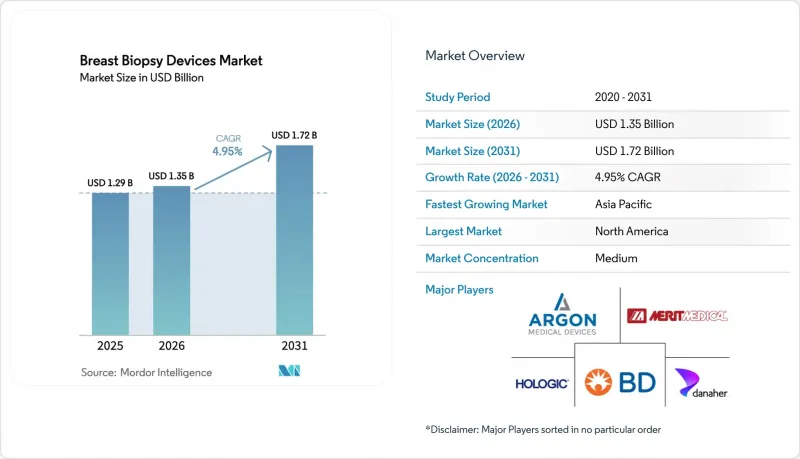
Mordor Intelligence에 의하면, 유방 생검 기기 시장 규모는 2025년 12억 9,000만 달러로 평가되었습니다. 2026년에는 13억 5,000만 달러로 확대되어 2026-2031년에 걸쳐 CAGR 4.95%로 성장을 지속하여, 2031년에는 17억 2,000만 달러에 이를 것으로 예측됩니다.
본 보고서는 제품별(유방 생검용 바늘, 기타), 시술별(진공 보조 생검, 기타), 방법별(영상 유도 하 생검(스테레오타크틱 가이드 하 등), 기타), 적응증별(섬유선종, 복합성 낭종, 기타), 최종 사용자(병원 및 클리닉, 유방암 치료 센터, 기타), 지역(북미, 기타)별로 분류되어 있습니다. 시장 예측은 금액(달러)으로 제시되어 있습니다.
세계의 유방 생검 기기 시장 동향 및 인사이트
유방암 유병률 및 인지도 상승
유방암 발병률은 젊은 층에서 증가하고 있으며, 특히 아시아에서는 발병 중앙값이 현재 50-54세로, 이는 서유럽 국가들보다 5-7년 빠른 상황입니다. 국가 검진 프로그램으로 인해 생검 대상 환자층은 확대되고 있지만, 중국의 참여율은 여전히 21.7%에 그치고 있어 큰 미충족 수요가 존재함을 보여줍니다. 도시와 농촌 간의 격차로 인해 2차 의료기관에서도 운용 가능한 휴대용이며 비용 효율적인 기기에 대한 수요가 높아지고 있습니다. 출생률 감소와 생활 방식의 변화가 위험을 더욱 높이고 있어, 인구 고령화와 관계없이 생검 시술 건수는 지속적으로 증가할 전망입니다. 인도와 동남아시아 각국 정부는 인식 제고 캠페인을 강화하고 있으며, 외래 진료 시설이 증가하는 환자 수에 대응하기 위해 자동화된 AI 지원 시스템에 대한 투자를 추진함에 따라 장비 교체 속도가 빨라지고 있습니다.
영상 유도 생검에 대한 보험 적용 범위 확대
메디케어는 BIRADS III-V 병변에 대한 경피적 영상 유도 유방 생검을 보험 적용 대상으로 하고 있으며, 많은 민간 보험사 및 해외 보험사들이 현재 이 모델을 따르고 있습니다. 진공 보조 스테레오타크틱 생검은 외과적 절제와 비교하여 1건당 741달러의 비용 절감이 가능하여, 저침습적 선택지의 경제적 타당성을 높이고 있습니다. 유럽의 진단 관련 그룹(DRG)도 경피적 생검을 평가 대상으로 하고 있으며, 일본과 한국의 초기 지침도 미국 모델을 반영하고 있습니다. AI 기반 3D 영상 도구의 경우, 보험 적용 범위에 편차가 있기 때문에 청구 코드를 확보한 공급업체가 선점 우위를 점하고 있습니다. 사모펀드가 자금을 지원하는 영상진단 체인은 센터 확장 및 신규 장비 도입 자금을 조달하기 위해 안정적인 보험 환급 수입에 의존하고 있습니다.
생검 후 감염 및 혈종 위험
진공 보조 생검 1주일 후에는 최대 94%의 환자에서 혈종이 발생하지만, 그 대부분은 21일 이내에 해소됩니다. 임상적으로 심각한 출혈은 정위 생검의 6.7%에서 발생하며, 그중 96.2%는 경미한 수준으로 분류됩니다. 비록 경미한 사건이라 할지라도 환자의 불안을 조장하고, 추적 검사를 주저하게 만드는 원인이 될 수 있습니다. 감염률은 고소득 국가에서는 낮은 수준을 유지하고 있지만, 무균 프로토콜이 철저히 준수되지 않는 지역에서는 상승하므로, 의료 서비스가 부족한 지역에서는 첨단 장비 도입에 신중한 태도가 요구됩니다.
부문 분석
2025년, 유방 생검용 바늘은 매출의 42.70%를 차지했으며, 이는 소모품이라는 특성과 모든 시술에서 필수적인 역할을 수행하고 있음을 보여줍니다. 가이드 및 영상 시스템용 유방 생검 기기 시장 규모는 비록 작지만, 학습 곡선을 단축하는 AI 오버레이, 로봇 제어 장치, 다중 모드 3D 시각화 기술의 도입으로 인해 연평균 성장률(CAGR) 9.85%로 확대될 것으로 예측됩니다. 병원에서는 스테레오택틱, 초음파, 토모신테시스 모듈을 통합한 콘솔이 채택되어 있어 시술 도중에도 원활하게 전환할 수 있습니다. 각 벤더사는 사용하기 쉬운 대시보드, 클라우드 연동 분석 기능, 외래 진료실에 설치할 수 있는 컴팩트한 본체 등을 통해 차별화를 꾀하고 있습니다. 일회용 액세서리 키트는 감염 예방 팀 사이에서 지지를 얻고 있으며, 각 가이드 플랫폼과 관련된 일회용 부품에 대한 견조한 수요를 보여주고 있습니다.
의료 기관은 재주문 가능한 바늘을 통한 수익의 예측 가능성을 중시하고 있지만, 워크플로우 분석용 구독형 소프트웨어와 이러한 소모품을 세트로 판매하는 경향이 강해지고 있습니다. 예를 들어, AI 지원형 콘솔을 도입한 한 의료기관에서는 생검 재실시율이 14% 감소했다고 보고되었으며, 이로 인해 보험사 측의 신뢰가 높아지면서 보험 적용 범위가 확대되고 있습니다. 가이드 플랫폼에 대한 예산이 확대됨에 따라 교차 판매 기회도 늘어나고 있으며, 유방 생검 기기 시장에서 선순환이 강화되고 있습니다.
진공 보조 생검(VAB)은 2025년에 유방 생검 기기 시장 점유율의 35.10%를 차지했으며, 조직학적 및 분자학적 검사를 가능하게 하는 연속적인 조직 실린더 채취가 가능하다는 점에서 높이 평가받고 있습니다. 클립 전개 기구가 내장된 비용 효율적인 키트를 통해 시술 중 마킹이 가능해져 재검사 횟수가 감소하고 있습니다. 세침 흡인 생검(FNAB)은 겨드랑이 림프절 병기 분류에서의 역할과 마취 요건 감소에 힘입어 연평균 성장률(CAGR) 9.05%라는 가장 빠른 성장세를 기록하고 있습니다. 자원이 제한된 환경에서는 FNAB의 소모품 수요가 최소화되고 체류 시간이 짧다는 점이 예산을 중시하는 의료 제공업체들에게 매력적으로 다가오고 있습니다.
향후에는 FNAB와 신속 현장 세포진단을 결합하여 당일 내에 결과를 제공함으로써, 수술 대기 목록을 단축하는 프로토콜이 도입될 전망입니다. 또한, 조기 도입 기관 중 일부는 FNAB의 잔여 검체를 활용한 분자 프로파일링을 모색하고 있으며, 이를 통해 임상적 유용성이 세포진단의 범위를 넘어 확대됨에 따라 일회용 제품 및 보조 시약에 기인한 유방 생검 기기 시장 규모가 더욱 확대될 것으로 기대됩니다.
지역별 분석
북미는 메디케어에 의한 종합적인 보험 적용과 펠로우십 연수를 수료한 유방 방사선과 전문의들의 긴밀한 네트워크를 배경으로, 2025년 매출의 42.30%를 차지했습니다. 널리 보급된 토모신테시스, AI에 대한 높은 수용성, 액체 생검 동반 진단에 대한 보험사의 환급 의지가 이 지역의 우위를 강화하고 있습니다. 산업 재편이 혁신을 가속화하고 있습니다. RadNet의 iCAD 인수를 통해 363개 영상 센터에 AI 리소스가 도입되어 알고리즘의 정확도를 높이고, 해당 지역의 기술적 우위를 유지하기 위한 데이터 파이프라인이 구축되고 있습니다.
아시아태평양은 정부의 전국적인 검진 프로그램에 대한 지원과 발병 연령의 중앙값이 낮아 조기 개입이 필요하다는 점으로 인해, 연평균 성장률(CAGR) 9.35%로 가장 빠르게 성장하고 있는 지역입니다. 중국이 연간 600만 명의 여성을 대상으로 검진을 실시하겠다는 목표는 방대한 잠재 대상 인구를 발굴하는 한편, 물류상의 과제도 부각시키고 있으며, 이는 휴대용 생검 카트 수요를 뒷받침하고 있습니다. 일본에서는 방사선 피폭에 대한 불안을 줄이기 위해 자기 시드 위치 결정법이나 저선량 토모신테시스 검사의 도입이 진행되고 있으며, 한국에서는 AI 지원 초음파 검사가 국민건강보험 적용 대상에 추가되어 장비 업그레이드가 촉진되고 있습니다. 중간 소득 국가들이 디지털 헬스 플랫폼을 확대하는 가운데, 지역 공급업체들은 유럽 및 미국의 OEM 업체와 제휴하여 설치 공간을 최소화한 장비를 맞춤 제작함으로써 유방 생검 기기 시장의 지속적인 성장을 확보하고 있습니다.
유럽에서는 CE 마크를 획득한 혁신적인 기술과 저침습 치료를 장려하는 진단 관련 그룹(DRG) 지불 제도 덕분에 꾸준한 성장이 나타나고 있습니다. 독일에서는 정위 수술의 외래 진료 규모를 확대하여 입원 환자 수용 여력을 확보하고 있습니다. 한편, 동유럽 국가들은 EU의 구조 기금을 활용하여 영상실 현대화를 추진함으로써 EU 내 기술 격차를 좁히고 있습니다.
남미와 중동 및 아프리카는 다른 지역에 비해 뒤처져 있지만, 일부 지역에서는 성장이 가속화되고 있습니다. 브라질에서는 보고서 작성 주기를 단축하는 원격 병리 진단 시범 사업이 도입된 반면, 걸프협력회의(GCC) 회원국에서는 국민을 대상으로 한 토모신테시스 검사에 대한 지원이 이루어지고 있습니다. 인프라 제약과 환율 변동은 여전히 과제로 남아 있지만, 종량제 모델과 같은 독창적인 자금 조달 방식은 접근성 확대와 유방 생검 기기 시장 육성에 유망한 조짐을 보이고 있습니다.
기타 혜택
- 엑셀 형식 시장 예측(ME) 시트
- 3개월간의 애널리스트 지원
자주 묻는 질문
목차
제1장 서론
제2장 조사 방법
제3장 주요 요약
제4장 시장 구도
제5장 시장 규모 및 성장 예측
제6장 경쟁 구도
제7장 시장 기회 및 향후 전망
KTH 26.09.10According to Mordor Intelligence, the breast biopsy devices market size is expected to grow from USD 1.29 billion in 2025 to USD 1.35 billion in 2026 and is forecast to reach USD 1.72 billion by 2031 at 4.95% CAGR over 2026-2031.
This report is Segmented by Product (Breast Biopsy Needles, and More), Procedure (Vacuum Assisted Biopsy, and More), Technique (Image Guided Biopsy [Stereotactic-Guided, and More], and More), Indication (Fibroadenoma, Complex Cyst, and More), End User (Hospitals & Clinics, Breast Care Centers, and More), and Geography (North America, and More). The Market Forecasts are Provided in Terms of Value (USD).
Global Breast Biopsy Devices Market Trends and Insights
Rising Prevalence & Awareness of Breast Cancer
Breast-cancer incidence is climbing in younger cohorts, especially in Asia where median onset now falls between ages 50-54, five to seven years earlier than in Western nations. National screening programs broaden the candidate pool for biopsy, yet China's participation rate remains 21.7%, signaling significant unmet need. Urban-rural disparity boosts demand for portable, cost-efficient equipment that can operate in secondary hospitals. Lower fertility rates and lifestyle shifts further elevate risk, making continual growth in biopsy procedures likely irrespective of population aging. Governments in India and Southeast Asia amplify awareness campaigns, accelerating equipment turnover as outpatient facilities invest in automated, AI-assisted systems to meet rising case volumes.
Expanding Reimbursement for Image-Guided Biopsies
Medicare covers percutaneous image-guided breast biopsy for BIRADS III-V lesions, providing a template many private payers and foreign insurers now follow. Vacuum-assisted stereotactic biopsies save USD 741 per case compared with surgical excision, strengthening the economic case for minimally invasive options. Europe's diagnosis-related groups also reward percutaneous sampling, while early directives in Japan and South Korea mirror the U.S. model. AI-based 3-D imaging tools remain variably covered, so vendors that secure billing codes gain a head start. Private-equity-funded imaging chains rely on stable reimbursement streams to finance center expansion and new equipment.
Post-Biopsy Infection & Hematoma Risk
Hematomas develop in up to 94% of patients one week after vacuum-assisted biopsy, though most resolve within 21 days. Clinically significant bleeding affects 6.7% of stereotactic cases, with 96.2% classified as mild. Even minor events fuel patient anxiety and can deter follow-up screening. Infection rates remain low in high-income settings but rise where sterile protocols are inconsistent, prompting cautious rollout of advanced equipment in underserved regions.
Other drivers and restraints analyzed in the detailed report include:
- Accelerating Shift Toward Vacuum-Assisted Systems
- AI-Enabled 3-D Imaging and Liquid-Biopsy Adoption
- Capital Cost & Limited Radiology Capacity
For complete list of drivers and restraints, kindly check the Table Of Contents.
Segment Analysis
Breast-biopsy needles retained 42.70% revenue in 2025, a testament to their consumable nature and essential role across every intervention. The breast biopsy devices market size for guidance and imaging systems, although smaller, is forecast to climb at 9.85% CAGR due to AI overlays, robotic controllers and multimodal 3-D visualization that shorten learning curves. Hospitals adopt integrated consoles that combine stereotactic, ultrasound and tomosynthesis modules, allowing seamless switching mid-procedure. Vendors differentiate through user-friendly dashboards, cloud-linked analytics and smaller form factors that fit outpatient suites. Single-use accessory kits are gaining favor among infection-prevention teams, pointing to resilient demand for disposable components linked to each guidance platform.
Healthcare enterprises value the revenue predictability of re-orderable needles but increasingly bundle those consumables with subscription software for workflow analytics. For example, an institution deploying AI-assisted consoles reports a 14% reduction in repeat biopsies, boosting payer confidence and broadening reimbursement eligibility. As guidance platforms carve out larger budgets, cross-selling opportunities multiply, reinforcing a virtuous cycle within the breast biopsy devices market.
Vacuum-assisted biopsy (VAB) commanded 35.10% of breast biopsy devices market share in 2025, prized for extracting contiguous tissue cylinders that support histologic and molecular tests. Cost-effective kits with integrated clip-deployment mechanisms enable in-procedure marking, reducing recalls. Fine-needle aspiration biopsy (FNAB) logs the swiftest growth at 9.05% CAGR, fueled by its role in axillary-node staging and reduced anesthesia requirements. In low-resource settings, FNAB's minimal consumable demand and short dwell time appeal to budget-conscious providers.
Future protocols combine FNAB with rapid onsite cytology to deliver same-day results, trimming surgical waitlists. Early adopters also explore molecular profiling from residual FNAB samples, extending clinical utility beyond cytology and expanding the breast biopsy devices market size attributed to disposables and ancillary reagents.
Complete Report Scope:
- By Product
- Breast Biopsy Needles
- Breast Biopsy Tables
- Guidance/Imaging Systems
- Localization Wires
- Assay & Reagent Kits
- Others
- By Procedure
- Vacuum-Assisted Biopsy (VAB)
- Core Needle Biopsy (CNB)
- Fine Needle Aspiration Biopsy (FNAB)
- Others
- By Technique
- Image-Guided Biopsy
- Stereotactic-Guided
- Ultrasound-Guided
- CT-Guided
- MRI-Guided
- Liquid-Biopsy Techniques
- Next-Generation Sequencing
- PCR-Based
- Microarray-Based
- Image-Guided Biopsy
- By Indication
- Fibroadenoma
- Suspicious Micro-calcifications
- Complex Cyst
- Recurrent Breast Cancer
- Invasive Lobular Carcinoma
- Other Indications
- By End User
- Breast Care Centres
- Hospitals & Clinics
- Diagnostic Centres
- Geography
- North America
- United States
- Canada
- Mexico
- Europe
- Germany
- United Kingdom
- France
- Italy
- Spain
- Rest of Europe
- Asia-Pacific
- China
- Japan
- India
- South Korea
- Australia
- Rest of Asia-Pacific
- Middle East and Africa
- GCC
- South Africa
- Rest of Middle East and Africa
- South America
- Brazil
- Argentina
- Rest of South America
- North America
Geography Analysis
North America commanded 42.30% of 2025 revenue behind comprehensive Medicare coverage and a dense network of fellowship-trained breast radiologists. Widely available tomosynthesis, high AI acceptance and payer willingness to reimburse liquid-biopsy companion diagnostics strengthen the region's dominance. Consolidation accelerates innovation: RadNet's acquisition of iCAD channels AI resources into 363 imaging centers, establishing data pipelines to refine algorithm accuracy and maintain the region's technological edge.
Asia-Pacific is the fastest-growing territory at 9.35% CAGR because governments subsidize nationwide screening programs and younger median onset mandates earlier intervention. China's goal to screen 6 million women per year opens a vast addressable population while revealing logistic gaps that favor portable biopsy carts. Japan pilots magnetic seed localization and low-dose tomosynthesis to reduce radiation anxiety, while South Korea extends national insurance to AI-assisted ultrasound, stimulating equipment upgrades. As middle-income economies scale digital health platforms, regional suppliers collaborate with Western OEMs to customize low-footprint devices, ensuring sustained growth for the breast biopsy devices market.
Europe records steady gains thanks to CE-marked innovations and diagnosis-related group payments that reward minimally invasive therapy. Germany expands outpatient quotas for stereotactic procedures, freeing inpatient capacity. Meanwhile, Eastern European countries tap EU structural funds to modernize imaging suites, narrowing technology gaps within the bloc.
South America and the Middle East & Africa trail but exhibit pockets of acceleration. Brazil introduces tele-pathology pilots that shorten report cycles, whereas Gulf Cooperation Council states subsidize tomosynthesis for nationals. Infrastructure constraints and currency volatility remain hurdles, yet creative financing-such as pay-per-use models-shows promise for broadening access and nurturing the breast biopsy devices market.
- Hologic
- Becton Dickinson & Co.
- Danaher Corp.
- Roche
- Argon Medical Devices
- Merit Medical Systems
- Menarini-Silicon Biosystems
- NeoGenomics
- Sysmex Inostics
- Bio-Rad Laboratories
- QIAGEN
- Exact Sciences Corp.
- Guardant Health
- Intact Medical (Philips)
- Boston Scientific
- Cook Group
- Olympus Corp.
- Cardinal Health
- B. Braun
- Sterylab S.R.L.
Additional Benefits:
- The market estimate (ME) sheet in Excel format
- 3 months of analyst support
TABLE OF CONTENTS
1 Introduction
- 1.1 Study Assumptions & Market Definition
- 1.2 Scope of the Study
2 Research Methodology
3 Executive Summary
4 Market Landscape
- 4.1 Market Overview
- 4.2 Market Drivers
- 4.2.1 Rising Prevalence & Awareness Of Breast Cancer
- 4.2.2 Expanding Reimbursement For Image-Guided Biopsies
- 4.2.3 Accelerating Shift Toward Vacuum-Assisted Systems
- 4.2.4 AI-Enabled 3-D Imaging Improves Lesion Localisation
- 4.2.5 Growing Demand For Liquid Biopsy Companion Diagnostics
- 4.3 Market Restraints
- 4.3.1 Post-Biopsy Infection & Hematoma Risk
- 4.3.2 High Capital Cost Of Stereotactic Tables
- 4.3.3 Limited Radiology Capacity In Low-Income Regions
- 4.4 Supply-Chain Analysis
- 4.5 Technological Outlook
- 4.6 Porter's Five Forces Analysis
- 4.6.1 Bargaining Power of Suppliers
- 4.6.2 Bargaining Power of Buyers/Consumers
- 4.6.3 Threat of New Entrants
- 4.6.4 Threat of Substitute Products
- 4.6.5 Intensity of Competitive Rivalry
5 Market Size & Growth Forecasts (Value, USD)
- 5.1 By Product
- 5.1.1 Breast Biopsy Needles
- 5.1.2 Breast Biopsy Tables
- 5.1.3 Guidance/Imaging Systems
- 5.1.4 Localization Wires
- 5.1.5 Assay & Reagent Kits
- 5.1.6 Others
- 5.2 By Procedure
- 5.2.1 Vacuum-Assisted Biopsy (VAB)
- 5.2.2 Core Needle Biopsy (CNB)
- 5.2.3 Fine Needle Aspiration Biopsy (FNAB)
- 5.2.4 Others
- 5.3 By Technique
- 5.3.1 Image-Guided Biopsy
- 5.3.1.1 Stereotactic-Guided
- 5.3.1.2 Ultrasound-Guided
- 5.3.1.3 CT-Guided
- 5.3.1.4 MRI-Guided
- 5.3.2 Liquid-Biopsy Techniques
- 5.3.2.1 Next-Generation Sequencing
- 5.3.2.2 PCR-Based
- 5.3.2.3 Microarray-Based
- 5.3.1 Image-Guided Biopsy
- 5.4 By Indication
- 5.4.1 Fibroadenoma
- 5.4.2 Suspicious Micro-calcifications
- 5.4.3 Complex Cyst
- 5.4.4 Recurrent Breast Cancer
- 5.4.5 Invasive Lobular Carcinoma
- 5.4.6 Other Indications
- 5.5 By End User
- 5.5.1 Breast Care Centres
- 5.5.2 Hospitals & Clinics
- 5.5.3 Diagnostic Centres
- 5.6 Geography
- 5.6.1 North America
- 5.6.1.1 United States
- 5.6.1.2 Canada
- 5.6.1.3 Mexico
- 5.6.2 Europe
- 5.6.2.1 Germany
- 5.6.2.2 United Kingdom
- 5.6.2.3 France
- 5.6.2.4 Italy
- 5.6.2.5 Spain
- 5.6.2.6 Rest of Europe
- 5.6.3 Asia-Pacific
- 5.6.3.1 China
- 5.6.3.2 Japan
- 5.6.3.3 India
- 5.6.3.4 South Korea
- 5.6.3.5 Australia
- 5.6.3.6 Rest of Asia-Pacific
- 5.6.4 Middle East and Africa
- 5.6.4.1 GCC
- 5.6.4.2 South Africa
- 5.6.4.3 Rest of Middle East and Africa
- 5.6.5 South America
- 5.6.5.1 Brazil
- 5.6.5.2 Argentina
- 5.6.5.3 Rest of South America
- 5.6.1 North America
6 Competitive Landscape
- 6.1 Market Concentration
- 6.2 Market Share Analysis
- 6.3 Company Profiles (includes Global level Overview, Market level overview, Core Business Segments, Financials, Headcount, Key Information, Market Rank, Market Share, Products and Services, and analysis of Recent Developments)
- 6.3.1 Hologic Inc.
- 6.3.2 Becton Dickinson & Co.
- 6.3.3 Danaher Corp.
- 6.3.4 F. Hoffmann-La Roche Ltd.
- 6.3.5 Argon Medical Devices
- 6.3.6 Merit Medical Systems
- 6.3.7 Menarini-Silicon Biosystems
- 6.3.8 NeoGenomics
- 6.3.9 Sysmex Inostics
- 6.3.10 Bio-Rad Laboratories
- 6.3.11 Qiagen
- 6.3.12 Exact Sciences Corp.
- 6.3.13 Guardant Health Inc.
- 6.3.14 Intact Medical (Philips)
- 6.3.15 Boston Scientific Corp.
- 6.3.16 Cook Medical LLC
- 6.3.17 Olympus Corp.
- 6.3.18 Cardinal Health Inc.
- 6.3.19 B. Braun Melsungen AG
- 6.3.20 Sterylab S.R.L.
7 Market Opportunities & Future Outlook
- 7.1 White-Space & Unmet-Need Assessment