|
시장보고서
상품코드
2119831
HbA1c 검사 시장 : 점유율 분석, 업계 동향과 통계, 성장 예측(2026-2031년)HbA1c Testing - Market Share Analysis, Industry Trends & Statistics, Growth Forecasts (2026 - 2031) |
||||||
 Mordor Intelligence
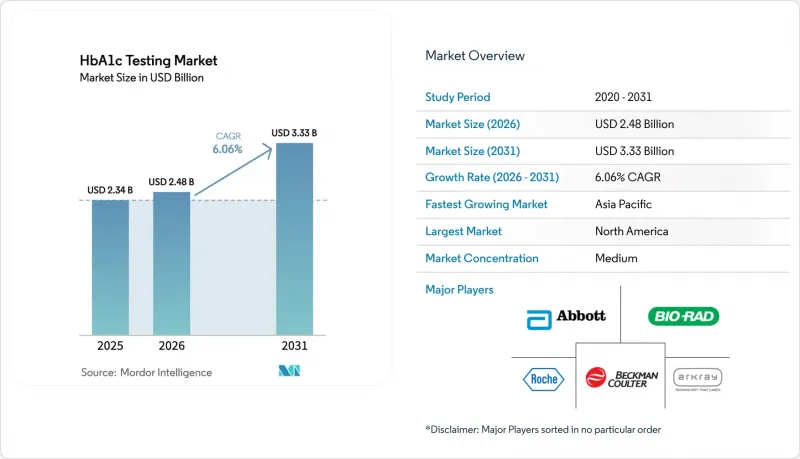
Mordor Intelligence에 의하면, HbA1c 검사 시장 규모는 2025년에 23억 4,000만 달러로 평가되었고 2026년 24억 8,000만 달러에서 2031년까지 33억 3,000만 달러에 이를 것으로 예측되며, 예측 기간(2026-2031년)에서 CAGR은 6.06%를 나타낼 전망입니다.
본 보고서는 기기 유형(휴대용 및 POCT 기기, 벤치탑형 임상 검사 장비), 기술(HPLC, 면역측정법, 효소법, 모세관 전기영동법, 기타), 최종 사용자(병원 및 진료소, 진단·참조 검사실, 기타), 환자 연령대(성인, 소아, 고령자),및 지역(북미, 기타)별로 분류되어 있습니다. 시장 예측은 금액(달러) 기준으로 제시되어 있습니다.
전 세계 HbA1c 검사 시장 동향 및 인사이트
전 세계 당뇨병 유병률 증가 및 조기 선별 검사 지침
당뇨병 유병률은 2025년까지 13억 1,000만 명에 달할 것으로 예측되어, 이용하기 쉬운 HbA1c 검사 솔루션에 대한 수요가 증가하고 있습니다. 미국 당뇨병 협회가 권장하는 조기 선별 검사에서 HbA1c는 주요 진단 지표로 자리 잡고 있어, 검사 기관들은 처리 능력 확충에 나서야 하는 상황입니다. 의료 시스템은 경제적 부담 증가에 직면해 있으며, 2022년 미국이 당뇨병 치료에 4,130억 달러를 지출한 것을 계기로 조기 발견을 위한 노력이 더욱 강화되고 있습니다. 세계보건기구(WHO)는 HbA1c를 ‘필수 진단 검사 목록’에 포함시켜 그 세계적 중요성을 강조하고 있습니다. 저소득 지역에서의 인식 제고는 분산형 프로그램에 적합한 비용 효율적인 검사 키트의 조달을 촉진하고 있습니다.
1차 진료 현장에서의 현장 진단용 HbA1c 분석기 도입 확대
지멘스(Siemens)사의 ‘DCA Vantage’와 같은 기기는 NGSP 성능 기준을 준수하며, 7분 이내에 결과를 산출합니다. 실시간 피드백을 통해 즉시 치료를 조정할 수 있으므로 혈당 조절이 개선됩니다. 로슈사의 ‘cobas b 101’은 손가락 채혈로 5분 이내에 결과를 얻을 수 있으며, 메디케어의 환급 대상이 되기 때문에 가정의학과 진료소에서의 이용이 확대되고 있습니다. 비교 연구에 따르면, 지역 프로그램에서 모세혈관 HbA1c 선별 검사의 도입률은 76%인 반면, 정맥 채혈의 경우 37.5%에 그치고 있습니다. 중국의 비용-효용 분석에 따르면, 증분 비율이 도시 및 농촌 지역의 지불 의향 임계값보다 낮아 경제적으로 유리함이 확인되었습니다.
소규모 검사실의 HPLC 분석 장비에 드는 높은 초기 도입비 및 유지비
초기 구입 가격은 5만 달러에서 20만 달러 사이이며, 연간 유지보수 계약 비용은 구입 비용의 15%를 초과하기도 합니다. CLIA 2024개정으로 성능 목표가 ±8%로 엄격해짐에 따라, 예산이 제한된 검사실의 경우 운영상의 복잡성이 증가하고 있습니다. 이온 교환 컬럼 및 교정 표준액과 같은 소모품 비용도 재정을 더욱 압박하고 있어, 소규모 시설에서는 면역 분석기로의 전환이 진행되고 있습니다.
부문 분석
2025년에는 벤치탑형 분석기가 HbA1c 검사 시장의 59.42%를 차지하며 최대 점유율을 기록했습니다. 이러한 장비들은 하루에 수천 건의 검체를 처리하는 고처리량 검사실의 핵심 장비로 자리매김하고 있습니다. 벡만 콜터(Beckman Coulter)사의 ‘DxC 500 AU’와 같은 시스템은 수작업에 의한 전처리가 필요 없이 전혈을 직접 처리할 수 있어 워크플로우의 효율성을 유지하고 있습니다. 대조적으로, 의료 서비스에서 환자 중심의 치료가 우선시되는 가운데, 휴대용 기기는 연평균 성장률(CAGR) 6.92%라는 가장 빠른 성장세를 보이고 있습니다. 6분 만에 NGSP 기준을 충족하는 결과를 제공하는 지멘스(Siemens)의 ‘DCA Vantage’는 분산형 검사의 신뢰성을 잘 보여주는 대표적인 사례입니다.
휴대용 기기의 성장세는 1차 진료 및 소매 클리닉에서의 만성 질환 관리가 증가하는 추세를 반영합니다. 많은 의료 제공업체는 미들웨어 솔루션을 통해 데이터를 전자 건강 기록(EHR)에 통합하고 있으며, 이를 통해 집단 건강 분석 및 AI를 활용한 의사 결정 지원이 가능해졌습니다. 각 제조업체는 데이터 보호 규정을 준수하면서 외래 진료 환경에서의 무선 연결 보안을 확보하기 위해 다층적인 사이버 보안 기능을 도입하고 있습니다. 아시아에서의 생산 규모 확대에 따라 일회용 검사 카트리지의 가격 곡선은 하락 추세를 보이고 있으며, 이로 인해 지역 의료 종사자 및 원격 지원 프로그램에서의 도입이 더욱 촉진되고 있습니다. 그 결과, HbA1c 시장에서는 중앙 집중형 검사실이 대량 처리를 위한 HPLC 라인을 업그레이드하는 한편, 분산형 의료 현장에서는 현장 진단 수요를 충족하기 위해 소형 분석 장비를 조달하는 등 두 가지 궤도를 병행하는 투자 패턴이 나타나고 있습니다.
HPLC는 확립된 정확도와 다양한 검출 능력을 바탕으로 2025년 매출의 61.12%를 차지했습니다. ARKRAY사의 HA-8160을 통한 완충액 최적화 등 최근의 화학적 개선을 통해 4.4%-17.3%의 HbA1c 범위에서 변동 계수가 1% 미만으로 떨어지는 등 정확도가 향상되었습니다. 한편, 면역 측정 시스템은 포인트 오브 케어 기기와의 호환성 및 운영자 교육 요건이 낮다는 점을 바탕으로 연평균 성장률(CAGR) 7%로 성장을 지속하고, 있습니다. Biolabo사의 ‘Kenza 450TX’ 면역 탁도 측정법은 많은 소규모 검사실에서 이미 사용되고 있는 탁상형 비색 분석 장치에서 작동하면서도 HPLC와 높은 상관관계를 보이고 있습니다.
하이브리드형 아키텍처도 부상하고 있습니다. 각 벤더사는 현재 검체 유형, 긴급도, 또는 변이체 존재 여부에 따라 검체를 자동으로 라우팅하는 HPLC와 면역측정법을 결합한 플랫폼을 출시하고 있습니다. 모세관 전기영동법이나 MALDI-TOF 질량 분석법은 틈새 분야에 머물러 있지만, 복잡한 헤모글로빈 질환에 대해 고감도의 대안을 제공합니다. 이러한 발전으로 HbA1c 시장은 다양화되었으며, 검사실은 임상적 요구 사항, 처리 능력, 예산에 맞추어 적절한 기법을 선택할 수 있게 되었습니다. 면역측정용 시약이 성숙해짐에 따라, 일반적인 헤모글로빈 변이체에 대한 내성을 유지하면서도 기존에 존재하던 성능 격차를 줄일 것으로 기대되며, 이를 통해 단기적인 성장 우위가 유지될 전망입니다.
지역별 분석
북미는 보험사의 선별 검사 대상 범위 확대와 고용주의 웰니스 프로그램을 통한 연례 생체 측정 검사 의무화로 인해 2025년 매출 점유율 41.12%로 1위를 유지했습니다. 메디케어가 2024년에 당뇨병 선별 검사 혜택에 HbA1c를 추가함에 따라, 연방 정부 자금을 지원하는 진료소에서의 검사 건수가 현저히 증가했습니다. 유럽은 독일, 영국, 프랑스의 국가 차원 당뇨병 대책 계획의 연계에 힘입어 2위를 차지했습니다. 검사실 네트워크는 ISO 15189 인증 기준을 충족하기 위해 통합된 LIS 미들웨어 인프라를 도입하여 현대화가 진행되고 있으며, 1차 진료 팀에 대한 신속한 검사 결과 전달이 촉진되고 있습니다.
아시아태평양은 당뇨병 유병률의 급증과 인프라 투자에 힘입어 연평균 성장률(CAGR) 7.13%를 나타낼 것으로 예측됩니다. 인도의 당뇨병 환자 수는 2021년 7,400만 명에서 2045년까지 1억 2,400만 명으로 증가할 것으로 예상되며, 이는 검사실 확충 및 현장 진단(PoC) 기기 도입을 촉진하고 있습니다. 중국의 도시 및 농촌 지역을 대상으로 한 비용 대비 효과 분석을 통해 분산형 선별 검사의 경제적 타당성이 입증되었으며, 각 성의 보건 예산을 통한 시범 프로그램에 대한 자금 지원이 촉진되고 있습니다. 동남아시아 국가들에서는 섬 지역의 교통 장벽을 극복하기 위해 아웃리치 활동에 건조 혈액 스팟(DBS) 검체 채취를 통합하여 검사 적용 범위를 확대되고 있습니다.
중동 및 아프리카에서는 변이주와 관련된 분석상의 복잡성에 직면해 있습니다. 헤모글로빈 S 및 C의 유병률이 높기 때문에 간섭 프로파일에 민감한 검사법의 선택이 요구되고 있으며, 일부 검사 기관에서는 면역측정법이나 모세관 전기영동 시스템으로의 전환이 진행되고 있습니다. 남미에서는 공중보건 캠페인을 통한 당뇨병에 대한 인식 제고와 민간 검사 기관이 서비스 메뉴를 국제 지침에 부합하도록 조정하는 움직임에 따라 검사 건수가 꾸준히 증가하고 있습니다. 모든 지역에서 HbA1c 시장은 조기 발견을 중시하는 정책과 가치 기반 의료비 재정으로의 광범위한 전환의 혜택을 받고 있습니다.
기타 혜택:
- 엑셀 형식 시장 예측(ME) 시트
- 3개월간의 애널리스트 지원
자주 묻는 질문
목차
제1장 서론
제2장 조사 방법
제3장 개요
제4장 시장 구도
제5장 시장 규모와 성장 예측
제6장 경쟁 구도
제7장 시장 기회와 향후 전망
JHS 26.09.03According to Mordor Intelligence, the HbA1c testing market size was valued at USD 2.34 billion in 2025 and estimated to grow from USD 2.48 billion in 2026 to reach USD 3.33 billion by 2031, at a CAGR of 6.06% during the forecast period (2026-2031).
This report is Segmented by Device Type (Handheld and POCT Devices, Benchtop Laboratory Analyzers), Technology (HPLC, Immunoassay, Enzymatic Assay, Capillary Electrophoresis, Others), End-User (Hospitals and Clinics, Diagnostic and Reference Laboratories, More), Patient Age Group (Adults, Pediatric, Geriatric), and Geography (North America, and More). The Market Forecasts are Provided in Terms of Value (USD).
Global HbA1c Testing Market Trends and Insights
Rising global diabetes prevalence & earlier screening guidelines
Diabetes prevalence is projected to reach 1.31 billion individuals by 2025, intensifying demand for accessible HbA1c testing solutions. Earlier screening recommended by the American Diabetes Association places HbA1c as the primary diagnostic metric, prompting laboratories to expand throughput . Health systems face rising economic burdens, with the United States spending USD 413 billion on diabetes care in 2022, reinforcing the push for early detection. The World Health Organization includes HbA1c on its Essential Diagnostics List, underscoring its global relevance . Greater awareness in low-income regions is stimulating procurement of cost-efficient test kits suitable for decentralized programs.
Growing uptake of point-of-care HbA1c analyzers in primary care settings
Devices such as the Siemens DCA Vantage deliver results in under 7 minutes, complying with NGSP performance criteria. Real-time feedback improves glycemic control by enabling immediate treatment adjustments. Roche's cobas b 101 provides finger-stick results in 5 minutes and benefits from Medicare reimbursement, expanding use in family practices. Comparative studies show 76% uptake for capillary HbA1c screening versus 37.5% for venous draws in community programs. Chinese cost-utility analyses confirm favorable economics with incremental ratios below urban and rural willingness-to-pay thresholds.
High capital and maintenance cost of HPLC analyzers for small labs
Initial purchase prices range from USD 50,000 to USD 200,000 and annual service contracts can exceed 15% of acquisition cost. CLIA 2024 updates tightened performance targets to +-8%, adding operational complexity for laboratories with limited budgets. Consumable costs, including ion-exchange columns and calibration standards, further strain finances, prompting smaller facilities to shift toward immunoassay analyzers.
Other drivers and restraints analyzed in the detailed report include:
- Expansion of HbA1c-based reimbursement metrics in value-based care contracts
- Rapid price declines in microfluidic single-use HbA1c cartridges for LMIC mass-screening
- Analytical interference from hemoglobin variants lowering test confidence
For complete list of drivers and restraints, kindly check the Table Of Contents.
Segment Analysis
Benchtop analyzers accounted for the largest share in 2025, capturing 59.42% of the HbA1c testing market. They remain the backbone of high-throughput laboratories that process thousands of specimens daily. Systems such as Beckman Coulter's DxC 500 AU accept whole blood without manual preparation, sustaining workflow efficiency. In contrast, handheld devices drive the fastest expansion at a 6.92% CAGR as health services prioritize patient-centric delivery. The Siemens DCA Vantage, which delivers NGSP-traceable results in 6 minutes, exemplifies the reliability that now characterizes decentralized testing.
Growth momentum for handheld formats reflects rising chronic disease management in primary care and retail clinics. Many providers integrate data into electronic health records through middleware solutions, enabling population health analytics and AI-driven decision support. Manufacturers are layering cybersecurity features to comply with data protection regulations while safeguarding wireless connectivity in ambulatory environments. The price curve for single-use test cartridges is trending downward as production scales in Asia, further encouraging adoption among community practitioners and remote outreach programs. Consequently, the HbA1c market is witnessing a dual-track investment pattern where centralized laboratories upgrade high-volume HPLC lines while distributed care sites procure compact analyzers to meet on-the-spot diagnostic needs.
HPLC commanded 61.12% of 2025 revenue, supported by its established accuracy and variant detection. Recent chemistry enhancements, such as ARKRAY's HA-8160 buffer optimization, have improved precision to coefficients of variation below 1% across 4.4%-17.3% HbA1c ranges. Yet immunoassay systems are posting a 7% CAGR, driven by compatibility with point-of-care devices and lower operator training requirements. The Biolabo Kenza 450TX immunoturbidimetric assay demonstrates strong correlation with HPLC while operating on benchtop photometric analyzers that many small laboratories already use.
Hybrid architectures are emerging. Vendors now ship combined HPLC-immunoassay platforms that auto-route specimens based on sample type, urgency or suspected variant presence. Capillary electrophoresis and MALDI-TOF mass spectrometry occupy niche segments but introduce high sensitivity alternatives for complex hemoglobinopathies. These advances diversify the HbA1c market, allowing laboratories to match technique to clinical requirement, throughput and budget. As immunoassay reagents mature, they are expected to reduce the historical performance gap while maintaining immunity to common hemoglobin variants, thereby sustaining their near-term growth advantage.
Complete Report Scope:
- By Device Type
- Handheld and POCT Devices
- Benchtop Laboratory Analyzers
- By Technology
- HPLC
- Immunoassay
- Enzymatic Assay
- Capillary Electrophoresis
- Others
- By End-User
- Hospitals and Clinics
- Diagnostic and Reference Laboratories
- Homecare Settings
- Others
- By Patient Age Group
- Adults
- Pediatric
- Geriatric
- By Geography
- North America
- United States
- Canada
- Mexico
- Europe
- Germany
- United Kingdom
- France
- Italy
- Spain
- Rest of Europe
- Asia-Pacific
- China
- Japan
- India
- Australia
- South Korea
- Malaysia
- Indonesia
- Thailand
- Philippines
- Vietnam
- Rest of Asia-Pacific
- Middle East and Africa
- GCC
- South Africa
- Rest of Middle East and Africa
- South America
- Brazil
- Argentina
- Rest of South America
- North America
Geography Analysis
North America maintained leadership with 41.12% revenue share in 2025 as insurers expanded screening coverage and employer wellness programs mandated annual biometric checks. Medicare's 2024 addition of HbA1c to the diabetes screening benefit notably increased test volumes in federally funded clinics. Europe ranks second, supported by coordinated national diabetes plans across Germany, the United Kingdom and France. Laboratory networks have modernized with integrated LIS-middleware infrastructures to meet ISO 15189 accreditation standards, fostering timely result transmission to primary care teams.
Asia-Pacific is forecast to grow at a 7.13% CAGR, driven by surging prevalence and infrastructure investment. India's diabetes burden is projected to rise from 74 million cases in 2021 to 124 million by 2045, catalyzing laboratory expansion and point-of-care deployment. China's urban and rural cost-utility analyses validate the economic logic of decentralized screening, encouraging provincial health budgets to fund pilot programs. Southeast Asian countries are integrating dried blood spot sampling into outreach initiatives to overcome transportation barriers in archipelagic regions, thus broadening test reach.
The Middle East and Africa region faces variant-related analytical complexity. Hemoglobin S and C prevalence requires method selection sensitive to interference profiles, directing some laboratories toward immunoassay or capillary electrophoresis systems. South America experiences steady testing uptick as public health campaigns raise diabetes awareness and private laboratories align their service menus with international guidelines. Across all regions, the HbA1c market is benefiting from policy emphasis on early detection and the broader shift toward value-based healthcare financing.
- Abbott Laboratories
- Roche
- Siemens Healthineers
- Danaher
- Bio-Rad Laboratories
- Tosoh
- Thermo Fisher Scientific
- Arkray
- Trinity Biotech
- EKF Diagnostics
- PTS Diagnostics
- Sebia
- Menarini Diagnostics
- Mindray
- Randox Laboratories
- Nova Biomedical
- HORIBA Medical
- Ortho Clinical Diagnostics
- Alere (Abbott POC)
- Aysan BioScience
Additional Benefits:
- The market estimate (ME) sheet in Excel format
- 3 months of analyst support
TABLE OF CONTENTS
1 Introduction
- 1.1 Study Assumptions & Market Definition
- 1.2 Scope of the Study
2 Research Methodology
3 Executive Summary
4 Market Landscape
- 4.1 Market Overview
- 4.2 Market Drivers
- 4.2.1 Rising Global Diabetes Prevalence & Earlier Screening Guidelines
- 4.2.2 Growing Uptake of Point-Of-Care HbA1c Analyzers in Primary Care Settings
- 4.2.3 Expansion Of HbA1c-Based Reimbursement/Quality Metrics in Value-Based Care Contracts
- 4.2.4 Rapid Price Declines in Microfluidic Single-Use HbA1c Cartridges for LMIC Mass-Screening
- 4.2.5 Employer-Funded Wellness Programs Mandating Annual HbA1c Checks
- 4.2.6 AI-Enabled Decision-Support Improving Demand for Lab-Quality HbA1c Datasets
- 4.3 Market Restraints
- 4.3.1 High Capital/Maintenance Cost of HPLC Analyzers for Small Labs
- 4.3.2 Analytical Interference from Hemoglobin Variants Lowering Test Confidence
- 4.3.3 Periodic Shortages of Ion-Exchange Resins & HPLC Columns Disrupting Supply Chain
- 4.3.4 Ethnicity-Specific HbA1c Bias Delaying Regulatory Harmonization in Emerging Markets
- 4.4 Regulatory Landscape
- 4.5 Technological Outlook
- 4.6 Porters Five Forces Analysis
- 4.6.1 Bargaining Power of Suppliers
- 4.6.2 Bargaining Power of Buyers
- 4.6.3 Threat of New Entrants
- 4.6.4 Threat of Substitutes
- 4.6.5 Intensity of Competitive Rivalry
5 Market Size & Growth Forecasts (Value, USD)
- 5.1 By Device Type
- 5.1.1 Handheld and POCT Devices
- 5.1.2 Benchtop Laboratory Analyzers
- 5.2 By Technology
- 5.2.1 HPLC
- 5.2.2 Immunoassay
- 5.2.3 Enzymatic Assay
- 5.2.4 Capillary Electrophoresis
- 5.2.5 Others
- 5.3 By End-User
- 5.3.1 Hospitals and Clinics
- 5.3.2 Diagnostic and Reference Laboratories
- 5.3.3 Homecare Settings
- 5.3.4 Others
- 5.4 By Patient Age Group
- 5.4.1 Adults
- 5.4.2 Pediatric
- 5.4.3 Geriatric
- 5.5 By Geography
- 5.5.1 North America
- 5.5.1.1 United States
- 5.5.1.2 Canada
- 5.5.1.3 Mexico
- 5.5.2 Europe
- 5.5.2.1 Germany
- 5.5.2.2 United Kingdom
- 5.5.2.3 France
- 5.5.2.4 Italy
- 5.5.2.5 Spain
- 5.5.2.6 Rest of Europe
- 5.5.3 Asia-Pacific
- 5.5.3.1 China
- 5.5.3.2 Japan
- 5.5.3.3 India
- 5.5.3.4 Australia
- 5.5.3.5 South Korea
- 5.5.3.6 Malaysia
- 5.5.3.7 Indonesia
- 5.5.3.8 Thailand
- 5.5.3.9 Philippines
- 5.5.3.10 Vietnam
- 5.5.3.11 Rest of Asia-Pacific
- 5.5.4 Middle East and Africa
- 5.5.4.1 GCC
- 5.5.4.2 South Africa
- 5.5.4.3 Rest of Middle East and Africa
- 5.5.5 South America
- 5.5.5.1 Brazil
- 5.5.5.2 Argentina
- 5.5.5.3 Rest of South America
- 5.5.1 North America
6 Competitive Landscape
- 6.1 Market Concentration
- 6.2 Market Share Analysis
- 6.3 Company Profiles (includes Global level overview, Market level overview, Core segments, Financials, Strategic information, Market rank/share, Products & Services, Recent developments)
- 6.3.1 Abbott
- 6.3.2 F. Hoffmann-La Roche
- 6.3.3 Siemens Healthineers
- 6.3.4 Danaher (Beckman Coulter)
- 6.3.5 Bio-Rad Laboratories
- 6.3.6 Tosoh Bioscience
- 6.3.7 Thermo Fisher Scientific
- 6.3.8 Arkray
- 6.3.9 Trinity Biotech
- 6.3.10 EKF Diagnostics
- 6.3.11 PTS Diagnostics
- 6.3.12 Sebia
- 6.3.13 Menarini Diagnostics
- 6.3.14 Mindray
- 6.3.15 Randox Laboratories
- 6.3.16 Nova Biomedical
- 6.3.17 HORIBA Medical
- 6.3.18 Ortho Clinical Diagnostics
- 6.3.19 Alere (Abbott POC)
- 6.3.20 Aysan BioScience
7 Market Opportunities & Future Outlook
- 7.1 White-space & Unmet-need Assessment