

|
시장보고서
상품코드
2119849
북미의 고형 폐기물 관리 시장 : 점유율 분석, 업계 동향과 통계, 성장 예측(2026-2031년)North America Solid Waste Management - Market Share Analysis, Industry Trends & Statistics, Growth Forecasts (2026 - 2031) |
||||||
 Mordor Intelligence
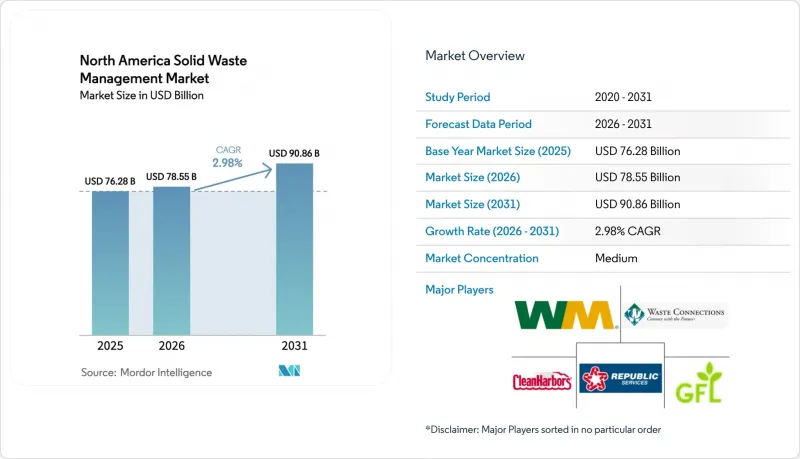
Mordor Intelligence에 의하면, 북미의 고형 폐기물 관리 시장 규모는 2025년에 762억 8,000만 달러로 평가되었고 2026년 785억 5,000만 달러에서 2031년까지 908억 6,000만 달러에 이를 것으로 추정되고 있어 예측 기간(2026-2031년)에서 CAGR은 2.98%를 나타낼 전망입니다.
본 보고서는 제품 유형(폐기물 처리 설비 및 폐기물 재활용·선별 설비), 폐기물 유형(유해 폐기물 및 비유해 폐기물), 수거 유형(가정별 수거 등), 최종 사용자(지자체 폐기물 관리, 의료 등), 지역(미국, 캐나다, 멕시코)별로 분류되어 있습니다. 시장 전망은 금액(달러) 기준으로 제시되어 있습니다.
북미 고형 폐기물 관리 시장 동향 및 인사이트
순환형 경제와 재활용 의무화가 인프라 투자를 가속화
캘리포니아주의 SB 54 및 캐나다 연방 정부의 일회용 플라스틱 금지령 등 생산자 책임(EPR)에 관한 법령에 따라, 생산자는 분리 및 처리 설비의 업그레이드 비용을 부담할 의무가 있으며, 이로 인해 북미 고형 폐기물 관리 시장의 사업자에게는 예측 가능한 수수료 수입이 발생하고 있습니다. 리퍼블릭 서비스는 주 정부 규정에 정해진 오염 기준치를 충족하는 광학 선별 설비 개조를 위해 2024년에 2억 달러를 계상하고 있습니다. 규정 준수 의무화 제도에 따라 재활용은 임의적인 경비에서 사업 운영에 통합된 비용으로 전환되었으며, 수지 가격 변동과 관계없이 최소 처리량을 보장하는 계약이 가능해졌습니다. 그 결과, 로봇 선별기, 화학적 재활용 및 첨단 자원 회수 시설로의 자본 유입이 가속화되고 있으며, 북미의 고형 폐기물 관리 시장은 지속 가능한 인프라 구축 단계에 접어들었습니다.
기업의 ESG 목표가 폐쇄형 서비스 수요를 끌어올리고 있다.
포춘 500대 기업의 조달 프로그램에서는 현재 검증 가능한 폐기물 전환 지표가 요구되고 있으며, 이에 따라 공급업체들은 수거, 재활용, 보고를 통합한 솔루션에 대한 투자를 강요받고 있습니다. 웨이스트 매니지먼트의 스텔리사이클 인수를 통해 합병 후 기업은 의약품 회수, 포장재 회수, 디지털 추적을 지원하는 종단간 의료 폐기물 플랫폼을 확보했습니다. 폐기물 재활용률과 이산화탄소 배출 감축을 핵심으로 하는 성과 연계형 계약을 통해 프리미엄 가격 책정 및 장기 계약 갱신이 가능해지면서, 북미 고형 폐기물 관리 시장에서 ‘양보다 가치’로 향하는 전환이 더욱 가속화되고 있습니다.
재활용 자원 가격 변동이 수익의 안정성을 해치고 있다.
2024년에는 혼합 종이 가격이 급락하고, 재생 폴리머 가격은 분기마다 40%나 변동함에 따라 로봇 선별기의 투자 회수 모델이 복잡해지고 있습니다. 사업자들은 현재 지자체와의 계약에 가격 조정 조항을 포함시켜, 헤지 수단이 없는 지자체에 리스크를 전가하고 있습니다. 이러한 불확실성으로 인해 차세대 수거 기술에 대한 투자가 지연되고 있으며, 북미 고형 폐기물 관리 시장의 단기적인 수익 성장이 둔화되고 있습니다.
부문별 분석
2025년, 폐기물 처리 시설은 북미 고형 폐기물 관리 시장 규모의 59.85%라는 압도적인 점유율을 유지하고 있으며, 이는 해당 지역 전체에 뿌리내린 매립지 및 중계 스테이션 인프라를 반영합니다. 그러나 수익 성장세는 첨단 재활용 및 선별 시스템으로 이동하고 있으며, EPR(생산자 책임) 의무화와 수작업 선별으로는 충족할 수 없는 순도 기준에 힘입어 2031년까지 연평균 성장률(CAGR) 3.47%를 나타낼 것으로 예측됩니다. AI를 활용한 광학 스캐너는 현재 대상 플라스틱 및 금속의 95%를 회수하고 있으며, 이를 통해 고가로 임베디드할 수 있게 되었고, 불순물 혼입에 따른 벌칙도 완화되고 있습니다.
설비 교체 주기에 따라 폐기물 처리 자산과 자원 회수 자산의 경계가 모호해지고 있습니다. 피닉스에서 웨스트 매니지먼트(Waste Management)사가 시범 도입한 자율 주행식 사이드 로딩 트럭은 추가 인력 없이도 연료 소비량을 12% 절감하고, 수거 노선의 처리 능력을 향상시켰습니다. IoT 센서가 탑재된 스마트 컴팩터는 실시간 충전률 데이터를 생성하고, 이를 바탕으로 동적인 수거 일정을 자동으로 설정함으로써 공회전 거리를 대폭 줄이고 컨테이너의 수명을 연장하고 있습니다. 각 제조업체들은 하드웨어 판매에 예측 유지보수 분석 기능을 통합하는 사례가 늘어나고 있으며, 이를 통해 안정성이 높은 서비스 수익이 창출되어 북미 고형 폐기물 관리 업계의 애프터마켓 생태계를 활성화하고 있습니다.
2025년 처리량 중 비유해 폐기물이 77.65%를 차지하지만, PFAS, 의약품, 반도체 폐수에 대한 규제가 강화됨에 따라 유해 폐기물 부문의 수익은 연평균 성장률(CAGR) 3.22%로 확대되고 있습니다. 북미 고형 폐기물 관리 시장에서 유해 물질 시장 규모는 총 처리 톤수가 여전히 소폭에 그치고 있음에도 불구하고, 표준 처리비의 최대 8배에 달하기도 하는 전문적인 운송, 처리 및 배상 책임 보험 비용으로 인해 지속적으로 증가하고 있습니다. 의료 업계와 전자기기 제조업체는 현재 관할 구역을 초월한 규정 준수를 보장하기 위해 여러 주에 걸친 처리 네트워크와 계약을 맺고 있으며, 이로 인해 북미 고형 폐기물 관리 시장에서 통합형 사업자의 가치 제안이 더욱 강화되고 있습니다.
유기성 폐기물은 비유해 폐기물로 분류되지만, 미국 각 주의 저탄소 연료 기준(LCFS)과 연계된 RNG(재생 가능 천연가스) 시설에 있어 최적의 원료로 주목받고 있습니다. 매립지나 낙농장에 병설된 혐기성 소화 장치는 식품 폐기물을 파이프라인 품질의 가스로 변환하여 수익원의 다각화를 도모하고 있습니다. RNG 수율이 향상됨에 따라, 비유해 폐기물 계약은 에너지 크레딧 수익을 분배하는 내용으로 개정되고 있으며, 북미 고형 폐기물 관리 업계 전반의 폐기물 감축 정책을 상쇄하는 재정적 인센티브가 추가되고 있습니다.
기타 혜택:
- 엑셀 형식 시장 예측(ME) 시트
- 3개월간의 애널리스트 지원
자주 묻는 질문
목차
제1장 서론
제2장 조사 방법
제3장 개요
제4장 시장 구도
제5장 시장 규모와 성장 예측
제6장 경쟁 구도
제7장 시장 기회와 향후 전망
JHS 26.09.03According to Mordor Intelligence, the North America solid waste management market size was valued at USD 76.28 billion in 2025 and estimated to grow from USD 78.55 billion in 2026 to reach USD 90.86 billion by 2031, at a CAGR of 2.98% during the forecast period (2026-2031).
This report is Segmented by Product Type (Waste Disposal Equipment and Waste Recycling and Sorting Equipment), Waste Type (Hazardous Waste and Non-Hazardous Waste), Collection Type (Curbside Pickup, and More), End User (Municipal Waste Management, Healthcare, and More), and Geography (United States, Canada, and Mexico). The Market Forecasts are Provided in Terms of Value (USD).
North America Solid Waste Management Market Trends and Insights
Circular-Economy and Recycling Mandates Accelerate Infrastructure Investment
EPR statutes, such as California's SB 54 and Canada's federal single-use plastic ban, obligate producers to finance sorting and processing upgrades, creating predictable fee income for operators in the North American solid waste management market. Republic Services has earmarked USD 200 million for optical-sorting retrofits in 2024 that meet contamination thresholds under state rules. Mandatory compliance structures convert recycling from a discretionary expense into an embedded cost of doing business, allowing contracts that guarantee minimum tonnage regardless of resin price cycles. As a result, capital flows toward robotic sorters, chemical recycling, and advanced material recovery facilities are accelerating, positioning the North American solid waste management market for sustained infrastructure build-out.
Corporate ESG Targets Boost Demand for Closed-Loop Services
Fortune 500 procurement programs now require verifiable waste diversion metrics, prompting suppliers to invest in integrated collection, recycling, and reporting solutions. Waste Management's acquisition of Stericycle gives the combined entity an end-to-end healthcare waste platform that supports pharmaceutical take-back, packaging recovery, and digital tracking. Outcome-based contracts, anchored in diversion and carbon reduction, enable premium pricing and long-term renewals, reinforcing the value-over-volume shift inside the North America solid waste management market.
Recycled-Commodity Price Volatility Undermines Revenue Stability
Mixed-paper prices plunged in 2024, while recycled-polymer values swung 40% quarter-to-quarter, complicating payback models for robotic sorters. Operators now write price-adjustment clauses into municipal contracts, shifting risk to cities that lack hedging tools. This uncertainty delays investment in next-generation recovery technology, tempering near-term revenue growth inside the North America solid waste management market.
Other drivers and restraints analyzed in the detailed report include:
- Landfill-Gas-to-RNG Projects Surge Under RFS, LCFS and IRA Incentives
- Ontario Landfill-Capacity Crisis and U.S. Export Fees Trigger Regional Build-Outs
- Chronic Labor Shortages and Work Stoppages Disrupt Collection
For complete list of drivers and restraints, kindly check the Table Of Contents.
Segment Analysis
Waste disposal equipment retained a commanding 59.85% share of the North America solid waste management market size in 2025, reflecting entrenched landfill and transfer-station infrastructure across the region. However, revenue growth is shifting toward high-tech recycling and sorting systems, which are projected to post a 3.47% CAGR through 2031, underpinned by EPR mandates and purity standards that manual sorting cannot meet. AI-guided optical scanners now recover 95% of target plastics and metals, unlocking premium offtake pricing and reducing contamination penalties.
The equipment refresh cycle is blurring boundaries between disposal and recovery assets. Autonomous side-loading trucks piloted by Waste Management in Phoenix reduced fuel use by 12% and increased route capacity without requiring additional labor. Smart compactors equipped with Internet-of-Things sensors generate real-time fullness data, triggering dynamic collection schedules that slash empty-run miles and extend container life. Manufacturers increasingly bundle predictive-maintenance analytics with hardware sales, creating sticky service revenues that enrich the North America solid waste management industry's aftermarket ecosystem.
Non-hazardous streams account for 77.65% of 2025 volume, but hazardous waste revenue is expanding at a 3.22% CAGR as PFAS, pharmaceutical, and semiconductor effluent regulations tighten. The North American solid waste management market size for hazardous materials continues to rise, even as overall tonnage remains modest, due to specialized transport, treatment, and liability-coverage fees that can reach eight times the standard tipping rates. Healthcare and electronics manufacturers now contract with multi-state treatment networks to ensure compliance across jurisdictions, reinforcing the value proposition of integrated players in the North America solid waste management market.
Organic waste, while classified as non-hazardous, is emerging as the feedstock of choice for RNG facilities tied to state Low-Carbon Fuel Standards. Anaerobic digestion units co-located at landfills or dairy farms convert food waste into pipeline-quality gas, diversifying revenue streams. As RNG yields increase, non-hazardous waste contracts are being rewritten to share energy credit proceeds, adding a financial incentive that counterbalances waste-reduction policies within the broader North America solid waste management industry.
Complete Report Scope:
- By Product Type
- Waste Disposal Equipment
- Waste Recycling and Sorting Equipment
- By Waste Type
- Hazardous Waste
- Non-hazardous Waste
- By Collection Type
- Curbside Pickup
- Door-to-Door Collection
- Community Recycling Programs
- By End User
- Municipal Waste Management
- Healthcare
- Chemical
- Mining
- By Geography
- United States
- Canada
- Mexico
List of Companies Covered in this Report:
- Casella Waste Systems
- Clean Harbors
- Covanta Holdings Corporation
- Darling Ingredients.
- GFL Environmental Inc.
- Kinder Morgan
- Montauk Renewables, Inc
- Recology
- Republic Services
- Rubicon Technologies, Inc.
- Stericycle
- US Ecology
- Veolia
- Waste Connections
- Waste Management Inc.
- Waste Pro USA
- WM Intellectual Property Holdings, L.L.C.
Additional Benefits:
- The market estimate (ME) sheet in Excel format
- 3 months of analyst support
TABLE OF CONTENTS
1 Introduction
- 1.1 Study Assumptions and Market Definition
- 1.2 Scope of the Study
2 Research Methodology
3 Executive Summary
4 Market Landscape
- 4.1 Market Overview
- 4.2 Market Drivers
- 4.2.1 Circular-economy and recycling mandates accelerate infrastructure investment
- 4.2.2 Corporate ESG targets boost demand for closed-loop services
- 4.2.3 Landfill-gas-to-RNG projects surge under RFS, LCFS and IRA incentives
- 4.2.4 Ontario landfill-capacity crisis and U.S. export fees trigger regional build-outs
- 4.2.5 Smart collection and AI sorting slash OPEX, enable PAYT pricing
- 4.3 Market Restraints
- 4.3.1 Recycled-commodity price volatility undermines revenue stability
- 4.3.2 Chronic labor shortages and work stoppages disrupt collection
- 4.3.3 CERCLA listing of PFAS heightens landfill liability exposure
- 4.4 Value Chain Analysis
- 4.5 Regulatory Landscape
- 4.6 Porter's Five Forces
- 4.6.1 Bargaining Power of Suppliers
- 4.6.2 Bargaining Power of Buyers
- 4.6.3 Threat of New Entrants
- 4.6.4 Threat of Substitutes
- 4.6.5 Intensity of Competitive Rivalry
5 Market Size and Growth Forecasts (Value)
- 5.1 By Product Type
- 5.1.1 Waste Disposal Equipment
- 5.1.2 Waste Recycling and Sorting Equipment
- 5.2 By Waste Type
- 5.2.1 Hazardous Waste
- 5.2.2 Non-hazardous Waste
- 5.3 By Collection Type
- 5.3.1 Curbside Pickup
- 5.3.2 Door-to-Door Collection
- 5.3.3 Community Recycling Programs
- 5.4 By End User
- 5.4.1 Municipal Waste Management
- 5.4.2 Healthcare
- 5.4.3 Chemical
- 5.4.4 Mining
- 5.5 By Geography
- 5.5.1 United States
- 5.5.2 Canada
- 5.5.3 Mexico
6 Competitive Landscape
- 6.1 Market Concentration
- 6.2 Strategic Moves
- 6.3 Market Share(%)/Ranking Analysis
- 6.4 Company Profiles {(includes Global level Overview, Market level overview, Core Segments, Financials as available, Strategic Information, Market Rank/Share for key companies, Products and Services, and Recent Developments)}
- 6.4.1 Casella Waste Systems
- 6.4.2 Clean Harbors
- 6.4.3 Covanta Holdings Corporation
- 6.4.4 Darling Ingredients.
- 6.4.5 GFL Environmental Inc.
- 6.4.6 Kinder Morgan
- 6.4.7 Montauk Renewables, Inc
- 6.4.8 Recology
- 6.4.9 Republic Services
- 6.4.10 Rubicon Technologies, Inc.
- 6.4.11 Stericycle
- 6.4.12 US Ecology
- 6.4.13 Veolia
- 6.4.14 Waste Connections
- 6.4.15 Waste Management Inc.
- 6.4.16 Waste Pro USA
- 6.4.17 WM Intellectual Property Holdings, L.L.C.
7 Market Opportunities and Future Outlook
- 7.1 White-space and Unmet-Need Assessment


