
|
시장보고서
상품코드
2119852
미국의 4PL(Fourth Party Logistics) : 시장 점유율 분석, 업계 동향 및 통계, 성장 예측(2026-2031년)United States Fourth-Party Logistics (4PL) - Market Share Analysis, Industry Trends & Statistics, Growth Forecasts (2026 - 2031) |
||||||
 Mordor Intelligence
Mordor Intelligence에 의하면, 미국의 4PL(Fourth Party Logistics) 시장 규모는 2025년에 160억 7,000만 달러로 평가되었습니다. 2026년 168억 1,000만 달러에서 2031년까지 210억 9,000만 달러에 이를 것으로 예상되며, 예측 기간(2026-2031년) CAGR은 4.62%를 나타낼 전망입니다.
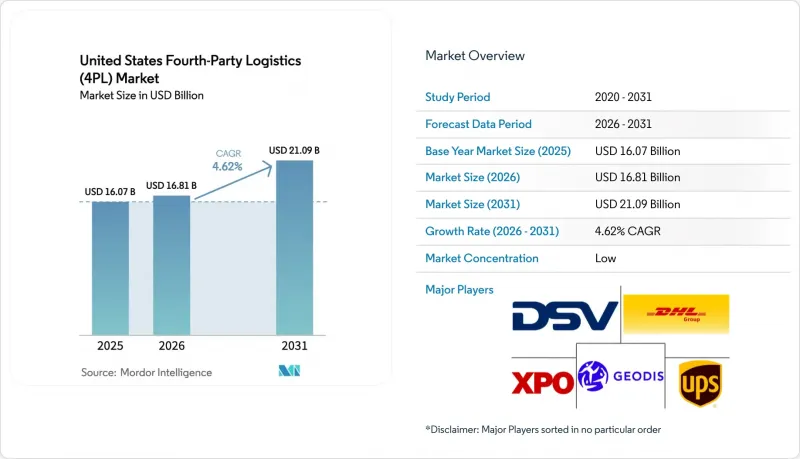
본 보고서는 사업 모델(리드 물류 제공업체(LLP), 솔루션 통합업체, 디지털 플랫폼 4PL), 최종 사용자 산업(FMCG, 소매 및 전자상거래, 패션·라이프스타일, 기술·전자, 냉장·의약품, 자동차·모빌리티, 산업 제조, 기타),미국 지역별로 분류되어 있습니다. 시장 예측은 금액(달러) 기준으로 제시되어 있습니다.
미국의 4PL(Fourth Party Logistics) 시장 동향 및 인사이트
옴니채널 공급망의 복잡화
옴니채널 전략을 전개하는 소매업체는 매장, 온라인, 시장의 재고를 동시에 동기화해야 하므로, 기존 3PL의 역량을 뛰어넘는 조정 요건이 발생하고 있습니다. 월마트의 AI 기반 네트워크는 실시간 수요 감지, 동적 경로 설정, 예측 기반 보충을 통해 안전 재고를 낮게 유지하면서 품절을 줄이는 방법을 보여주고 있습니다. 아마존의 인바운드 크로스독 시설은 통합된 풀필먼트 네트워크를 확장하는 데 필요한 인프라 구축 노력을 보여줍니다. 이러한 복잡성으로 인해 재고 배치 및 주문 조정에 머신러닝을 활용하는 디지털 플랫폼 4PL 제공업체의 중요성이 커지고 있습니다. 규제 체계는 여전히 관대하지만, 새롭게 제정되고 있는 데이터 개인정보 보호 관련 법규로 인해 4PL이 채널 전반에 걸쳐 쇼핑객에 대한 인사이트를 통합하는 방식에 제약이 발생할 가능성이 있습니다. 전반적으로 옴니채널의 성장은 운송, 인력, 재고를 동시에 최적화하는 전국 규모의 컨트롤 타워 솔루션에 대한 구조적 수요를 공고히 하고 있습니다.
리드 물류 제공업체(LLP)를 통한 비용 절감 모델의 확대 도입
인플레이션과 공급망 혼란으로 인해 물류 비용 관리는 이사회 차원의 최우선 과제가 되었습니다. 분산된 3PL 계약을 단일 LLP(리드 물류 제공업체) 계약으로 통합함으로써 즉각적인 규모의 경제 효과를 얻을 수 있으며, 공급업체 관리에 드는 간접비를 절감할 수 있습니다. 한 미국 제조업체는 LLP 프레임워크를 도입한 결과, 2억 6,000만 달러의 물류 비용 절감과 운송비 15% 감축을 달성했습니다. 또한, 자산을 최소화한 공급업체가 운임 변동 위험을 부담함으로써, 운전 자금 및 용량과 관련된 위험이 기업의 대차대조표에서 제거됩니다. 자동차 및 내구소비재 부문의 제조 기업들이 도입을 선도하고 있지만, 서비스 산업에서도 현재 LLP는 예측 불가능한 운송 능력 시장에 대한 전략적 헤지 수단으로 주목받고 있습니다. 또한, 주마다 다른 노동법 및 안전 규제로 골머리를 앓고 있는 다주 진출 기업들에게 규정 준수 관리의 일원화는 더욱 큰 매력이 되고 있습니다.
사이버 보안 및 데이터 소유권에 대한 우려
공급망의 디지털화는 특히 규제가 엄격한 산업에서 4PL 도입을 제약하는 중대한 사이버 보안 취약점을 초래하고 있습니다. 세계경제포럼(WEF) 보고서에 따르면, 대기업의 54%가 사이버 복원력의 주요 장벽으로 공급망을 꼽았으며, 2024년 전 세계 IT 시스템 장애는 중요한 제3자에 대한 의존성을 여실히 드러냈습니다. 4PL 제공업체는 네트워크 내의 많은 공급업체를 직접 감독하지 않고 운영하기 때문에 기존 위험 관리 기법으로는 적절히 대처할 수 없는 잠재적 공격 경로를 만들어내며 특유의 과제에 직면해 있습니다. 물류 산업에서는 2023년 7월부터 2024년 7월 사이에 27건의 사이버 사고가 발생했으며, 물류 분야의 사이버 보안 시장은 2024년부터 2037년까지 연평균 성장률(CAGR) 12%로 확대되어 366억 달러에 달할 것으로 예측됩니다. 4PL 제공업체가 여러 고객에 걸친 정보를 집계하는 경우, 독자적인 비즈니스 인텔리전스를 둘러싼 잠재적 갈등이 발생하기 때문에 데이터 소유권에 대한 우려는 특히 심각해집니다.
부문 분석
2025년, 리드 물류 제공업체(LLP)는 4PL(Fourth Party Logistics) 시장 규모의 42.35%를 차지했습니다. 이는 복잡성을 줄이고 책임성을 강화하는 단일 제공업체와의 관계를 통해 종합적인 공급망 관리를 추구하는 기업의 경향을 반영합니다. LLP 모델의 우위는 규모의 경제를 통해 비용 시너지를 실현하는 동시에, 더 깊은 물류 전문 지식을 갖춘 전문 제공업체에 운영 리스크를 이전할 수 있다는 점에 기인합니다. 솔루션 통합자 모델은 중간에 위치하며, 직접적인 운영 책임을 지지 않고 기술을 활용하여 여러 물류 제공업체 간의 조정에 중점을 둡니다. 디지털 플랫폼 4PL은 기존 모델에서는 제공할 수 없는 AI를 활용한 가시성과 자율적인 의사결정 능력을 추구하는 기업 수요에 힘입어, 2031년까지 연평균 성장률(CAGR) 4.96%로 가장 빠르게 성장하는 부문으로 부상하고 있습니다.
디지털 플랫폼 4PL 부문의 성장 가속화는 데이터 주도형 공급망 조정을 향한 4PL(Fourth Party Logistics) 시장의 진화를 반영하고 있으며, 여기에서 실시간 분석과 예측 모델링은 단순한 업무상의 사치가 아닌 경쟁적 차별화 요소가 되고 있습니다. Blue Yonder의 ‘Network Ops Agent’는 AI 에이전트가 인적 개입 없이 도착 시간 예측, 화물 클러스터링, 자원 활용도 극대화를 수행하며 물류 업무를 자율적으로 관리할 수 있음을 입증하고 있습니다. 순수한 조정 기능은 자동화에 의해 상품화가 진행되는 가운데, 솔루션 통합자 모델은 전문적인 산업 지식과 지리적 커버리지를 통해 차별화를 꾀해야 할 필요성에 점점 더 직면하고 있습니다. 규제 환경은 특히 데이터 개인정보 보호 및 알고리즘의 설명 책임에 관한 요건이 발전함에 따라, 의사결정 과정에서 투명성과 감사 가능성을 입증할 수 있는 플랫폼 모델을 긍정적으로 받아들이고 있습니다.
기타 혜택
- 엑셀 형식 시장 예측(ME) 시트
- 3개월간의 애널리스트 지원
자주 묻는 질문
목차
제1장 서론
제2장 조사 방법
제3장 주요 요약
제4장 시장 구도
제5장 시장 규모 및 성장 예측(금액, 10억 달러)
제6장 경쟁 구도
제7장 시장 기회 및 향후 전망
KTH 26.09.10According to Mordor Intelligence, the United States fourth-Party logistics market size was valued at USD 16.07 billion in 2025 and estimated to grow from USD 16.81 billion in 2026 to reach USD 21.09 billion by 2031, at a CAGR of 4.62% during the forecast period (2026-2031).
This report is Segmented by Operating Model (Lead Logistics Provider, Solution Integrator, Digital Platform 4PL), End-User Industry (FMCG, Retail & E-Commerce, Fashion & Lifestyle, Technology & Electronics, Refrigerated & Pharma, Automotive & Mobility, Industrial Manufacturing, Others), and Geography. The Market Forecasts are Provided in Terms of Value (USD).
United States Fourth-Party Logistics (4PL) Market Trends and Insights
Rising Complexity of Omnichannel Supply Chains
Retailers deploying omnichannel strategies must synchronize store, online, and marketplace inventory simultaneously, creating orchestration requirements beyond traditional 3PL capabilities. Walmart's AI-driven network shows how real-time demand sensing, dynamic routing, and predictive replenishment cut stock-outs while maintaining low safety inventory. Amazon's inbound cross-dock facilities illustrate infrastructure commitments needed to scale unified fulfillment networks. Such complexity elevates digital platform 4PL providers that leverage machine learning for inventory placement and order orchestration. Regulatory frameworks remain permissive, yet emerging data-privacy statutes may constrain how 4PLs aggregate shopper insights across channels. Overall, omnichannel growth locks in structural demand for nationwide control-tower solutions that optimize transport, labor, and inventory concurrently.
Increasing Adoption of Lead-Logistics-Provider Cost-Out Models
Inflation and supply-chain disruption make logistics cost control a board-level priority. Consolidating disparate 3PL contracts under a single LLP generates immediate scale efficiencies and reduces vendor-management overhead. A U.S. manufacturer documented USD 260 million in logistics savings and a 15% cut in transportation spend by embracing an LLP framework. Asset-light providers also shoulder freight-rate volatility, shifting working-capital and capacity risks off corporate balance sheets. Manufacturing firms in automotive and durable goods are leading adopters, but services sectors now view LLPs as strategic hedges against unpredictable capacity markets. Centralized compliance management further appeals to multistate operators wrestling with fragmented labor and safety rules.
Cyber-security and Data-ownership Concerns
Supply chain digitization creates significant cybersecurity vulnerabilities that constrain fourth party logistics adoption, especially in regulated industries. The World Economic Forum reports 54% of large organizations cite supply chains as major barriers to cyber resilience, with the 2024 global IT outage exposing critical third-party dependencies. Fourth-party logistics providers face unique challenges because they operate without direct oversight of many vendors in their networks, creating potential attack vectors that traditional risk management approaches cannot adequately address. The logistics sector experienced 27 cyber incidents between July 2023 and July 2024, with the cybersecurity market in logistics projected to grow at 12% CAGR from 2024 to 2037, reaching USD 36.6 billion. Data ownership concerns become particularly acute when 4PL providers aggregate information across multiple clients, creating potential conflicts over proprietary business intelligence.
Other drivers and restraints analyzed in the detailed report include:
- E-commerce-Driven Demand for Nationwide Control-Tower Orchestration
- Integrated Control-Tower IT Platforms (AI/IoT) Become Table-Stakes
- High Implementation Cost and Change-Management Burden
For complete list of drivers and restraints, kindly check the Table Of Contents.
Segment Analysis
Lead Logistics Provider (LLP) commanded 42.35% of the fourth party logistics market size in 2025, reflecting enterprises' preference for comprehensive supply chain management through single-provider relationships that reduce complexity and enhance accountability. The LLP model's dominance stems from its ability to deliver cost synergies through economies of scale while transferring operational risk to specialized providers with deeper logistics expertise. Solution Integrator models occupy the middle ground, focusing on technology-enabled coordination across multiple logistics providers without assuming direct operational responsibility. Digital Platform 4PL emerges as the fastest-growing segment at 4.96% CAGR through 2031, driven by enterprises seeking AI-powered visibility and autonomous decision-making capabilities that traditional models cannot deliver.
The Digital Platform 4PL segment's growth acceleration reflects the fourth party logistics market evolution toward data-driven supply chain orchestration, where real-time analytics and predictive modeling become competitive differentiators rather than operational luxuries. Blue Yonder's Network Ops Agent demonstrates how AI agents can autonomously manage logistics operations, predicting arrival times, clustering shipments, and maximizing resource utilization without human intervention. Solution Integrator models face increasing pressure to differentiate through specialized industry expertise or geographic coverage, as pure coordination functions become commoditized through automation. The regulatory landscape favors platform models that can demonstrate transparency and auditability in their decision-making processes, particularly as data privacy and algorithmic accountability requirements evolve.
Complete Report Scope:
- By Operating Model
- Lead Logistics Provider (LLP)
- Solution Integrator
- Digital Platform 4PL
- By End-User Industry
- FMCG
- Retail and E-commerce
- Fashion and Lifestyle
- Technology and Electronics
- Refrigerated and Pharma
- Automotive and Mobility
- Industrial Manufacturing
- Others
- By US Region
- Northeast
- Midwest
- South
- West
List of Companies Covered in this Report:
- United Parcel Service, Inc.
- DSV
- Geodis
- XPO Inc.
- DHL Supply Chain
- C.H. Robinson
- Kuehne + Nagel
- FedEx
- Ryder Supply Chain Solutions
- Penske Logistics
- CEVA Logistics
- Rhenus Group
- Logistics Plus
- Allyn International Services
- Covenant Logistics Group
- Redwood Logistics
- Odyssey
- Yusen Logistics
- 4PL Central Station Group
- Toll Group
Additional Benefits:
- The market estimate (ME) sheet in Excel format
- 3 months of analyst support
TABLE OF CONTENTS
1 Introduction
- 1.1 Study Assumptions and Market Definition
- 1.2 Scope of the Study
2 Research Methodology
3 Executive Summary
4 Market Landscape
- 4.1 Market Overview
- 4.2 Market Drivers
- 4.2.1 Rising complexity of omnichannel supply chains
- 4.2.2 Increasing adoption of Lead-Logistics-Provider cost-out models
- 4.2.3 E-commerce-driven demand for nationwide control-tower orchestration
- 4.2.4 Integrated control-tower IT platforms (AI/IoT) become table-stakes
- 4.2.5 Near-shoring wave requires domestic network re-design
- 4.2.6 Freight-rate volatility pushes shippers toward asset-light risk transfer
- 4.3 Market Restraints
- 4.3.1 Cyber-security and data-ownership concerns
- 4.3.2 High implementation cost and change-management burden
- 4.3.3 Scarcity of supply-chain data-science talent for control towers (under-radar)
- 4.3.4 Channel conflict with large incumbent 3PLs (under-radar)
- 4.4 Value / Supply-Chain Analysis
- 4.5 Regulatory Landscape
- 4.6 Technological Outlook
- 4.7 Porter's Five Forces Analysis
- 4.7.1 Threat of New Entrants
- 4.7.2 Bargaining Power of Buyers
- 4.7.3 Bargaining Power of Suppliers
- 4.7.4 Threat of Substitutes
- 4.7.5 Competitive Rivalry
- 4.8 Impact of COVID-19 and Post-Pandemic Reset
- 4.9 Impact of Inflationary Freight Cycles and Near-shoring
5 Market Size and Growth Forecasts (Value, USD Bn)
- 5.1 By Operating Model
- 5.1.1 Lead Logistics Provider (LLP)
- 5.1.2 Solution Integrator
- 5.1.3 Digital Platform 4PL
- 5.2 By End-User Industry
- 5.2.1 FMCG
- 5.2.2 Retail and E-commerce
- 5.2.3 Fashion and Lifestyle
- 5.2.4 Technology and Electronics
- 5.2.5 Refrigerated and Pharma
- 5.2.6 Automotive and Mobility
- 5.2.7 Industrial Manufacturing
- 5.2.8 Others
- 5.3 By US Region
- 5.3.1 Northeast
- 5.3.2 Midwest
- 5.3.3 South
- 5.3.4 West
6 Competitive Landscape
- 6.1 Market Concentration
- 6.2 Strategic Moves
- 6.3 Market Share Analysis
- 6.4 Company Profiles (includes Global-level Overview, Market-level Overview, Core Segments, Financials as available, Strategic Information, Market Rank/Share, Products and Services, Recent Developments)
- 6.4.1 United Parcel Service, Inc.
- 6.4.2 DSV
- 6.4.3 Geodis
- 6.4.4 XPO Inc.
- 6.4.5 DHL Supply Chain
- 6.4.6 C.H. Robinson
- 6.4.7 Kuehne + Nagel
- 6.4.8 FedEx
- 6.4.9 Ryder Supply Chain Solutions
- 6.4.10 Penske Logistics
- 6.4.11 CEVA Logistics
- 6.4.12 Rhenus Group
- 6.4.13 Logistics Plus
- 6.4.14 Allyn International Services
- 6.4.15 Covenant Logistics Group
- 6.4.16 Redwood Logistics
- 6.4.17 Odyssey
- 6.4.18 Yusen Logistics
- 6.4.19 4PL Central Station Group
- 6.4.20 Toll Group
7 Market Opportunities and Future Outlook
- 7.1 White-space and Unmet-need Assessment