

|
시장보고서
상품코드
2119869
미국의 철물점 소매 시장 : 시장 점유율 분석, 업계 동향 및 통계, 성장 예측(2026-2031년)United States Hardware Stores Retail - Market Share Analysis, Industry Trends & Statistics, Growth Forecasts (2026 - 2031) |
||||||
 Mordor Intelligence
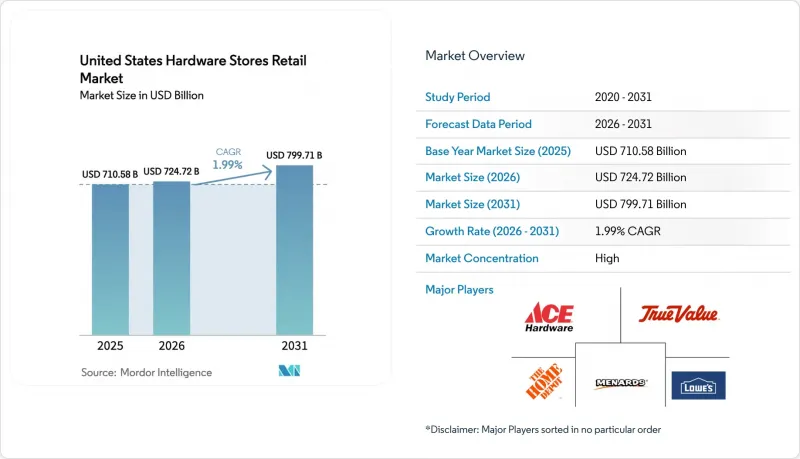
Mordor Intelligence에 의하면, 2026년 미국의 철물점 소매 시장 규모는 7,247억 2,000만 달러로 추정되고 2025년 7,105억 8,000만 달러에서 확대해, 2031년에는 7,997억 1,000만 달러에 이를 것으로 예측됩니다.
2026년부터 2031년까지 연평균 성장률(CAGR) 1.99%로 성장할 것으로 전망됩니다.
본 보고서는 제품 유형(문용 하드웨어, 건축자재, 주방·욕실 용품, 기타 제품 유형), 유통 채널(오프라인, 온라인), 매장 형태(대형 홈센터, 기존 철물점, 기타), 지역(북동부, 중서부, 남부, 서부)별로 분류되어 있습니다. 시장 전망은 금액(달러)으로 표시되어 있습니다.
미국의 철물점 소매 시장 동향 및 인사이트
2024년 이후의 대규모 주택 리모델링 붐
2024년 한 해 동안 평균 6.5%라는 높은 수준의 주택 담보 대출 금리는 주택 소유자의 행동을 근본적으로 변화시켰으며, 이사가 경제적으로 어려워지는 상황에서 리모델링 프로젝트에 대한 확실한 수요층을 창출했습니다. 이러한 금리 환경은 업계 분석가들이 ‘모기지 금리 고정(lock-in)’이라고 부르는 현상을 야기하고 있으며, 2020-2021년에 4% 이하의 금리로 주택담보대출을 받은 주택 소유자들은 매각을 미루고, 대신 자유 재량 지출을 주택 개보수에 사용하고 있습니다. 주택연구공동센터(Joint Center for Housing Studies)는 2025년 리모델링 지출이 5,090억 달러에 달할 것으로 예측했으며, 이는 기존 예측치보다 6.4% 상향 조정된 수치입니다. 이러한 지출 급증을 주도하고 있는 것은 주방과 욕실 리모델링이며, 주택 소유자들은 이러한 프로젝트를 단순한 재량 지출이 아닌 장기적인 투자로 인식하기 시작했습니다. 이러한 추세는 평균 거래 금액 증가와 전문가용 제품 구매 빈도의 상승을 통해 특히 하드웨어 소매업체에 혜택을 주고 있습니다.
소셜 미디어 튜토리얼이 부추기는 DIY 문화
소셜 미디어 플랫폼은 주택 개조에 관한 지식을 널리 확산시켰습니다. 유튜브와 틱톡의 튜토리얼은 특히 밀레니얼 세대와 Z세대 주택 소유자 같은 DIY 초보자들 사이에서 전례 없는 자신감을 불러일으키고 있습니다. 이러한 문화적 변화는 단순한 오락에 그치지 않고, 튜토리얼을 시청한 사람들이 온라인에서 본 프로젝트를 재현하기 위해 자재와 공구를 구매함으로써 소매 매출로 직접 이어지고 있습니다. 이러한 현상은 특정 기술이나 제품을 둘러싼 바이럴 트렌드를 만들어내며, 기존의 재고 계획으로는 대응하기 어려운 급격한 수요 급증을 초래하고 있습니다. 소셜 미디어 컨텐츠를 통해 복잡한 프로젝트가 친숙해짐에 따라, 하드웨어 소매업체들은 이전에는 전문 계약업자 전용으로 여겨졌던 특수 공구 및 자재의 매출이 증가하고 있다고 보고하고 있습니다. 이러한 추세는 개별 프로젝트에 그치지 않고, DIY 능력이 개인의 역량과 경제적 지혜의 표현으로 간주되는 더 광범위한 라이프스타일에 대한 동경으로까지 확대되고 있습니다. 소매업체들은 디지털상의 참여가 오프라인 매장 방문에 선행하는 경우가 많다는 점을 인식하고, 이 계층을 포섭하기 위해 소셜 미디어 인플루언서와의 제휴나 독자적인 컨텐츠 제작을 점점 더 적극적으로 추진하고 있습니다.
소매 채널을 우회하는 전문 시공업체의 통합
대규모 전문 도급업체들은 기존 소매 채널을 우회하여 제조업체나 유통업체와 직접 거래 관계를 구축하고, 대량 구매를 통한 가격 우대나 안정적인 공급 물량을 확보하는 사례가 늘고 있습니다. 도급업체의 통합이 진행되고, 과거에는 대형 소매업체에게만 허용되었던 제조업체와의 직접 거래 조건을 협상할 수 있는 충분한 규모를 갖춘 사업체가 등장함에 따라 이러한 추세는 가속화되고 있습니다. 이러한 변화는 특히 대량 판매로 인해 이익률이 낮은 제품에 영향을 미치고 있으며, 도급업체는 직접 조달 계약을 통해 15-25%의 비용 절감을 실현할 수 있습니다. 지역별 도급업체 네트워크나 구매 협동조합은 소규모 사업자의 구매력을 결집하여 도매 가격으로 임베디드할 수 있게 함으로써 이러한 추세를 더욱 강화하고 있습니다. 하드웨어 소매업체들은 직접 거래 경로에서는 재현할 수 없는 부가가치 서비스, 전문 제품, 비상 시 공급 체계를 강조함으로써 대응하고 있지만, 중개 배제를 위한 구조적 변화는 기존 소매 모델에 여전히 뿌리 깊은 역풍으로 작용하고 있습니다.
부문 분석
2025년, 건축자재는 36.05%의 시장 점유율을 차지하며, 주택 및 상업용 신축·리모델링 프로젝트 모두에서 그 기본적인 역할을 반영했습니다. 이 부문의 우위는 경제 상황에 관계없이 기초적인 수요를 유지하는 정기적인 교체 주기와 규제 준수 요건에 기인합니다. 스마트 홈용 하드웨어는 연결형 기기의 소비자 보급과 홈 오토메이션 시스템과의 통합에 힘입어, 2031년까지 연평균 성장률(CAGR) 10.03%를 기록하며 가장 빠르게 성장하는 부문으로 부상하고 있습니다. 문용 하드웨어는 보안 강화를 위한 교체 주기와 미관을 중시하는 리모델링 추세에 힘입어 안정적인 수요를 유지하고 있는 반면, 주방 및 화장실 제품은 주택 개조에서 가장 부가가치가 높은 카테고리인 욕실 및 주방 리모델링 프로젝트의 혜택을 받고 있습니다.
이 부문의 진화는 보다 광범위한 기술 통합을 반영하고 있으며, 기존 하드웨어에는 프리미엄 가격을 실현하는 스마트 기능과 연결 옵션이 점점 더 많이 통합되고 있습니다. 로우즈(Lowe’s)가 ‘Mylow’ AI 어드바이저를 위해 OpenAI와 제휴한 사례는 소매업체가 기술을 활용하여 이 카테고리 내에서 상품 선택 및 교차 판매를 어떻게 촉진하고 있는지를 보여줍니다. ‘기타 제품 유형’은 기존 분류에 해당하지 않는 특수한 용도나 신흥 카테고리를 포괄하며, 새로운 제품 라인 및 공급업체와의 관계 구축에 적극적으로 나서는 소매업체에게 혁신의 기회가 되고 있습니다.
기타 혜택
- 엑셀 형식 시장 예측(ME) 시트
- 3개월간의 애널리스트 지원
자주 묻는 질문
목차
제1장 서론
제2장 조사 방법
제3장 주요 요약
제4장 시장 구도
제5장 시장 규모 및 성장 예측
제6장 경쟁 구도
제7장 시장 기회 및 향후 전망
KTH 26.09.10According to Mordor Intelligence, the United States hardware stores retail market size in 2026 is estimated at USD 724.72 billion, growing from 2025 value of USD 710.58 billion with 2031 projections showing USD 799.71 billion, growing at 1.99% CAGR over 2026-2031.

This report is Segmented by Product Type (Door Hardware, Building Materials, Kitchen and Toilet Products, Other Product Types), Distribution Channel (Offline, Online), Store Format (Big-Box Home Centers, Traditional Hardware Stores, and Other), and Geography (Northeast, Midwest, South, West). The Market Forecasts are Provided in Terms of Value (USD).
United States Hardware Stores Retail Market Trends and Insights
Big-Ticket Home-Renovation Boom Post-2024
Elevated mortgage rates averaging 6.5% through 2024 have fundamentally altered homeowner behaviour, creating a captive audience for renovation projects as moving becomes financially prohibitive. This rate environment has generated what industry analysts term "mortgage rate lock-in," where homeowners with sub-4% rates from 2020-2021 defer selling, redirecting discretionary spending toward home improvements instead. The Joint Center for Housing Studies projects renovation spending will reach USD 509 billion in 2025, representing a 6.4% upward revision from earlier forecasts. Kitchen and bathroom upgrades dominate this spending surge, with homeowners increasingly viewing these projects as long-term investments rather than discretionary expenses. The trend particularly benefits hardware retailers through higher average transaction values and increased frequency of professional-grade product purchases.
DIY Culture Amplified by Social-Media Tutorials
Social media platforms have democratized home improvement knowledge, with YouTube and TikTok tutorials generating unprecedented confidence among novice DIY enthusiasts, particularly millennials and Gen Z homeowners. This cultural shift represents more than entertainment it translates directly into retail sales as tutorial viewers purchase materials and tools to replicate projects they observe online. The phenomenon has created viral trends around specific techniques and products, driving sudden demand spikes that challenge traditional inventory planning. Hardware retailers report increased sales of specialty tools and materials previously reserved for professional contractors, as social media content normalizes complex projects. The trend extends beyond individual projects to encompass broader lifestyle aspirations, where DIY capability signals personal competence and financial savvy. Retailers increasingly partner with social media influencers and create their own content to capture this audience, recognizing that digital engagement often precedes physical store visits.
Pro-Contractor Consolidation Bypassing Retail
Large-scale professional contractors increasingly establish direct relationships with manufacturers and distributors, circumventing traditional retail channels to secure volume pricing and guaranteed supply allocation. This trend accelerates as contractor consolidation creates entities with sufficient scale to negotiate manufacturer-direct terms previously reserved for major retailers. The shift particularly impacts high-volume, low-margin products where contractors can achieve 15-25% cost savings through direct sourcing arrangements. Regional contractor networks and buying cooperatives further amplify this trend, pooling smaller operators' purchasing power to access wholesale pricing. Hardware retailers respond by emphasizing value-added services, specialized products, and emergency availability that direct channels cannot replicate, but the structural shift toward disintermediation remains a persistent headwind for traditional retail models.
Other drivers and restraints analyzed in the detailed report include:
- Energy-Efficient Building Code Updates
- Rapid Wildfire-Resilient Construction Mandates
- Volatile Lumber & Steel Pricing
For complete list of drivers and restraints, kindly check the Table Of Contents.
Segment Analysis
Building Materials commanded 36.05% market share in 2025, reflecting their fundamental role in both new construction and renovation projects across residential and commercial applications. This segment's dominance stems from recurring replacement cycles and regulatory compliance requirements that sustain baseline demand regardless of economic conditions. Smart-Home Hardware emerges as the fastest-growing segment at 10.03% CAGR through 2031, driven by consumer adoption of connected devices and integration with home automation systems. Door Hardware maintains steady demand through security upgrade cycles and aesthetic renovation trends, while Kitchen and Toilet Products benefit from bathroom and kitchen remodeling projects that represent the highest-value home improvement categories.
The segment's evolution reflects broader technological integration, where traditional hardware increasingly incorporates smart features and connectivity options that command premium pricing. Lowe's partnership with OpenAI for its "Mylow" AI advisor demonstrates how retailers leverage technology to guide product selection and cross-selling within this category. Other Product Types capture specialized applications and emerging categories that don't fit traditional classifications, representing innovation opportunities for retailers willing to experiment with new product lines and supplier relationships.
Complete Report Scope:
- By Product Type
- Door Hardware
- Building Materials
- Kitchen and Toilet Products
- Other Product Types
- By Distribution Channel
- Offline
- Online
- By Store Format
- Big-Box Home Centers
- Traditional Hardware Stores
- Lumber & Building-Material Yards
- Farm & Ranch Supply Stores
- Warehouse Clubs
- By Region (U.S.)
- Northeast
- Midwest
- South
- West
List of Companies Covered in this Report:
- The Home Depot
- Lowe's Companies, Inc.
- Menards
- Ace Hardware Corp.
- True Value Co.
- Do it Best Corp.
- Harbor Freight Tools
- Tractor Supply Co.
- 84 Lumber
- Fastenal
- Orgill
- HD Supply
- Builders FirstSource Retail Yards
- LL Flooring (formerly Lumber Liquidators)
- Ferguson
- Ace-owned Westlake Ace
- Northern Tool + Equipment
- Blain's Farm & Fleet
- Bomgaars
- McCoy's Building Supply
Additional Benefits:
- The market estimate (ME) sheet in Excel format
- 3 months of analyst support
TABLE OF CONTENTS
1 Introduction
- 1.1 Study Assumptions & Market Definition
- 1.2 Scope of the Study
2 Research Methodology
3 Executive Summary
4 Market Landscape
- 4.1 Market Overview
- 4.2 Market Drivers
- 4.2.1 Big-ticket home-renovation boom post-2024
- 4.2.2 DIY culture amplified by social-media tutorials
- 4.2.3 Energy-efficient building code updates
- 4.2.4 Rapid wildfire-resilient construction mandates (under-the-radar)
- 4.2.5 Aging-in-place retrofits for seniors (under-the-radar)
- 4.2.6 Insurance-driven demand for fortified roofs (under-the-radar)
- 4.3 Market Restraints
- 4.3.1 Pro-contractor consolidation bypassing retail
- 4.3.2 Volatile lumber & steel pricing
- 4.3.3 Skilled-labor shortages slowing DIY completions (under-the-radar)
- 4.3.4 Rising retail crime/shrink rates on small hardware items (under-the-radar)
- 4.4 Value / Supply-Chain Analysis
- 4.5 Regulatory Landscape
- 4.6 Technological Outlook
- 4.7 Porter's Five Forces
- 4.7.1 Threat of New Entrants
- 4.7.2 Bargaining Power of Suppliers
- 4.7.3 Bargaining Power of Buyers
- 4.7.4 Threat of Substitutes
- 4.7.5 Industry Rivalry
5 Market Size & Growth Forecasts
- 5.1 By Product Type
- 5.1.1 Door Hardware
- 5.1.2 Building Materials
- 5.1.3 Kitchen and Toilet Products
- 5.1.4 Other Product Types
- 5.2 By Distribution Channel
- 5.2.1 Offline
- 5.2.2 Online
- 5.3 By Store Format
- 5.3.1 Big-Box Home Centers
- 5.3.2 Traditional Hardware Stores
- 5.3.3 Lumber & Building-Material Yards
- 5.3.4 Farm & Ranch Supply Stores
- 5.3.5 Warehouse Clubs
- 5.4 By Region (U.S.)
- 5.4.1 Northeast
- 5.4.2 Midwest
- 5.4.3 South
- 5.4.4 West
6 Competitive Landscape
- 6.1 Market Concentration
- 6.2 Strategic Moves
- 6.3 Market Share Analysis
- 6.4 Company Profiles (includes Global level Overview, Market level overview, Core Segments, Financials as available, Strategic Information, Market Rank/Share for key companies, Products & Services, and Recent Developments)
- 6.4.1 The Home Depot
- 6.4.2 Lowe's Companies, Inc.
- 6.4.3 Menards
- 6.4.4 Ace Hardware Corp.
- 6.4.5 True Value Co.
- 6.4.6 Do it Best Corp.
- 6.4.7 Harbor Freight Tools
- 6.4.8 Tractor Supply Co.
- 6.4.9 84 Lumber
- 6.4.10 Fastenal
- 6.4.11 Orgill
- 6.4.12 HD Supply
- 6.4.13 Builders FirstSource Retail Yards
- 6.4.14 LL Flooring (formerly Lumber Liquidators)
- 6.4.15 Ferguson
- 6.4.16 Ace-owned Westlake Ace
- 6.4.17 Northern Tool + Equipment
- 6.4.18 Blain's Farm & Fleet
- 6.4.19 Bomgaars
- 6.4.20 McCoy's Building Supply
7 Market Opportunities & Future Outlook
- 7.1 Growth of smart-home installation services inside stores
- 7.2 B2B e-commerce platforms for pro contractors


