
|
시장보고서
상품코드
2119880
아크릴 수지 : 시장 점유율 분석, 업계 동향 및 통계, 성장 예측(2026-2031년)Acrylic Resin - Market Share Analysis, Industry Trends & Statistics, Growth Forecasts (2026 - 2031) |
||||||
 Mordor Intelligence
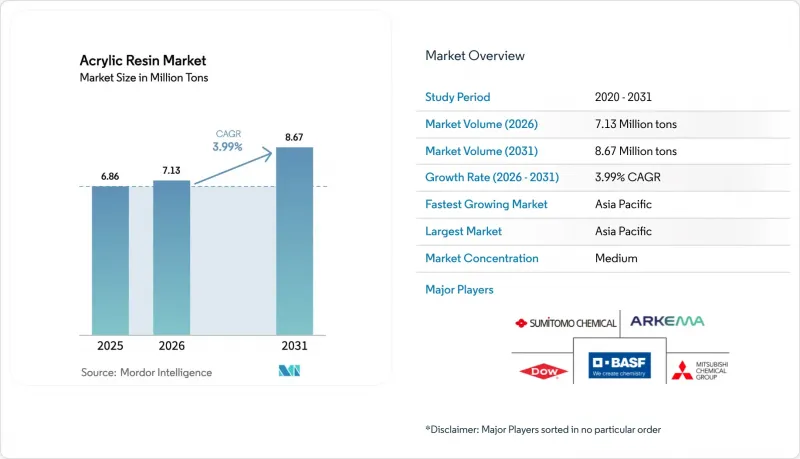
Mordor Intelligence에 의하면, 아크릴 수지 시장 규모는 2025년 686만 톤으로 평가되었습니다. 2026년에는 713만 톤으로 확대되어 2026-2031년에 걸쳐 CAGR 3.99%로 성장을 지속하여, 2031년까지 867만 톤에 이를 것으로 예측됩니다.
본 보고서는 제품 유형(아크릴레이트, 메타크릴레이트, 하이브리드), 용도(페인트 및 코팅, 접착제 및 실란트, 기타 용도), 최종 사용자 산업(건축 및 건설, 자동차, 전기 및 전자기기, 플라스틱, 섬유·섬유 제품, 기타),지역(아시아태평양, 북미, 유럽, 남미, 중동 및 아프리카)별로 분류되어 있습니다.
세계의 아크릴 수지 시장 동향 및 인사이트
건설 및 인프라 사업의 확대
세계 건설 산업의 회복이 아크릴 수지 시장의 꾸준한 성장을 뒷받침하고 있으며, 중국, 인도, 미국에서 수년에 걸쳐 진행되는 인프라 구축 계획이 도료 및 패널 수요 증가로 이어지고 있습니다. 프로젝트 개발자들은 그린 빌딩 기준을 충족하기 위해 수성 아크릴 수지의 사용을 점점 더 지정하고 있으며, 이로 인해 외장 및 내장 용도의 소비량이 증가하고 있습니다. BASF의 Acrodur 시스템과 같은 포름알데히드 무함유 바인더 기술은 실내 공기질 기준을 충족함으로써 시장 수요를 더욱 부추기고 있습니다. 전반적으로 인프라 투자는 주기적인 최종 용도 동향 속에서도 아크릴 수지 시장을 지탱하는 견고한 수요 기반을 보장하고 있습니다.
자동차용 경량 부품 수요 증가
전동화로 인해 경량화의 필요성이 가속화되고 있으며, 아크릴 수지는 유리, 차체 패널, 배터리 하우징 등에서 경량화를 가능하게 하고 있습니다. 예를 들어, 혼다와 미쓰비시 화학의 공동 제품 개발인 착색된 PMMA 부품은 도장 공정을 생략하는 동시에 수명 주기 동안의 CO2 배출량을 50% 감축하고 있습니다. 유럽과 미국의 규제상 연비 목표는 고강도·저밀도 폴리머에 대한 장기적인 수요를 보장하고 있습니다. 또한, 전기차의 배터리 하우징에는 열 안정성과 치수 정밀도가 요구되는데, 이는 메타크릴레이트계 수지가 뛰어난 특성을 발휘하는 분야입니다. 자율주행차용 센서에 요구되는 광학적 투명성과의 시너지 효과로 인해, 이러한 요인들이 아크릴 수지 시장에서 프리미엄 제품에 대한 수요를 뒷받침하고 있습니다.
아크릴레이트의 환경 및 건강 위험성
규제 당국은 노출 위험 평가를 지속적으로 수행하고 있으며, 제조 공정 및 소비자 제품에서 허용되는 모노머 농도를 더욱 엄격하게 제한하고 있습니다. 환기 설비 강화, 모니터링, 개인 보호구 도입으로 인해 아크릴 수지 산업 전반에 걸쳐 규정 준수 비용이 증가하고 있습니다. VOC 및 악취 특성에 대한 소비자의 인식은 특히 주택용 도료의 경우 구매 선택에 영향을 미치고 있습니다. 따라서 안전성을 중시한 브랜드 차별화는 필요하지만, 생산자에게는 비용이 발생합니다. 현재 진행 중인 독성학 연구는 안전한 사용 임계치를 입증하는 것을 목표로 하고 있으나, 대체 수지가 존재하는 부문에서는 여전히 남아 있는 이미지상의 리스크가 채택을 제한하고 있습니다.
부문 분석
메타크릴레이트는 광학적 투명성과 내후성 덕분에 2025년에도 아크릴 수지 시장에서 51.62%의 점유율을 유지했으나, 바이오 화학 기술이 용도의 폭을 넓혀감에 따라 아크릴레이트는 2031년까지 연평균 성장률(CAGR) 5.18%로 성장할 전망입니다. 수량 기준으로는 메타크릴레이트 등급이 유리, 간판, 고급 도료에 사용되어 아크릴 수지 시장의 상위층을 지탱하고 있습니다. 아크릴레이트 폴리머는 접착제 및 연질 코팅 수요에 힘입어, 저렴한 비용과 가공 용이성을 활용해 새로운 용도 분야에서 점유율을 확대되고 있습니다. LG화학이 완전 식물 유래 아크릴산을 시장에 출시한 것은 지속가능성이라는 특징이 고객을 아크릴레이트 계열 제품으로 이끌고 있음을 보여줍니다.
화학 재활용을 둘러싼 업계의 노력으로, 버진 메타크릴레이트와 재생 메타크릴레이트의 성능 격차는 점차 줄어들고 있습니다. 미쓰비시 화학이 개발한, 사용 후 PMMA를 마이크로파를 이용하여 MMA 단량체로 분해하는 기술은 재료의 품질을 저하시키지 않으면서 순환형 경제에 부합하는 것을 실현한 것입니다. 촉매 구조 및 반응기 설계의 발전으로 인해 두 제품군의 처리 능력과 물성 제어력이 더욱 향상되어, 경쟁적 차별화가 뚜렷해지고 있습니다.
지역별 분석
아시아태평양은 2025년에 전 세계 생산량의 50.96%를 차지했으며, 2031년까지 연평균 성장률(CAGR) 5.57%로 성장할 것으로 전망됩니다. 이는 해당 지역이 제조 거점인 동시에 소비의 중심지로도 부상하고 있다는 이중적인 역할을 반영한 것입니다. 중국은 계속해서 대규모 인프라 투자를 우선시하고 있으며, 교통, 에너지, 주택 프로젝트 전반에 걸쳐 도료 및 실런트에 대한 수요를 촉진하고 있습니다. 일본의 첨단 자동차 및 전자 산업 클러스터는 광학 및 기계적 공차가 엄격한 프리미엄 메타크릴레이트 등급에 대한 수요를 창출하고 있습니다.
북미와 유럽은 기술 및 규제 분야의 선도자 역할을 수행하고 있습니다. 미국 환경보호청(EPA)이 개정된 에어로졸 도료 VOC 규정에 따라 2027년까지 준수 유예 기간을 부여하고 있지만, 그럼에도 불구하고 저배출 아크릴계 화학물질로의 전환이라는 방향성은 확고합니다. 유럽 산업계는 화학적 재활용 시범 사업과 ISCC+ 인증을 받은 공급망에 자본을 투입하고 있으며, 추적 가능성이 확보된 저 PCF 수지에 대한 수요를 높이고 있습니다. 두 지역 모두 자동차 경량화 프로그램에 크게 의존하고 있어, 특수 등급 제품에 대한 고수익 판매처가 확대되고 있습니다.
남미, 중동 및 아프리카는 아직 발전 단계에 있지만, 성장세가 가속화되고 있습니다. 걸프 지역의 산업화, 물류 회랑, 석유화학 합작 사업이 해당 지역의 아크릴 수지 생산 능력 확대를 뒷받침하고 있습니다. 환율 변동이나 규제 차이는 장벽이 되기도 하지만, 현지 시장과의 근접성으로 인해 운송비와 수입 관세가 절감되어 서비스 제공 비용 지표가 개선되고 있습니다.
기타 혜택
- 엑셀 형식 시장 예측(ME) 시트
- 3개월간의 애널리스트 지원
자주 묻는 질문
목차
제1장 서론
제2장 조사 방법
제3장 주요 요약
제4장 시장 구도
제5장 시장 규모 및 성장 예측
제6장 경쟁 구도
제7장 시장 기회 및 향후 전망
KTH 26.09.10According to Mordor Intelligence, the acrylic resin market size is expected to grow from 6.86 million tons in 2025 to 7.13 million tons in 2026 and is forecast to reach 8.67 million tons by 2031 at 3.99% CAGR over 2026-2031.
This report is Segmented by Product Type (Acrylates, Methacrylates, and Hybrids), Application (Paints and Coatings, Adhesives and Sealants, and Other Applications), End-User Industry (Building and Construction, Automotive, Electrical and Electronics, Plastics, Textile and Fibers, and More), and Geography (Asia-Pacific, North America, Europe, South America, and Middle-East and Africa).
Global Acrylic Resin Market Trends and Insights
Expansion in Construction and Infrastructure Activities
Global construction recovery underpins consistent acrylic resin market growth, with multi-year infrastructure programs in China, India, and the United States translating into rising coatings and panel demand. Project developers increasingly specify waterborne acrylics to meet green-building criteria, elevating consumption across exterior and interior applications. Formaldehyde-free binder technologies such as BASF's Acrodur systems further strengthen market pull by aligning with indoor-air-quality standards. Overall, infrastructure spending assures a visible demand pipeline that anchors the acrylic resin market amid cyclical end-uses.
Rising Demand for Lightweight Automotive Components
Electrification accelerates lightweighting imperatives, and acrylic resins enable mass reduction across glazing, body panels, and battery enclosures. Collaborative product development, for example, Honda and Mitsubishi Chemical's pre-colored PMMA parts, removes paint steps while lowering lifecycle CO2 emissions by 50%. Regulatory fuel-economy targets in Europe and the United States guarantee long-run demand for high-strength, low-density polymers. Electric-vehicle battery housings further require thermal stability and dimensional accuracy, properties well served by methacrylate grades. Coupled with autonomous-vehicle sensor needs for optical clarity, these factors sustain premium volumes within the acrylic resin market.
Environmental and Health Hazards of Acrylates
Regulators continue to evaluate exposure risks, tightening permissible monomer concentrations in manufacturing and consumer products. Enhanced ventilation, monitoring, and personal protective equipment raise compliance costs across the acrylic resin industry. Consumer awareness of VOC and odor profiles influences purchasing choices, particularly in residential coatings. Safety-driven brand differentiation is, therefore, necessary but costly for producers. Ongoing toxicology studies aim to substantiate safe-use thresholds, yet lingering perception risks cap adoption where substitute resins exist.
Other drivers and restraints analyzed in the detailed report include:
- Increasing Consumption of Low-VOC Water-Borne Coatings
- Rapid Adoption of 3D-Printing Photopolymer Resins
- Volatile Propylene and MMA Feed-Stock Prices
For complete list of drivers and restraints, kindly check the Table Of Contents.
Segment Analysis
Methacrylates retained a 51.62% acrylic resin market share in 2025 thanks to their optical clarity and weatherability, but acrylates are on track for a 5.18% CAGR through 2031 as bio-based chemistries broaden their usage window. In volume terms, methacrylate grades serve glazing, signage, and premium coatings, anchoring the upper tier of the acrylic resin market. Acrylate polymers, propelled by adhesive and flexible-coating demand, capitalize on lower cost and easier processability, gaining ground in emerging applications. LG Chem's roll-out of fully plant-derived acrylic acid illustrates how sustainability attributes are pulling customers toward acrylate variants.
Industry initiatives around chemical recycling are narrowing the performance gap between virgin and recovered methacrylates. Mitsubishi Chemical's microwave-assisted depolymerization of post-consumer PMMA back to MMA monomer promises circular-economy compliance without sacrificing material quality. Advancements in catalyst architectures and reactor design further enhance throughput and property control across both product families, sharpening competitive differentiation.
Complete Report Scope:
- By Product Type
- Acrylates
- Methacrylates
- Hybrids
- By Application
- Paints and Coatings
- Adhesives and Sealants
- Other Applications (Pigment Dispersion, Elastomers, etc.)
- By End-User Industry
- Building and Construction
- Automotive
- Electrical and Electronics
- Plastics
- Textile and Fibers
- Paper and Paperboard
- Other Applications (Packaging and Consumer Goods)
- By Geography
- Asia-Pacific
- China
- India
- Japan
- South Korea
- Malaysia
- Thailand
- Indonesia
- Vietnam
- Rest of Asia-Pacific
- North America
- United States
- Canada
- Mexico
- Europe
- Germany
- United Kingdom
- France
- Italy
- Spain
- Nordic Countries
- Turkey
- Russia
- Rest of Europe
- South America
- Brazil
- Argentina
- Colombia
- Rest of South America
- Middle-East and Africa
- Saudi Arabia
- United Arab Emirates
- Qatar
- South Africa
- Nigeria
- Egypt
- Rest of Middle-East and Africa
- Asia-Pacific
Geography Analysis
Asia-Pacific held 50.96% of global volume in 2025 and is positioned for a 5.57% CAGR through 2031, reflecting the region's dual role as a manufacturing hub and rising consumption center. China continues to prioritize megainfrastructure investment, stimulating coatings and sealants uptake across transport, energy, and residential projects. Japan's advanced automotive and electronics clusters carve out demand for premium methacrylate grades with tight optical and mechanical tolerances.
North America and Europe operate as technology and regulation leaders. The EPA's revised aerosol-coating VOC rule grants a compliance grace period to 2027, yet still locks in a trajectory toward low-emission acrylic chemistries. European industry is channeling capital into chemical-recycling pilots and ISCC+ certified supply chains, reinforcing a premium on traceable low-PCF resins. Both regions lean heavily on lightweight automotive programs, adding high-margin outlets for specialty grades.
South America, the Middle East, and Africa are nascent but gathering pace. Industrialization, logistics corridors, and petrochemical joint ventures in the Gulf are fostering regional acrylic resin capacity additions. Although currency swings and regulatory heterogeneity pose hurdles, local market proximity cuts freight and import tariffs, improving cost-to-serve metrics.
- Allnex GMBH
- Arkema
- BASF
- Covestro AG
- DIC Corporation
- Dow
- Evonik Industries AG
- Henkel AG & Co. KGaA
- Mitsubishi Chemical Group Corporation
- Nippon Shokubai Co., Ltd.
- Resonac Holdings Corporation
- Rohm GmbH
- Sumitomo Chemical Co., Ltd.
Additional Benefits:
- The market estimate (ME) sheet in Excel format
- 3 months of analyst support
TABLE OF CONTENTS
1 Introduction
- 1.1 Study Assumptions and Market Definition
- 1.2 Scope of the Study
2 Research Methodology
3 Executive Summary
4 Market Landscape
- 4.1 Market Overview
- 4.2 Market Drivers
- 4.2.1 Expansion in Construction and Infrastructure Activities
- 4.2.2 Rising Demand for Lightweight Automotive Components
- 4.2.3 Increasing Consumption of Low-VOC Water-Borne Coatings
- 4.2.4 Rapid Adoption of 3-D-Printing Photopolymer Resins
- 4.2.5 Growth of Smart/Self-Healing Coating Technologies
- 4.3 Market Restraints
- 4.3.1 Environmental and Health Hazards of Acrylates
- 4.3.2 Volatile Propylene and MMA Feed-Stock Prices
- 4.3.3 Competition From Bio-Based Polymer Alternatives
- 4.4 Value Chain Analysis
- 4.5 Porter's Five Forces
- 4.5.1 Bargaining Power of Suppliers
- 4.5.2 Bargaining Power of Buyers
- 4.5.3 Threat of New Entrants
- 4.5.4 Threat of Substitutes
- 4.5.5 Degree of Competition
5 Market Size and Growth Forecasts (Volume)
- 5.1 By Product Type
- 5.1.1 Acrylates
- 5.1.2 Methacrylates
- 5.1.3 Hybrids
- 5.2 By Application
- 5.2.1 Paints and Coatings
- 5.2.2 Adhesives and Sealants
- 5.2.3 Other Applications (Pigment Dispersion, Elastomers, etc.)
- 5.3 By End-User Industry
- 5.3.1 Building and Construction
- 5.3.2 Automotive
- 5.3.3 Electrical and Electronics
- 5.3.4 Plastics
- 5.3.5 Textile and Fibers
- 5.3.6 Paper and Paperboard
- 5.3.7 Other Applications (Packaging and Consumer Goods)
- 5.4 By Geography
- 5.4.1 Asia-Pacific
- 5.4.1.1 China
- 5.4.1.2 India
- 5.4.1.3 Japan
- 5.4.1.4 South Korea
- 5.4.1.5 Malaysia
- 5.4.1.6 Thailand
- 5.4.1.7 Indonesia
- 5.4.1.8 Vietnam
- 5.4.1.9 Rest of Asia-Pacific
- 5.4.2 North America
- 5.4.2.1 United States
- 5.4.2.2 Canada
- 5.4.2.3 Mexico
- 5.4.3 Europe
- 5.4.3.1 Germany
- 5.4.3.2 United Kingdom
- 5.4.3.3 France
- 5.4.3.4 Italy
- 5.4.3.5 Spain
- 5.4.3.6 Nordic Countries
- 5.4.3.7 Turkey
- 5.4.3.8 Russia
- 5.4.3.9 Rest of Europe
- 5.4.4 South America
- 5.4.4.1 Brazil
- 5.4.4.2 Argentina
- 5.4.4.3 Colombia
- 5.4.4.4 Rest of South America
- 5.4.5 Middle-East and Africa
- 5.4.5.1 Saudi Arabia
- 5.4.5.2 United Arab Emirates
- 5.4.5.3 Qatar
- 5.4.5.4 South Africa
- 5.4.5.5 Nigeria
- 5.4.5.6 Egypt
- 5.4.5.7 Rest of Middle-East and Africa
- 5.4.1 Asia-Pacific
6 Competitive Landscape
- 6.1 Market Concentration
- 6.2 Strategic Moves
- 6.3 Market Share Analysis
- 6.4 Company Profiles (includes Global level Overview, Market level overview, Core Segments, Financials as available, Strategic Information, Market Rank/Share for key companies, Products and Services, and Recent Developments)
- 6.4.1 Allnex GMBH
- 6.4.2 Arkema
- 6.4.3 BASF
- 6.4.4 Covestro AG
- 6.4.5 DIC Corporation
- 6.4.6 Dow
- 6.4.7 Evonik Industries AG
- 6.4.8 Henkel AG & Co. KGaA
- 6.4.9 Mitsubishi Chemical Group Corporation
- 6.4.10 Nippon Shokubai Co., Ltd.
- 6.4.11 Resonac Holdings Corporation
- 6.4.12 Rohm GmbH
- 6.4.13 Sumitomo Chemical Co., Ltd.
7 Market Opportunities and Future Outlook
- 7.1 White-space and Unmet-Need Assessment