|
시장보고서
상품코드
2119901
산업용 클라우드 : 시장 점유율 분석, 업계 동향과 통계, 성장 예측(2026-2031년)Industrial Cloud - Market Share Analysis, Industry Trends & Statistics, Growth Forecasts (2026 - 2031) |
||||||
 Mordor Intelligence
Mordor Intelligence에 따르면 산업용 클라우드 시장 규모는 2025년에 905억 2,000만 달러로 평가되며, 2026년 1,049억 2,000만 달러에서 2031년까지 2,196억 8,000만 달러에 달할 것으로 예측되고 있으며, 예측 기간(2026-2031년) CAGR은 15.91%에 달할 전망입니다.
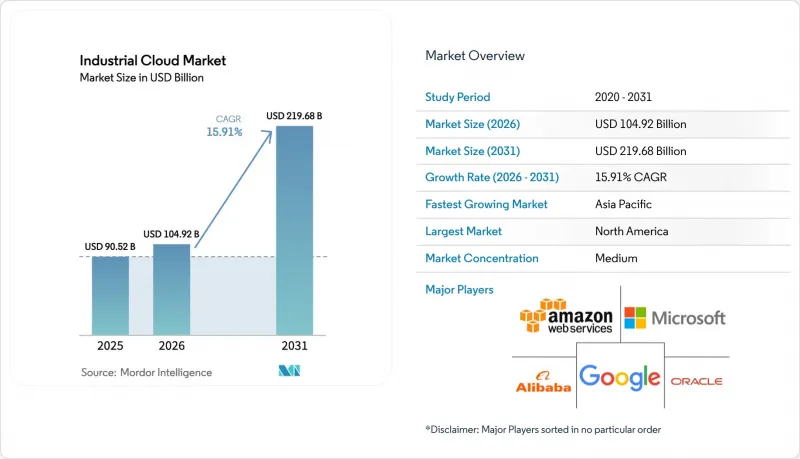
이 보고서는 제공 방식(플랫폼, 서비스), 서비스 모델(Infrastructure-As-A-Service, Platform-As-A-Service, Software-As-A-Service), 배포 방식(퍼블릭 클라우드, 프라이빗 클라우드), 최종사용자 산업(석유 및 가스,에너지·공공사업, 화학, 기타), 기업 규모(대기업, 중소기업) 및 지역별로 분류되어 있습니다. 시장 예측은 금액(달러) 기준으로 제시되어 있습니다.
글로벌 산업용 클라우드 시장의 동향 및 인사이트
인더스트리 4.0 구상 도입
제조업의 디지털화에 대한 요구로 인해 기업은 클라우드 환경과 현장의 제어 시스템을 연동해야 할 필요성에 직면하고 있으며, 이는 산업용 등급 클라우드 플랫폼에 대한 지속적인 수요를 견인하고 있습니다. 지멘스는 2024년에 759억 유로의 매출을 기록했으며, 자사의 디지털 인더스트리 부문에서는 클라우드 지원 제조 실행 시스템(MES)의 수주가 가속화되고 있다고 보고하고 있습니다. 독일과 일본의 에너지 효율화 지침에서는 자원 소비량을 실시간으로 모니터링하는 디지털 트윈의 도입이 의무화되어 있으며, 이에 따라 공장은 운영 데이터를 클라우드로 이전할 수밖에 없는 상황입니다. 조기에 도입한 기업은 생산성과 품질 향상을 실현하고 있으며, 이로 인해 경쟁 장벽이 높아지면서 뒤처진 동종 업계 기업에게는 전환을 서두르라는 압력이 가해지고 있습니다. 각 자동화 벤더들은 레거시 PLC 프로토콜을 안전한 클라우드 API로 변환하는 커넥터 라이브러리를 제공함으로써 통합 장벽을 낮추고 있으며, 자산 교체로 인한 업무 중단을 초래하지 않고 기존 설비(브라운필드)에서도 클라우드 분석을 활용할 수 있도록 하고 있습니다.
클라우드의 비용 효율성이 뛰어난 확장성
경제의 변동성으로 인해 제조업체들은 변동비형 IT 모델로의 전환을 강요받고 있습니다. 오라클의 클라우드 인프라 매출은 2024년 4분기에 52% 증가한 159억 달러를 기록했는데, 그 대부분은 계절적 수요 급증이나 신제품 출시에 따른 수요 급증에 대응하기 위한 탄력적인 용량을 필요로 하는 산업용 ERP 마이그레이션에서 비롯된 것입니다. 운영 비용(Op-ex) 모델에서는 온프레미스 서버의 유휴 상태를 방지하고 재생 가능 에너지로 가동되는 하이퍼스케일 데이터센터를 활용함으로써 전기 요금과 Scope 2 배출량을 모두 절감할 수 있습니다. 이러한 가치 제안은 그동안 고정형 인프라에서 에너지 집약적인 배치 처리 워크로드를 실행해 온 금속 및 광업 기업에게 큰 반향을 일으키고 있습니다. 중소기업은 클라우드 제공업체가 베스트 프랙티스에 기반한 보안 및 고가용성(HA) 구성을 미리 가격이 책정된 번들에 포함하고 있으므로 사내 전문가를 배치할 필요가 없어 상대적으로 큰 이점을 얻을 수 있습니다.
데이터 보안 및 규정 준수 관련 우려
공격자들은 IT 시스템에서 클라우드로 연결된 운영 기술(OT) 자산으로 표적을 옮기고 있으며, 이로 인해 경영진의 위험 인식이 높아지고 있습니다. IBM의 ‘2025년 X-Force 보고서’에서는 자동차 및 화학 제품 생산을 며칠간 중단시킨 랜섬웨어 공격 사례를 다루고 있으며, 이는 금전적 손실뿐만 아니라 안전성에 대한 직접적인 영향도 초래하고 있습니다. 제약 및 식품 가공 공장에서는 제품의 전체 수명 주기 동안 전자 기록이 변조되지 않았음을 증명해야 하지만, 많은 클라우드 플랫폼은 여전히 책임 소재가 모호해지는 ‘책임 분담 모델’에 의존하고 있습니다. 이 문제를 더욱 심각하게 만드는 것은 기술 격차입니다. 플랜트 엔지니어가 IAM(신원 및 접근 관리)이나 네트워크 세분화 관련 인증 자격을 보유하고 있는 경우는 드물기 때문입니다. 그 결과, 조직들은 레퍼런스 아키텍처나 매니지드 서비스가 성숙해질 때까지 특정 전환을 미루고 있습니다.
부문 분석
2025년에는 제조업체들이 클라우드 플랫폼과 이종 혼재 공장 설비를 통합하기 위해 전문 파트너에 의존하게된 결과, 서비스 부문이 산업용 클라우드 시장의 58.12%를 차지했습니다. 이 부문은 2031년까지 연평균 20.17%의 성장률을 보일 것으로 예상되며, 이는 컨설팅, 마이그레이션, 매니지드 서비스가 단순한 추가 옵션이 아닌 필수 요건임을 지원합니다. 서비스 제공업체들은 20년 전의 PLC와 최신 API를 연결하는 미들웨어를 구축하고 있으며, 이를 통해 도입 주기를 분기 단위에서 몇 주 단위로 단축하여 공장 직원이 더 높은 부가가치를 창출하는 업무에 집중할 수 있도록 하고 있습니다. 플랫폼 수익은 시장 점유율은 작지만 이익률이 높아, AI, 디지털 트윈, 사이버 보안 기능을 스택의 더 깊은 계층으로 추진하는 연구개발(R&D)의 자금원이 되고 있습니다. 현재 많은 벤더들이 자사 플랫폼과 인증 서비스 파트너를 결합한 레퍼런스 아키텍처를 번들로 제공하고 있으며, 플랫폼 기능 강화가 서비스 수익을 끌어올리고, 그 반대의 경우도 마찬가지인 선순환 구조를 강화하고 있습니다.
2025년 매출 중 Software-as-a-Service(SaaS)가 46.55%를 차지했으나, 2031년까지 연평균 성장률(CAGR)이 20.8%로 가장 높은 분야는 Platform-as-a-Service(PaaS)입니다. ERP 및 CRM 분야에서 SaaS가 초기에 거둔 성공은 로우코드 PaaS 툴키트을 기반으로 구축된 맞춤형 산업용 애플리케이션으로의 길을 열었습니다. 엔지니어들은 이제 첨단 코딩 기술 없이도 예측 유지보수 대시보드나 품질 검사 흐름을 설정할 수 있게 되어, 기업 IT 부서의 업무 부담을 덜어주고 있습니다. Infrastructure-as-a-Service(IaaS)는 여전히 기반으로서의 역할을 수행하고 있지만, 하이퍼스케일러 기업이 가격 경쟁을 벌이면서 이익률에 대한 압박은 커지고 있습니다. 차별화의 초점은 범용 클라우드에는 부족한 특성인 결정론적 네트워크와 시간 의존성이 높은 워크로드로 이동하고 있습니다. 이 계층 구조는 성숙의 조짐을 보이고 있습니다. 기본적인 컴퓨팅 환경의 전환이 완료되면, 가치는 경쟁력 있는 지적 재산(IP)을 호스팅하는 개발 플랫폼으로 이동하게 됩니다.
지역별 분석
북미는 인더스트리 4.0의 조기 도입과 하이퍼스케일 지역이 밀집해 있는 덕분에 48.35%의 점유율로 1위를 차지했습니다. 아시아태평양은 인도와 베트남이 가동 첫날부터 클라우드 네이티브 생산 셀을 갖춘 신규 공장을 가동함에 따라 2031년까지 연평균 22.78%의 성장이 예상됩니다. 이 시장들의 정부는 세제 혜택을 디지털 트윈 도입과 연계함으로써 수요를 공고히 하고 있습니다. 유럽은 지속가능성과 주권 확보의 요구에 힘입어 꾸준히 성장하고 있는 반면, 중동 및 아프리카 및 남미에서는 석유, 광업, 농업의 디지털화와 연계된 성장 여지가 예상됩니다.
기타 혜택:
- 엑셀 형식의 시장 예측(ME) 시트
- 3개월간의 애널리스트 지원
자주 묻는 질문
목차
제1장 서론
제2장 조사 방법
제3장 개요
제4장 시장 구도
제5장 시장 규모와 성장 예측
제6장 경쟁 구도
제7장 시장 기회와 향후 전망
KSA 26.09.02According to Mordor Intelligence, the industrial cloud market size was valued at USD 90.52 billion in 2025 and estimated to grow from USD 104.92 billion in 2026 to reach USD 219.68 billion by 2031, at a CAGR of 15.91% during the forecast period (2026-2031).
This report is Segmented by Offering (Platforms, Services), Service Model (Infrastructure-As-A-Service, Platform-As-A-Service, Software-As-A-Service), Deployment (Public Cloud, Private Cloud), End-User Vertical (Oil and Gas, Energy and Utilities, Chemicals, and More), Enterprise Size (Large Enterprises, Small and Medium Enterprises), and by Geography. The Market Forecasts are Provided in Terms of Value (USD).
Global Industrial Cloud Market Trends and Insights
Adoption of Industry 4.0 Initiatives
Manufacturing digitalization mandates are pushing enterprises to link cloud environments with shop-floor control systems, driving sustained demand for industrial-grade cloud platforms. Siemens generated EUR 75.9 billion revenue in 2024 with its Digital Industries division reporting accelerated orders for cloud-enabled manufacturing execution systems. Energy-efficiency directives in Germany and Japan now require digital twins that monitor resource consumption in real time, compelling plants to migrate operational data to the cloud. Early adopters are capturing productivity and quality gains that raise competitive thresholds and pressure lagging peers to fast-track migration. Automation vendors are lowering integration hurdles by shipping connector libraries that translate legacy PLC protocols into secure cloud APIs, opening brownfield footprints to cloud analytics without disruptive asset swaps.
Cost-efficient Scalability of Cloud
Economic volatility is pushing manufacturers toward variable-cost IT models. Oracle's cloud-infrastructure revenue rose 52% in Q4 2024 to USD 15.9 billion, with a material share coming from industrial ERP migrations seeking elastic capacity for seasonal or launch-driven demand spikes.Op-ex models avoid idle on-premises servers and leverage renewable-powered hyperscale data centers that cut both electricity bills and Scope 2 emissions. The value prop resonates with metals and mining firms that previously ran energy-intensive, batch-driven workloads on fixed infrastructure. SMEs gain proportionally more because cloud providers wrap best-practice security and HA configurations into pre-priced bundles that negate the need for in-house specialists.
Data-security and Compliance Concerns
Attackers are pivoting from IT systems to cloud-connected operational-technology assets, heightening risk awareness in boardrooms. IBM's 2025 X-Force report highlights ransomware strikes that halted automotive and chemical production for multiple days, adding direct safety impacts to financial losses. Pharmaceutical and food-processing plants must prove that electronic records remain immutable throughout the product life-cycle, yet many cloud platforms still rely on shared-responsibility models that blur accountability. The skills gap compounds the issue because plant engineers seldom hold certifications in IAM or network segmentation. As a result, organizations delay certain migrations until reference architectures and managed services mature.
Other drivers and restraints analyzed in the detailed report include:
- Remote Operations and Resilience Post-COVID-19
- Sovereign/Regulated Industry-Cloud Frameworks
- Vendor Lock-in Fears for Proprietary Clouds
For complete list of drivers and restraints, kindly check the Table Of Contents.
Segment Analysis
Services captured 58.12% of the industrial cloud market in 2025 as manufacturers turned to specialist partners to integrate cloud platforms with heterogeneous factory equipment. The segment is forecast to grow 20.17% annually to 2031, reinforcing how consulting, migration and managed services are prerequisites rather than optional add-ons. Service providers are building middleware that bridges 20-year-old PLCs with modern APIs, cutting deployment cycles from quarters to weeks and freeing plant staff for higher-value tasks. Platform revenue, although a smaller slice, carries better margins and funds RandD that pushes AI, digital twins and cybersecurity features deeper into the stack. Many vendors now bundle reference architectures that couple their platforms with certified services partners, reinforcing a flywheel where platform enhancements boost service revenue and vice versa.
Software-as-a-Service preserved 46.55% of 2025 revenue, yet Platform-as-a-Service is the fastest mover at 20.8% CAGR through 2031. Early wins in SaaS for ERP and CRM paved the runway for bespoke industrial apps built on low-code PaaS toolkits. Engineers can now configure predictive-maintenance dashboards or quality-inspection flows without deep coding skills, reducing backlog on corporate IT. Infrastructure-as-a-Service remains foundational, though margin pressure rises as hyperscalers battle on price. Differentiation shifts toward deterministic networking and time-sensitive workloads, traits that general-purpose clouds lack. The hierarchy shows maturation: once basic compute shifts are complete, value migrates to development platforms that host competitive IP.
Complete Report Scope:
- By Offering
- Platforms
- Services
- By Service Model
- Infrastructure-as-a-Service (IaaS)
- Platform-as-a-Service (PaaS)
- Software-as-a-Service (SaaS)
- By Deployment
- Public Cloud
- Private Cloud
- By End-user Vertical
- Oil and Gas
- Energy and Utilities
- Chemicals
- Food and Beverages
- Pharmaceuticals
- Automotive and Transportation
- Metals and Mining
- Other Process and Discrete Industries
- By Enterprise Size
- Large Enterprises
- Small and Medium Enterprises (SMEs)
- By Geography
- North America
- United States
- Canada
- Mexico
- South America
- Brazil
- Argentina
- Rest of South America
- Europe
- United Kingdom
- Germany
- France
- Italy
- Spain
- Russia
- Rest of Europe
- Asia-Pacific
- China
- Japan
- India
- South Korea
- Australia and New Zealand
- Rest of Asia-Pacific
- Middle East and Africa
- Middle East
- Saudi Arabia
- UAE
- Turkey
- Rest of Middle East
- Africa
- South Africa
- Nigeria
- Kenya
- Rest of Africa
- Middle East
- North America
Geography Analysis
North America led with 48.35% share owing to early Industry 4.0 rollouts and dense hyperscale regions. Asia-Pacific is forecast to grow 22.78% annually through 2031 as India and Vietnam commission new factories with cloud-native cells from day one. Governments in these markets link tax incentives to digital-twin adoption, locking in demand. Europe grows steadily under sustainability and sovereignty mandates, whereas Middle East and Africa and South America present upside tied to oil, mining and agriculture digitalization.
- Amazon Web Services
- Microsoft Corporation
- Google LLC
- Alibaba Group Holdings Limited
- Oracle Corporation
- IBM Corporation
- Siemens Digital Industries
- ABB Ltd.
- Schneider Electric
- Honeywell Forge
- Bosch Connected Industry
- GE Vernova (Predix)
- SAP SE
- Cisco Systems
- Dell Technologies
- Rockwell Automation
- Tencent Cloud
- OVH Cloud
- DigitalOcean
- Akamai Technologies
- Snowflake Inc.
Additional Benefits:
- The market estimate (ME) sheet in Excel format
- 3 months of analyst support
TABLE OF CONTENTS
1 INTRODUCTION
- 1.1 Study Assumptions and Market Definition
- 1.2 Scope of the Study
2 RESEARCH METHODOLOGY
3 EXECUTIVE SUMMARY
4 MARKET LANDSCAPE
- 4.1 Market Overview
- 4.2 Market Drivers
- 4.2.1 Adoption of Industry 4.0 Initiatives
- 4.2.2 Coste Efficient Scalability of Cloud
- 4.2.3 Remote Operations and Resilience Post-COVID-19
- 4.2.4 Sovereign/Regulated Industry-Cloud Frameworks
- 4.2.5 Vertical Cloud Marketplaces for OT Software
- 4.2.6 Edge-to-Cloud Convergence in Brownfield Plants
- 4.3 Market Restraints
- 4.3.1 Data-security and Compliance Concerns
- 4.3.2 Lack of IT Infrastructure in Developing Regions
- 4.3.3 Carbon-Footprint Limits on Hyperscale DCs
- 4.3.4 Vendor Lock-in Fears for Proprietary Clouds
- 4.4 Value / Supply-Chain Analysis
- 4.5 Regulatory Landscape
- 4.6 Technological Outlook
- 4.7 Porter's Five Forces Analysis
- 4.7.1 Bargaining Power of Suppliers
- 4.7.2 Bargaining Power of Buyers
- 4.7.3 Threat of New Entrants
- 4.7.4 Threat of Substitutes
- 4.7.5 Competitive Rivalry
5 MARKET SIZE AND GROWTH FORECASTS (VALUE)
- 5.1 By Offering
- 5.1.1 Platforms
- 5.1.2 Services
- 5.2 By Service Model
- 5.2.1 Infrastructure-as-a-Service (IaaS)
- 5.2.2 Platform-as-a-Service (PaaS)
- 5.2.3 Software-as-a-Service (SaaS)
- 5.3 By Deployment
- 5.3.1 Public Cloud
- 5.3.2 Private Cloud
- 5.4 By End-user Vertical
- 5.4.1 Oil and Gas
- 5.4.2 Energy and Utilities
- 5.4.3 Chemicals
- 5.4.4 Food and Beverages
- 5.4.5 Pharmaceuticals
- 5.4.6 Automotive and Transportation
- 5.4.7 Metals and Mining
- 5.4.8 Other Process and Discrete Industries
- 5.5 By Enterprise Size
- 5.5.1 Large Enterprises
- 5.5.2 Small and Medium Enterprises (SMEs)
- 5.6 By Geography
- 5.6.1 North America
- 5.6.1.1 United States
- 5.6.1.2 Canada
- 5.6.1.3 Mexico
- 5.6.2 South America
- 5.6.2.1 Brazil
- 5.6.2.2 Argentina
- 5.6.2.3 Rest of South America
- 5.6.3 Europe
- 5.6.3.1 United Kingdom
- 5.6.3.2 Germany
- 5.6.3.3 France
- 5.6.3.4 Italy
- 5.6.3.5 Spain
- 5.6.3.6 Russia
- 5.6.3.7 Rest of Europe
- 5.6.4 Asia-Pacific
- 5.6.4.1 China
- 5.6.4.2 Japan
- 5.6.4.3 India
- 5.6.4.4 South Korea
- 5.6.4.5 Australia and New Zealand
- 5.6.4.6 Rest of Asia-Pacific
- 5.6.5 Middle East and Africa
- 5.6.5.1 Middle East
- 5.6.5.1.1 Saudi Arabia
- 5.6.5.1.2 UAE
- 5.6.5.1.3 Turkey
- 5.6.5.1.4 Rest of Middle East
- 5.6.5.2 Africa
- 5.6.5.2.1 South Africa
- 5.6.5.2.2 Nigeria
- 5.6.5.2.3 Kenya
- 5.6.5.2.4 Rest of Africa
- 5.6.5.1 Middle East
- 5.6.1 North America
6 COMPETITIVE LANDSCAPE
- 6.1 Market Concentration
- 6.2 Strategic Initiatives and MandA
- 6.3 Market Share Analysis
- 6.4 Company Profiles (includes Global level Overview, Market level overview, Core Segments, Financials as available, Strategic Information, Market Rank/Share for key companies, Products and Services, and Recent Developments)
- 6.4.1 Amazon Web Services
- 6.4.2 Microsoft Corporation
- 6.4.3 Google LLC
- 6.4.4 Alibaba Group Holdings Limited
- 6.4.5 Oracle Corporation
- 6.4.6 IBM Corporation
- 6.4.7 Siemens Digital Industries
- 6.4.8 ABB Ltd.
- 6.4.9 Schneider Electric
- 6.4.10 Honeywell Forge
- 6.4.11 Bosch Connected Industry
- 6.4.12 GE Vernova (Predix)
- 6.4.13 SAP SE
- 6.4.14 Cisco Systems
- 6.4.15 Dell Technologies
- 6.4.16 Rockwell Automation
- 6.4.17 Tencent Cloud
- 6.4.18 OVH Cloud
- 6.4.19 DigitalOcean
- 6.4.20 Akamai Technologies
- 6.4.21 Snowflake Inc.
7 MARKET OPPORTUNITIES AND FUTURE OUTLOOK
- 7.1 White-space and Unmet-Need Assessment