
|
시장보고서
상품코드
2119906
데이터 어노테이션 툴 시장 : 점유율 분석, 업계 동향과 통계, 성장 예측(2026-2031년)Data Annotation Tools - Market Share Analysis, Industry Trends & Statistics, Growth Forecasts (2026 - 2031) |
||||||
 Mordor Intelligence
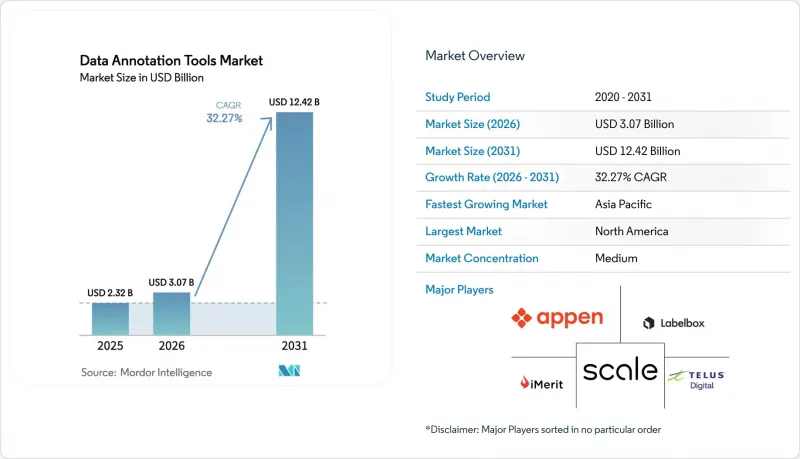
Mordor Intelligence에 의하면, 데이터 어노테이션 툴 시장 규모는 2025년 23억 2,000만 달러에서 2026년에는 30억 7,000만 달러로 확대되어 2026년부터 2031년까지 CAGR 32.27%로 성장을 지속하여, 2031년에는 124억 2,000만 달러에 이를 것으로 예측됩니다.
본 보고서는 구성 요소(소프트웨어 플랫폼 및 서비스), 데이터 유형(텍스트, 이미지 등),주석 유형(수동, 반지도 학습 등), 도입 형태(클라우드, On-Premise, 하이브리드), 최종 사용자 산업(IT 및 통신, 은행, 금융서비스 및 보험(BFSI), 소매 및 전자상거래 등), 지역별로 분류되어 있습니다. 시장 규모 및 전망은 상기 모든 부문에 대해 금액(달러) 기준으로 제시되어 있습니다.
세계 데이터 어노테이션 툴 시장 동향 및 인사이트
업종을 불문하고 AI/ML 도입이 확대되고 있습니다.
기업 내 AI 도입으로 인해 어노테이션의 품질이 수익에 직접적인 영향을 미치게 되었습니다. Target사는 상품 컨텐츠 감사에서 96%의 자동화와 99%의 정확도를 달성하여, 라벨링 정확도를 전자상거래 채널의 전환율 향상으로 연결했습니다. Scale AI의 매출은 2024년에 8억 7,000만 달러에 달하고, 2025년에는 20억 달러에 이를 것으로 예상되며, 이는 대규모 멀티모달 데이터셋에 대한 수요가 데이터 어노테이션 툴 시장을 어떻게 변화시키고 있는지를 보여줍니다. Inscribe와 같은 금융 서비스 기업들은 전문가가 라벨링한 데이터를 활용해 문서 검증 모델을 학습시킴으로써, 부정 심사 소요 시간을 20분의 1로 단축했습니다. 업종을 불문하고 파운데이션 모델로의 전환이 진행되는 가운데, 어노테이션 플랫폼은 단순한 전술적 벤더가 아닌 전략적 인프라로서의 입지를 공고히 하고 있습니다.
자율주행차 개발의 급증
각 프로그램은 연구개발(R&D) 단계의 시범 사업에서 상용화로 발전하고 있으며, 정밀한 3D 어노테이션과 센서 퓨전 데이터가 요구되고 있습니다. 테슬라의 버팔로, 팔로알토, 드레이퍼 센터에서는 완전 자율주행(Full Self-Driving) 소프트웨어 학습을 위해 매일 수천 개의 동영상 클립을 처리하고 있으며, 이를 통해 작업량의 규모와 정교함을 엿볼 수 있습니다. Waymo의 오픈 세트에는 훈련을 받은 어노테이터가 엄선한 1,200만 건의 LiDAR 데이터와 990만 건의 카메라 어노테이션이 포함되어 있습니다. Scale AI와 같은 공급업체는 2D 및 3D 어노테이션과 지속적인 학습 루프를 결합한 자동차용 데이터 엔진을 제공하고 있으며, 이는 범용적인 기능보다 해당 분야의 전문 지식이 더 중요함을 보여줍니다.
숙련된 어노테이터 부족
라이더 포인트 클라우드에서 방사선 이미지 시리즈에 이르기까지, 복잡한 이용 사례에는 수개월에 걸친 훈련이 필요하며, 이는 임금 상승과 프로젝트 기간 연장으로 이어지고 있습니다. 테슬라의 여러 거점에 걸친 어노테이터 체계는 실제 운영 환경에 필요한 대규모 인력의 필요성을 여실히 보여주고 있습니다. 크라우드소싱 포털에서는 품질 유지가 어려워, 기업들은 사내 팀을 구성하거나 전문 벤더에 고액의 비용을 지불할 수밖에 없습니다.
부문 분석
2025년, 소프트웨어 플랫폼은 데이터 어노테이션 툴 시장에서 50.12%의 점유율을 유지하며, 사내 워크플로우를 확장하는 기업들에게 ‘첫 번째 선택’으로서의 입지를 확고히 했습니다. 그러나 서비스 부문은 연평균 성장률(CAGR) 18.12%를 나타낼 것으로 예측되며, 이는 프로젝트에서 규정 준수 및 전문 지식이 요구될 경우 관리형 솔루션에 대한 수요가 증가하고 있음을 보여줍니다. CloudFactory의 7,000명 규모의 애널리스트 네트워크가 대형 소매 기업을 위해 하루 5만 건의 라벨링 처리를 수행하고 있다는 사실은 서비스 기업이 현재 보유하고 있는 처리 능력의 깊이를 여실히 보여줍니다.
이 서비스 시장의 급성장은 전략적 전환을 반영하고 있습니다. 기업들은 인력 관리, 품질 보증, 규정 준수를 포함한 라벨링 파이프라인 전체를 Sama와 같은 파트너 기업에 아웃소싱하는 경향이 강해지고 있습니다. Sama는 고객 승인률이 99%이며, ISO 준수 감사 추적을 갖추고 있다고 보고하고 있습니다. 이러한 파트너십을 통해 고객이 라이선스와 처리 능력을 모두 구매하는 혼합형 조달 패턴이 생겨나면서, 데이터 어노테이션 툴 시장 전체에서 기존 플랫폼과 서비스의 경계가 모호해지고 있습니다.
2025년에도 이미지는 소매, 보안, 의료 분야의 비전 프로젝트에 힘입어 데이터 어노테이션 툴 시장 점유율의 35.74%를 계속 차지하고 있습니다. 그러나 자율 주행, 공간 컴퓨팅 및 산업용 시뮬레이션에 대한 수요에 힘입어 3D/포인트 클라우드 분야는 연평균 성장률(CAGR) 22.45%로 확대되고 있습니다. 퀄컴, 애플, 구글은 포인트 클라우드 압축 및 복셀 기반 매핑에 관한 특허를 지속적으로 출원하고 있어 기술적 모멘텀이 확인되고 있습니다.
애플의 평면도 생성에 관한 특허는 3D 라벨링이 증강현실(AR) 내비게이션에서 실시간 공간 인식을 어떻게 가능하게 하는지를 보여줍니다. 이 부문의 복잡성으로 인해 독자적인 도구를 보유한 제공업체가 유리한 입장에 있으며, 수요가 2D에서 체적 공간으로 이동함에 따라 선도적인 기업들이 수익을 확대할 수 있는 위치에 있습니다.
지역별 분석
북미는 2025년에 전 세계 매출의 41.10%를 차지하며, 풍부한 벤처 캐피탈 자금, 주요 기술 기업의 연구 개발, 그리고 성숙한 고객 기반에 힘입고 있습니다. Scale AI의 8억 7,000만 달러 매출은 이 지역의 강력한 수요를 입증하며, 중요한 데이터 인프라 확보를 목표로 한 Meta의 143억 달러 투자도 이를 뒷받침하고 있습니다. 기술 인력 부족과 임금 상승으로 인해 일부 프로젝트는 해외로 이전되고 있지만, 데이터 주권에 관한 규제로 인해 고위험 워크로드는 국내에 유지되고 있어 고가 가격대가 유지되고 있습니다.
아시아태평양은 2031년까지 연평균 성장률(CAGR) 17.86%를 기록하며, 다른 모든 지역을 앞지를 전망입니다. 중국 국가발전개혁위원회는 연간 20% 성장을 목표로 하는 라벨링 산업 로드맵을 공식적으로 수립하고, AI 훈련 직종을 표준화했습니다. 이에 따라 현지 언어, 멀티모달, 3D 데이터셋 분야의 수급이 모두 활성화되고 있습니다. 지역적 비용 우위, 풍부한 인재 풀, 그리고 AI 도입 가속화(2030년에는 아시아의 AI 관련 매출이 3,000억 달러에 육박할 전망)로 인해, 이 지역은 용량 확대에 있어 매우 중요한 역할을 수행하게 될 것입니다.
유럽에서는 GDPR(EU 개인정보보호규정) 및 향후 시행될 AI 법에 따라 감사 가능하고 편향이 억제된 데이터셋에 대한 요구가 높아지고 있어 꾸준한 성장이 예상됩니다. Brighter AI와 같은 제공업체들은 철도 운영사인 독일 철도(Deutsche Bahn)를 대상으로 GDPR(EU 개인정보보호규정)을 준수하는 동영상 익명화 서비스를 제공하고 있으며, 이는 개인정보 보호를 최우선으로 하는 환경에서의 수직적 틈새 시장이 부각되고 있음을 보여줍니다. 중동 및 아프리카는 새로운 처리 능력 거점으로 부상하고 있습니다. 케냐에 대한 UAE의 데이터센터 투자는 어노테이션 서비스 분야에서 새로운 ‘남남 회랑’의 형성을 시사합니다. 남미는 다국어 NLP 수요와 핀테크 투자 증가에 힘입어 규모는 작지만 지속적인 성장을 보이는 클러스터로 자리 잡고 있습니다.
기타 혜택:
- 엑셀 형식 시장 예측(ME) 시트
- 3개월간의 애널리스트 지원
자주 묻는 질문
목차
제1장 서론
제2장 조사 방법
제3장 개요
제4장 시장 구도
제5장 시장 규모와 성장 예측
제6장 경쟁 구도
제7장 시장 기회와 향후 전망
JHS 26.09.03According to Mordor Intelligence, the data annotation tools market size is expected to grow from USD 2.32 billion in 2025 to USD 3.07 billion in 2026 and is forecast to reach USD 12.42 billion by 2031 at 32.27% CAGR over 2026-2031.
This report is Segmented by Component (Software Platforms, and Services), Data Type (Text, Image, and More), Annotation Type (Manual, Semi-Supervised, and More), Deployment Mode (Cloud, On-Premise, and Hybrid), End-User Industry (IT and Telecom, BFSI, Retail and E-Commerce, and More), and Geography. The Market Sizes and Forecasts are Provided in Terms of Value (USD) for all the Above Segments.
Global Data Annotation Tools Market Trends and Insights
Growing adoption of AI/ML across industries
Enterprise AI roll-outs now link annotation quality directly to revenue impact. Target reached 96% automation with 99% accuracy in product-content auditing, translating labeling precision into higher conversion on its e-commerce channels. Scale AI's revenue climbed to USD 870 million in 2024 and is tracking USD 2 billion in 2025, illustrating how demand for massive multimodal data sets is reshaping the data annotation tools market. Financial-services players such as Inscribe cut fraud review time twenty-fold by training document-verification models on expertly labeled data. The pivot toward foundation models across sectors positions annotation platforms as strategic infrastructure rather than tactical vendors.
Surge in autonomous-vehicle development
Programs have advanced from R&D pilots to commercial deployment, requiring granular 3-D labeling and sensor-fusion data. Tesla's Buffalo, Palo Alto, and Draper centers process thousands of clips daily to train Full Self-Driving software, illustrating the scale and sensitivity of the workload. Waymo's open set contains 12 million LiDAR and 9.9 million camera annotations curated by trained labelers. Providers such as Scale AI supply automotive data engines that pair 2-D and 3-D labeling with continuous-learning loops, demonstrating that domain expertise trumps generic capabilities.
Shortage of skilled annotators
Complex use cases-from LiDAR point clouds to radiology series-require months of training, pushing wages up and elongating project timelines. Tesla's multi-site annotator workforce underscores the scale needed for production environments. Crowdsourcing portals struggle to maintain quality, forcing enterprises to create in-house teams or pay premium rates to specialized vendors.
Other drivers and restraints analyzed in the detailed report include:
- Expanding medical-imaging AI demand
- Synthetic-data workflows need hybrid tools
- High cost and time of manual labeling
For complete list of drivers and restraints, kindly check the Table Of Contents.
Segment Analysis
Software platforms retained 50.12% share of the data annotation tools market in 2025, cementing their role as the first stop for enterprises scaling internal workflows. Yet services are forecast to climb at an 18.12% CAGR, signaling rising preference for managed solutions when projects demand regulatory compliance or specialized expertise. CloudFactory's 7,000-person analyst network processing 50,000 daily labels for retail majors highlights the depth of capacity service firms now command.
The services boom reflects a strategic shift. Enterprises increasingly outsource entire labeling pipelines-including workforce management, quality assurance, and compliance-to partners such as Sama, which reports 99% client acceptance and ISO-aligned audit trails. These partnerships create a blended procurement pattern in which customers purchase both licenses and capacity, blurring historical platform-service lines across the data annotation tools market.
Images still held a 35.74% slice of the data annotation tools market share in 2025, underpinned by retail, security, and healthcare vision projects. However, the 3-D/point-cloud segment is expanding at 22.45% CAGR, catalyzed by autonomous driving, spatial computing, and industrial simulation needs. Qualcomm, Apple, and Google continue to file patents for point-cloud compression and voxel-based mapping, confirming technological momentum.
Apple's floor-plan generation patent shows how 3-D labeling unlocks real-time spatial understanding for augmented-reality navigation. The segment's complexity favors providers with proprietary tooling, positioning advanced players to consolidate revenue as demand shifts from 2-D to volumetric contexts.
Complete Report Scope:
- By Component
- Software Platforms
- Services
- By Data Type
- Text
- Image
- Video
- Audio
- 3D/Point Cloud
- By Annotation Method
- Manual
- Semi-Supervised
- Automatic
- By Deployment Mode
- Cloud
- On-Premise
- Hybrid
- By End-user Industry
- IT and Telecom
- BFSI
- Retail and E-commerce
- Healthcare and Life Sciences
- Automotive and Transportation
- Government and Public Sector
- Others
- By Geography
- North America
- United States
- Canada
- Mexico
- South America
- Brazil
- Argentina
- Rest of South America
- Europe
- United Kingdom
- Germany
- France
- Italy
- Spain
- Nordics
- Rest of Europe
- Middle East and Africa
- GCC
- Israel
- South Africa
- Rest of Middle East and Africa
- Asia-Pacific
- China
- India
- Japan
- South Korea
- ASEAN
- Australia
- New Zealand
- Rest of Asia-Pacific
- North America
Geography Analysis
North America posted 41.10% of worldwide revenue in 2025, anchored by deep venture capital pools, big-tech R&D, and a mature buyer base. Scale AI's USD 870 million revenue underscores regional demand intensity and explains Meta's USD 14.3 billion stake aimed at locking down critical data infrastructure. Skills shortages and wage inflation are nudging some projects offshore, yet data-sovereignty rules keep high-stakes workloads onshore, sustaining premium pricing.
Asia-Pacific is set to outpace all regions with an 17.86% CAGR to 2031. China's National Development and Reform Commission has formalized a labeling-industry roadmap targeting 20% growth per year and standardized AI training professions, catalyzing both supply and demand in local language, multimodal, and 3-D datasets. Regional cost advantages, vast talent pools, and accelerated AI adoption-Asia's AI revenue could near USD 300 billion in 2030-make the region pivotal for capacity expansion.
Europe exhibits steady growth as GDPR and forthcoming AI-Act rules elevate requirements for auditable, bias-controlled datasets. Providers such as Brighter AI deliver GDPR-compliant video anonymization for rail operator Deutsche Bahn, revealing vertical niches within privacy-first environments. Middle East and Africa are emerging capacity nodes; the UAE's data-center investments in Kenya point to a new South-South corridor for annotation services. South America remains a smaller yet growing cluster, buoyed by multilingual NLP demand and rising fintech investment.
- Appen Ltd
- TELUS International AI Inc
- Scale AI Inc
- Labelbox Inc
- iMerit Technology Services
- SenseTime Group Ltd
- CloudFactory Ltd
- SuperAnnotate Inc
- Kili Technology SAS
- Cogito Tech LLC
- Keymakr Inc
- Sama Inc
- Hive Data Inc
- Alegion Inc
- DefinedCrowd Corp
- Clickworker GmbH
- Diffgram Inc
- TaskUs Inc
- Globalme Localization Inc
- Datatang Tech Co
Additional Benefits:
- The market estimate (ME) sheet in Excel format
- 3 months of analyst support
TABLE OF CONTENTS
1 INTRODUCTION
- 1.1 Study Assumptions and Market Definition
- 1.2 Scope of the Study
2 RESEARCH METHODOLOGY
3 EXECUTIVE SUMMARY
4 MARKET LANDSCAPE
- 4.1 Market Overview
- 4.2 Market Drivers
- 4.2.1 Growing adoption of AI/ML across industries
- 4.2.2 Surge in autonomous-vehicle development
- 4.2.3 Expanding medical-imaging AI demand
- 4.2.4 Synthetic-data workflows need hybrid tools
- 4.2.5 Regulatory push for auditable annotation
- 4.2.6 Rapid adoption of conversational AI and virtual assistants
- 4.3 Market Restraints
- 4.3.1 Shortage of skilled annotators
- 4.3.2 High cost and time of manual labeling
- 4.3.3 Data-sovereignty limits on offshore labor
- 4.3.4 Open-source auto-label tools eroding platform revenues
- 4.4 Value Chain Analysis
- 4.5 Valuation of Critical Regulatory Framework
- 4.6 Technological Outlook
- 4.7 Porter's Five Forces
- 4.7.1 Bargaining Power of Suppliers
- 4.7.2 Bargaining Power of Buyers
- 4.7.3 Threat of New Entrants
- 4.7.4 Threat of Substitutes
- 4.7.5 Competitive Rivalry
- 4.8 Impact Assessment of Key Stakeholders
- 4.9 Key Use Cases and Case Studies
- 4.10 Impact on Macroeconomic Factors of the Market
- 4.11 Investment Analysis
5 MARKET SIZE AND GROWTH FORECAST (VALUE)
- 5.1 By Component
- 5.1.1 Software Platforms
- 5.1.2 Services
- 5.2 By Data Type
- 5.2.1 Text
- 5.2.2 Image
- 5.2.3 Video
- 5.2.4 Audio
- 5.2.5 3D/Point Cloud
- 5.3 By Annotation Method
- 5.3.1 Manual
- 5.3.2 Semi-Supervised
- 5.3.3 Automatic
- 5.4 By Deployment Mode
- 5.4.1 Cloud
- 5.4.2 On-Premise
- 5.4.3 Hybrid
- 5.5 By End-user Industry
- 5.5.1 IT and Telecom
- 5.5.2 BFSI
- 5.5.3 Retail and E-commerce
- 5.5.4 Healthcare and Life Sciences
- 5.5.5 Automotive and Transportation
- 5.5.6 Government and Public Sector
- 5.5.7 Others
- 5.6 By Geography
- 5.6.1 North America
- 5.6.1.1 United States
- 5.6.1.2 Canada
- 5.6.1.3 Mexico
- 5.6.2 South America
- 5.6.2.1 Brazil
- 5.6.2.2 Argentina
- 5.6.2.3 Rest of South America
- 5.6.3 Europe
- 5.6.3.1 United Kingdom
- 5.6.3.2 Germany
- 5.6.3.3 France
- 5.6.3.4 Italy
- 5.6.3.5 Spain
- 5.6.3.6 Nordics
- 5.6.3.7 Rest of Europe
- 5.6.4 Middle East and Africa
- 5.6.4.1 GCC
- 5.6.4.2 Israel
- 5.6.4.3 South Africa
- 5.6.4.4 Rest of Middle East and Africa
- 5.6.5 Asia-Pacific
- 5.6.5.1 China
- 5.6.5.2 India
- 5.6.5.3 Japan
- 5.6.5.4 South Korea
- 5.6.5.5 ASEAN
- 5.6.5.6 Australia
- 5.6.5.7 New Zealand
- 5.6.5.8 Rest of Asia-Pacific
- 5.6.1 North America
6 COMPETITIVE LANDSCAPE
- 6.1 Market Concentration
- 6.2 Strategic Moves
- 6.3 Market Share Analysis
- 6.4 Company Profiles (includes Global level Overview, Market level overview, Core Segments, Financials as available, Strategic Information, Market Rank/Share for key companies, Products and Services, and Recent Developments)
- 6.4.1 Appen Ltd
- 6.4.2 TELUS International AI Inc
- 6.4.3 Scale AI Inc
- 6.4.4 Labelbox Inc
- 6.4.5 iMerit Technology Services
- 6.4.6 SenseTime Group Ltd
- 6.4.7 CloudFactory Ltd
- 6.4.8 SuperAnnotate Inc
- 6.4.9 Kili Technology SAS
- 6.4.10 Cogito Tech LLC
- 6.4.11 Keymakr Inc
- 6.4.12 Sama Inc
- 6.4.13 Hive Data Inc
- 6.4.14 Alegion Inc
- 6.4.15 DefinedCrowd Corp
- 6.4.16 Clickworker GmbH
- 6.4.17 Diffgram Inc
- 6.4.18 TaskUs Inc
- 6.4.19 Globalme Localization Inc
- 6.4.20 Datatang Tech Co
7 MARKET OPPORTUNITIES AND FUTURE OUTLOOK
- 7.1 White-space and Unmet-need Assessment