

|
시장보고서
상품코드
2120258
비호지킨 림프종 치료제 시장 : 점유율 분석, 업계 동향과 통계, 성장 예측(2026-2031년)Non-Hodgkin Lymphoma Therapeutics - Market Share Analysis, Industry Trends & Statistics, Growth Forecasts (2026 - 2031) |
||||||
 Mordor Intelligence
Mordor Intelligence에 의하면, 비호지킨 림프종 치료제 시장 규모는 2025년에 111억 5,000만 달러로 평가되었고 2026년 119억 3,000만 달러에서 2031년까지 166억 9,000만 달러에 이를 것으로 예측되며, 예측 기간(2026-2031년)에서 CAGR은 6.96%를 나타낼 전망입니다.
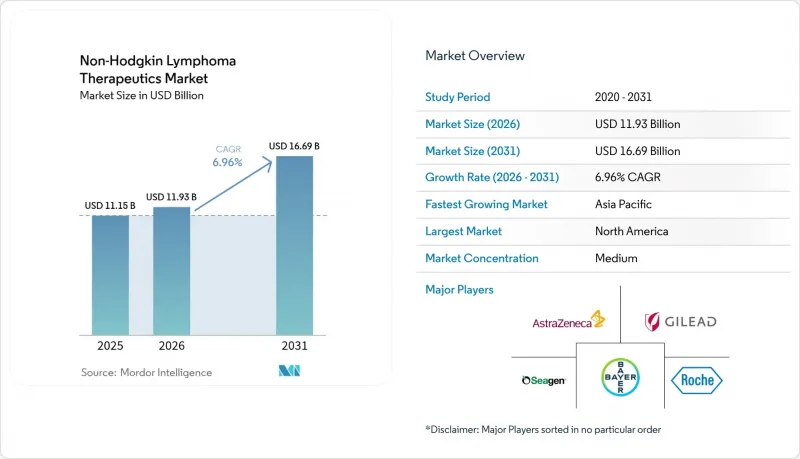
본 보고서는 치료법별(화학요법, 방사선 요법, 표적 요법, 면역 요법, 기타 치료법), 세포 유형별(B세포 림프종, T세포 림프종), 치료 단계별(1차 치료, 2차 치료, 3차 치료 및 난치성), 그리고 지역별(북미, 유럽,아시아태평양, 중동 및 아프리카, 남미)로 분류되어 있습니다. 시장 전망은 금액(달러) 기준으로 제시되어 있습니다.
전 세계 비호지킨 림프종 치료제 시장 동향 및 인사이트
비호지킨 림프종 환자 수 증가가 시장 확대를 주도
미국 내 미만성 대세포형 B세포 림프종의 연간 진단 건수는 현재 1만 8,000건을 넘어섰으며, 인구 고령화와 진단 능력 향상에 따라 계속 증가하고 있습니다. 표준 R-CHOP 요법 후에도 40%의 환자가 지속적인 관해를 달성하지 못하기 때문에 재발은 여전히 빈번하게 발생하고 있습니다. 이후 각 치료 단계마다 치료 실패 위험이 높아져, 5차 치료에서는 80%에 달할 전망입니다. 환자 수 증가에 따라 입원 환자 수, 정맥주사 센터에 대한 수요 및 전체 의약품 지출이 증가하여 비호지킨 림프종 치료제 시장의 매출을 직접적으로 끌어올리고 있습니다. 특히 영상 진단 및 면역조직화학 검사 체계가 갖춰지고 있는 중소득 국가에서 이러한 역학적 추세는 두드러집니다. 증례 수가 증가함에 따라 임상시험에 참여할 수 있는 환자층이 확대되고, 혁신적인 약물의 피험자 모집이 가속화되고 있습니다.
혁신적인 의약품 기술이 치료 패러다임을 변화시키고 있습니다.
악시카부타젠·실로레우셀 등의 CAR-T 요법은 관해 유지 요법에서 1년 무재발 생존율 89%를 달성하여 기존의 벤치마크를 크게 상회하고 있습니다. 에프코리타맙과 같은 피하 투여형 이중 특이성 항체는 3차 치료 단계의 대세포형 B세포 림프종에서 38.9%의 완전 반응률을 달성했으며, 이는 화학면역요법의 9.4%를 크게 상회하는 수치입니다. 자동 교반조형 바이오리액터는 현재 7일 이내에 5×10^6 세포/ml를 초과하는 세포 밀도를 달성하여, 제조 시간 단축과 오염 위험 감소를 실현하고 있습니다. 인공지능(AI) 도구는 유전체 데이터, 바이오마커 데이터 및 치료 결과 데이터를 통합하여 시퀀싱를 도출함으로써, 반응의 지속성을 높이고 과잉 치료를 줄입니다. 이러한 진전은 임상적 가치 제안을 강화하고, 보험사의 고가 정가에 대한 상환 의지를 높이고 있습니다.
고액의 치료비가 시장 침투를 저해
미국에서 1회 투여형 CAR-T 제품의 구매 가격 중앙값은 40만 달러를 초과하며, 많은 의료 기관에서는 지지 요법 비용까지 더해져 1건당 총 지출이 50만 달러를 넘고 있습니다. 예산 영향 모델에 따르면, 적격한 3차 치료 대상 환자 전원을 치료할 경우 전국의 항암제 지출이 연간 3-4% 증가하여 공공 및 민간 지불 기관에 부담이 가중될 것으로 나타났습니다. 가치 기반 계약은 재정적 위험을 완화하지만, 미국 외 지역에서의 도입 상황은 여전히 고르지 않습니다. 신흥국에서는 전문 의료 기관의 부족과 환자 본인 부담을 전제로 한 지불 구조가 접근성을 제한하고 있어, 비호지킨 림프종 치료제 시장의 세계적 확산을 저해하고 있습니다. 또한 가격 민감도 역시 이중 특이성 항체 및 항체-약물 복합체의 보험 적용 결정에 영향을 미치고 있어, 임상적 유효성이 있음에도 불구하고 도입 속도가 둔화되고 있습니다.
부문 분석
방사선 치료는 근치를 목적으로 하는 치료 프로토콜에서 확립된 역할과 장비의 광범위한 이용 가능성 덕분에 2025년 비호지킨 림프종 치료제 시장에서 46.83%의 점유율을 유지했습니다. 그러나 고용량 집중 요법 및 새로운 유지 요법 일정에 따른 내약성 개선과 고령층으로의 적용 확대에 힘입어, 화학요법은 2031년까지 연평균 성장률(CAGR) 8.28%로 가장 높은 성장률을 보이고 있습니다. 면역요법 시장 규모는 여전히 작지만, 난치성 질환의 치료 공백을 메우는 CAR-T 요법 및 이중 특이성 항체의 출시로 뒷받침되어 연평균 성장률(CAGR) 8.16%로 가속화되고 있습니다. 비교 임상 연구에 따르면, 이식 후 CAR-T 요법을 이용한 강화 요법에서 1년 무재발 생존율이 89%였던 반면, 기존의 구제 요법에서는 54%였던 것으로 보고되어, 임상 현장에서의 선호도가 입증되었습니다.
밀폐형 자동 제조의 보급으로 생산 주기가 22일에서 12일로 단축되어 시설 운영 비용이 절감되는 동시에, 주문형 치료의 실현 가능성이 높아지고 있습니다. 이중 특이성 항체는 외래에서 피하 투여가 가능하여 치료에 소요되는 시간을 단축하고, 지역 클리닉에서의 투여를 가능하게 함으로써 환자의 접근성을 확대되고 있습니다. 이러한 장점 덕분에 면역요법이 총매출에서 차지하는 비중이 증가하고 있으며, 화학요법에 대한 의존도는 꾸준히 낮아지고 있습니다. 다만, 국소성 조기 병변에 대해서는 방사선 요법이 여전히 주류를 이루고 있어, 기초 치료법에 새로운 생물학적 제제를 결합하는 다각적인 치료의 미래가 부각되고 있습니다.
지역별 분석
북미는 2025년 매출의 45.12%를 차지했습니다. 이는 보험사의 광범위한 보장 확대와 미국 FACT 인증 프로그램에 기반한 105곳의 인증 세포 치료 센터 덕분에 급속한 보급이 가능했기 때문입니다. 이 지역의 비호지킨 림프종 치료제 시장 점유율은 가격 측면의 역풍이 있음에도 불구하고 2031년까지 안정될 것으로 예측됩니다. 이는 새로운 적응증이 단가 상승 압력을 상쇄하기 때문입니다. CIBMTR 등 지역별 실세계 데이터 네트워크를 통해 지속적인 안전성 정보가 제공되고 있으며, 이를 통해 프로토콜이 개선되고 임상의들의 신뢰가 유지되고 있습니다.
이어 유럽은 성숙했으나 성장 속도가 완만한 시장 기반을 갖추고 있으며, 의료 기술 평가가 도입 여부에 영향을 미치고 있습니다. EMA의 승인은 FDA에 비해 약 3분기 정도 늦어지고 있지만, 독일과 스페인에서 진행 중인 결과 기반 보험 지급 시범 사업을 통해 단계적인 접근성 확대가 진행되고 있습니다. 각국의 프로그램은 국내 세포 제조 허브에 투자하고 있으며, 국경을 넘는 물류 지연을 완화하는 동시에 지속가능성 목표와의 조화를 도모하고 있습니다. 주요 EU 5개국과 관련된 비호지킨 림프종 치료제 시장 규모는 주로 백혈구 분리가 필요 없는 이중 특이성 항체의 보급에 힘입어 향후 몇 년간 확대될 것으로 예측됩니다.
아시아태평양은 8.63%라는 가장 강력한 연평균 성장률(CAGR)을 기록하고 있으며, 중국의 신속화된 국내 규제 절차와 메디케어 방식의 상환 시범 사업이 환자의 접근성을 획기적으로 확대되고 있습니다. 20개 이상의 중국 제조업체가 상업용 CAR-T 시설을 운영하고 있으며, 진료 현장에서의 제조 모델을 통해 주요 암 전문 병원에서 치료 시작까지의 기간이 7일로 단축되었습니다. 일본의 의약품 및 의료기기종합기구는 시판 후 조사를 수반하는 조건부 승인을 지원함으로써 환자에게의 조기 제공을 가속화하고 있습니다. 이러한 노력에 더해 중산층의 보험 가입률 상승이 맞물리면서 지역 전체 수요가 증가하고 있습니다. 라틴아메리카 및 중동 및 아프리카는 여전히 발전 단계에 있지만, 브라질, 사우디아라비아, 남아프리카공화국에 지역 핵심 의료 거점이 등장함에 따라 상황은 개선되고 있습니다. 국경을 넘는 환자 이동, 공동 연수 프로그램, 기술 이전 파트너십을 통해 현지 치료 역량이 점차 강화되면서, 비호지킨 림프종 치료제 시장의 영향력은 기존의 고소득 지역을 넘어 확대되고 있습니다.
기타 혜택:
- 엑셀 형식 시장 예측(ME) 시트
- 3개월간의 애널리스트 지원
자주 묻는 질문
목차
제1장 서론
제2장 조사 방법
제3장 개요
제4장 시장 구도
제5장 시장 규모와 성장 예측
제6장 경쟁 구도
제7장 시장 기회와 향후 전망
JHS 26.09.03According to Mordor Intelligence, the non-Hodgkin lymphoma therapeutics market size was valued at USD 11.15 billion in 2025 and estimated to grow from USD 11.93 billion in 2026 to reach USD 16.69 billion by 2031, at a CAGR of 6.96% during the forecast period (2026-2031).
This report is Segmented by Therapy Type (Chemotherapy, Radiation Therapy, Targeted Therapy, Immunotherapy, Other Therapies), Cell Type (B-Cell Lymphomas, T-Cell Lymphomas), Treatment Line (First-Line, Second-Line, Third-Line & Refractory), and Geography (North America, Europe, Asia-Pacific, Middle East and Africa, South America). The Market Forecasts are Provided in Terms of Value (USD).
Global Non-Hodgkin Lymphoma Therapeutics Market Trends and Insights
Growing Burden of Non-Hodgkin Lymphoma Drives Market Expansion
Annual U.S. diagnoses of diffuse large B-cell lymphoma now exceed 18,000 and continue to rise with population aging and improved detection capabilities. Relapse remains frequent, as 40% of patients fail to achieve durable remission after standard R-CHOP. Each subsequent therapy line raises failure risk, reaching 80% by the fifth attempt. Expanding incidence increases hospitalizations, infusion-center demand, and overall pharmaceutical spending, directly lifting Non-Hodgkin lymphoma therapeutics market revenue. Epidemiologic momentum is especially strong in middle-income economies where diagnostic imaging and immunohistochemistry capacity are scaling. Rising case volumes generate larger trial-ready patient pools that speed enrollment for innovative agents.
Innovative Drug Technologies Transform Treatment Paradigms
CAR-T constructs such as axicabtagene ciloleucel deliver 89% one-year progression-free survival in consolidation settings, far exceeding historical benchmarks. Subcutaneous bispecifics like epcoritamab achieve 38.9% complete responses in third-line large B-cell lymphoma versus 9.4% for chemo-immunotherapy. Automated stirred-tank bioreactors now reach cell densities above 5 X 10^6 cells/ml within seven days, cutting production time and contamination risk. Artificial-intelligence tools integrate genomic, biomarker, and outcomes data to guide sequencing, elevating response durability and reducing overtreatment. These advances strengthen clinical value propositions and reinforce payer willingness to reimburse premium list prices.
High Therapeutic Costs Limit Market Penetration
Median U.S. acquisition prices for single-dose CAR-T products exceed USD 400,000, and supportive-care costs lift total episode spending above USD 500,000 in many centers. Budget-impact models show that treating every eligible third-line patient would raise national oncology drug outlays by 3-4% annually, pressuring public and private payers. While value-based contracts temper financial exposure, their uptake remains patchy outside the United States. Emerging economies face steeper hurdles as limited specialized facilities and out-of-pocket payment structures restrict access, curbing the Non-Hodgkin lymphoma therapeutics market's global reach. Price sensitivity also influences formulary placements for bispecific antibodies and antibody-drug conjugates, decelerating uptake despite clinical benefit.
Other drivers and restraints analyzed in the detailed report include:
- Regulatory Expedited Pathways Accelerate Market Access
- Real-World Evidence Expansion Strengthens Reimbursement Decisions
- Safety Concerns and Adverse Effects Constrain Adoption
For complete list of drivers and restraints, kindly check the Table Of Contents.
Segment Analysis
Radiation therapy retained 46.83% share of the Non-Hodgkin lymphoma therapeutics market in 2025 owing to its established role in curative intent protocols and broad equipment availability. Yet chemotherapy posts the fastest 8.28% CAGR through 2031 as dose-dense regimens and novel maintenance schedules raise tolerability and extend use into older cohorts. The immunotherapy subset remains smaller but accelerates at 8.16% CAGR, supported by CAR-T and bispecific launches that address refractory disease gaps. A comparative real-world study reported 89% one-year progression-free survival for post-transplant CAR-T consolidation versus 54% under historical salvage, reinforcing clinical preference.
Broader adoption of closed, automated manufacturing has compressed production cycles from 22 days to 12 days, lowering facility overhead and making on-demand therapy more feasible. Bispecific antibodies deliver outpatient subcutaneous dosing, reducing chair-time and enabling administration in community clinics, which widens patient access. These advantages increase the immunotherapy contribution to overall revenue, steadily eroding chemotherapy dependence. Still, radiation remains entrenched for localized early-stage presentations, underlining a multimodal future in which novel biologics are layered onto foundational modalities.
Complete Report Scope:
- By Therapy Type
- Chemotherapy
- Radiation Therapy
- Targeted Therapy
- Immunotherapy (incl. CAR-T, Bispecifics)
- Other Therapies
- By Cell Type
- B-cell Lymphomas
- T-cell Lymphomas
- By Treatment Line
- First-line
- Second-line
- Third-line & Refractory
- By Geography
- North America
- United States
- Canada
- Mexico
- Europe
- Germany
- United Kingdom
- France
- Italy
- Spain
- Rest of Europe
- Asia-Pacific
- China
- Japan
- India
- Australia
- South Korea
- Rest of Asia-Pacific
- Middle East and Africa
- GCC
- South Africa
- Rest of Middle East and Africa
- South America
- Brazil
- Argentina
- Rest of South America
- North America
Geography Analysis
North America contributed 45.12% of 2025 revenue, as widespread payer coverage and 105 certified cell-therapy centers under the U.S. FACT accreditation program enable rapid uptake. The region's non-Hodgkin lymphoma therapeutics market share is expected to remain stable through 2031 despite price headwinds, as new indications offset unit-cost pressure. Regional real-world data networks such as CIBMTR feed continuous safety updates that refine protocols and sustain clinician confidence.
Europe follows with a mature yet slower-growing base where health-technology assessments shape adoption. While EMA approval lags FDA by roughly three quarters, outcome-based reimbursement pilots in Germany and Spain are unlocking incremental access. National programs invest in domestic cell-manufacturing hubs, reducing cross-border logistical delays and aligning with sustainability targets. The Non-Hodgkin lymphoma therapeutics market size linked to key EU5 countries is anticipated to rise in the coming years, primarily from bispecific uptake that requires no leukapheresis.
Asia-Pacific registers the most vigorous 8.63% CAGR as China's expedited local regulatory pathways and Medicare-style reimbursement pilot dramatically expand patient access. More than 20 Chinese manufacturers operate commercial CAR-T facilities, and point-of-care production models shorten turnaround to seven days in top oncology hospitals. Japan's Pharmaceutical and Medical Device Agency supports conditional approvals with post-marketing surveillance, accelerating earlier patient availability. These initiatives combine with rising middle-class insurance penetration to elevate overall regional demand. Latin America and the Middle East & Africa remain nascent but improving as regional centers of excellence emerge in Brazil, Saudi Arabia, and South Africa. Cross-border patient flow, collaborative training programs, and technology-transfer partnerships gradually enhance localized treatment capacity, broadening the Non-Hodgkin lymphoma therapeutics market footprint beyond traditional high-income geographies.
- Roche
- Novartis
- Gilead Sciences Inc. / Kite Pharma
- Bristol-Myers Squibb
- Seagen
- Takeda Pharmaceuticals
- AstraZeneca
- Janssen Biotech / Johnson & Johnson
- BeiGene Ltd.
- Genmab
- Regeneron Pharmaceuticals
- ADC Therapeutics
- Incyte Corp.
- Eli Lilly and Company
- Bayer
- Amgen
- Abbvie
Additional Benefits:
- The market estimate (ME) sheet in Excel format
- 3 months of analyst support
TABLE OF CONTENTS
1 Introduction
- 1.1 Study Assumptions & Market Definition
- 1.2 Scope of the Study
2 Research Methodology
3 Executive Summary
4 Market Landscape
- 4.1 Market Overview
- 4.2 Market Drivers
- 4.2.1 Growing Burden of Non-Hodgkin Lymphoma (NHL)
- 4.2.2 Demand For Innovative Drugs & Novel Technologies
- 4.2.3 Favourable Regulatory Approvals & Expedited Pathways
- 4.2.4 Expansion of Real-World Evidence Datasets Boosting Reimbursement
- 4.2.5 Precision-Diagnostic Biomarkers Driving Earlier-Line Adoption
- 4.2.6 Shift Toward Personalized Medicine
- 4.3 Market Restraints
- 4.3.1 High Cost of Novel NHL Therapies
- 4.3.2 Adverse Effects & Safety Concerns (E.G., CRS, Neuro-Toxicity)
- 4.3.3 Autologous Cell-Therapy Manufacturing Bottlenecks
- 4.3.4 Stringent Regulations and Guidelines Regarding the Treatments
- 4.4 Value / Supply-Chain Analysis
- 4.5 Regulatory Landscape
- 4.6 Pipeline Outlook
- 4.7 Porter's Five Forces Analysis
- 4.7.1 Threat of New Entrants
- 4.7.2 Bargaining Power of Buyers/Consumers
- 4.7.3 Bargaining Power of Suppliers
- 4.7.4 Threat of Substitute Products
- 4.7.5 Intensity of Competitive Rivalry
5 Market Size & Growth Forecasts (Value - USD)
- 5.1 By Therapy Type
- 5.1.1 Chemotherapy
- 5.1.2 Radiation Therapy
- 5.1.3 Targeted Therapy
- 5.1.4 Immunotherapy (incl. CAR-T, Bispecifics)
- 5.1.5 Other Therapies
- 5.2 By Cell Type
- 5.2.1 B-cell Lymphomas
- 5.2.2 T-cell Lymphomas
- 5.3 By Treatment Line
- 5.3.1 First-line
- 5.3.2 Second-line
- 5.3.3 Third-line & Refractory
- 5.4 By Geography
- 5.4.1 North America
- 5.4.1.1 United States
- 5.4.1.2 Canada
- 5.4.1.3 Mexico
- 5.4.2 Europe
- 5.4.2.1 Germany
- 5.4.2.2 United Kingdom
- 5.4.2.3 France
- 5.4.2.4 Italy
- 5.4.2.5 Spain
- 5.4.2.6 Rest of Europe
- 5.4.3 Asia-Pacific
- 5.4.3.1 China
- 5.4.3.2 Japan
- 5.4.3.3 India
- 5.4.3.4 Australia
- 5.4.3.5 South Korea
- 5.4.3.6 Rest of Asia-Pacific
- 5.4.4 Middle East and Africa
- 5.4.4.1 GCC
- 5.4.4.2 South Africa
- 5.4.4.3 Rest of Middle East and Africa
- 5.4.5 South America
- 5.4.5.1 Brazil
- 5.4.5.2 Argentina
- 5.4.5.3 Rest of South America
- 5.4.1 North America
6 Competitive Landscape
- 6.1 Market Concentration
- 6.2 Market Share Analysis
- 6.3 Company Profiles (includes Global level Overview, Market level overview, Core Segments, Financials as available, Strategic Information, Market Rank/Share for key companies, Products & Services, and Recent Developments)
- 6.3.1 F. Hoffmann-La Roche Ltd.
- 6.3.2 Novartis AG
- 6.3.3 Gilead Sciences Inc. / Kite Pharma
- 6.3.4 Bristol Myers Squibb Co.
- 6.3.5 Seagen Inc.
- 6.3.6 Takeda Pharmaceutical Co. Ltd.
- 6.3.7 AstraZeneca PLC
- 6.3.8 Janssen Biotech / Johnson & Johnson
- 6.3.9 BeiGene Ltd.
- 6.3.10 Genmab A/S
- 6.3.11 Regeneron Pharmaceuticals
- 6.3.12 ADC Therapeutics SA
- 6.3.13 Incyte Corp.
- 6.3.14 Eli Lilly & Co.
- 6.3.15 Bayer AG
- 6.3.16 Amgen Inc.
- 6.3.17 AbbVie Inc.
7 Market Opportunities & Future Outlook
- 7.1 White-space & Unmet-need Assessment


