

|
시장보고서
상품코드
2120266
전동 수술 기구 : 시장 점유율 분석, 업계 동향과 통계, 성장 예측(2026-2031년)Powered Surgical Instrument - Market Share Analysis, Industry Trends & Statistics, Growth Forecasts (2026 - 2031) |
||||||
 Mordor Intelligence
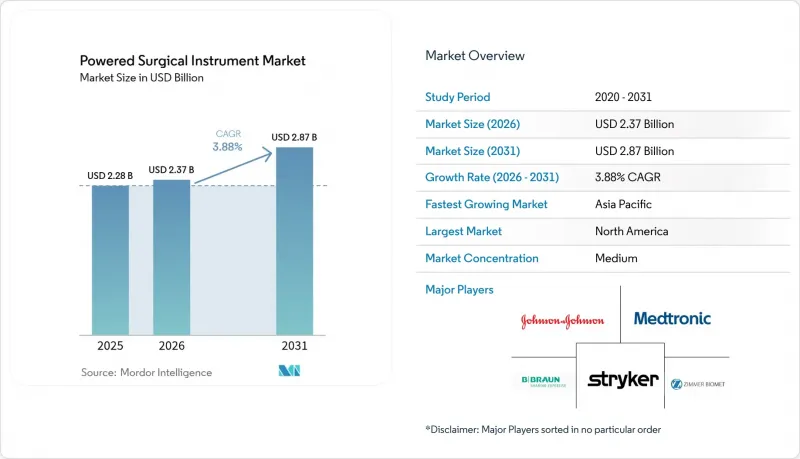
Mordor Intelligence에 따르면 전동 수술 기구 시장 규모는 2025년 22억 8,000만 달러에서 2026년에는 23억 7,000만 달러로 확대하며, 2026-2031년에 CAGR 3.88%로 추이하며, 2031년까지 28억 7,000만 달러에 달할 것으로 예측됩니다.
이 보고서는 동력원(유선식, 배터리 구동식(리튬이온, 니켈수소), 기타), 제품 유형(핸드피스, 기타), 용도(정형외과·외상, 기타), 최종사용자(병원, 기타),지역(북미, 유럽, 아시아태평양, 중동 및 아프리카, 남미)별로 분류되어 있습니다. 시장 예측은 금액(달러) 기준으로 제시되어 있습니다.
전 세계 전동 수술 기구 시장의 동향 및 인사이트
외과수술 건수 및 외상 사례 수 증가
신흥 국가에서의 보험 적용 범위 확대와 도시화에 따른 외상 발생률 증가에 힘입어, 전 세계에서 수술실 활동이 증가하고 있습니다. 응급실에서는 수동 툴보다 신속하게 골절을 고정할 수 있는 전동 드릴이나 톱에 의존하고 있으며, 이를 통해 치료 성과가 향상되고 중환자실 병상을 비울 수 있게 되었습니다. 아시아태평양의 대규모 의료 시설에서는 현재 배터리 구동 모드와 유선 모드를 결합한 하이브리드 콘솔이 도입되어 외상 환자 간 회전 시간을 단축하고 있습니다. 교통사고와 산업 재해는 예측 가능한 수요를 창출하며, 급성장하는 대도시권에서 전동 수술 기구 시장의 기반을 공고히 하고 있습니다. 복잡한 다발성 외상을 치료하는 병원에서는 재고 관리를 효율화하고 신속한 멸균 주기를 확보하기 위해 모듈식 핸드피스 시스템의 도입이 증가하고 있습니다. 외과의사들은 수술 시간 단축을 보고하고 있으며, 이는 전동 플랫폼에 대한 지속적인 투자에 대한 관리 부문의 지지를 강화하고 있습니다.
퇴행성 질환을 앓는 고령 인구 증가
선진국에서 65세 이상 고령자는 가장 빠르게 증가하는 인구층으로, 관절 치환술 및 척추 고정술 시행 건수를 끌어올리고 있습니다. 이러한 수술에는 고토크 드릴과 리머가 필수적이며, 이는 전동 수술 기구 시장에 장기적인 수익 기반을 확보해 주고 있습니다. 미국의 고관절 및 무릎 관절 치환술 보상 패키지는 병원에 수술을 효율적으로 완료할 것을 요구하고 있으며, 이에 따라 외과의사의 피로를 줄여주는 경량 배터리식 핸드피스가 선호되고 있습니다. 유럽의 당일 수술 부문에서는 무선 시스템을 활용하여 수술실 준비를 간소화하고, 고관절 재치환술을 당일 내에 시행하고 있습니다. 일본의 진료소에서는 이동식 수술팀을 통해 지방의 고령 환자에게 서비스를 제공하기 위해 휴대용 콘솔을 도입하고 있으며, 의료 접근성이 확대되고 있습니다. 이러한 인구 통계학적 요인에 기인한 수요는 구조적인 것이며, 2030년 이후에도 공급업체에게 지속적인 매출 파이프라인을 확보해 줄 것입니다.
전동 수술 기구의 높은 초기 투자 비용 및 유지비
초기 구매 가격은 5만 달러에서 20만 달러 사이이며, 연간 유지보수 계약비는 일반적으로 초기 비용의 10-15%에 해당하므로 소규모 시설의 경우 예산상의 부담이 되고 있습니다. 연구에 따르면 로봇 담낭 절제술용 일회용 제품의 비용은 복강경 수술용과 동등하거나 그 이상임에도 불구하고 치료 성과가 더 뛰어나지는 않은 것으로 나타나, 관리자들은 첨단 콘솔의 투자 수익률(ROI)에 의문을 품고 있습니다. 신흥 시장의 진료소에서는 배터리 교체 비용을 피하기 위해 업그레이드를 미루고 중고 유선 시스템을 구매하는 경우가 많습니다. 다년간의 리스 모델이 점차 보급되고 있지만, 금리 변동으로 인해 자금 조달 비용이 상승하고 있으며, 단기적으로는 도입 계획에 제동이 걸릴 가능성이 있습니다. 그 결과, 임상팀이 전동식 솔루션을 강력히 희망하고 있음에도 불구하고 높은 자본 집약성이 시장 침투를 방해하고 있습니다.
부문 분석
리튬이온 배터리 플랫폼이 전동 수술 기구 시장을 주도하고 있으며, 배터리 시스템의 연평균 성장률(CAGR)은 2031년까지 4.72%로 예측됩니다. 2025년에도 유선식 전동 기기는 여전히 40.78%의 점유율을 차지하고 있으며, 이는 끊김 없는 전력 공급을 중시하는 수술 건수가 많은 시설의 기존 설비를 반영한 것입니다. 교체 가능한 배터리 포드가 장착된 어셈블리는 외래 수술 센터의 처리 시간을 단축하며, 정형외과 외상 수술실에서 보급이 확대되고 있습니다. 하이브리드 콘솔은 수술 중 위치 조정시 벽면 콘센트 전원에서 배터리 백업으로 원활하게 전환되어, 케이블이 없는 드레이프의 무균성을 보장합니다. 현재 경쟁은 충전 사이클의 내구성과 병원 자산 관리 소프트웨어와 연동되는 실시간 배터리 진단 기능에 초점이 맞춰져 있습니다. 예측 기간 중 휴대성의 이점으로 인해 배터리 구동식 장치는 신규 도입의 최전선에 계속 서 있을 것입니다. 특히 아시아태평양에서 계속 확대되고 있는 당일 수술 네트워크에서 이러한 경향이 두드러집니다.
외과의사들은 2시간을 넘기도 하는 인공관절 치환술에서 케이블이 엉키는 일이 줄어들고 핸드피스가 경량화된 점이 인체공학적 관점에서 주요 이점이라고 지적하고 있습니다. 공압식 플랫폼은 매우 부드러운 토크 전달 덕분에 신경외과 분야에서 틈새 수요를 유지하고 있지만, 병원이 디지털 수술실에 투자할 때 기대하는 연결성을 갖추지 못하고 있습니다. 따라서 공급업체들은 블루투스를 통한 펌웨어 업데이트 기능을 배터리식 핸들에 탑재하고, 멸균 가능한 충전 도크와 결합하고 있습니다. 가격에 민감한 라틴아메리카의 병원에서는 초기 비용을 절감할 수 있는 트레이드인 프로그램을 통해 재생된 유선식 장비가 여전히 선호되고 있습니다. 전원 유형을 균형 있게 구매하는 경향으로 인해 전동 수술 기구 시장은 다양성을 유지하면서도 배터리 기술의 혁신이 지속적인 성장의 원동력임을 부각시키고 있습니다.
2025년에는 핸드피스가 매출의 59.86%를 차지하며, 전동 수술 기구 시장의 경제적 기반을 형성하고 있습니다. 정형외과 분야에서는 톱 시스템과 고속 드릴이 수요를 주도하는 반면, 이비인후과 및 스포츠 의학 분야에서는 셰이버의 시장 점유율이 확대되고 있습니다. 한편, 액세서리 및 소모품은 연평균 성장률(CAGR) 4.95%로 확대되고 있으며, 일회용 바, 블레이드, 슬리브는 제조사에게 사례별 예측 가능한 수익을 가져다주고 있습니다. 일회용 제품은 재멸균의 번거로움을 덜어주고 감염 관리 감사 요건에도 부합하므로 병원 측에서는 변동비가 높아지더라도 이를 수용하고 있습니다.
각 OEM 업체들은 스마트 콘솔에서 수집된 사용 데이터를 바탕으로 블레이드의 자동 배송과 서비스 계약을 결합하여 연금과 같은 수익을 창출하고 있습니다. 소모품 시장의 확대는 주기적인 자본 예산의 영향으로부터 수익을 안정화시켜, 공급업체들이 거시경제의 변동을 극복할 수 있는 체제를 갖추고 있습니다. 성형외과 클리닉에서는 코 성형술의 미세 조정에 마이크로 버링 팁을 채택하고 있으며, 이는 시술에 특화된 소모품이 고객 기반을 얼마나 확대하고 있는지를 보여줍니다. 재고 센서와 연동된 디지털 발주 포털은 고객 충성도를 더욱 높여, 견고한 관계를 통해 전동 수술 기구 시장을 강화하고 있습니다.
지역별 분석
2025년에는 북미가 매출 점유율 35.02%로 1위를 차지했습니다. 메디케어의 번들 계약으로 인해 수술 시간을 단축하는 기구에 대한 설비 투자가 촉진되는 한편, 미국의 외과의사들은 예측적 서비스 진단이 가능한 스마트 콘솔을 도입하고 있습니다. 캐나다의 주별 구매 그룹은 통합 예산 하에서 수익을 극대화하기 위해 다목적 키트를 선호하고 있으며, 멕시코 국경 인근 병원들은 의료 관광객을 수용하기 위해 전동 수술 기기 시장을 활용하고 있습니다.
유럽은 두 번째로 큰 지역입니다. 독일, 프랑스, 이탈리아에서는 고령화에 따라 정형외과수술 건수가 증가하고 있으며, 병원에서는 입원 일수 단축을 장려하는 가치 기반 계약이 도입되고 있습니다. 영국에서는 NHS(국민보건서비스)의 사례당 비용 기준에 맞춰 조달 지침이 수립되어 있으며, 이에 따라 콘솔의 로그 데이터를 기반으로 한 내구 연수 분석이 조달 과정에서 중요하게 고려되고 있습니다. EU 의료기기 규정에서는 확립된 브랜드가 제공할 수 있는 견고한 임상 데이터가 요구되고 있으며, 이를 통해 가격 주도형 경쟁으로부터 브랜드를 보호하는 동시에 환자 안전을 강화하고 있습니다.
아시아태평양은 5.21%라는 가장 높은 연평균 성장률(CAGR)을 기록하고 있습니다. 중국에서는 국민보험에 의한 정형외과 보장 범위가 확대됨에 따라 지방의 현립 병원에서 수술 기구 재고를 갱신하고 있습니다. 인도의 도시 지역에서는 배터리 구동식 키트를 선호하는 가동률이 높은 당일 진료 클리닉이 개설되고 있습니다. 일본의 초고령 사회에서는 고관절 및 척추 수술 건수가 견고한 추세를 보이고 있는 반면, 한국의 의료 관광 분야에서는 외국인 환자의 수요를 충족시키기 위해 유럽산 마이크로 드릴이 수입되고 있습니다. 아세안(ASEAN)의 규제 조화로 승인까지의 기간이 단축되었으나, 현지 조달 요건으로 인해 다국적 기업과 지역 OEM(Original Equipment Manufacturer) 간의 제휴가 촉진되고 있습니다. 이러한 동향들이 맞물려 아시아 신흥 경제권내 전동 수술 기구 시장에 결정적인 성장 벡터를 그려내고 있습니다.
기타 혜택:
- 엑셀 형식의 시장 예측(ME) 시트
- 3개월간의 애널리스트 지원
자주 묻는 질문
목차
제1장 서론
제2장 조사 방법
제3장 개요
제4장 시장 구도
제5장 시장 규모와 성장 예측
제6장 경쟁 구도
제7장 시장 기회와 향후 전망
KSA 26.09.02According to Mordor Intelligence, the powered surgical instruments market size is expected to grow from USD 2.28 billion in 2025 to USD 2.37 billion in 2026 and is forecast to reach USD 2.87 billion by 2031 at 3.88% CAGR over 2026-2031.
This report is Segmented by Power Source (Wired-Electric, Battery-Powered (Li-Ion, Nimh), and More), Product Type (Handpieces, and More), Application (Orthopedic & Trauma, and More), End-User (Hospitals, and More), Geography (North America, Europe, Asia-Pacific, The Middle East and Africa, and South America). The Market Forecasts are Provided in Terms of Value (USD).
Global Powered Surgical Instrument Market Trends and Insights
Rising Volume of Surgical Procedures and Trauma Cases
Global operating-room activity is rising as insurance coverage broadens in emerging economies and urbanization elevates trauma incidence. Emergency departments rely on power-driven drills and saws to stabilize fractures faster than manual tools, improving outcomes and freeing critical-care beds. High-volume centers in Asia-Pacific now integrate hybrid consoles that combine battery and wired modes, shortening turnover time between trauma cases. Traffic accidents and industrial injuries create predictable demand, anchoring the powered surgical instruments market in fast-growing metropolitan regions. Hospitals that treat complex polytrauma increasingly purchase modular handpiece systems to streamline inventory and ensure quick sterilization cycles. Surgeons report shorter operative times, reinforcing administrative support for continued investment in power platforms.
Growing Geriatric Population with Degenerative Disorders
People aged 65 + are the fastest-growing cohort in developed economies, pushing joint-replacement and spinal-fusion volumes upward. These interventions depend on high-torque drills and reamers, securing a long-term revenue base for the powered surgical instruments market. United States reimbursement bundles for hip and knee arthroplasty pressure hospitals to complete procedures efficiently, favoring lightweight battery handpieces that mitigate surgeon fatigue. European day-surgery units now perform same-day hip revisions, leveraging cordless systems to simplify OR setup. Japanese clinics deploy portable consoles to serve rural geriatric patients via mobile surgical teams, widening access. This demographic-linked demand is structural, ensuring a durable sales pipeline for suppliers through 2030 and beyond.
High Capital and Maintenance Costs of Powered Instruments
Initial purchase prices range from USD 50,000 to USD 200,000, while annual service contracts typically equal 10-15% of the original spend, challenging budgets of smaller facilities. Studies show robotic cholecystectomy disposables can exceed laparoscopic equivalents without superior outcomes, prompting administrators to question ROI on advanced consoles. Emerging-market clinics often delay upgrades, buying pre-owned wired systems to avoid battery replacement expense. Multiyear leasing models are spreading, yet interest-rate volatility raises financing costs and may temper acquisition plans in the near term. Consequently, capital intensity restrains penetration even as clinical teams voice strong preference for powered solutions.
Other drivers and restraints analyzed in the detailed report include:
- Continuous Technological Advancements in Powered Surgical Tools
- Increasing Adoption of Minimally Invasive and Outpatient Surgeries
- Shortage of Skilled Surgical Workforce in Low-Income Regions
For complete list of drivers and restraints, kindly check the Table Of Contents.
Segment Analysis
Lithium-ion battery platforms have propelled the powered surgical instruments market, with battery systems tracking a 4.72% CAGR through 2031. In 2025 wired-electric devices still held 40.78% share, reflecting legacy installations at high-volume centers that value uninterrupted current. Assemblies featuring swappable battery pods cut turnover time in ambulatory suites and gain traction in orthopedic trauma rooms. Hybrid consoles seamlessly transfer from wall power to battery backup during intraoperative repositioning, ensuring sterility of cable-free drapes. Competition now centers on charge-cycle longevity and real-time battery diagnostics that feed into hospital asset software. Over the forecast period, portability advantages keep battery units at the forefront of new installations, especially across Asia-Pacific's expanding day-surgery grid.
Surgeons cite reduced cord clutter and lighter handpieces as key ergonomic benefits during arthroplasty that may last beyond two hours. Pneumatic platforms retain niche demand in neurosurgery for their ultra-smooth torque delivery, but they lack the connectivity that hospitals expect from digital OR investments. Suppliers therefore integrate Bluetooth firmware updates into battery handles, pairing them with sterilizable charging docks. Price-sensitive hospitals in Latin America still favor wired rigs refurbished through trade-in programs that lower upfront expense. Balanced purchasing across power types keeps the powered surgical instruments market diversified while underscoring battery innovation as an enduring growth lever.
Handpieces dominated 59.86% of revenues in 2025, making them the economic cornerstone of the powered surgical instruments market. Saw systems and high-speed drills lead orthopedic demand, while shavers carve share in ENT and sports medicine suites. Meanwhile, accessories and consumables are expanding at a 4.95% CAGR, with single-use burs, blades, and sleeves offering predictable per-case income to manufacturers. Hospitals accept higher variable costs because disposables eliminate re-sterilization labor and align with infection-control audits.
OEMs bundle service contracts with auto-shipping of blades based on usage data from smart consoles, creating annuity-like revenue. Consumable expansion also smooths earnings against cyclical capital budgets, positioning suppliers to weather macroeconomic swings. Plastic-surgery clinics adopt micro-burring tips for rhinoplasty refinements, illustrating how procedure-specific consumables widen the customer base. Digital ordering portals tied to inventory sensors further lock in clients, reinforcing the powered surgical instruments market through sticky relationships.
Complete Report Scope:
- By Power Source
- Wired-Electric
- Battery-Powered (Li-ion, NiMH)
- Pneumatic / Nitrogen
- Hybrid Smart Consoles
- By Product Type
- Handpieces
- Drill Systems
- Saw Systems
- Reamer Systems
- Staplers
- Shavers & Debriders
- Other Handpieces
- Power Sources & Controls
- Accessories & Consumables
- Handpieces
- By Application
- Orthopedic & Trauma
- Dental & Maxillofacial
- Neurosurgery & Spine
- Cardiothoracic & Cardiovascular
- Plastic & Reconstructive
- Other Applications
- By End-User
- Hospitals
- Ambulatory Surgical Centers
- Specialty Orthopedic & Dental Clinics
- Other End-Users
- Geography
- North America
- United States
- Canada
- Mexico
- Europe
- Germany
- United Kingdom
- France
- Italy
- Spain
- Rest of Europe
- Asia-Pacific
- China
- Japan
- India
- Australia
- South Korea
- Rest of Asia-Pacific
- Middle East & Africa
- GCC
- South Africa
- Rest of Middle East & Africa
- South America
- Brazil
- Argentina
- Rest of South America
- North America
Geography Analysis
North America led with 35.02% revenue share in 2025. Medicare bundles stimulate capital spending on instruments that cut theater time, while United States surgeons adopt smart consoles capable of predictive service diagnostics. Canada's provincial buying groups favor multi-procedure kits to maximize return under universal budgets, and Mexico's border hospitals tap the powered surgical instruments market to serve medical tourists.
Europe is the second-largest region. Germany, France, and Italy see orthopedic case growth tied to aging citizens, and hospitals adopt value-based contracts that reward shorter length of stay. The United Kingdom aligns purchasing guidelines to NHS cost-per-case thresholds, which puts procurement weight on lifespan analytics from console logs. EU Medical Device Regulation demands robust clinical data that established brands can supply, shielding them against price-led competition while reinforcing patient safety.
Asia-Pacific posts the strongest 5.21% CAGR. China's county hospitals upgrade tool inventories as national insurance expands orthopedic coverage. India's urban clusters open high-volume day clinics that prefer batterized kits. Japan's super-aged society sustains steady hip and spine volumes, while South Korea's cosmetic tourism imports European micro-drills to satisfy foreign patients. ASEAN harmonization has trimmed approval timelines, yet local-content rules spur partnerships between multinationals and regional OEMs. Combined, these dynamics outline a decisive growth vector for the powered surgical instruments market across emerging Asian economies.
- Stryker
- Medtronic
- Johnson & Johnson
- Zimmer Biomet
- B. Braun (Aesculap)
- Smiths Group
- Conmed
- De Soutter Medical
- MicroAire
- Adeor Medical
- Panther Healthcare
- Arthrex
- Brasseler USA
- OsteoMed
- MatOrtho
- NSK Nakanishi
- Bien-Air Surgery
- Ruijin Medical
- Arbutus Medical
Additional Benefits:
- The market estimate (ME) sheet in Excel format
- 3 months of analyst support
TABLE OF CONTENTS
1 Introduction
- 1.1 Study Assumptions & Market Definition
- 1.2 Scope of the Study
2 Research Methodology
3 Executive Summary
4 Market Landscape
- 4.1 Market Overview
- 4.2 Market Drivers
- 4.2.1 Rising Volume of Surgical Procedures and Trauma Cases
- 4.2.2 Growing Geriatric Population With Degenerative Disorders
- 4.2.3 Continuous Technological Advancements in Powered Surgical Tools
- 4.2.4 Increasing Adoption of Minimally Invasive and Outpatient Surgeries
- 4.2.5 Expansion of Specialist Day Surgery Centers in Emerging Markets
- 4.2.6 Transition To Value-Based Care Driving Efficiency Investments in OR Technology
- 4.3 Market Restraints
- 4.3.1 High Capital and Maintenance Costs of Powered Instruments
- 4.3.2 Shortage of Skilled Surgical Workforce in Low-Income Regions
- 4.3.3 Stringent Regulatory And Environmental Policies on Device Sterilization And Battery Disposal
- 4.3.4 Data Security Concerns With Network-Connected Surgical Equipment
- 4.4 Regulatory Landscape
- 4.5 Porter's Five Forces Analysis
- 4.5.1 Threat of New Entrants
- 4.5.2 Bargaining Power of Buyers
- 4.5.3 Bargaining Power of Suppliers
- 4.5.4 Threat of Substitutes
- 4.5.5 Intensity of Competitive Rivalry
5 Market Size & Growth Forecasts (Value, USD)
- 5.1 By Power Source
- 5.1.1 Wired-Electric
- 5.1.2 Battery-Powered (Li-ion, NiMH)
- 5.1.3 Pneumatic / Nitrogen
- 5.1.4 Hybrid Smart Consoles
- 5.2 By Product Type
- 5.2.1 Handpieces
- 5.2.1.1 Drill Systems
- 5.2.1.2 Saw Systems
- 5.2.1.3 Reamer Systems
- 5.2.1.4 Staplers
- 5.2.1.5 Shavers & Debriders
- 5.2.1.6 Other Handpieces
- 5.2.2 Power Sources & Controls
- 5.2.3 Accessories & Consumables
- 5.2.1 Handpieces
- 5.3 By Application
- 5.3.1 Orthopedic & Trauma
- 5.3.2 Dental & Maxillofacial
- 5.3.3 Neurosurgery & Spine
- 5.3.4 Cardiothoracic & Cardiovascular
- 5.3.5 Plastic & Reconstructive
- 5.3.6 Other Applications
- 5.4 By End-User
- 5.4.1 Hospitals
- 5.4.2 Ambulatory Surgical Centers
- 5.4.3 Specialty Orthopedic & Dental Clinics
- 5.4.4 Other End-Users
- 5.5 Geography
- 5.5.1 North America
- 5.5.1.1 United States
- 5.5.1.2 Canada
- 5.5.1.3 Mexico
- 5.5.2 Europe
- 5.5.2.1 Germany
- 5.5.2.2 United Kingdom
- 5.5.2.3 France
- 5.5.2.4 Italy
- 5.5.2.5 Spain
- 5.5.2.6 Rest of Europe
- 5.5.3 Asia-Pacific
- 5.5.3.1 China
- 5.5.3.2 Japan
- 5.5.3.3 India
- 5.5.3.4 Australia
- 5.5.3.5 South Korea
- 5.5.3.6 Rest of Asia-Pacific
- 5.5.4 Middle East & Africa
- 5.5.4.1 GCC
- 5.5.4.2 South Africa
- 5.5.4.3 Rest of Middle East & Africa
- 5.5.5 South America
- 5.5.5.1 Brazil
- 5.5.5.2 Argentina
- 5.5.5.3 Rest of South America
- 5.5.1 North America
6 Competitive Landscape
- 6.1 Market Concentration
- 6.2 Market Share Analysis
- 6.3 Company Profiles (Includes Global Level Overview, Market Level Overview, Core Segments, Financials As Available, Strategic Information, Market Rank/Share, Products & Services, Recent Developments)
- 6.3.1 Stryker Corporation
- 6.3.2 Medtronic plc
- 6.3.3 Johnson & Johnson (DePuy Synthes)
- 6.3.4 Zimmer Biomet
- 6.3.5 B. Braun (Aesculap)
- 6.3.6 Smith & Nephew
- 6.3.7 ConMed Corporation
- 6.3.8 De Soutter Medical
- 6.3.9 MicroAire Surgical Instruments
- 6.3.10 Adeor Medical
- 6.3.11 Panther Healthcare
- 6.3.12 Arthrex
- 6.3.13 Brasseler USA
- 6.3.14 OsteoMed
- 6.3.15 MatOrtho
- 6.3.16 NSK Nakanishi
- 6.3.17 Bien-Air Surgery
- 6.3.18 Ruijin Medical
- 6.3.19 Arbutus Medical
7 Market Opportunities & Future Outlook
- 7.1 White-space & Unmet-Need Assessment


