

|
시장보고서
상품코드
2120275
공항 승객 검색 시스템 시장 : 점유율 분석, 업계 동향과 통계, 성장 예측(2026-2031년)Airport Passenger Screening Systems - Market Share Analysis, Industry Trends & Statistics, Growth Forecasts (2026 - 2031) |
||||||
 Mordor Intelligence
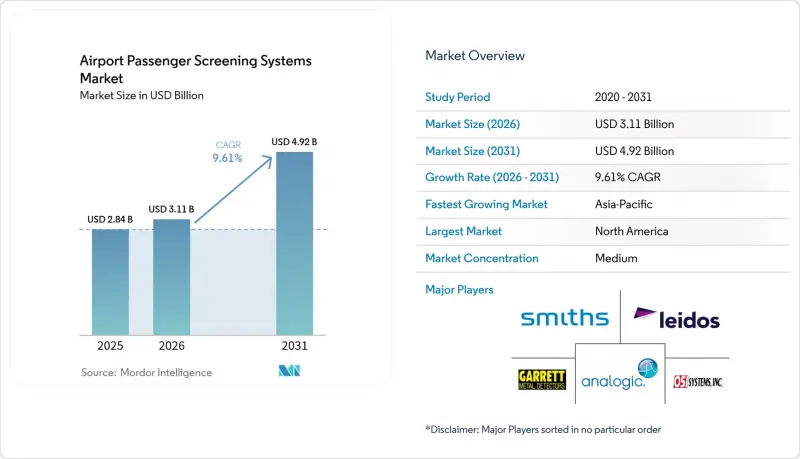
Mordor Intelligence에 의하면, 2026년 공항 승객 검색 시스템 시장 규모는 31억 1,000만 달러로 추정되고 있어 2025년 28억 4,000만 달러에서 확대해, 2031년에는 49억 2,000만 달러에 이를 것으로 예측됩니다.2026년부터 2031년에 걸친 CAGR은 9.61%를 나타낼 전망입니다.
본 보고서는 유형별(금속 감지기, 전신 스캐너 및 첨단 영상 기술), 구성 요소별(하드웨어 및 소프트웨어), 도입 형태별(1차 승객 검사장, 2차/무작위 검사, 기타), 공항 허브 규모별(대규모, 중규모, 소규모),지역별(북미, 유럽, 기타)로 분류되어 있습니다. 시장 전망은 금액(달러) 기준으로 제시되어 있습니다.
전 세계 공항 승객 검색 시스템 시장 동향 및 인사이트
승객 수 증가가 높은 처리 용량을 갖춘 시스템에 대한 수요를 끌어올리고 있습니다.
2024년, 아시아태평양 공항에서는 30억 명 이상의 승객이 이용하며 2019년의 처리 수치를 넘어섰습니다. 이에 따라 엄격한 감지 기준을 유지하면서도 시간당 300명 이상의 여행객을 검사할 수 있는 장비에 대한 수요가 높아지고 있습니다. 1조 달러에 육박하는 중동의 메가 프로젝트에서는 생체 인식과 AI 감지를 융합한 ‘브라이트 코리도(Bright Corridor)’가 도입되고 있으며, 이는 승객 수 증가가 첨단 CT 스캐너 및 mm파 스캐너에 대한 설비 투자로 직접 이어지고 있음을 보여줍니다. 신흥 시장의 공항에서는 두 자릿수 승객 증가율에 대응하기 위해 확장성이 뛰어나고 소프트웨어를 통해 업그레이드가 가능한 플랫폼이 선호되고 있습니다. 한편, 성숙한 북미의 허브 공항에서는 워크플로우 최적화에 중점을 두고 있습니다. 2024년 이후, 운영 사업자가 위험 완화나 대기 시간과 같은 지표를 바탕으로 검문소의 성과를 평가하게 됨에 따라, 승객 수와 보안 투자 간의 직접적인 연관성은 더욱 강화되고 있습니다. 그 결과, 공항 승객 검색 시스템 시장에서는 규정 준수 요건을 충족할 뿐만 아니라 처리 능력 향상을 입증할 수 있는 공급업체에 대한 평가가 높아지고 있습니다.
CT 도입에 관한 규제상 의무
TSA(미국 교통안전청)는 카테고리 X 검문소에 대해 2026년까지 CT로 전환할 것을 의무화하고 있으며, 도입 및 설치 전용으로 28억 달러를 계상하여 이를 통해 수년에 걸친 조달 파이프라인이 확보되었습니다. 또한, 유럽집행위원회가 2024년 9월 C3 CT를 도입하지 않은 공항에 대해 액체 반입 제한을 재도입함에 따라 EU 내 도입이 가속화되었습니다. ICAO(국제민간항공기구)의 2024년판 ‘세계 항공 보안 계획’은 193개 회원국에 대한 기준으로 CT를 권장하고 있습니다. 이러한 의무는 TSA의 ‘Rap Back’ 프로그램에 따른 직원 검사에도 적용되어, 1차 검사 레인 이외의 2차 수요를 창출하고 있습니다. 규정 위반에 대한 제재로 인해 신속한 입찰이 요구되면서, 인증된 솔루션과 전 세계적인 지원 체계를 갖춘 공급업체로 시장 점유율이 집중되고 있습니다. 그 결과, 공항 승객 검색 시스템 시장에서는 각 규정의 마감 기한 직전에 예측 가능한 수요 급증이 예상됩니다.
공간, 전력, 중량을 제한하는 기존 인프라
주요 국제공항의 약 40%는 1980년 이전에 개항한 것으로, 기존 X선 장비에 비해 15-20% 더 많은 면적을 차지하고 3배의 전력을 소비하는 CT 장비를 설치하기 위한 바닥 면적, 전력 용량 또는 구조적 강도가 부족합니다. 터미널 개보수 비용은 레인당 50만 달러를 초과할 수 있으며, 주요 허브 공항에서는 하루 운영 중단으로 인한 손실이 10만 달러를 넘기도 합니다. 높은 곳에 위치한 검사 지점의 중량 제한은 특히 다층 구조의 유럽 및 아시아 터미널에서 설치를 더욱 복잡하게 만듭니다. 이러한 제약으로 인해 도입이 지연되고, 개보수 예산이나 신규 건설 프로젝트가 따라잡을 때까지 공항 승객 검색 시스템 시장의 성장 잠재력이 억제될 것입니다.
부문 분석
공항 승객 검색 시스템 시장에서 금속 감지기 시장 점유율은 2025년에 35.12%에 달했으나, CT(컴퓨터 단층 촬영) 기반의 첨단 영상 기술은 2031년까지 9.78%라는 가장 높은 연평균 성장률(CAGR)을 나타낼 전망입니다. 공항 운영사들은 수하물을 개봉하지 않고도 액체나 전자기기를 검사할 수 있는 3D 영상 기능을 갖춘 CT에 주력하고 있으며, 이를 통해 레인의 처리 능력을 최대 20%까지 향상시키고 있습니다. 전신용 밀리파 스캐너는 많은 허브 공항에서 도입이 포화 상태에 이르렀지만, AI를 활용한 패턴 인식으로 감지 정확도가 향상되고 오경보가 감소하고 있습니다. ICAO가 CT를 모범 사례로 권장함에 따라 그 역할이 확고해졌으며, 한편 기존 설비에 후속 장착이 가능한 기종 덕분에 중규모 공항에서의 도입 범위도 확대되고 있습니다. 지속적인 소프트웨어 업그레이드를 통해 사업자는 하드웨어를 교체하지 않고도 위협 데이터베이스를 정교화할 수 있어, 공항 승객 검색 시스템 시장에서 수명 주기 가치를 유지하고 있습니다.
CT의 비용 프리미엄은 생산 규모 확대와 규제 당국의 자금 투입에 따라 축소되고 있습니다. 한편, 기존의 워크스루식 금속 감지기는 주변 경비, 직원 출입 및 예산 제약이 있는 터미널에서 여전히 중요한 역할을 수행하고 있습니다. 금속 감지기와 CT 또는 밀리파 장비를 결합한 하이브리드 레인 설계는 처리 능력을 극대화하고, 위험 평가에 따라 유연하게 대응합니다. 따라서 다중 기술 포트폴리오를 제공하는 공급업체는 공항의 성장 단계에 관계없이 더 광범위한 시장 점유율을 확보하고 있습니다.
2025년에는 스캐너, 컨베이어, 케이블 배선에 자본 지출의 대부분이 할당됨에 따라 하드웨어가 매출의 71.60%를 차지했습니다. 그러나 알고리즘이 예측적 위협 분석, 자동 이미지 해석, 상태 기반 유지보수를 뒷받침하고 있기 때문에 소프트웨어 매출은 연평균 성장률(CAGR) 10.05%로 확대되고 있습니다. 분석 기술에 기인한 공항 승객 검색 시스템 시장 규모는 실시간 업그레이드 및 사이버 보안 패치를 제공하는 구독 라이선스에 의해 더욱 확대되고 있습니다.
엣지 처리를 통해 클라우드와의 왕복 통신에 대한 의존도가 해소되어, 데이터 주권 규정을 충족하면서 지연 시간을 밀리초 단위로 단축할 수 있습니다. 이는 시간당 250명 이상의 승객을 처리하는 레인에 있어 매우 중요합니다. 알고리즘의 성능은 풍부한 운영 데이터에 의존하기 때문에 수십 년에 걸친 스캔 실적을 보유한 기존 기업들은 신규 시장 진출기업에 비해 경쟁 우위를 확보하고 있습니다. 미국 국토안보부(DHS) 과학기술국이 양자 센싱 및 AI 연구에 2,755만 달러의 보조금을 지급한 것은 정부가 소프트웨어 주도형 감지 기술 분야에서 획기적인 발전을 강력히 요구하고 있음을 보여줍니다. 독립 소프트웨어 공급업체(ISV)에 API를 개방하는 하드웨어 공급업체는 혁신을 가속화하지만, 공항 측의 신뢰를 유지하기 위해서는 인증의 무결성을 확보해야 합니다.
지역별 분석
2025년, 북미는 전 세계 매출의 33.10%를 차지했습니다. 이는 미국 교통안전청(TSA)의 107억 달러 규모 현대화 계획과 체계적인 업데이트 주기를 거치고 있는 성숙한 인프라 덕분입니다. CAT의 신원 확인 기술은 현재 매달 300만 건 이상의 신분증을 스캔하고 있으며, CT 레인은 주요 허브 공항에서 지방 지선 공항으로 확대되고 있습니다. 캐나다와 멕시코는 규정을 미국 기준에 맞추고 있어, TSA 인증을 받은 공급업체에 이익이 되는 통합된 북미 조달 시장이 형성되고 있습니다.
아시아태평양은 중국과 인도의 공항 건설 추진에 힘입어 10.28%라는 가장 높은 연평균 성장률(CAGR)을 기록하고 있습니다. 2024년까지 총 승객 수는 이미 2019년 기준치의 103%에 달할 전망입니다. 신축 터미널에서는 기존의 제약을 피하고, 운영 첫날부터 CT, 생체 인식, AI가 통합되어 있습니다. 스마트 시티 계획에 기반한 정부의 경기 부양책으로 인해 엣지 분석 및 클라우드 대시보드에 대한 자금이 추가되면서 공항 승객 검색 시스템 시장이 확대되고 있습니다. 일본이나 호주와 같은 성숙한 시장에서는 AI 위협 라이브러리와 개인정보 보호 기능을 통합한 업그레이드가 진행되고 있습니다.
유럽에서는 ECAC(유럽민간항공회의)의 통일된 규정과 C3 CT를 도입하지 않은 공항에서의 2024년 액체 반입 제한 재도입으로 인해 한 자릿수 중반대의 성장이 지속되고 있습니다. GDPR(EU 개인정보보호규정)(일반 데이터 보호 규정)이 생체 인증 도입을 주도하며, On-Premise형 솔루션 및 명확한 동의 절차의 도입을 촉진하고 있습니다. 한편, 중동 및 아프리카에서는 계획된 1조 달러 규모의 용량을 활용하여 여행객의 95%가 손을 대지 않고 통과할 수 있는 ‘생체 인증 + AI’ 스마트 게이트를 도입하고 있습니다. 규제 진행 속도가 다양해지고 있으므로, 세계 시장 점유율 확보를 목표로 하는 벤더에게는 유연한 인증 전략이 요구되고 있습니다.
기타 혜택:
- 엑셀 형식 시장 예측(ME) 시트
- 3개월간의 애널리스트 지원
자주 묻는 질문
목차
제1장 서론
제2장 조사 방법
제3장 개요
제4장 시장 구도
제5장 시장 규모와 성장 예측
제6장 경쟁 구도
제7장 시장 기회와 향후 전망
JHS 26.09.03According to Mordor Intelligence, the airport passenger screening systems market size in 2026 is estimated at USD 3.11 billion, growing from 2025 value of USD 2.84 billion with 2031 projections showing USD 4.92 billion, growing at 9.61% CAGR over 2026-2031.
This report is Segmented by Type (Metal Detectors, Full Body Scanners, and Advancing Imaging Technology), Component (Hardware and Software), Deployment Mode (Primary Passenger Checkpoint, Secondary/Randomized Screening, and Others), Airport Hub Size (Large, Medium, and Small), and Geography (North America, Europe, and More). The Market Forecasts are Provided in Terms of Value (USD).
Global Airport Passenger Screening Systems Market Trends and Insights
Rising Passenger Traffic Pushing Demand for High-Throughput Systems
Asia-Pacific airports processed more than 3 billion passengers in 2024, surpassing 2019 throughput and intensifying the need for equipment that screens 300-plus travelers per hour while upholding stringent detection standards. Middle-Eastern megaprojects valued near USD 1 trillion incorporate bright corridors that fuse biometrics with AI detection, illustrating how traffic growth directly converts into capital orders for advanced CT and mmWave scanners. Airports in emerging markets favor scalable, software-upgradable platforms to keep pace with double-digit passenger growth, whereas mature North American hubs concentrate on workflow optimization. The direct link between volume and security investment has strengthened since 2024 as operators measure checkpoint performance on risk mitigation and queue-time metrics. Consequently, the airport passenger screening systems market increasingly rewards vendors capable of proving throughput gains alongside compliance credentials.
Regulatory Mandates for CT Deployment
TSA requires Category X checkpoints to convert to CT by 2026 and has earmarked USD 2.8 billion solely for acquisition and installation, guaranteeing a multi-year procurement pipeline. The European Commission's September 2024 re-imposition of liquid restrictions on airports lacking C3 CT accelerated EU rollouts. ICAO's 2024 Global Aviation Security Plan endorses CT as the reference standard for its 193 member states. These mandates extend to employee screening under TSA's Rap Back program, producing secondary demand beyond primary lanes. Noncompliance penalties compel rapid tenders, channeling share toward suppliers with certified solutions and global support. As a result, the airport passenger screening systems market sees forecastable surges just ahead of each regulatory deadline.
Legacy Infrastructure Limiting Space, Power, Weight
Roughly 40% of leading international airports opened before 1980 and lack the floor space, electrical capacity, or structural strength to house CT gear that occupies 15-20% more area and draws triple the power of legacy X-ray units. Terminal modifications can exceed USD 500,000 per lane and cause daily disruption losses topping USD 100,000 at peak hubs. Weight limits on elevated checkpoints further complicate installs, especially in multi-level European and Asian terminals. These constraints delay rollouts and temper growth potential within the airport passenger screening systems market until retrofit budgets or greenfield projects catch up.
Other drivers and restraints analyzed in the detailed report include:
- Modernization Programs Integrating Biometric Identity
- Retrofit Friendly Technologies Lowering Upgrade Costs
- Rising Cybersecurity and Privacy Compliance Costs
For complete list of drivers and restraints, kindly check the Table Of Contents.
Segment Analysis
The airport passenger screening systems market size for metal detectors reached a 35.12% share in 2025, yet CT-based advanced imaging technology is poised for the strongest 9.78% CAGR to 2031. Airport managers gravitate to CT for 3D imaging that clears liquids and electronics without unpacking, boosting lane throughput by up to 20%. Full-body mmWave scanners have reached saturation at many hubs, but AI-assisted pattern recognition is lifting detection accuracy and lowering false alarms. ICAO's endorsement of CT as best practice cements its role, while retrofittable units broaden access for mid-tier airports. Continuous software upgrades let operators refine threat libraries without swapping hardware, sustaining lifecycle value within the airport passenger screening systems market.
CT's cost premium narrows as production scales and as regulators fund procurement. Meanwhile, traditional walk-through metal detectors preserve relevance for perimeter checks, employee entries, and budget-constrained terminals. Hybrid lane designs that pair metal detection with CT or mmWave equipment maximize capacity and flex to risk ratings. Therefore, vendors that package multi-technology portfolios capture broader wallet shares across airport growth stages.
Hardware accounted for 71.60% revenue in 2025 because scanners, conveyors, and cabling require the bulk of capital outlay. Yet software revenues are expanding at a 10.05% CAGR as algorithms underpin predictive threat analysis, automatic image interpretation, and condition-based maintenance. The airport passenger screening systems market size attributed to analytics is further lifted by subscription licenses that deliver real-time upgrades and cybersecurity patches.
Edge processing removes reliance on cloud round-trips, meeting data sovereignty rules while shrinking latency to milliseconds-vital for 250-plus passenger-per-hour lanes. Algorithm performance depends on abundant operational data, giving incumbents with decades of scans a moat against new entrants. DHS Science & Technology grants of USD 27.55 million for quantum-sensing and AI research underscore the government's appetite for software-led detection breakthroughs. Hardware suppliers that open APIs to independent software vendors multiply innovation, yet must safeguard certification integrity to retain airport trust.
Complete Report Scope:
- By Type
- Metal Detectors
- Full Body Scanners
- Advancing Imaging Technology
- By Component
- Hardware
- Software
- By Deployment Mode
- Primary Passenger Checkpoint
- Secondary/Randomized Screening
- Others
- By Airport Hub Size
- Large
- Medium
- Small
- By Geography
- North America
- United States
- Canada
- Mexico
- Europe
- United Kingdom
- France
- Germany
- Spain
- Rest of Europe
- Asia-Pacific
- China
- India
- Japan
- Australia
- Rest of Asia-Pacific
- South America
- Brazil
- Rest of South America
- Middle East and Africa
- Middle East
- United Arab Emirates
- Saudi Arabia
- Rest of Middle East
- Africa
- South Africa
- Rest of Africa
- Middle East
- North America
Geography Analysis
North America generated 33.10% of global revenue in 2025, owing to the TSA's USD 10.7 billion modernization pipeline and mature infrastructure undergoing systematic refresh cycles. CAT identity technology now scans more than 3 million IDs monthly, and CT lanes are extending from flagship hubs to regional spokes. Canada and Mexico align rulesets with US standards, creating an integrated North American procurement theater that benefits suppliers certified by the TSA.
Asia-Pacific delivers the fastest 10.28% CAGR, fueled by China and India's airport-construction drives. By 2024, passenger totals will already be 103% of 2019 benchmarks. Greenfield terminals embed CT, biometrics, and AI from day one, bypassing legacy constraints. Government stimulus under smart-city plans adds funding for edge analytics and cloud dashboards, broadening the airport passenger screening systems market. Mature markets like Japan and Australia pursue upgrades that embed AI threat libraries and privacy safeguards.
Europe sustains mid-single-digit growth under harmonized ECAC rules and the 2024 liquid-restriction reinstatement for airports lacking C3 CT. GDPR shapes biometric rollouts, prompting on-prem solutions and explicit consent flows. Meanwhile, the Middle East and Africa leverage USD 1 trillion in planned capacity to showcase biometric-plus-AI smart gates that clear 95% of travelers hands-free. Diverse regulatory cadence demands flexible certification strategies from vendors looking to capture global share.
- Smiths Group plc
- OSI Systems, Inc.
- Analogic Corporation
- Garrett Electronics Inc.
- CEIA S.p.A.
- Nuctech Technology Co., Ltd.
- Leidos, Inc.
- Rohde & Schwarz GmbH & Co. KG
- Liberty Defense Holdings Ltd.
- Astrophysics, Inc.
- Tek84, Inc.
- Vanderlande Industries B.V.
- Thales Group
- Autoclear LLC
- Kromek Group plc
Additional Benefits:
- The market estimate (ME) sheet in Excel format
- 3 months of analyst support
TABLE OF CONTENTS
1 INTRODUCTION
- 1.1 Study Assumptions and Market Definition
- 1.2 Scope of the Study
2 RESEARCH METHODOLOGY
3 EXECUTIVE SUMMARY
4 MARKET LANDSCAPE
- 4.1 Market Overview
- 4.2 Market Drivers
- 4.2.1 Growth in global air passenger traffic increasing demand for advanced screening technologies
- 4.2.2 Implementation of regulatory mandates driving adoption of computed tomography (CT) systems
- 4.2.3 Modernization initiatives promoting deployment of advanced identity authentication solutions
- 4.2.4 Emergence of retrofit-friendly technologies reducing infrastructure upgrade costs
- 4.2.5 Integration of AI in millimeter-wave (mmWave) systems enhancing real-time threat detection capabilities
- 4.2.6 Expansion of airport security protocols to include employee screening operations
- 4.3 Market Restraints
- 4.3.1 Physical and infrastructure limitations at airports hindering technology deployment
- 4.3.2 Rising cybersecurity and data compliance costs impacting biometric system integration
- 4.3.3 Public concerns regarding privacy and health risks associated with certain scanning technologies
- 4.3.4 Escalating component costs affecting affordability of next-generation screening systems
- 4.4 Value Chain Analysis
- 4.5 Regulatory Landscape
- 4.6 Technological Outlook
- 4.7 Porter's Five Forces Analysis
- 4.7.1 Bargaining Power of Buyers
- 4.7.2 Bargaining Power of Suppliers
- 4.7.3 Threat of New Entrants
- 4.7.4 Threat of Substitutes
- 4.7.5 Intensity of Competitive Rivalry
5 MARKET SIZE AND GROWTH FORECASTS (VALUE)
- 5.1 By Type
- 5.1.1 Metal Detectors
- 5.1.2 Full Body Scanners
- 5.1.3 Advancing Imaging Technology
- 5.2 By Component
- 5.2.1 Hardware
- 5.2.2 Software
- 5.3 By Deployment Mode
- 5.3.1 Primary Passenger Checkpoint
- 5.3.2 Secondary/Randomized Screening
- 5.3.3 Others
- 5.4 By Airport Hub Size
- 5.4.1 Large
- 5.4.2 Medium
- 5.4.3 Small
- 5.5 By Geography
- 5.5.1 North America
- 5.5.1.1 United States
- 5.5.1.2 Canada
- 5.5.1.3 Mexico
- 5.5.2 Europe
- 5.5.2.1 United Kingdom
- 5.5.2.2 France
- 5.5.2.3 Germany
- 5.5.2.4 Spain
- 5.5.2.5 Rest of Europe
- 5.5.3 Asia-Pacific
- 5.5.3.1 China
- 5.5.3.2 India
- 5.5.3.3 Japan
- 5.5.3.4 Australia
- 5.5.3.5 Rest of Asia-Pacific
- 5.5.4 South America
- 5.5.4.1 Brazil
- 5.5.4.2 Rest of South America
- 5.5.5 Middle East and Africa
- 5.5.5.1 Middle East
- 5.5.5.1.1 United Arab Emirates
- 5.5.5.1.2 Saudi Arabia
- 5.5.5.1.3 Rest of Middle East
- 5.5.5.2 Africa
- 5.5.5.2.1 South Africa
- 5.5.5.2.2 Rest of Africa
- 5.5.5.1 Middle East
- 5.5.1 North America
6 COMPETITIVE LANDSCAPE
- 6.1 Market Concentration
- 6.2 Strategic Moves
- 6.3 Market Share Analysis
- 6.4 Company Profiles (includes Global level Overview, Market level overview, Core Segments, Financials as available, Strategic Information, Market Rank/Share for key companies, Products and Services, and Recent Developments)
- 6.4.1 Smiths Group plc
- 6.4.2 OSI Systems, Inc.
- 6.4.3 Analogic Corporation
- 6.4.4 Garrett Electronics Inc.
- 6.4.5 CEIA S.p.A.
- 6.4.6 Nuctech Technology Co., Ltd.
- 6.4.7 Leidos, Inc.
- 6.4.8 Rohde & Schwarz GmbH & Co. KG
- 6.4.9 Liberty Defense Holdings Ltd.
- 6.4.10 Astrophysics, Inc.
- 6.4.11 Tek84, Inc.
- 6.4.12 Vanderlande Industries B.V.
- 6.4.13 Thales Group
- 6.4.14 Autoclear LLC
- 6.4.15 Kromek Group plc
7 MARKET OPPORTUNITIES AND FUTURE OUTLOOK
- 7.1 White-space and Unmet-Need Assessment


