

|
시장보고서
상품코드
2120286
농업용 킬레이트제 시장 : 점유율 분석, 업계 동향과 통계, 성장 예측(2026-2031년)Agricultural Chelates - Market Share Analysis, Industry Trends & Statistics, Growth Forecasts (2026 - 2031) |
||||||
 Mordor Intelligence
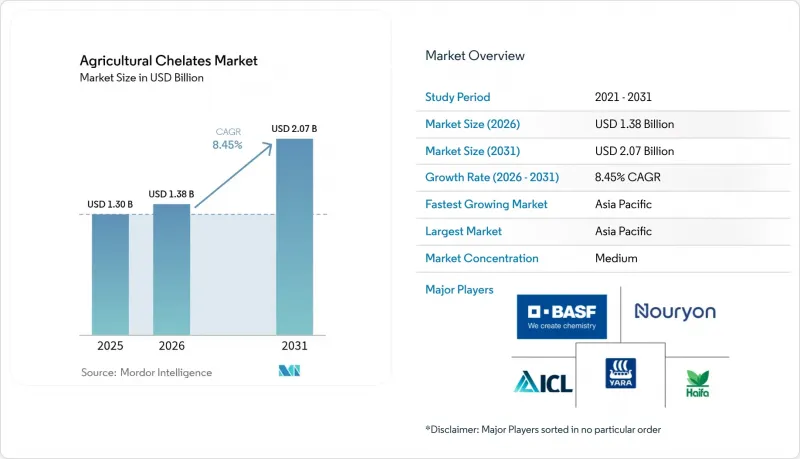
Mordor Intelligence에 의하면, 농업용 킬레이트제 시장 규모는 2025년 13억 달러, 2026년 13억 8,000만 달러에서 2031년까지 20억 7,000만 달러로 확대한다고 예측되고 있어 2026년부터 2031년까지 CAGR 8.45%를 기록하는 전망입니다.
본 보고서는 유형별(합성 및 유기), 용도별(토양 시비, 엽면 살포, 비료 관개, 기타 용도), 작물별(곡물, 콩류·유지종자, 상업용 작물 등), 지역별(북미, 유럽, 아시아태평양, 남미, 중동 및 아프리카)로 분류되어 있습니다. 시장 예측은 금액(달러) 기준으로 제시되어 있습니다.
세계 농업용 킬레이트제 시장 동향 및 인사이트
경작지 감소에 따른 세계 식량 안보에 대한 압박
유엔 식량농업기구(FAO) 및 유엔 사막화 방지를 위한 협약(UNCCD)의 데이터에 따르면, 전 세계 농경지는 매년 1,200만 헥타르씩 감소하고 있으며, 헥타르당 수확량을 향상시키는 자재에 대한 관심이 높아지고 있습니다. 킬레이트화된 미량 영양소는 황산염에 비해 3-5배 높은 생체 이용률을 발휘하여, 제한된 경작 면적에서 생산자가 영양 목표를 달성할 수 있도록 지원합니다. 유엔 식량농업기구(FAO)는 2050년까지 곡물 생산량이 50% 증가할 것으로 예측하고 있으며, 고수확형 농업 시스템에서 킬레이트제의 역할이 부각되고 있습니다. 아시아태평양과 아프리카에서 가장 큰 압박이 발생하고 있어, 이들 지역에서의 도입이 가속화되고 있습니다. 각국 정부가 고효율 비료에 대한 보조금을 배정하고 있는 만큼, 중기적으로는 그 영향이 계속해서 클 것으로 보입니다.
농업용 토양에서 발생하는 광범위한 미량 영양소 결핍 문제
세계 곡물 재배 토양의 약 절반은 아연 결핍 상태인 반면, 지중해 지역 등의 석회질 지대에서는 철 결핍성 황화증이 원예 작물의 생산을 제약하고 있습니다. 세계보건기구(WHO)는 토양의 미량 영양소 결핍을 20억 명에게 영향을 미치는 ‘숨겨진 기아’와 연관 짓고 있습니다. 킬레이트제는 염류가 침전되기 쉬운 알칼리성 토양에서도 미량 영양소의 이용 가능성을 유지하기 때문에 토양 개량에 필수적인 역할을 하고 있습니다. 인도나 중국의 대규모 벼·밀 생산 지역에서는 영양 기준을 충족하기 위해 킬레이트제를 엽면 시비하고 있습니다. 이러한 구조적 요인은 농업용 킬레이트제 시장에 장기적인 영향을 미치고 있습니다.
잔류성이 높은 합성 킬레이트제에 대한 엄격한 규제
에틸렌디아민테트라아세트산(EDTA)은 전 세계 농업에서 널리 사용되는 킬레이트제이지만, 생분해성이 낮다는 이유로 유럽화학물질청(ECHA)의 평가 대상이 되고 있습니다. ‘고위험 물질(SVHC)’로 분류되지는 않았지만, 유럽 시장에서는 유럽연합(EU)의 ‘그린 딜’이 제시하는 ‘제로 오염’목표에 부합하기 위해 글루탐산 디아세트산 테트라나트륨(GLDA)이나 이미노디코하르산(IDHA)과 같은 생분해성 대체제로의 전환이 진행되고 있습니다. 미국 환경보호청(EPA)도 병행하여 심사를 진행하고 있으며, 2026년에 평가안이 공표될 전망입니다. 이러한 움직임에 따라 제제 제조업체들은 국제인도지원디플로마(IDHA)나 에틸렌디아민-N,N'-비스(2-하이드록시페닐아세트산)(EDDHA)와 같은 생분해성 대체재의 도입을 가속화할 수밖에 없게 되었습니다. 규제 준수 비용 및 제품 포트폴리오 재검토로 인해 단기적으로는 이익률이 압박받고 출하량도 감소할 것으로 보입니다. 새로운 등급이 규제 당국의 승인을 받으면 이러한 제약은 완화될 전망입니다.
부문별 분석
2025년, 합성 킬레이트제는 농업용 킬레이트제 시장에서 70%라는 압도적인 점유율을 차지하고 있으며, 오랜 기간에 걸친 현장 검증과 정부의 비료 보조금 대상에 포함된 혜택을 누리고 있습니다. 바이오 킬레이트제는 가장 빠르게 성장하는 그룹으로, 유럽 및 미국의 규제 당국이 에틸렌디아민테트라아세트산(EDTA)과 같은 잔류성 물질을 면밀히 검토하고 있는 만큼, 2031년까지 연평균 성장률(CAGR) 9.5%로 확대되고 있습니다. 미쓰비시 화학이 2025년에 글루탐산 디아세트산 테트라나트륨(GLDA)의 생산 능력을 40% 확대하는 등 발효 능력 증강으로 단위 비용이 낮아짐에 따라, 이 두 그룹 간의 가격 차이는 점차 줄어들고 있습니다. 누리옹의 글루탐산, N,N-디아세트산, 4나트륨염(디솔바인 GL)은 2025년에 유럽연합(EU)의 에코라벨 인증을 획득했습니다. 이는 생분해성 등급이 성능을 저하시키지 않으면서도 비료 및 관개 분야에서 에틸렌디아민테트라아세트산(EDTA)을 대체할 수 있게 되었음을 의미합니다.
바이오 제품 중 리그노설폰산염은 목초 및 사료 작물을 위한 저비용 대안이지만, 알칼리성 토양에서는 안정성이 떨어집니다. 글리신이나 글루타민산으로 만든 아미노산 킬레이트는 외관 품질이 프리미엄 가격을 결정하는 과일 및 채소에서 잎을 통한 신속한 흡수를 실현합니다. 헵타글루코네이트는 유기 인증을 받은 토양 관리 프로그램에서 중간 수준의 비용과 안정성을 제공합니다. 한편, 구연산 및 글루코네이트 복합체는 수경 재배에서 틈새 자재로 자리 잡고 있으며, 신속한 생분해를 통해 성분의 축적을 방지할 수 있습니다. 농업용 킬레이트제 시장 규모가 지속적으로 확대되는 가운데, 이러한 다양화 덕분에 생산자는 작물의 가치, 토양의 pH, 그리고 지속가능성 목표에 맞추어 킬레이트제를 선택할 수 있게 되었습니다.
지역별 분석
아시아태평양은 2025년에 농업용 킬레이트제 시장 점유율의 53.4%를 차지하며, 2031년까지 연평균 성장률(CAGR) 8.8%로 확대될 것으로 전망됩니다. 인도와 중국의 정부 영양 강화 정책에 따라 킬레이트화된 아연과 철에 대한 보조금이 지급되고 있으며, 이로 인해 소규모 농가에서의 채택이 가속화되고 있습니다. 국내 제조업체들은 국제 인도주의 지원 디플로마(IDHA) 규격 및 아미노산 등급의 생산을 확대하고 있으며, 이를 통해 수입 의존도를 낮추고 가격 압박도 완화되고 있습니다. 국가의 절수 프로그램에 따른 점적 관개 확대에 따라 완전 용해성 킬레이트제에 대한 수요는 더욱 증가하고 있습니다.
유럽, 북미, 중동 및 아프리카는 각각 서로 다른 성장 경로를 밟고 있습니다. 유럽에서는 화학물질의 평가, 승인, 제한에 관한 규정(REACH)이 강화됨에 따라 생분해성 배위체로의 전환이 진행되고 있지만, 스페인의 감귤류 산업은 에틸렌디아민-N,N'-비스(2-하이드록시페닐)아세트산(EDDHA)-철의 안정적인 소비를 뒷받침하고 있습니다. 북미에서는 미국 농무부의 비용 분담형 인센티브가 특산 작물이나 온실 채소용의 높은 가격을 상쇄하는 형태로 혜택을 주고 있습니다. 중동의 온실에서는 알칼리성 토양이라는 과제를 극복하기 위해 킬레이트제가 활용되고 있으며, 아프리카의 상업 농장에서는 비용 측면의 장벽이 있음에도 불구하고, 대상을 좁힌 엽면 시비가 도입되고 있습니다.
환경 제어 시설이 증가하고 탄소 크레딧 제도가 영양 효율을 평가함에 따라 지역별 도입은 더욱 확대될 것입니다. 인도와 중국에서의 현지 생산으로 단가가 하락하여 남아시아 및 동남아시아 전역에서 이용이 확대될 것으로 예측됩니다. 친환경 라벨 인증을 획득한 유럽 공급업체들은 가격에 민감하지 않은 유기 농업 분야 시장 점유율을 확보할 것입니다. 공공 부문의 보급 지원 서비스와 정밀 농업 플랫폼이 모범 사례를 확산시켜, 농업용 킬레이트제 시장의 세계 입지를 확대할 것입니다.
기타 혜택:
- 엑셀 형식 시장 예측(ME) 시트
- 3개월간의 애널리스트 지원
자주 묻는 질문
목차
제1장 서론
제2장 조사 방법
제3장 개요
제4장 시장 구도
제5장 시장 규모와 성장 예측
제6장 경쟁 구도
제7장 시장 기회와 향후 전망
JHS 26.09.03According to Mordor Intelligence, the agricultural chelates market size is projected to expand from USD 1.30 billion in 2025 and USD 1.38 billion in 2026 to USD 2.07 billion by 2031, registering a 8.45% CAGR between 2026 and 2031.
This report is Segmented by Type (Synthetic and Organic), by Application (Soil Application, Foliar Application, Fertigation, and Other Applications), by Crop Type (Grains and Cereals, Pulses and Oilseeds, Commercial Crops, and More), and by Geography (North America, Europe, Asia-Pacific, South America, Middle East, and Africa). The Market Forecasts are Provided in Terms of Value (USD).
Global Agricultural Chelates Market Trends and Insights
Global Food-Security Pressure Amid Shrinking Arable Land
World farmland continues to decline by 12 million hectares each year, intensifying interest in inputs that raise yields per hectare, according to data from the United Nations Food and Agriculture Organization (FAO) and the UN Convention to Combat Desertification (UNCCD). Chelated micronutrients deliver three- to five-fold higher bioavailability than sulfate salts, helping growers meet nutrition targets on limited acreage. The Food and Agriculture Organization projects a 50% increase in cereal output by 2050, underscoring the role of chelates in yield-intensive systems. Asia-Pacific and Africa feel the greatest pressure, driving faster adoption in those regions. The impact remains significant through the medium term as governments allocate subsidies to high-efficiency fertilizers.
Widespread Micronutrient Deficiency in Agricultural Soils
Roughly half of global cereal soils are zinc-deficient, while iron chlorosis constrains horticultural output in calcareous zones such as the Mediterranean. The World Health Organization links soil deficiency to "hidden hunger," which affects 2 billion people. Chelates keep micronutrients available in alkaline soils where salts precipitate, making them critical to remediation. Large-scale rice and wheat belts in India and China use foliar chelated sprays to meet nutritional standards. This structural driver exerts a long-lasting influence on the agricultural chelates market.
Stringent Regulations on Persistent Synthetic Chelating Agents
Ethylenediaminetetraacetic acid (EDTA) is a widely used chelating agent in global agriculture but is under European Chemicals Agency (ECHA) assessment for low biodegradability. Although not classified as a Substance of Very High Concern (SVHC), the European market is shifting to biodegradable alternatives like Tetrasodium Glutamate Diacetate (GLDA) and Iminodisuccinic Acid (IDHA) to align with the European Union (EU) Green Deal's zero-pollution goals. The United States Environmental Protection Agency is conducting parallel reviews, and draft assessments are anticipated in 2026. These actions force formulators to accelerate the adoption of biodegradable alternatives such as the International Diploma in Humanitarian Assistance (IDHA) and Ethylenediamine-N, N'-bis (2-hydroxyphenylacetic Acid) (EDDHA). Compliance costs and portfolio pivots compress margins and slow shipment volumes in the short run. The restraint will ease after new grades gain regulatory acceptance.
Other drivers and restraints analyzed in the detailed report include:
- Rising Demand for Nutritionally Fortified and Biofortified Crop
- Expansion of Controlled-Environment Agriculture Facilities
- High Product Cost Versus Conventional Micronutrient Salts
For complete list of drivers and restraints, kindly check the Table Of Contents.
Segment Analysis
Synthetic chelates held a dominant 70% of agricultural chelates market share in 2025, benefiting from long-standing field validation and inclusion in government fertilizer subsidies. Bio-based chelates are the fastest-growing group and are advancing at a 9.5% CAGR through 2031 as European and United States regulators scrutinize persistent agents like Ethylenediaminetetraacetic Acid (EDTA). The price gap between the two groups is shrinking because fermentation capacity expansions, such as Mitsubishi Chemical's 40% Tetrasodium Glutamate Diacetate (GLDA) boost in 2025, lower unit costs. Nouryon's Glutamic Acid, N,N-Diacetic Acid, Tetrasodium Salt (Dissolvine GL) earned European Union (EU) Ecolabel certification in 2025, signaling that biodegradable grades can now replace Ethylenediaminetetraacetic Acid (EDTA) in fertigation without sacrificing performance.
Within bio-based offerings, lignosulfonates supply a budget option for pasture and forage crops but lack stability in alkaline soils. Amino-acid chelates made from glycine or glutamic acid deliver rapid foliar uptake for fruits and vegetables where visual quality drives premium pricing. Heptagluconates offer mid-range cost and stability for organic-certified soil programs, while citrate and gluconate complexes remain niche inputs in hydroponics where quick biodegradation prevents buildup. This diversification allows growers to tailor chelate choice to crop value, soil pH, and sustainability goals as the agricultural chelates market size continues to expand.
Complete Report Scope:
- By Type
- Synthetic
- Ethylenediaminetetraacetic Acid (EDTA)
- Ethylenediamine-N, N-bis(2-hydroxyphenylacetic Acid (EDDHA))
- Diethylenetriaminepentaacetic Acid (DTPA)
- Iminodisuccinic Acid (IDHA)
- Other Synthetic Types
- Organic
- Lignosulfonates
- Amino Acids
- Heptagluconates
- Other Organic Types
- Synthetic
- By Application
- Soil Application
- Foliar Application
- Fertigation
- Other Applications
- By Crop Type
- Grains and Cereals
- Pulses and Oilseeds
- Commercial Crops
- Fruits and Vegetables
- Turfs and Ornamentals
- By Geography
- North America
- United States
- Canada
- Mexico
- Rest of North America
- Europe
- Spain
- United Kingdom
- France
- Germany
- Russia
- Italy
- Rest of Europe
- Asia-Pacific
- China
- Japan
- India
- Australia
- Rest of Asia-Pacific
- South America
- Brazil
- Argentina
- Rest of South America
- Middle East
- Saudi Arabia
- United Arab Emirates
- Rest of Middle East
- Africa
- South Africa
- Nigeria
- Rest of Africa
- North America
Geography Analysis
Asia-Pacific held 53.4% of the agricultural chelates market share in 2025 and is forecast to expand at an 8.8% CAGR through 2031. Government biofortification mandates in India and China subsidize chelated zinc and iron, thereby accelerating adoption among smallholders. Domestic producers are scaling International Diploma in Humanitarian Assistance (IDHA) and amino-acid grades, trimming import dependency, and easing price pressures. Expansion of drip irrigation under national water-savings programs further elevates demand for fully soluble chelates.
Europe, North America, the Middle East, and Africa follow with varied growth paths. Europe pivots toward biodegradable ligands as Evaluation, Authorisation and Restriction of Chemicals (REACH) rules tighten, while Spain's citrus industry anchors steady Ethylenediamine-N, N'-Bis (2-Hydroxyphenyl)Acetic acid (EDDHA)-iron consumption. North America benefits from the United States Department of Agriculture cost-share incentives that offset premium pricing for specialty crops and greenhouse vegetables. Middle East greenhouses rely on chelates to overcome the challenges of alkaline soils, and Africa's commercial farms adopt targeted foliar sprays despite cost hurdles.
Regional adoption will deepen as controlled-environment facilities multiply and carbon-credit programs reward nutrient efficiency. Local manufacturing in India and China is anticipated to lower unit costs, widening access across South and Southeast Asia. European suppliers that secure eco-label certifications will capture price-insensitive organic segments. Public-sector extension services and precision-agriculture platforms will disseminate best practices, expanding the worldwide footprint of the agricultural chelates market.
- BASF SE
- Yara International ASA
- Nouryon Chemicals Holding B.V.
- ICL Group Ltd.
- Haifa Chemicals Ltd.
- Syngenta Group Co., Ltd.
- Nufarm Limited
- BMS Micro-Nutrients NV
- Mitsubishi Chemical Corporation
- Protex International
- Innospec Inc.
- Van Iperen International B.V.
- Aries Agro Limited
- Compass Minerals International Inc.
- J. R. Simplot Company
Additional Benefits:
- The market estimate (ME) sheet in Excel format
- 3 months of analyst support
TABLE OF CONTENTS
1 Introduction
- 1.1 Study Assumptions and Market Definition
- 1.2 Scope of the Study
2 Research Methodology
3 Executive Summary
4 Market Landscape
- 4.1 Market Overview
- 4.2 Market Drivers
- 4.2.1 Global food-security pressure amid shrinking arable land
- 4.2.2 Widespread micronutrient deficiency in agricultural soils
- 4.2.3 Rising demand for nutritionally fortified and biofortified crops
- 4.2.4 Expansion of controlled-environment agriculture facilities
- 4.2.5 Smart-fertigation-ready specialty chelates
- 4.2.6 Carbon-credit-linked nutrient-use-efficiency programs
- 4.3 Market Restraints
- 4.3.1 Stringent regulations on persistent synthetic chelating agents
- 4.3.2 High product cost versus conventional micronutrient salts
- 4.3.3 Emergence of next-generation bio-stimulant substitutes
- 4.3.4 Supply-chain volatility for bio-based chelating ligands
- 4.4 Regulatory Landscape
- 4.5 Technological Outlook
- 4.6 Porter's Five Forces Analysis
- 4.6.1 Bargaining Power of Suppliers
- 4.6.2 Bargaining Power of Buyers
- 4.6.3 Threat of New Entrants
- 4.6.4 Threat of Substitutes
- 4.6.5 Intensity of Competitive Rivalry
5 Market Size and Growth Forecasts (Value)
- 5.1 By Type
- 5.1.1 Synthetic
- 5.1.1.1 Ethylenediaminetetraacetic Acid (EDTA)
- 5.1.1.2 Ethylenediamine-N, N-bis(2-hydroxyphenylacetic Acid (EDDHA))
- 5.1.1.3 Diethylenetriaminepentaacetic Acid (DTPA)
- 5.1.1.4 Iminodisuccinic Acid (IDHA)
- 5.1.1.5 Other Synthetic Types
- 5.1.2 Organic
- 5.1.2.1 Lignosulfonates
- 5.1.2.2 Amino Acids
- 5.1.2.3 Heptagluconates
- 5.1.2.4 Other Organic Types
- 5.1.1 Synthetic
- 5.2 By Application
- 5.2.1 Soil Application
- 5.2.2 Foliar Application
- 5.2.3 Fertigation
- 5.2.4 Other Applications
- 5.3 By Crop Type
- 5.3.1 Grains and Cereals
- 5.3.2 Pulses and Oilseeds
- 5.3.3 Commercial Crops
- 5.3.4 Fruits and Vegetables
- 5.3.5 Turfs and Ornamentals
- 5.4 By Geography
- 5.4.1 North America
- 5.4.1.1 United States
- 5.4.1.2 Canada
- 5.4.1.3 Mexico
- 5.4.1.4 Rest of North America
- 5.4.2 Europe
- 5.4.2.1 Spain
- 5.4.2.2 United Kingdom
- 5.4.2.3 France
- 5.4.2.4 Germany
- 5.4.2.5 Russia
- 5.4.2.6 Italy
- 5.4.2.7 Rest of Europe
- 5.4.3 Asia-Pacific
- 5.4.3.1 China
- 5.4.3.2 Japan
- 5.4.3.3 India
- 5.4.3.4 Australia
- 5.4.3.5 Rest of Asia-Pacific
- 5.4.4 South America
- 5.4.4.1 Brazil
- 5.4.4.2 Argentina
- 5.4.4.3 Rest of South America
- 5.4.5 Middle East
- 5.4.5.1 Saudi Arabia
- 5.4.5.2 United Arab Emirates
- 5.4.5.3 Rest of Middle East
- 5.4.6 Africa
- 5.4.6.1 South Africa
- 5.4.6.2 Nigeria
- 5.4.6.3 Rest of Africa
- 5.4.1 North America
6 Competitive Landscape
- 6.1 Market Concentration
- 6.2 Strategic Moves
- 6.3 Market Share Analysis
- 6.4 Company Profiles (includes Global-level Overview, Market-level Overview, Core Segments, Financials as Available, Strategic Information, Market Rank/Share, Products and Services, and Recent Developments)
- 6.4.1 BASF SE
- 6.4.2 Yara International ASA
- 6.4.3 Nouryon Chemicals Holding B.V.
- 6.4.4 ICL Group Ltd.
- 6.4.5 Haifa Chemicals Ltd.
- 6.4.6 Syngenta Group Co., Ltd.
- 6.4.7 Nufarm Limited
- 6.4.8 BMS Micro-Nutrients NV
- 6.4.9 Mitsubishi Chemical Corporation
- 6.4.10 Protex International
- 6.4.11 Innospec Inc.
- 6.4.12 Van Iperen International B.V.
- 6.4.13 Aries Agro Limited
- 6.4.14 Compass Minerals International Inc.
- 6.4.15 J. R. Simplot Company


