
|
시장보고서
상품코드
2120287
네트워크 분석 : 시장 점유율 분석, 업계 동향과 통계, 성장 예측(2026-2031년)Network Analytics - Market Share Analysis, Industry Trends & Statistics, Growth Forecasts (2026 - 2031) |
||||||
 Mordor Intelligence
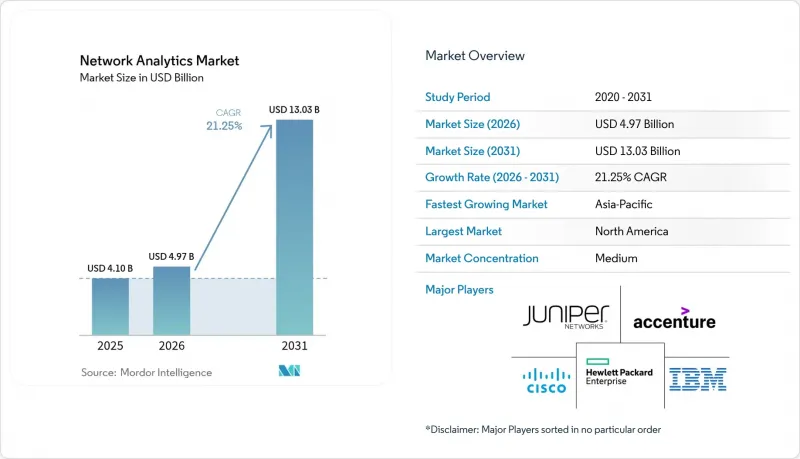
Mordor Intelligence에 따르면 네트워크 분석 시장 규모는 2025년에 41억 달러로 평가되며, 2026년 49억 7,000만 달러에서 성장하며, 2031년까지 130억 3,000만 달러에 달할 것으로 예측됩니다.
예측 기간(2026-2031년) 동안 연평균 성장률(CAGR)은 21.25%에 달할 것으로 전망됩니다.
이 보고서는 배포 모델(온프레미스, 클라우드, 하이브리드), 구성 요소(솔루션 및 서비스), 용도(성능 관리, 장애 관리 등), 최종사용자(통신 서비스 제공업체, 클라우드 서비스 제공업체 등), 지역(북미, 유럽, 아시아태평양 등)별로 분류되어 있습니다. 시장 예측은 금액(달러) 기준으로 제시되어 있습니다.
글로벌 네트워크 분석 시장의 동향 및 인사이트
자율형 및 자가 관리형 네트워크의 필요성
네트워크가 점점 더 복잡해지고, 다운타임으로 인한 비용(클라우드 중심 기업의 경우 분당 9,000달러)이 증가함에 따라 자가 복구형 인프라에 대한 수요가 높아지고 있습니다. AI가 통합된 분석 플랫폼은 현재 장애를 예측하고 복구할 수 있게 되어, 사후 대응형 문제 해결에서 선제적인 최적화로 전환할 수 있게 해줍니다. 미션 크리티컬 워크로드를 운영하는 업계에서는 AIOps에 대한 의존도가 높아지고 있으며, IT 리더의 72%가 분석, 자동화, 가시성을 통합한 플랫폼 기반 아키텍처를 계획하고 있습니다. 그 결과, 각 벤더들은 평균 복구 시간(MTTR)을 단축하고 서비스 수준 목표(SLA)를 보장하기 위해 실시간 이상 감지 및 정책 기반 오케스트레이션 기능을 통합하고 있습니다.
IoT 및 M2M 통신의 부상
네트워크 분석 플랫폼에는 디바이스 수준의 가시화, 프로토콜 디코딩 및 동작 기준선 설정 기능이 추가되어, 이기종 트래픽을 관리할 수 있게 되었습니다. 제조업, 공공 사업, 스마트 시티 구축 분야에서 실시간 분석은 예측 유지보수 및 에너지 최적화를 지원하여, 측정 가능한 비용 절감과 가동 시간 향상을 실현하고 있습니다.
높은 초기 비용과 투자 수익률(ROI)의 불확실성
포괄적인 도입을 위해서는 소프트웨어 라이선스, 원격 측정 지원하드웨어, 시스템 통합 및 직원 교육이 필요합니다. 특히 중소기업의 경우, 가동 중단 시간 단축이나 고객 경험 향상으로 이어지는 경제적 이익을 정량화하는 것은 여전히 어려운 과제로 남아 있습니다. 구독형 클라우드 제공은 자본 부담을 줄여주지만, 신흥 국가의 예산 제약이 여전히 도입의 걸림돌이 되고 있습니다.
부문 분석
클라우드 배포는 연평균 성장률(CAGR) 23.4%로 확대될 전망이며, 이는 네트워크 분석 시장 전체를 상회하는 속도입니다. 이러한 추세는 유연한 확장성, 종량제 요금제의 경제성, 그리고 분산형 팀의 접근 용이성에 의해 주도되고 있습니다. 이러한 성장세에도 불구하고 보안 및 주권에 대한 요구가 높아짐에 따라 2025년에도 온프레미스 도입이 매출의 55.20%를 차지할 것으로 전망됩니다. 조직이 기존 투자와 미래의 민첩성을 양립시키려는 과정에서 하이브리드 아키텍처가 지지를 얻고 있으며, 이러한 추세는 금융 기관에 의해 더욱 가속화되고 있습니다. 해당 업계에서는 91%의 기업이 이미 클라우드 현대화 노력을 시작했습니다.
하이브리드 운영 패턴은 현실적인 접근 방식을 보여줍니다. 즉, 엄격한 데이터 관리 요건이 요구되는 워크로드는 온프레미스에 남겨두고, 버스트형 분석 작업은 퍼블릭 클라우드로 이전하는 것입니다. 이러한 이원적인 접근 방식을 통해 거버넌스를 희생하지 않고도 비용 최적화가 가능해집니다. 분석가에 따르면 현재 기업 워크로드의 30%가 퍼블릭 클라우드에 있으며, 이러한 전환을 주도하는 것은 애널리틱스와 데브옵스입니다. 각 벤더사는 이에 대응하여 컨테이너화된 수집기, SaaS 대시보드, 프라이빗 및 퍼블릭 도메인을 아우르는 통합 정책 엔진을 제공하고 있습니다. 지속적 통합(CI) 파이프라인을 통해 분석이 일상 업무에 더욱 통합되면서 개발 주기가 단축되고 있습니다.
2025년 매출에서 솔루션이 62.40%를 차지하며 주도적인 위치를 차지했으나, 조직들이 전문적인 노하우를 추구함에 따라 서비스 부문은 연평균 22.6%의 성장이 예상됩니다. 컨설팅 및 통합 프로젝트에서는 분석 아키텍처를 비즈니스 목표에 부합하도록 조정하고, 매니지드 서비스에서는 일상적인 튜닝 및 규칙 유지 관리를 외부에 위탁하고 있습니다. 이러한 서비스의 확산은 보다 광범위한 IT 아웃소싱 추세를 반영하고 있으며, 매니지드 서비스 제공업체(MSP) 부문은 2024년에 3,500억 달러에 달하고, 2033년까지 1조 달러를 넘어설 것으로 예측됩니다.
서비스 파트너들은 성능에 대한 인사이트를 비즈니스 성과로 연결하는 AI 기반 자문 서비스를 점점 더 많이 제공하고 있습니다. 이러한 모델을 도입한 기업은 20-30%의 비용 절감과 최대 25%의 생산성 향상을 보고하고 있습니다. 수요에 부응하기 위해 벤더들은 런북, 사전 학습된 모델, 원격 SOC 기능을 패키지화하여 가치 실현까지의 시간을 단축하는 동시에 AI 기술 격차를 완화하고 있습니다. 이러한 진화를 통해 서비스는 네트워크 분석 시장의 초석으로서 확고한 입지를 다지며, 지속적인 수익과 고객 관계 심화를 가져오고 있습니다.
지역별 분석
북미는 조기 도입, 풍부한 IT 예산, 그리고 첨단인 공급업체 생태계의 지원에 힘입어 2025년에도 매출 점유율 37.60%를 유지했습니다. 미국의 금융 서비스 및 의료 기관은 엄격한 가동 시간 요건과 개인정보 보호 규제를 충족하기 위해 AI를 통합한 분석 솔루션을 도입하고 있습니다. 캐나다의 통신 사업자들은 분석을 활용하여 전국 규모의 5G 구축을 최적화하고, 지방 통신 서비스 제공 의무를 관리하고 있습니다. 명확한 규제와 풍부한 인재 pool 덕분에 예측 기반 자동화 실험이 가속화되고 있으며, 이 지역은 혁신의 최전선에 계속 서 있습니다.
아시아태평양은 2031년까지 연평균 성장률(CAGR) 22.7%를 기록하며 가장 빠르게 성장하는 지역입니다. 중국과 인도는 다중 벤더 환경에 대한 세밀한 가시성이 필요한 대규모 5G, 스마트 시티 및 산업용 IoT 프로젝트에 자금을 투자하고 있습니다. 일본과 한국은 자율주행차 시범 운영 및 공장 자동화를 지원하기 위해 AI를 네트워크 모니터링에 통합하고 있는 반면, 호주는 중요 인프라를 사이버 위협으로부터 보호하기 위해 분석 기술을 활용하고 있습니다.
유럽은 엄격한 규제와 높아지는 보안 의식 속에서 진전을 이루고 있습니다. 영국과 독일은 금융 서비스 및 제조업 분야의 도입을 주도하며, 하이브리드 아키텍처 전반에 걸쳐 GDPR을 준수하는 인사이트를 추구하고 있습니다. 프랑스와 이탈리아는 경쟁이 치열한 모바일 시장에서 고객 만족도를 유지하기 위해 통신 인프라 확충을 추진하고 있습니다. 북유럽 및 동유럽의 에너지·공공사업 사업자들은 스마트 그리드 원격 측정에서 이상 징후를 탐지하기 위해 분석 툴을 도입하고 있습니다. 이 지역에서 성공을 거두고 있는 각 벤더들은 데이터 주권 관리, 세분화된 사용자 접근 정책, 그리고 자동화된 규정 준수 보고를 중시하고 있습니다.
기타 혜택:
- 엑셀 형식의 시장 전망(ME) 시트
- 3개월간의 애널리스트 지원
자주 묻는 질문
목차
제1장 서론
제2장 조사 방법
제3장 개요
제4장 시장 인사이트
제5장 시장 세분화
제6장 경쟁 구도
제7장 시장 기회와 향후 동향
KSA 26.09.02According to Mordor Intelligence, the network analytics market size was valued at USD 4.10 billion in 2025 and estimated to grow from USD 4.97 billion in 2026 to reach USD 13.03 billion by 2031, at a CAGR of 21.25% during the forecast period (2026-2031).
This report is Segmented by Deployment Model (On-Premise, Cloud, and Hybrid), Component (Solutions and Services), Application (Performance Management, Fault Management, and More), End-User (Communication Service Providers, Cloud Service Providers, and More), and Geography (North America, Europe, Asia-Pacific, and More). The Market Forecasts are Provided in Terms of Value (USD).
Global Network Analytics Market Trends and Insights
Need for Autonomous and Self-Managing Networks
Escalating network complexity and the cost of downtime-USD 9,000 per minute for cloud-centric firms-have intensified demand for self-healing infrastructure. AI-infused analytics platforms now predict and remediate faults, enabling a shift from reactive troubleshooting to proactive optimisation. Industries running mission-critical workloads increasingly depend on AIOps, with 72% of IT leaders planning platform-based architectures that merge analytics, automation, and observability. As a result, vendors are embedding real-time anomaly detection and policy-driven orchestration to cut mean-time-to-repair and protect service-level objectives.
Rise of IoT and Machine-to-Machine Communications
Network analytics platforms have added device-level visibility, protocol decoding, and behavioural baselining to manage heterogeneous traffic. In manufacturing, utilities, and smart-city roll-outs, real-time analytics supports predictive maintenance and energy optimisation, unlocking measurable cost savings and uptime improvements.
High Initial Costs and Uncertain Return on Investment
Comprehensive deployments require software licences, telemetry-ready hardware, systems integration, and staff training. Quantifying financial returns linked to reduced outages or improved customer experience remains challenging, particularly for small and mid-sized organisations. Subscription-based cloud delivery eases capital burdens, yet budget pressures in emerging economies still slow adoption.
Other drivers and restraints analyzed in the detailed report include:
- Exponential Data Traffic and 5G Roll-Out Pressure
- Closed-Loop AI Digital-Twin Optimisation
- API-Based Network-as-Code Monetisation Needs Real-Time Analytics
- Data-Privacy and Regulatory Constraints
For complete list of drivers and restraints, kindly check the Table Of Contents.
Segment Analysis
Cloud deployments are set to expand at a 23.4% CAGR, outpacing the overall network analytics market. The move is driven by elastic scalability, pay-as-you-go economics, and easier access for distributed teams. Despite that momentum, on-premise installations retained 55.20% revenue in 2025 due to heightened security and sovereignty needs. Hybrid architectures have gained favour as organisations bridge legacy investments with future agility, a trend reinforced by financial institutions, where 91% have already begun their cloud modernisation journeys.
Hybrid operating patterns illustrate a pragmatic view: workloads with stringent data-control requirements remain on-premise, while bursty analytic tasks shift to public clouds. This duality supports cost optimisation without sacrificing governance. Analysts note that 30% of enterprise workloads now sit in public clouds, with analytics and DevOps leading migrations. Vendors have responded by delivering containerised collectors, SaaS dashboards, and unified policy engines that span private and public domains. Continuous integration pipelines further embed analytics into daily operations, compressing development cycles.
Solutions dominated 2025 revenue with 62.40%, yet services are forecast to grow 22.6% annually as organisations seek specialised expertise. Consulting and integration engagements align analytics architectures with business objectives, while managed services offload daily tuning and rule-maintenance. The services wave mirrors broader IT outsourcing patterns; the managed service provider segment is projected to reach USD 350 billion in 2024 and top USD 1 trillion by 2033.
Service partners increasingly deliver AI-driven advisory offerings that contextualise performance insights into business outcomes. Enterprises adopting such models have reported 20-30% cost savings and up to 25% productivity gains. To meet demand, vendors package runbooks, pre-trained models, and remote SOC capabilities, shortening time to value and mitigating the AI skills gap. This evolution cements services as a cornerstone of the network analytics market, unlocking recurring revenue and deeper client relationships.
Complete Report Scope:
- By Deployment Model
- On-premise
- Cloud
- Hybrid
- By Component
- Solutions
- Network intelligence platforms
- Performance management
- Security analytics
- Root-cause and anomaly detection
- Traffic optimisation
- Services
- Professional services
- Managed services
- Solutions
- By Application
- Performance management
- Fault management
- Customer experience management
- Security and anomaly detection
- Smart routing and traffic optimisation
- By End User
- Communication service providers
- Telecom providers
- Internet service providers
- Satellite communication providers
- Cable network providers
- Cloud service providers
- Enterprises
- Banking, Financial Services, and Insurance (BFSI)
- Healthcare
- Retail and e-commerce
- Manufacturing
- Government and public sector
- Communication service providers
- By Geography
- North America
- United States
- Canada
- South America
- Brazil
- Rest of South America
- Europe
- United Kingdom
- Germany
- France
- Italy
- Spain
- Russia
- Rest of Europe
- Asia-Pacific
- China
- Japan
- India
- South Korea
- Australia and New Zealand
- Rest of Asia-Pacific
- Middle East and Africa
- Middle East
- Saudi Arabia
- United Arab Emirates
- Turkey
- Rest of Middle East
- Africa
- South Africa
- Rest of Africa
- Middle East
- North America
Geography Analysis
North America retained 37.60% revenue share in 2025, supported by early adoption, sizeable IT budgets, and an advanced supplier ecosystem. United States financial-services and healthcare organisations deploy AI-infused analytics to satisfy stringent uptime and privacy mandates. Canadian carriers use analytics to optimise nationwide 5G roll-outs and manage rural-coverage obligations. Regulatory clarity and abundant talent expedite experimentation with predictive automation, keeping the region at the forefront of innovation.
Asia-Pacific is the fastest-growing region with a 22.7% CAGR to 2031. China and India fund large-scale 5G, smart-city, and industrial-IoT projects that demand granular visibility into multi-vendor environments. Japan and South Korea integrate AI with network monitoring to support autonomous-vehicle trials and factory automation, while Australia leverages analytics to protect critical infrastructure from cyber threats.
Europe advances amid stringent regulations and heightened security awareness. United Kingdom and Germany lead adoption in financial services and manufacturing, seeking GDPR-compliant insights across hybrid architectures. France and Italy augment telecom deployments to maintain customer satisfaction in competitive mobile markets. Energy and utilities operators in Northern and Eastern Europe deploy analytics to detect anomalies in smart-grid telemetry. Vendors thriving in the region emphasise data-sovereignty controls, granular user-access policies, and automated compliance reporting.
- Accenture PLC
- Cisco Systems Inc.
- Hewlett Packard Enterprise Co.
- IBM Corporation
- Juniper Networks Inc.
- SAS Institute Inc.
- Sandvine Corporation
- Alcatel-Lucent Enterprise SA
- TIBCO Software Inc.
- Broadcom Inc. (incl. VMware)
- Nokia Corporation
- Ericsson Inc.
- Huawei Technologies Co. Ltd.
- Dell Technologies Inc.
- Oracle Corporation
- NetScout Systems Inc.
- Allot Ltd.
- NEC Corporation
- ZTE Corporation
- Amdocs Ltd.
- F5 Networks Inc.
- Splunk Inc.
- Keysight Technologies Inc.
Additional Benefits:
- The market estimate (ME) sheet in Excel format
- 3 months of analyst support
TABLE OF CONTENTS
1 INTRODUCTION
- 1.1 Study Assumptions and Market Definition
- 1.2 Scope of the Study
2 RESEARCH METHODOLOGY
3 EXECUTIVE SUMMARY
4 MARKET INSIGHTS
- 4.1 Market Overview
- 4.2 Market Drivers
- 4.2.1 Need for autonomous and self-managing networks
- 4.2.2 Rise of Internet of Things (IoT) and machine-to-machine communications
- 4.2.3 Exponential data traffic and 5G roll-out pressure
- 4.2.4 Closed-loop Artificial Intelligence (AI) digital-twin optimisation
- 4.2.5 API-based network-as-code monetisation needs real-time analytics
- 4.3 Market Restraints
- 4.3.1 High initial costs and uncertain Return on Investment (RoI)
- 4.3.2 Data-privacy and regulatory constraints
- 4.3.3 AI/ML Ops skills gap for network data pipelines
- 4.3.4 Vendor lock-in via proprietary telemetry protocols
- 4.4 Value / Supply-Chain Analysis
- 4.5 Regulatory Landscape
- 4.6 Technological Outlook
- 4.7 Porter's Five Forces Analysis
- 4.7.1 Bargaining Power of Suppliers
- 4.7.2 Bargaining Power of Buyers/Consumers
- 4.7.3 Threat of New Entrants
- 4.7.4 Threat of Substitute Products
- 4.7.5 Intensity of Competitive Rivalry
5 MARKET SEGMENTATION
- 5.1 By Deployment Model
- 5.1.1 On-premise
- 5.1.2 Cloud
- 5.1.3 Hybrid
- 5.2 By Component
- 5.2.1 Solutions
- 5.2.1.1 Network intelligence platforms
- 5.2.1.2 Performance management
- 5.2.1.3 Security analytics
- 5.2.1.4 Root-cause and anomaly detection
- 5.2.1.5 Traffic optimisation
- 5.2.2 Services
- 5.2.2.1 Professional services
- 5.2.2.2 Managed services
- 5.2.1 Solutions
- 5.3 By Application
- 5.3.1 Performance management
- 5.3.2 Fault management
- 5.3.3 Customer experience management
- 5.3.4 Security and anomaly detection
- 5.3.5 Smart routing and traffic optimisation
- 5.4 By End User
- 5.4.1 Communication service providers
- 5.4.1.1 Telecom providers
- 5.4.1.2 Internet service providers
- 5.4.1.3 Satellite communication providers
- 5.4.1.4 Cable network providers
- 5.4.2 Cloud service providers
- 5.4.3 Enterprises
- 5.4.3.1 Banking, Financial Services, and Insurance (BFSI)
- 5.4.3.2 Healthcare
- 5.4.3.3 Retail and e-commerce
- 5.4.3.4 Manufacturing
- 5.4.3.5 Government and public sector
- 5.4.1 Communication service providers
- 5.5 By Geography
- 5.5.1 North America
- 5.5.1.1 United States
- 5.5.1.2 Canada
- 5.5.2 South America
- 5.5.2.1 Brazil
- 5.5.2.2 Rest of South America
- 5.5.3 Europe
- 5.5.3.1 United Kingdom
- 5.5.3.2 Germany
- 5.5.3.3 France
- 5.5.3.4 Italy
- 5.5.3.5 Spain
- 5.5.3.6 Russia
- 5.5.3.7 Rest of Europe
- 5.5.4 Asia-Pacific
- 5.5.4.1 China
- 5.5.4.2 Japan
- 5.5.4.3 India
- 5.5.4.4 South Korea
- 5.5.4.5 Australia and New Zealand
- 5.5.4.6 Rest of Asia-Pacific
- 5.5.5 Middle East and Africa
- 5.5.5.1 Middle East
- 5.5.5.1.1 Saudi Arabia
- 5.5.5.1.2 United Arab Emirates
- 5.5.5.1.3 Turkey
- 5.5.5.1.4 Rest of Middle East
- 5.5.5.2 Africa
- 5.5.5.2.1 South Africa
- 5.5.5.2.2 Rest of Africa
- 5.5.5.1 Middle East
- 5.5.1 North America
6 COMPETITIVE LANDSCAPE
- 6.1 Market Concentration
- 6.2 Strategic Moves
- 6.3 Market Share Analysis
- 6.4 Company Profiles {(includes Global level Overview, Market level overview, Core Segments, Financials as available, Strategic Information, Market Rank/Share for key companies, Products and Services, and Recent Developments)}
- 6.4.1 Accenture PLC
- 6.4.2 Cisco Systems Inc.
- 6.4.3 Hewlett Packard Enterprise Co.
- 6.4.4 IBM Corporation
- 6.4.5 Juniper Networks Inc.
- 6.4.6 SAS Institute Inc.
- 6.4.7 Sandvine Corporation
- 6.4.8 Alcatel-Lucent Enterprise SA
- 6.4.9 TIBCO Software Inc.
- 6.4.10 Broadcom Inc. (incl. VMware)
- 6.4.11 Nokia Corporation
- 6.4.12 Ericsson Inc.
- 6.4.13 Huawei Technologies Co. Ltd.
- 6.4.14 Dell Technologies Inc.
- 6.4.15 Oracle Corporation
- 6.4.16 NetScout Systems Inc.
- 6.4.17 Allot Ltd.
- 6.4.18 NEC Corporation
- 6.4.19 ZTE Corporation
- 6.4.20 Amdocs Ltd.
- 6.4.21 F5 Networks Inc.
- 6.4.22 Splunk Inc.
- 6.4.23 Keysight Technologies Inc.
7 MARKET OPPORTUNITIES AND FUTURE TRENDS
- 7.1 White-space and Unmet-need Assessment