|
시장보고서
상품코드
2120288
파이낸싱 클라우드 시장 : 점유율 분석, 업계 동향과 통계, 성장 예측(2026-2031년)Finance Cloud - Market Share Analysis, Industry Trends & Statistics, Growth Forecasts (2026 - 2031) |
||||||
 Mordor Intelligence
Mordor Intelligence에 의하면, 파이낸싱 클라우드 시장 규모는 2025년 374억 5,000만 달러에서 2026년에는 431억 7,000만 달러로 확대되어 2026년부터 2031년까지 CAGR 15.3%로 성장을 지속하여, 2031년에는 878억 6,000만 달러에 이를 것으로 예측됩니다.
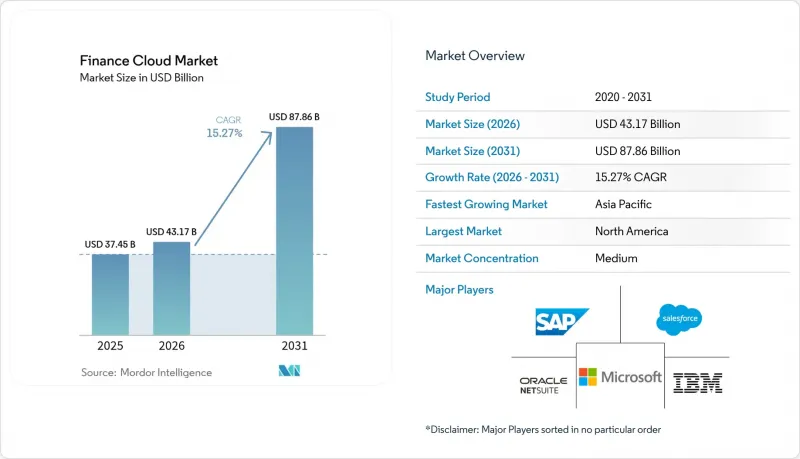
본 보고서는 솔루션별(핵심 회계 및 총계정원장, 재무 예측 및 계획, 기타), 도입 모델별(퍼블릭 클라우드, 프라이빗 클라우드, 하이브리드/멀티 클라우드), 최종 사용자별(은행, 보험, 자본 시장, 기타),조직 규모별(대기업 및 중소기업(SME)), 그리고 지역별로 분류되어 있습니다. 시장 예측은 금액(달러)으로 표시되어 있습니다.
세계 파이낸싱 클라우드 시장 동향 및 인사이트
고객 관계 관리(CRM) 개선 필요성
클라우드 기반 CRM 제품군은 금융 기관에 행동 패턴에 대한 실시간 인사이트력을 제공하며, 경쟁이 치열한 시장에서 고객 유지율을 향상시키는 초개인화된 제안을 가능하게 합니다. 아시아태평양의 은행들은 수천만 건의 동시 세션을 지원할 수 있는 클라우드 플랫폼을 운영하고 있으며, 1억 명 이상의 고객에게 서비스를 제공하는 AIBank의 마이크로서비스형 코어 시스템이 그 예입니다. 이와 동시에, 북미의 금융 기관들은 클라우드 분석과 로열티 엔진을 통합하여, 여전히 기존 금융 기관의 60% 이상에 영향을 미치고 있는 고객 이탈률을 낮추기 위해 노력하고 있습니다. 금융 데이터는 엄격한 규제의 대상이기 때문에 각 벤더들은 규제 당국의 요건을 충족하면서 크로스 채널 연동을 가능하게 하는 플랫폼 내 암호화, 감사 추적, 데이터 거주지 관리와 같은 기능을 통해 차별화를 꾀하고 있습니다. 고객 생애 가치(CLV)가 중요한 KPI로 부상함에 따라, 은행들이 노후화된 CRM 도구를 확장성이 뛰어나고 AI를 지원하는 대체 도구로 교체하려는 의향으로 인해 파이낸싱 클라우드 시장은 더욱 탄력을 받고 있습니다.
금융 부문의 업무 효율화 수요
금융 워크로드를 종량제 클라우드 환경으로 이전함으로써, 자본 지출(CAPEX)을 변동 운영 비용(OPEX)으로 전환하고, 제품 혁신을 위한 자금을 확보할 수 있습니다. 클라우드로의 완전한 이전을 완료한 금융 기관들은 월말 결산 주기가 20-30% 단축되었으며, 규제 보고 속도에서도 비슷한 수준의 개선을 보고하고 있습니다. 클라우드 ERP에 기본적으로 내장된 자동화 기능 덕분에 수작업 분개가 필요 없어졌으며, 서버리스 컴퓨팅은 성능 저하를 초래하지 않으면서 예측 불가능한 결제량 급증에 대응합니다. 예를 들어, 디스커버 파이낸셜 서비스는 계절적 지출이 정점에 달할 때 자원을 유연하게 조정하기 위해 하이브리드 환경을 활용하고 있습니다. 이익률이 축소되는 가운데, 수익과 함께 ‘비용 대 수익 비율’이 이사회 대시보드에 표시되게 되면서, 앞으로도 파이낸싱 클라우드 시장을 주도해 나갈 효율성의 중요성이 더욱 강조되고 있습니다.
클라우드 기반 사이버 위협의 부상
금융 서비스 업계는 여전히 정교한 공격의 최대 표적이 되고 있으며, 클라우드 환경은 위협의 표적 범위를 확대시키고 있습니다. 미국 규제 당국은 중요한 결제 인프라를 마비시키는 랜섬웨어 사건이 증가하고 있다고 보고하고 있으며, 이에 따라 각 은행은 제로 트러스트 아키텍처 및 확장형 감지 플랫폼에 대한 투자를 두 배로 늘리고 있습니다. 적절한 보안 강화 조치 없이 기밀 데이터를 이전할 경우, 금융 기관은 연간 IT 예산을 초과할 수도 있는 규제 당국의 벌금 부과 대상이 될 수 있습니다. 클라우드 제공업체들은 기밀 컴퓨팅, 하드웨어 기반 암호화, 주권 클라우드 청사진 등을 통해 이에 대응하고 있지만, 이러한 통제 조치를 도입하는 데는 비용과 복잡성이 수반되므로 파이낸싱 클라우드 시장의 단기적인 성장세는 둔화되고 있습니다.
부문 분석
‘재무 예측 및 계획’ 부문은 2025년 매출의 37.70%를 차지하며, 이는 경제 변동성이 높은 상황에서 시나리오 모델링이 보편적으로 필요함을 반영합니다. 클라우드 기반 EPM 제품군을 통해 재무 팀은 수천 개의 비용 센터에 걸친 롤링 예측을 작성할 수 있어 데이터 기반 의사 결정이 촉진됩니다. 통합된 동인 기반 모델은 금리나 환율의 급격한 변동 후 즉시 이익 전망을 업데이트하므로, 클라우드 전환의 시급성을 더욱 높이고 있습니다. 한편, ‘리스크, 컴플라이언스 및 RegTech’는 가장 빠르게 성장하는 솔루션 분야로, DORA 및 유사한 규제를 배경으로 2031년까지 연평균 성장률(CAGR) 15.62%로 성장할 전망입니다. 각 벤더사는 API 지원 규제 라이브러리를 통합하고 있으며, 금융 기관은 원클릭 보고서 생성을 통해 상세한 거래 데이터를 감독 당국에 전송할 수 있게 되었습니다. 지속적인 통제 모니터링 기능을 통해 감사 준비 업무 부담이 경감되어, 규정 준수 예산이 그대로 파이낸싱 클라우드 시장 수요로 이어지고 있습니다.
핵심 회계 및 총계정원장(GL) 플랫폼은 다른 모든 클라우드 재무 모듈에 있어 ‘시스템 오브 레코드(System of Record)’의 기반으로서 여전히 필수적인 존재로 남아 있습니다. 자금 조달 시장의 변동성이 심화되는 가운데, 실시간 유동성 인사이트가 우선시됨에 따라 재무 및 현금 관리 도구는 새로운 활력을 얻고 있습니다. 예를 들어, 씨티그룹은 클라우드 기반 재무 작업 공간을 확장하여 전 세계 현금 포지션을 분 단위로 집계할 수 있게 했습니다. 급여 계산 및 인사 재무 용도는 재무와 인사 부서의 긴밀한 협업으로 인한 혜택을 누리고 있습니다. 워크데이의 최신 릴리스에서는 인력 계획과 지출 분석이 통합되어, 통합 제품군이 기업의 협업을 어떻게 강화하는지 여실히 보여주고 있습니다. 벤더들이 이러한 기능을 통합된 데이터 패브릭 아래로 패키징함에 따라 업셀링 파이프라인이 확대되어, 파이낸스 클라우드 시장에서 지속 가능한 수익원을 견인하고 있습니다.
하이퍼스케일러의 세계 확장, 고도화된 보안 인증, 그리고 지속적인 혁신 로드맵에 힘입어 2025년 매출의 56.90%를 퍼블릭 클라우드가 차지할 것으로 전망됩니다. 은행들은 하드웨어 프로비저닝 없이 신제품 출시를 가속화하기 위해 관리형 PaaS 데이터베이스를 일상적으로 도입하고 있습니다. 그러나 단일 공급자에 대한 의존은 내결함성에 대한 우려를 야기하고 있으며, 이로 인해 하이브리드 클라우드 및 멀티 클라우드 도입이 연평균 성장률(CAGR) 16.55%로 가속화되고 있습니다. 유럽의 금융 기관들은 규제 당국이 지적하는 집중 위험을 염두에 두고, 프라이빗 클라우드 상에서 초저지연 거래 엔진을 유지하면서 워크로드를 최소 2개의 벤더에 분산시키는 경향이 강해지고 있습니다. Form3의 결제 플랫폼은 이러한 전략의 대표적인 사례로, 라우팅 로직을 추상화함으로써 은행은 장애 발생 시 클라우드 간에 엔드포인트를 전환할 수 있게 되었습니다.
프라이빗 클라우드는 엄격한 성능 요구 사항이나 데이터 주권 요구 사항이 필요한 이용 사례에서 여전히 필수적입니다. JP모건 체이스는 지연 시간에 민감한 리스크 계산의 기반이 되는 4개의 새로운 프라이빗 클라우드 데이터센터에 20억 달러를 투자하고 있습니다. 통합된 가시성 스택과 ‘정책으로서의 코드(Policy-as-Code)’는 혼합 환경 전반에 걸친 운영상의 마찰을 줄여, 하이브리드 환경을 진정으로 원활하게 만듭니다. 규제 당국의 논의에서 ‘출구 전략’이 명시적으로 언급됨에 따라, 금융 기관들은 락인을 피하기 위해 컨테이너화된 워크로드와 오픈 API를 선호하고 있으며, 이러한 추세는 파이낸싱 클라우드 시장의 잠재적인 비즈니스 기회를 더욱 확대되고 있습니다.
지역별 분석
북미는 넉넉한 기술 예산과 전환 가속화를 촉진하는 명확한 규제 환경 덕분에 2025년 매출의 40.60%를 차지했습니다. 이 지역을 주도하는 것은 미국으로, JP모건 체이스만 해도 연간 170억 달러를 기술에 투자하며 6,000개의 용도를 클라우드 플랫폼으로 이전하고 있습니다. 캐나다는 안전한 API 생태계를 촉진하는 오픈 뱅킹 지침을 마련하고 있으며, 멕시코의 은행들은 국경을 넘는 보고 기준을 충족하기 위해 클라우드를 도입하고 있습니다. 사이버 보안 및 디지털 ID 프레임워크에 대한 민관 협력을 통해 도입에 따른 위험이 더욱 완화되어, 이 지역의 파이낸싱 클라우드 시장이 강화되고 있습니다. 공급업체들은 고빈도 거래자들이 요구하는 10밀리초 미만의 지연 시간 기준을 충족하기 위해 고밀도 데이터센터 네트워크를 활용하고 있습니다.
아시아태평양은 2031년까지 연평균 성장률(CAGR)이 15.96%로 가장 빠르게 성장하는 지역입니다. 정부가 뒷받침하는 디지털 경제 청사진은 클라우드를 금융 포용 이니셔티브의 중심에 두고 있으며, 2030년까지 1조 달러에 달할 것으로 예상되는 이 지역의 디지털 경제 가치를 뒷받침하고 있습니다. 중국의 AIBank는 컨테이너화된 플랫폼에서 1억 명 이상의 고객에게 서비스를 제공함으로써 클라우드의 확장성을 입증하고 있습니다. 인도의 퍼블릭 클라우드 정책에 따라 규제 대상 기업은 엄격한 암호화 키 하에서 핵심 데이터를 해외에 호스팅할 수 있게 되었으며, 하이퍼스케일러의 채택이 더욱 확대되고 있습니다. 일본과 호주는 현지 감독 기관을 위해 사전 인증된 규정 준수 결과물을 제공하는 ‘인더스트리 클라우드’ 모델을 권장하고 있습니다. 수수료 수익 목표의 상승(아시아태평양의 은행들은 2030년까지 디지털 관련 사업이 이익의 40%를 차지할 것으로 전망하고 있습니다)과 맞물려, 이러한 동향은 파이낸싱 클라우드 시장의 지속적인 성장을 확고히 하고 있습니다.
유럽에서는 DORA(데이터 보호 및 권리 규정)의 운영 복원력 요건에 따라 클라우드 현대화가 가속화되고 있으며, 약 22,000개의 금융 기관이 그 영향을 받고 있습니다. 독일, 프랑스, 영국에서는 사이버 사고 시뮬레이션을 위한 공유 테스트 프레임워크가 도입되어 증거 수집을 자동화하는 플랫폼의 채택이 촉진되고 있습니다. 주요 벤더가 운영하는 소버린 클라우드 지역은 데이터 주권 조항을 충족하며, 멀티 벤더 전략을 통해 시스템적 위험이 완화되고 있습니다. 남미에서는 Nubank와 같은 브라질의 지점이 없는 챌린저 뱅크를 원동력으로 높은 성장이 예상됩니다. Nubank는 완전히 클라우드 인프라 위에서 운영되면서 2024년에 20억 달러의 이익을 기록했습니다. 중동 및 아프리카에서의 도입은 급속히 확대되고 있으며, MENA 지역 금융 기업의 83%가 현재 클라우드 워크로드를 운영하고 있고, 2년 이내에 연간 2,114만 달러의 비용 절감을 기대하고 있습니다. 걸프협력회의(GCC) 회원국 은행들은 각국의 클라우드 도입 의무와 야심찬 디지털 전환 로드맵을 조화시켜, 파이낸싱 클라우드 시장의 새로운 수요원을 확고히 하고 있습니다.
기타 혜택:
- 엑셀 형식 시장 예측(ME) 시트
- 3개월간의 애널리스트 지원
목차
제1장 서론
제2장 조사 방법
제3장 개요
제4장 시장 구도
제5장 시장 규모와 성장 예측
제6장 경쟁 구도
제7장 시장 기회와 향후 전망
JHSAccording to Mordor Intelligence, the finance cloud market size is expected to grow from USD 37.45 billion in 2025 to USD 43.17 billion in 2026 and is forecast to reach USD 87.86 billion by 2031 at 15.3% CAGR over 2026-2031.
This report is Segmented by Solution (Core Accounting and GL, Financial Forecasting and Planning, and More), Deployment Model (Public Cloud, Private Cloud, and Hybrid / Multi-Cloud), End-User (Banking, Insurance, Capital Markets, and More), Organization Size (Large Enterprises and Small and Medium Enterprises (SMEs)), and Geography. The Market Forecasts are Provided in Terms of Value (USD).
Global Finance Cloud Market Trends and Insights
Need for Improved Customer Relationship Management
Cloud-based CRM suites give financial institutions real-time insight into behavioural patterns, enabling hyper-personalised offers that improve retention in crowded markets. Asia-Pacific banks run cloud platforms capable of supporting tens of millions of concurrent sessions, as illustrated by AIBank's micro-services core that serves more than 100 million customers. In parallel, North American lenders integrate cloud analytics with loyalty engines to cut churn that still affects over 60% of legacy institutions. Because finance data is highly regulated, vendors differentiate through in-platform encryption, audit trails, and data-residency controls that satisfy regulators while still allowing cross-channel orchestration. As customer lifetime value becomes a pivotal KPI, the finance cloud market gains further momentum from banks' willingness to replace ageing CRM tools with elastic, AI-ready alternatives.
Demand for Operational Efficiency in Financial Sector
Moving finance workloads to consumption-based clouds converts capital expenditure into variable operating cost, releasing cash for product innovation. Institutions that completed full cloud migrations report 20-30% reductions in month-end close cycles and similar gains in regulatory reporting speed. Automation natively embedded in cloud ERPs eliminates manual journals, while serverless compute handles unpredictable spikes in payment volumes without performance degradation. Discover Financial Services, for example, relies on a hybrid estate to flex resources during seasonal spending peaks. As margins tighten, cost-to-income ratios now appear on board dashboards alongside revenue, reinforcing the efficiency narrative that will continue to propel the finance cloud market.
Rise of Cloud-based Cyber Threats
Financial services remain the top target for sophisticated attacks, and cloud environments enlarge the threat surface. US regulators report escalating ransom incidents that disrupt critical payment infrastructures, prompting banks to double investments in zero-trust architectures and extended detection platforms. Migrating sensitive data without commensurate security uplift exposes institutions to regulatory fines that can exceed annual IT budgets. Cloud providers answer with confidential computing, hardware-rooted encryption, and sovereign-cloud blueprints, yet implementing these controls adds cost and complexity, muting short-term acceleration in the finance cloud market.
Other drivers and restraints analyzed in the detailed report include:
- Regulatory Push for Real-Time Transparency and Reporting
- GenAI-enabled Self-service Finance Analytics
- Legacy-core Integration Complexity
For complete list of drivers and restraints, kindly check the Table Of Contents.
Segment Analysis
The Financial Forecasting and Planning segment retained 37.70% revenue in 2025, reflecting the universal need for scenario modelling when economic volatility remains high. Cloud-based EPM suites let finance teams generate rolling forecasts across thousands of cost centres, elevating data-driven decision-making. Integrated driver-based models update profit outlooks instantly after rate or FX shocks, reinforcing migration urgency. Concurrently, Risk, Compliance, and RegTech is the fastest-growing solution line, advancing at 15.62% CAGR through 2031 on the back of DORA and comparable regimes. Vendors embed API-ready regulatory libraries so institutions can push granular transaction data to supervisors with one-click reporting. Continuous control monitoring features lower audit-prep workloads, translating compliance budgets directly into demand for the finance cloud market.
Core Accounting and General Ledger platforms remain indispensable, acting as system-of-record anchors for all other cloud finance modules. Treasury and Cash-Management tools gain new momentum as volatile funding markets prioritise real-time liquidity insight. Citigroup, for instance, expanded its cloud treasury workspace to aggregate global cash positions minute-by-minute. Payroll and Workforce Finance applications benefit from tight finance-HR convergence; Workday's latest release bundles headcount planning with spend analytics, underscoring how integrated suites improve enterprise alignment. As vendors package these capabilities under unified data fabrics, upsell pipelines expand, driving sustainable revenue streams within the finance cloud market.
Public clouds controlled 56.90% of 2025 revenue due to hyperscalers' global footprints, advanced security certifications, and continuous innovation roadmaps. Banks routinely adopt managed PaaS databases to accelerate new product rollouts without provisioning hardware. Yet dependence on a single provider raises resilience concerns, propelling Hybrid and Multi-Cloud uptake at 16.55% CAGR. European lenders, mindful of concentration risk outlined by regulators, increasingly split workloads across at least two vendors, while retaining ultra-low-latency trading engines on private clouds. Form3's payment platform exemplifies this strategy, abstracting routing logic so banks can toggle endpoints among clouds during outages.
Private clouds remain vital for use cases with stringent performance or data-sovereignty requirements. JPMorgan Chase is spending USD 2 billion on four new private cloud data centres that anchor latency-sensitive risk computations. Unified observability stacks and policy-as-code reduce operational friction across mixed estates, making hybrid truly seamless. Because regulatory discourse now explicitly references "exit plans," institutions favour containerised workloads and open APIs to avoid lock-in, a development that further broadens addressable opportunity for the finance cloud market.
Complete Report Scope:
- By Solution
- Core Accounting and GL
- Financial Forecasting and Planning
- Risk, Compliance and Reg-Tech
- Treasury and Cash-Management
- Payroll and Workforce Finance
- By Deployment Model
- Public Cloud
- Private Cloud
- Hybrid / Multi-Cloud
- By End-User
- Banking
- Insurance
- Capital Markets
- FinTech / Neo-banks
- By Organisation Size
- Large Enterprises
- Small and Medium Enterprises (SMEs)
- By Geography
- North America
- United States
- Canada
- Mexico
- Europe
- Germany
- United Kingdom
- France
- Italy
- Spain
- Rest of Europe
- Asia-Pacific
- China
- Japan
- India
- South Korea
- Australia
- Rest of Asia-Pacific
- South America
- Brazil
- Argentina
- Rest of South America
- Middle East and Africa
- Middle East
- Saudi Arabia
- United Arab Emirates
- Turkey
- Rest of Middle East
- Africa
- South Africa
- Egypt
- Nigeria
- Rest of Africa
- Middle East
- North America
Geography Analysis
North America retained 40.60% of 2025 revenue thanks to deep technology budgets and regulatory clarity that fosters accelerated migration. The United States anchors the region, with JPMorgan Chase alone allocating USD 17 billion annually to tech and moving 6,000 applications to cloud platforms. Canada follows with open-banking guidelines that encourage secure API ecosystems, while Mexican banks adopt cloud to meet cross-border reporting standards. Public-private collaboration on cybersecurity and digital-identity frameworks further de-risks adoption, strengthening the finance cloud market in the region. Providers leverage dense data-centre footprints to meet sub-10-millisecond latency thresholds demanded by high-frequency traders.
Asia-Pacific is the fastest-growing territory at 15.96% CAGR through 2031. Government-backed digital-economy blueprints place cloud at the centre of financial-inclusion agendas, underpinning a regional digital-economy value expected to reach USD 1 trillion by 2030. China's AIBank demonstrates cloud scalability by serving over 100 million customers on a containerised platform. India's public-cloud policy now allows regulated entities to host core data offshore under strict encryption keys, unlocking broader hyperscaler adoption. Japan and Australia endorse Industry-Cloud models that deliver pre-certified compliance artefacts for local supervisory bodies. Coupled with rising fee-based revenue targets-APAC banks expect digital adjacencies to supply 40% of profit pools by 2030-these trends ensure sustained upside for the finance cloud market.
Europe accelerates cloud modernisation under DORA's operational-resilience mandate, affecting roughly 22,000 financial organisations. Germany, France, and the United Kingdom roll out shared testing frameworks for cyber-incident simulations, incentivising the adoption of platforms that automate evidence collection. Sovereign-cloud regions operated by large providers satisfy data-sovereignty clauses, while multi-vendor strategies mitigate systemic risk. South America charts high growth, powered by Brazil's branchless challenger banks such as Nubank, which posted USD 2 billion profit in 2024 while operating entirely on cloud infrastructure. Middle East and Africa adoption climbs swiftly; 83% of MENA financial firms now run cloud workloads and expect USD 21.14 million in annual savings within two years. Gulf Cooperation Council banks align national cloud mandates with ambitious digital transformation roadmaps, solidifying new demand pockets for the finance cloud market.
- Oracle Corporation(Netsuite)
- SAP
- Microsoft
- Salesforce
- IBM
- Workday
- Sage Intacct
- Unit4 / FinancialForce
- Intuit
- Anaplan
- Workiva
- BlackLine
- Coupa
- Xero
- FIS
- Fiserv
- Temenos
- Finastra
- Acumatica
- AWS
- Google Cloud
- Huawei
Additional Benefits:
- The market estimate (ME) sheet in Excel format
- 3 months of analyst support
TABLE OF CONTENTS
1 INTRODUCTION
- 1.1 Study Assumptions and Market Definition
- 1.2 Scope of the Study
2 RESEARCH METHODOLOGY
3 EXECUTIVE SUMMARY
4 MARKET LANDSCAPE
- 4.1 Market Overview
- 4.2 Market Drivers
- 4.2.1 Need for improved customer relationship management
- 4.2.2 Demand for operational efficiency in financial sector
- 4.2.3 Regulatory push for real-time transparency and reporting
- 4.2.4 GenAI-enabled self-service finance analytics
- 4.2.5 FinOps adoption to optimise cloud spending
- 4.2.6 Industry-cloud platforms for BFSI verticals
- 4.3 Market Restraints
- 4.3.1 Rise of cloud-based cyber threats
- 4.3.2 Legacy-core integration complexity
- 4.3.3 Talent gap in cloud-FinOps and data engineering
- 4.3.4 Vendor lock-in and GenAI cost overruns
- 4.4 Value Chain Analysis
- 4.5 Regulatory Landscape
- 4.6 Technological Outlook
- 4.7 Porter's Five Forces Analysis
- 4.7.1 Bargaining Power of Suppliers
- 4.7.2 Bargaining Power of Consumers
- 4.7.3 Threat of New Entrants
- 4.7.4 Threat of Substitute Products
- 4.7.5 Intensity of Competitive Rivalry
- 4.8 Assessment of the Impact of Macroeconomic Trends on the Market
5 MARKET SIZE AND GROWTH FORECASTS (VALUE)
- 5.1 By Solution
- 5.1.1 Core Accounting and GL
- 5.1.2 Financial Forecasting and Planning
- 5.1.3 Risk, Compliance and Reg-Tech
- 5.1.4 Treasury and Cash-Management
- 5.1.5 Payroll and Workforce Finance
- 5.2 By Deployment Model
- 5.2.1 Public Cloud
- 5.2.2 Private Cloud
- 5.2.3 Hybrid / Multi-Cloud
- 5.3 By End-User
- 5.3.1 Banking
- 5.3.2 Insurance
- 5.3.3 Capital Markets
- 5.3.4 FinTech / Neo-banks
- 5.4 By Organisation Size
- 5.4.1 Large Enterprises
- 5.4.2 Small and Medium Enterprises (SMEs)
- 5.5 By Geography
- 5.5.1 North America
- 5.5.1.1 United States
- 5.5.1.2 Canada
- 5.5.1.3 Mexico
- 5.5.2 Europe
- 5.5.2.1 Germany
- 5.5.2.2 United Kingdom
- 5.5.2.3 France
- 5.5.2.4 Italy
- 5.5.2.5 Spain
- 5.5.2.6 Rest of Europe
- 5.5.3 Asia-Pacific
- 5.5.3.1 China
- 5.5.3.2 Japan
- 5.5.3.3 India
- 5.5.3.4 South Korea
- 5.5.3.5 Australia
- 5.5.3.6 Rest of Asia-Pacific
- 5.5.4 South America
- 5.5.4.1 Brazil
- 5.5.4.2 Argentina
- 5.5.4.3 Rest of South America
- 5.5.5 Middle East and Africa
- 5.5.5.1 Middle East
- 5.5.5.1.1 Saudi Arabia
- 5.5.5.1.2 United Arab Emirates
- 5.5.5.1.3 Turkey
- 5.5.5.1.4 Rest of Middle East
- 5.5.5.2 Africa
- 5.5.5.2.1 South Africa
- 5.5.5.2.2 Egypt
- 5.5.5.2.3 Nigeria
- 5.5.5.2.4 Rest of Africa
- 5.5.5.1 Middle East
- 5.5.1 North America
6 COMPETITIVE LANDSCAPE
- 6.1 Market Concentration
- 6.2 Strategic Moves
- 6.3 Market Share Analysis
- 6.4 Company Profiles (includes Global level Overview, Market level overview, Core Segments, Financials as available, Strategic Information, Market Rank/Share for key companies, Products and Services, and Recent Developments)
- 6.4.1 Oracle Corporation(Netsuite)
- 6.4.2 SAP
- 6.4.3 Microsoft
- 6.4.4 Salesforce
- 6.4.5 IBM
- 6.4.6 Workday
- 6.4.7 Sage Intacct
- 6.4.8 Unit4 / FinancialForce
- 6.4.9 Intuit
- 6.4.10 Anaplan
- 6.4.11 Workiva
- 6.4.12 BlackLine
- 6.4.13 Coupa
- 6.4.14 Xero
- 6.4.15 FIS
- 6.4.16 Fiserv
- 6.4.17 Temenos
- 6.4.18 Finastra
- 6.4.19 Acumatica
- 6.4.20 AWS
- 6.4.21 Google Cloud
- 6.4.22 Huawei
7 MARKET OPPORTUNITIES AND FUTURE OUTLOOK
- 7.1 White-Space and Unmet-Need Assessment