|
시장보고서
상품코드
2120302
비인두암 : 시장 점유율 분석, 업계 동향과 통계, 성장 예측(2026-2031년)Nasopharyngeal Cancer - Market Share Analysis, Industry Trends & Statistics, Growth Forecasts (2026 - 2031) |
||||||
 Mordor Intelligence
Mordor Intelligence에 따르면 비인두암 시장 규모는 2025년 11억 4,000만 달러에서 2026년에는 12억 2,000만 달러로 확대하며, 2026-2031년에 CAGR 6.66%로 추이하며, 2031년에는 16억 8,000만 달러에 달할 것으로 예측됩니다.
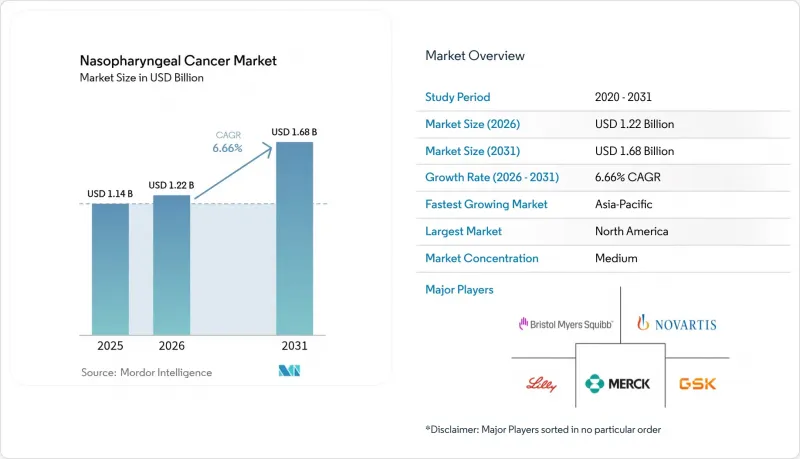
이 보고서는 치료법(화학요법, 표적 치료, 면역 요법, 방사선 요법, 기타 치료법), 최종사용자(병원 및 전문 클리닉, 외래 수술 센터, 기타 최종사용자), 연령대(성인, 소아, 노인), 지역(북미, 유럽, 아시아태평양, 중동 및 아프리카, 남미)별로 분류되어 있습니다. 시장 전망은 금액(달러) 기준으로 제시되어 있습니다.
전 세계 비인두암 시장의 동향 및 인사이트
PD-1/PD-L1 체크포인트 억제제의 획기적인 결과
트리파리맙 및 펜프리맙과 같은 PD-1 항체는 백금 제제 기반 화학요법과 병용함으로써 무재발 생존 기간(PFS)을 임상적으로 유의미하게 연장하는 것으로 나타났으며, 재발 또는 전이성 질환에 대한 1차 치료의 표준으로 부상하고 있음이 입증되었습니다. JUPITER-02 임상시험의 3상 결과에 따르면 트리파리맙과 화학요법을 병용한 군의 PFS 중앙값은 21.4개월이었던 반면, 위약과 화학요법을 병용한 군에서는 8.2개월이었습니다. 그 후, FDA는 펜프리마브에 대해 획기적 치료제(Breakthrough Designation), 희귀질환 치료제(Orphan Drug Designation), 신속 심사(Fast Track Designation)를 부여했으며, 그 결과 2025년 4월 승인을 받아 개발 기간을 약 18개월 단축했습니다. 모델 분석에 따르면 진행 지연은 누적 입원 비용을 절감하고 질 조정 생존 연수(QALY)를 향상시키는 것으로 나타났으며, 이로 인해 면역요법이 널리 보급된 시장에서 보험사의 면역요법 보험 적용 의지가 높아지고 있습니다. 분자 수준의 연구 결과에 따르면 EBV에 기인한 바이러스 항원이 고도로 염증화된 종양 미세환경을 촉진하고 있으며, 이로 인해 비인두 종양은 본질적으로 PD-1 억제에 민감한 것으로 밝혀졌습니다. 이러한 패러다임의 변화로 인해 면역요법은 장기적인 질병 제어 전략의 중심에 자리 잡게 되었으며, 차세대 체크포인트 조절제 개발 기업 간에 치열한 경쟁이 벌어지고 있습니다.
유행 지역인 동아시아 및 동남아시아의 환자 수 증가
전 세계 환자 수는 2020년 13만 3,354건에서 2040년까지 17만 9,476건으로 증가할 것으로 예측되며, 동아시아는 전 세계 인구의 불과 5분의 1을 차지함에도 불구하고 그 부담의 70%를 떠안게 될 것으로 보입니다. 광둥성의 광둥어를 사용하는 지역 사회에서는 염장 생선 섭취나 가족내 집단 발병과 같은 유전적 요인과 환경적 요인의 상호 작용으로 인해 발병률이 서구 평균의 50-100배에 달하고 있습니다. 도시화로 인해 진단 접근성이 개선되고, EBV DNA 분석을 이용한 정부 지원 선별 검사가 촉진된 결과, 지침에 따른 치료를 받는 환자층이 확대되고 있습니다. 다국적 종양학 기업은 이러한 집중된 환자 집단을 포착하기 위해 아시아에 본사를 둔 주요 임상 시험을 확대하고 있으며, 중국 및 아세안(ASEAN) 규제 당국에 대한 신청 서류 제출을 가속화하고 있습니다. 이와 동시에, 현지 계약 개발 기관(CDO)이 생물제제의 제조 효율을 높임으로써 단가를 낮추고, 저소득층의 접근성을 확대하고 있습니다.
면역종양학 병용 요법의 높은 비용
백금 기반 이중 요법에 PD-1 항체를 추가하면 말레이시아 환자 1인당 약물 치료비는 7만 8,860달러에 달해 기존 치료법에 비해 약 6배 더 비싸집니다. QALY(질 조정 생존년)당 1만 5,103달러라는 증분 비용-효과 비율은 일부 아세안 국가 경제의 지불 능력 한도를 초과하여, 공공 부문과 민간 부문 간 치료 접근성에 격차가 발생하고 있습니다. 제약사들은 단계적 가격 책정 제도 도입을 시도하고 있지만, 국제적인 참조 가격 제도와 병행 수입으로 인해 그 유연성이 제한받고 있습니다. 자선 파트너십 및 국내 바이오시밀러 개발을 통해 향후 고가의 약가가 미치는 충격이 완화될 가능성은 있으나, 저소득 지역의 단기 수요는 임상적 잠재력을 밑돌 것으로 예상되며, 이는 전 세계 비인두암 시장의 성장 궤도를 둔화시키는 요인이 될 것입니다.
부문 분석
면역요법의 등장으로 오랫동안 확고히 자리 잡았던 화학요법의 우위는 흔들리고 있지만, 2025년에도 화학요법은 여전히 비인두암 시장에서 가장 큰 점유율(44.25%)을 차지하고 있었습니다. 현재, 백금 제제를 기반으로 한 치료에 PD-1 억제제를 병용할 경우, 전체 생존 기간의 중앙값은 33개월을 초과합니다. 이는 화학요법 단독의 12-15개월이라는 기준치를 크게 상회하는 수치이며, 면역요법 부문의 연평균 성장률(CAGR) 7.48%를 견인하고 있습니다. 조기 치료 단계에서의 사용이 치료 지침의 표준이 됨에 따라 비인두암 시장내 면역요법 시장 규모는 절대값 기준으로 확대될 것으로 예상됩니다. 표적 치료는 여전히 규모는 작지만 전략적으로 매우 중요한 부문이며, EGFR 억제제나 항혈관신생제의 병용은 EBV에 기인한 분자 프로파일과 부합하므로, 향후 병용 요법의 승인으로 이어질 가능성이 있습니다.
II-III기 질환에 대한 근치적 효능을 고려할 때, 방사선 치료에 대한 수요는 계속 존재할 것입니다. IMRT(강도 변조 방사선 치료)는 5년 전체 생존율 86.5%를 달성하여, 기존의 2D 기술을 능가하는 성과를 보이고 있습니다. AI를 활용한 자동 윤곽 그리기 및 적응형 치료 계획을 통해 독성과 자원 부담을 줄임으로써 방사선 치료의 경쟁력이 유지되고 있습니다. 실험 단계에 있는 알파선 방출체를 이용한 치료법은 아직 초기 단계이긴 하지만, 동위원소 공급망이 안정화되고 후기 임상시험의 근거가 축적되면 획기적인 가능성을 지닐 것으로 보이며, 보다 광범위한 비인두암 시장에서 미래가 유망한 ‘와일드카드’로서의 입지를 확보할 것으로 기대됩니다.
지역별 분석
북미는 비인두암 발생률이 10만 명당 1명 미만임에도 불구하고 2025년 매출의 41.20%를 차지했습니다. 이는 고가의 생물제제의 가격 책정과 고액 약제비를 흡수하는 보험 제도를 반영한 것입니다. 탄탄한 임상시험 인프라 덕분에 임상 시험 중인 병용 요법의 조기 도입이 지원되고 있지만, 환자 수의 증가세가 제한적이어서 신흥 아시아 국가들에 비해 해당 지역의 연평균 성장률(CAGR)은 완만합니다.
아시아태평양은 판매량과 성장 모멘텀 모두를 주도하며, 41.20%라는 동일한 점유율을 유지하는 동시에 전 지역에서 가장 높은 7.86%의 연평균 성장률(CAGR)을 기록하고 있습니다. 중국, 홍콩, 싱가포르, 말레이시아의 비인두암 시장 규모는 보험 적용 범위 확대와 수입품보다 훨씬 저렴한 국내 PD-1 억제제의 승인을 따라 확대되고 있습니다. 정부가 지원하는 EBV DNA 선별 검사를 통해 치료 대상 환자층이 더욱 확대되었으며, 현지 유전자 프로파일에 적합한 치료 파이프라인이 확립되고 있습니다.
유럽은 성숙한 시장이지만 성장 속도는 완만하며, 국민건강보험 제도를 통한 안정적인 접근성과 다기관 공동 임상시험에 대한 적극적인 참여가 특징입니다. 가격·수량 협정에 따라 생물제제에 대한 지출은 억제되고 있지만, 환자에 대한 공평한 접근성은 확보되어 있습니다. 중동 및 아프리카의 비인두암 시장은 여전히 초기 단계에 있지만, 암 의료 인프라 구축이 가속화되고 질병에 대한 인식이 높아지고 있으며, 방사선 치료 수용 능력이 향상된다면 두 자릿수 성장이 예상되는 분야의 기반이 마련되고 있습니다.
기타 혜택:
- 엑셀 형식의 시장 예측(ME) 시트
- 3개월간의 애널리스트 지원
자주 묻는 질문
목차
제1장 서론
제2장 조사 방법
제3장 개요
제4장 시장 구도
제5장 시장 규모와 성장 예측
제6장 경쟁 구도
제7장 시장 기회와 향후 전망
KSA 26.09.02According to Mordor Intelligence, the nasopharyngeal cancer market size is expected to grow from USD 1.14 billion in 2025 to USD 1.22 billion in 2026 and is forecast to reach USD 1.68 billion by 2031 at 6.66% CAGR over 2026-2031.
This report is Segmented by Therapy (Chemotherapy, Targeted Therapy, Immunotherapy, Radiation Therapy, Other Therapies), End-User (Hospitals and Specialty Clinics, Ambulatory Surgery Centres, Other End-Users), Age Group (Adult, Pediatric, Geriatric), and Geography (North America, Europe, Asia-Pacific, Middle East and Africa, South America). The Market Forecasts are Provided in Terms of Value (USD).
Global Nasopharyngeal Cancer Market Trends and Insights
Breakthrough Results of PD-1/PD-L1 Checkpoint Inhibitors
PD-1 antibodies such as toripalimab and penpulimab have produced clinically meaningful extensions in progression-free survival when combined with platinum-based chemotherapy, underscoring their emergence as first-line standards for recurrent or metastatic disease. Phase III evidence documented median PFS of 21.4 months for toripalimab-chemotherapy versus 8.2 months for placebo-chemotherapy in the JUPITER-02 study. The FDA then granted penpulimab breakthrough, orphan, and fast-track statuses, culminating in its April 2025 approval that shortened development timelines by nearly 18 months . Modelling shows that delayed progression lowers cumulative hospitalization spend and raises quality-adjusted life years, reinforcing payer willingness to reimburse immunotherapy in endemic markets. Molecular insights reveal that EBV-driven viral antigens promote a highly inflamed tumor microenvironment, making nasopharyngeal tumors intrinsically sensitive to PD-1 blockade. The resulting paradigm shift places immunotherapy at the center of long-term disease control strategies and injects competitive urgency among developers of next-generation checkpoint modulators.
Rising Incidence in Endemic East & South-East Asia
Global case counts are projected to climb from 133,354 in 2020 to 179,476 by 2040, with Eastern Asia expected to carry 70% of that burden despite comprising only one-fifth of the world's population. Cantonese communities in Guangdong Province post incidence rates 50-100 times higher than Western averages because of gene-environment interactions that include salted-fish consumption and family clustering. Urbanization has improved diagnostic access and stimulated government-funded screening using EBV DNA assays, thereby enlarging the identified patient pool entering guideline-directed therapy. Multinational oncology sponsors are scaling Asia-based pivotal trials to capture these concentrated patient cohorts, accelerating dossier submissions to Chinese and ASEAN regulators. In parallel, local contract-development organizations streamline biologics manufacturing, driving down unit prices and broadening access for lower-income segments.
High Cost of Immuno-Oncology Combinations
Adding PD-1 antibodies to platinum doublets lifts drug-treatment invoices to USD 78,860 per Malaysian patient, roughly six-fold above conventional regimens. The incremental cost-effectiveness ratio of USD 15,103 per QALY exceeds affordability thresholds in several ASEAN economies, leading to unequal access between public and private sectors. Manufacturers are experimenting with tiered-pricing schemes, but international reference pricing and parallel importation constrain flexibility. Philanthropic partnerships and domestic biosimilar development may alleviate sticker-shock over time, yet near-term demand will underperform clinical potential in low-income geographies, tempering the global nasopharyngeal cancer market trajectory.
Other drivers and restraints analyzed in the detailed report include:
- Regulatory Orphan-Drug & Fast-Track Incentives
- Plasma EBV-DNA Guided Precision Medicine Protocols
- Limited Radiotherapy Infrastructure in Low-Income Nations
For complete list of drivers and restraints, kindly check the Table Of Contents.
Segment Analysis
Immunotherapy's advent has disrupted entrenched chemotherapy primacy, yet chemotherapy still held the largest 44.25% share of the nasopharyngeal cancer market in 2025. Median overall survival now surpasses 33 months when PD-1 inhibitors are layered onto platinum-based backbones, dwarfing the 12-15-month benchmarks of chemotherapy alone and fuelling a 7.48% CAGR for the immunotherapy segment. The nasopharyngeal cancer market size for immunotherapy applications is anticipated to widen in absolute terms as earlier-line use becomes guideline standard. Targeted therapy remains a smaller but strategically pivotal segment; integration of EGFR inhibitors and anti-angiogenic agents aligns with the EBV-driven molecular landscape and may yield future combination approvals.
Demand for radiation therapy persists given its curative efficacy in stage II-III disease; IMRT achieves 5-year overall survival of 86.5%, outperforming older two-dimensional techniques. AI-enabled auto-contouring and adaptive planning keep radiation competitive by reducing toxicity and resource intensity. Experimental a-emitter constructs, while nascent, carry disruptive potential once isotope supply chains stabilize and late-phase evidence matures, positioning them as prospective wildcards within the broader nasopharyngeal cancer market.
Complete Report Scope:
- By Therapy
- Chemotherapy
- Targeted Therapy
- Immunotherapy
- Radiation Therapy
- Other Therapies
- By End-User
- Hospitals and Spcialty Clinics
- Ambulatory Surgery Centres
- Other End-Users
- By Age Group
- Adult
- Pediatric
- Geriatric
- By Geography
- North America
- United States
- Canada
- Mexico
- Europe
- Germany
- United Kingdom
- France
- Italy
- Spain
- Rest of Europe
- Asia-Pacific
- China
- Japan
- India
- Australia
- South Korea
- Rest of Asia-Pacific
- Middle East and Africa
- GCC
- South Africa
- Rest of Middle East and Africa
- South America
- Brazil
- Argentina
- Rest of South America
- North America
Geography Analysis
North America captured 41.20% of 2025 revenues even though nasopharyngeal incidence remains below 1 per 100,000, a reflection of premium biologic pricing and insurance mechanisms that absorb high drug costs. Robust clinical-trial infrastructure sustains early adoption of investigational combinations, but limited patient growth moderates regional CAGR compared with emerging Asia.
Asia-Pacific anchors both volume and momentum, holding a matching 41.20% share while propelling a 7.86% CAGR that leads all regions. The nasopharyngeal cancer market size in China, Hong Kong, Singapore, and Malaysia rises in tandem with reimbursement expansion and domestic PD-1 approvals that price well below imported analogues. Government-backed EBV DNA screening further enlarges the treated population and solidifies therapy pipelines adapted to local genetic profiles.
Europe maintains a mature but slower-growing landscape characterized by consistent access via national health systems and active participation in multi-center trials. Price-volume agreements constrain biologic spending yet secure equitable patient access. The nasopharyngeal cancer market in Middle East & Africa remains nascent; however, accelerating oncology infrastructure and heightened disease awareness lay the foundation for double-digit growth pockets once radiotherapy capacity improves.
- Merck
- Bristol-Myers Squibb
- Novartis
- Roche
- Pfizer
- AstraZeneca
- GlaxoSmithKline
- Sanofi
- Eli Lilly and Company
- Innovent Biologics
- Junshi Biosciences
- BeiGene
- Hutchmed
- Theravectys
- Cyclacel Pharma
- Biocon
- CSPC ZhongQi
- Qilu Pharma
- ONO Pharma
- Astellas Pharma
Additional Benefits:
- The market estimate (ME) sheet in Excel format
- 3 months of analyst support
TABLE OF CONTENTS
1 Introduction
- 1.1 Study Assumptions & Market Definition
- 1.2 Scope of the Study
2 Research Methodology
3 Executive Summary
4 Market Landscape
- 4.1 Market Overview
- 4.2 Market Drivers
- 4.2.1 Rising incidence in endemic East & South-East Asia
- 4.2.2 Regulatory orphan-drug & fast-track incentives
- 4.2.3 Break-through results of PD-1/PD-L1 checkpoint inhibitors
- 4.2.4 Plasma EBV-DNA guided precision medicine protocols
- 4.2.5 AI-enabled IMRT planning & automated MRI segmentation
- 4.2.6 Accelerating EBV/HPV prophylactic vaccine pipelines
- 4.3 Market Restraints
- 4.3.1 High cost of immuno-oncology combinations
- 4.3.2 Limited radiotherapy infrastructure in low-income nations
- 4.3.3 Supply constraints in a-emitter radio-isotopes
- 4.3.4 Lack of harmonised EBV-DNA testing standards
- 4.4 Value / Supply-Chain Analysis
- 4.5 Regulatory Landscape
- 4.6 Technological Outlook
- 4.7 Porters Five Forces Analysis
- 4.7.1 Threat of New Entrants
- 4.7.2 Bargaining Power of Buyers
- 4.7.3 Bargaining Power of Suppliers
- 4.7.4 Threat of Substitutes
- 4.7.5 Intensity of Competitive Rivalry
5 Market Size & Growth Forecasts (Value, USD)
- 5.1 By Therapy
- 5.1.1 Chemotherapy
- 5.1.2 Targeted Therapy
- 5.1.3 Immunotherapy
- 5.1.4 Radiation Therapy
- 5.1.5 Other Therapies
- 5.2 By End-User
- 5.2.1 Hospitals and Spcialty Clinics
- 5.2.2 Ambulatory Surgery Centres
- 5.2.3 Other End-Users
- 5.3 By Age Group
- 5.3.1 Adult
- 5.3.2 Pediatric
- 5.3.3 Geriatric
- 5.4 By Geography
- 5.4.1 North America
- 5.4.1.1 United States
- 5.4.1.2 Canada
- 5.4.1.3 Mexico
- 5.4.2 Europe
- 5.4.2.1 Germany
- 5.4.2.2 United Kingdom
- 5.4.2.3 France
- 5.4.2.4 Italy
- 5.4.2.5 Spain
- 5.4.2.6 Rest of Europe
- 5.4.3 Asia-Pacific
- 5.4.3.1 China
- 5.4.3.2 Japan
- 5.4.3.3 India
- 5.4.3.4 Australia
- 5.4.3.5 South Korea
- 5.4.3.6 Rest of Asia-Pacific
- 5.4.4 Middle East and Africa
- 5.4.4.1 GCC
- 5.4.4.2 South Africa
- 5.4.4.3 Rest of Middle East and Africa
- 5.4.5 South America
- 5.4.5.1 Brazil
- 5.4.5.2 Argentina
- 5.4.5.3 Rest of South America
- 5.4.1 North America
6 Competitive Landscape
- 6.1 Market Concentration
- 6.2 Market Share Analysis
- 6.3 Company Profiles (includes Global-level Overview, Market-level Overview, Core Segments, Financials as available, Strategic Information, Market Rank/Share, Products & Services, Recent Developments)
- 6.3.1 Merck & Co.
- 6.3.2 Bristol Myers Squibb
- 6.3.3 Novartis
- 6.3.4 F. Hoffmann-La Roche
- 6.3.5 Pfizer
- 6.3.6 AstraZeneca
- 6.3.7 GlaxoSmithKline
- 6.3.8 Sanofi
- 6.3.9 Eli Lilly
- 6.3.10 Innovent Biologics
- 6.3.11 Junshi Biosciences
- 6.3.12 BeiGene
- 6.3.13 Hutchmed
- 6.3.14 Theravectys
- 6.3.15 Cyclacel Pharma
- 6.3.16 Biocon
- 6.3.17 CSPC ZhongQi
- 6.3.18 Qilu Pharma
- 6.3.19 ONO Pharma
- 6.3.20 Astellas Pharma
7 Market Opportunities & Future Outlook
- 7.1 White-space & Unmet-need Assessment