|
시장보고서
상품코드
2120315
사료용 인산염 : 시장 점유율 분석, 업계 동향과 통계, 성장 예측(2026-2031년)Feed Phosphate - Market Share Analysis, Industry Trends & Statistics, Growth Forecasts (2026 - 2031) |
||||||
 Mordor Intelligence
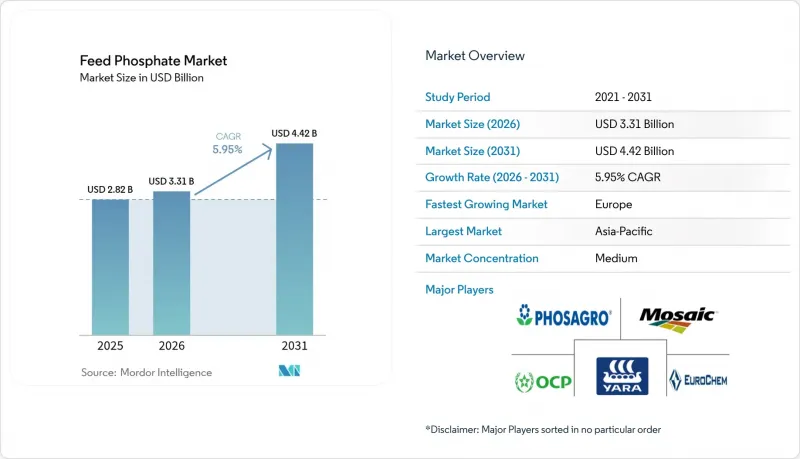
Mordor Intelligence에 따르면 사료용 인산염 시장 규모는 2025년 28억 2,000만 달러, 2026년 33억 1,000만 달러에서 2031년까지 44억 2,000만 달러로 확대하며, 2026-2031년에 CAGR 5.95%를 기록할 것으로 예측됩니다.
이 보고서는 사료 유형(인산일칼슘, 인산이칼슘, 인산일·이칼슘,인산삼칼슘, 불소 제거 인산염, 기타 사료), 가축 유형(가금류, 돼지, 소, 수산동물, 기타 가축) 및 지역(북미, 유럽, 아시아태평양, 기타)별로 분류되어 있습니다. 시장 전망은 금액(달러) 기준으로 제시되어 있습니다.
전 세계 사료용 인산염 시장의 동향 및 인사이트
육류 및 유제품 단백질에 대한 수요 증가
향후 10년 동안 육류의 총 소비량은 47.9메트릭톤 증가할 것으로 예측됩니다. 2034년까지 1인당 연간 소비량은 1인당 0.9kg(소매용 식용 중량 기준) 증가할 것으로 예상됩니다. 고소득 국가에서는 동물 복지, 환경 영향, 건강에 대한 우려가 소비자 행동에 영향을 미치고 있으며, 경우에 따라 1인당 육류 소비량이 정체되는 반면, 아시아태평양과 남미에서는 가금류와 돼지고기가 소비 증가를 주도하고 있습니다. 중국과 인도의 도시화로 인해 가처분 소득은 동물성 단백질 중심의 식생활로 이동하고 있으며, 이를 위해서는 육계, 비육돈, 고생산성 젖소를 위한 인산 강화 사료가 필요합니다. 브라질과 아르헨티나는 수출 시장 공급을 목적으로 집약적 사육을 확대하여 가격을 안정시키는 한편, 현물 시장의 공급량을 부족하게 만드는 다년간의 인산염 계약을 체결했습니다. 정밀한 툴을 통해 배합 비율이 감소하고 있음에도 불구하고 뼈의 강도를 해치지 않으면서 최소 인 함량 이하로 떨어질 수는 없기 때문에 수요는 여전히 견고합니다. 그 결과, 사료용 인산염 시장은 효율이 향상되고 있음에도 불구하고 계속해서 ‘단백질 전환’ 추세를 따르고 있습니다.
산업형 축산 사업의 확대
2025년, 미국의 집약형 축산 시설에서는 920만 마리의 소, 7,300만 마리의 돼지, 18억 마리의 육계가 사육되었으며, 안정적인 성장과 추적성을 보장하는 고순도 인산염에 대한 수요가 집중되었습니다. 유럽의 농장들도 규모를 확대함에 따라 균일한 입자 크기와 낮은 중금속 함량이 인증된 제품을 생산할 수 있는 공급업체에게 유리한 상황이 조성되었습니다. 2025년, 중국의 주요 돼지고기 생산자들은 생산량의 대부분을 장악했으며, 그 점유율은 1년 만에 4포인트 상승했습니다. 또한 이들 기업은 전용 인산염 블렌딩 라인에 공동 투자하여 현지 제분 업체들을 시장에서 배제하고 있습니다. 가축 사육 두수가 증가함에 따라 분뇨 관리에 대한 감독이 엄격해지면서, 통합형 생산자들은 배설량을 줄일 수 있는 생체 이용 가능한 인산염을 선호하는 추세입니다. 대형 통합 생산자들이 체결한 대규모 계약은 독립형 혼합 업체들의 이익률을 압박하고 있지만, 한편으로는 수요 전망을 명확히 하여 상류 공정에서의 새로운 소성로 투자를 촉진하고 있습니다.
인 유출에 대한 엄격한 규제
체서피크 만의 ‘총 최대 일일 부하량(TMDL)’은 연간 인 배출량을 830만 킬로그램으로 제한하고, 위반을 반복할 경우 최대 50만 달러의 벌금을 부과하도록 규정하고 있으며, 생산자들은 사료내 인 함량을 12%에서 18%까지 줄여야 합니다. 이 규제로 인해 규정 준수 기준을 충족하기 위해 사료 배합 및 분뇨 관리 관행에 큰 변화가 일어났습니다. 발트해 지역에서는 배출 제한으로 인해 가축 분뇨 처리 기술과 정밀 사료 급여 기법이 발전하여 영양소의 이용 효율이 향상되었습니다. 규제 준수에 드는 비용으로 인해 가격 변동에 민감한 시장에서는 이익률이 압박받고 있으며, 생산자들은 비용 대비 효과가 높은 해결책을 채택할 수밖에 없는 상황입니다. 피타아제 사용이나 AI 투여는 인의 소화율을 높이고 폐기물을 줄임으로써 일정한 개선을 가져오고 있지만, 규제 대상 유역의 인산염 총량은 정체되거나 감소하는 추세를 보이고 있으며, 사료용 인산염 시장 전체의 성장을 억제하고 있습니다.
부문 분석
2025년, 인산이칼슘은 사료용 인산염 시장 점유율의 41.5%를 차지했습니다. 이는 배합을 단순화하고 산란용 사료에서 달걀 껍질 강도를 지원하는 균형 잡힌 칼슘 대 인 비율을 반영한 것입니다. 산란계는 비용 예측 가능성을 중시하는 안정적이고 가격에 민감한 고객층이므로, 이에 따라 인산이칼슘 공급업체는 사료용 인산염 시장의 베이스로드 수요를 지원하는 연간 계약을 확보할 수 있습니다. 통합형 제조업체들은 이 제품의 유동성이 뛰어난 과립을 높이 평가하고 있습니다. 이를 통해 처리 용량이 큰 분쇄기에서 빈브릿지 현상이 억제되고, 혼합의 균일성이 향상됩니다. 수직 통합형 대기업은 광석 소유권을 활용하여 경쟁력 있는 납품 가격을 제공함으로써 지역 블렌딩 업체들을 견제하고 있습니다. 다만, 중국과 인도의 규제 강화에 대응하기 위해 인산이칼슘 생산 라인에서도 불소 함량 저감을 위한 개량이 진행되고 있습니다.
인산일칼슘은 가장 빠르게 성장하는 사료용 인산염의 일종으로, 연평균 성장률(CAGR) 6.1%를 기록하며 2031년까지 사료용 인산염 시장 점유율을 확대할 것으로 예상됩니다. 90%를 넘는 생체 이용률 덕분에 사료 배합 업체들은 총 인 함량을 줄이면서도 성능 목표를 달성할 수 있으며, 이는 영양소 배출에 세금이 부과되는 지역에서 강력한 가치 제안을 제공합니다. 고정밀 센서가 이러한 이점을 정량화하여 공장장용 대시보드에 실시간으로 표시되는 최적화를 가능하게 하고 있습니다. 모로코와 사우디아라비아에서는 공급량이 증가하고 있으며, 이 지역에서는 새로 설립된 산법 공장이 계절적 수요 변동에 맞춰 일칼슘급과 이칼슘급을 전환할 수 있습니다.
지역별 분석
2025년, 아시아태평양은 사료용 인산염 시장 점유율의 34.2%를 차지했습니다. 이는 중국의 2,800만 메트릭톤 규모의 가금류 부문과 인도의 급성장하는 수산양식 생산량이 견인한 결과입니다. 중국에서는 피타제 첨가가 의무화되어 있지만, 저불소 요건을 충족하기 위해 여전히 고품질 인산염을 수입하고 있으며, 2025년에는 모로코와 사우디아라비아로부터의 공급량이 증가했습니다. 동남아시아의 새우 양식 급성장에 따라 소화율이 90%로 입증된 모노칼슘인산에 대한 수요가 증가하고 있습니다. 이 사양은 해당 지역의 혼합 업체들이 아직 충족하지 못하고 있으며, 수입 의존도가 높아지고 있습니다. 일본과 한국은 순환형 인(P) 시범 사업의 유망한 시험장이 되고 있으며, 자본 비용을 충당해 주는 정부의 보조금 덕분에 재활용 사료용 인산염 시장에 신규 진입자가 증가하고 있습니다.
유럽에서는 ‘농장에서 식탁까지(Farm-to-Fork) 전략’과 조달 결정에 영향을 미치는 탄소 가격 상승에 힘입어, 2031년까지 연평균 성장률(CAGR)이 5.2%로 가장 빠른 성장이 예상됩니다. 독일, 프랑스, 네덜란드는 불소 함량이 0.18% 미만인 프리미엄 등급의 수요를 주도하고 있는 반면, 폴란드와 스페인은 수출 시장을 겨냥한 가금류 생산 확대를 통해 판매량 성장을 이끌고 있습니다. 영국에서는 영양염류 부하 저감과 관련된 생태계 서비스에 대한 지불을 허용하는 정책이 도입되어, 이를 통해 정밀한 투여가 촉진되고, 상세한 생체 이용률 자료를 보유한 공급업체들이 혜택을 보고 있습니다.
북미, 남미, 중동 및 아프리카의 수요 전망은 엇갈리고 있습니다. 미국에서는 체서피크만이나 캘리포니아주 등 규제 대상 유역에서 소비량이 소폭 감소하고 있지만, 중서부 지역의 돼지 및 육계 생산 확대에 힘입어 전국적으로는 안정적인 수준을 유지하고 있습니다. 브라질에서 아시아로의 수출로 인해 가금류 및 돼지 생산자들은 환율 변동에도 불구하고 인산염 수입을 확보해야 하는 상황에 놓여 있으며, 새로운 곤충 단백질 관련 합작 투자가 프리미엄 제품 라인에서 부분적인 대체를 약속하고 있습니다. 사우디아라비아의 Ma'aden사는 라스 알 카일에서 연간 수십만 메트릭톤을 출하하고 있으며, 이집트와 요르단 시장에서 입지를 강화하기 위해 대폭적인 할인을 제공하고 있습니다. 사하라 이남 아프리카에서는 나이지리아와 남아프리카공화국이 낮은 수준에서 출하량을 늘리고 있지만, 환율 변동으로 인해 통합 생산 업체들은 2-3개월 분량의 재고를 늘릴 수밖에 없어 운전자금이 증가하고 있습니다.
기타 혜택:
- 엑셀 형식의 시장 예측(ME) 시트
- 3개월간의 애널리스트 지원
자주 묻는 질문
목차
제1장 서론
제2장 조사 방법
제3장 개요
제4장 시장 구도
제5장 시장 규모와 성장 예측
제6장 경쟁 구도
제7장 시장 기회와 향후 전망
KSA 26.09.02According to Mordor Intelligence, the feed phosphate market size is projected to expand from USD 2.82 billion in 2025 and USD 3.31 billion in 2026 to USD 4.42 billion by 2031, registering a 5.95% CAGR between 2026 and 2031.
This report is Segmented by Feed Type (Monocalcium Phosphate, Dicalcium Phosphate, Mono-Dicalcium Phosphate, Tricalcium Phosphate, Defluorinated Phosphate, and Other Feed Types), by Livestock Type (Poultry, Swine, Cattle, Aquatic Animals, and Other Livestock Types), and by Geography (North America, Europe, Asia-Pacific, and More). The Market Forecasts are Provided in Terms of Value (USD).
Global Feed Phosphate Market Trends and Insights
Rising Demand for Meat and Dairy Proteins
Total meat consumption is projected to grow by 47.9 metric tons over the next decade. Annual per capita consumption is projected to rise by 0.9 kg per capita per year (edible retail weight equivalent) by 2034. In high-income countries, concerns about animal welfare, environmental impact, and health are influencing consumer behavior, leading to stagnation in per capita meat consumption in some cases, with poultry and pork driving gains in Asia-Pacific and South America. Urbanization in China and India pushes disposable incomes toward animal-protein diets that require phosphate-fortified rations for broilers, finishers, and high-yielding dairy cows. Brazil and Argentina expanded confined feeding to supply export markets, signing multi-year phosphate contracts that stabilize prices yet tighten spot availability. Demand remains resilient because minimum phosphorus thresholds cannot be breached without compromising bone integrity, even as precision tools shave inclusion rates. Consequently, the feed phosphate market continues to track the protein transition despite efficiency gains.
Expansion of Industrial Livestock Operations
Concentrated animal feeding operations in the United States housed 9.2 million cattle, 73 million hogs, and 1.8 billion broilers in 2025, channeling demand toward high-purity phosphates that ensure consistent growth and traceability. European farms with grew, a scale that rewards suppliers capable of producing uniform particle size and certified low heavy metals. China's top pork producers controlled significant output in 2025, up four points in one year, and co-invested in dedicated phosphate blending lines that crowd out local mills. Larger herds intensify scrutiny of manure management, pushing integrators to prefer bioavailable phosphates that reduce excretion loads. Volume contracts signed by mega-integrators also compress margins for independent blenders, yet they provide demand visibility that encourages upstream investment in new kilns.
Stringent Regulations on Phosphorus Run-Off
The Chesapeake Bay Total Maximum Daily Load limits annual phosphorus discharge to 8.3 million kilograms and imposes fines of up to USD 500,000 for repeat violations, requiring producers to reduce dietary phosphorus by 12% to 18%. This regulation has driven significant changes in feed formulations and manure management practices to meet compliance standards. In the Baltic Sea region, a discharge limit has driven advancements in manure treatment technologies and precision feeding practices, enabling more efficient nutrient utilization. Compliance costs have tightened profit margins in price-sensitive markets, compelling producers to adopt cost-effective solutions. While the use of phytase and AI dosing provides some relief by improving phosphorus digestibility and reducing waste, overall phosphate volumes in regulated watersheds remain stable or decline, tempering growth in the broader feed phosphate market.
Other drivers and restraints analyzed in the detailed report include:
- Insect-Protein Co-Feeding Improving Phosphate Utilization
- Phosphorus-Recycling Mandates Accelerating Circular Feed Phosphates
- Carbon-Pricing Schemes Inflating High-Energy Thermal Defluorination Costs
For complete list of drivers and restraints, kindly check the Table Of Contents.
Segment Analysis
Dicalcium phosphate captured 41.5% of the feed phosphate market share in 2025, reflecting its balanced calcium-to-phosphorus ratio that simplifies formulation and supports eggshell strength in layer diets. Layers represent a steady, price-sensitive customer base that values cost predictability, enabling dicalcium suppliers to secure annual contracts that underpin base-load demand in the feed phosphate market. Integrators appreciate the product's free-flowing granules, which reduce bin bridging and improve mixing uniformity in high-throughput mills. Vertical-integrated majors leverage rock ownership to offer competitive delivered pricing, keeping regional blenders at bay. Nonetheless, even dicalcium lines are upgrading to lower fluorine profiles to meet tightening limits in China and India.
Monocalcium phosphate is the fastest-growing feed type, projected to log a 6.1% CAGR and raise its share of the feed phosphate market by 2031. Its 90%-plus bioavailability lets formulators cut total phosphorus while still hitting performance targets, a powerful value proposition in regions that tax nutrient discharge. Precision sensors quantify this advantage, enabling real-time optimization that lights up on dashboards for mill managers. Supply is ramping in Morocco and Saudi Arabia, where new acid-route plants can swing between mono- and dicalcium grades to match seasonal pulls.
Complete Report Scope:
- By Feed Type
- Monocalcium Phosphate
- Dicalcium Phosphate
- Mono-Dicalcium Phosphate
- Tricalcium Phosphate
- Defluorinated Phosphate
- Other Feed Types
- By Livestock Type
- Poultry
- Swine
- Cattle
- Aquatic Animals
- Other Livestock Types
- By Geography
- North America
- United States
- Canada
- Mexico
- Rest of North America
- Europe
- Germany
- United Kingdom
- France
- Russia
- Spain
- Rest of Europe
- Asia-Pacific
- India
- China
- Japan
- Australia
- Rest of Asia-Pacific
- South America
- Brazil
- Argentina
- Rest of South America
- Middle East
- Saudi Arabia
- United Arab Emirates
- Rest of Middle East
- Africa
- South Africa
- Nigeria
- Rest of Africa
- North America
Geography Analysis
Asia-Pacific generated 34.2% of the feed phosphate market share in 2025, anchored by China's 28 million metric tons poultry sector and India's accelerating aquaculture output. China mandates phytase inclusion yet still imports premium phosphates to meet low-fluorine demands, lifting Moroccan and Saudi deliveries in 2025. Southeast Asia's shrimp boom has shifted preference toward monocalcium grades with verified 90% digestibility, a specification that regional blenders cannot yet match, leading to increased reliance on imports. Japan and South Korea provide fertile test beds for circular-phosphorus pilots, and government subsidies covering capital costs draw new entrants into the recycled feed phosphate market.
Europe is anticipated to witness the fastest growth, with a 5.2% CAGR through 2031, supported by the Farm to Fork Strategy and increasing carbon prices shaping procurement decisions. Germany, France, and the Netherlands dominate demand for premium grades with fluorine content below 0.18%, while Poland and Spain drive volume growth through poultry expansion aimed at export markets. In the United Kingdom, policies now offer payments for ecosystem services linked to reduced nutrient loading, promoting precision dosing and benefiting suppliers with detailed bioavailability dossiers.
The demand in North America, South America, the Middle East, and Africa presents a mixed outlook. United States consumption edges lower in regulated watersheds such as Chesapeake Bay and California, but stays stable nationally due to hog and broiler growth in the Midwest. Brazil's exports to Asia push poultry and swine producers to lock in phosphate imports despite currency swings, with new insect-protein joint ventures promising partial substitution in premium lines. Saudi Arabia's Ma'aden ships hundreds of thousands of metric tons annually from Ras Al Khair, offering significant discounts to strengthen its market presence in Egypt and Jordan. In sub-Saharan Africa, Nigeria and South Africa lift volume from a low base, although forex volatility forces integrators to stockpile two to three months of inventory, inflating working capital.
- OCP S.A.
- The Mosaic Company
- Public Joint-Stock Company PhosAgro
- EuroChem Group AG
- Yara International ASA
- TIMAB Industries S.A.S. (Groupe Roullier S.A.)
- Nutrien Ltd.
- J.R. Simplot Company
- ICL Group Ltd.
- Saudi Arabian Mining Company (Ma'aden)
- Innophos Holdings Inc.
- Guizhou Chia Tai Industry Co., Ltd. (Charoen Pokphand Group Co., Ltd.)
- Lomon Billions Group Co., Ltd.
- WengFu Group Co., Ltd.
- Vishnupriya Chemicals Pvt. Ltd
Additional Benefits:
- The market estimate (ME) sheet in Excel format
- 3 months of analyst support
TABLE OF CONTENTS
1 Introduction
- 1.1 Study Assumptions and Market Definition
- 1.2 Scope of the Study
2 Research Methodology
3 Executive Summary
4 Market Landscape
- 4.1 Market Overview
- 4.2 Market Drivers
- 4.2.1 Rising demand for meat and dairy proteins
- 4.2.2 Expansion of industrial livestock operations
- 4.2.3 Technological advances in precision feed processing
- 4.2.4 Insect-protein co-feeding improving phosphate utilization
- 4.2.5 Phosphorus-recycling mandates accelerating circular feed phosphates
- 4.2.6 Artificial Intelligence driven precision phosphorus dosing cutting wastage and cost
- 4.3 Market Restraints
- 4.3.1 Stringent regulations on phosphorus run-off
- 4.3.2 Volatility in phosphate-rock prices
- 4.3.3 Geo-political supply risk to Moroccan and Russian rock exports
- 4.3.4 Carbon-pricing schemes inflating high-energy thermal defluorination costs
- 4.4 Regulatory Landscape
- 4.5 Technological Outlook
- 4.6 Porter's Five Forces Analysis
- 4.6.1 Bargaining Power of Suppliers
- 4.6.2 Bargaining Power of Buyers
- 4.6.3 Threat of New Entrants
- 4.6.4 Threat of Substitute Products
- 4.6.5 Intensity of Competitive Rivalry
5 Market Size and Growth Forecasts (Value)
- 5.1 By Feed Type
- 5.1.1 Monocalcium Phosphate
- 5.1.2 Dicalcium Phosphate
- 5.1.3 Mono-Dicalcium Phosphate
- 5.1.4 Tricalcium Phosphate
- 5.1.5 Defluorinated Phosphate
- 5.1.6 Other Feed Types
- 5.2 By Livestock Type
- 5.2.1 Poultry
- 5.2.2 Swine
- 5.2.3 Cattle
- 5.2.4 Aquatic Animals
- 5.2.5 Other Livestock Types
- 5.3 By Geography
- 5.3.1 North America
- 5.3.1.1 United States
- 5.3.1.2 Canada
- 5.3.1.3 Mexico
- 5.3.1.4 Rest of North America
- 5.3.2 Europe
- 5.3.2.1 Germany
- 5.3.2.2 United Kingdom
- 5.3.2.3 France
- 5.3.2.4 Russia
- 5.3.2.5 Spain
- 5.3.2.6 Rest of Europe
- 5.3.3 Asia-Pacific
- 5.3.3.1 India
- 5.3.3.2 China
- 5.3.3.3 Japan
- 5.3.3.4 Australia
- 5.3.3.5 Rest of Asia-Pacific
- 5.3.4 South America
- 5.3.4.1 Brazil
- 5.3.4.2 Argentina
- 5.3.4.3 Rest of South America
- 5.3.5 Middle East
- 5.3.5.1 Saudi Arabia
- 5.3.5.2 United Arab Emirates
- 5.3.5.3 Rest of Middle East
- 5.3.6 Africa
- 5.3.6.1 South Africa
- 5.3.6.2 Nigeria
- 5.3.6.3 Rest of Africa
- 5.3.1 North America
6 Competitive Landscape
- 6.1 Market Concentration
- 6.2 Strategic Moves
- 6.3 Market Share Analysis
- 6.4 Company Profiles (Includes Global-Level Overview, Market-Level Overview, Core Segments, Financials as Available, Strategic Information, Market Rank/Share, Products and Services, and Recent Developments)
- 6.4.1 OCP S.A.
- 6.4.2 The Mosaic Company
- 6.4.3 Public Joint-Stock Company PhosAgro
- 6.4.4 EuroChem Group AG
- 6.4.5 Yara International ASA
- 6.4.6 TIMAB Industries S.A.S. (Groupe Roullier S.A.)
- 6.4.7 Nutrien Ltd.
- 6.4.8 J.R. Simplot Company
- 6.4.9 ICL Group Ltd.
- 6.4.10 Saudi Arabian Mining Company (Ma'aden)
- 6.4.11 Innophos Holdings Inc.
- 6.4.12 Guizhou Chia Tai Industry Co., Ltd. (Charoen Pokphand Group Co., Ltd.)
- 6.4.13 Lomon Billions Group Co., Ltd.
- 6.4.14 WengFu Group Co., Ltd.
- 6.4.15 Vishnupriya Chemicals Pvt. Ltd