

|
시장보고서
상품코드
2120317
고형암 치료제 : 시장 점유율 분석, 업계 동향과 통계, 성장 예측(2026-2031년)Solid Tumor Therapeutics - Market Share Analysis, Industry Trends & Statistics, Growth Forecasts (2026 - 2031) |
||||||
 Mordor Intelligence
Mordor Intelligence에 따르면 고형암 치료제 시장 규모는 2025년 2,072억 9,000만 달러에서 2026년에는 2,236억 5,000만 달러로 확대하며, 2026-2031년에 CAGR 7.88%로 추이하며, 2031년에는 3,268억 2,000만 달러에 달할 것으로 예측됩니다.
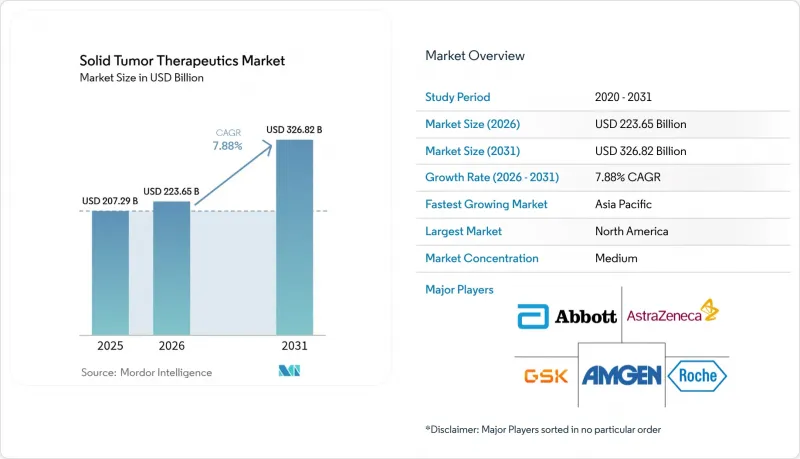
이 보고서는 암 유형(유방암, 폐암 등), 약제 유형(카보플라틴, 시스플라틴 등), 투여 경로(정맥 내, 경구, 피하, 종양 내, 기타 투여 경로) 및 지역(북미, 유럽, 아시아태평양, 중동 및 아프리카, 남미)별로 분류되어 있습니다. 시장 전망은 금액(달러) 기준으로 제시되어 있습니다.
전 세계 고형암 치료제 시장의 동향 및 인사이트
전 세계 암 발병률 및 유병률 증가
고형암 치료제 시장은 암의 부담 증가와 수요가 직접적으로 연동되어 있으며, 2050년까지 연간 3,200만 건의 신규 진단 건수에 도달할 것으로 예측됩니다. 이 중 약 85%를 고형암이 차지하고 있으며, 도시화와 생활 방식의 변화가 위험 요인을 악화시키고 있으며, 아시아태평양에서 가장 급격한 증가세가 나타나고 있습니다. 중국만으로도 전 세계 발병 건수의 30% 가까이를 차지하고 있으며, 다국적 기업은 각 성의 보험 환급 제도에 맞춰 시장 진입 계획을 수립하고 있습니다. 한편, 미국이나 서유럽에서는 인구 고령화에 따라 새로운 치료법의 적용 대상이 되는 환자층이 확대되고 있습니다. 이러한 역학적 경향을 종합해 볼 때, 고형암 치료제 시장에서 차세대 치료법의 후보가 될 환자 수가 꾸준히 증가할 것으로 확실시됩니다.
표적 치료 및 면역종양학 치료 분야의 기술적 진보
항체-약물 접합체(ADC)는 가장 역동적인 치료법으로 부상하고 있으며, 2023년 매출 100억 달러에서 2033년까지 약 390억 달러로 확대될 것으로 전망됩니다. 이는 후기 단계 ADC 개발 후보의 80%가 고형암을 대상으로 하고 있기 때문입니다. HER2 저발현 유방암에 대한 트라스투주맙 데르쿠스테칸 및 폐암에 대한 다포타맙 데르쿠스테칸과 같은 획기적인 승인 약물은 화학요법과 비교하여 50%를 넘는 무진행 생존 기간 연장을 가져오고 있습니다. PD-1 억제제와 CTLA-4 억제제, 그리고 표준 화학요법을 병용함으로써 전이성 비소세포폐암(NSCLC)의 5년 전체 생존율은 18%에 달하며, 이는 화학요법 단독의 11%를 상회하는 수치입니다. 알고리즘 기반의 신약 개발 플랫폼이 성숙해짐에 따라 각 기업은 신약 개발 기간을 단축하기 위해 AI를 활용한 제휴에 10억 달러 이상을 투자하고 있습니다. 이러한 과학적 진보로 인해 고형암 치료제 시장의 장기적인 확장에 대한 확신이 더욱 강해지고 있습니다.
암 치료제에 대한 엄격한 승인 절차
항암제의 평균 개발 기간은 여전히 10-15년에 달하며, 1상 임상시험부터 승인에 이르기까지의 실패율은 90%를 초과합니다. FDA의 2021년 가치 중심 지침에서는 능동 대조군 데이터가 요구되고 있으며, 임상시험의 복잡성이 증가하고 있습니다. 병용 요법의 경우, 종양 유형을 아우르는 다군 임상시험이 필요해져 자원 부담이 더욱 커지고 있습니다. 중국의 우선 심사 제도로 인해 승인까지 소요되는 기간은 263.5일로 단축되었으나, 신청 서류에는 여전히 광범위한 유효성 증거가 필요하며, 이로 인해 상용화가 최대 3년 지연될 가능성이 있습니다. 이러한 요인들이 복합적으로 작용하여 고형암 치료제 시장의 단기 성장 속도는 둔화되고 있습니다.
부문 분석
유방암은 2025년 매출의 25.41%를 차지하며, 고형암 치료제 시장에서 가장 큰 점유율을 유지했습니다. 트라스투주맙 델크스테칸으로 가능해진 HER2-low 분류 덕분에 치료 대상 환자군이 60% 확대되어 매출 성장이 가속화되었습니다. 2위 부문인 폐암은 3기 EGFR 변이 양성 질환에서 오시머티닙이 39.1개월의 무진행 생존 기간 중앙값을 보인 것이 호재로 작용했습니다.
전립선암은 소수 전이 사례에서 무진행 기간을 연장하는 전이 표적 치료에 힘입어, 2031년까지 10.16%라는 가장 높은 연평균 성장률(CAGR)을 기록할 것으로 예측됩니다. 대장암 프로그램에서는 완전 절제술의 평가가 진행되고 있으며, 자궁경부암의 동향은 HPV 백신 접종으로 인해 유병률 패턴이 변화함에 따라 변모하고 있습니다. 췌장암 및 신경내분비종양 분야에서 종양 치료용 전기장부터 새로운 면역조절제에 이르는 혁신으로 인해 고형암 치료제 업계 전체의 수입원이 다양화되고 있습니다.
지역별 분석
2025년에는 북미가 매출의 42.03%를 차지하며 1위를 차지했습니다. 이는 프리미엄 가격 책정, 광범위한 보험 적용, 그리고 탄탄한 임상 시험 네트워크가 신약의 급속한 보급을 지원했기 때문입니다. 종양학 클리닉의 통합이 진행되면서 판매업체의 협상력이 강화되고 있지만, 한편으로는 고가 의약품에 대한 지불 주체 측의 심사가 더욱 엄격해지고 있습니다.
유럽은 여전히 2위 지역이며, 독일, 영국, 프랑스가 유럽의약품청(EMA)의 조율된 체계 하에서 첨단 치료법의 도입을 주도하고 있습니다. 참조 가격 책정(reference pricing) 및 의료기술평가(HTA)에 따른 심사가 정가 인상을 억제하고 있으며, 제약 기업은 비밀리에 할인 협상을 진행할 수밖에 없지만, 그럼에도 불구하고 고형암 치료제 시장에서는 매력적인 이익률이 유지되고 있습니다.
아시아태평양은 2031년까지 연평균 성장률(CAGR)이 9.38%로 가장 빠르게 성장하고 있는 지역입니다. 중국은 신약 개발 및 상용화의 거점으로 변모하고 있으며, 2024년에는 228개의 신약이 승인되었고, 그중 37%가 항종양제였습니다. 국내 혁신 기업은 신규 보험 등재의 71%를 확보했습니다. 한편, 일본과 인도는 효율적인 임상시험 개시 기간과 미치료 환자층을 배경으로 임상시험 투자를 유치했습니다. 중동 및 아프리카 및 남미는 장기적인 성장 여지가 있으나, 인프라 부족과 예산 상한선으로 인해 단기적인 성장은 제약을 받고 있습니다. 전반적으로 고형암 치료제 시장에서 균형 잡힌 사업 전개를 목표로 하는 기업에게 지역적 분산은 필수적입니다.
기타 혜택:
- 엑셀 형식의 시장 예측(ME) 시트
- 3개월간의 애널리스트 지원
자주 묻는 질문
목차
제1장 서론
제2장 조사 방법
제3장 개요
제4장 시장 구도
제5장 시장 규모와 성장 예측
제6장 경쟁 구도
제7장 시장 기회와 향후 전망
KSA 26.09.02According to Mordor Intelligence, the solid tumor therapeutics market size is expected to grow from USD 207.29 billion in 2025 to USD 223.65 billion in 2026 and is forecast to reach USD 326.82 billion by 2031 at 7.88% CAGR over 2026-2031.
This report is Segmented by Cancer Type (Breast Cancer, Lung Cancer, and More), Drug Type (Carboplatin, Cisplatin, and More), Administration Route (Intravenous, Oral, Subcutaneous, Intratumoral, Other Administration Routes), and Geography (North America, Europe, Asia-Pacific, Middle East & Africa, South America). The Market Forecasts are Provided in Terms of Value (USD).
Global Solid Tumor Therapeutics Market Trends and Insights
Rising Global Cancer Incidence and Prevalence
The solid tumor therapeutics market has a direct demand correlation with the escalating burden of cancer, which is projected to hit 32 million new diagnoses each year by 2050. Solid tumors represent around 85% of these cases, with Asia-Pacific registering the steepest uptick as urbanization and lifestyle shifts aggravate risk factors. China alone accounts for nearly 30% of worldwide incidence, prompting multinational companies to tailor market-entry plans toward provincial reimbursement schemes. Population aging in the United States and Western Europe is simultaneously growing the pool of patients eligible for novel therapies. Taken together, these epidemiological patterns ensure a steady inflow of candidates for next-generation treatments within the solid tumor therapeutics market.
Technological Advancements in Targeted and Immuno-Oncology Therapies
Antibody-drug conjugates (ADCs) have become the most dynamic modality, expanding from USD 10 billion sales in 2023 to an estimated USD 39 billion by 2033 as 80% of late-stage ADC assets target solid tumors . Breakthrough approvals such as trastuzumab deruxtecan for HER2-low breast cancer and datopotamab deruxtecan for lung cancer are delivering progression-free survival gains exceeding 50% versus chemotherapy. Combining PD-1 inhibitors with CTLA-4 agents and standard chemotherapy has yielded five-year overall-survival rates of 18% in metastatic NSCLC compared with 11% for chemotherapy alone. As algorithm-driven drug-design platforms mature, companies are allocating over USD 1 billion to AI partnerships to compress discovery timelines. These scientific strides are reinforcing confidence in the long-run expansion of the solid tumor therapeutics market.
Stringent Regulatory Approval Processes for Oncology Drugs
Median development timelines for an oncology asset still span 10-15 years, while failure rates exceed 90% from Phase I to approval. The FDA's 2021 value-oriented guidance demands active-comparator data, raising trial complexity. Combination regimens require multi-arm studies across tumor types, further stretching resources. Although China's priority-review channel has trimmed approval to 263.5 days, dossiers still need expansive efficacy evidence that can delay commercialization by up to three years. The cumulative effect tempers the near-term growth velocity of the solid tumor therapeutics market.
Other drivers and restraints analyzed in the detailed report include:
- Growing Adoption of Precision Medicine and Companion Diagnostics
- Increasing Government and Private Funding In Oncology Research
- High Treatment Costs Limiting Patient Access
For complete list of drivers and restraints, kindly check the Table Of Contents.
Segment Analysis
Breast cancer retained 25.41% of 2025 revenue, giving it the largest slice of the solid tumor therapeutics market size. HER2-low classifications enabled by trastuzumab deruxtecan enlarged the treatable group by 60%, accelerating revenue growth. Lung cancer, the second-largest segment, benefited from osimertinib's 39.1-month median progression-free survival in stage III EGFR-mutated disease.
Prostate cancer is projected to log the fastest 10.16% CAGR through 2031, buoyed by metastasis-directed approaches that enhance progression-free intervals in oligometastatic settings. Colorectal programs are evaluating total-ablative therapy, and cervical-cancer dynamics are shifting as HPV vaccination alters prevalence patterns. Innovation in pancreatic and neuroendocrine tumors, ranging from tumor-treating fields to novel immunomodulators, is diversifying revenue sources across the solid tumor therapeutics industry.
Complete Report Scope:
- By Cancer Type
- Breast Cancer
- Lung Cancer
- Colorectal Cancer
- Prostate Cancer
- Cervical Cancer
- Other Cancer Types
- By Drug Type
- Carboplatin
- Cisplatin
- Gemcitabine
- Paclitaxel
- Doxorubicin
- Bevacizumab
- Erlotinib
- Sunitinib
- Everolimus
- Other Drug Types
- By Administration Route
- Intravenous
- Oral
- Subcutaneous
- Intratumoral
- Other Administration Routes
- Geography
- North America
- United States
- Canada
- Mexico
- Europe
- Germany
- United Kingdom
- France
- Italy
- Spain
- Rest of Europe
- Asia-Pacific
- China
- Japan
- India
- Australia
- South Korea
- Rest of Asia-Pacific
- Middle East & Africa
- GCC
- South Africa
- Rest of Middle East & Africa
- South America
- Brazil
- Argentina
- Rest of South America
- North America
Geography Analysis
North America led revenue with a 42.03% slice in 2025 as premium pricing, broad insurance coverage and deep clinical-trial networks supported rapid uptake of novel agents. Continued consolidation of oncology practices is strengthening distributor bargaining clout, although payer scrutiny of high-cost drugs is intensifying.
Europe remains the second-largest region, with Germany, the United Kingdom and France spearheading adoption of advanced therapies under coordinated EMA frameworks. Reference-pricing and health-technology-assessment reviews temper list-price inflation, compelling manufacturers to negotiate confidential discounts that still preserve attractive margins for the solid tumor therapeutics market.
Asia-Pacific is the fastest-growing region at 9.38% CAGR through 2031 as China transforms into a discovery and commercialization hub, having approved 228 new medicines in 2024, 37% of which were antineoplastics. Domestic innovators secured 71% of new reimbursement-list inclusions, while Japan and India captured trial investments due to efficient start-up timelines and treatment-naive populations. Middle East & Africa and South America offer long-run upside, yet limited infrastructure and budget caps constrain near-term growth. Collectively, geographical diversification is vital for companies seeking balanced exposure within the solid tumor therapeutics market.
- Abbott Laboratories
- Amgen
- AstraZeneca
- Baxter
- Boehringer Ingelheim
- Bristol-Myers Squibb
- Eli Lilly and Company
- Roche
- GlaxoSmithKline
- Merck
- Pfizer
- Novartis
- Seagen
- Daiichi Sankyo
- Johnson & Johnson
- Sanofi
- Takeda Pharmaceuticals
- Bayer
- Eisai
- BeiGene
- Regeneron
- Exelixis
- Innovent
Additional Benefits:
- The market estimate (ME) sheet in Excel format
- 3 months of analyst support
TABLE OF CONTENTS
1 Introduction
- 1.1 Study Assumptions & Market Definition
- 1.2 Scope of the Study
2 Research Methodology
3 Executive Summary
4 Market Landscape
- 4.1 Market Drivers
- 4.1.1 Rising Global Cancer Incidence and Prevalence
- 4.1.2 Technological Advancements in Targeted And Immuno-Oncology Therapies
- 4.1.3 Growing Adoption of Precision Medicine and Companion Diagnostics
- 4.1.4 Increasing Government and Private Funding in Oncology Research
- 4.1.5 Breakthrough Approvals of Antibody-Drug Conjugates and Radioligand Therapies
- 4.1.6 Integration of Artificial Intelligence in Drug Discovery And Clinical Decision Support
- 4.2 Market Restraints
- 4.2.1 Stringent Regulatory Approval Processes for Oncology Drugs
- 4.2.2 High Treatment Costs Limiting Patient Access
- 4.2.3 Reimbursement And Pricing Challenges in Emerging Economies
- 4.2.4 Manufacturing Capacity Constraints for Complex Biologics
- 4.3 Regulatory Landscape
- 4.4 Porter's Five Forces Analysis
- 4.4.1 Threat Of New Entrants
- 4.4.2 Bargaining Power Of Buyers/Consumers
- 4.4.3 Bargaining Power Of Suppliers
- 4.4.4 Threat Of Substitute Products
- 4.4.5 Intensity Of Competitive Rivalry
5 Market Size & Growth Forecasts (Value, USD)
- 5.1 By Cancer Type
- 5.1.1 Breast Cancer
- 5.1.2 Lung Cancer
- 5.1.3 Colorectal Cancer
- 5.1.4 Prostate Cancer
- 5.1.5 Cervical Cancer
- 5.1.6 Other Cancer Types
- 5.2 By Drug Type
- 5.2.1 Carboplatin
- 5.2.2 Cisplatin
- 5.2.3 Gemcitabine
- 5.2.4 Paclitaxel
- 5.2.5 Doxorubicin
- 5.2.6 Bevacizumab
- 5.2.7 Erlotinib
- 5.2.8 Sunitinib
- 5.2.9 Everolimus
- 5.2.10 Other Drug Types
- 5.3 By Administration Route
- 5.3.1 Intravenous
- 5.3.2 Oral
- 5.3.3 Subcutaneous
- 5.3.4 Intratumoral
- 5.3.5 Other Administration Routes
- 5.4 Geography
- 5.4.1 North America
- 5.4.1.1 United States
- 5.4.1.2 Canada
- 5.4.1.3 Mexico
- 5.4.2 Europe
- 5.4.2.1 Germany
- 5.4.2.2 United Kingdom
- 5.4.2.3 France
- 5.4.2.4 Italy
- 5.4.2.5 Spain
- 5.4.2.6 Rest of Europe
- 5.4.3 Asia-Pacific
- 5.4.3.1 China
- 5.4.3.2 Japan
- 5.4.3.3 India
- 5.4.3.4 Australia
- 5.4.3.5 South Korea
- 5.4.3.6 Rest of Asia-Pacific
- 5.4.4 Middle East & Africa
- 5.4.4.1 GCC
- 5.4.4.2 South Africa
- 5.4.4.3 Rest of Middle East & Africa
- 5.4.5 South America
- 5.4.5.1 Brazil
- 5.4.5.2 Argentina
- 5.4.5.3 Rest of South America
- 5.4.1 North America
6 Competitive Landscape
- 6.1 Market Concentration
- 6.2 Market Share Analysis
- 6.3 Company Profiles (includes Global level Overview, Market level overview, Core Business Segments, Financials, Headcount, Key Information, Market Rank, Market Share, Products and Services, and analysis of Recent Developments)
- 6.3.1 Abbott Laboratories
- 6.3.2 Amgen, Inc.
- 6.3.3 AstraZeneca PLC
- 6.3.4 Baxter International Inc.
- 6.3.5 Boehringer Ingelheim GmbH
- 6.3.6 Bristol-Myers Squibb Company
- 6.3.7 Eli Lilly and Company
- 6.3.8 F. Hoffmann-La Roche AG
- 6.3.9 GSK plc
- 6.3.10 Merck & Co.
- 6.3.11 Pfizer, Inc.
- 6.3.12 Novartis AG
- 6.3.13 Seagen
- 6.3.14 Daiichi Sankyo
- 6.3.15 Johnson & Johnson
- 6.3.16 Sanofi
- 6.3.17 Takeda Pharmaceutical Company
- 6.3.18 Bayer
- 6.3.19 Eisai
- 6.3.20 BeiGene
- 6.3.21 Regeneron
- 6.3.22 Exelixis
- 6.3.23 Innovent
7 Market Opportunities & Future Outlook
- 7.1 White-Space & Unmet-Need Assessment


