

|
시장보고서
상품코드
2120326
화물 운송 관리 : 시장 점유율 분석, 업계 동향 및 통계, 성장 예측(2026-2031년)Freight Transport Management - Market Share Analysis, Industry Trends & Statistics, Growth Forecasts (2026 - 2031) |
||||||
 Mordor Intelligence
에 의하면, 화물 운송 관리 시장 규모는 2025년 256억 2,000만 달러로 평가되었습니다. 2026년에는 264억 3,000만 달러로 확대되어 2026년부터 2031년에 걸쳐 CAGR 7.92%로 성장하여 2031년에는 386억 9,000만 달러에 이를 것으로 예측됩니다.
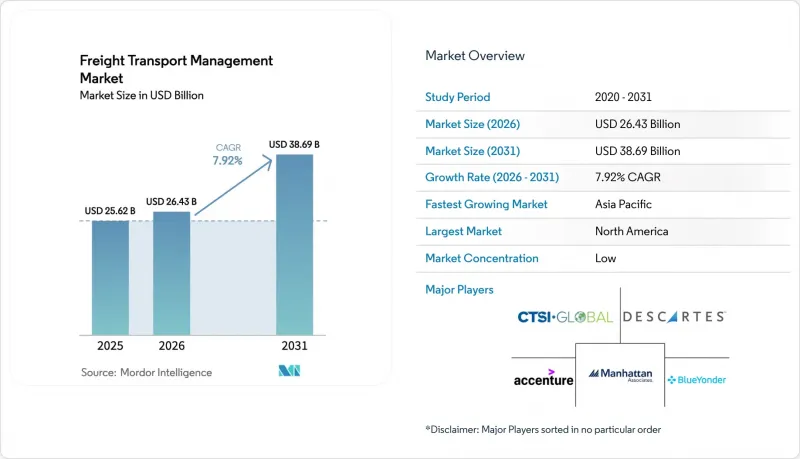
본 보고서는 솔루션별(화물 운송 비용 관리, 화물 모빌리티 솔루션 등), 도입 형태별(클라우드, On-Premise), 운송 수단별(철도 화물, 도로 화물, 해상 화물, 항공 화물), 최종 사용자별(항공우주 및 방위, 자동차, 석유 및 가스,소비재 및 소매 등), 그리고 지역별로 분류되어 있습니다. 시장 예측은 금액(미 달러)으로 제시되어 있습니다.
세계의 화물 운송 관리 시장 동향 및 인사이트
국경을 넘는 전자상거래 소포의 급증
2025년에는 국경을 넘는 소포 운송량이 93억 개를 돌파함에 따라, 운송업체와 화주들은 쇼핑 성수기를 몇 주 앞두고 컨테이너나 항공기 공간을 확보하기 위해 예측형 용량 계획 알고리즘을 도입할 수밖에 없었습니다. 당일 배송 서비스 지역은 급속히 확대되었습니다. 예를 들어, 미국의 한 온라인 소매업체는 2025년에 90개 대도시권으로 당일 배송 서비스를 확대하며, 지역 사업자들이 시장 점유율을 유지하기 위해 충족해야 할 성과 기준을 제시했습니다. 2025년에 전 세계 상품 무역이 GDP의 52.3%에 달함에 따라, 실시간 화물 조정은 단순한 백오피스 업무가 아닌 핵심 경쟁력이 되었습니다.
AI 기반 동적 경로 설정 엔진의 통합
2025년에는 AI 플랫폼이 10억 건 이상의 출하 데이터를 처리하며, 교통 상황, 기상 조건 또는 하역문 이용 현황의 변화에 따라 그 자리에서 배송 순서를 재조정했습니다. 한 대형 3PL 기업은 북미 트럭 적재량의 15%에 대해 운임 협상을 자동화하여 조달 주기 시간을 40% 단축하는 동시에, 브로커가 예외 사항 처리에 전념할 수 있는 체계를 구축했습니다. 한 세계 소포 운송업체는 자사의 경로 최적화 엔진을 통해 연간 1억 로드마일을 절감하여, 1,000만 갤런의 연료와 4억 달러의 직접 비용을 절감했다고 보고했습니다.
TMS 플랫폼의 사이버 보안 취약점
2025년, 운송 업계의 정보 유출 평균 비용은 513만 달러로 상승하여 타 업계의 평균을 상회했습니다. 이는 화물 데이터의 전략적 가치를 반영한 것입니다. 한 유럽 물류 소프트웨어 공급업체에서 발생한 72시간에 걸친 시스템 중단은 12만 건의 컨테이너 운송에 차질을 빚게 했으며, 화주들은 자사의 엔터프라이즈 시스템을 외부 TMS 플랫폼과 통합하기 전에 ISO 27001 인증 및 사이버 보험 가입을 요구하게 되었습니다. 이러한 전략적 위험은 직후의 복구 비용에만 그치지 않습니다. 화주들은 자사의 ERP 시스템을 외부 운송 관리 플랫폼과 통합하기 전에 제3자에 의한 보안 감사나 사이버 보험 증명을 점점 더 요구하고 있으며, 그 결과 ISO 27001 인증이나 SOC 2 Type II 준수를 획득하지 못한 벤더의 경우 판매 주기가 길어지고 고객 확보 비용이 증가하고 있습니다.
부문 분석
화주들이 화물 입고 및 피킹 업무의 워크플로우를 동기화한 결과, 창고 관리 시스템(WMS)은 2025년 매출의 33.68%를 차지했습니다. 한 대형 벤더는 클라우드 기반 WMS 도입이 연평균 28%의 성장률을 기록했다고 지적했는데, 이는 레거시 배치 업데이트에 내재된 48시간의 데이터 지연 문제를 해소해야 할 필요성을 반영한 것입니다. 화물 모빌리티 솔루션은 7일 후까지의 항만 혼잡을 예측하는 분석 모듈의 강점을 바탕으로 2031년까지 연평균 성장률(CAGR) 8.22%로 성장하고 있습니다. 이를 통해 화주사는 컨테이너의 우회 배송이 가능해져 체류료를 피할 수 있습니다. 한편, 화물 감사 도구는 자동화된 청구서 검증이 필요한 변동형 연료 할증료의 혜택을 받고 있습니다. 또한, 도난이 빈번한 운송 경로에서는 보험사가 GPS 지원 이모빌라이저를 의무화함에 따라 화물의 보안 및 모니터링이 꾸준히 확산되고 있습니다. 벤처 캐피털의 지원을 받은 신규 진출기업들이 단일 대시보드 하에서 마켓플레이스의 유동성과 가시성을 통합함에 따라, 3PL 컨트롤 타워 플랫폼에 대한 투자는 계속되고 있습니다.
창고에 특화된 제품군에서 화물 운송 관리 시장 규모는 여전히 가장 크지만, 실시간 위치 정보 데이터에 예측 분석을 접목함으로써 모바일 우선 플랫폼이 가장 빠르게 성장하고 있습니다. 이러한 변화는 사후 대응형에서 선제적인 화물 조정에 이르는 광범위한 전환을 여실히 보여주고 있습니다. 기존 기업들이 AI 코파일럿을 기존 제품에 통합하는 가운데, 중견 벤더들은 고급 엔터프라이즈 제품군과 기본적인 화물 정보 앱 사이의 공백 영역을 공략하며, 구독형 가격대에서 모듈식 가시화 기능을 제공합니다.
2025년에는 클라우드 모델이 화물 운송 관리 시장의 58.25% 점유율을 차지했으며, 이는 연평균 성장률(CAGR) 9.62%의 전망에 힘입은 것입니다. 구독 기반 가격 책정을 통해 자본 지출(Capex)이 운영 비용(OpEx)으로 전환되며, 계절적 피크가 있는 화주에게 유연한 컴퓨팅 능력을 제공합니다. 한 대형 ERP 공급업체는 2025년에 18개 데이터센터 전체에서 99.95%의 가동률을 달성했는데, 이는 병렬 하드웨어 없이는 On-Premise 환경에서는 달성하기 어려운 신뢰성 벤치마크입니다. 또한, 공공 기관이 FedRAMP 인증 서비스를 도입함에 따라 이전의 데이터 주권에 대한 우려가 완화되고, 클라우드 플랫폼을 위한 화물 운송 관리 시장 규모도 확대되고 있습니다.
에어 갭 운영이 의무화된 규제 대상 산업에서는 On-Premise 도입이 41.75%의 점유율을 유지하고 있지만, 하이브리드 설계도 부상하고 있습니다. 한 텔레매틱스 공급업체는 2025년에 ‘클라우드 인접형’ 옵션을 도입했습니다. 이는 기밀 데이터를 방화벽 내부에서 처리하면서도, 익명화된 성과 지표를 벤치마킹을 위해 클라우드로 전송하는 방식입니다. 이 아키텍처는 규제가 명확해짐에 따라 단계적인 전환 경로를 시사하고 있습니다.
지역별 분석
북미는 SaaS의 광범위한 도입과 첨단 전자상거래 주문 처리 네트워크를 통해 높은 수준의 디지털 기반이 확립됨에 따라 2025년 매출의 38.11%를 계속 차지했습니다. USMCA(미국-멕시코-캐나다 협정)의 틀 아래, 2020년부터 2025년에 걸쳐 미국과 멕시코 간의 트럭 국경 간 운송이 23% 증가하여, 이중 언어 통관 워크플로우를 관리하는 TMS 모듈에 대한 수요를 끌어올렸습니다. 캐나다의 ‘국가 무역 회랑 기금’(42억 캐나다 달러(31억 달러) 상당)은 항만 및 철도 연결을 정비하고 있으며, 화주들의 복합 운송 최적화 기능 도입을 촉진하고 있습니다.
아시아태평양은 10.09%라는 가장 높은 연평균 성장률(CAGR)을 기록하고 있습니다. 인도의 물류 부문은 2024년 2,150억 달러에서 2027년까지 4,350억 달러로 두 배로 증가할 전망이며, 이는 온라인 소매의 성장을 뒷받침하기 위해 규모를 확장하고 있는 3PL 사업자들의 클라우드 기반 TMS 도입을 촉진하고 있습니다. 중국의 ‘일대일로(One Belt, One Road)’ 이니셔티브에 따라 2025년에는 참여 항만의 컨테이너 처리량이 전년 대비 47.6% 증가했습니다. 동남아시아국가연합(ASEAN)의 디지털 통관 프레임워크에 따라 통관 시간이 72시간에서 12시간으로 단축되었으며, 조화관세번호나 증명서를 자동으로 입력하는 플랫폼이 주목받고 있습니다. 일본에서는 2025년에 시행된 500kg을 초과하는 화물에 대한 전자 배송 증명 의무화로 인해 디지털화가 라스트 원 마일까지 확대되고 있습니다.
유럽의 수익 점유율은 20%대 중반을 차지하고 있습니다. ‘모빌리티 패키지’에 따른 내항 운송 제한 및 운전자의 휴식 시간 강화와 같은 개혁으로 인해 2025년에는 트럭 운송 능력이 8-10% 감소할 전망이며, 화물 집약 알고리즘에 대한 수요가 높아지고 있습니다. ‘유럽 그린 딜’의 회랑 자금 지원에 더해, 2024년에 배출권 거래 제도(ETS)가 해상 운송으로 확대됨에 따라 화주들은 노선별 탄소 영향을 산출해야 합니다. 중동에서는 환적 거점의 정비가 진행되고 있습니다. DP월드의 30억 달러 규모 제벨 알리 확장 프로젝트로 400만 TEU의 처리 능력이 추가되었으며, 트럭 게이트 통과 시간이 25분으로 단축되었습니다. 남미와 아프리카는 여전히 발전 단계에 있지만, 무거운 데스크톱 환경이 필요 없는 ‘모바일 우선’ TMS 앱을 통해 기존 시스템을 뛰어넘을 잠재력을 지니고 있습니다.
기타 혜택 :
- 엑셀 형식 시장 예측(ME) 시트
- 3개월간의 애널리스트 지원
자주 묻는 질문
목차
제1장 서론
제2장 조사 방법
제3장 주요 요약
제4장 시장 구도
제5장 시장 규모 및 성장 예측
제6장 경쟁 구도
제7장 시장 기회 및 향후 전망
KTH 26.09.10According to Mordor Intelligence, the freight transport management market size is expeceted to grow from USD 25.62 billion in 2025 to USD 26.43 billion in 2026 and is projected to expand to USD 38.69 billion by 2031 at 7.92% CAGR over 2026-2031.

This report is Segmented by Solution (Freight Transportation Cost Management, Freight Mobility Solution, and More), Deployment (Cloud, and On-Premise), Mode of Transport (Rail Freight, Road Freight, Waterborne Freight, and Air Freight), End-User (Aerospace and Defense, Automotive, Oil and Gas, Consumer and Retail, and More), and Geography. The Market Forecasts are Provided in Terms of Value (USD).
Global Freight Transport Management Market Trends and Insights
Surge in Cross-border E-commerce Parcels
Cross-border parcel shipments surpassed 9.3 billion units in 2025, forcing carriers and shippers alike to embrace predictive capacity-planning algorithms that reserve container and aircraft space weeks ahead of peak shopping events. Same-day fulfillment footprints expanded sharply; for instance, one U.S. online retailer extended same-day service to 90 metropolitan areas in 2025, setting a performance bar that regional players must meet to retain market share. As global merchandise trade intensity rose to 52.3% of GDP in 2025, real-time freight orchestration has become a core competency rather than a back-office task.
Integration of AI-driven Dynamic Routing Engines
AI platforms processed more than a billion shipment data points in 2025 to resequence stops on the fly as traffic, weather, or dock-door availability changed. A leading 3PL automated rate negotiations for 15% of its North American truckload volume, trimming procurement cycle time by 40% and freeing brokers to handle exceptions. A global parcel carrier reported that its route-optimization engine saved 100 million road miles annually, translating into 10 million gallons of fuel and USD 400 million in direct cost avoidance.
Cyber-security Vulnerabilities in TMS Platforms
Average breach costs in transportation climbed to USD 5.13 million in 2025, outpacing the multi-sector mean and reflecting the strategic value of shipment data. A 72-hour outage at a European logistics software provider disrupted 120,000 container moves, prompting shippers to demand ISO 27001 attestations and cyber-insurance coverage before integrating enterprise systems with external TMS platforms. The strategic risk extends beyond immediate recovery costs, shippers are increasingly requiring third-party security audits and cyber-insurance attestations before integrating their enterprise resource planning systems with external transportation management platforms, lengthening sales cycles and raising customer-acquisition costs for software vendors that lack ISO 27001 certification or SOC 2 Type II compliance.
Other drivers and restraints analyzed in the detailed report include:
- Accelerated Rollout of 5G-enabled IoT Tracking
- Government Incentives for Green Freight Corridors
- High Capex for End-to-end Visibility Digitization
For complete list of drivers and restraints, kindly check the Table Of Contents.
Segment Analysis
Warehouse management systems captured 33.68% of 2025 revenue as shippers synchronized inbound freight arrivals with order-picking workflows. A leading vendor noted 28% annual growth in cloud WMS deployments, reflecting the need to eliminate 48-hour data latency inherent in legacy batch updates. Freight mobility solutions are advancing at an 8.22% CAGR through 2031 on the strength of analytics modules that forecast port congestion seven days ahead, allowing shippers to divert containers and avoid dwell fees. Freight audit tools, meanwhile, benefit from dynamic fuel surcharges that demand automated invoice verification. Freight security and monitoring is gaining ground along high-theft corridors where insurers now require GPS-enabled immobilizers. Investment in 3PL control-tower platforms continues as venture-backed entrants consolidate marketplace liquidity and visibility under single dashboards.
The Freight Transport Management market size for warehouse-focused suites remains the largest, yet mobile-first platforms are expanding fastest by layering predictive analytics on top of real-time location data. This shift underscores a broader pivot from reactive to anticipatory freight orchestration. With incumbents integrating AI co-pilots into existing products, mid-tier vendors target the white space between high-end enterprise suites and basic load-board apps, offering modular visibility at subscription price points.
Cloud models held 58.25% of Freight Transport Management market share in 2025, supported by a 9.62% CAGR outlook. Subscription pricing converts capex to opex and delivers elastic compute for shippers with seasonal peaks. One major ERP provider achieved 99.95% uptime across 18 data centers in 2025, a reliability benchmark difficult to match on-premise without parallel hardware. The Freight Transport Management market size for cloud platforms is also widening as public-sector agencies adopt FedRAMP-certified services, softening earlier data-sovereignty objections.
On-premise installations retained 41.75% share in regulated verticals that mandate air-gapped operations, but hybrid designs are emerging. A telematics supplier introduced a "cloud-adjacent" option in 2025 that processes sensitive data behind the firewall while pushing anonymized performance metrics to the cloud for benchmarking. This architecture points to a gradual migration path as regulatory clarity improves.
Complete Report Scope:
- By Solution
- Freight Transportation Cost Management
- Freight Security and Monitoring System
- Freight Mobility Solution
- Warehouse Management System
- Freight 3PL Solutions
- Other Solutions
- By Deployment
- Cloud
- On-Premise
- By Mode of Transport
- Rail Freight
- Road Freight
- Waterborne Freight
- Air Freight
- By End-User
- Aerospace and Defense
- Automotive
- Oil and Gas
- Consumer and Retail
- Energy and Power
- Other End-Users
- By Geography
- North America
- United States
- Canada
- Mexico
- South America
- Brazil
- Argentina
- Rest of South America
- Europe
- Germany
- United Kingdom
- France
- Italy
- Spain
- Rest of Europe
- Asia-Pacific
- China
- Japan
- India
- South Korea
- ASEAN
- Rest of Asia-Pacific
- Middle East
- Saudi Arabia
- United Arab Emirates
- Rest of Middle East
- Africa
- South Africa
- Nigeria
- Rest of Africa
- North America
Geography Analysis
North America retained 38.11% of 2025 revenue as widespread SaaS adoption and advanced e-commerce fulfillment networks set a high digital baseline. U.S.-Mexico truck crossings increased 23% from 2020 to 2025 under the USMCA framework, boosting demand for TMS modules that manage bilingual customs-clearance workflows. Canada's National Trade Corridors Fund, worth CAD 4.2 billion (USD 3.1 billion), is upgrading port and rail links and spurring shippers to implement intermodal optimization features.
Asia Pacific registers the highest CAGR of 10.09%. India's logistics sector is on course to double from USD 215 billion in 2024 to USD 435 billion by 2027, catalyzing cloud TMS adoption among 3PLs scaling to support online retail growth. China's Belt and Road Initiative elevated container throughput at participating ports by 47.6% year on year in 2025. The Association of Southeast Asian Nations' digital customs framework reduced clearance times from 72 hours to 12 hours, drawing attention to platforms that auto-populate harmonized codes and certificates. Japan's mandate for electronic proof of delivery for loads above 500 kg, effective in 2025, extends digitization to the last mile.
Europe holds a mid-20s revenue share. Mobility Package reforms limiting cabotage and tightening driver rest periods removed 8-10% of truck capacity in 2025, intensifying demand for consolidation algorithms. The European Green Deal's corridor funding, coupled with the extension of the Emissions Trading System to maritime transport in 2024, requires shippers to calculate route-level carbon impacts. The Middle East is building trans-shipment gateways; DP World's USD 3 billion Jebel Ali expansion added 4 million TEU capacity and reduced truck gate times to 25 minutes. South America and Africa remain nascent but could leapfrog legacy systems through mobile-first TMS apps that avoid heavy desktop requirements.
- Accenture plc
- Manhattan Associates Inc.
- Blue Yonder Group, Inc.
- CTSI-Global LLC
- Descartes Systems Group Inc.
- DSV A/S
- Korber Supply Chain Software GmbH (HighJump)
- CEVA Logistics SA
- Schenker AG (DB Schenker)
- GEODIS SA
- Oracle Corporation
- SAP SE
- Trimble Inc.
- C.H. Robinson Worldwide, Inc.
- Kuehne + Nagel International AG
- XPO Logistics, Inc.
- Deutsche Post DHL Group (DHL Global Forwarding)
- FedEx Corporation
- United Parcel Service, Inc.
- DPDgroup (GeoPost SA)
- Flexport Inc.
- WiseTech Global Limited
- FourKites Inc.
- project44 Inc.
- Transporeon GmbH
- Honeywell International Inc.
- Shippeo
Additional Benefits:
- The market estimate (ME) sheet in Excel format
- 3 months of analyst support
TABLE OF CONTENTS
1 INTRODUCTION
- 1.1 Study Assumptions and Market Definition
- 1.2 Scope of the Study
2 RESEARCH METHODOLOGY
3 EXECUTIVE SUMMARY
4 MARKET LANDSCAPE
- 4.1 Market Overview
- 4.2 Market Drivers
- 4.2.1 Surge in Cross-border E-commerce Parcels
- 4.2.2 Integration of AI-driven Dynamic Routing Engines
- 4.2.3 Accelerated Rollout of 5G-enabled IoT Tracking
- 4.2.4 Maritime Capacity Expansion Under Belt-and-Road Parts
- 4.2.5 Government Incentives for Green Freight Corridors
- 4.2.6 Rising Freight Volumes from Near-shoring in North America
- 4.3 Market Restraints
- 4.3.1 Cyber-security Vulnerabilities in TMS Platforms
- 4.3.2 High Capex for End-to-End Visibility Digitization
- 4.3.3 Congestion and Labour Shortages at Major Trans-shipment Hubs
- 4.3.4 Volatility of Bunker Fuel and Aviation Turbine Fuel Prices
- 4.4 Industry Value Chain Analysis
- 4.5 Regulatory Landscape
- 4.6 Technological Outlook
- 4.7 Porter's Five Forces Analysis
- 4.7.1 Bargaining Power of Suppliers
- 4.7.2 Bargaining Power of Buyers
- 4.7.3 Threat of New Entrants
- 4.7.4 Threat of Substitutes
- 4.7.5 Intensity of Competitive Rivalry
5 MARKET SIZE AND GROWTH FORECASTS (VALUE)
- 5.1 By Solution
- 5.1.1 Freight Transportation Cost Management
- 5.1.2 Freight Security and Monitoring System
- 5.1.3 Freight Mobility Solution
- 5.1.4 Warehouse Management System
- 5.1.5 Freight 3PL Solutions
- 5.1.6 Other Solutions
- 5.2 By Deployment
- 5.2.1 Cloud
- 5.2.2 On-Premise
- 5.3 By Mode of Transport
- 5.3.1 Rail Freight
- 5.3.2 Road Freight
- 5.3.3 Waterborne Freight
- 5.3.4 Air Freight
- 5.4 By End-User
- 5.4.1 Aerospace and Defense
- 5.4.2 Automotive
- 5.4.3 Oil and Gas
- 5.4.4 Consumer and Retail
- 5.4.5 Energy and Power
- 5.4.6 Other End-Users
- 5.5 By Geography
- 5.5.1 North America
- 5.5.1.1 United States
- 5.5.1.2 Canada
- 5.5.1.3 Mexico
- 5.5.2 South America
- 5.5.2.1 Brazil
- 5.5.2.2 Argentina
- 5.5.2.3 Rest of South America
- 5.5.3 Europe
- 5.5.3.1 Germany
- 5.5.3.2 United Kingdom
- 5.5.3.3 France
- 5.5.3.4 Italy
- 5.5.3.5 Spain
- 5.5.3.6 Rest of Europe
- 5.5.4 Asia-Pacific
- 5.5.4.1 China
- 5.5.4.2 Japan
- 5.5.4.3 India
- 5.5.4.4 South Korea
- 5.5.4.5 ASEAN
- 5.5.4.6 Rest of Asia-Pacific
- 5.5.5 Middle East
- 5.5.5.1 Saudi Arabia
- 5.5.5.2 United Arab Emirates
- 5.5.5.3 Rest of Middle East
- 5.5.6 Africa
- 5.5.6.1 South Africa
- 5.5.6.2 Nigeria
- 5.5.6.3 Rest of Africa
- 5.5.1 North America
6 COMPETITIVE LANDSCAPE
- 6.1 Market Concentration
- 6.2 Strategic Moves
- 6.3 Market Share Analysis
- 6.4 Company Profiles (includes Global level Overview, Market Level Overview, Core Segments, Financials as Available, Strategic Information, Market Rank/Share for Key Companies, Products and Services, and Recent Developments)
- 6.4.1 Accenture plc
- 6.4.2 Manhattan Associates Inc.
- 6.4.3 Blue Yonder Group, Inc.
- 6.4.4 CTSI-Global LLC
- 6.4.5 Descartes Systems Group Inc.
- 6.4.6 DSV A/S
- 6.4.7 Korber Supply Chain Software GmbH (HighJump)
- 6.4.8 CEVA Logistics SA
- 6.4.9 Schenker AG (DB Schenker)
- 6.4.10 GEODIS SA
- 6.4.11 Oracle Corporation
- 6.4.12 SAP SE
- 6.4.13 Trimble Inc.
- 6.4.14 C.H. Robinson Worldwide, Inc.
- 6.4.15 Kuehne + Nagel International AG
- 6.4.16 XPO Logistics, Inc.
- 6.4.17 Deutsche Post DHL Group (DHL Global Forwarding)
- 6.4.18 FedEx Corporation
- 6.4.19 United Parcel Service, Inc.
- 6.4.20 DPDgroup (GeoPost SA)
- 6.4.21 Flexport Inc.
- 6.4.22 WiseTech Global Limited
- 6.4.23 FourKites Inc.
- 6.4.24 project44 Inc.
- 6.4.25 Transporeon GmbH
- 6.4.26 Honeywell International Inc.
- 6.4.27 Shippeo
7 MARKET OPPORTUNITIES AND FUTURE OUTLOOK
- 7.1 White-space and Unmet-Need Assessment


