

|
시장보고서
상품코드
2120334
남미의 젖산 : 시장 점유율 분석, 업계 동향과 통계, 성장 예측(2026-2031년)South America Lactic Acid - Market Share Analysis, Industry Trends & Statistics, Growth Forecasts (2026 - 2031) |
||||||
 Mordor Intelligence
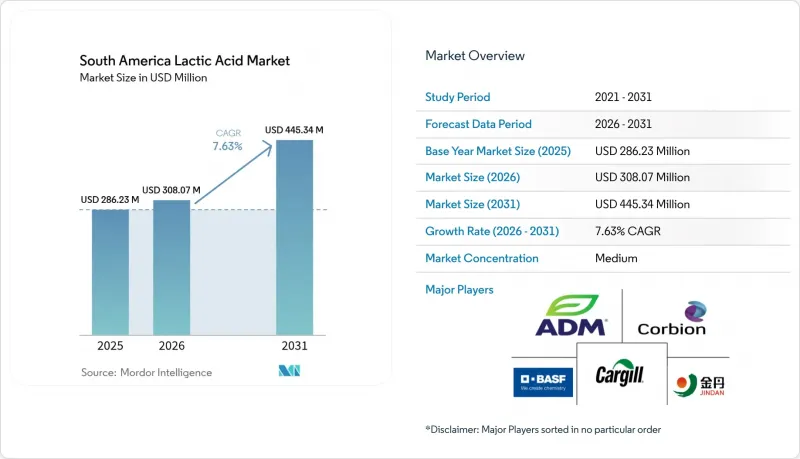
Mordor Intelligence에 따르면 남미의 젖산 시장 규모는 2025년 2억 8,623만 달러에서 2026년에는 3억 807만 달러로 확대하며, 2026-2031년에 CAGR 7.63%로 추이하며, 2031년에는 4억 4,534만 달러에 달할 것으로 예측됩니다.
이 보고서에서는 업계를 원료별(천연 및 합성), 형태별(액체 및 고체), 등급별(식품 등급, 산업용 등급, 의약품 등급, 화장품 등급), 용도별(식품 및 음료, 퍼스널 케어·화장품, 의약품, 동물 사료, 산업·화학 처리) 및 지역별(브라질 등)로 분류하고 있습니다. 시장 예측은 금액(달러)으로 표시되어 있습니다.
남미 젖산 시장의 동향 및 인사이트
브라질의 식물 유래 식품 가공 시장 성장이 천연 산미료 수요를 끌어올리고 있습니다.
브라질의 식물 유래 식품 부문에서는 규제 측면에서 현저한 진전이 나타나고 있으며, 이는 제조 공정에서 천연 산미료의 채택을 촉진할 것으로 예상됩니다. ANVISA 및 MAPA와 같은 규제 당국은 식물 유래 제품에 관한 규제 체계를 적극적으로 정비하고 있습니다. 이러한 개정안은 명확한 최소 기준이 되는 식별 기준 및 품질 기준을 확립하는 동시에 소비자의 혼란을 해소하는 것을 목적으로 하고 있습니다. 이러한 규제 변화는 천연 방부제에 대한 표준화된 수요를 촉진하고 있으며, 젖산이 주요 해결책으로 부상하고 있습니다. 제안된 규정에 따르면 식물성 제품과 동물성 제품을 구별하기 위한 명확한 표시가 의무화되어 있으며, 이에 따라 제조업체들은 클린 라벨 및 지속가능성을 중시하는 전략에 부합하는 천연 산미료의 채택을 촉진하고 있습니다. 가공 시설에서는 식물 유래 육류 대체품, 유제품 대체품, 발효 제품 등 다양한 용도에서 pH 조절 및 유통기한 연장과 같은 젖산의 장점을 활용하여 그 도입을 확대하고 있습니다. 해당 업계의 혁신에 대한 집중, 특히 식물성 원료 제품 및 클린 라벨 제품 개발에 대한 집중은 천연 산미료에 대한 수요를 더욱 부추기고 있습니다. 이러한 원료는 끊임없이 변화하는 규제 요건을 충족할 뿐만 아니라, 지속가능하고 투명성이 높은 제품 배합에 대한 소비자의 높아지는 기대에도 부응하고 있습니다. 이처럼 규제와 시장 동향 모두에 부합함에 따라 천연 산미료는 브라질 식물성 식품 부문의 지속적인 성장에 있으며, 필수적인 요소로서의 입지를 확고히 하고 있습니다.
제빵 분야에서 클린 라벨 방부제에 대한 소비자 선호도 증가
클린 라벨의 흐름은 남미 베이커리 제품의 배합에 큰 변화를 가져오고 있습니다. 이는 소비자들이 합성 대체품보다 투명성과 천연 성분을 점점 더 요구하고 있기 때문입니다. 유기산, 특히 젖산은 그 이중 기능성 덕분에 주요 성분으로 부상하고 있습니다. 젖산은 pH 저하와 직접적인 항균 작용이라는 이중 메커니즘을 통해 대장균이나 살모넬라균 등의 식중독균을 효과적으로 억제하는 동시에, 구운 과자의 관능적 품질을 유지합니다. 이러한 능력 덕분에 배합 개발자는 식품 안전 기준을 훼손하지 않으면서 합성 방부제를 대체할 수 있게 되었습니다. 이러한 증가하는 수요에 부응하여 브라질의 제빵 제조사들은 유통 기한을 연장할 뿐만 아니라 클린 라벨(Clean Label) 기준에도 부합하는 젖산 기반 솔루션을 채택하고 있습니다. 보존 효과 외에도 PURACAL® PP와 같은 젖산 유도체는 제빵 과정에서 생성되는 유해 화합물인 아크릴아마이드의 생성을 억제하는 데 활용되고 있습니다. 이러한 추가 기능은 젖산의 다용도성을 부각시켜 제빵 제조업체에게 전략적인 원료로 자리매김하고 있습니다. 천연 원료를 선호하는 소비자의 기호에 부응하고 엄격한 식품 안전 규제를 준수함으로써, 젖산은 남미 제빵 시장의 재편 과정에서 매우 중요한 역할을 수행하고 있습니다.
원료(옥수수, 사탕수수) 가격 변동이 생산 마진에 영향
남미의 젖산 생산자들은 기후 및 정책 요인의 영향을 받은 농산물 시장의 변동성 증가로 인해 원료 가격의 불안정성에 기인한 큰 이익률 압박에 직면해 있습니다. 브라질에서는 사탕수수 생산이 여전히 악천후의 영향을 받고 있습니다. 경작 면적은 안정적이지만, 2025/26년산 수확량은 전 시즌 대비 2% 감소할 것으로 예측됩니다. 이러한 감소는 주요 생산 지역의 가뭄으로 인한 생산성 2.3% 하락에 기인하며, 사탕수수 유래 원료에 의존하는 제조업체들에게는 원료 비용 상승을 초래하고 있습니다. 동시에, 옥수수를 원료로 하는 에탄올 생산의 급속한 확대로 인해 옥수수 원료를 둘러싼 경쟁이 격화되고 있습니다. 2024/25년도 브라질의 옥수수 소비량은 34억 6,400만 부셸에 달할 것으로 예상되며, 가동중인 25개의 에탄올 공장이 기존의 사료 및 식품 용도와 경쟁하고 있습니다. 사탕수수 공급 감소와 옥수수 수요 증가라는 이 이중의 과제로 인해 국내 원료 가격은 2022년 이후 최고 수준까지 치솟았습니다. 이러한 압박에 대응하기 위해 각 젖산 제조사들은 원료 조달 전략을 최적화하고, 대체 기질의 대안을 적극적으로 모색하고 있습니다. 공급망 혼란과 투입 비용 상승의 영향을 점점 더 크게 받는 시장에서 경쟁력을 유지하기 위해서는 이러한 조치가 필수적입니다.
부문 분석
2025년, 천연 젖산은 91.62%라는 압도적인 시장 점유율을 차지하고 있으며, 2031년까지 연평균 성장률(CAGR) 8.11%의 견고한 성장이 예상됩니다. 이러한 성장은 주로 브라질의 풍부한 농업 원료와 바이오 유래 성분에 대한 소비자 수요 증가에 의해 주도되고 있습니다. 바이오화학 제품 생산에 쉽게 적응할 수 있는 브라질의 첨단 사탕수수 가공 인프라는 합성 제품에 비해 뚜렷한 비용 우위를 가져다주고 있습니다. 또한 브라질 농림부가 천연 사료 원료에 대해 정한 엄격한 안전성 및 유효성 기준이 동물 영양 분야에서의 천연 유래 젖산 채택을 지원하고 있습니다. 최근 제정된 법률 제15,070/2024호는 농업 및 축산 분야의 미생물 유래 및 생명공학 제품에 대한 엄격한 품질 기준을 규정하고 있으며, 이를 통해 제품의 품질 안정성과 시장 확대가 보장됨으로써 천연 부문이 더욱 강화되고 있습니다.
또한 바이오 기반 화학물질 생산을 촉진하는 정부의 노력과 클린 라벨 식품에서의 천연 젖산 사용 확대에 힘입어 시장은 인상적인 성장을 달성하고 있습니다. 2023년, 브라질 에너지 연구국은 사탕수수와 옥수수를 원료로 한 에탄올 생산에 힘입어 사탕수수 처리량이 사상 최고치인 7억 1,300만 톤에 달했다고 보고했습니다. 이 성과로 인해 천연 젖산 제조업체에 대한 안정적인 원료 공급이 보장되고 있습니다. 또한 라틴아메리카 개발은행이 지속가능한 개발과 환경 품질 향상에 주력하고 있는 점도 더해져, 다양한 산업 용도에서 합성 화학 물질보다 천연 화학 물질이 우선적으로 채택되는 추세가 더욱 가속화되고 있습니다.
2025년에는 액상 젖산이 시장 점유율의 59.58%라는 큰 비중을 차지할 것으로 전망됩니다. 이는 대규모 식품 가공에서의 높은 운영 효율과 음료 배합에 원활하게 통합될 수 있다는 점이 요인으로 작용하고 있습니다. 액상 형태는 취급이 용이하고 정확한 투여가 가능하게 해주며, 이는 유제품의 산미 조절, 육류 보존, 음료의 pH 조절과 같은 용도에서 매우 중요합니다. 이러한 특성 덕분에 남미의 광범위한 식품 가공 산업에서 액상 젖산은 없어서는 안 될 존재가 되었습니다. 또한 유제품 및 식품 첨가물에 관한 구체적인 기준을 정한 아르헨티나의 엄격한 식품 법규로 인해 액상 산미료에 대한 표준화된 수요가 형성되고 있습니다. 이러한 산미료는 기존 가공 시스템에 쉽게 통합될 수 있으며, 시장에서의 우위를 더욱 공고히 하고 있습니다.
분말 및 과립 부문은 2031년까지 연평균 성장률(CAGR)이 9.02%에 달할 것으로 예측되며, 급속한 성장이 기대됩니다. 이러한 성장을 촉진하는 요인은 드라이 믹스 용도 및 수출 시장에서 상온 보관이 가능한 배합에 대한 수요가 증가하고 있다는 점과, 농축 형태가 운송 비용을 절감해 준다는 점에 있습니다. 또한 이 부문은 특히 수처리 분야의 산업 용도로부터도 혜택을 받고 있습니다. 세계은행은 라틴아메리카의 폐수 인프라에 대한 막대한 투자의 필요성을 강조하고 있으며, 2010-2030년에 하수도 정비에 800억 달러, 폐수 처리에 330억 달러가 필요할 것으로 추산하고 있습니다. 이러한 투자는 산업용수 처리 공정에서 분말 형태에 대한 수요 확대로 이어질 기회를 창출하고 있습니다. 또한 분말 부문은 동물 사료 업계에서도 성장세를 보이고 있으며, 건식 혼합의 장점과 장기 보존성이 운영상 이점을 제공하고 있습니다. 이러한 특징은 해당 지역에서 지속적으로 성장하고 있는 축산 부문에 대응하는 사료 제조업체에게 특히 가치가 높으며, 이 부문의 추가적인 확장을 지원하고 있습니다.
기타 혜택:
- 엑셀 형식의 시장 예측(ME) 시트
- 3개월간의 애널리스트 지원
자주 묻는 질문
목차
제1장 서론
제2장 조사 방법
제3장 개요
제4장 시장 구도
제5장 시장 규모와 성장 예측
제6장 경쟁 구도
제7장 시장 기회와 향후 전망
KSA 26.09.02According to Mordor Intelligence, the South America lactic acid market size is expected to grow from USD 286.23 million in 2025 to USD 308.07 million in 2026 and is forecast to reach USD 445.34 million by 2031 at 7.63% CAGR over 2026-2031.
This report Segments the Industry by Source (Natural and Synthetic); Form (Liquid and Solid); Grade (Food Grade, Industrial Grade, Pharmaceutical Grade, and Cosmetic Grade); and Application (Food and Beverages, Personal Care and Cosmetics, Pharmaceutical, Animal Feed, and Industrial and Chemical Processing), and Geography (Brazil and More). The Market Forecasts are Provided in Terms of Value (USD).
South America Lactic Acid Market Trends and Insights
Growth of plant-based food processing in brazil boosting demand for natural acidulants
Brazil's plant-based food sector is witnessing significant regulatory advancements, which are expected to drive the adoption of natural acidulants in manufacturing processes. Regulatory bodies such as ANVISA and MAPA are actively refining their frameworks for plant-based products. These updates aim to eliminate consumer confusion while establishing clear minimum identity and quality standards. This regulatory shift is fostering a standardized demand for natural preservatives, with lactic acid emerging as a key solution. The proposed regulations mandate clear labeling to distinguish plant-based products from animal-based ones, encouraging manufacturers to adopt natural acidulants that align with clean-label and sustainability-focused strategies. Processing facilities are increasingly integrating lactic acid into their operations, leveraging its benefits for pH control and shelf-life extension across various applications, including plant-based meat alternatives, dairy substitutes, and fermented products. The sector's emphasis on innovation, particularly in developing plant-based and clean-label offerings, is further fueling the demand for natural acidulants. These ingredients not only comply with evolving regulatory requirements but also meet growing consumer expectations for sustainable and transparent product formulations. This dual alignment with regulatory and market trends positions natural acidulants as essential components in the continued growth of Brazil's plant-based food sector.
Rising consumer preference for clean-label preservatives in bakery segment
The clean-label movement is driving significant changes in South American bakery formulations as consumers increasingly demand transparency and natural ingredients over synthetic alternatives. Organic acids, particularly lactic acid, are emerging as key components due to their dual functionality. Lactic acid effectively combats foodborne pathogens such as E. coli and Salmonella through its dual mechanism of pH reduction and direct antimicrobial action, all while maintaining the sensory quality of baked goods. This capability enables formulators to replace synthetic preservatives without compromising food safety standards. In response to this growing demand, Brazilian bakery manufacturers are adopting lactic acid-based solutions that not only extend shelf life but also align with clean-label claims. Beyond preservation, lactic acid derivatives, such as PURACAL(R) PP, are being utilized to reduce acrylamide formation-a harmful compound generated during baking processes. This additional functionality highlights the versatility of lactic acid, making it a strategic ingredient for bakery manufacturers. By addressing consumer preferences for natural ingredients and adhering to stringent food safety regulations, lactic acid is playing a pivotal role in reshaping the bakery market in South America.
Volatility in feedstock (corn, sugarcane) prices impacting production margins
South American lactic acid producers are facing significant margin pressures due to feedstock price instability, driven by heightened volatility in agricultural commodity markets influenced by climate and policy factors. In Brazil, sugarcane production remains under strain from adverse weather conditions. The 2025/26 harvest is projected to decline by 2% compared to the previous season, despite a stable cultivation area. This decline is attributed to a 2.3% drop in productivity caused by drought conditions in key producing regions, which is driving up feedstock costs for manufacturers reliant on sugarcane-derived substrates. Simultaneously, the rapid expansion of corn ethanol production is intensifying competition for corn feedstocks. Brazil's corn consumption is expected to reach 3,464 million bushels in 2024/25, as 25 operational ethanol plants compete with traditional feed and food applications. This dual challenge of reduced sugarcane availability and heightened corn demand has pushed domestic feedstock prices to their highest levels since 2022. To navigate these pressures, lactic acid producers are optimizing their feedstock sourcing strategies and actively exploring alternative substrate options. These measures are critical for maintaining competitive positioning in a market increasingly shaped by supply chain disruptions and rising input costs.
Other drivers and restraints analyzed in the detailed report include:
- Government incentives for sugarcane bio-based chemicals production in brazil
- Increasing utilization of lactic acid in livestock feed acidifiers to combat antibiotic ban
- Limited availability of food-grade fermentation infrastructure outside brazil
For complete list of drivers and restraints, kindly check the Table Of Contents.
Segment Analysis
In 2025, natural lactic acid commands a dominant 91.62% market share and is set to expand at a robust CAGR of 8.11% through 2031. This growth is largely driven by Brazil's rich agricultural feedstock and a rising consumer appetite for bio-based ingredients. Brazil's sophisticated sugarcane processing infrastructure, easily adaptable for biochemical production, provides a notable cost edge over synthetic counterparts. Furthermore, the Brazilian Ministry of Agriculture's stringent safety and efficacy standards for natural feed ingredients bolster the adoption of naturally derived lactic acid in animal nutrition. The recent enactment of Law #15,070/2024 further fortifies the natural segment, instituting rigorous quality benchmarks for microbial and biotechnological products in agriculture and livestock, thereby ensuring product consistency and market expansion.
Moreover, bolstered by government initiatives championing bio-based chemical production and the surging use of natural lactic acid in clean-label food products, the market is witnessing significant growth. In 2023, Brazil's Energy Research Office highlighted a record sugarcane processing volume of 713 million tons, buoyed by both sugarcane and corn-based ethanol production. This achievement guarantees a reliable feedstock supply for natural lactic acid producers. Additionally, the Development Bank of Latin America's commitment to sustainable development and enhancing environmental quality further propels the preference for natural chemicals over synthetic ones across diverse industrial applications.
In 2025, liquid lactic acid secures a significant 59.58% share of the market, driven by its operational efficiency in large-scale food processing and its seamless incorporation into beverage formulations. The liquid form offers ease of handling and precise dosing, which are critical for applications such as dairy acidification, meat preservation, and beverage pH control. These attributes make it indispensable in South America's expansive food processing industry. Additionally, Argentina's stringent food code, which outlines specific standards for dairy products and food additives, has fostered a standardized demand for liquid acidulants. These acidulants integrate effortlessly into existing processing systems, further solidifying their market dominance.
The powder and granules segment is poised for rapid growth, with a projected CAGR of 9.02% through 2031. This growth is fueled by the increasing preference for shelf-stable formulations in dry mix applications and export markets, where concentrated forms reduce transportation costs. The segment also benefits from industrial applications, particularly in water treatment. The World Bank has highlighted the need for significant investments in Latin America's wastewater infrastructure, estimating USD 80 billion for sewerage and USD 33 billion for wastewater treatment between 2010 and 2030. These investments create opportunities for powder forms in industrial water treatment processes. Moreover, the powder segment is gaining traction in the animal feed industry, where its dry mixing capabilities and extended shelf life provide operational advantages. These features are particularly valuable for feed manufacturers catering to the region's growing livestock sector, further driving the segment's expansion.
Complete Report Scope:
- By Source
- Natural
- Synthetic
- By Form
- Liquid
- Solid (Powder/Granules)
- By Grade
- Food Grade
- Industrial Grade
- Pharmaceutical Grade
- Cosmetic Grade
- By Application
- Food and Beverages
- Bakery
- Confectionery
- Dairy Products
- Meat, Poultry and, Seafood
- Beverages
- Other Food and Beverage Applications
- Personal Care and Cosmetics
- Pharmaceutical
- Animal Feed
- Industrial and Chemical Processing
- Food and Beverages
- By Geography
- Brazil
- Argentina
- Colombia
- Chile
- Peru
- Rest of South America
List of Companies Covered in this Report:
- Corbion NV
- Cargill, Incorporated
- BASF SE
- Archer-Daniels-Midland Company
- Galactic Holdings, Inc
- Henan Jindan Lactic Acid Co., Ltd.
- Jungbunzlauer Suisse AG, Basel
- Arshine Food Additives Co., Ltd.
- Cellulac plc,
- Brenntag AG
- Dsm-Firmenich AG
- Futerro SA
- Univar Solutions LLC.
- Shenzhen Esun Industrial Co., Ltd.
- BBCA Group Corporation
- International Flavors & Fragrances (Danisco)
- Natureworks LLC
- Musashino Chemical Laboratory, Ltd.
- DuPont de Nemours, Inc.
- Tokyo Chemical Industry Co., Ltd.
Additional Benefits:
- The market estimate (ME) sheet in Excel format
- 3 months of analyst support
TABLE OF CONTENTS
1 INTRODUCTION
- 1.1 Study Assumptions and Market Definition
- 1.2 Scope of the Study
2 RESEARCH METHODOLOGY
3 EXECUTIVE SUMMARY
4 MARKET LANDSCAPE
- 4.1 Market Overview
- 4.2 Market Drivers
- 4.2.1 Growth of plant-based food processing in brazil boosting demand for natural acidulants
- 4.2.2 Rising consumer preference for clean-label preservatives in bakery segment
- 4.2.3 Government incentives for sugarcane bio-based chemicals production in brazil
- 4.2.4 Increasing utilization of lactic acid in livestock feed acidifiers to combat antibiotic ban
- 4.2.5 Pharmaceutical companies adopting lactic acid for topical drug formulations in dermatology
- 4.2.6 Rising demand for fermented dairy alternatives in urban south american markets
- 4.3 Market Restraints
- 4.3.1 Volatility in feedstock (corn, sugarcane) prices impacting production margins
- 4.3.2 Limited availability of food-grade fermentation infrastructure outside brazil
- 4.3.3 Stringent effluent disposal norms increasing operating costs in andean countries
- 4.3.4 Competition from cheaper imported acidulants such as citric acid from asia
- 4.4 Supply-Chain Analysis
- 4.5 Regulatory Outlook
- 4.6 Porter's Five Forces
- 4.6.1 Threat of New Entrants
- 4.6.2 Bargaining Power of Buyers/Consumers
- 4.6.3 Bargaining Power of Suppliers
- 4.6.4 Threat of Substitute Products
- 4.6.5 Intensity of Competitive Rivalry
5 MARKET SIZE AND GROWTH FORECASTS (VALUE)
- 5.1 By Source
- 5.1.1 Natural
- 5.1.2 Synthetic
- 5.2 By Form
- 5.2.1 Liquid
- 5.2.2 Solid (Powder/Granules)
- 5.3 By Grade
- 5.3.1 Food Grade
- 5.3.2 Industrial Grade
- 5.3.3 Pharmaceutical Grade
- 5.3.4 Cosmetic Grade
- 5.4 By Application
- 5.4.1 Food and Beverages
- 5.4.1.1 Bakery
- 5.4.1.2 Confectionery
- 5.4.1.3 Dairy Products
- 5.4.1.4 Meat, Poultry and, Seafood
- 5.4.1.5 Beverages
- 5.4.1.6 Other Food and Beverage Applications
- 5.4.2 Personal Care and Cosmetics
- 5.4.3 Pharmaceutical
- 5.4.4 Animal Feed
- 5.4.5 Industrial and Chemical Processing
- 5.4.1 Food and Beverages
- 5.5 By Geography
- 5.5.1 Brazil
- 5.5.2 Argentina
- 5.5.3 Colombia
- 5.5.4 Chile
- 5.5.5 Peru
- 5.5.6 Rest of South America
6 COMPETITIVE LANDSCAPE
- 6.1 Market Concentration
- 6.2 Strategic Moves
- 6.3 Market Ranking Analysis
- 6.4 Company Profiles (includes Global level Overview, Market level overview, Core Segments, Financials as available, Strategic Information, Market Rank/Share for key companies, Products and Services, and Recent Developments)
- 6.4.1 Corbion NV
- 6.4.2 Cargill, Incorporated
- 6.4.3 BASF SE
- 6.4.4 Archer-Daniels-Midland Company
- 6.4.5 Galactic Holdings, Inc
- 6.4.6 Henan Jindan Lactic Acid Co., Ltd.
- 6.4.7 Jungbunzlauer Suisse AG, Basel
- 6.4.8 Arshine Food Additives Co., Ltd.
- 6.4.9 Cellulac plc,
- 6.4.10 Brenntag AG
- 6.4.11 Dsm-Firmenich AG
- 6.4.12 Futerro SA
- 6.4.13 Univar Solutions LLC.
- 6.4.14 Shenzhen Esun Industrial Co., Ltd.
- 6.4.15 BBCA Group Corporation
- 6.4.16 International Flavors & Fragrances (Danisco)
- 6.4.17 Natureworks LLC
- 6.4.18 Musashino Chemical Laboratory, Ltd.
- 6.4.19 DuPont de Nemours, Inc.
- 6.4.20 Tokyo Chemical Industry Co., Ltd.


