

|
시장보고서
상품코드
2120347
첨단 세라믹 : 시장 점유율 분석, 업계 동향과 통계, 성장 예측(2026-2031년)Advanced Ceramics - Market Share Analysis, Industry Trends & Statistics, Growth Forecasts (2026 - 2031) |
||||||
 Mordor Intelligence
Mordor Intelligence에 따르면 첨단 세라믹 시장 규모는 2026년에 1,051억 2,000만 달러로 추정되고 있으며, 예측 기간(2026-2031년)에 CAGR 6.81%로 확대하며, 2031년에는 1,461억 3,000만 달러에 달할 것으로 전망되고 있습니다.
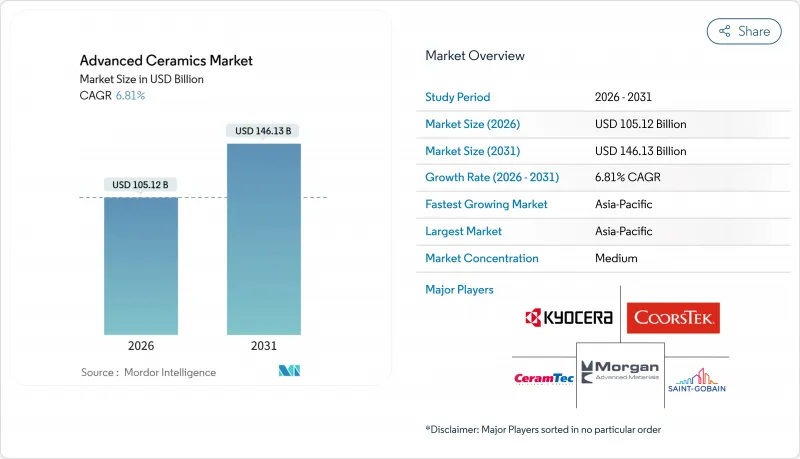
이 보고서는 재료 유형별(알루미나, 지르코니아 등), 유형별(모놀리식 세라믹, 세라믹 매트릭스 복합재료, 세라믹 코팅 등), 용도별(구조용 세라믹, 바이오세라믹 등), 최종사용자 산업별(전기·전자, 운송 등),지역별(아시아태평양, 북미, 유럽 등)로 분류되어 있습니다. 시장 예측은 금액(달러) 기준으로 제시되어 있습니다.
세계 첨단 세라믹 시장의 동향 및 인사이트
금속 및 고성능 플라스틱에서의 전환
자동차 및 항공우주 분야의 경량화 규제로 인해 강철 및 알루미늄에서 실리콘 질화물 및 실리콘 카바이드로의 전환이 가속화되고 있습니다. 현대트랜시스(Hyundai-Transys)는 2024년 시험에서 세라믹 베어링이 강철 베어링에 비해 기생 손실을 12% 줄였음을 보여주었습니다. NASA의 2025년 연구에 따르면 실리콘 질화물 터빈 블레이드는 1,400°C를 견디며, 니켈 초합금보다 200°C 더 높은 온도를 견디면서도 질량을 40% 줄일 수 있는 것으로 입증되었습니다. 그러나 NSK의 2024년 제출 자료에 따르면 세라믹 볼 1개당 비용이 15달러를 초과하므로 일부 공급업체는 여전히 하이브리드 설계를 채택하고 있는 것으로 밝혀졌습니다. 전반적으로 OEM 업체들은 비용 차이가 있음에도 불구하고 전기자동차(EV)용 기어박스 및 초음속 추진 시스템을 위한 풀 세라믹 부품의 인증을 계속 진행하고 있습니다.
의료용 임플란트 및 의료기기에서의 용도 확대
지르코니아 강화 알루미나 및 이트리아 안정화 지르코니아는 이온 방출이 적고 내마모성이 높기 때문에 관절 치환술에서 코발트-크롬을 대체하고 있습니다. Zimmer Biomet사는 2025년 3월, 지르코니아 헤드를 채택한 ‘Persona IQ’ 대퇴골 컴포넌트에 대해 FDA의 510(k) 승인을 획득했습니다. 이 제품은 15년 동안 폴리에틸렌의 마모를 60% 저감시킵니다. 스트라이커(Stryker)사의 2025년 투자자용 자료에 따르면 세라믹 라이너를 채택한 동사의 ‘Mako’ 플랫폼에서는 10년 후 재수술률이 2% 미만으로 억제되고 있습니다. 유럽의 더욱 엄격해진 의료기기 규제로 인해 시장 출시까지 소요되는 기간이 18-24개월 연장되었으나, 이러한 규제 강화로 인해 ISO 13485 인증을 획득한 공장의 시장 점유율은 더욱 공고해졌습니다.
높은 제조 비용
1,600°C를 넘는 가마 온도와 기계 가공 후 공정을 거치면서 세라믹의 가격은 성형 폴리머의 3-5배로 치솟습니다. CoorsTek사의 2024년판 자료에 따르면 알루미나 기판 제조에는 1톤당 12 MWh가 필요하며, 유럽의 가스 가격 변동으로 인해 1kg당 0.80-1.20달러의 추가 비용이 발생하고 있습니다. CeramTec사의 2025년 지속가능성 보고서에서는 가마의 전기화에 1,800만 유로(1,940만 달러)의 비용이 소요될 것으로 예상되며, 전력 가격이 안정될 때까지 단위 비용이 6% 상승할 것으로 예측되고 있습니다. 열분해법을 이용한 질화 붕소와 같은 소량 생산되는 틈새 제품은 1kg당 500달러를 초과하므로 더 광범위한 보급을 저해하고 있습니다.
부문 분석
2025년, 알루미나(Alumina)는 첨단 세라믹 시장에서 41.26%의 점유율을 차지했습니다. 이는 매년 수조 개가 출하되는 다층 세라믹 커패시터의 유전체로 그 사용이 정착되어 있음을 반영합니다. 이러한 우위는 기준 연도에 개별 소재 중 첨단 세라믹 시장 규모에서 가장 큰 비중을 차지한 것과 같습니다. 티탄산염 세라믹은 티탄산염 바륨과 티탄산염 지르코네이트 납이 주도하여 2031년까지 연평균 성장률(CAGR) 7.82%를 기록할 것으로 예상되며, 이는 재료 카테고리 중 가장 높은 성장률입니다. 따라서 알루미나와 티탄산염는 전자 부품 및 센싱 기술 분야에서 첨단 세라믹 시장의 향후 전개를 좌우하는 중요한 요소가 될 것입니다. 무라타 제작소가 1장당 최대 2,000개의 콘덴서가 필요한 AI 서버 기판의 수요를 충족하기 위해 아웃소싱 공장의 생산 능력을 20% 확대함에 따라 알루미나 MLCC 유전체의 수요가 더욱 증가했습니다.
MLCC 외에도 지르코니아는 치과용 크라운과 대퇴골두 시장에서 점유율을 차지하고 있습니다. 이는 이트륨 안정화 등급이 10 MPa√m을 초과하는 파괴 인성을 발휘하며, 이는 알루미나에 비해 2배에 달하기 때문입니다. 실리콘 카바이드(SiC)와 실리콘 나이트라이드(SiN)는 고온용 하드웨어의 주력 소재로 자리 잡고 있으며, SiC 기판은 이미 800볼트 전기자동차용 인버터에 탑재되고 있습니다. 질화알루미늄은 170 W/m·K의 열전도율로 인해 질화갈륨(GaN) 고주파 증폭기를 안전한 작동 범위 내로 유지할 수 있으므로 1cm²당 8-12달러라는 고가에 판매되고 있습니다. 첨단 세라믹 시장이 석유 화학의 개질 및 반도체 결정 성장으로 다각화되는 가운데, 규산마그네슘 촉매담체와 열분해 질화 붕소 도가니는 규모는 작지만 수익성이 높은 틈새 시장을 차지하고 있습니다. 이러한 소재들은 전반적으로 첨단 세라믹 시장 전체에서 기능적 전문화의 다음 단계를 정의합니다.
2025년에는 모놀리식 제품이 매출의 78.24%를 차지하며, 첨단 세라믹 시장 전체에서 가장 큰 점유율을 기록했습니다. 이러한 압도적인 존재감은 모든 분류 중에서 첨단 세라믹 시장 규모에 가장 큰 기여를 했습니다. 한편, 세라믹 매트릭스 복합재(CMC)는 항공우주 대기업이 니켈 합금보다 100°C 더 높은 온도에서 작동 가능한 CMC 터빈 부품의 인증을 추진함에 따라 시장 평균보다 약 2퍼센트 포인트 높은 8.17%의 연평균 성장률(CAGR)로 확대될 것으로 예측됩니다. 교세라, 쿠어즈테크, TDK의 ‘분말에서 부품까지’ 수직 통합을 통해 모노리식 기판은 AI 서버의 엄격한 임피던스 허용 오차를 충족할 수 있게 되었으며, 이로 인해 단기적인 생산량 우위가 강화되고 있습니다.
하지만 그 기세는 변화하고 있습니다. 사프란(Safran)은 LEAP 엔진이 장착된 항공기에서 CMC로 제작된 슈라우드(shroud)가 연료 소비량을 1.2% 절감한다고 보고했습니다. 플라크에어 서피스 테크놀러지스(Placair Surface Technologies)는 이트리아 안정화 지르코니아(Yttria-stabilized zirconia) 코팅을 통해 정비 주기를 15,000 비행 시간에서 22,000 비행 시간으로 연장할 수 있으며,엔진 1기당 320만 달러의 이익을 창출할 수 있음을 입증했습니다. 이러한 성과는 코팅 및 복합재료가 기존의 모놀리식 재료의 우위를 어떻게 잠식하고 있는지를 보여줍니다. 따라서 첨단 세라믹 시장은 생산량은 여전히 모놀리식 형태에 머물러 있는 반면, 부가가치는 가혹한 열 환경 하에서 수명을 연장하도록 설계된 CMC 및 코팅 구조로 이동하고 있는 기로에 서 있습니다.
지역별 분석
2025년, 아시아태평양은 매출의 54.22%를 차지하며 첨단 세라믹 시장에서 가장 큰 지역 점유율을 기록했습니다. 이 지역은 2031년까지 연평균 성장률(CAGR) 7.11%를 기록하여 북미 및 유럽을 크게 앞지를 것으로 예상되므로, 이러한 선두 위상은 더욱 확대될 것으로 전망됩니다. 일본 경제산업성에 따르면 2024년 국내 출하액은 1조 2,000억 엔(81억 달러)에 달했으며, 지정학적 마찰에도 불구하고 수출은 18% 증가했습니다. 교세라, 무라타 제작소, TDK의 분말 합성부터 전기 시험에 이르는 수직 통합은 사이클 타임을 단축하고 독자적인 노하우를 보호함으로써, 첨단 세라믹 시장에서 아시아태평양의 우위를 공고히 하고 있습니다.
한국은 삼성일렉트로메카닉스와 LG이노텍을 통해 생산 능력 확대를 가속화하고 있으며, 두 회사의 2024년 설비 투자 총액은 새로운 MLCC 및 기판 생산 라인을 위해 8,000억 원(6억 1,000만 달러)을 넘어섰습니다. 중국의 ‘중국 제조 2025’ 정책에 따른 장려 조치로 시노세라의 이싱(Yixing) 공장에서 알루미나 분말 생산 확대가 지원되고 있으며, 현재 이 공장은 연간 1만 5,000메트릭톤을 생산하고 있습니다. 인도는 여전히 수요의 70%를 수입에 의존하고 있지만, 전자기기용 ‘생산 연계형 인센티브 제도’에 따라 2028년까지 기판의 현지 조립이 실현될 전망이며, 이로 인해 지역 첨단 세라믹 시장에 새로운 활력이 더해질 가능성이 있습니다.
북미의 첨단 세라믹 수요는 CoorsTek, 3M, 코닝과 같은 미국 공급업체를 우선적으로 선정하는 항공우주 및 방위 프로그램에 의해 지원되고 있습니다. ‘인플레이션 억제법’의 국내 조달 조항에 따라 제너럴 모터스는 2026년부터 Ultium 배터리 팩에 미국산 질화알루미늄 기판을 채택하기로 결정했습니다. 플랫 앤 휘트니 캐나다는 걸프스트림사의 비즈니스 제트기 연비 향상을 위해 PW800 엔진에 세라믹 매트릭스 복합재로 제작된 터빈 부품을 채택하고 있으며, 이는 해당 기술이 북미 전역으로 확산되고 있음을 보여줍니다. 멕시코 케레타로에 위치한 자동차 산업 거점에는 USMCA(미국·멕시코·캐나다 협정)에 기반한 지역 부가가치 기준을 활용하여, 미국의 전기자동차 공장에 공급할 기판 조립 라인이 설치되어 있습니다.
2025년, 유럽은 상당한 시장 점유율을 차지했으며, 독일, 프랑스, 영국이 생산과 소비를 주도했습니다. CeramTec사와 Morgan Advanced Materials사는 ISO 13485 인증을 획득한 공장을 운영하며, 지르코니아 재질의 대퇴골두 및 알루미나 재질의 비구 라이너를 생산하고 있습니다. 유럽 의료기기 규정(MDR)으로 인해 승인 주기는 길어지고 있지만, 동시에 기준을 충족하지 못하는 수입업체를 배제하고 수요를 확립된 브랜드로 집중시키고 있습니다. 독일의 프라운호퍼 IKTS는 지멘스 에너지와 협력하여 2027년까지 수소를 연료로 하는 SOFC 스택에서 65%의 전기 효율을 달성하는 것을 목표로 하고 있습니다. EU의 ‘호라이즌 유럽(Horizon Europe)’ 보조금을 통해 초음속 항공기용 초고온 세라믹에 1억 2,000만 유로가 투입되어, 이 지역이 첨단 세라믹 시장에서 계속해서 중요한 위치를 유지할 수 있도록 지원하고 있습니다.
남미, 중동 및 아프리카에서는 첨단 세라믹에 대한 수요가 증가하고 있습니다. 브라질의 엠브라에르(EMBRAER)는 항공기 정비 비용을 절감하기 위해 실리콘 질화물(SiN)로 제작된 플랩 트랙 롤러를 시험하고 있는 반면, 사우디 아람코는 사내 반도체 파일럿 라인을 위해 열분해 붕소 질화물(BN)로 제작된 도가니에 자금을 지원하고 있습니다. 그러나 두 지역 모두 분말 수입에 의존하고 있으며, 첨단 세라믹 시장에서 부가가치를 창출하는 데에는 한계가 있습니다. 장기적인 성장 가능성은 기술 이전과 현지 세라믹 공학 교육 과정의 확충에 달려 있습니다.
기타 혜택:
- 엑셀 형식의 시장 예측(ME) 시트
- 3개월간의 애널리스트 지원
자주 묻는 질문
목차
제1장 서론
제2장 조사 방법
제3장 개요
제4장 시장 구도
제5장 시장 규모와 성장 예측
제6장 경쟁 구도
제7장 시장 기회와 향후 전망
KSA 26.09.02According to Mordor Intelligence, the advanced ceramics market size is estimated at USD 105.12 billion in 2026, and is expected to reach USD 146.13 billion by 2031, at a CAGR of 6.81% during the forecast period (2026-2031).
This report is Segmented by Material Type (Alumina, Zirconia, and More), Class Type (Monolithic Ceramics, Ceramic Matrix Composites, and Ceramic Coatings), Application (Structural Ceramics, Bioceramics, and More), End-User Industry (Electrical and Electronics, Transportation, and More), and Geography (Asia-Pacific, North America, Europe, and More). Market Forecasts are Provided in Terms of Value (USD).
Global Advanced Ceramics Market Trends and Insights
Shift From Metals And High-Performance Plastics
Automotive and aerospace weight-reduction rules accelerate the swap from steel and aluminum to silicon nitride and silicon carbide. Hyundai-Transys showed ceramic bearings cut parasitic losses by 12% versus steel in 2024 tests. NASA's 2025 work proved silicon-nitride turbine blades endure 1,400 °C, 200 °C hotter than nickel superalloys, while lowering mass by 40%. Yet NSK's 2024 filing revealed that ceramic-ball costs above USD 15 each keep some suppliers on hybrid designs. Overall, OEMs continue to qualify all-ceramic parts for EV gearboxes and hypersonic propulsion despite cost gaps.
Expanding Use In Medical Implants And Devices
Zirconia-toughened alumina and yttria-stabilized zirconia are replacing cobalt-chromium in joint arthroplasty because of low ion release and high wear resistance. Zimmer Biomet won FDA 510(k) clearance in March 2025 for its Persona IQ femoral component featuring a zirconia head that lowers polyethylene wear by 60% over 15 years. Stryker's 2025 investor deck said its Mako platform with ceramic liners cut revision surgeries below 2% at 10 years. Although Europe's stricter Medical Device Regulation extends launch timelines 18-24 months, the added rigor consolidates share for ISO 13485-certified plants.
High Production Costs
Kiln temperatures above 1,600 °C and post-machining inflate ceramic prices 3-5X molded polymers. CoorsTek's 2024 deck showed alumina substrates need 12 MWh per ton, with volatile European gas adding USD 0.80-1.20/kg. CeramTec's 2025 sustainability report projected EUR 18 million (USD 19.4 million) to electrify kilns, raising unit cost by 6% until power prices stabilize. Small-batch niches like pyrolytic boron nitride exceed USD 500/kg, deterring wider uptake.
Other drivers and restraints analyzed in the detailed report include:
- Demand In High-Frequency Power Electronics
- Rising Aerospace And Defense Thermal Needs
- Complex, Capital-Intensive Manufacturing
For complete list of drivers and restraints, kindly check the Table Of Contents.
Segment Analysis
Alumina captured 41.26% of the advanced ceramics market share in 2025, reflecting its entrenched use as the dielectric in multilayer ceramic capacitors that ship in the trillions every year. That dominance equated to the largest slice of the advanced ceramics market size for any individual material during the base year. Titanate ceramics, led by barium titanate and lead zirconate titanate, are projected to clock a 7.82% CAGR through 2031, the fastest rate among material categories. Together, alumina and titanate therefore set the tone for how the advanced ceramics market will evolve in electronic components and sensing technologies. Demand for alumina MLCC dielectrics intensified after Murata expanded Izumo capacity by 20% to satisfy AI-server boards that need up to 2,000 capacitors each.
Beyond MLCCs, zirconia commands a share in dental crowns and femoral heads because yttria-stabilized grades deliver fracture toughness above 10 MPa√m, double alumina. Silicon carbide and silicon nitride remain staples for high-temperature hardware, with SiC substrates already embedded in 800-volt electric-vehicle inverters. Aluminum nitride sells at premium prices-USD 8-12 per cm2-because 170 W/m-K thermal conductivity keeps gallium-nitride radio-frequency amplifiers within safe operating limits. Magnesium silicate catalyst supports and pyrolytic boron nitride crucibles fill smaller but profitable niches as the advanced ceramics market diversifies into petrochemical reforming and semiconductor crystal growth. Collectively, these materials define the next phase of functional specialization across the advanced ceramics market.
Monolithic products generated 78.24% of revenue in 2025, giving them the largest position in the overall advanced ceramics market. That commanding presence translated into the single biggest contribution to the advanced ceramics market size for any class type. Yet ceramic matrix composites are forecast to expand at an 8.17% CAGR, almost two percentage points above the market average, as aerospace primes qualify CMC turbine components capable of running 100 °C hotter than nickel alloys. Powder-to-part vertical integration at Kyocera, CoorsTek, and TDK allows monolithic substrates to meet tight AI-server impedance tolerances, thereby reinforcing short-term volume advantages.
Momentum nonetheless is shifting. Safran reported that CMC shrouds trim fuel burn by 1.2% on LEAP-equipped aircraft. Praxair Surface Technologies documented yttria-stabilized zirconia coatings that stretch overhaul intervals from 15,000 to 22,000 flight hours, a USD 3.2 million benefit per engine. These gains illustrate how coatings and composites erode the incumbent lead of monolithics. The advanced ceramics market, therefore, stands at a crossroads where volume remains in monolithic formats while value migrates to engineered CMC and coating architectures that lengthen service life in demanding thermal profiles.
Complete Report Scope:
- By Material Type
- Alumina
- Zirconia
- Titanate
- Silicon Carbide
- Silicon Nitride
- Aluminum Nitride
- Magnesium Silicate
- Pyrolytic Boron Nitride
- Others
- By Class Type
- Monolithic Ceramics
- Ceramic Matrix Composites
- Ceramic Coatings
- By Application
- Structural Ceramics
- Bioceramics
- Electroceramics
- Wear and Corrosion Components
- Thermal Barrier and UHTC Components
- Catalyst Supports and Filters
- Others (Environmental and Energy Systems)
- By End-user Industry
- Electrical and Electronics
- Transportation
- Medical
- Industrial
- Defense and Security
- Chemical
- Other End-user Industries (Energy and Environmental)
- By Geography
- Asia-Pacific
- China
- India
- Japan
- South Korea
- Rest of Asia-Pacific
- North America
- United States
- Canada
- Mexico
- Europe
- Germany
- United Kingdom
- France
- Italy
- Rest of Europe
- South America
- Brazil
- Argentina
- Rest of South America
- Middle East and Africa
- Saudi Arabia
- South Africa
- Rest of Middle East and Africa
- Asia-Pacific
Geography Analysis
Asia-Pacific generated 54.22% of revenue in 2025, making it the largest regional slice of the advanced ceramics market. That lead is projected to widen as the region posts a 7.11% CAGR through 2031, well ahead of North America and Europe. Japan's Ministry of Economy, Trade and Industry indicated domestic shipments hit JPY 1.2 trillion in 2024 (USD 8.1 billion) and still grew exports 18% despite geopolitical frictions. Vertical integration at Kyocera, Murata, and TDK-spanning powder synthesis to electrical testing-compresses cycle times and safeguards proprietary know-how, cementing Asia-Pacific's dominance in the advanced ceramics market.
South Korea accelerates capacity via Samsung Electro-Mechanics and LG Innotek, whose combined 2024 capital outlays topped KRW 800 billion (USD 610 million) for new MLCC and substrate lines. China's Made in China 2025 incentives subsidize alumina-powder expansion at Sinocera's Yixing plant, now producing 15,000 metric tons per year. India remains import-dependent for 70% of its needs, yet its Production-Linked Incentive scheme for electronics foresees localized substrate assembly by 2028, potentially adding fresh momentum to the regional advanced ceramics market.
The advanced ceramics demand in North America is anchored by aerospace and defense programs that favor U.S. suppliers such as CoorsTek, 3M, and Corning. The Inflation Reduction Act's domestic-content clauses prompted General Motors to commit to U.S. aluminum-nitride substrates in Ultium battery packs from 2026 onward. Pratt & Whitney Canada is deploying ceramic-matrix-composite turbine components in PW800 engines to improve fuel economy for Gulfstream business jets, demonstrating the technology's northward diffusion. Mexico's Queretaro automotive hub hosts substrate assembly lines that supply U.S. EV plants, capitalizing on regional-value-content rules under USMCA.
Europe represented a considerable market share in 2025, with Germany, France, and the United Kingdom leading production and consumption. CeramTec and Morgan Advanced Materials operate ISO 13485-certified plants producing zirconia femoral heads and alumina acetabular liners. While the European Medical Device Regulation lengthens approval cycles, it also filters out non-compliant importers, funneling demand toward established brands. Germany's Fraunhofer IKTS collaborates with Siemens Energy to achieve 65% electrical efficiency in hydrogen-fueled SOFC stacks by 2027. EU Horizon Europe grants are channeling EUR 120 million into ultra-high-temperature ceramics for hypersonic vehicles, ensuring the region remains relevant in the advanced ceramics market.
South America and the Middle East and Africa are witnessing rising demand for advanced ceramics. Brazil's EMBRAER is testing silicon-nitride flap-track rollers to shave aircraft maintenance costs, while Saudi Aramco finances pyrolytic boron nitride crucibles for in-house semiconductor pilot lines. Both regions, however, depend on imported powders, limiting value capture within the advanced ceramics market. Long-term upside hinges on knowledge transfer and the maturation of local ceramic-engineering curricula.
- 3M
- AGC Inc.
- Blasch Precision Ceramics, Inc.
- CeramTec GmbH
- CoorsTek Inc.
- Corning Incorporated
- Elan Technology
- International Syalons (Newcastle) Limited
- KYOCERA Corporation
- MARUWA Co., Ltd.
- Materion Corporation
- McDanel Advanced Material Technologies LLC
- Morgan Advanced Materials
- Murata Manufacturing Co., Ltd.
- Rauschert Heinersdorf-Pressig GmbH
- Saint-Gobain
- SPT-Group
- Vesuvius
- Wonik QnC Corporation
Additional Benefits:
- The market estimate (ME) sheet in Excel format
- 3 months of analyst support
TABLE OF CONTENTS
1 Introduction
- 1.1 Study Assumptions and Market Definition
- 1.2 Scope of the Study
2 Research Methodology
3 Executive Summary
4 Market Landscape
- 4.1 Market Overview
- 4.2 Market Drivers
- 4.2.1 Shift from Metals and High-Performance Plastics
- 4.2.2 Expanding Use in Medical Implants and Devices
- 4.2.3 Demand in High-Frequency Power Electronics
- 4.2.4 Rising Aerospace and Defence Thermal Needs
- 4.2.5 Solid-State Batteries and SOFC Adoption
- 4.3 Market Restraints
- 4.3.1 High Production Costs
- 4.3.2 Complex, Capital-Intensive Manufacturing
- 4.3.3 Limited End-of-Life Recycling Infrastructure
- 4.4 Value Chain Analysis
- 4.5 Porter's Five Forces
- 4.5.1 Bargaining Power of Suppliers
- 4.5.2 Bargaining Power of Buyers
- 4.5.3 Threat of New Entrants
- 4.5.4 Threat of Substitutes
- 4.5.5 Competitive Rivalry
- 4.6 Patent Analysis
- 4.7 Price Analysis
5 Market Size and Growth Forecasts (Value)
- 5.1 By Material Type
- 5.1.1 Alumina
- 5.1.2 Zirconia
- 5.1.3 Titanate
- 5.1.4 Silicon Carbide
- 5.1.5 Silicon Nitride
- 5.1.6 Aluminum Nitride
- 5.1.7 Magnesium Silicate
- 5.1.8 Pyrolytic Boron Nitride
- 5.1.9 Others
- 5.2 By Class Type
- 5.2.1 Monolithic Ceramics
- 5.2.2 Ceramic Matrix Composites
- 5.2.3 Ceramic Coatings
- 5.3 By Application
- 5.3.1 Structural Ceramics
- 5.3.2 Bioceramics
- 5.3.3 Electroceramics
- 5.3.4 Wear and Corrosion Components
- 5.3.5 Thermal Barrier and UHTC Components
- 5.3.6 Catalyst Supports and Filters
- 5.3.7 Others (Environmental and Energy Systems)
- 5.4 By End-user Industry
- 5.4.1 Electrical and Electronics
- 5.4.2 Transportation
- 5.4.3 Medical
- 5.4.4 Industrial
- 5.4.5 Defense and Security
- 5.4.6 Chemical
- 5.4.7 Other End-user Industries (Energy and Environmental)
- 5.5 By Geography
- 5.5.1 Asia-Pacific
- 5.5.1.1 China
- 5.5.1.2 India
- 5.5.1.3 Japan
- 5.5.1.4 South Korea
- 5.5.1.5 Rest of Asia-Pacific
- 5.5.2 North America
- 5.5.2.1 United States
- 5.5.2.2 Canada
- 5.5.2.3 Mexico
- 5.5.3 Europe
- 5.5.3.1 Germany
- 5.5.3.2 United Kingdom
- 5.5.3.3 France
- 5.5.3.4 Italy
- 5.5.3.5 Rest of Europe
- 5.5.4 South America
- 5.5.4.1 Brazil
- 5.5.4.2 Argentina
- 5.5.4.3 Rest of South America
- 5.5.5 Middle East and Africa
- 5.5.5.1 Saudi Arabia
- 5.5.5.2 South Africa
- 5.5.5.3 Rest of Middle East and Africa
- 5.5.1 Asia-Pacific
6 Competitive Landscape
- 6.1 Market Concentration
- 6.2 Strategic Moves
- 6.3 Market Share/Ranking Analysis
- 6.4 Company Profiles (includes Global overview, Market overview, Core Segments, Financials, Strategic Information, Products and Services, Recent Developments)
- 6.4.1 3M
- 6.4.2 AGC Inc.
- 6.4.3 Blasch Precision Ceramics, Inc.
- 6.4.4 CeramTec GmbH
- 6.4.5 CoorsTek Inc.
- 6.4.6 Corning Incorporated
- 6.4.7 Elan Technology
- 6.4.8 International Syalons (Newcastle) Limited
- 6.4.9 KYOCERA Corporation
- 6.4.10 MARUWA Co., Ltd.
- 6.4.11 Materion Corporation
- 6.4.12 McDanel Advanced Material Technologies LLC
- 6.4.13 Morgan Advanced Materials
- 6.4.14 Murata Manufacturing Co., Ltd.
- 6.4.15 Rauschert Heinersdorf-Pressig GmbH
- 6.4.16 Saint-Gobain
- 6.4.17 SPT-Group
- 6.4.18 Vesuvius
- 6.4.19 Wonik QnC Corporation
7 Market Opportunities and Future Outlook
- 7.1 White-space and Unmet-Need Assessment


