

|
시장보고서
상품코드
2120351
아세트산에틸 : 시장 점유율 분석, 업계 동향과 통계, 성장 예측(2026-2031년)Ethyl Acetate - Market Share Analysis, Industry Trends & Statistics, Growth Forecasts (2026 - 2031) |
||||||
 Mordor Intelligence
Mordor Intelligence에 따르면 아세트산에틸 시장 규모는 2025년 399만 톤, 2026년 416만 톤으로부터 2031년까지 514만 톤으로 확대할 것으로 예측되고 있으며, 2026-2031년까지 연평균 성장률(CAGR)은 4.32%에 달할 전망입니다.

이 보고서는 원료별(석유 유래 및 바이오 유래), 순도 등급별(공업용/코팅용 등급, 식품용 등급,의약품용/GMP 등급), 용도별(페인트·코팅, 연포장용 잉크 등), 최종사용자 산업별(자동차, 인조 가죽 등) 및 지역별(아시아태평양, 북미, 유럽 등)로 분류되어 있습니다. 시장 예측은 톤 기준으로 제시되어 있습니다.
세계 에틸아세테이트 시장의 동향 및 인사이트
용제 용도에서의 수요 증가
도료, 코팅, 접착제 및 일반적인 공정 용도로 대량 소비되므로 산업용 용제의 사용량이 에틸아세테이트 시장 성장의 기반이 되고 있습니다. 북미의 건축용 코팅 시장 회복과 인도 및 동남아시아의 인프라 투자로 인해 대량 수요는 견고한 추세를 보이고 있습니다. 이스트만(Eastman)사의 화학 중간체 부문은 2024년 3분기 매출이 전 분기 대비 15% 증가했다고 보고했습니다. 그 요인으로 유지보수 작업 후 아세틸류 공급 증가와 판매 가격의 견고함을 꼽았으며, 이는 통합형 생산자가 수급 균형을 조이고 있음을 시사합니다. E-Commerce용 포장재의 확대에 따라 폴리우레탄 및 아크릴계 라미네이트용 접착제의 소비가 증가하고 있으며, 다층 필름에서는 에틸아세테이트가 주요 용매로 사용되고 있습니다. 자동차 노후화에 따라 자동차 재도장량이 정상화되면서 북미와 유럽 양측에서 용제에 대한 추가 수요를 지원하고 있습니다. 독성이 낮고 규제 승인을 받은 점을 배경으로, 특정 코팅 배합에서 메틸에틸케톤에서 에틸아세테이트로의 전환이 서서히 진행되고 있는 점도 수요 증가에 기여하고 있습니다.
제약 부문의 성장
의약품 제조에서는 에틸 아세테이트가 추출 매체, 반응 용매 및 크로마토그래피용 용출액으로 사용됩니다. GMP 등급 사양에서는 단일 생산 시설에서의 생산, 배치 격리 및 검증된 불순물 프로파일이 의무화되어 있으며, 이러한 요인들이 진입 장벽을 높여 높은 가격 책정을 지원하고 있습니다. 2024년, 인도의 제네릭 의약품 수출액은 500억 달러를 돌파하여 항생제 정제, 스테로이드 추출, 정제 코팅 공정에서 의약품 등급 에틸아세테이트에 대한 수요를 끌어올렸습니다. FDA 규정 21 CFR 182.60에 따르면 이 용매는 GRAS(일반적으로 안전하다고 인정되는 물질)로 지정되어 있으며, cGMP 체제 하에서 부형제 및 맛 마스킹 제제에 사용이 허용되고 있습니다. ICH Q3C의 잔류 용매 시험에서는 제거 기준이 엄격하게 설정되어 있으며, 고순도 등급 제품의 매출을 지원하고 있습니다. 세라니즈(Ceranex)사의 테네시주 킹스포트에 위치한 수직 통합형 복합 시설은 제약 제조업체 고객들에게 추적성이 확보된 cGMP 준수 용매를 공급하고 있으며, 이는 원료 관리가 어떻게 지속가능한 경쟁 우위를 확보할 수 있는지를 보여주고 있습니다.
유럽의 수성 접착제로의 전환
유럽의 포장 가공업체들은 엄격한 VOC 배출 상한치를 준수하기 위해 수성 시스템을 꾸준히 도입하고 있습니다. 독일과 프랑스에서는 용제 감축을 최우선 과제로 삼는 기업의 지속가능성 프레임워크가 전개되고 있으며, 이에 따라 접착제 배합 제조업체들은 수성 또는 고고형분 배합의 시험적 도입에 나서고 있습니다. 연포장 분야에서는 특히 높은 접착 강도와 빠른 경화 속도가 필수적인 경우 여전히 용제형 라미네이션이 주류를 이루고 있지만, 라벨 용지 조립이나 특정 골판지 봉합 라인과 같은 최종 사용 사례에서는 수성 기술로의 단계적 전환이 진행되고 있습니다. 이러한 전환 과정에서는 건조 시간 연장 및 수분 제거에 따른 에너지 소비량 증가에 적응해야 하며, 이것이 현재 보급률 증가를 제한하는 요인이 되고 있습니다. 북미의 가공업체들은 유럽의 동향을 주시하고 있으며, 규제 압력이 강해지면 유사한 사양을 채택할 가능성이 있습니다.
부문 분석
2025년, 석유 유래 제품은 세계 생산량의 90.23%를 유지했습니다. 이는 확고히 자리 잡은 피셔 에스테르화 설비가 규모의 경제와 원료 비용 측면에서 우위를 누리고 있기 때문입니다. 그럼에도 불구하고 브랜드 소유주들의 넷제로 의무화가 ISCC PLUS 및 USDA 인증을 받은 용제계 등급에 대한 발주로 이어지고 있으며, 바이오 유래 제품은 2031년까지 연평균 성장률(CAGR) 6.37%로 확대되고 있습니다. SEKAB사가 새로 인증을 획득한 바이오 아세트산 스트림은 유럽의 도료 제조업체 고객에게 매스 밸런스 관련 문서를 제공하고 있는 반면, Viridis Chemical사는 북미의 구매자에게 100% 바이오 유래 제품을 공급하고 있습니다. Godavari Biorefineries사는 용제 1톤당 증기 사용량을 2.5톤으로 줄여 지속가능성 실적을 향상시킴으로써, 재생 가능 원료 공급에 있으며, 비용 곡선을 개선하고 있습니다.
셀레네즈(Selenese)는 바이오 함유율이 최대 43%에 달하는 ‘ECO-B’ 시리즈를 출시하여, 기존의 석유 유래 공급망에서 부분적인 드롭인 대체 옵션을 확대했습니다. 아시아태평양에서는 여전히 석유 유래 경로를 선호하는 가격 중심의 조달 문화가 뿌리 깊게 자리 잡고 있는 반면, 유럽 및 북미의 정책은 차별화된 틈새 시장을 육성하고 있으며, 인증 프리미엄이 과거 수준 내에서 유지된다면 2031년까지 두 자릿수 시장 점유율을 차지할 가능성이 있습니다.
2025년에는 산업용 및 코팅용 등급이 세계 수요의 60.14%를 차지하며, 대량 생산되는 코팅, 잉크, 접착제의 주력 제품으로 자리매김하고 있습니다. 한편, 의약품 및 GMP 등급에 기인한 에틸아세테이트 시장 규모는 인도와 중국의 API 제조 성장에 힘입어 연평균 5.36%의 속도로 확대되고 있습니다. USP 및 Ph.Eur.의 99% 이상 순도 기준, 엄격한 불순물 허용 한도, 그리고 로트 추적성 덕분에 산업용 등급에 비해 20% 이상의 가격 상승이 정당화됩니다. 이스트만의 롱뷰 사업장은 검증된 시험 방법, 잔류 용매 분석, ISO 준수 문서화 등 규제 당국의 감사에 필수적인 요건을 모두 충족하는 베스트 프랙티스를 구현하고 있습니다.
식품 등급 용매는 규모는 작지만 전략적으로 중요한 틈새 시장을 차지하고 있으며, FDA 21 CFR 173.228에 따른 커피 및 홍차의 카페인 제거를 포함합니다. 또한 GRAS(일반적으로 안전하다고 인정됨) 지위 덕분에 향료 추출 분야에서 수용성이 더욱 높아지고 있습니다. 지침 2009/32/EC에 기반한 유럽 규정 또한 이러한 승인을 반영하고 있습니다. 식품 등급 수요의 향후 성장은 아시아태평양의 무카페인 커피 소비 확대와, 용매의 효율성 및 회수율이 중요한 식물 유래 단백질의 풍미 추출 확대에 달려 있습니다.
지역별 분석
아시아태평양은 중국의 430만 톤에 달하는 거대한 설치 기반과 인도의 호황을 누리고 있는 API(의약품 원료) 수출 산업 덕분에 2025년 총 취급량의 73.15%를 차지했습니다. 만성적인 공급 과잉에도 불구하고 인프라 정비가 코팅 수요를 지원하고 있으며, 이 지역의 소비 성장률은 4%를 상회하고 있습니다. 북미는 2031년까지 지역별 연평균 성장률(CAGR)이 5.91%로 가장 높으며, 이는 자동차 공급망의 리쇼어링과 ISCC PLUS 인증의 혜택을 받고 있는 Viridis Chemical사의 네브래스카 공장 같은 새로운 바이오 기반 프로젝트 덕분입니다.
유럽에서는 수성 접착제의 보급과 환경 규제 준수에 따른 막대한 비용으로 인해 이익률 압박에 직면하고 있지만, 오프셋 인쇄용 잉크의 배합 변경과 제약 업계의 수요로 인해 용제 수요는 안정적입니다. 중동의 생산자들은 더욱 어려운 경제 상황에 직면해 있으며, Sipchem사가 사우디아라비아 공장을 가동 중단하기로 결정한 것은 아시아의 가격이 하락했을 때 수출 지향적인 공장이 얼마나 어려운 처지에 놓이게 되는지를 여실히 보여주고 있습니다. 남미와 아프리카에서는 꾸준하지만 완만한 성장세를 보이고 있으며, 투자는 해당 지역의 식품 가공 산업에 서비스를 제공하는 연포장 변환 업체에 집중되고 있습니다.
기타 혜택:
- 엑셀 형식의 시장 전망(ME) 시트
- 3개월간의 애널리스트 지원
자주 묻는 질문
목차
제1장 서론
제2장 조사 방법
제3장 개요
제4장 시장 구도
제5장 시장 규모와 성장 예측
제6장 경쟁 구도
제7장 시장 기회와 향후 전망
KSA 26.09.02According to Mordor Intelligence, the ethyl acetate market size is projected to expand from 3.99 million tons in 2025 and 4.16 million tons in 2026 to 5.14 million tons by 2031, registering a CAGR of 4.32% between 2026 to 2031.
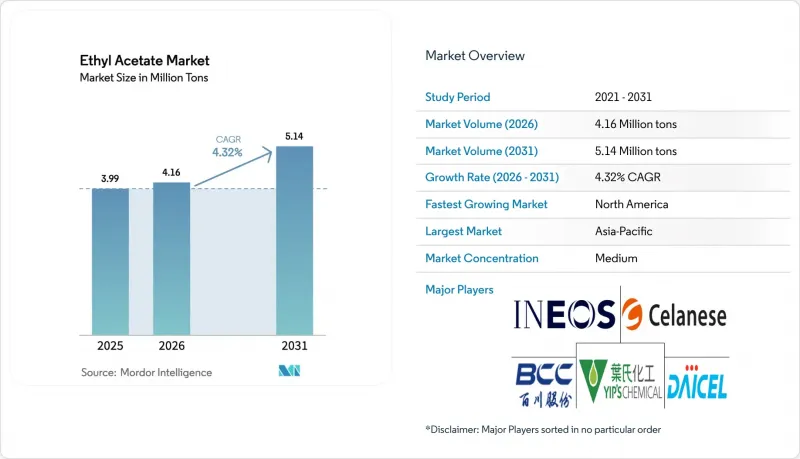
This report is Segmented by Source (Petro-Based and Bio-Based), Purity Grade (Industrial/Coatings Grade, Food Grade, and Pharmaceutical/GMP Grade), Application (Paints and Coatings, Flexible-Packaging Inks, and More), End-User Industry (Automotive, Artificial Leather, and More), and Geography (Asia-Pacific, North America, Europe, and More). The Market Forecasts are Provided in Terms of Volume (Tons).
Global Ethyl Acetate Market Trends and Insights
Rising Demand in Solvent Applications
Industrial solvent usage sets the baseline for ethyl acetate market growth as paints, coatings, adhesives, and general process applications consume large volumes. Architectural-coating recovery in North America and infrastructure spending in India and Southeast Asia keep bulk demand resilient. Eastman's Chemical Intermediates division reported a 15% sequential revenue jump in Q3 2024, citing higher acetyls availability after maintenance work and firmer selling prices, a signal that integrated producers are tightening supply-demand balances. E-commerce packaging expansion amplifies consumption of polyurethane and acrylic laminating adhesives, where ethyl acetate provides the primary solvent in multilayer films. Automotive refinish volumes are normalizing as vehicle fleets age, supporting additional solvent offtake in both North America and Europe. The progressive shift away from methyl ethyl ketone to ethyl acetate in certain coating formulations, driven by lower toxicity and regulatory acceptance, is adding incremental demand.
Growth of the Pharmaceutical Sector
Pharmaceutical manufacturing absorbs ethyl acetate as an extraction medium, reaction solvent, and chromatography eluent. GMP-grade specifications mandate single-site production, batch quarantine, and validated impurity profiling, which raise entry barriers and support premium pricing. India's generic-drug exports surpassed USD 50 billion in 2024, boosting demand for pharmaceutical-grade ethyl acetate in antibiotic purification, steroid extraction, and tablet-coating processes. FDA regulation 21 CFR 182.60 lists the solvent as GRAS, validating its use in excipients and taste-masking formulations under cGMP regimes. ICH Q3C residual-solvent testing keeps removal thresholds tight, sustaining sales of high-purity grades. Celanese's vertically integrated Kingsport, Tennessee complex supplies pharmaceutical customers with traceable, cGMP-compliant solvent, illustrating how feedstock control can secure a durable competitive edge.
Conversion to Water-Borne Adhesives in Europe
European packaging converters have steadily introduced water-borne systems to comply with stringent VOC ceilings. Germany and France have rolled out corporate sustainability frameworks that rank solvent reduction as a top priority, persuading adhesive formulators to trial water-borne or high-solids chemistries. Although solvent-borne lamination still dominates flexible packaging, especially where high bond strength and fast cure speed are critical, a gradual migration to water-borne technologies is under way in end-use cases such as label-stock assembly and certain carton-sealing lines. The learning curve involves adapting to longer drying times and higher energy consumption for water removal, which presently caps penetration rates. North American converters are monitoring European developments and could adopt similar specifications once regulatory pressure converges.
Other drivers and restraints analyzed in the detailed report include:
- EU Shift to Low-VOC Solvents Boosting Offset-Printing Inks
- Increasing Demand for Personal-Care Products
- Volatile Acetic-Acid Feedstock Prices in North America
For complete list of drivers and restraints, kindly check the Table Of Contents.
Segment Analysis
Petro-based maintained 90.23% of worldwide output in 2025 because entrenched Fischer-esterification assets enjoy scale and feedstock cost advantages. Nonetheless, bio-based is expanding at a 6.37% CAGR through 2031 as brand-owner net-zero mandates translate into purchase orders for ISCC PLUS and USDA-certified solvent grades. SEKAB's newly certified bio-acetic acid stream gives European coatings customers mass-balance documentation, while Viridis Chemical services North American buyers with 100% bio-based product. Godavari Biorefineries trimmed steam use to 2.5 tons per ton of solvent and upgraded sustainability credentials, which sharpens the cost curve for renewable supply.
Celanese launched its ECO-B line with up to 43% bio-content, expanding options for partial drop-in replacement in established petro-based chains. Although Asia-Pacific retains a price-centric procurement culture that favors petro-routes, European and North American policies are nurturing a differentiated niche that could account for double-digit percentage shares by 2031 if certification premiums stay inside historical bounds.
Industrial/coatings grade supplied 60.14% of global demand in 2025 and remains the workhorse for high-volume coatings, inks, and adhesives. The ethyl acetate market size attributable to pharmaceutical/GMP grade is however enlarging at a 5.36% clip thanks to API manufacturing growth in India and China. USP and Ph.Eur. assays above 99% purity, strict impurity limits, and batch traceability justify price uplifts that exceed 20% over industrial grades. Eastman's Longview operations illustrate best-practice with validated test methods, residual-solvent assays, and ISO-compliant documentation, all prerequisites for regulatory inspections.
Food-grade solvent fills a smaller but strategically important niche, covering coffee and tea decaffeination under FDA 21 CFR 173.228, with GRAS status reinforcing acceptability for flavor extraction. European rules under Directive 2009/32/EC echo this clearance. Future growth in food-grade demand rides on rising decaf coffee consumption in Asia-Pacific and the scaling of flavor extraction for plant-based proteins where solvent efficiency and recoverability matter.
Complete Report Scope:
- By Source
- Petro-based
- Bio-based
- By Purity Grade
- Industrial/Coatings Grade
- Food Grade
- Pharmaceutical/GMP Grade
- By Application
- Paints and Coatings
- Flexible-Packaging Inks
- Adhesives and Sealants
- Pigments and Dyes
- Process Solvents
- Other Applications (Flavor and Fragrance Enhancers, Inks)
- By End-user Industry
- Automotive
- Artificial Leather
- Food and Beverage
- Pharmaceuticals
- Other End-user Industries (Packaging)
- By Geography
- Asia-Pacific
- China
- India
- Japan
- South Korea
- ASEAN Countries
- Rest of Asia-Pacific
- North America
- United States
- Canada
- Mexico
- Europe
- Germany
- United Kingdom
- France
- Italy
- NORDIC Countries
- Rest of Europe
- South America
- Brazil
- Argentina
- Rest of South America
- Middle-East and Africa
- Saudi Arabia
- United Arab Emirates
- South Africa
- Nigeria
- Rest of Middle-East and Africa
- Asia-Pacific
Geography Analysis
Asia-Pacific accounted for 73.15% of 2025 tonnage thanks to China's gigantic 4.30 million-ton installed base and India's thriving API export industry. Despite chronic oversupply, regional consumption growth stays above 4% as infrastructure build-outs support coatings demand. North America records the fastest regional CAGR at 5.91% through 2031, a function of automotive supply-chain reshoring and new bio-based projects such as Viridis Chemical's Nebraska plant, which benefits from ISCC PLUS certification.
Europe grapples with margin pressure from water-borne adhesive uptake and heavy environmental compliance costs, yet offset-printing ink reformulation and pharmaceutical demand stabilize solvent pull. Middle-East producers face harsher economics; Sipchem's decision to idle its Saudi unit highlights how export-oriented plants struggle when Asian prices dip. South America and Africa post steady but modest gains, with investment concentrated in flexible-packaging converters serving regional food-processing industries.
- Celanese Corporation
- Daicel Corporation
- Eastman Chemical Company
- Godavari Biorefineries Ltd
- Greenfield Global Inc.
- INEOS
- Jiangsu Baichuan High-Tech New Materials Co., Ltd.
- Jiangsu SOPO (Group) Co. Ltd
- Jubilant Pharmova Ltd
- Laxmi Organic Industries Ltd.
- PetroChina Company Limited
- PT Pertamina (Persero)
- Resonac Holdings Corporation
- Sasol Ltd
- SEKAB
- Solvay
- Tokuyama Corporation
- Viridis Chemical, LLC
- Yip's Chemical Holdings Limited
Additional Benefits:
- The market estimate (ME) sheet in Excel format
- 3 months of analyst support
TABLE OF CONTENTS
1 Introduction
- 1.1 Study Assumptions and Market Definition
- 1.2 Scope of the Study
2 Research Methodology
3 Executive Summary
4 Market Landscape
- 4.1 Market Overview
- 4.2 Market Drivers
- 4.2.1 Rising Demand in Solvent Applications
- 4.2.2 Growth of the Pharmaceutical Sector
- 4.2.3 EU Shift to Low-VOC Solvents Boosting Offset-Printing Inks
- 4.2.4 Increasing Demand for Personal-Care Products
- 4.2.5 Net-Zero Roadmaps Accelerating Bio-Based Ethyl-Acetate Purchases
- 4.3 Market Restraints
- 4.3.1 Conversion To Water-Borne Adhesives in Europe
- 4.3.2 Volatile Acetic-Acid Feedstock Prices in North America
- 4.3.3 Global Oversupply from Recent Chinese Capacity Additions
- 4.4 Value Chain Analysis
- 4.5 Porter's Five Forces
- 4.5.1 Bargaining Power of Suppliers
- 4.5.2 Bargaining Power of Buyers
- 4.5.3 Threat of New Entrants
- 4.5.4 Threat of Substitutes
- 4.5.5 Degree of Competition
5 Market Size and Growth Forecasts (Volume)
- 5.1 By Source
- 5.1.1 Petro-based
- 5.1.2 Bio-based
- 5.2 By Purity Grade
- 5.2.1 Industrial/Coatings Grade
- 5.2.2 Food Grade
- 5.2.3 Pharmaceutical/GMP Grade
- 5.3 By Application
- 5.3.1 Paints and Coatings
- 5.3.2 Flexible-Packaging Inks
- 5.3.3 Adhesives and Sealants
- 5.3.4 Pigments and Dyes
- 5.3.5 Process Solvents
- 5.3.6 Other Applications (Flavor and Fragrance Enhancers, Inks)
- 5.4 By End-user Industry
- 5.4.1 Automotive
- 5.4.2 Artificial Leather
- 5.4.3 Food and Beverage
- 5.4.4 Pharmaceuticals
- 5.4.5 Other End-user Industries (Packaging)
- 5.5 By Geography
- 5.5.1 Asia-Pacific
- 5.5.1.1 China
- 5.5.1.2 India
- 5.5.1.3 Japan
- 5.5.1.4 South Korea
- 5.5.1.5 ASEAN Countries
- 5.5.1.6 Rest of Asia-Pacific
- 5.5.2 North America
- 5.5.2.1 United States
- 5.5.2.2 Canada
- 5.5.2.3 Mexico
- 5.5.3 Europe
- 5.5.3.1 Germany
- 5.5.3.2 United Kingdom
- 5.5.3.3 France
- 5.5.3.4 Italy
- 5.5.3.5 NORDIC Countries
- 5.5.3.6 Rest of Europe
- 5.5.4 South America
- 5.5.4.1 Brazil
- 5.5.4.2 Argentina
- 5.5.4.3 Rest of South America
- 5.5.5 Middle-East and Africa
- 5.5.5.1 Saudi Arabia
- 5.5.5.2 United Arab Emirates
- 5.5.5.3 South Africa
- 5.5.5.4 Nigeria
- 5.5.5.5 Rest of Middle-East and Africa
- 5.5.1 Asia-Pacific
6 Competitive Landscape
- 6.1 Market Concentration
- 6.2 Strategic Moves
- 6.3 Market Share (%)/Ranking Analysis
- 6.4 Company Profiles (includes Global level Overview, Market level overview, Core Segments, Financials as available, Strategic Information, Products and Services, and Recent Developments)
- 6.4.1 Celanese Corporation
- 6.4.2 Daicel Corporation
- 6.4.3 Eastman Chemical Company
- 6.4.4 Godavari Biorefineries Ltd
- 6.4.5 Greenfield Global Inc.
- 6.4.6 INEOS
- 6.4.7 Jiangsu Baichuan High-Tech New Materials Co., Ltd.
- 6.4.8 Jiangsu SOPO (Group) Co. Ltd
- 6.4.9 Jubilant Pharmova Ltd
- 6.4.10 Laxmi Organic Industries Ltd.
- 6.4.11 PetroChina Company Limited
- 6.4.12 PT Pertamina (Persero)
- 6.4.13 Resonac Holdings Corporation
- 6.4.14 Sasol Ltd
- 6.4.15 SEKAB
- 6.4.16 Solvay
- 6.4.17 Tokuyama Corporation
- 6.4.18 Viridis Chemical, LLC
- 6.4.19 Yip's Chemical Holdings Limited
7 Market Opportunities and Future Outlook
- 7.1 White-space and Unmet-need Assessment


