|
시장보고서
상품코드
2120352
자동차용 3D 프린팅 : 시장 점유율 분석, 업계 동향과 통계, 성장 예측(2026-2031년)Automotive 3D Printing - Market Share Analysis, Industry Trends & Statistics, Growth Forecasts (2026 - 2031) |
||||||
 Mordor Intelligence
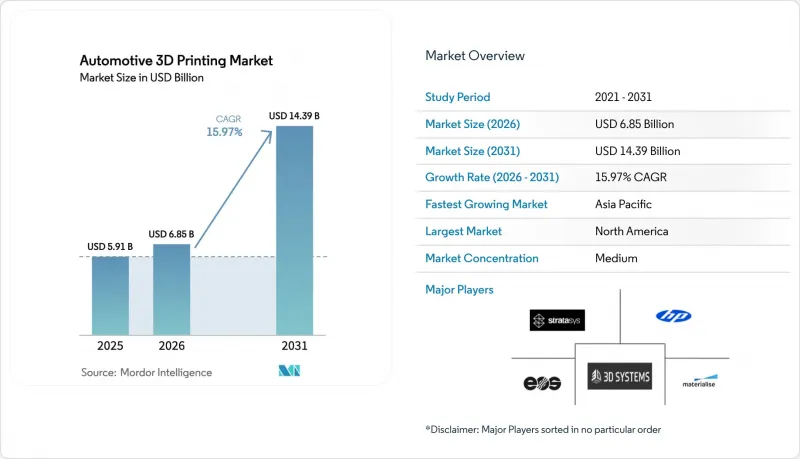
Mordor Intelligence에 따르면 자동차용 3D 프린팅 시장 규모는 2025년에 59억 1,000만 달러로 평가되며, 2026년 68억 5,000만 달러에서 2031년까지 143억 9,000만 달러에 달할 것으로 예측되고 있으며, 예측 기간(2026-2031년)에 CAGR은 15.97%에 달할 전망입니다.
이 보고서는 기술 유형(선택적 레이저 소결(SLS), 스테레오리소그래피(SLA) 등), 구성 요소 유형(하드웨어, 소프트웨어, 서비스), 재료 유형(금속, 폴리머 등), 용도 유형(생산, 프로토타이핑 등) 및 지역별로 분류되어 있습니다. 시장 전망은 금액(달러) 및 수량(단위)으로 제시되어 있습니다.
전 세계 자동차용 3D 프린팅 시장 동향 및 인사이트
전기자동차용 경량 부품 수요
전기자동차 제조업체들은 주행 거리 연장 및 배기가스 규제 준수를 위해 경량화를 추구하고 있습니다. 제너럴 모터스(GM)는 캐딜락 ‘셀레스틱’에 130개 이상의 3D 프린팅 부품을 채택하고 있으며, 그 중에는 자동차 생산 분야에서 최대 규모의 적층 제조 알루미늄 부품도 포함되어 있습니다. 유럽의 유로 7 규제에 따라 브레이크 디스크 코팅 및 구조 부재에 3D 프린팅 기술의 도입이 가속화되고 있습니다. 모래를 소재로 한 3D 프린팅은 금형 개발 주기를 단축하고, 공차 목표를 유지하면서 질량을 줄이는 주조 설계를 가능하게 합니다. 배터리 무게를 상쇄해야 할 필요성으로 인해 모든 차종 플랫폼에서 1그램이라도 경량화를 도모하려는 경쟁적 동기가 강화되고 있습니다.
신속 프로토타이핑을 통한 비용 절감
초기 단계의 설계 반복 과정에서 절삭 가공 대신 적층 조형 기술이 채택됨에 따라 기업은 프로토타입 리드 타임을 최대 90% 단축하고 단일 부품의 비용을 대폭 절감할 수 있었다고 보고하고 있습니다. 스테레오리소그래피(SLS)의 높은 치수 정밀도는 저비용 투자 주조의 대안이 되고 있으며, AI를 활용한 성형 매개변수 최적화를 통해 첫 시도부터 정확하게 성형할 수 있는 성공률이 향상되고 있습니다. 3,000달러 미만의 데스크톱형 SLS 프린터의 등장으로 중소규모 공급업체에 대한 접근성이 확대되었으며, 아시아태평양의 전체 제조 클러스터에서 혁신 주기가 단축되고 있습니다.
금속 프린터의 높은 비용
산업용 SLS 프린터의 정가는 12,000-33,000달러 범위이며, 특수 금속 분말의 평균 가격은 1kg당 300-600달러이므로, 비용을 중시하는 공급업체의 도입이 제한되고 있습니다. 헬륨 분무법을 이용한 분말 제조가 가장 지속가능한 방법이지만, 설비 투자 비용은 여전히 고액입니다. 수명 주기 분석에 따르면 분말 침대 용융법은 고복잡도 부품에 있으며, 경제적이지만, 초기 투자 부담이 여전히 광범위한 도입을 가로막고 있습니다. 저비용 금속 필라멘트 공정은 진입 장벽을 완화하지만, 후처리 과정이 복잡해짐에 따라 자동차용 3D 프린팅 시장의 연평균 성장률(CAGR)을 2.4포인트 하락시키고 있습니다.
부문 분석
FDM은 시스템 비용이 낮고 재료 선택의 폭이 넓기 때문에 2025년 자동차용 3D 프린팅 시장 점유율의 37.74%를 차지했습니다. SLS는 3,000달러 미만의 데스크톱형 분말 베드 시스템을 통해 고성능 나일론 및 복합재료의 프린팅이 보급됨에 따라 2031년까지 연평균 성장률(CAGR) 18.02%로 성장할 것으로 예측됩니다. 나노 규모의 광중합 기술의 발전으로 스테레오리소그래피의 해상도는 초당 100µm로 100 nm에 도달했으며, 그 용도가 마이크로 유체 및 광학 분야로 확대되고 있습니다. 디지털 라이트 프로세싱(DLP)은 보석 및 치과용 모델 제조에 점점 더 많이 활용되는 한편, 전자빔 용융법은 항공우주 분야의 티타늄 부품 제조에 사용되고 있습니다. EV 제조사들이 내구성이 뛰어난 나일론 기어나 보닛 내부의 부품을 채택함에 따라 SLS 기반 부품의 자동차용 3D 프린팅 시장 규모는 급속히 확대될 것으로 예측됩니다.
적층 조형과 절삭 가공 기술을 융합한 하이브리드 제조가 꾸준히 보급되고 있습니다. FDM의 툴패스에는 연속 섬유 보강이 통합되어 있으며, 2차 가공 없이도 인장 강도를 향상시키고 있습니다. 홀로그래픽 체적 프린팅은 층 전체를 동시에 경화시켜 최대 20배의 속도 향상을 실현하고 있으며, 자동차 내장 부품의 대량 생산에 있으며, 큰 가능성을 지니고 있습니다. 공정 시뮬레이션 소프트웨어의 지속적인 개선을 통해 시제품 제작의 반복 횟수가 줄어들고, SLS 도입 대수가 증가하는 상황에서도 FDM의 중요성은 여전히 유지되고 있습니다.
2025년 매출 중 프린터, 후처리 스테이션, 스캐너를 포함한 하드웨어가 56.61%를 차지했습니다. 그러나 기계학습 알고리즘을 통해 불량률이 감소하고, 여러 공장에 걸쳐 있는 설비군의 운영이 최적화됨에 따라 소프트웨어 시장은 연평균 성장률(CAGR) 18.21%로 확대되고 있습니다. 베이커 휴즈(Baker Hughes)에 도입된 제조 운영 플랫폼 덕분에 모니터링 시간이 98% 단축되고, 폐기율이 18% 감소했습니다. 자동차 제조사가 설비 투자 대비 수익성이 낮은 특수 소재나 소량 생산을 외부에 위탁할 경우, 서비스 뷰로는 번창합니다.
AI를 활용한 조형 매개변수 엔진 덕분에 엔지니어링 작업이 80% 감소하여, 자동차용 3D 프린팅 시장에서 소프트웨어 점유율 확대에 기여하고 있습니다. 브라우저 기반의 협업 제품군을 통해 대륙을 넘나드는 설계 반복이 가능해져, 동시 엔지니어링과 생산으로의 신속한 전환이 실현됩니다. 클라우드 연결이 확대됨에 따라 구독 수익은 벤더에게 높은 이익률을 가진 지속적인 수입을 가져다주며, 경쟁의 중심은 기계에서 디지털 생태계로 이동하고 있습니다.
지역별 분석
북미는 미국의 항공우주 및 전기자동차(EV) 공급망 우위를 바탕으로 2025년에는 38.02%의 점유율로 자동차용 3D 프린팅 시장을 선도하고 있습니다. GE 에어로스페이스의 적층 제조 시설에 대한 10억 달러 투자는 국내 생산에 대한 장기적인 신뢰를 보여줍니다. 리쇼어링 노력과 ‘인플레이션 억제법’이 맞물려 현지 생산이 촉진되고 있으며, 자동차 업계의 각 티어에서 프린터 도입이 가속화되고 있습니다. 캐나다와 멕시코는 국경을 넘는 무역 체제를 활용하여 경량 트럭용 부품 및 항공우주용 주조 금형을 통해 시장에 기여하고 있습니다.
아시아태평양은 2031년까지 연평균 성장률(CAGR)이 18.96%로 가장 빠르게 성장하는 지역이며, 중국의 제조업 디지털화와 인도에서 부상하는 바이오프린팅 관련 스타트업에 의해 주도되고 있습니다. 중국의 5개년 계획에서는 적층 제조가 전략적 핵심 축으로 자리매김하고 있으며, 자동차 산업 거점 및 배터리 공장에서의 도입 확대가 촉진되고 있습니다. 인도에서는 EOS사와 고드레이사의 제휴를 통해 항공우주 분야에서의 응용이 가속화되고 있는 한편, 민관 공동 연구개발 센터가 기술 개발을 추진하고 있습니다. 일본과 한국은 소재 혁신을 추진하며, 하이브리드 전기 파워트레인에 최적화된 내열성 폴리머를 개발하고 있습니다. 동남아시아의 전자 산업 클러스터에서는 정부의 세제 혜택에 힘입어 금형 제조에 3D 프린팅이 도입되고 있습니다.
유럽은 큰 시장 점유율을 차지하고 있으며, 그 중심인 독일에서는 대다수의 제조업체가 적층 제조 공정을 도입하고 있습니다. 이 지역에서는 AM 기업의 매출의 30.6%를 연구개발에 재투자하며, 금속 프린터 수출 분야에서 리더십을 강화하고 있습니다. 프랑스와 이탈리아에서는 슈퍼카용 복합 소재 프린팅을 확대하고 있는 반면, 스칸디나비아 국가들에서는 차량 내장재용 바이오 기반 폴리머 연구가 진행되고 있습니다. ISO/ASTM 규격에 따른 규제 조화가 프린팅 부품의 국경을 초월한 인증을 지원하며, 공급망의 흐름을 원활하게 하고 있습니다. 남미와 중동 등 신흥 지역에서는 사업 다각화가 진행되고 있습니다. 사우디아라비아에서는 금속 가공시 에너지 소비를 줄이기 위해 중소기업을 대상으로 엔트리 레벨 프린터를 도입하고 있습니다. 브라질에서는 농업기계를 위한 적층 제조 방식의 수리 거점에 대한 시범 운영이 진행되고 있으며, 이 기술이 소득 수준이 높은 경제권 이외의 지역으로도 확산되고 있음을 보여주고 있습니다.
기타 혜택:
- 엑셀 형식의 시장 예측(ME) 시트
- 3개월간의 애널리스트 지원
자주 묻는 질문
목차
제1장 서론
제2장 조사 방법
제3장 개요
제4장 시장 구도
제5장 시장 규모와 성장 예측
제6장 경쟁 구도
제7장 시장 기회와 향후 전망
KSA 26.09.02According to Mordor Intelligence, the automotive 3D printing market size was valued at USD 5.91 billion in 2025 and estimated to grow from USD 6.85 billion in 2026 to reach USD 14.39 billion by 2031, at a CAGR of 15.97% during the forecast period (2026-2031).
This report is Segmented by Technology Type (Selective Laser Sintering (SLS), Stereo Lithography (SLA), and More ), Component Type (Hardware, Software, and Service), Material Type (Metal, Polymer, and More), Application Type (Production, Prototyping, and More), and Geography. The Market Forecasts are Provided in Terms of Value (USD) and Volume (Units).
Global Automotive 3D Printing Market Trends and Insights
EV Lightweight-Parts Demand
Electric vehicle makers pursue weight optimization to extend their range and comply with emissions standards. General Motors integrates more than 130 printed parts in the Cadillac Celestiq, including the largest additively manufactured aluminum component in automotive production. Europe's Euro 7 norms accelerate adoption for brake-disc coatings and structural elements. Sand-based 3D printing shortens mold-development cycles, enabling casting designs that reduce mass while preserving tolerance targets. The need to offset battery weight intensifies competitive incentives to remove every gram across vehicle platforms.
Rapid Prototyping Cost-Cuts
Enterprises report up to 90% reductions in prototype lead times and sharp declines in single-part costs as additive manufacturing replaces machining for early-stage design iterations. Stereolithography's high dimensional accuracy supports low-cost investment casting alternatives, while AI-based build-parameter optimization elevates first-time-right success rates. Desktop SLS printers priced below USD 3,000 broaden access for small and midsize suppliers, compressing innovation cycles across Asia-Pacific manufacturing clusters.
High Cost of Metal Printers
Industrial SLS printers list between USD 12,000 and USD 33,000, while specialty metal powders average USD 300-600 per kg, limiting adoption among cost-sensitive suppliers. Helium-atomized powder production offers the most sustainable route, yet capital outlays remain steep. Lifecycle analyses show powder-bed fusion is economical for high-complexity components, but up-front capital still deters wide deployment. Lower-cost metal-filament processes mitigate entry barriers but add post-processing complexity, reducing the Automotive 3D printing market CAGR by 2.4 percentage points
Other drivers and restraints analyzed in the detailed report include:
- Custom Production Tooling
- Digital Spare-Parts Inventory
- Material-Qualification Gaps
For complete list of drivers and restraints, kindly check the Table Of Contents.
Segment Analysis
FDM accounted for 37.74% of the Automotive 3D printing market share in 2025, owing to low system costs and broad material selection. SLS is projected to grow at an 18.02% CAGR through 2031 as desktop powder-bed systems below USD 3,000 democratize high-performance nylon and composite printing. Advances in nanoscale photopolymerization have pushed stereolithography resolution to 100 nm at 100 µm per second, extending its use into microfluidic and optics applications. Digital Light Processing (DLP) increasingly supports jewelry and dental models, while electron-beam melting serves aerospace titanium parts. The Automotive 3D printing market size for SLS-based parts is forecast to expand sharply as EV manufacturers adopt durable nylon gears and under-hood components.
Hybrid manufacturing that blends additive and subtractive techniques is gaining ground. FDM toolpaths integrate continuous-fiber reinforcement, improving tensile strength without secondary operations. Holographic volumetric printing demonstrates up-to-20-fold speed gains by curing entire layers simultaneously, holding promise for high-volume automotive interiors. Continual improvements in process simulation software reduce trial iterations, ensuring FDM retains relevance even as the SLS installed base rises.
Hardware captured 56.61% of 2025 revenue, encompassing printers, post-processing stations, and scanners. However, software is expanding at 18.21% CAGR as machine-learning algorithms cut defect rates and orchestrate multi-factory fleets. Manufacturing operations platforms deployed at Baker Hughes trimmed monitoring time by 98% and scrap by 18%. Service bureaus flourish when automakers outsource specialty materials or small production runs that do not justify capital spending.
AI-driven build-parameter engines reduce engineering labor by 80%, contributing to a rising software share within the Automotive 3D printing market. Browser-based collaboration suites allow design iterations across continents, enabling simultaneous engineering and rapid release to production. As cloud connectivity scales, subscription revenue offers vendors a high-margin annuity, shifting the competitive balance from machines to digital ecosystems
Complete Report Scope:
- By Technology Type
- Selective Laser Sintering (SLS)
- Stereolithography (SLA)
- Digital Light Processing (DLP)
- Electron Beam Melting (EBM)
- Selective Laser Melting (SLM)
- Fused Deposition Modeling (FDM)
- By Component Type
- Hardware
- Software
- Service
- By Material Type
- Metal
- Polymer
- Ceramic
- Composite
- By Application Type
- Production
- Prototyping
- Tooling and Fixtures
- Spare-Parts / MRO
- Geography
- North America
- United States
- Canada
- Rest of North America
- South America
- Brazil
- Argentina
- Rest of South America
- Europe
- Germany
- United Kingdom
- France
- Italy
- Spain
- Russia
- Rest of Europe
- Asia-Pacific
- China
- Japan
- India
- South Korea
- Rest of Asia-Pacific
- Middle East and Africa
- United Arab Emirates
- Saudi Arabia
- South Africa
- Egypt
- Rest of Middle East and Africa
- North America
Geography Analysis
North America leads the Automotive 3D printing market with a 38.02% share in 2025, supported by the United States' dominant aerospace and EV supply chains. GE Aerospace's USD 1 billion investment in additive facilities signals long-term confidence in domestic productio. Reshoring initiatives combined with the Inflation Reduction Act incentivize localized manufacturing, accelerating printer installations across automotive tiers. Canada and Mexico contribute through lightweight truck components and aerospace casting molds, leveraging cross-border trade frameworks.
Asia-Pacific is the fastest-growing region at a 18.96% CAGR through 2031, propelled by China's manufacturing digitalization and India's emerging bioprinting startups. Chinese five-year plans earmark additive manufacturing as a strategic pillar, spurring installation growth across automotive hubs and battery factories. India's collaboration between EOS and Godrej accelerates aerospace applications, while public-private R&D centers foster skill development. Japan and South Korea push materials innovation, developing heat-resistant polymers tailored to hybrid-electric powertrains. Southeast Asian electronics clusters adopt 3D printing for tooling, aided by government tax incentives.
Europe holds a significant share, anchored by Germany where majority of manufacturers deploy additive processes. The region invests 30.6% of AM company turnover back into R&D, reinforcing leadership in metal-printer exports. France and Italy expand composite printing for supercars, while Scandinavia explores bio-based polymers for vehicle interiors. Regulatory alignment through ISO/ASTM standards supports cross-border qualification of printed parts, smoothing supply-chain flows. Emerging regions in South America and the Middle East pursue diversification; Saudi Arabia outfits SMEs with entry-level printers to decrease energy consumption in metal fabrication. Brazil pilots additive repair hubs for agricultural machinery, demonstrating the technology's reach beyond high-income economies.
- Stratasys Ltd
- 3D Systems Corporation
- EOS GmbH
- HP Inc.
- Materialise NV
- GE Additive (Arcam AB)
- Desktop Metal (ExOne)
- Ultimaker BV
- Voxeljet AG
- Carbon Inc.
- Hoganos AB
- EnvisionTEC GmbH
- SLM Solutions Group AG
- Renishaw plc
- BASF Forward AM
- Markforged Inc.
- Sindoh Co. Ltd
- XYZprinting Inc.
- Moog Inc.
Additional Benefits:
- The market estimate (ME) sheet in Excel format
- 3 months of analyst support
TABLE OF CONTENTS
1 Introduction
- 1.1 Study Assumptions & Market Definition
- 1.2 Scope of the Study
2 Research Methodology
3 Executive Summary
4 Market Landscape
- 4.1 Market Overview
- 4.2 Market Drivers
- 4.2.1 EV lightweight-parts demand
- 4.2.2 Rapid prototyping cost-cuts
- 4.2.3 Custom production tooling
- 4.2.4 Digital spare-parts inventory
- 4.2.5 Multi-material AM integration
- 4.2.6 Supply-chain on-shoring push
- 4.3 Market Restraints
- 4.3.1 High cost of metal printers
- 4.3.2 Material-qualification gaps
- 4.3.3 Energy-intensive laser systems
- 4.3.4 IP-security concerns
- 4.4 Value/Supply-Chain Analysis
- 4.5 Regulatory Landscape
- 4.6 Technological Outlook
- 4.7 Porter's Five Forces
- 4.7.1 Bargaining Power of Suppliers
- 4.7.2 Bargaining Power of Buyers
- 4.7.3 Threat of New Entrants
- 4.7.4 Threat of Substitutes
- 4.7.5 Intensity of Competitive Rivalry
5 Market Size & Growth Forecasts (Value (USD) and Volume (Units))
- 5.1 By Technology Type
- 5.1.1 Selective Laser Sintering (SLS)
- 5.1.2 Stereolithography (SLA)
- 5.1.3 Digital Light Processing (DLP)
- 5.1.4 Electron Beam Melting (EBM)
- 5.1.5 Selective Laser Melting (SLM)
- 5.1.6 Fused Deposition Modeling (FDM)
- 5.2 By Component Type
- 5.2.1 Hardware
- 5.2.2 Software
- 5.2.3 Service
- 5.3 By Material Type
- 5.3.1 Metal
- 5.3.2 Polymer
- 5.3.3 Ceramic
- 5.3.4 Composite
- 5.4 By Application Type
- 5.4.1 Production
- 5.4.2 Prototyping
- 5.4.3 Tooling and Fixtures
- 5.4.4 Spare-Parts / MRO
- 5.5 Geography
- 5.5.1 North America
- 5.5.1.1 United States
- 5.5.1.2 Canada
- 5.5.1.3 Rest of North America
- 5.5.2 South America
- 5.5.2.1 Brazil
- 5.5.2.2 Argentina
- 5.5.2.3 Rest of South America
- 5.5.3 Europe
- 5.5.3.1 Germany
- 5.5.3.2 United Kingdom
- 5.5.3.3 France
- 5.5.3.4 Italy
- 5.5.3.5 Spain
- 5.5.3.6 Russia
- 5.5.3.7 Rest of Europe
- 5.5.4 Asia-Pacific
- 5.5.4.1 China
- 5.5.4.2 Japan
- 5.5.4.3 India
- 5.5.4.4 South Korea
- 5.5.4.5 Rest of Asia-Pacific
- 5.5.5 Middle East and Africa
- 5.5.5.1 United Arab Emirates
- 5.5.5.2 Saudi Arabia
- 5.5.5.3 South Africa
- 5.5.5.4 Egypt
- 5.5.5.5 Rest of Middle East and Africa
- 5.5.1 North America
6 Competitive Landscape
- 6.1 Market Concentration
- 6.2 Strategic Moves
- 6.3 Market Share Analysis
- 6.4 Company Profiles (Includes Global Level Overview, Market Level Overview, Core Segments, Financials as Available, Strategic Information, Market Rank/Share for Key Companies, Products and Services, and Recent Developments)
- 6.4.1 Stratasys Ltd
- 6.4.2 3D Systems Corporation
- 6.4.3 EOS GmbH
- 6.4.4 HP Inc.
- 6.4.5 Materialise NV
- 6.4.6 GE Additive (Arcam AB)
- 6.4.7 Desktop Metal (ExOne)
- 6.4.8 Ultimaker BV
- 6.4.9 Voxeljet AG
- 6.4.10 Carbon Inc.
- 6.4.11 Hoganos AB
- 6.4.12 EnvisionTEC GmbH
- 6.4.13 SLM Solutions Group AG
- 6.4.14 Renishaw plc
- 6.4.15 BASF Forward AM
- 6.4.16 Markforged Inc.
- 6.4.17 Sindoh Co. Ltd
- 6.4.18 XYZprinting Inc.
- 6.4.19 Moog Inc.