|
시장보고서
상품코드
2120357
항균 코팅 : 시장 점유율 분석, 업계 동향 및 통계, 성장 예측(2026-2031년)Anti-microbial Coatings - Market Share Analysis, Industry Trends & Statistics, Growth Forecasts (2026 - 2031) |
||||||
 Mordor Intelligence
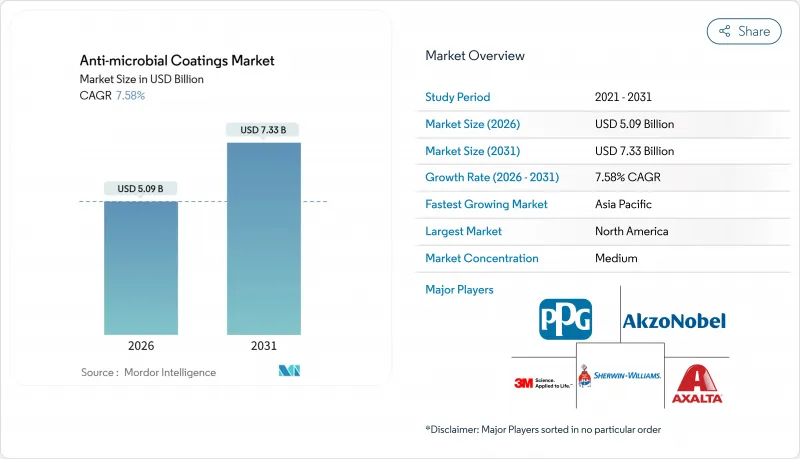
Mordor Intelligence에 의하면, 항균 코팅 시장 규모는 2026년에 50억 9,000만 달러로 추정되고 예측 기간(2026-2031년) CAGR 7.58%로 확대되어 2031년에는 73억 3,000만 달러에 이를 전망입니다.
본 보고서는 소재(은 구리, 폴리머 등), 코팅 형태(분말, 액체, 기타), 용도(건축 및 건설, 식품 가공, 섬유, 가전, 의료, 선박, 기타 용도) 및 지역(아시아태평양, 북미, 유럽, 남미, 중동 및 아프리카)별로 분류되어 있습니다. 시장 전망은 금액(달러) 기준으로 제시되어 있습니다.
세계의 항균 코팅 시장 동향 및 인사이트
병원 내 감염(HAI) 저감 프로그램이 북미의 병원용 표면 코팅 도입을 가속화하고 있습니다.
미국 질병통제예방센터(CDC)는 2025년, 급성기 의료 현장에서 발생하는 병원체 전파의 최대 40%가 환경 표면에 기인한다고 보고했습니다. 업데이트된 CDC 지침에서는 침대 난간,수액 스탠드, 간호사 호출 버튼에 EPA 등록 항균 코팅을 ‘Tier 2’ 개입 조치로 권장하고 있으며, 손 위생과 더불어 영구적인 표면 개질을 중요시하게 되었습니다. 조인트 커미션은 2025년 인증 조사에 코팅 감사를 포함시켜, 대응이 늦어지고 있는 시설에 대해 개조를 촉구하고 있습니다. 병원 내 감염(HAI) 발생률이 중앙값을 초과하는 병원에는 최대 3%의 환급 감액 조치가 부과되므로, 내구성이 뛰어난 항균 인프라에 대한 투자에 대한 직접적인 경제적 인센티브가 발생하고 있습니다. 이에 대응하여 각 공급업체들은 최대 5년간 효과를 유지하는 은 이온 및 구리 합금 코팅을 제공하며, 항균 코팅을 소모품으로서의 경비가 아닌 자본 자산으로 재정의하고 있습니다.
인도 및 아세안(ASEAN) 지역의 콜드체인 확장이 항균 분말 수요를 견인
인도의 ‘국가 콜드체인 미션’은 2024년에 400억 루피(4억 8,000만 달러)를 예산으로 책정하고, 냉장 창고 및 운송 컨테이너에 항균 분체 코팅을 의무화했습니다. 2025년 1월에 발효된 개정판 ‘적정 유통 기준(GDP)’ 지침에서는 코로나19 대응 캠페인 기간 중 발생한 콜드체인 문제를 반영하여, 백신 보관 시설에서 ISO 21702 인증을 획득한 항바이러스 코팅의 사용을 의무화하고 있습니다. 아세안 규제 당국도 유사한 움직임을 보이고 있습니다. 인도네시아의 BPOM 규정 제12/2025호는 의약품 허브에서의 항균 처리를 규정하고 있으며, 베트남은 EU 고객을 대상으로 수산물의 콜드체인을 개선하기 위해 1억 2,000만 달러를 배정했습니다. 정전기 분체 도장은 골판금에 균일한 도포를 보장하고, VOC(휘발성 유기 화합물) 배출을 최소화함으로써 산업안전보건 요건도 충족합니다.
개발도상국 및 미개발국의 기술적 인식 부족
세계보건기구(WHO)의 데이터에 따르면, 저소득국의 공립 병원 중 감염 관리 프로토콜에 내구성 있는 표면 처리를 명시하고 있는 곳은 불과 15%인 반면, 고소득국에서는 78%에 달할 전망입니다. ISO 22196 및 ISO 21702 표준에 대한 이해가 제한적이기 때문에 조달 담당자는 코팅의 효능을 평가할 기준을 갖추고 있지 않습니다. 교육 부족이 이 문제를 더욱 심각하게 만들고 있습니다. 사하라 이남 아프리카의 시설 관리자 중 항균 코팅에 관한 정규 교육을 받은 비율은 고작 22%인 반면, 북미에서는 61%에 달할 전망입니다. 또한, 항균 코팅은 기존 도료에 비해 30-50% 더 비싸기 때문에 가격에 대한 민감성도 보급을 저해하고 있습니다. 각 공급업체는 다자간 금융기관과 공동으로 실증 프로젝트를 시범적으로 실시하여 그 유효성을 입증함과 동시에 현지에서 신뢰를 쌓으려고 하고 있습니다.
부문 분석
은계 코팅은 광범위한 효능과 제품 승인을 간소화하는 규제 측면의 실적을 바탕으로, 2025년에도 매출 점유율 49.45%로 선두 자리를 유지했습니다. 병원에서는 전체 수명 주기 비용 절감에 기여하며, 수년에 걸쳐 성능이 입증된 은계 코팅이 선호되고 있습니다. 유기 활성 물질, 4급 암모늄, 키토산 및 에센셜 오일 유도체는 2031년까지 연평균 9.72%의 성장률을 보이며, 금속 용출을 최소화하는 것을 우선시하는 용도에서 점유율을 확대되고 있습니다. 구리 제제는 칠레공급 차질로 인한 원자재 비용 변동에 직면해 있으며, 이로 인해 생산자들은 금속 사용량을 줄이는 고분자 매트릭스로의 전환을 추진하고 있습니다. 산화 그래핀, 광촉매성 이산화티타늄 및 기타 신흥 소재는 여전히 틈새 시장으로 남아 있지만, 저비용 또는 저독성으로 높은 성능을 추구하는 공급업체들로부터 지속적인 연구개발 투자를 받고 있습니다.
생태 독성에 대한 감시가 강화됨에 따라, 제제 개발자들은 효능과 금속 함유량을 분리해야 하는 압박을 받고 있습니다. 폴리머로 코팅된 살생물제는 방출 동태를 연장하여 유효 성분의 사용량을 30-40% 줄일 수 있게 해줍니다. 그래핀-은 복합재와 같은 하이브리드 접근 방식은 동등한 항균 로그 감소율을 달성하면서도 은 함유량을 최대 60%까지 줄일 수 있어, 최종 사용자가 예산 제약이나 친환경 건축 기준에 직면한 상황에서 매력적인 대안이 되고 있습니다. 바이오 대안이 확대됨에 따라, 경쟁력 있는 가격 책정으로 인해 은 이온 코팅에 기존에 붙어 있던 가격 프리미엄은 축소될 전망입니다.
지역별 분석
북미는 2025년 매출의 45.27%를 차지했습니다. 이는 감염 방지 프로토콜에서 항균 코팅의 중요성을 강조한 CDC(미국 질병통제예방센터)의 지침과, 수성 코팅의 채택을 가속화한 EPA(미국 환경보호청)의 VOC 규제에 힘입은 결과입니다. 캐나다도 비슷한 경로를 따르고 있으며, 재사용 가능한 기기의 표면에 대한 항균 효과 표시를 허용하고 있습니다. 한편, 멕시코에서는 미국으로의 수출 자격을 유지하기 위해 식품 가공 공장의 개보수가 진행되고 있습니다. 제로 VOC 배합은 의료 및 교육 분야의 입찰에서 빠르게 표준으로 자리 잡고 있으며, 선진적인 수성 제품 포트폴리오를 보유한 공급업체에 유리하게 작용하고 있습니다.
아시아태평양은 인도의 ‘국가 콜드체인 미션’, 중국의 적극적인 병원 건설 계획, 그리고 한국의 전자기기 OEM 통합에 힘입어 연평균 성장률(CAGR) 9.08%로 가장 높은 성장률을 기록하고 있습니다. 인도는 냉장 물류 분야에서 항균 코팅을 의무화함으로써 2028년까지 백신 품질 저하를 50% 줄이는 것을 목표로 하고 있습니다. 중국의 ‘제14차 5개년 계획’에서는 빈번하게 접촉되는 표면에 코팅을 적용하는 것을 포함해 감염 관리 규격을 충족해야 하는 신규 병원 1,400곳의 건설이 예정되어 있습니다. 한국에서는 전자 부품 공급업체를 대상으로 한 행동 강령에서 ISO 22196 인증이 의무화되어, 밸류체인 전반에 걸친 표준화가 가속화되고 있습니다.
유럽 시장은 엄격한 ‘살생물제 규제’에 따른 감독과, 바이오 및 수성 솔루션을 장려하는 VOC(휘발성 유기 화합물) 상한 규제에 의해 형성되고 있습니다. 독일에서는 교통 및 교육 인프라에 항균 코팅이 권장되는 반면, 영국의 국민보건서비스(NHS)에서는 18개월마다 ISO 22196 재검사를 의무화하고 있습니다. 프랑스의 식품 가공 분야 도입과 이탈리아의 해양 분야로의 전환은 EU 전체의 환경 우선 순위를 반영하고 있습니다. 남미, 중동 및 아프리카에서는 아직 도입 초기 단계이지만, 브라질과 사우디아라비아의 병원 건설 계획에 발맞추어 국지적인 성장이 나타나고 있습니다.
기타 혜택 :
- 엑셀 형식 시장 예측(ME) 시트
- 3개월간의 애널리스트 지원
자주 묻는 질문
목차
제1장 서론
제2장 조사 방법
제3장 주요 요약
제4장 시장 구도
제5장 시장 규모 및 성장 예측
제6장 경쟁 구도
제7장 시장 기회 및 향후 전망
KTH 26.09.10According to Mordor Intelligence, the anti-microbial coatings market size is estimated at USD 5.09 billion in 2026, and is expected to reach USD 7.33 billion by 2031, at a CAGR of 7.58% during the forecast period (2026-2031).
This report is Segmented by Material (Silver, Copper, Polymeric, and More), Coating Form (Powder, Liquid, and Others), Application (Building and Construction, Food Processing, Textiles, Home Appliances, Healthcare, Marine, and Other Applications), and Geography (Asia-Pacific, North America, Europe, South America, and Middle East and Africa). Market Forecasts are Provided in Terms of Value (USD).
Global Anti-microbial Coatings Market Trends and Insights
HAI-Reduction Programs Accelerating Hospital Surface Coating Uptake in North America
The Centers for Disease Control and Prevention reported in 2025 that environmental surfaces contribute up to 40% of pathogen transmission in acute-care settings. Updated CDC guidance now recommends EPA-registered antimicrobial coatings on bed rails, IV poles, and nurse call buttons as a Tier 2 intervention, elevating permanent surface engineering alongside hand hygiene. The Joint Commission incorporated coating audits into its 2025 accreditation surveys, pushing lagging facilities toward retrofits. Reimbursement penalties of up to 3% for hospitals with above-median HAI rates create a direct financial incentive to invest in durable antimicrobial infrastructure. Suppliers have responded with silver-ion and copper-alloy coatings that maintain efficacy for up to five years, repositioning antimicrobial coatings as a capital asset instead of a consumable expense.
Cold-Chain Expansion in India & ASEAN Propelling Antimicrobial Powder Demand
India's National Cold Chain Mission earmarked INR 40 billion (USD 480 million) in 2024 and mandates antimicrobial powder coatings on refrigerated warehouses and transport containers. Revised Good Distribution Practice guidelines, effective January 2025, require ISO 21702-certified antiviral coatings in vaccine storage, following cold-chain failures during the COVID-19 campaign. ASEAN regulators mirror the move: Indonesia's BPOM Regulation No. 12/2025 stipulates antimicrobial treatment in pharmaceutical hubs, and Vietnam allocated USD 120 million to upgrade seafood cold chains that serve EU customers. Electrostatic powder application ensures uniform coverage on corrugated metal and minimizes VOC emissions, aligning with occupational-safety requirements.
Lack of Technological Awareness in Developing & Under-Developed Nations
World Health Organization data show that only 15% of public hospitals in low-income countries reference durable surface treatments in infection-control protocols, compared with 78% in high-income economies. Limited familiarity with ISO 22196 and ISO 21702 standards leaves procurement officials without benchmarks to assess coating claims. Training gaps compound the issue; only 22% of facility managers in sub-Saharan Africa had formal education on antimicrobial coatings, versus 61% in North America. Price sensitivity also restrains uptake, as antimicrobial coatings can command a 30-50% premium over conventional paints. Suppliers are piloting demonstration projects with multilateral lenders to showcase efficacy and build local credibility.
Other drivers and restraints analyzed in the detailed report include:
- Touch-Interface Hygiene Requirements Driving Electronics OEM Coating Integration
- VOC-Cap Compliance Shifting Demand Toward Water-Borne & Nano Formulations
- Emission-Toxicity Concerns for Active Ingredients
For complete list of drivers and restraints, kindly check the Table Of Contents.
Segment Analysis
Silver retained the leading 49.45% revenue share in 2025, underpinned by broad-spectrum efficacy and a regulatory track record that simplifies product approval. Hospitals prefer silver-based coatings that demonstrate multi-year performance, which helps reduce total lifecycle costs. Organic actives, quaternary ammonium, chitosan, and essential-oil derivatives are growing at 9.72% annually through 2031, capturing share in applications that prioritize minimal metal leaching. Copper formulations face input-cost volatility linked to Chilean supply disruptions, driving producers toward polymeric matrices that cut metal usage. Graphene oxide, photocatalytic titanium dioxide, and other emerging materials remain niche but attract sustained R&D investment from suppliers seeking performance at lower cost or toxicity.
Rising ecotoxicity scrutiny has pushed formulators to decouple efficacy from metal loading. Polymer-encapsulated biocides extend release kinetics, allowing a 30-40% reduction in active-ingredient use. Hybrid approaches such as graphene-silver composites target the same antimicrobial log-reduction while cutting silver content by up to 60%, making them attractive where end-users face budget constraints or green-building criteria. As bio-based options scale, competitive pricing is likely to narrow the historical premium of silver-ion coatings.
Complete Report Scope:
- By Material
- Silver
- Copper
- Polymeric
- Organic
- Other Materials
- By Coating Form
- Powder
- Liquid (Solvent- and Water-borne)
- Others (Nano-Engineered Sprays and Films, Surface Modification Treatments)
- By Application
- Building and Construction
- Food Processing
- Textiles
- Home Appliances
- Healthcare
- Marine
- Other Applications
- By Geography
- Asia-Pacific
- China
- India
- Japan
- South Korea
- Rest of Asia-Pacific
- North America
- United States
- Canada
- Mexico
- Europe
- Germany
- United Kingdom
- France
- Italy
- Rest of Europe
- South America
- Brazil
- Argentina
- Rest of South America
- Middle East and Africa
- Saudi Arabia
- South Africa
- Rest of Middle East and Africa
- Asia-Pacific
Geography Analysis
North America captured 45.27% of 2025 revenue, supported by CDC guidance that elevated antimicrobial coatings in infection-control protocols and by EPA VOC regulations that accelerate water-borne adoption. Canada follows a similar path, permitting antimicrobial claims on reusable equipment surfaces, while Mexico retrofits food-processing plants to preserve US export eligibility. Zero-VOC formulations are quickly becoming the standard in healthcare and education tenders, favoring suppliers with advanced water-borne portfolios.
Asia-Pacific is the highest-growth region at a 9.08% CAGR, driven by India's National Cold Chain Mission, China's aggressive hospital-construction pipeline, and Korea's electronics OEM integration. India targets a 50% vaccine spoilage reduction by 2028 through mandatory antimicrobial coatings in refrigerated logistics. China's 14th Five-Year Plan schedules 1,400 new hospitals that must meet infection-control specifications, including coated high-touch surfaces. South Korea's supplier code of conduct for electronics components now mandates ISO 22196 certification, accelerating standardization across the value chain.
Europe's market is shaped by strict Biocidal Products Regulation oversight and VOC caps that encourage bio-based and water-borne solutions. Germany recommends antimicrobial coatings in transit and education infrastructure, while the United Kingdom's National Health Service mandates ISO 22196 retesting every 18 months. Food-processing adoption in France and marine transitions in Italy reflect broader EU environmental priorities. South America and Middle East-Africa remain nascent but show isolated growth pockets tied to hospital construction programs in Brazil and Saudi Arabia.
- 3M
- Advanced Nanotech Lab
- AGC Inc.
- Akzo Nobel N.V.
- AST Products, Inc.
- Axalta Coating Systems, LLC
- BASF
- BioCote Limited
- Bio-Fence
- Covalon Technologies Ltd.
- Diamond Vogel
- dsm-firmenich
- DuPont
- Henkel AG & Co. KGaA
- Hydromer
- Jotun
- Lonza
- Microban International
- NEI Corporation
- Novapura AG
- PPG Industries, Inc.
- Sciessent LLC
- Sono-Tek Corporation
- Specialty Coating Systems Inc.
- The Sherwin-Williams Company
Additional Benefits:
- The market estimate (ME) sheet in Excel format
- 3 months of analyst support
TABLE OF CONTENTS
1 Introduction
- 1.1 Study Assumptions & Market Definition
- 1.2 Scope of the Study
2 Research Methodology
3 Executive Summary
4 Market Landscape
- 4.1 Market Overview
- 4.2 Market Drivers
- 4.2.1 HAI-reduction programs accelerating hospital surface coating uptake in North America
- 4.2.2 Cold-chain expansion in India & ASEAN propelling antimicrobial powder demand
- 4.2.3 Touch-interface hygiene requirements driving electronics OEM coating integration
- 4.2.4 VOC-cap compliance shifting demand toward water-borne & nano formulations in North America & Europe
- 4.2.5 Smart self-sanitising public-transit surfaces linked to micro-mobility adoption
- 4.3 Market Restraints
- 4.3.1 Lack of technological awareness in developing & under-developed nations
- 4.3.2 Emission-toxicity concerns for active ingredients
- 4.3.3 Chilean copper-ore supply strikes inflating raw-material costs
- 4.4 Value Chain Analysis
- 4.5 Porter's Five Forces
- 4.5.1 Bargaining Power of Suppliers
- 4.5.2 Bargaining Power of Buyers
- 4.5.3 Threat of New Entrants
- 4.5.4 Threat of Substitutes
- 4.5.5 Industry Rivalry
5 Market Size and Growth Forecasts (Value)
- 5.1 By Material
- 5.1.1 Silver
- 5.1.2 Copper
- 5.1.3 Polymeric
- 5.1.4 Organic
- 5.1.5 Other Materials
- 5.2 By Coating Form
- 5.2.1 Powder
- 5.2.2 Liquid (Solvent- and Water-borne)
- 5.2.3 Others (Nano-Engineered Sprays and Films, Surface Modification Treatments)
- 5.3 By Application
- 5.3.1 Building and Construction
- 5.3.2 Food Processing
- 5.3.3 Textiles
- 5.3.4 Home Appliances
- 5.3.5 Healthcare
- 5.3.6 Marine
- 5.3.7 Other Applications
- 5.4 By Geography
- 5.4.1 Asia-Pacific
- 5.4.1.1 China
- 5.4.1.2 India
- 5.4.1.3 Japan
- 5.4.1.4 South Korea
- 5.4.1.5 Rest of Asia-Pacific
- 5.4.2 North America
- 5.4.2.1 United States
- 5.4.2.2 Canada
- 5.4.2.3 Mexico
- 5.4.3 Europe
- 5.4.3.1 Germany
- 5.4.3.2 United Kingdom
- 5.4.3.3 France
- 5.4.3.4 Italy
- 5.4.3.5 Rest of Europe
- 5.4.4 South America
- 5.4.4.1 Brazil
- 5.4.4.2 Argentina
- 5.4.4.3 Rest of South America
- 5.4.5 Middle East and Africa
- 5.4.5.1 Saudi Arabia
- 5.4.5.2 South Africa
- 5.4.5.3 Rest of Middle East and Africa
- 5.4.1 Asia-Pacific
6 Competitive Landscape
- 6.1 Market Concentration
- 6.2 Strategic Moves (Mergers and Acquisitions, JV, Funding)
- 6.3 Market Share(%)/Ranking Analysis
- 6.4 Company Profiles {(includes Global level Overview, Market level overview, Core Segments, Financials as available, Strategic Information, Products and Services, and Recent Developments)}
- 6.4.1 3M
- 6.4.2 Advanced Nanotech Lab
- 6.4.3 AGC Inc.
- 6.4.4 Akzo Nobel N.V.
- 6.4.5 AST Products, Inc.
- 6.4.6 Axalta Coating Systems, LLC
- 6.4.7 BASF
- 6.4.8 BioCote Limited
- 6.4.9 Bio-Fence
- 6.4.10 Covalon Technologies Ltd.
- 6.4.11 Diamond Vogel
- 6.4.12 dsm-firmenich
- 6.4.13 DuPont
- 6.4.14 Henkel AG & Co. KGaA
- 6.4.15 Hydromer
- 6.4.16 Jotun
- 6.4.17 Lonza
- 6.4.18 Microban International
- 6.4.19 NEI Corporation
- 6.4.20 Novapura AG
- 6.4.21 PPG Industries, Inc.
- 6.4.22 Sciessent LLC
- 6.4.23 Sono-Tek Corporation
- 6.4.24 Specialty Coating Systems Inc.
- 6.4.25 The Sherwin-Williams Company
7 Market Opportunities and Future Outlook
- 7.1 White-Space and Unmet-Need Assessment
- 7.2 Development of Multi-functional Coatings
- 7.3 Growing Demand for HVAC Applications