

|
시장보고서
상품코드
2120367
브로모벤젠 : 시장 점유율 분석, 업계 동향 및 통계, 성장 예측(2026-2031년)Bromobenzene - Market Share Analysis, Industry Trends & Statistics, Growth Forecasts (2026 - 2031) |
||||||
 Mordor Intelligence
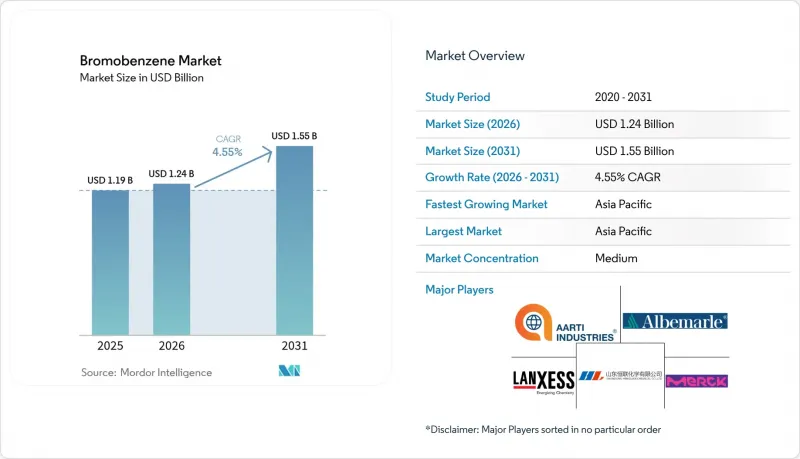
Mordor Intelligence에 의하면, 2026년 브로모벤젠 시장 규모는 12억 4,000만 달러로 추정되고 2025년 11억 9,000만 달러에서 확대해, 2031년에는 15억 5,000만 달러에 이를 것으로 예측됩니다.
2026년부터 2031년까지 연평균 성장률(CAGR) 4.55%로 성장할 것으로 전망됩니다.
본 보고서는 제품별(페닐마그네슘 브로마이드, 펜시클리딘, 기타 제품),용도별(그리냐르 시약, 용매, 화학 중간체, 의약품, 전자 등급 용매, 기타 용도), 지역별(아시아태평양, 북미, 유럽, 남미, 중동 및 아프리카)로 분류되어 있습니다. 시장 예측은 금액(달러)으로 제시되어 있습니다.
세계의 브로모벤젠 시장 동향 및 인사이트
아시아태평양의 의약품 아웃소싱 확대
생명과학 분야의 아웃소싱 급증으로 인해 인도, 중국, 동남아시아 전역에서 브로모벤젠 수요 구조가 재편되고 있습니다. 지역의 위탁 개발·제조 기관(CDMO)은 향정신성 약물 및 항암제 원료의약품(API)에 대한 유럽 및 미국과공급 계약을 확보하기 위해 브롬화 및 유기금속 합성 생산 라인을 확충하고 있습니다. ICH 지침에 따른 규제 조화로 기술 이전이 간소화되는 한편, 중국의 풍부한 브롬 원료는 물류 비용을 절감하고, 다운스트림 공정인 페닐마그네슘 브로마이드 생산의 가격 경쟁력을 높이고 있습니다.
고부가가치 중간체를 위한 그리냐르법에 기반한 제조 확대
제약, 농약 및 소재 제조업체들은 그리냐르 교차 커플링의 활용을 확대하여, 더 높은 처리량으로 복잡한 골격 구조에 접근하고 있습니다. 연속 흐름 반응기는 시공간 생산성을 높이고 부반응을 억제하기 때문에 브로모벤젠 유래의 페닐마그네슘브로마이드는 어려운 탄소-탄소 결합 형성에서 비용 효율이 뛰어난 친핵제로 자리 잡고 있습니다. 새롭게 등장한 로듐 촉매를 이용한 호모커플링을 통해 브로모벤젠의 응용 범위는 인테그린 억제제 합성 및 기타 최첨단 치료제로 확대되고 있습니다.
염소화 방향족 화합물과의 경쟁
클로로벤젠이 15-20% 저렴하다는 가격 차이로 인해, 비용 효율을 중시하는 제제 제조에서 브로모벤젠의 채택이 과제로 대두되고 있습니다. 2024년에는 공급 차질로 인해 브롬 원료 가격이 급등하면서 이 가격 차이가 더욱 확대되었고, 일부 제제 제조업체는 클로로 방향족 화합물을 중심으로 한 합성 경로를 재설계할 수밖에 없었습니다. 생산자들은 브로모벤젠의 뛰어난 선택성과 낮은 반응 온도를 강조하며 대응하고 있지만, 적극적인 가격 경쟁으로 인해 이익률은 압박받고 있습니다.
부문 분석
2025년, 페닐마그네슘 브로마이드가 브로모벤젠 시장의 42.68%를 차지하며, 의약품 및 특수 화학제품 전반의 워크플로우에서 탄소 결합 형성에 사용되는 그리냐르 시약으로 널리 보급되어 있음이 부각되었습니다. 플로우 케미스트리로의 전환을 통해 공간 이용 효율이 향상되고 용매 사용량이 감소함에 따라, 이 주력 제품의 반응기 가동률이 향상되었습니다. 제약 통합 기업들은 대체품을 사용할 경우 수율이나 입체화학이 저하되는 경우가 많기 때문에 페닐마그네슘 브로마이드 조달을 계속해서 우선시하고 있습니다. 이러한 수요의 안정성 덕분에 브로모벤젠 시장은 유기 브롬 화합물 시장 전체에서 나타나는 변동의 영향을 덜 받게 되었습니다. 지속적인 공정 고효율화와 90%의 패러데이 효율을 실현하는 특허로 보호된 전기화학적 브로민화 경로를 통해 경쟁력 향상이 기대되지만, 아시아의 많은 공장에서는 여전히 기존의 배치 방식이 주류를 이루고 있습니다.
오르토 및 파라 브로모화 유도체, 그리고 특수 연구용 화학 물질을 포함한 기타 제품들은 농약, 재료 과학, 향료 중간체를 뒷받침하는 다양한 틈새 시장을 형성하고 있습니다. 이러한 틈새 시장은 생산량은 적지만 1Kg당 이익률이 높아 수익의 주기성을 완화시켜 줍니다. 시장 점유율 5.03%를 차지하는 펜시클리진은 이러한 경향을 여실히 보여줍니다. 엄격한 규제로 인해 생산 규모는 제한되고 있지만, 승인된 치료 프로토콜에 기반한 지속적인 수요로 인해 판매 가격은 높은 수준을 유지하고 있습니다. 장기적으로는 연속 흐름 공정에서 선택성이 점진적으로 향상됨에 따라 소량 생산 제품이 페닐마그네슘 브로마이드의 점유율을 서서히 잠식할 가능성은 있지만, 브로모벤젠 시장 전체적으로는 2031년까지 특정 제품에 집중된 상태가 지속될 것으로 전망됩니다.
지역별 분석
2025년에 41.72%의 점유율을 차지한 아시아태평양은 브로모벤젠 시장의 생산 및 수요 중심지입니다. 중국은 원소 상태의 브롬의 주요 생산국으로, 인근의 브로모벤젠 및 하류 페닐마그네슘브로마이드 제조 공장을 지원하고 있습니다. 이러한 시설은 현지 제제 제조업체에 공급하는 것 외에도 수출 계약 이행에도 대응하고 있습니다. 인도의 Aarti Industries 및 기타 국내 기업 그룹은 브롬의 안정적인 공급을 확보하고 유럽 바이어들이 요구하는 더 엄격한 불순물 기준을 충족하기 위해 생산 능력의 병목 현상 해소와 후방 통합에 150억-180억 루피를 투자하고 있습니다. 일본 및 한국의 전자 산업 클러스터는 초순도 용매 등급에 대한 수요를 증가시키고 있습니다. 동남아시아 국가들은 저비용 수탁 생산 능력을 추가하고 있으며, 이는 2031년까지 해당 지역의 전체 연평균 성장률(CAGR)을 뒷받침하고 있습니다.
북미는 소비량이 아시아태평양보다 적음에도 불구하고, 브로모벤젠 시장에 있어 여전히 중요한 기술 거점입니다. 미국에는 차세대 항암제 및 중추신경계(CNS) 활성 물질을 위해 브로모벤젠 유래 중간체를 지정하는 선진적인 의약품 연구 파이프라인이 존재합니다. 아칸소주에 위치한 알베마르 코퍼레이션의 염수 사업은 현지 공급의 회복력을 강화하고 가격 변동을 완화하고 있습니다. 캐나다와 멕시코의 구매자들은 국내 생산이 여전히 제한적임에도 불구하고 현물 수입을 통해 지역 내 원료를 확보하고 있습니다. TSCA(미국 유해물질관리법)에 따른 규제 강화는 보다 친환경적인 합성 방법에 대한 투자를 촉진하는 한편, 소규모 사용자에게는 부담이 되는 등록 기준을 높이고 있습니다.
유럽은 가장 엄격한 규제 체제 하에서 운영되고 있지만, 고부가가치 용도에서의 특수 수요 흐름은 유지되고 있습니다. 독일의 정밀화학 제조업체들은 배출량을 줄이기 위해 폐쇄형 브롬 회수 시스템을 도입하고 있으며, REACH 등록 서류 작성에 드는 비용에도 불구하고 공급의 지속성을 확보하고 있습니다. 스위스, 프랑스, 영국에 본사를 둔 다국적 제약 기업들은 소량으로 고효능 원료의약품에 사용되는 GMP 등급 브로모벤젠 중간체 수요를 주도하고 있습니다. 동유럽의 화학 단지는 낮은 인건비와 EU 단일 시장 접근성을 활용하여 위탁 제제 사업을 유치하고 있습니다. 중동 및 아프리카의 소비량은 제한적이지만, 요르단은 대규모 브롬 생산 능력을 바탕으로 지역 내 중요한 원자재 허브로서의 지위를 확립하고 있으며, 향후 브로모벤젠 관련 프로젝트를 촉진할 가능성이 있습니다. 남미는 여전히 규모는 작지만 성장세가 두드러지는 소비 지역이며, 브라질과 아르헨티나의 농약 제조업체들이 새로운 유효 성분으로 방향족 브로마이드의 활용을 모색하고 있습니다.
기타 혜택 :
- 엑셀 형식 시장 전망(ME) 시트
- 3개월간 애널리스트 지원
자주 묻는 질문
목차
제1장 서론
제2장 조사 방법
제3장 주요 요약
제4장 시장 구도
제5장 시장 규모 및 성장 예측
제6장 경쟁 구도
제7장 시장 기회 및 향후 전망
KTH 26.09.10According to Mordor Intelligence, bromobenzene market size in 2026 is estimated at USD 1.24 billion, growing from 2025 value of USD 1.19 billion with 2031 projections showing USD 1.55 billion, growing at 4.55% CAGR over 2026-2031.
This report is Segmented by Product (Phenylmagnesium Bromide, Phencyclidine, Other Products), Application (Grignard Reagent, Solvent, Chemical Intermediate, Pharmaceuticals, Electronics-Grade Solvents, Other Applications), and Geography (Asia-Pacific, North America, Europe, South America, Middle East and Africa). The Market Forecasts are Provided in Terms of Value (USD).
Global Bromobenzene Market Trends and Insights
Rising Pharmaceutical Outsourcing in Asia Pacific
Surging life-science outsourcing is reshaping bromobenzene demand profiles across India, China and Southeast Asia. Regional contract development and manufacturing organizations have scaled bromination and organometallic synthesis lines to secure Western supply contracts for psychoactive and oncology APIs. Regulatory harmonisation under ICH guidelines simplifies technology transfer while China's abundant bromine feedstock cuts logistics costs, reinforcing price competitiveness for downstream phenylmagnesium bromide production.
Expansion of Grignard-Based Manufacturing for High-Value Intermediates
Pharmaceutical, agrochemical, and materials firms are widening their use of Grignard cross-coupling to access complex scaffolds at higher throughput. Continuous-flow reactors raise space-time productivity and suppress side reactions, making bromobenzene-derived phenylmagnesium bromide a cost-efficient nucleophile for difficult carbon-carbon bond formations. Emerging rhodium-catalyzed homo-couplings extend bromobenzene's reach to integrin inhibitor syntheses and other frontier therapeutics.
Price Competition from Chlorinated Aromatics
Chlorobenzene's 15-20% price discount challenges bromobenzene adoption in cost-sensitive formulations. The differential widened in 2024 after bromine feedstock prices spiked on supply disruptions, prompting some formulators to redesign synthesis routes around chlorinated aromatics. Producers counter by highlighting bromobenzene's superior selectivity and lower reaction temperatures, yet aggressive price matching erodes margins.
Other drivers and restraints analyzed in the detailed report include:
- Growing Demand for High-Purity Solvents in Electronics
- Surge in Contract Production of Psychoactive APIs
- Stricter REACH/TSCA Restrictions on Organobromines
For complete list of drivers and restraints, kindly check the Table Of Contents.
Segment Analysis
Phenylmagnesium bromide represented 42.68% of the bromobenzene market in 2025, underscoring its ubiquity as a Grignard reagent for carbon-bond construction across pharmaceutical and specialty-chemical workflows. Flow-chemistry retrofits improved space utilisation and cut solvent volumes, lifting reactor uptime for this marquee product. Pharmaceutical integrators continue to prioritise phenylmagnesium bromide procurement because substitutions often compromise yield or stereochemistry. This demand stability shields the bromobenzene market from wider organobromine volatility. Continuous process intensification and a patent-protected electrochemical bromination route capable of 90% Faradaic efficiency are poised to enhance competitiveness, yet entrenched batch methods remain dominant in many Asian plants.
Other products, including ortho- and para-brominated derivatives plus specialised research chemicals, together form a diversified tail that services agrochemical, material-science and fragrance intermediates. Although these niches are smaller in volume, they command higher per-kilogram margins that temper revenue cyclicality. Phencyclidine, holding 5.03% share, illustrates the pattern: tight regulatory controls constrain scale, yet recurring demand from validated therapeutic protocols keeps price realisations elevated. Over the long run, incremental gains in continuous-flow selectivity may allow small-volume products to chip away at phenylmagnesium bromide's share, but the broader bromobenzene market will likely remain product-concentrated through 2031.
Complete Report Scope:
- By Product
- Phenylmagnesium Bromide
- Phencyclidine
- Other Products
- By Application
- Grignard Reagent
- Solvent
- Chemical Intermediate
- Pharmaceuticals
- Electronics-grade Solvents
- Other Applications
- By Geography
- Asia-Pacific
- China
- India
- Japan
- South Korea
- Rest of Asia-Pacific
- North America
- United States
- Canada
- Mexico
- Europe
- Germany
- United Kingdom
- France
- Italy
- Rest of Europe
- South America
- Brazil
- Argentina
- Rest of South America
- Middle East and Africa
- Saudi Arabia
- South Africa
- Rest of Middle East and Africa
- Asia-Pacific
Geography Analysis
Asia Pacific, with a 41.72% share in 2025, is the operational and demand epicentre of the bromobenzene market. China is a significant producer of elemental bromine, which supports nearby bromobenzene and downstream phenylmagnesium bromide plants. These facilities cater to both local formulators and fulfill export contracts. India's Aarti Industries and other domestic groups are spending INR 1,500-1,800 crore on debottlenecking and backward integration to secure bromine availability and meet stricter impurity limits demanded by European buyers. Japanese and Korean electronics clusters generate incremental volumes for ultra-pure solvent grades. Southeast Asian countries add low-cost tolling capacity that supports the region's overall CAGR through 2031.
North America remains a critical technology hub for the bromobenzene market, even though its consumption is lower than Asia Pacific. The United States hosts advanced pharmaceutical research pipelines that specify bromobenzene-derived intermediates for next-generation oncology and CNS actives. Albemarle Corporation's brine operations in Arkansas strengthen local supply resilience and moderate price volatility. Canadian and Mexican buyers secure regional feedstock through spot imports, though their domestic production remains limited. Regulatory momentum under TSCA encourages investment in greener synthesis but also raises registration thresholds that smaller users find burdensome.
Europe operates under the strictest regulatory regime yet sustains specialty demand streams in high-value applications. German fine-chemical producers deploy closed-loop bromine recovery to curtail emissions, ensuring continuity of supply despite REACH dossier costs. Pharmaceutical multinationals headquartered in Switzerland, France, and the United Kingdom drive demand for GMP-grade bromobenzene intermediates used in small-batch, high-potency drug substances. Eastern European chemical parks attract contract formulations that benefit from lower labour costs and EU single-market access. Despite limited consumption in the Middle East and Africa, Jordan's significant bromine production capacity positions it as a pivotal regional raw-material hub, potentially spurring future bromobenzene projects. South America remains a small but rising consumer as Brazilian and Argentine agrochemical producers explore aromatic bromides for new active ingredients.
- Aarti Industries Limited
- Albemarle Corporation
- Exxon Mobil Chemical
- Hawks Chemical Company
- Heranba Industries Ltd
- Lanxess AG
- Merck KGaA
- Pragna Group
- Shandong Henglian Chemical Co. Ltd
- Shanghai Wescco Chemical Co. Ltd
- Sontara Organo Industries
- Zhejiang Xieshi New Materials
Additional Benefits:
- The market estimate (ME) sheet in Excel format
- 3 months of analyst support
TABLE OF CONTENTS
1 Introduction
- 1.1 Study Assumptions and Market Definition
- 1.2 Scope of the Study
2 Research Methodology
3 Executive Summary
4 Market Landscape
- 4.1 Market Overview
- 4.2 Market Drivers
- 4.2.1 Rising pharmaceutical outsourcing in Asia Pacific
- 4.2.2 Expansion of Grignard-based manufacturing for high-value intermediates
- 4.2.3 Growing demand for high-purity solvents in electronics
- 4.2.4 Surge in contract production of psychoactive APIs
- 4.2.5 Transition to low-VOC solvents in coatings
- 4.3 Market Restraints
- 4.3.1 Price competition from chlorinated aromatics
- 4.3.2 Stricter REACH/TSCA restrictions on organobromines
- 4.3.3 Volatility in bromine supply from Dead Sea producers
- 4.4 Value Chain Analysis
- 4.5 Porter's Five Forces
- 4.5.1 Bargaining Power of Suppliers
- 4.5.2 Bargaining Power of Buyers
- 4.5.3 Threat of New Entrants
- 4.5.4 Threat of Substitutes
- 4.5.5 Degree of Competition
5 Market Size and Growth Forecasts (Value)
- 5.1 By Product
- 5.1.1 Phenylmagnesium Bromide
- 5.1.2 Phencyclidine
- 5.1.3 Other Products
- 5.2 By Application
- 5.2.1 Grignard Reagent
- 5.2.2 Solvent
- 5.2.3 Chemical Intermediate
- 5.2.4 Pharmaceuticals
- 5.2.5 Electronics-grade Solvents
- 5.2.6 Other Applications
- 5.3 By Geography
- 5.3.1 Asia-Pacific
- 5.3.1.1 China
- 5.3.1.2 India
- 5.3.1.3 Japan
- 5.3.1.4 South Korea
- 5.3.1.5 Rest of Asia-Pacific
- 5.3.2 North America
- 5.3.2.1 United States
- 5.3.2.2 Canada
- 5.3.2.3 Mexico
- 5.3.3 Europe
- 5.3.3.1 Germany
- 5.3.3.2 United Kingdom
- 5.3.3.3 France
- 5.3.3.4 Italy
- 5.3.3.5 Rest of Europe
- 5.3.4 South America
- 5.3.4.1 Brazil
- 5.3.4.2 Argentina
- 5.3.4.3 Rest of South America
- 5.3.5 Middle East and Africa
- 5.3.5.1 Saudi Arabia
- 5.3.5.2 South Africa
- 5.3.5.3 Rest of Middle East and Africa
- 5.3.1 Asia-Pacific
6 Competitive Landscape
- 6.1 Market Concentration
- 6.2 Strategic Moves
- 6.3 Market Share Analysis
- 6.4 Company Profiles (includes Global level Overview, Market level overview, Core Segments, Financials as available, Strategic Information, Market Rank/Share, Products and Services, Recent Developments)
- 6.4.1 Aarti Industries Limited
- 6.4.2 Albemarle Corporation
- 6.4.3 Exxon Mobil Chemical
- 6.4.4 Hawks Chemical Company
- 6.4.5 Heranba Industries Ltd
- 6.4.6 Lanxess AG
- 6.4.7 Merck KGaA
- 6.4.8 Pragna Group
- 6.4.9 Shandong Henglian Chemical Co. Ltd
- 6.4.10 Shanghai Wescco Chemical Co. Ltd
- 6.4.11 Sontara Organo Industries
- 6.4.12 Zhejiang Xieshi New Materials
7 Market Opportunities and Future Outlook
- 7.1 White-space and Unmet-need Assessment


