

|
시장보고서
상품코드
2120375
의료 폐기물 관리 : 시장 점유율 분석, 업계 동향 및 통계, 성장 예측(2026-2031년)Medical Waste Management - Market Share Analysis, Industry Trends & Statistics, Growth Forecasts (2026 - 2031) |
||||||
 Mordor Intelligence
에 의하면, 의료 폐기물 관리 시장 규모는 2026년에 205억 2,000만 달러로 추정되고 예측 기간(2026-2031년) CAGR 6.11%로 확대되어 2031년에는 276억 달러에 이를 전망입니다.
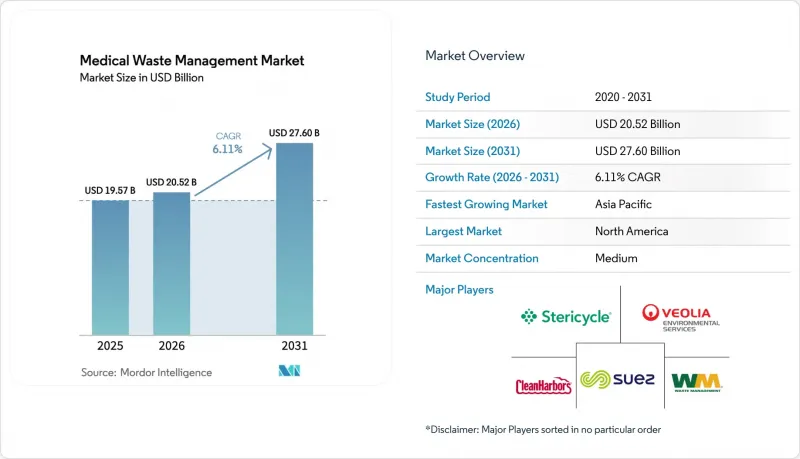
본 보고서는 서비스별(수집·운송·보관, 처리·처분, 재활용), 폐기물 유형별(비유해 폐기물 및 유해 폐기물(감염성·병리학적 폐기물 등)), 처리 시설별(오프사이트 및 온사이트), 폐기물 발생원별(병원 및 진단실험실 등),지역별(북미, 유럽 등)로 분류되어 있습니다. 시장 예측은 금액(미 달러) 기준으로 제시되어 있습니다.
세계의 의료 폐기물 관리 시장 동향 및 인사이트
의료 폐기물 및 생의학 폐기물 처리량 증가
2025년, 전 세계 의료시설에서 발생한 폐기물 양은 약 260만 메트릭톤에 달할 것으로 보이며, 세계보건기구(WHO)는 신흥 시장의 병상 수 확대에 따라 2030년까지 15% 증가할 것으로 전망하고 있습니다. 인도에서만 2024년에 15만 병상이 추가되어 연간 8만 2,000메트릭톤의 새로운 폐기물이 발생하고 있습니다. 중국의 1급 병원에서는 화학요법 및 영상 진단 건수 증가로 인해 2025년에 감염성 폐기물이 12% 급증한 것으로 보고되었습니다. 이러한 급증으로 인해 허가된 처리 능력에 부담이 가중되고 있으며, 새로운 소각로의 인허가에는 3년 이상 걸리는 경우가 흔합니다. 그 결과, 현물 시장 가격이 급등하고, 병원들은 반출 능력 부족에 대비하기 위해 시설 내 멸균 처리를 검토하고 있습니다.
여러 관할 구역에 걸쳐 적용되는 엄격한 폐기물 처리 규정
미국 환경보호청(EPA)이 2024년에 시행한 40 CFR Part 60 개정안에 따라, 미세먼지 배출 기준이 0.015 gr/dscf로 하향 조정되면서 18개 소각 시설은 2025년까지 각각 최대 500만 달러를 스크러버 설치에 투자해야만 했습니다. 유럽의 ‘폐기물 기본 지침’에서는 2030년까지 55%의 재활용이 의무화되어 있으며, 그 적용 범위는 무해한 의료용 포장재까지 확대되었습니다. 인도의 2024년 규정 개정에서는 모든 폐기물 운반 차량에 GPS 추적 장치 장착이 의무화되어, 소규모 사업자의 경우 비용이 8%-12% 증가하게 됩니다. 이러한 중복된 규제로 인해 규정 준수를 위한 투자 비용을 상쇄할 수 있는 통합형 사업자는 혜택을 보는 반면, 지역 밀착형 운반 업체는 이익률 하락으로 어려움을 겪고 있습니다.
첨단 처리 기술에 따른 막대한 설비 투자 및 운영비
가스 세정 기능을 갖춘 일일 10톤 규모의 턴키 방식 소각로 비용은 800만 달러 이상으로, 남아시아 및 아프리카 지방 자치 단체의 예산에 있어 큰 장벽이 되고 있습니다. 오토클레이브에 천연가스를 사용함으로써 톤당 18달러의 추가 비용이 발생하며, 내화물 뒷면 라이닝 교체에는 2년마다 40만 달러의 비용이 듭니다. 인도 규제 당국의 조사에 따르면, 일반 처리 시설의 38%에서 가동률이 60% 미만에 그치고 있으며, 그 결과 톤당 비용이 비공식적인 불법 투기 비용을 초과하고 있습니다. 마이크로파 시스템은 설비 투자를 줄일 수 있지만, 화학 약품 바이알을 처리할 수 없어 기술의 적용 범위가 좁아집니다.
부문별 분석
2025년에는 수거, 운송, 보관이 수익의 44.26%를 차지하여, 병원이 다년 계약에 계속 묶여 있는 원인이 되고 있는 물류의 중요성이 부각되었습니다. 연료 가격 변동과 운전기사 임금 상승으로 인해 이익률은 압박을 받았지만, 노선 밀도가 높아 의료 폐기물 관리 시장에서는 여전히 안정적인 현금 흐름이 확보되고 있습니다. 처리·처분 서비스가 나머지 매출을 차지하고 있지만, 중국 제조업체의 범용 오토클레이브가 가격 하한선을 재설정함에 따라 상품화 우려가 커지고 있습니다. 재활용과 관련된 의료 폐기물 관리 시장 규모는 현재로서는 여전히 작지만, EU의 순환형 경제 지침 및 캘리포니아주 SB 54법에 따라 연평균 성장률(CAGR) 8.64%의 성장이 촉진되고 있어, 오염 물질을 포함하지 않는 수지의 인증이 가능한 공급업체에게는 긍정적인 요인으로 작용하고 있습니다.
재활용의 가속화는 서비스 번들화를 뒷받침할 것입니다. 리퍼블릭 서비스가 2024년에 시작한 ‘토탈 웨이스트 패키지(Total Waste Package)’는 생물학적 유해 폐기물 수거, 의약품 수거 및 OSHA 규정 준수 교육을 통합함으로써 외래 수술 시설에서 140개의 신규 고객을 확보했습니다. 동시에, 다니엘스 샤프스마트(Daniels SharpSmart)사의 재사용 가능한 컨테이너 프로그램은 혁신을 통해 수거 빈도를 25% 줄이고, 수익을 운반 거리와 분리하면서도 날카로운 의료 폐기물 발생원에서 의료 폐기물 관리 시장 점유율을 확대할 수 있음을 보여주고 있습니다. 프랑스의 확대 생산자 책임(EPR) 제도는 안정적인 자금원을 창출하여 2030년까지 재활용 보급률을 30% 가까이 끌어올리고, 의료 폐기물 관리 시장 규모에 대한 이 부문의 기여도를 높일 것으로 예측됩니다.
2025년 시점에서 비유해 폐기물은 전 세계 처리량의 81.56%를 차지했으나, 처분 비용이 낮기 때문에 그 가치 점유율은 40% 미만에 그치고 있습니다. 연간 10.06%의 성장이 예상되는 감염성 및 병리학적 폐기물 흐름은 의료 폐기물 관리 시장의 주요 수익원으로 계속 자리 잡고 있습니다. 미국의 의약품 소각 처리 능력은 47곳으로 제한되어 있어 지역적인 병목 현상이 발생하고, 이로 인해 가격 프리미엄이 상승하고 있습니다. 2025년에는 자가 투여형 생물학적 제제의 보급을 배경으로, 날카로운 폐기물의 양이 42만 메트릭톤으로 증가했습니다. 또한, 안전 장치의 도입으로 바늘 1개당 플라스틱 질량이 35% 증가했습니다.
감사 결과, 오분류가 만연하고 있는 것으로 밝혀졌습니다. 영국 병원 폐기물 중 비유해 폐기물로 분류되었던 것의 22%에 의약품이나 날카로운 폐기물이 포함되어 있어, 재선별이나 벌금 부과로 이어지고 있습니다. FDA가 의무화한 밀폐형 이송 장치로 인해 오염된 주사기의 수가 18% 증가하여, 유해 폐기물의 양이 늘어나고 있음이 드러났습니다. 그 결과, 엄격한 분리 수거 프로토콜을 확립한 업체는 의료 폐기물 관리 시장에서의 점유율을 확대하고 프리미엄 가격을 책정할 수 있게 됩니다.
지역별 분석
북미는 2025년 의료 폐기물 관리 시장의 31.76%를 차지했으나, 시장 포화와 규정 준수 비용 상승이 겹치면서 성장률은 연평균 성장률(CAGR) 4.8%로 둔화되고 있습니다. 2025년, 미국의 소각 시설은 시설당 최대 500만 달러를 스크러버 개보수에 지출했으며, 그 비용을 가격에 전가하여 8%-12%의 가격 인상을 단행했습니다. 캐나다는 원주민 거주 지역의 폐기물 처리 시설 개보수에 1억 2,000만 캐나다 달러(8,900만 달러)를 책정한 반면, 멕시코는 매니페스트 시스템을 디지털화하고 대규모 IT 인프라를 보유한 다국적 운송업체를 우대했습니다.
유럽에서는 독일, 프랑스, 영국이 지출을 주도하고 있으며, 폐기물 기본 지침이 정한 2030년 재활용률 55%라는 목표가 투자의 계기가 되고 있습니다. 영국에서는 NHS(국민보건서비스) 계약을 7년간 12억 파운드 규모의 계약으로 통합하여, 메가 입찰을 향한 조달 동향이 주목받고 있습니다. 독일의 생산자 책임법에서는 2027년까지 기기 제조업체가 회수 비용의 70%를 부담하도록 의무화하고 있으며, 이에 따라 이익의 원천이 운반업체에서 재활용 업체로 이동하면서 순환형 서비스 제공업체를 위한 의료 폐기물 관리 시장 규모가 확대되고 있습니다.
아시아태평양은 연평균 성장률(CAGR) 9.12%를 기록하며 가장 빠르게 성장하고 있는 지역입니다. 중국에서는 개정된 ‘고형 폐기물법’에 따라 디지털화되지 않은 운송 매니페스트에 대해 100만 위안 벌금이 부과됨에 따라 IT 도입이 가속화되고 있습니다. 인도에서는 15만 병상의 신규 병상이 추가됨에 따라, 인가 시설을 보유한 지역이 62%에 그치는 수용 능력 격차가 심화되어 이동식 또는 현장 처리 수요가 발생하고 있습니다. 일본에서는 연간 1만 5,000톤을 회수하는 시범 사업에서 PVC 수액백 재활용이 이루어지고 있는 반면, 한국의 ‘폐기물관리법’에서는 일회용 기구에 대해서도 제조자 책임이 확대되고 있습니다. 호주는 2030년까지 자원 회수율 80%를 목표로 하고 있지만, 병원 네트워크가 분산되어 있는 점에 어려움을 겪고 있어 시설 내 오토클레이브 이용이 권장되고 있습니다.
중동 및 아프리카 및 남미 지역 시장 점유율은 처리 시설 부족과 비공식적인 처분으로 인해 제약을 받고 있습니다. 아부다비가 하루 25톤의 처리 능력을 갖춘 소각 시설에 4억 5,000만 AED를 투자한 것은 걸프 국가들의 지출 증가를 보여주는 반면,남아프리카공화국의 콰줄나탈 주에서는 여전히 병원의 41%가 날카로운 의료 폐기물을 일반 폐기물로 처리하고 있어, 의료 폐기물 관리 시장의 잠재적 가능성이 시사되고 있습니다.
기타 혜택 :
- 엑셀 형식 시장 예측(ME) 시트
- 3개월간의 애널리스트 지원
자주 묻는 질문
목차
제1장 서론
제2장 조사 방법
제3장 주요 요약
제4장 시장 구도
제5장 시장 규모 및 성장 예측
제6장 경쟁 구도
제7장 시장 기회 및 향후 전망
KTH 26.09.10According to Mordor Intelligence, the medical waste management market size is estimated at USD 20.52 billion in 2026, and is expected to reach USD 27.60 billion by 2031, at a CAGR of 6.11% during the forecast period (2026-2031).
This report is Segmented by Service (Collection, Transportation & Storage; Treatment & Disposal; Recycling), Type of Waste (Non-Hazardous and Hazardous [Infectious & Pathological, and More]), Treatment Site (Offsite and Onsite), Waste Generator (Hospitals & Diagnostic Laboratories and More), and Geography (North America, Europe and More). Market Forecasts are Provided in Terms of Value (USD).
Global Medical Waste Management Market Trends and Insights
Rising Volume of Healthcare and Biomedical Waste
Global healthcare facilities generated about 2.6 million metric tons of waste in 2025, and the World Health Organization projects a 15% rise by 2030 as emerging-market bed capacity expands.India alone added 150,000 beds in 2024, adding 82,000 metric tons of new waste streams annually. Tier-1 Chinese hospitals reported a 12% jump in infectious waste in 2025 due to rising chemotherapy and imaging volumes. These surges strain permitted treatment capacity, where new incinerator licensing often exceeds three years. Resulting spot-market price spikes encourage hospitals to explore onsite sterilization to hedge against haulage shortages.
Stringent Multi-Jurisdictional Disposal Regulations
The U.S. EPA's 2024 revision of 40 CFR Part 60 cut particulate limits to 0.015 gr/dscf, forcing 18 incinerators to invest up to USD 5 million each in scrubbers by 2025. Europe's Waste Framework Directive requires 55% recycling by 2030, extending responsibility to non-hazardous medical packaging. India's 2024 rule amendments add GPS tracking for every waste-haul vehicle, elevating costs 8%-12% for small operators. These overlapping rules reward integrated players able to amortize compliance investments, while regional haulers grapple with shrinking margins.
High Capital and Operating Expenditure for Advanced Treatment Technologies
A turnkey 10-ton-per-day incinerator with gas scrubbing costs more than USD 8 million, a hurdle for municipal budgets in South Asia and Africa. Natural-gas usage for autoclaves adds USD 18 per ton, while refractory relining hits USD 400,000 every two years. India's regulator found 38% of common treatment facilities below 60% utilization, driving per-ton costs above informal dumping rates. Microwave systems cut capex but cannot handle chemo vials, narrowing technology applicability.
Other drivers and restraints analyzed in the detailed report include:
- Outsourcing to Specialized Third-Party Service Providers
- Decentralized Home-Care and Point-of-Care Diagnostics Waste Surge
- Tightening Incinerator-Emission Norms and Public Opposition
For complete list of drivers and restraints, kindly check the Table Of Contents.
Segment Analysis
Collection, transportation, and storage generated 44.26% of revenue in 2025, underscoring the logistics intensity that keeps hospitals locked into multi-year contracts. Fuel volatility and driver wage inflation eroded margins, but route density still secures recurring cash flow in the medical waste management market. Treatment and disposal services delivered the remainder, yet commoditization looms as generic autoclave units from Chinese makers reset price floors. The medical waste management market size tied to recycling remains small today, but EU circular-economy directives and California SB 54 are stimulating 8.64% CAGR growth, a bright spot for vendors that can certify contaminant-free resins.
Recycling acceleration will spur service bundling. Republic Services' 2024 launch of a total-waste package won 140 new ambulatory-surgery clients by integrating biohazard pickup, pharma take-back, and OSHA compliance training. At the same time, Daniels Sharpsmart's reusable container program shows how innovation can shrink collection frequency by 25%, decoupling revenue from haulage miles while enlarging medical waste management market share among sharps generators. Extended producer responsibility schemes in France create steady funding that should elevate recycling penetration toward 30% by 2030, lifting the segment's contribution to medical waste management market size.
Non-hazardous waste held 81.56% of global volume in 2025, yet low disposal fees restrict its value share to below 40%. Infectious and pathological streams, expected to grow 10.06% annually, remain the primary profit pool for the medical waste management market. Pharmaceutical incineration capacity in the United States is limited to 47 sites, creating regional bottlenecks that push pricing premiums. Sharps waste rose to 420,000 metric tons in 2025, fueled by self-administered biologics, while safety devices increased per-needle plastic mass by 35%.
Audits find misclassification rife; 22% of supposedly non-hazardous U.K. hospital waste contained pharmaceuticals or sharps, triggering re-sorting and penalty fees. Closed-system transfer devices mandated by the FDA boost contaminated syringe counts by 18%, highlighting rising hazardous waste volumes. In turn, vendors that prove exacting segregation protocols can capture incremental medical waste management market share and command premium pricing.
Complete Report Scope:
- By Service
- Collection, Transportation & Storage Services
- Treatment & Disposal Services
- Recycling Services
- By Type of Waste
- Non-hazardous Waste
- Hazardous Waste
- Infectious & Pathological
- Pharmaceutical
- Sharps
- Other Hazardous Waste
- By Treatment Site
- Offsite Treatment
- Onsite Treatment
- By Waste Generator
- Hospitals & Diagnostic Laboratories
- Clinics & Ambulatory Surgical Centres
- Pharmaceutical & Biotechnology Companies
- Research Laboratories
- Other Generators (Blood Banks, Mortuaries, Veterinary, etc.)
- By Geography
- North America
- United States
- Canada
- Mexico
- Europe
- Germany
- France
- United Kingdom
- Italy
- Spain
- Rest of Europe
- Asia-Pacific
- China
- Japan
- India
- South Korea
- Australia
- Rest of Asia-Pacific
- Middle East & Africa
- GCC
- South Africa
- Rest of Middle East & Africa
- South America
- Brazil
- Argentina
- Rest of South America
- North America
Geography Analysis
North America commanded 31.76% of the medical waste management market in 2025, but growth moderates to 4.8% CAGR as saturation and higher compliance costs converge. U.S. incinerators spent up to USD 5 million each on scrubber retrofits in 2025, passing through 8%-12% price hikes. Canada earmarked CAD 120 million (USD 89 million) to upgrade waste facilities in Indigenous territories, while Mexico digitized manifest systems, favoring multinational haulers with IT scale.
In Europe Germany, France, and the U.K. led spending as the Waste Framework Directive's 55% recycling target for 2030 triggers investments. The U.K. consolidated NHS contracts into a seven-year GBP 1.2 billion deal, spotlighting a procurement trend toward mega-tenders. Germany's producer-responsibility law compels device makers to fund 70% of take-back costs by 2027, shifting margin pools from haulers to recyclers and increasing medical waste management market size for circular-services providers.
Asia-Pacific is the fastest-growing region at 9.12% CAGR. China's revised Solid Waste Law imposes CNY 1 million fines for non-digital transfer manifests, accelerating IT adoption. India's 150,000 new beds exacerbate a capacity gap where only 62% of districts have licensed facilities, creating demand for mobile or onsite treatment. Japan recycles PVC IV bags in a pilot collecting 15,000 tons annually, while South Korea's Waste Control Act extends producer responsibility to single-use tools. Australia targets 80% resource recovery by 2030 but grapples with dispersed hospital networks, favoring onsite autoclaves.
Middle East and Africa and South America's share, constrained by limited plant availability and informal disposal. Abu Dhabi's AED 450 million investment in a 25-ton-per-day incinerator shows rising Gulf spending, whereas 41% of hospitals in South Africa's KwaZulu-Natal still discard sharps as municipal refuse, signaling latent medical waste management market potential.
- BioMedical Waste Solutions LLC
- Clean Harbors Inc.
- Cleanaway Waste Management Ltd.
- Covanta Holding
- Cyntox LLC
- Daniels Sharpsmart
- EcoMed Services
- GFL Environmental Inc.
- MedPro Disposal LLC
- MedWaste Management
- Remondis SE & Co. KG
- Republic Services Inc.
- Sharps Compliance
- Sharps Technology Inc.
- Stericycle Inc.
- Suez Environmental Services
- Triumvirate Environmental
- Veolia Environnement SA
- Waste Management Inc.
- WM Intellectual Property Holdings
Additional Benefits:
- The market estimate (ME) sheet in Excel format
- 3 months of analyst support
TABLE OF CONTENTS
1 Introduction
- 1.1 Study Assumptions & Market Definition
- 1.2 Scope of the Study
2 Research Methodology
3 Executive Summary
4 Market Landscape
- 4.1 Market Overview
- 4.2 Market Drivers
- 4.2.1 Rising Volume of Healthcare & Biomedical Waste
- 4.2.2 Stringent Multi-Jurisdictional Disposal Regulations
- 4.2.3 Outsourcing to Specialized Third-Party Service Providers
- 4.2.4 Decentralized Homecare & POC Diagnostics Waste Surge
- 4.2.5 Biotech & Cell-Therapy Manufacturing Contamination Risk Waste
- 4.2.6 IoT-Enabled Traceability & ESG-Reporting Demand
- 4.3 Market Restraints
- 4.3.1 High Capex/Opex for Advanced Treatment Technologies
- 4.3.2 Tightening Incinerator-Emission Norms & Public Opposition
- 4.3.3 Consumables Supply-Chain Disruptions (E.G., Sharps Containers)
- 4.3.4 Informal/Unregulated Disposal in Developing Nations
- 4.4 Value / Supply-Chain Analysis
- 4.5 Regulatory Landscape
- 4.6 Technological Outlook
- 4.7 Porter's Five Forces Analysis
- 4.7.1 Threat of New Entrants
- 4.7.2 Bargaining Power of Suppliers
- 4.7.3 Bargaining Power of Buyers
- 4.7.4 Threat of Substitutes
- 4.7.5 Intensity of Competitive Rivalry
5 Market Size & Growth Forecasts (Value in USD)
- 5.1 By Service
- 5.1.1 Collection, Transportation & Storage Services
- 5.1.2 Treatment & Disposal Services
- 5.1.3 Recycling Services
- 5.2 By Type of Waste
- 5.2.1 Non-hazardous Waste
- 5.2.2 Hazardous Waste
- 5.2.2.1 Infectious & Pathological
- 5.2.2.2 Pharmaceutical
- 5.2.2.3 Sharps
- 5.2.2.4 Other Hazardous Waste
- 5.3 By Treatment Site
- 5.3.1 Offsite Treatment
- 5.3.2 Onsite Treatment
- 5.4 By Waste Generator
- 5.4.1 Hospitals & Diagnostic Laboratories
- 5.4.2 Clinics & Ambulatory Surgical Centres
- 5.4.3 Pharmaceutical & Biotechnology Companies
- 5.4.4 Research Laboratories
- 5.4.5 Other Generators (Blood Banks, Mortuaries, Veterinary, etc.)
- 5.5 By Geography
- 5.5.1 North America
- 5.5.1.1 United States
- 5.5.1.2 Canada
- 5.5.1.3 Mexico
- 5.5.2 Europe
- 5.5.2.1 Germany
- 5.5.2.2 France
- 5.5.2.3 United Kingdom
- 5.5.2.4 Italy
- 5.5.2.5 Spain
- 5.5.2.6 Rest of Europe
- 5.5.3 Asia-Pacific
- 5.5.3.1 China
- 5.5.3.2 Japan
- 5.5.3.3 India
- 5.5.3.4 South Korea
- 5.5.3.5 Australia
- 5.5.3.6 Rest of Asia-Pacific
- 5.5.4 Middle East & Africa
- 5.5.4.1 GCC
- 5.5.4.2 South Africa
- 5.5.4.3 Rest of Middle East & Africa
- 5.5.5 South America
- 5.5.5.1 Brazil
- 5.5.5.2 Argentina
- 5.5.5.3 Rest of South America
- 5.5.1 North America
6 Competitive Landscape
- 6.1 Market Concentration
- 6.2 Market Share Analysis
- 6.3 Company Profiles (includes Global level Overview, Market level overview, Core Segments, Financials as available, Strategic Information, Market Rank/Share for key companies, Products and Services, and Recent Developments)
- 6.3.1 BioMedical Waste Solutions LLC
- 6.3.2 Clean Harbors Inc.
- 6.3.3 Cleanaway Waste Management Ltd.
- 6.3.4 Covanta Holding Corporation
- 6.3.5 Cyntox LLC
- 6.3.6 Daniels Sharpsmart Inc.
- 6.3.7 EcoMed Services
- 6.3.8 GFL Environmental Inc.
- 6.3.9 MedPro Disposal LLC
- 6.3.10 MedWaste Management
- 6.3.11 Remondis SE & Co. KG
- 6.3.12 Republic Services Inc.
- 6.3.13 Sharps Compliance Inc.
- 6.3.14 Sharps Technology Inc.
- 6.3.15 Stericycle Inc.
- 6.3.16 Suez Environmental Services
- 6.3.17 Triumvirate Environmental
- 6.3.18 Veolia Environnement SA
- 6.3.19 Waste Management Inc.
- 6.3.20 WM Intellectual Property Holdings
7 Market Opportunities & Future Outlook
- 7.1 White-space & Unmet-Need Assessment


